REVIEW 2 major objections 6 minor 39 references
Effect of Galactic Chemical Evolution on Exoplanet Properties
T0 review · 2 major / 6 minor · reviewed 2026-08-06 · deepseek-v4-flash
Pith's one-line read This paper predicts that planets become denser as the galaxy ages because iron arrives late, from low-mass stars.
desk verdict A useful first-generation coupling of galactic chemical evolution to rocky planet interiors, with a plausible qualitative trend and a quantitative signal that is not yet robust to the paper's own key inputs. read the letter →
The pith
A machine-rendered reading of the paper's core claim, the machinery that carries it, and where it could break.
The reading
What carries the argument
The load-bearing object is a two-timescale decomposition of nucleosynthesis: high-mass stars of 12 solar masses enrich the galaxy instantly, while low-mass stars of 2 solar masses contribute only after a fixed 2 Gyr delay, with each element assigned a fast/slow fraction (iron about 68% slow, oxygen 100% fast, magnesium and silicon mostly fast). This composition history feeds a dust-condensation calculation that turns galactic abundances into condensed rocky solids in a protoplanetary disk, and those solids are passed to a two-layer, differentiated interior-structure solver that predicts planet mass, radius, and core mass fraction. The changing balance of fast and slow material is what drives the secular growth of core mass fraction and density.
What would settle it
Find a sample of volatile-free rocky exoplanets with masses, radii, and asteroseismic stellar ages; the model predicts that planets younger than about 2 Gyr should have core mass fractions roughly 0.15-0.20 higher than planets older than 8 Gyr, so observing no systematic density-age difference, or the opposite, across such a sample would cast the central claim in doubt.
Extended reading notes
Core claim
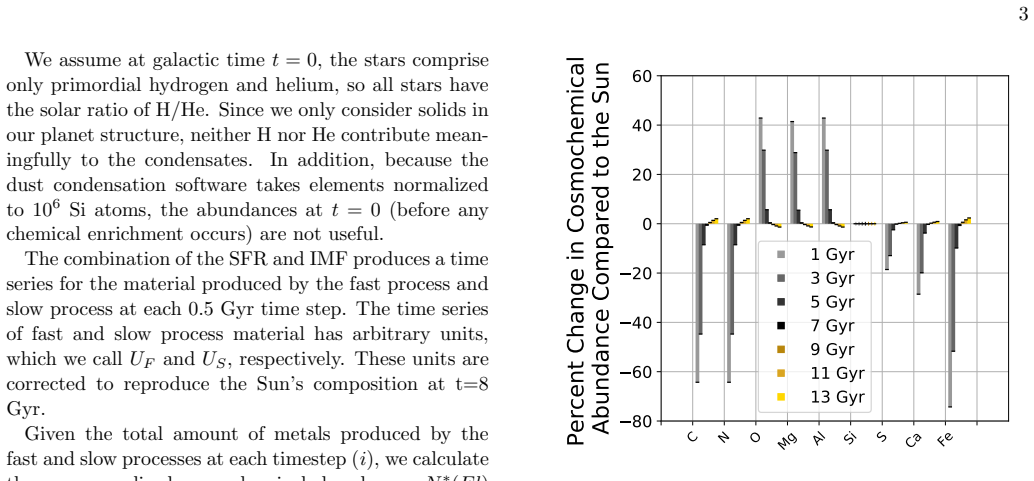
The central claim is that planets become more dense as the galaxy evolves because iron and other siderophile elements are mostly produced by low-mass stars and arrive on a delayed timescale, while oxygen, silicon, and magnesium come promptly from massive stars. Early rocky planets therefore have larger mantles and smaller cores; later planets have relatively larger iron cores and higher bulk density. The paper predicts core mass fractions rising from about 0.13-0.14 at 1 Gyr to about 0.30 by 6 Gyr, with little change afterward, and radius decreases of 1-2% over the same interval. The model also reproduces the direction of the observed density-age trend for 26 Kepler planets but yields a shallower age dependence than the published linear fit.
Load-bearing premise
The result rests on the assumption that iron and other core-forming elements are delivered mostly by low-mass stars with a delay of about two billion years, while oxygen, silicon, and magnesium arrive promptly from massive stars; if those delays or element splits are wrong, the core-mass-fraction trend could change or reverse.
Editorial extensions
If this is right
- Stellar age becomes a useful predictor of rocky exoplanet composition: older stars should host planets with smaller iron cores and lower bulk density, with the core mass fraction rising from about 0.13-0.14 at 1 Gyr to about 0.30 at 6 Gyr.
- Bulk density changes are small but measurable, with planet radii shrinking by roughly 1-2% over the main enrichment window between 2 and 5 Gyr, and the effect is strongest for close-in planets.
- The predicted trend matches the direction of the observed density-age relation for 26 Kepler planets, though with a shallower slope than the reported linear fit and without requiring a large population of extreme iron-rich super-Mercuries.
- The framework yields ancillary predictions, such as rising C/O and Fe/Mg ratios with time and declining Mg/Si, which affect mantle mineralogy and the carbon chemistry of rocky bodies.
Reading between the lines
- Beyond the paper, the same mechanism implies that the distribution of core mass fractions among old-star rocky planets should be both lower and narrower than among young-star planets, a population-level signature that averaged data could test.
- Because oxygen, silicon, and magnesium are assigned to the fast channel, early planets should carry systematic mantle-mineralogy differences, such as higher Mg/Si, which could alter crust thickness and volcanic activity; the paper does not model those geological consequences.
- If the assumed two-billion-year delay is inaccurate, the timing of the predicted plateau near 6 Gyr would shift, so measuring the age-density inflection point in a large exoplanet sample would constrain the enrichment timescale of low-mass stars.
Editorial analysis
A structured set of objections, weighed in public.
Referee Report
Summary. This paper couples a simplified two-channel galactic chemical evolution (GCE) model with a protoplanetary disk condensation code and the MAGRATHEA interior solver to predict how rocky exoplanet compositions and densities depend on the time of planet formation. The GCE model assigns elements to either a prompt 'fast' channel (high-mass stars) or a delayed 'slow' channel (low-mass stars, with a fixed 2 Gyr delay), and normalizes the mixture to solar composition at a formation time of 8 Gyr. The central finding is that early-forming planets have smaller iron cores and lower bulk densities, while planets formed after roughly 6 Gyr have substantially higher core mass fractions (CMF), implying that older host stars should host less dense rocky planets. The model also produces trends in C/O, Fe/Mg, and Mg/Si, and the authors compare the predicted CMF-age relation qualitatively with the 26-planet sample of Weeks et al. (2025).
Significance. If the central prediction survives robustness checks, this framework is a valuable first step in connecting galactic chemical evolution to exoplanet interior properties. The paper's main strength is that the result is not tuned to the target planet-density data: the only external calibration is the solar composition, and the Weeks et al. sample is used for comparison rather than fitting. The prediction that older planets should be less dense is falsifiable with upcoming asteroseismic ages from PLATO, and the framework is clearly described and reproducible from public tools. The primary weakness is that the two load-bearing inputs—the 2 Gyr delay and the element-by-element fast/slow fractions—are never varied, and no uncertainties are propagated through the model. Because the paper explicitly presents itself as a first application, these gaps are fixable within the manuscript's scope.
major comments (2)
- [§2.2, Eq. (2), Eq. (4), Table A1] The predicted growth in CMF from roughly 0.14 at 1 Gyr to 0.30 by 6 Gyr (Table A2, 1 AU, 1 M_sun) is controlled by two assumptions: the fixed 2 Gyr delay in Eq. (2) and the element-specific fast/slow fractions in Table A1, especially Fe being 32% fast / 68% slow while Mg is 99% fast. The paper never varies either input or propagates their uncertainties. This matters because Table A3 shows that changing the fast/slow enrichment mixture at a fixed age shifts CMF by up to ~0.16 (e.g., 8 Gyr, 1 AU: CMF 0.238 for fast-enriched versus 0.397 for slow-enriched), which is comparable to the entire nominal age trend of ~0.16. A substantial prompt Fe component or a modestly larger fast fraction of Fe would reduce the early-time Fe deficit and flatten or reverse the predicted age-density relation. I request a sensitivity scan over the delay (e.g., 0.5–5 Gyr) and over the Fe, Mg, Si, and O fast/slow fractions, with the resulting spread shown on the CMF-age curves.
- [§4, Figure 5] The claim that the model is 'broadly consistent' with Weeks et al. (2025) rests on a visual overlay of three deterministic model curves on 26 data points. There is no statistical test, no model uncertainty band, and no statement of how the data would scatter if the model were correct. Given the large 1-sigma CMF uncertainties and the limited age range of the sample, the current comparison cannot distinguish the predicted trend from a null or much weaker trend. Please add a quantitative comparison—for example, a likelihood or at least the model spread including the enrichment scenarios—or soften the claim of observational support.
minor comments (6)
- [Eq. (2)] The formula for the main-sequence lifetime is typeset ambiguously; please define M_star in solar masses and write the relation explicitly, e.g., T_star = 10 Gyr (M_star/M_sun)^{-2.5}, so that the exponent is unambiguous.
- [Eqs. (6)–(7)] The factor (8/9)(Slow/Total)_C evaluated with Slow/Total = 0.75 is 2/3, so the carbon enhancement factor is 5/3 rather than 3/2; this gives C/O ≈ 0.83, not the claimed 0.75. Please correct the arithmetic or the intended formula.
- [§2.2] Typo: 'astonomical' should be 'astronomical'.
- [§4 and Figure 5 caption] 'Verses' should be 'versus' in the phrase 'CMF verses the stellar age' and in the figure caption.
- [§3] The statement that at 1 Gyr 'Iron levels in the condensed materials are below Silicon and Magnesium' should specify whether the comparison is by number or by mass; later text suggests by mass.
- [§4] The sentence beginning 'Another, more subtle trend is the relationship between elements of similar sources' is vague; consider rewriting to state the predicted correlation explicitly, e.g., that high Ca/Al ratios should correlate with high Fe/Mg and C/O ratios.
Circularity Check
No significant circularity: the age–CMF trend is a forward consequence of externally sourced nucleosynthesis inputs, not a fit to the target planet data.
full rationale
The derivation chain is self-contained as a forward model. The galactic chemical evolution input combines an SFR profile (Snaith et al. 2015), a Salpeter IMF, a 2 Gyr low-mass-star lifetime from Eq. 2 anchored to Salaris & Cassisi (2006), and element-specific fast/slow fractions from Johnson (2019), Table A1. These are externally sourced inputs, not parameters fitted to the Weeks et al. (2025) planet sample. The model is normalized to solar abundances at t = 8 Gyr using Lodders (2003), which anchors the absolute scale but does not impose the sign or magnitude of the predicted time trend. The Weeks et al. data are used only for comparison in Figure 5; no constant in the model is tuned to reproduce the observed density or CMF trend. The predicted increase in CMF with time follows from the assumed delayed iron input (Fe mostly slow) versus prompt Mg/Si/O (mostly fast), which is exactly the physical premise being tested rather than an output recycled as an input. Self-citations to Huang et al. (2022), Rice et al. (2025), Shakespeare et al. (2025), and Li et al. (2020) concern software tools and prior model components; the central nucleosynthesis timing assumption comes from independent stellar evolution and GCE literature. The skeptical concern that the 2 Gyr delay and Johnson fast/slow splits are not varied is a robustness or uncertainty issue, not a circularity issue. No equation reduces to its own output, and no fitted parameter is renamed as a prediction. Therefore the circularity score is 0.
Assumptions & free parameters
free parameters (2)
- Fast/slow yield normalization (UF and US scales) =
Set so the mixture equals the Sun's composition at t=8 Gyr
- C/O enrichment factors for fast/slow enriched models =
8/9 and 0.561 multipliers
assumptions (10)
- domain assumption The Sun is representative of stellar composition at t=8 Gyr.
- domain assumption The piecewise star formation history approximates the Milky Way's enrichment: high SFR for 4 Gyr, 93% drop for 2 Gyr, 26% recovery until today.
- domain assumption A Salpeter IMF with two representative masses, 12 Msun (fast) and 2 Msun (slow), captures the enrichment ratio.
- domain assumption The element-specific fractions produced by fast and slow processes are those from Johnson (2019), listed in Table A1.
- domain assumption The 2 Gyr delay for slow-process material equals the main-sequence lifetime of a 2 Msun star.
- domain assumption All siderophile elements partition into the core; the planet has two fully differentiated layers (core and mantle).
- domain assumption Dust condensation only above 300 K; no volatile ices are included.
- domain assumption The disk evolution parameters are those tuned to the solar system and are used unchanged for 2 Msun stars.
- domain assumption The observed C/O variation range (0.333-0.75) corresponds to differences in fast/slow enrichment at fixed stellar age.
- domain assumption Observed short-period planets formed at the modeled radii (0.5-4 AU) and migrated inward.
Cite this review
Pith. "Pith review of Effect of Galactic Chemical Evolution on Exoplanet Properties." pith.science (2026). https://pith.science/paper/HUPF6IUP
@misc{pith2026250710942,
  author       = {Pith},
  title        = {Pith review of: Effect of Galactic Chemical Evolution on Exoplanet Properties},
  year         = {2026},
  howpublished = {\url{https://pith.science/paper/HUPF6IUP}},
  note         = {Machine review of arXiv:2507.10942}
}
read the original abstract
We couple a simplified model for the galactic chemical evolution, with software that models the condensation of dust in protoplanetary disks and software that models the interior structure of planets in order to estimate the effects that the galactic chemical evolution has on the properties of planets as they form over time. We find that the early abundance of elements formed from the evolution and death of high-mass stars (such as Oxygen, Silicon, and Magnesium) yields planets with larger mantles and smaller cores. The later addition of elements produced in low-mass stars (such as Iron and Nickel) causes the planet cores to become relatively larger. The result is planets that orbit older stars are less dense than planets orbiting younger stars. These results are broadly consistent with recent observations of planet properties from stars of varying ages.
Figures


Figures from the paper (2 more)


Reference graph
Works this paper leans on
-
[1]
, " * write output.state after.block = add.period write newline
ENTRY address archivePrefix author booktitle chapter doi edition editor eprint howpublished institution journal key month number organization pages publisher school series title misctitle type volume year version url label extra.label sort.label short.list INTEGERS output.state before.all mid.sentence after.sentence after.block FUNCTION init.state.consts ...
-
[2]
write newline
" write newline "" before.all 'output.state := FUNCTION format.url url empty "" new.block "" url * "" * if FUNCTION format.eprint eprint empty "" archivePrefix empty "" archivePrefix "arXiv" = new.block " " eprint * " " * new.block " " eprint * " " * if if if FUNCTION format.doi doi empty "" " " doi * " " * if FUNCTION format.pid doi empty eprint empty ur...
-
[3]
- [1] #1 = = ^ ^ ^ .\!\!^ d .\!\!^ h .\!\!^ m .\!\!^ s .\!\!^ @mss
thebibliography [1] 20pt to REFERENCES 6pt =0pt -12pt 10pt plus 3pt =0pt =0pt =1pt plus 1pt =0pt =0pt -12pt =13pt plus 1pt =20pt =13pt plus 1pt \@M =10000 =-1.0em =0pt =0pt 0pt =0pt =1.0em @enumiv\@empty 10000 10000 `\.\@m \@noitemerr \@latex@warning Empty `thebibliography' environment \@ifnextchar \@reference \@latexerr Missing key on reference command E...
2021
-
[4]
Adibekyan, V., Dorn, C., Sousa, S. G., et al. 2021, Science, 374, 330, 10.1126/science.abg8794
-
[5]
2023, , 670, A6, 10.1051/0004-6361/202245106
Bogdan , T., Pillich , C., Landers , J., Wende , H., & Wurm , G. 2023, , 670, A6, 10.1051/0004-6361/202245106
-
[6]
Boley , K. M., Christiansen , J. L., Zink , J., et al. 2024, , 168, 128, 10.3847/1538-3881/ad6570
-
[7]
Bond , J. C., O'Brien , D. P., & Lauretta , D. S. 2010, , 715, 1050, 10.1088/0004-637X/715/2/1050
-
[8]
Brewer , J. M., & Fischer , D. A. 2016, , 831, 20, 10.3847/0004-637X/831/1/20
Show all 39 references
-
[9]
L., Polanski , A
Brinkman , C. L., Polanski , A. S., Huber , D., et al. 2024, , 168, 281, 10.3847/1538-3881/ad82eb
2024 doi
-
[10]
2023, , 673, A117, 10.1051/0004-6361/202243882
Cabral , N., Guilbert-Lepoutre , A., Bitsch , B., Lagarde , N., & Diakite , S. 2023, , 673, A117, 10.1051/0004-6361/202243882
2023 doi
-
[11]
1996, , 31, 793, 10.1111/j.1945-5100.1996.tb02114.x
Cassen , P. 1996, , 31, 793, 10.1111/j.1945-5100.1996.tb02114.x
1996
-
[12]
C., & Steffen , J
Ferich , N., Childs , A. C., & Steffen , J. H. 2025, , 114, 102315, 10.1016/j.newast.2024.102315
2025
-
[13]
Goldschmidt, V. M. 1937, J. Chem. Soc., 655, 10.1039/JR9370000655
1937 doi
-
[14]
R., Millman, K
Harris, C. R., Millman, K. J., van der Walt, S. J., et al. 2020, Nature, 585, 357, 10.1038/s41586-020-2649-2
2020 doi
-
[15]
D., Di Matteo , P., et al
Haywood , M., Lehnert , M. D., Di Matteo , P., et al. 2016, , 589, A66, 10.1051/0004-6361/201527567
2016 doi
-
[16]
R., & Steffen , J
Huang , C., Rice , D. R., & Steffen , J. H. 2022, , 513, 5256, 10.1093/mnras/stac1133
2022 doi
-
[17]
Hunter, J. D. 2007, Computing in Science & Engineering, 9, 90, 10.1109/MCSE.2007.55
2007 doi
-
[18]
2012, , 220, 162, 10.1016/j.icarus.2012.04.022
Jacquet , E., Gounelle , M., & Fromang , S. 2012, , 220, 162, 10.1016/j.icarus.2012.04.022
2012 doi
-
[19]
Johnson , J. A. 2019, Science, 363, 474, 10.1126/science.aau9540
2019 doi
-
[20]
I., & Lugaro , M
Kobayashi , C., Karakas , A. I., & Lugaro , M. 2020, , 900, 179, 10.3847/1538-4357/abae65
2020 doi
- [21]
-
[22]
I., Zhu , Z., & Steffen , J
Li , M., Huang , S., Petaev , M. I., Zhu , Z., & Steffen , J. H. 2020, , 495, 2543, 10.1093/mnras/staa1149
2020 doi
- [23]
-
[24]
2024, Nature Astronomy, 8, 1399, 10.1038/s41550-024-02347-z
Luo , H., Dorn , C., & Deng , J. 2024, Nature Astronomy, 8, 1399, 10.1038/s41550-024-02347-z
2024 doi
-
[25]
2017, , 848, 25, 10.3847/1538-4357/aa8b6e
Maoz , D., & Graur , O. 2017, , 848, 25, 10.3847/1538-4357/aa8b6e
2017 doi
-
[26]
A., Sasselov , D., Hernquist , L., & Stewart , S
Marcus , R. A., Sasselov , D., Hernquist , L., & Stewart , S. T. 2010, , 712, L73, 10.1088/2041-8205/712/1/L73
2010 doi
-
[27]
K., Johnston, K
Ness, M. K., Johnston, K. V., Blancato, K., et al. 2019, The Astrophysical Journal, 883, 177, 10.3847/1538-4357/ab3e3c
2019 doi
-
[28]
Nissen , P. E. 2015, , 579, A52, 10.1051/0004-6361/201526269
2015 doi
-
[29]
Petaev, M. I. 2009, Calphad, 33, 317, 10.1016/j.calphad.2008.12.001
2009 doi
-
[30]
2025, Experimental Astronomy, 59, 26, 10.1007/s10686-025-09985-9
Rauer , H., Aerts , C., Cabrera , J., et al. 2025, Experimental Astronomy, 59, 26, 10.1007/s10686-025-09985-9
2025 doi
- [31]
-
[32]
G., Dorn , C., Aditya Raj , V., Schlichting , H
Rogers , J. G., Dorn , C., Aditya Raj , V., Schlichting , H. E., & Young , E. D. 2025, , 979, 79, 10.3847/1538-4357/ad9f61
2025 doi
-
[33]
2006, Evolution of Stars and Stellar Populations
Salaris , M., & Cassisi , S. 2006, Evolution of Stars and Stellar Populations
2006
-
[34]
Salpeter , E. E. 1955, , 121, 161, 10.1086/145971
1955 doi
-
[35]
J., Li , M., Huang , S., Zhu , Z., & Steffen , J
Shakespeare , C. J., Li , M., Huang , S., Zhu , Z., & Steffen , J. H. 2025, , 169, 180, 10.3847/1538-3881/adaead
2025 doi
-
[36]
2015, , 578, A87, 10.1051/0004-6361/201424281
Snaith , O., Haywood , M., Di Matteo , P., et al. 2015, , 578, A87, 10.1051/0004-6361/201424281
2015 doi
-
[37]
2025, Astronomische Nachrichten, 346, e20240076, 10.1002/asna.20240076
Teixeira , J., Adibekyan , V., & Bossini , D. 2025, Astronomische Nachrichten, 346, e20240076, 10.1002/asna.20240076
2025 doi
-
[38]
2016, , 590, A32, 10.1051/0004-6361/201527848
Tucci Maia , M., Ram \' rez , I., Mel \'e ndez , J., et al. 2016, , 590, A32, 10.1051/0004-6361/201527848
2016 doi
-
[39]
2025, , 10.1093/mnras/staf474
Weeks , A., Van Eylen , V., Huber , D., et al. 2025, , 10.1093/mnras/staf474
2025 doi
Reviewed August 6, 2026 · model on record in the stance chip above.
Discussion (0). Sign in to comment.