REVIEW 3 major objections 5 minor 12 references
Detector Dependence of Inspiral Christodoulou Gravitational Wave Memory in Binary Black Hole Systems
T0 review · 3 major / 5 minor · reviewed 2026-08-11 · deepseek-v4-flash
Pith's one-line read A scaling law connects the detector's low-frequency cutoff to the binary mass that maximizes observable inspiral Christodoulou memory: $M_{\rm peak} = 2006.5 / f_{\rm low}$.
desk verdict A clean, reproducible numerical study whose main result — the M_peak ~ 1/f_low scaling — is credible within the inspiral model but needs a realistic detector-response check before being used as a predictive tool. read the letter →
The pith
A machine-rendered reading of the paper's core claim, the machinery that carries it, and where it could break.
The reading
What carries the argument
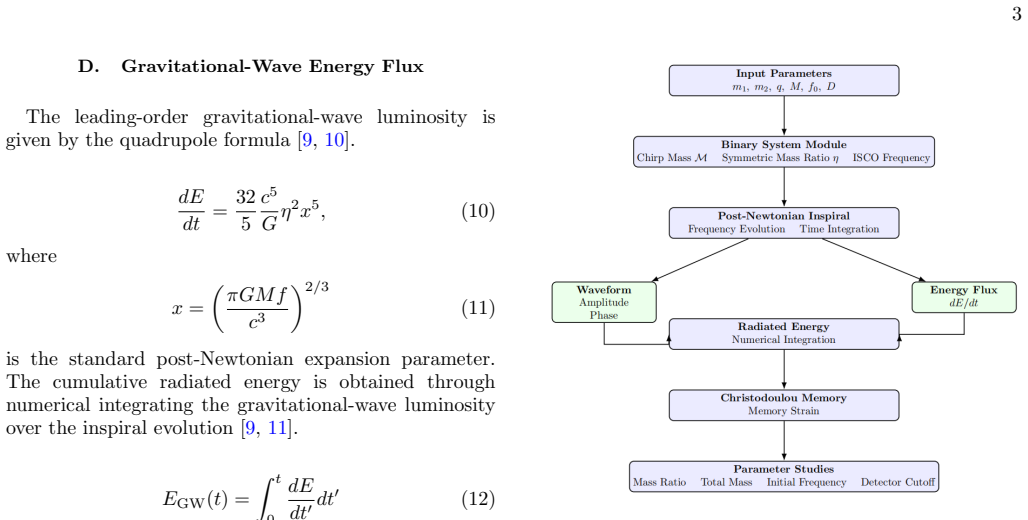
The load-bearing object is the scalar proxy $h_{\rm mem} = 4 G E_{\rm GW}/(c^4 D)$, which converts the accumulated quadrupole energy $E_{\rm GW}$ into an angle-averaged characteristic memory strain at luminosity distance $D$; the paper treats this as a phenomenological scale isolating the mass-energy dependence of the full tensorial memory. The rest of the machinery is the leading-order post-Newtonian frequency evolution $\dot f \propto f^{11/3}$, the quadrupole luminosity $dE/dt \propto \eta^2 x^5$, and the Schwarzschild ISCO cutoff $f_{\rm ISCO} = c^3/(6^{3/2}\pi G M)$. Their interplay -- more mass means more luminosity but a shorter in-band inspiral -- is what produces the peak in $h_{\rm mem}$ versus $M$.
What would settle it
At $f_{\rm low} = 10$ Hz the paper's own data show the memory still increasing at the upper edge of the explored mass range ($M = 200\,M_\odot$), while Eq. (17) predicts the peak near $200\,M_\odot$; extending the mass grid to 300--400 $M_\odot$ at 10 Hz would show whether the memory actually turns over there or continues to rise, which would falsify the inverse scaling. A companion check is recomputing the same grid with the full spin-weighted memory tensor to see whether the scalar proxy changes the peak location.
Extended reading notes
Core claim
Within the leading-order post-Newtonian approximation for non-spinning, quasi-circular binaries, the accumulated inspiral Christodoulou memory is computed as $h_{\rm mem} = 4 G E_{\rm GW}/(c^4 D)$, so the memory tracks the total radiated energy. The paper shows that, for a fixed detector low-frequency cutoff, this observable memory is not monotonic in total mass: increasing mass raises the gravitational-wave luminosity, but it also lowers the ISCO frequency ($f_{\rm ISCO} \propto M^{-1}$), shortening the part of the inspiral that falls inside the detector band. The balance produces a distinct optimal mass $M_{\rm peak}$ for each cutoff, and a fit across cutoffs in the 10--40 Hz range gives $M_{\rm peak} = 2006.5 / f_{\rm low}$ in solar masses (with $f_{\rm low}$ in Hz), with coefficient of determination $R^2 = 0.999243$. The paper presents this inverse scaling as a new quantitative connection between detector bandwidth and the binary systems that yield the largest observable inspiral memory, noting that such a scaling has not been explicitly reported for inspiral-only nonlinear memory studies.
Load-bearing premise
All quantitative memory amplitudes and the fitted coefficient 2006.5 rest on representing the Christodoulou memory by the angle-averaged scalar $4 G E_{\rm GW}/(c^4 D)$; if the true direction-dependent tensor memory has a different energy-to-strain relation, the optimal masses could shift.
Editorial extensions
If this is right
- At a given cutoff $f_{\rm low}$, the observable inspiral memory is largest for total mass about $2006.5/f_{\rm low}$ solar masses, so lower-cutoff detectors should target heavier black-hole binaries.
- Equal-mass binaries produce the largest memory because the symmetric mass ratio is maximal ($\eta = 1/4$), while highly unequal ratios suppress the radiated energy and memory.
- Lowering the cutoff from 40 Hz to 10 Hz increases the accumulated memory by more than an order of magnitude because a much longer early inspiral is included in the observed band.
- The non-monotonic mass dependence implies that the heaviest binaries are not the best memory sources; the optimum balances luminosity against in-band inspiral duration.
Reading between the lines
- An implication the authors leave implicit is that the same inverse scaling can be used to choose target masses for future low-frequency detectors: at $f_{\rm low} = 5$ Hz it predicts $M_{\rm peak} \approx 400\,M_\odot$, well outside the range simulated here, so the low-frequency end of the scaling is currently untested.
- A testable extension is to replace the scalar proxy with the full angle-resolved memory tensor; if the angular structure changes the energy-to-memory mapping, detectors with non-uniform antenna patterns could see a spread of optimal masses rather than a single value.
- Higher-order post-Newtonian corrections, spin, and eccentricity are likely to preserve the inverse functional form but rescale the coefficient 2006.5, so the exact number should be treated as a leading-order estimate.
Editorial analysis
A structured set of objections, weighed in public.
Referee Report
Summary. The paper presents GWMemoryLab, a modular Python framework for computing the leading-order post-Newtonian inspiral contribution to the nonlinear (Christodoulou) gravitational-wave memory in non-spinning, quasi-circular binary black holes. The framework evolves the inspiral with the quadrupole formula, computes the radiated energy within a detector band [f0, fISCO], and converts it to a characteristic memory strain via h_mem = 4 G E_GW/(c^4 D). The authors validate the implementation with analytical checks and a convergence study, then study how the memory depends on mass ratio, total mass, and detector low-frequency cutoff. The central result is the empirical scaling M_peak = 2006.5/f_low M_sun (Eq. 17), which states that the total mass maximizing the observable inspiral memory is inversely proportional to the detector cutoff frequency.
Significance. If the scaling relation holds, it provides a convenient rule of thumb for selecting target binary masses in searches for inspiral memory. The paper's strengths include the public release of GWMemoryLab with a Zenodo archive, a modular architecture that permits component validation, and a convergence table demonstrating good numerical stability for the fiducial configuration. A further strength, not noted in the paper, is that the inverse scaling is not purely empirical: it follows from the leading-order PN energy spectrum dE/df ∝ M_c^{5/3} f^{-1/3} combined with f_ISCO ∝ 1/M, and the analytic coefficient c^3/(10^{3/2} π G M_sun) ≈ 2040 is close to the fitted 2006.5. The paper is therefore a useful contribution, provided the detector-response limitation and the boundary peak issue are addressed.
major comments (3)
- [§IV.I, Fig. 11, Eq. (17)] The f0 = 10 Hz point used to fit Eq. (17) is not an interior maximum: the text states that for 10 Hz the memory "continues to increase throughout the investigated mass range" and reaches its maximum at the edge of the grid, 200 M_sun. Using a boundary value as a peak biases the fitted coefficient 2006.5. The authors should either extend the mass range for f0 = 10 Hz until a true peak appears, or restrict the fit to cutoffs with a well-defined interior peak and state the extrapolated nature of the 10 Hz point.
- [§IV.I and Conclusions, Eqs. (17)-(19)] The quantity maximized in this paper is the scalar memory h_mem computed from the energy radiated in the sharp band [f0, fISCO]. A real detector's sensitivity is governed by the matched-filter SNR, rho^2 ∝ ∫ |\tilde{h}(f)|^2 / S_n(f) df, with a continuous noise spectral density S_n(f); the memory's low-frequency spectral content is then weighted by S_n(f), not by a sharp cutoff. Since the paper's stated purpose is to guide "future memory searches," Eq. (17) should not be presented as predicting the most detectable mass until the calculation is repeated with a realistic noise curve (e.g., aLIGO design sensitivity), or the claim should be explicitly restricted to the sharp-cutoff proxy.
- [Table I] The convergence study does not report the binary parameters used, and the step counts imply an inspiral duration near 0.9 s at dt = 1e-4. The parameter study includes much shorter inspirals: a 200 M_sun binary with f0 = 10 Hz has a duration of about 0.03 s, giving only ~300 steps at the adopted dt = 1e-4. The claimed relative error of ~1e-7 is therefore not demonstrated for the shortest-inspiral configurations, which are exactly the ones that control the f0 = 10 Hz data point in the fit. The authors should add convergence tests for a high-mass, short-duration case or justify why 300 steps suffice there.
minor comments (5)
- [§II.C] The sentence "The leading-order gravitational-wave strain is follows the quadrupole approximation" contains a grammatical error; it should read "The leading-order gravitational-wave strain follows the quadrupole approximation."
- [§II.E, Eq. (13)] The paper correctly labels Eq. (13) as an angle-averaged characteristic scalar. It would help to state explicitly that the absolute strain values quoted in Section IV (e.g., 4.08e-22) are this characteristic amplitude, not the strain in any particular detector orientation, and that the fitted coefficient in Eq. (17) consequently inherits this scalar-proxy convention.
- [§IV.F] The text mentions an empirical fit with R^2 ≈ 0.99999 for the mass-ratio dependence, but the fit function and parameters are not given. Please include the fit equation or remove the claim.
- [Eq. (17)] No uncertainties are quoted for the coefficient 2006.5 or the exponent -1. Adding standard errors from the fit would allow readers to judge how well constrained the scaling is.
- [Introduction] The introduction motivates memory as a detectable signal; citing recent observational searches for gravitational-wave memory by LIGO/Virgo would strengthen the motivation and connect the detector-cutoff discussion to actual search strategies.
Circularity Check
No significant circularity: the central scaling is an openly empirical fit to a self-contained PN simulation.
full rationale
GWMemoryLab is a self-contained numerical implementation of standard leading-order post-Newtonian equations (Eqs. 5, 10, 12), with the Christodoulou memory represented by the explicitly labeled scalar proxy of Eq. (13). The paper does not claim to derive the memory from an independent first-principles theory; it computes h_mem from the cumulative radiated energy within its own model. The mass-ratio and initial-frequency trends are direct mathematical consequences of the quadrupole luminosity and the positive-definite cumulative integral, and the paper presents them as consistency checks, not as independent predictions. The central result, Eq. (17), is stated in Section IV.I as an 'empirical relation' obtained by fitting the simulated peak masses, with the coefficient acknowledged to be specific to the model assumptions. Because the fit is transparently labeled and is not used as an input to compute the very quantities it describes, there is no fitted-input-called-prediction circularity. The inverse scaling M_peak ∝ 1/f_low is physically interpretable from f_ISCO ∝ 1/M (Eq. 15) and is a genuine emergent property of the model. The only self-citation is to the publicly archived software [8], which is not load-bearing for the physics and is externally reproducible. The sharp low-frequency cutoff is an acknowledged modeling simplification, which is a validity concern rather than a circular step. No equation is defined in terms of its own output, and no result is forced by a self-citation chain.
Assumptions & free parameters
free parameters (1)
- M_peak fit coefficient =
2006.5 Msun*Hz
assumptions (3)
- standard math Quadrupole formula for gravitational-wave luminosity (Eq. 10) and leading-order frequency evolution (Eq. 5) from standard PN theory.
- domain assumption Inspiral terminates at the Schwarzschild ISCO frequency f_ISCO = c^3 / (6^{3/2} pi G M) (Eq. 6).
- ad hoc to paper The nonlinear memory is proportional to the total radiated energy via h_mem = 4 G E_GW / (c^4 D) (Eq. 13), treated as a characteristic scalar amplitude.
Cite this review
Pith. "Pith review of Detector Dependence of Inspiral Christodoulou Gravitational Wave Memory in Binary Black Hole Systems." pith.science (2026). https://pith.science/paper/HUTRS446
@misc{pith2026260809295,
  author       = {Pith},
  title        = {Pith review of: Detector Dependence of Inspiral Christodoulou Gravitational Wave Memory in Binary Black Hole Systems},
  year         = {2026},
  howpublished = {\url{https://pith.science/paper/HUTRS446}},
  note         = {Machine review of arXiv:2608.09295}
}
read the original abstract
The nonlinear gravitational-wave memory, or Christodoulou memory effect, is a permanent displacement produced by the self-interaction of gravitational waves predicted by General Relativity. In this work, we present GWMemoryLab, a modular numerical framework for investigating leading-order Christodoulou memory during the inspiral of non-spinning binary black hole systems within the post-Newtonian approximation. The framework implements modules for binary dynamics, post-Newtonian inspiral evolution, oscillatory waveform generation, gravitational-wave energy flux, and nonlinear memory accumulation. Analytical comparisons and convergence tests demonstrate numerical stability. We investigate the dependence of accumulated memory on binary mass ratio, total mass, and detector low-frequency cutoff. The simulations reveal an optimal total mass that maximizes the observable inspiral memory for a given detector bandwidth. Within the explored parameter space, the optimal mass follows an approximately inverse dependence on the detector low-frequency cutoff. This behaviour arises from the competition between increasing gravitational-wave luminosity and decreasing inspiral duration as the binary approaches the innermost stable circular orbit. These results provide insight into the detectability of nonlinear gravitational-wave memory and demonstrate the utility of GWMemoryLab for systematic parameter studies.
Figures


Figures from the paper (4 more)


Reference graph
Works this paper leans on
-
[1]
B. P. Abbottet al.(LIGO Scientific Collaboration and Virgo Collaboration), Observation of Gravitational Waves from a Binary Black Hole Merger, Phys. Rev. Lett. 116, 061102 (2016)
2016
-
[2]
B. P. Abbottet al.(LIGO Scientific Collaboration and Virgo Collaboration), GWTC-1: A Gravitational-Wave 11 Transient Catalog of Compact Binary Mergers, Phys. Rev. X9, 031040 (2019)
work page 2019
-
[3]
Christodoulou, Nonlinear Nature of Gravitation and Gravitational-Wave Experiments, Phys
D. Christodoulou, Nonlinear Nature of Gravitation and Gravitational-Wave Experiments, Phys. Rev. Lett.67, 1486 (1991)
work page 1991
-
[4]
K. S. Thorne, Gravitational-wave bursts with memory: The Christodoulou effect, Phys. Rev. D45, 520 (1992)
work page 1992
-
[5]
Blanchet and T
L. Blanchet and T. Damour, Hereditary effects in gravi- tational radiation, Phys. Rev. D46, 4304 (1992)
1992
-
[6]
Favata, The Gravitational-Wave Memory Effect, Class
M. Favata, The Gravitational-Wave Memory Effect, Class. Quantum Grav.27, 084036 (2010)
work page 2010
-
[7]
Favata, Nonlinear gravitational-wave memory from binary black hole mergers, Astrophys
M. Favata, Nonlinear gravitational-wave memory from binary black hole mergers, Astrophys. J. Lett.696, L159 (2009)
work page 2009
-
[8]
J. Varghese,GWMemoryLab: A Python Framework for Inspiral Christodoulou Gravitational-Wave Memory, Zenodo (2026), doi:10.5281/zenodo.21783195
Show all 12 references
-
[9]
Blanchet, Gravitational Radiation from Post- Newtonian Sources and Inspiralling Compact Binaries, Living Rev
L. Blanchet, Gravitational Radiation from Post- Newtonian Sources and Inspiralling Compact Binaries, Living Rev. Relativ.17, 2 (2014)
2014
-
[10]
P. C. Peters and J. Mathews, Gravitational Radiation from Point Masses in a Keplerian Orbit, Phys. Rev.131, 435 (1963)
1963
-
[11]
Maggiore,Gravitational Waves: Volume 1: The- ory and Experiments(Oxford University Press, 2007), doi:10.1093/acprof:oso/9780198570745.001.0001
M. Maggiore,Gravitational Waves: Volume 1: The- ory and Experiments(Oxford University Press, 2007), doi:10.1093/acprof:oso/9780198570745.001.0001
2007
-
[12]
C. W. Misner, K. S. Thorne, and J. A. Wheeler,Gravi- tation(W. H. Freeman, 1973)
1973
Reviewed August 11, 2026 · model on record in the stance chip above.
Discussion (0). Continue with ORCID to comment.