Robust Capacity Expansion under Wildfire Ignition Risk and High Renewable Penetration
Pith reviewed 2026-05-25 06:20 UTC · model grok-4.3
The pith
A robust optimization model identifies optimal battery storage locations and transmission line undergrounding to mitigate wildfire de-energization risks combined with variable renewables.
A machine-rendered reading of the paper's core claim, the machinery that carries it, and where it could break.
Core claim
The central discovery is a robust optimization model that determines the optimal location of battery storage and undergrounding of transmission line investment by addressing the worst-case realization of ignition risk leading to de-energization of transmission lines combined with the worst-case realization of renewable energy availability, using representative weeks and uncertainty sets to capture temporal relationships.
What carries the argument
Robust optimization with uncertainty sets for ignition risk and renewable availability, solved as a MILP using duality theory, binary decomposition, and column-and-constraint generation algorithm.
If this is right
- The model yields investment decisions that improve system resilience to combined wildfire and renewable variability risks.
- It captures temporal dependencies between uncertain variables through representative weeks.
- Optimal storage and undergrounding reduce adverse effects of line de-energization.
- The framework is effective on real systems like San Diego's power grid.
Where Pith is reading between the lines
- The approach could extend to other climate-related risks such as floods or storms affecting infrastructure.
- Policymakers might use similar models to prioritize investments in vulnerable regions.
- Future work could incorporate more granular uncertainty sets derived from climate projections.
Load-bearing premise
The selected uncertainty sets and representative weeks sufficiently represent the joint worst-case temporal relationships between ignition risk and renewable availability so that no omitted scenarios would change the investment decisions.
What would settle it
Comparing the model's recommended investments against those from a model using actual historical worst-case events from the San Diego area; if the decisions differ significantly, the adequacy of the uncertainty sets would be questioned.
Figures
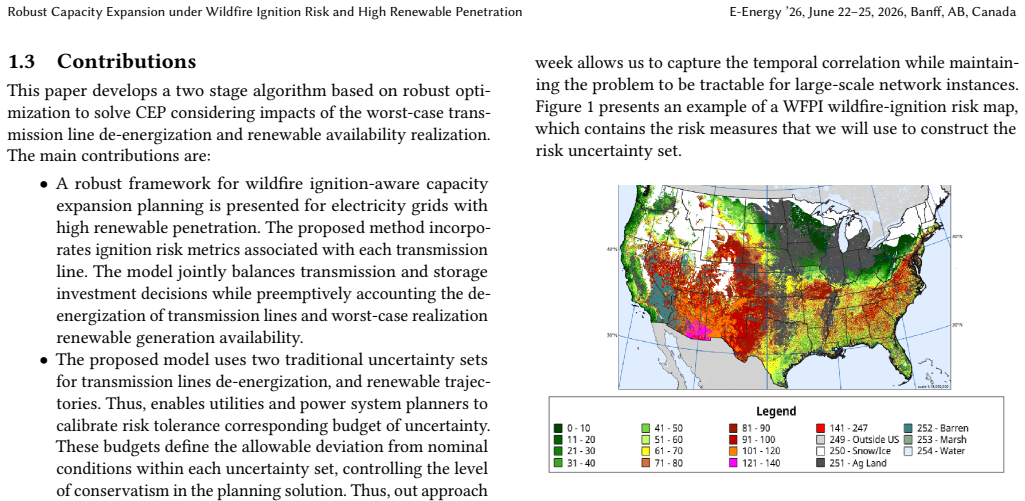


read the original abstract
In power systems, the risk of wildfire ignition has increased significantly in recent years. The impact and severity of these events on energy dispatch, as well as their societal ramifications, make wildfire prevention critical for power system planning and operation. A common intervention by system operators is to de-energize transmission lines to mitigate the risk of fire caused by equipment failures. With the growing integration of variable renewable generation, managing and preparing the system to de-energization under wildfire risk has become even more challenging. In this context, mitigation decisions such as installing battery energy storage systems and undergrounding transmission lines can reduce the risk and adverse effects associated with de-energization and renewable generation variability. This paper presents a robust optimization model to determine the optimal location of battery storage and undergrounding of transmission line investment, utilizing representative weeks and uncertainty sets to capture the temporal relationship of uncertain variables. Specifically, this paper addresses: (i) the worst-case realization of ignition risk leading to the de-energization of transmission lines, combined with the worst-case realization of renewable energy availability, and (ii) the optimal investment decisions for energy storage capacity and undergrounding of transmission lines that are exposed to ignition risk. The proposed model is formulated as a mixed-integer linear programming (MILP) problem, employing duality theory and binary decomposition to address nonlinearities, and is solved using a column-and-constraint generation algorithm. The proposed framework is evaluated on a model of the San Diego power system, demonstrating its practical effectiveness in improving the resilience to wildfire risk.
Editorial analysis
A structured set of objections, weighed in public.
Referee Report
Summary. The manuscript proposes a robust optimization model formulated as a MILP for determining optimal investments in battery energy storage systems and undergrounding of transmission lines under wildfire ignition risk and high renewable penetration. It utilizes representative weeks and uncertainty sets to model temporal relationships of uncertain variables, addresses worst-case ignition risk leading to de-energization combined with worst-case renewable availability, employs duality theory and binary decomposition, solves via column-and-constraint generation, and evaluates the framework on a model of the San Diego power system.
Significance. If the uncertainty sets and representative weeks adequately capture the required joint worst-case scenarios, the framework could offer a useful tool for resilience-focused capacity expansion planning in wildfire-prone regions with high renewable shares. The choice of column-and-constraint generation for the robust MILP is a standard and appropriate solution method for this class of problems.
major comments (2)
- [Abstract] Abstract: the claim that the framework is 'evaluated on a model of the San Diego power system, demonstrating its practical effectiveness' is unsupported because the manuscript provides no numerical results, investment decisions, objective values, or comparisons to non-robust baselines.
- [Model formulation (uncertainty sets)] Model formulation and uncertainty set definition: the construction of the uncertainty sets for ignition risk and renewable availability is not shown to enforce joint temporal correlations; if the sets are formed marginally, the column-and-constraint generation procedure optimizes against an incomplete adversary, which directly affects the claimed optimal locations for storage and undergrounding.
minor comments (1)
- [Representative weeks selection] The description of how representative weeks are selected and weighted could be expanded with explicit criteria or an algorithm to improve reproducibility.
Simulated Author's Rebuttal
We thank the referee for the constructive comments. We address each major point below and commit to revisions that strengthen the manuscript without misrepresenting the work.
read point-by-point responses
-
Referee: [Abstract] Abstract: the claim that the framework is 'evaluated on a model of the San Diego power system, demonstrating its practical effectiveness' is unsupported because the manuscript provides no numerical results, investment decisions, objective values, or comparisons to non-robust baselines.
Authors: We agree that the abstract claim requires explicit support from results in the manuscript. The current version does not present numerical results, investment decisions, objective values, or baseline comparisons. We will add a dedicated computational results section reporting these elements for the San Diego system, including optimal storage and undergrounding decisions, objective values, and comparisons to non-robust cases, to substantiate the practical effectiveness claim. revision: yes
-
Referee: [Model formulation (uncertainty sets)] Model formulation and uncertainty set definition: the construction of the uncertainty sets for ignition risk and renewable availability is not shown to enforce joint temporal correlations; if the sets are formed marginally, the column-and-constraint generation procedure optimizes against an incomplete adversary, which directly affects the claimed optimal locations for storage and undergrounding.
Authors: The manuscript states that representative weeks and uncertainty sets are used to capture temporal relationships of the uncertain variables. We acknowledge that the current text does not explicitly demonstrate enforcement of joint (rather than marginal) temporal correlations between ignition risk and renewable availability. We will revise the model formulation section to detail the joint construction of the uncertainty sets, including how representative weeks ensure correlated worst-case scenarios are considered by the adversary in the column-and-constraint generation algorithm. revision: yes
Circularity Check
No circularity: standard robust optimization formulation with external inputs
full rationale
The paper formulates a MILP robust optimization model solved via column-and-constraint generation, with uncertainty sets and representative weeks supplied as exogenous inputs drawn from the San Diego system data. No derivation step reduces by construction to a fitted parameter, self-definition, or load-bearing self-citation; the investment decisions for storage and undergrounding are outputs of the optimization against the given adversary sets rather than tautological renamings or internal fits. The model is self-contained against external benchmarks and real-world evaluation.
Axiom & Free-Parameter Ledger
free parameters (2)
- Uncertainty set parameters for ignition risk and renewable availability
- Selection and weighting of representative weeks
axioms (1)
- domain assumption Power system operations and investment decisions can be accurately represented as a mixed-integer linear program with linear approximations for storage and line investments.
Lean theorems connected to this paper
-
IndisputableMonolith/Cost/FunctionalEquation.leanwashburn_uniqueness_aczel unclear?
unclearRelation between the paper passage and the cited Recognition theorem.
robust optimization model … two traditional uncertainty sets … column-and-constraint generation algorithm
-
IndisputableMonolith/Foundation/RealityFromDistinction.leanreality_from_one_distinction unclear?
unclearRelation between the paper passage and the cited Recognition theorem.
U_r (z_UG) … box uncertainty set … Γ_d,w √|L|
What do these tags mean?
- matches
- The paper's claim is directly supported by a theorem in the formal canon.
- supports
- The theorem supports part of the paper's argument, but the paper may add assumptions or extra steps.
- extends
- The paper goes beyond the formal theorem; the theorem is a base layer rather than the whole result.
- uses
- The paper appears to rely on the theorem as machinery.
- contradicts
- The paper's claim conflicts with a theorem or certificate in the canon.
- unclear
- Pith found a possible connection, but the passage is too broad, indirect, or ambiguous to say the theorem truly supports the claim.
Reference graph
Works this paper leans on
- [1]
-
[2]
Michael Abdelmalak and Mohammed Benidris. 2022. Enhancing power system operational resilience against wildfires.IEEE Transactions on Industry Applications 58, 2 (2022), 1611–1621
work page 2022
-
[3]
Frédéric Allaire, Vivien Mallet, and Jean-Baptiste Filippi. 2021. Emulation of wildland fire spread simulation using deep learning.Neural networks141 (2021), 184–198
work page 2021
-
[4]
Reza Bayani and Saeed D Manshadi. 2023. Resilient expansion planning of electricity grid under prolonged wildfire risk.IEEE Transactions on Smart Grid 14, 5 (2023), 3719–3731
work page 2023
-
[5]
Reza Bayani, Muhammad Waseem, Saeed D Manshadi, and Hassan Davani. 2022. Quantifying the risk of wildfire ignition by power lines under extreme weather conditions.IEEE Systems Journal17, 1 (2022), 1024–1034
work page 2022
-
[6]
California Public Utilities Commission. 2025. Public Safety Power Shutoffs (PSPS). https://www.cpuc.ca.gov/psps/. Accessed: 2025-08-06
work page 2025
-
[7]
Akshay Gupte, Shabbir Ahmed, Myun Seok Cheon, and Santanu Dey. 2013. Solving mixed integer bilinear problems using MILP formulations.SIAM Journal on Optimization23, 2 (2013), 721–744
work page 2013
-
[8]
2022.Data-driven power system optimal decision making strategy under wildfire events
Wanshi Hong, Bin Wang, Mengqi Yao, Duncan Callaway, Larry Dale, and Can Huang. 2022.Data-driven power system optimal decision making strategy under wildfire events. Technical Report. Lawrence Livermore National Lab, Livermore, CA, US
work page 2022
- [9]
-
[10]
Can Li, Antonio J Conejo, John D Siirola, and Ignacio E Grossmann. 2022. On representative day selection for capacity expansion planning of power systems under extreme operating conditions.International Journal of Electrical Power & Energy Systems137 (2022), 107697
work page 2022
-
[11]
Salman Mohagheghi and Steffen Rebennack. 2015. Optimal resilient power grid operation during the course of a progressing wildfire.International Journal of Electrical Power & Energy Systems73 (2015), 843–852
work page 2015
-
[12]
Amelia Musselman, Tomas Valencia Zuluaga, Elizabeth Glista, Minda Mon- teagudo, J Michael, Matthew Signorotti Grappone, and Jean-Paul Watson. 2025. Climate-Resilient Nodal Power System Expansion Planning for a Realistic Cali- fornia Test Case. (2025)
work page 2025
-
[13]
Ryan Piansky, Rahul Gupta, and Daniel K Molzahn. 2025. Optimizing battery and line undergrounding investments for transmission systems under wildfire risk scenarios: A benders decomposition approach.Sustainable Energy, Grids and Networks(2025), 101838
work page 2025
-
[14]
Ryan Piansky, Georgia Stinchfield, Alyssa Kody, Daniel K Molzahn, and Jean- Paul Watson. 2024. Long duration battery sizing, siting, and operation under wildfire risk using progressive hedging.Electric Power Systems Research235 (2024), 110785
work page 2024
- [15]
-
[16]
Noah Rhodes and Line A Roald. 2023. Co-optimization of power line shutoff and restoration under high wildfire ignition risk. In2023 IEEE Belgrade PowerTech. IEEE, 1–7
work page 2023
-
[17]
U.S. Geological Survey. 2025. Wildland Fire Potential Index. Accessed: 2028-08
work page 2025
-
[18]
Tomás Tapia, Alvaro Lorca, Daniel Olivares, Matias Negrete-Pincetic, and Alberto Lamadrid. 2021. A robust decision-support method based on optimization and simulation for wildfire resilience in highly renewable power systems.European Journal of Operational Research294, 2 (2021), 723–733
work page 2021
-
[19]
2023.A Robust Optimization Approach to Determine Power Line Undergrounding under Wildfire Risk
S Taylor, AE Musselman, LA Roald, and JP Watson. 2023.A Robust Optimization Approach to Determine Power Line Undergrounding under Wildfire Risk. Technical Report. Lawrence Livermore National Laboratory, Livermore, CA, US
work page 2023
-
[20]
Sofia Taylor, Aditya Rangarajan, Noah Rhodes, Jonathan Snodgrass, Bernard C Lesieutre, and Line A Roald. 2023. California test system (CATS): A geographically accurate test system based on the California grid.IEEE Transactions on Energy Markets, Policy and Regulation2, 1 (2023), 107–118
work page 2023
-
[21]
Sofia Taylor, Gabriela Setyawan, Bai Cui, Ahmed Zamzam, and Line A Roald. 2023. Managing Wildfire Risk and Promoting Equity through Optimal Configuration of Networked Microgrids. InACM e-Energy
work page 2023
-
[22]
Daniel A Zuniga Vazquez, Feng Qiu, Neng Fan, and Kevin Sharp. 2022. Wildfire mitigation plans in power systems: A literature review.IEEE Transactions on Power Systems37, 5 (2022), 3540–3551
work page 2022
-
[23]
Felipe Verástegui, Alvaro Lorca, Daniel E Olivares, Matias Negrete-Pincetic, and Pedro Gazmuri. 2019. An adaptive robust optimization model for power systems planning with operational uncertainty.IEEE Transactions on Power Systems34, 6 (2019), 4606–4616
work page 2019
discussion (0)
Sign in with ORCID, Apple, or X to comment. Anyone can read and Pith papers without signing in.