REVIEW 4 major objections 6 minor 33 references
Optical interference by amplitude measurement
T0 review · 4 major / 6 minor · reviewed 2026-08-08 · deepseek-v4-flash
Pith's one-line read A single homodyne measurement recovers interference between distinguishable light fields.
desk verdict A solid, well-supported demonstration that homodyne amplitude addition recovers interference between distinguishable modes; the central physics is standard but the multi-case verification earns it a serious referee. read the letter →
The pith
A machine-rendered reading of the paper's core claim, the machinery that carries it, and where it could break.
The reading
What carries the argument
The load-bearing object is the balanced homodyne detector treated as a quadrature-amplitude meter: its output photocurrent is proportional to the real quadrature $X(\varphi)$ of the field component that matches the local oscillator mode, and the same current also carries the quadrature of the vacuum mode entering the unused port. Because the photocurrent is linear in field amplitude, summing currents from several local oscillators performs amplitude addition directly in the electronics. In the unbalanced-interferometer variants the detector response function $k(\tau)$ plays the role of a temporal projection: the overlap integral $\int d\tau\, k(\tau)k(\tau+\Delta T)$ determines whether the two time-separated amplitudes are added, and when it vanishes an electronic delay $\Delta T_e$ or a time-average over $T>\Delta T$ restores the overlap. This same object—photocurrent addition before squaring—is what produces the fringe in $\langle i^2\rangle$ despite orthogonal polarizations or non-overlapping pulses.
What would settle it
Use the setup of Fig. 2 with two fields whose mutual coherence is strictly zero ($\gamma_{12}=0$, for example by deriving the two inputs from independent lasers). Equation (7) predicts a flat $\langle i^2\rangle$ with visibility exactly 0; any phase-dependent fringe would disprove the claimed visibility formula. Conversely, with $\gamma_{12}=1$, scanning the two LO phases should produce the predicted $V=2\sqrt{\lambda}/(1+\lambda)$ profile.
Extended reading notes
Core claim
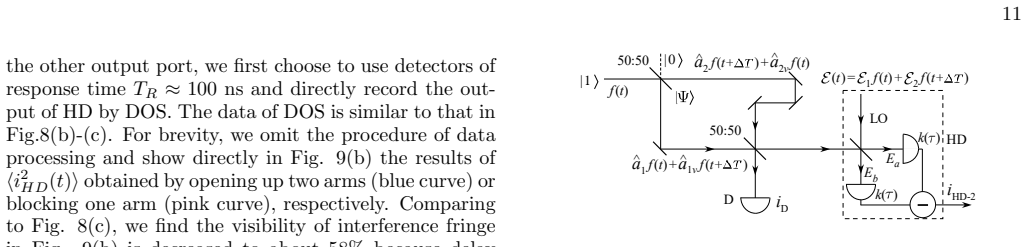
The central claim is that interference can be recovered after detection by adding photocurrents that are each linear in the amplitude of one field component, rather than by projecting the optical fields onto a common mode before a detector. In balanced homodyne detection the output current is proportional to the quadrature-phase amplitude $X(\varphi)=Ee^{-i\varphi}+E^*e^{i\varphi}$ of the field matched to the local oscillator, so with two mode-matched local oscillators the current is $i_{\mathrm{HD}-2}\propto |E_1|X_1(\varphi_1)+|E_2|X_2(\varphi_2)$. Squaring and averaging this current yields Eq. (7): a fringe pattern in $\langle i^2_{\mathrm{HD}-2}\rangle$ with visibility $V=2|\gamma_{12}|\sqrt{\lambda}/(1+\lambda)$, where $\gamma_{12}$ is the normalized mutual coherence of the two fields and $\lambda$ is the LO intensity ratio. The same amplitude-addition mechanism works for path-unbalanced interferometers: fringe visibility is controlled by the overlap of the detector response $k(t)$ with its delayed copy $k(t+\Delta T)$, so slow detection, time averaging, or an electronic delay $i_+(t)=i(t)+i(t+\Delta T_e)$ restores fringes even for $\Delta T\gg T_c$. Experiments with cw thermal fields, pulsed thermal fields, and path delays up to $20$ ns confirm that direct intensity shows nothing while the homodyne photocurrent power shows visibilities of roughly $50\%$–$95\%$. For quantum fields, the same analysis gives a maximum single-photon visibility of $1/3$ and a general visibility $N/(N+2)$ set by photon number per mode, with vacuum noise as the limiting background.
Load-bearing premise
Everything rests on the local oscillator maintaining a stable phase over every time scale in the experiment; if the LO phase drifts, the two amplitude measurements lose their common phase reference and the fringes in the squared photocurrent wash out.
Editorial extensions
If this is right
- Unbalanced interferometers with path difference far beyond the coherence length can be used for interference measurements; the path delay is compensated electronically instead of optically, extending the practical reach of Michelson-style stellar interferometry and LIDAR or remote sensing.
- Interference fringes no longer require the two fields to be projected into a common mode; recovery is a data-processing matter (time averaging, electronic delay, or slow detection), so the technique can be retrofitted to existing homodyne setups.
- For quantum fields, the visibility formula $N/(N+2)$ quantifies how vacuum noise degrades amplitude-based interference at low photon number, and the paper argues squeezed or entangled states can restore it.
- The observed effect is fourth order in the field amplitudes and can be viewed as two-photon interference with one photon from the signal fields and one from the local oscillators; the signal scales with photon rate rather than the square of photon rate, so strong LOs can amplify a weak interference signal.
- Spectrally analyzing the homodyne photocurrent of an unbalanced interferometer should give the same information as frequency-domain optical coherence measurements, since the photocurrent carries both amplitude and phase.
Reading between the lines
- Because amplitude addition happens in the photocurrent, the mode-projection step can in principle be postponed indefinitely and performed numerically; one could record a single multi-channel homodyne trace and later synthesize interference between any pair of modes that were measured, including modes that never overlapped in space or time.
- The dependence of visibility on detector response suggests a calibration-free way to measure the coherence function $\gamma_{12}$: scan the electronic delay $\Delta T_e$ and read the visibility envelope, which directly maps $|\gamma(\tau)|$ without optical path balancing.
- If the same amplitude-addition logic is applied to more than two modes, the scheme generalizes naturally to an optical very-long-baseline-style interferometer at a single location, where separate local oscillators play the role of separate antennas and the interference pattern is assembled in software.
- The paper's complementarity resolution suggests that a hypothetical direct electric-field detector would make optical interferometry behave like radio interferometry, with no indistinguishability requirement at all; homodyne detection is the current approximation to such a detector.
Signed reviews
Editorial analysis
A structured set of objections, weighed in public.
Referee Report
Summary. The paper proposes and demonstrates that optical interference can be revealed by measuring field amplitudes with balanced homodyne detection and then adding the photocurrents, even when the two interfering fields are in distinguishable modes: orthogonal polarizations (Sec. II), temporally non-overlapping pulses (Sec. IV), or path-unbalanced interferometers beyond the coherence length (Sec. III). The central theoretical result is a set of visibility formulas (Eqs. 7, 13, 18, 25, 36, 43) showing that fringes appear in the power of the homodyne photocurrent with a visibility related to the degree of coherence between the two fields. The paper reports experimental confirmations for cw thermal light, pulsed thermal light, and a quantum-noise-limited case where visibility depends on photon number. It also discusses the relation to fourth-order interference and interprets the results in the context of complementarity.
Significance. If the results hold, the manuscript provides a unified and experimentally well-supported framework for amplitude-based interference, extending homodyne detection to situations where traditional intensity-based interference fails. This could be practically useful for unbalanced interferometry and remote sensing beyond the coherence length. The paper's strengths include explicit, closed-form visibility formulas, multiple independent experimental demonstrations (cw, pulsed, and quantum-noise cases), and a quantitative comparison with Eq. (21) using independently measured detector response and input spectrum. The main weaknesses are the lack of error bars on all visibility data, the unverified local-oscillator phase-stability assumption, and an overstatement in the interpretation of complementarity that is later moderated in Sec. VI.
major comments (4)
- [Sec. III, end (after Eq. 18 and Fig. 6)] The central technique requires the relative phase Δφ between the two local oscillators (or between the LO and the delayed replica) to be stable over the averaging time Tav; Eq. (7) and Eq. (13) both contain an oscillatory factor cos(Δφ+φγ). The paper states this requirement only qualitatively as TLO ≫ Tc, TR, ΔT and does not report any measurement of TLO or of the phase drift of Δφ over the relevant timescales. Since the observed fringes would vanish if Δφ fluctuated significantly during Tav, please add a quantitative verification: for example, a delayed self-heterodyne linewidth measurement of the LO, or a direct measurement of fringe contrast versus averaging time, together with an explicit statement of the maximum acceptable phase drift.
- [Figs. 5, 6, 8, 9, 11 and Eqs. (13), (21), (25), (43)] All experimental visibility values are reported without error bars or statistical uncertainties. For example, Fig. 5(b) reports 85% visibility, Fig. 8(c) reports 95%, Fig. 6(c) claims agreement with Eq. (21) based on a blue curve and red dots, and Fig. 11 fits to V=CN/(CN+2) with C=0.25. Without uncertainties or the number of independent measurements, it is not possible to judge the quantitative support for the visibility formulas. Please provide error bars based on repeated measurements, standard deviations over independent averages, or a Monte Carlo propagation of the main noise sources.
- [Sec. V.B, Fig. 11 and Eq. (43)] The visibility-versus-photon-number curve is fitted with a single free efficiency parameter C=0.25, but the total detection efficiency and round-trip losses are not independently measured. As it stands, the fit demonstrates that the data are consistent with the functional form N/(N+2) times an efficiency, but it does not provide an independent test of Eq. (43). Please either calibrate the system efficiency independently and compare it with the fitted C, or clearly state that C is a fit parameter and give its uncertainty and the quality of fit.
- [Abstract and Sec. VI (first and last paragraphs)] The abstract and introduction state that the results 'directly challenge complementarity principle', but Sec. VI explains that complementarity is restored when the LO fields are included in the measurement or when the phenomenon is reinterpreted as fourth-order/two-photon interference. This makes the 'challenge' an interpretive claim rather than a physical contradiction. The wording should be moderated, or the paper should articulate precisely which version of the complementarity principle is violated and why the two-photon description does not fully account for the observed interference.
minor comments (6)
- [Sec. II, Eqs. (1)-(7)] The same symbols E1, E2 are used for both the input fields and the local oscillator fields; please use distinct notation (e.g., Es1, ELO1) to avoid confusion, particularly in Eq. (4) where the LO amplitudes are introduced.
- [Eq. (7)] The term 'γ∗12ei∆φ' should presumably be 'γ∗12e−i∆φ' to give a real cosine fringe; please correct this typo.
- [Introduction and Fig. 2 caption] There are several typos: 'obseravble' should be 'observable', 'balance homodyne detection' should be 'balanced homodyne detection', and 'orthgogonal' should be 'orthogonal'.
- [Sec. III, paragraph after Eq. (13)] The phrase 'we guarantee the superposition of the amplitudes of the fields from the two paths even though they are very off balance' is unclear; please clarify that 'off balance' means the path difference ΔT exceeds the coherence time Tc.
- [Fig. 5(c) and Eq. (13)] The fitted curve V(T)=1−ΔT/T is only defined for T>ΔT and is zero otherwise; please state this domain explicitly in the caption and in the text to avoid the impression that the fit extends below T=ΔT.
- [Sec. IV.B, Fig. 9] The statement 'we omit the procedure of data processing' is too terse; please briefly describe how ⟨i2_HD(t)⟩ and ⟨i2_+(t)⟩ were obtained from the raw oscilloscope traces, including the length of the averaging window and any subtraction of dark or electronic offsets.
Circularity Check
No significant circularity: the central visibility formulas are derived from standard homodyne-detection theory and tested against new experimental data, while the disclosed loss fit and self-citations are not load-bearing.
full rationale
The paper's derivation chain is self-contained. Equations (7), (12), (14), (18), (24), (29), (35), and (43) are obtained by substituting the standard balanced-homodyne current i ∝ |E| X(φ) into the power of the added photocurrent and evaluating the resulting field correlations; the coherence function γ12 or γ(τ) enters as the quantity being measured, not as a fitted output. The experimental sections test the predicted dependences on detector response time and averaging time (Figs. 5c and 8e), on electronic delay compensation (Fig. 6c and 9c), and on photon number (Fig. 11). The only adjusted parameter in Fig. 11 is the loss factor C = 0.25, which the text explicitly presents as a fit to Eq. (43) and not as a predicted value. The self-citations (Refs. 15, 26, 30) are historical, motivational, or interpretive; no uniqueness theorem and no ansatz is imported from them to force the central result. The stated requirement that the LO coherence time TLO exceed all experimental time scales is a spelled-out assumption, not an input disguised as a prediction. Therefore no circular step can be identified.
Assumptions & free parameters
free parameters (1)
- C (detection efficiency/loss factor) =
0.25
assumptions (5)
- standard math Balanced homodyne detection current is proportional to the quadrature-phase amplitude of the field (Eq. 3).
- domain assumption The input fields have random phases relative to the LOs so that <X_j> = 0, but retain a nonzero mutual phase correlation gamma12 (Eq. 7).
- domain assumption The local oscillator provides a stable phase reference with TLO longer than all experimental time scales (Sec. III).
- domain assumption The detector response function k(tau) is linear, time-invariant, and known; LO modes are matched to the signal modes.
- standard math Quantum field commutators give [E(t), E^dagger(t)] = DeltaB for the detection bandwidth (Eq. 40).
Cite this review
Pith. "Pith review of Optical interference by amplitude measurement." pith.science (2026). https://pith.science/paper/HVVPRNWK
@misc{pith2026250204010,
  author       = {Pith},
  title        = {Pith review of: Optical interference by amplitude measurement},
  year         = {2026},
  howpublished = {\url{https://pith.science/paper/HVVPRNWK}},
  note         = {Machine review of arXiv:2502.04010}
}
read the original abstract
Interference effects are usually observed by intensity measurement. Path indistinguishability by quantum complementarity principle requires projection of the interfering fields into a common indistinguishable mode before detection. On the other hand, the essence of wave interference is the addition of amplitudes of the interfering fields. Therefore, if amplitudes can be directly measured and added, interference can occur even though the interfering fields are in well-distinguishable modes. Here, we make a comprehensive study in both theory and experiment of a technique by homodyne measurement of field amplitudes to reveal interference. This works for both classical and quantum fields even though there exists distinguishability in the interfering paths of light. This directly challenges complementarity principle. We present a resolution of this issue from the viewpoint of measurement that emphasizes either particle or wave. This technique is particularly useful for recovering interference in unbalanced interferometers with path-imbalance beyond coherence length of the input field and can be applied to remote sensing to extend applicable range. Since the amplitude-based interference phenomena studied here are fundamentally different from the traditional intenisty-based interference phenomena, our approach leads to a new paradigm to study coherence between optical fields.
Figures


Figures from the paper (7 more)



Reference graph
Works this paper leans on
-
[1]
Bohr in Quantum Theory and Measurement, ed
N. Bohr in Quantum Theory and Measurement, ed. J. A. Wheeler and W. H. Zurek (Princeton University Press, 1983)
work page 1983
-
[2]
B. -G. Englert, Fringe Visibility and Which-Way Information: An Inequality, Phys. Rev. Lett. 77 , 2154 (1996)
work page 1996
-
[3]
X. Y. Zou, L. J. Wang, and L. Mandel, Induced coherence and indistinguishability in optical interference, Phys. Rev. Lett. 67, 318 (1991)
work page 1991
-
[4]
T. J. Herzog, J. G. Rarity, H. Weinfurter, and A. Zeilinger, Frustrated two-photon creation via interference, Phys. Rev. Lett. 72 , 629 (1994)
work page 1994
-
[5]
D. F. V. James and E. Wolf, Some New Aspects of Young's Interference Experiment, Phys. Lett. A 157 , 6 (1991)
work page 1991
-
[6]
G. S. Agarwal and D. F. V. James, Spectral Changes in the Mach-Zehnder Interferometer, J. of Mod. Opt. 40 , 1431 (1993)
work page 1993
-
[7]
X. Y. Zou, T. P. Grayson, and L. Mandel, Observation of Quantum Interference Effects in the Frequency Domain, Phys. Rev. Lett. 69 , 3041 (1992)
work page 1992
-
[8]
D. L. Jacobson, S. A. Werner, and H. Rauch, Spectral modulation and squeezing at high-order neutron interferences, Phys. Rev. A 49 , 3196 (1994)
work page 1994
Show all 33 references
-
[9]
Mandel and E
L. Mandel and E. Wolf, Coherence Properties of Optical Fields, Rev. Mod. Phys. 37 , 231 (1965)
1965
-
[10]
R. J. Glauber, The Quantum Theory of Optical Coherence, Phys. Rev. 130, 2529 (1963)
1963
-
[11]
Wolf, Optics in terms of observable quantities, Nuovo Cimento 12 , 884-888 (1954)
E. Wolf, Optics in terms of observable quantities, Nuovo Cimento 12 , 884-888 (1954)
1954
-
[12]
J. M. Marr, R. L. Snell, S. E. Kurtz in Fundamentals of Radio Astronomy: Observational Methods (CRC Press, 2015)
2015
-
[13]
H. P. Yuen and J. H. Shapiro, Optical communication with two-photon coherent states - Part I: Quantum-state propagation and quantum-noise, IEEE Trans. Inf. Theory IT-24 , 657 (1978)
1978
-
[14]
Z. Y. Ou and H. J. Kimble, Probability distribution of photoelectric currents in photodetection processes and its connection to the measurement of a quantum state, Phys. Rev. A 52 , 3126 (1995)
1995
-
[15]
Nan Huo, Liang Cui, Yunxiao Zhang, Wen Zhao, Xueshi Guo, Z. Y. Ou, and Xiaoying Li, Measurement-Dependent Erasure of Distinguishability for the Observation of Interference in an Unbalanced SU(1,1) Interferometer, PRX Quantum 3 , 020313 (2022)
2022
-
[16]
Taylor, Coherent Detection Method Using DSP for Demodulation of Signal and Subsequent Equalization of Propagation Impairments, IEEE Photon
Michael G. Taylor, Coherent Detection Method Using DSP for Demodulation of Signal and Subsequent Equalization of Propagation Impairments, IEEE Photon. Tech. Lett. 16 , 674 (2004)
2004
-
[17]
Guifang Li, Recent advances in coherent optical communication , Adv. Opt. Photo. 1 , 279 (2009)
2009
-
[18]
Swanson, Charles P
David Huang, Eric A. Swanson, Charles P. Lin, Joel S. Schuman, William G. Stinson, Warren Chang, Michael R. Hee, Thomas Flotte, Kenton Gregory, Carmen A. Puliafito, and James G. Fujimoto, Optical coherence tomography, Science 254 1178 (1991)
1991
-
[19]
M. A. Johnson, A. L. Betz, and C. H. Townes, 10- m Heterodyne Stellar Interferometer, Phys. Rev. Lett. 33 , 1617 (1974)
1974
-
[20]
D. D. S. Hale, M. Bester, W. C. Danchi, W. Fitelson, S. Hoss, E. A. Lipman, J. D. Monnier, P. G. Tuthill, and C. H. Townes, Astrophys. J. 537 , 998 (2000)
2000
-
[21]
Min Xiao, Ling-An Wu, and H. J. Kimble, Precision measurement beyond the shot-noise limit, Phys. Rev. Lett. 59 , 278 (1987)
1987
-
[22]
Grangier, R
P. Grangier, R. E. Slusher, B. Yurke, and A. LaPorta, Squeezed-light–enhanced polarization interferometer, Phys. Rev. Lett. 59 , 2153 (1987)
1987
-
[23]
A. A. Michelson and F. G. Pease, Astrophys. J. 53 , 249 (1921)
1921
-
[24]
Tamma and J
V. Tamma and J. Seiler, Multipath correlation interference and controlled-NOT gate simulation with a thermal source, New J. Phys. 18 , 032002 (2016)
2016
-
[25]
Y. S. Ihn, Y. Kim, V. Tamma, and Y.-H. Kim, Second-Order Temporal Interference with Thermal Light: Interference Beyond the Coherence Time, Phys. Rev. Lett. 119 , 263603 (2017)
2017
-
[26]
Z. Y. Ou and Xiaoying Li, Unbalanced fourth-order interference beyond coherence time, Phys. Rev. Research 4 , 023125 (2022)
2022
-
[27]
S. M. Tan, D. F. Walls, and M. J. Collett, Nonlocality of a single photon, Phys. Rev. Lett. 66 , 252 (1991)
1991
-
[28]
Xiaoxin Ma, Xiaoying Li, Liang Cui , Xueshi Guo, and Lei Yang, Effect of chromatic-dispersion-induced chirp on the temporal coherence properties of individual beams from spontaneous four-wave mixing, Phys. Rev. A, 84 , 023829 (2011)
2011
-
[29]
C. M. Caves, Quantum-mechanical noise in an interferometer, Phys. Rev. D 23 , 1693 (1981)
1981
-
[30]
Z. Y. Ou and Xiaoying Li, Quantum SU(1,1) Interferometers: Basic principles and applications, APL Photonics 5 , 080902 (2020)
2020
-
[31]
Zhe-Yu Jeff Ou, Multi-Photon Quantum Interference (Springer, New York, 2007)
2007
-
[32]
J. D. Franson, Bell Inequality for Position and Time, Phys. Rev. Lett. 62 , 2205 (1989)
1989
-
[33]
Kikuchi, Fundamentals of Coherent Optical Fiber Communications, J
K. Kikuchi, Fundamentals of Coherent Optical Fiber Communications, J. Lightwave Tech. 34 , 157 (2016)
2016
Reviewed August 8, 2026 · model on record in the stance chip above.
Discussion (0). Continue with ORCID to comment.