REVIEW 5 major objections 7 minor 3 references
Beyond Black-Box AI: Interpretable Hybrid Systems for Dementia Care
T0 review · 5 major / 7 minor · reviewed 2026-08-06 · deepseek-v4-flash
Pith's one-line read The paper argues that hybrid AI, not bigger models, will make dementia care decision support usable.
desk verdict A well-argued position piece whose central causal claim rests on thinner evidence than the prose suggests. read the letter →
The pith
A machine-rendered reading of the paper's core claim, the machinery that carries it, and where it could break.
The reading
What carries the argument
The load-bearing mechanism is the hybrid AI loop formed by three components: a machine-learning model that supplies pattern recognition, an expert rule base that supplies context and conditional logic, and clinician feedback, structured as cases, that updates the rule base without retraining the model. The paper calls for output organised as explanatory coherence, a term taken from Thagard, meaning that propositions are linked into a causal, consistent account of the patient's situation. This mechanism does the work of converting a statistical prediction into a recommendation that a clinician can trace, question, and act on.
What would settle it
A pragmatic randomized trial in memory clinics comparing a hybrid rule-plus-LLM decision-support system with a black-box risk-score AI and usual care, measuring diagnostic accuracy, clinician confidence, time per case, trust, and adoption. If the hybrid system does not outperform the black-box AI on these outcomes, the claim that interpretability and actionability drive adoption is contradicted.
Extended reading notes
Core claim
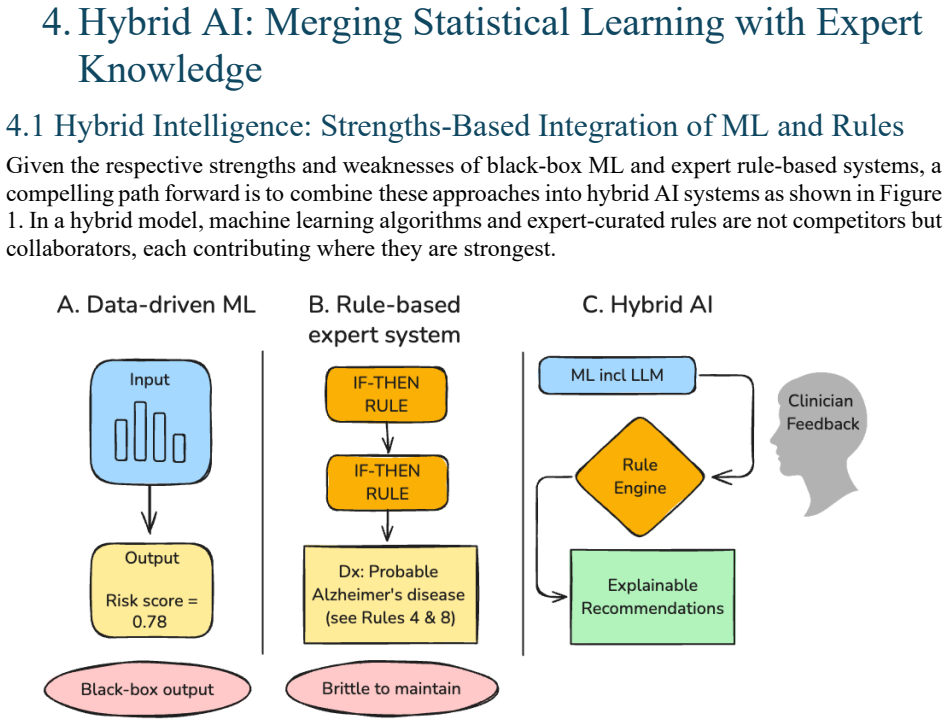
This review's central claim is that prediction-only AI has reached its practical limit in dementia care, and that the next useful step is hybrid intelligence: machine-learning models detect patterns in high-dimensional data, an expert rule layer interprets those patterns using clinical knowledge, and clinicians refine the rules through case-based feedback. The paper points to historical systems such as PEIRS, with pathologist-maintained rules for chemical pathology reports, as proof that clinician-maintained rule bases can deliver traceable, actionable output, and contrasts them with black-box models whose LIME and SHAP explanations still leave the clinician with an interpretation gap. It proposes three levels of hybrid integration, from knowledge retrieval to adaptive optimisation, and illustrates a dementia workflow in which the system returns an interpretation, a differential, and a suggested plan rather than a bare risk score. The argument is that this structure fits how clinicians reason and therefore will be trusted and adopted.
Load-bearing premise
The load-bearing premise is that lack of interpretability and actionable guidance is the primary cause of low AI adoption in dementia care, rather than regulatory, reimbursement, data-infrastructure, or workflow barriers.
Editorial extensions
If this is right
- Decision support in dementia should return an interpretation, differential diagnosis, and suggested next steps, not only a risk score or classification label.
- Clinicians need interfaces that let them inspect, correct, and extend the rule base; each correction becomes a learning case, following the PEIRS pattern.
- Evaluation of medical AI should broaden from accuracy metrics to include clinician trust, workflow fit, changes in decisions, and patient outcomes.
- LLM-generated explanations and plans should be passed through a rule layer or human review so that fluent text does not bypass factual and guideline checking.
Reading between the lines
- If the interpretability-actionability diagnosis is correct, the rate-limiting step for medical AI is knowledge maintenance, so the field should invest in tools that let clinicians edit rules and cornerstone cases as easily as they use a search engine.
- The same hybrid structure is a plausible route for other specialties with incomplete mechanistic knowledge and high liability, such as psychiatry, though the review does not test that transfer.
- A concrete extension of the paper's feedback-loop idea is an uncertainty dashboard that shows the nearest clinician-approved cornerstone case for each prediction, letting clinicians spot 'broken leg' conditions; this operationalises the review's ripple-down rules discussion but is not itself proposed.
- If benchmark-driven LLM development continues without clinician-in-the-loop constraints, the paper predicts that gains in fluency will not translate into measurable improvements at the bedside.
Signed reviews
Editorial analysis
A structured set of objections, weighed in public.
Referee Report
Summary. The paper is a narrative/scoping review arguing that pure prediction-oriented machine learning and LLM tools have not improved clinical dementia care, and that hybrid systems combining statistical learning with expert rule-based knowledge, together with clinician involvement, will restore interpretability and actionability. It draws on critiques of black-box AI, historical expert systems (PEIRS, MYCIN), and Meehl's clinical-versus-statistical prediction debate, and it proposes progressive levels of hybrid integration, a digital therapeutics workflow, and a future research agenda.
Significance. The paper offers a useful synthesis of well-known limitations of black-box AI, a clear taxonomy of hybrid integration levels (Table 1), and a plausible research agenda for clinician-in-the-loop decision support. Its strengths include the concrete framing of hybrid levels, the historical perspective from expert systems and Meehl, and the emphasis on pragmatic evaluation beyond accuracy metrics. However, as a review it provides no systematic methodology, no direct empirical evidence for hybrid systems in dementia care, and its central causal claim that interpretability is the key adoption barrier is not established. If repositioned as a perspective paper with tempered claims, it could be a valuable contribution to the clinical-AI discussion; in its current form, the conclusions outrun the evidence.
major comments (5)
- [§2.1, §3.1, §6.3 vs §3.3] The paper's central claim that lack of interpretability and actionable guidance is a key barrier to clinical adoption is asserted without comparative evidence and is undercut by the paper's own account of PEIRS. Sections 2.1 and 3.1 state that prediction-only outputs erode trust and that lack of transparency "remains a key barrier to clinical adoption," while Section 6.3 concludes that accuracy metrics alone do not translate into adoption. However, Section 3.3 concedes that PEIRS, a fully transparent, pathologist-maintained rule-based system, had "uptake... stalled" and success "limited to a few well-defined, metric-based domains" due to brittleness and maintenance burden. That concession shows interpretability and clinician involvement were not sufficient for adoption in that historical case, so the manuscript needs either comparative evidence for its causal-priority claim or a more cautious formulation.
- [Abstract vs main text] The abstract names ATHENA-CDS as a worked example alongside PEIRS ("as seen in examples like PEIRS and ATHENA-CDS"), but the full text never mentions or references ATHENA-CDS. This is a concrete gap: one of the two headline exemplars of hybrid success is unsupported by the manuscript's own text.
- [§3.3] PEIRS is a pure rule-based expert system rather than a hybrid ML-plus-rule system, so using it as evidence for the hybrid approach is an extrapolation. The paper does not provide a single deployed example of a hybrid ML-plus-rule system in dementia care; the central recommendation currently rests on hypothetical workflows (Tables 1 and 3) rather than empirical demonstrations.
- [§1 and Methods (absent)] The paper is described as a scoping review but contains no methods section, including no search strategy, databases, inclusion criteria, or PRISMA-type flow diagram. This omission makes the evidence synthesis non-reproducible and is a load-bearing issue for a review that claims to survey the literature.
- [§1 and §3.2] The paper generalizes from a single randomized trial (Goh et al., 2024) to the claim that "LLM assistants have yet to deliver measurable improvements at the bedside." That trial evaluated GPT-4 assistance on diagnostic vignettes; it is one intervention in one setting and cannot support a blanket conclusion about all LLM assistance. The manuscript should temper this generalization and explicitly acknowledge the limited evidence base.
minor comments (7)
- [§4.4] There are two tables labeled "Table 2" (Complementary Strengths in §4.1 and Role of Digital Therapeutics in §4.4); the tables should be renumbered sequentially.
- [§2.2, §6.3, Table 1] There are typographical errors: "clincians" should be "clinicians" in §2.2, "reults" should be "results" in Table 1, and §6.3 contains the duplicated phrase "changes in changes in diagnostic or care decision."
- [§3.3] MYCIN is attributed to Bruce Buchanan, but MYCIN was created by Edward Shortliffe, with Buchanan as a contributor; the attribution should be corrected.
- [§2.2] The phrase "phosphorylated tau 271 (p-tau217)" is inconsistent; p-tau217 refers to phosphorylation at threonine 217, not residue 271, so the text should be corrected.
- [§5.2] The sentence "Early studies in the lab medicine domain have already shown improvements in decision-making with interpretative reporting" appears without a citation; a supporting reference is needed.
- [§4.2 and Table 3] The example outputs in Tables 1 and 3 are hypothetical but are not explicitly labeled as such; adding "(illustrative)" would prevent readers from mistaking them for evaluated system outputs.
- [Figures 1 and 2] Figures 1 and 2 are referenced in the text but no figures or descriptive captions appear in the manuscript text; ensure the figures are included with full captions.
Circularity Check
No significant circularity: the review's recommendations rest on external evidence; the only self-citation is explicitly labeled as adapted and is illustrative, not load-bearing.
full rationale
This is a narrative/scoping review, not a derivation with fitted parameters or predictive equations. The central recommendation—that hybrid ML-plus-rule systems with clinician involvement improve interpretability and workflow fit—is argued from external sources such as Goh et al. (2024), Ghassemi et al. (2021), Petch et al. (2022), Meehl (1954, 1967), and Westen and Weinberger (2005), none of which are the authors' own results. The only self-citation is Yang et al. (2025), used as the source of Table 1's 'progressive levels of hybrid AI integration'; the table is explicitly labeled 'Adapted from Yang et al 2025' and functions as an organizing taxonomy, not as evidence for the paper's causal claims. No equation or prediction reduces to its inputs by construction, and no uniqueness theorem or fitted parameter is invoked. The paper's own Section 3.3 concedes that rule-based systems like PEIRS saw stalled uptake due to brittleness and maintenance burden, which weakens the causal argument that interpretability alone drives adoption, but this is a correctness and evidence concern, not circularity. The abstract names ATHENA-CDS as an example that the full text never describes; again, this is an internal completeness issue rather than a circular derivation. Accordingly, the circularity burden is minimal.
Assumptions & free parameters
assumptions (3)
- domain assumption Clinicians require transparent reasoning to trust AI, so rule traceability builds trust.
- ad hoc to paper Hybrid systems can overcome the brittleness and maintenance burden of earlier expert systems by adding ML and LLM components.
- domain assumption The interpretation gap, not predictive accuracy, is the main barrier to clinical adoption.
Cite this review
Pith. "Pith review of Beyond Black-Box AI: Interpretable Hybrid Systems for Dementia Care." pith.science (2026). https://pith.science/paper/HWH7KOLF
@misc{pith2026250701282,
  author       = {Pith},
  title        = {Pith review of: Beyond Black-Box AI: Interpretable Hybrid Systems for Dementia Care},
  year         = {2026},
  howpublished = {\url{https://pith.science/paper/HWH7KOLF}},
  note         = {Machine review of arXiv:2507.01282}
}
read the original abstract
The recent boom of large language models (LLMs) has re-ignited the hope that artificial intelligence (AI) systems could aid medical diagnosis. Yet despite dazzling benchmark scores, LLM assistants have yet to deliver measurable improvements at the bedside. This scoping review aims to highlight the areas where AI is limited to make practical contributions in the clinical setting, specifically in dementia diagnosis and care. Standalone machine-learning models excel at pattern recognition but seldom provide actionable, interpretable guidance, eroding clinician trust. Adjacent use of LLMs by physicians did not result in better diagnostic accuracy or speed. Key limitations trace to the data-driven paradigm: black-box outputs which lack transparency, vulnerability to hallucinations, and weak causal reasoning. Hybrid approaches that combine statistical learning with expert rule-based knowledge, and involve clinicians throughout the process help bring back interpretability. They also fit better with existing clinical workflows, as seen in examples like PEIRS and ATHENA-CDS. Future decision-support should prioritise explanatory coherence by linking predictions to clinically meaningful causes. This can be done through neuro-symbolic or hybrid AI that combines the language ability of LLMs with human causal expertise. AI researchers have addressed this direction, with explainable AI and neuro-symbolic AI being the next logical steps in further advancement in AI. However, they are still based on data-driven knowledge integration instead of human-in-the-loop approaches. Future research should measure success not only by accuracy but by improvements in clinician understanding, workflow fit, and patient outcomes. A better understanding of what helps improve human-computer interactions is greatly needed for AI systems to become part of clinical practice.
Figures

Reference graph
Works this paper leans on
-
[1]
Abubakar, M. B., Sanusi, K. O., Ugusman, A., Mohamed, W., Kamal, H., Ibrahim, N. H., Khoo, C. S., & Kumar, J. (2022). Alzheimer’s Disease: An Update and Insights Into Pathophysiology. Frontiers in Aging Neuroscience, 14, 742408. https://doi.org/10.3389/fnagi.2022.742408 Akras, Z., Jing, J., Westover, M. B., & Zafar, S. F. (2025). Using artificial intellig...
-
[80]
https://doi.org/10.1038/s41746-024-01080-1 Meehl, P. E. (1954). Clinical versus statistical prediction. University of Minnesota Press. Meehl, P. E. (1967). What Can the Clinician Do Well? In Problems in human assessment (pp. 594–599). McGraw-Hill. Nguyen, H.-D., Clément, M., Planche, V., Mansencal, B., & Coupé, P. (2023). Deep grading for MRI-based differ...
-
[2019]
https://doi.org/10.1016/S2215-0366(21)00395-3 Ghassemi, M., Oakden-Rayner, L., & Beam, A
The Lancet Psychiatry, 9(2), 137–150. https://doi.org/10.1016/S2215-0366(21)00395-3 Ghassemi, M., Oakden-Rayner, L., & Beam, A. L. (2021). The false hope of current approaches to explainable artificial intelligence in health care. The Lancet Digital Health, 3(11), e745–e750. https://doi.org/10.1016/S2589-7500(21)00208-9 Goh, E., Gallo, R., Hom, J., Strong...
arXiv 2021
Reviewed August 6, 2026 · model on record in the stance chip above.
Discussion (0). Continue with ORCID to comment.