REVIEW 4 major objections 5 minor 19 references
Learning to Detect Collisions for Continuum Manipulators without a Prior Model
T0 review · 4 major / 5 minor · reviewed 2026-08-14 · deepseek-v4-flash
Pith's one-line read Collision detection for a continuum manipulator can be learned from fiber-optic strain readings alone, with no model of the arm or its surroundings.
desk verdict A genuinely new use of FBG data for model-free CM collision detection, but the camera-derived labels and missing quantitative metrics leave the central claim under-supported. read the letter →
The pith
A machine-rendered reading of the paper's core claim, the machinery that carries it, and where it could break.
The reading
What carries the argument
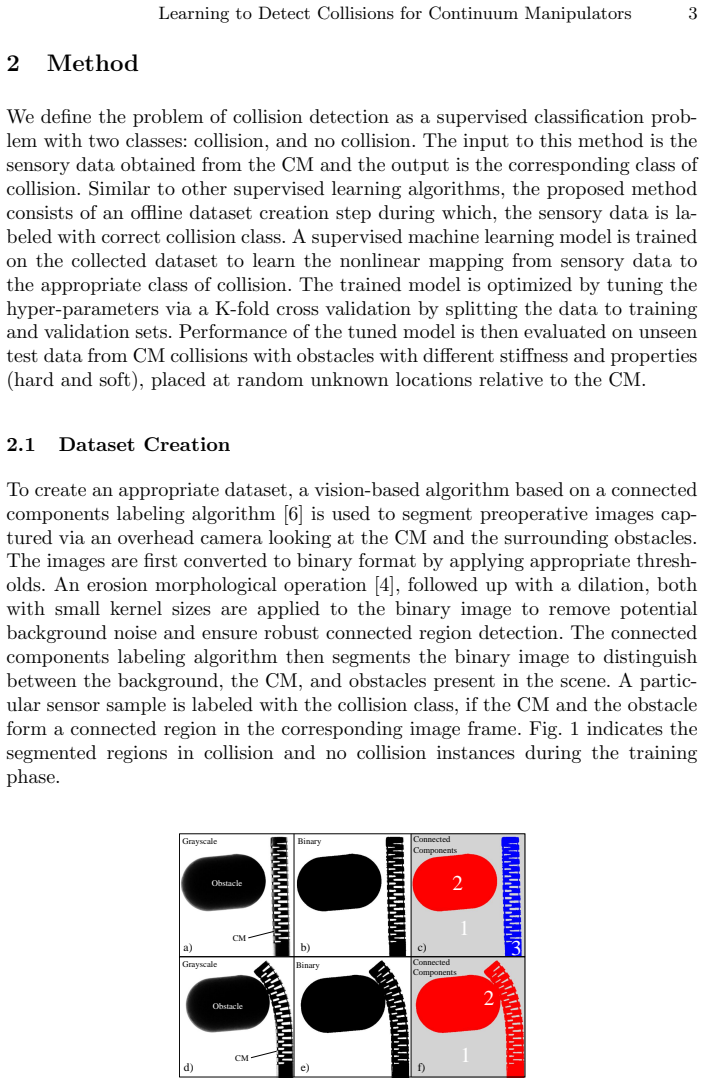
The load-bearing mechanism is the learned map from nine fiber-Bragg-grating strain measurements to collision probability, implemented as a gradient-boosting classifier with depth-3 decision trees, 500 boosting iterations, shrinkage (learning rate below 1), and subsampling. The classifier is the component that replaces explicit kinematics and geometry: no constant-curvature assumption, no object mesh, and no environment model enters the intraoperative loop. The other essential piece is the labeling pipeline that makes supervised training possible—connected-components segmentation of overhead camera images, where contact is defined as the CM and obstacle forming one connected region. Together these turn an existing shape-sensing fiber into a contact sensor.
What would settle it
Replay the same trajectories while an instrumented obstacle or force sensor records true contact; then check whether the classifier's collision probability tracks that independent ground truth. If it reports collision on trajectories where the manipulator only passes in front of or behind an obstacle without touching, the image-based labeling assumption is the source of the error.
Extended reading notes
Core claim
The paper's central claim is that collision detection for a continuum manipulator is not a modeling problem but a classification problem. Using a non-constant-curvature, cable-driven CM whose shape is sensed by three fiber-Bragg-grating fibers (nine strain readings per frame), the authors train a gradient-boosted decision-tree ensemble to map raw FBG observations to a binary collision/no-collision label. Training labels come from an overhead camera: a connected-components segmentation treats the CM and an obstacle as a single merged region whenever they visually touch. The trained detector is then tested intraoperatively on obstacles never seen in training—a hand, soft gelatin, sponge foam, and hard ABS plastic—placed at locations different from the training set, and the classifier outputs a collision probability that tracks the camera-derived ground truth. The claim is that this sensor-only, model-free pipeline generalizes to obstacles of unknown stiffness and location and can drive real-time audio feedback to a surgeon.
Load-bearing premise
The training labels assume that a two-dimensional overhead image in which the manipulator and obstacle merge into one connected region is proof of physical contact, and that the 30 Hz camera frames align with the 100 Hz sensor readings.
Editorial extensions
If this is right
- Because only existing FBG readings are needed, the method can augment a shape-sensing fiber into a collision detector with no hardware change.
- The classifier output can be sonified, giving the surgeon a contact warning that does not rely on visual attention.
- The algorithm depends only on the raw sensor stream, so other sensors such as electromagnetic trackers could replace FBG without altering the learning framework.
- Although the test platform bends in a plane, the three-fiber FBG arrangement senses 3D motion, so the approach could transfer to 3D manipulators.
- The detector generalized from one training obstacle shape at five locations to unseen hard and soft obstacles at new locations, indicating the learned signal is contact-induced strain rather than obstacle identity.
Reading between the lines
- A controlled comparison against force-sensor contact ground truth would separate genuine detection skill from artifacts of the image-labeling procedure; this is not reported in the paper.
- The 30 Hz camera / 100 Hz FBG rate mismatch means each label is applied to roughly three sensor frames, so temporal alignment or smoothing could change the apparent accuracy.
- The same classification approach could plausibly transfer to catheters, needles, or guidewires carrying strain or shape sensors, but those devices are not evaluated here.
- Training on one physical CM and testing on another would reveal whether the learned mapping is device-specific or a general contact signature in strain space.
Signed reviews
Editorial analysis
A structured set of objections, weighed in public.
Referee Report
Summary. The paper proposes a data-driven collision detection method for continuum manipulators (CMs) using only Fiber Bragg Grating (FBG) strain data, without a kinematic model or prior knowledge of obstacle geometry, stiffness, or location. Training labels are generated offline by an overhead-camera connected-components algorithm that marks a collision whenever the CM and an obstacle form a single segmented region. A gradient boosting classifier maps 9-channel FBG data to a collision probability, which is then sonified in real time. The authors tune hyperparameters via 4-fold cross-validation on an offline dataset and report qualitative real-time collision detection trials with hand, gelatin, and foam obstacles at previously unseen locations.
Significance. If the qualitative results are backed by rigorous evaluation, the contribution is practically useful: it enables collision feedback using sensors already present for shape sensing, avoids model-based geometric assumptions, and offers a simple pipeline that could transfer to other flexible instruments. The sonification interface is a sensible addition for intraoperative use. However, the paper's significance is currently limited by the absence of quantitative test-set metrics, the lack of comparison with even simple baselines, and the reliance on a camera-based labeling scheme that is treated as ground truth without validation. The core idea is sound but the evidence as presented is incomplete.
major comments (4)
- [Section 4, Fig. 4] The central claim of successful detection on unseen obstacles is supported only by qualitative probability-versus-ground-truth curves for hand, gelatin, and foam. No held-out test metrics—accuracy, precision, recall, F1, or confusion matrices—are reported for these unseen trials. Table 1 reports cross-validation accuracy on the offline dataset collected with the same 3D-printed oval at five locations, which does not directly quantify performance on the new obstacle types and locations shown in Fig. 4. Please add per-material quantitative evaluation on the unseen test trials, including detection latency if possible.
- [Section 2.1 and Fig. 4] The ground-truth labels from the overhead camera connected-components algorithm equate 2D visual connectivity with physical contact. This can mislabel near-contact or out-of-plane proximity and can fail when the CM occludes the obstacle. The 30 Hz camera versus 100 Hz FBG synchronization mismatch further introduces labeling noise. Because this same camera-based method is used both to train the classifier and to produce the 'ground truth' curves in Fig. 4, the evaluation is not independent of the labeling assumptions. If the labels are wrong, the classifier learns the wrong mapping and the comparison in Fig. 4 is not authoritative. Please validate the labeling against an independent ground-truth source (e.g., force/torque sensing, manual frame-by-frame annotation, or calibrated geometric overlap) and quantify labeling uncertainty, or at minimum analyze the visible dips in the ground-truth curves that occur while the classifier score spikes.
- [Section 3.1 and Section 4] The paper does not compare the proposed method against any baseline, such as a simple FBG strain threshold, a kinematics-model-based detector, or a non-learning classifier. Without such a comparison, it is difficult to assess whether the gradient boosting model adds value beyond simpler alternatives. Please include at least one model-free or model-based baseline on the same unseen test trials, or clearly justify why such a comparison is infeasible.
- [Section 2.2 and Section 3.1] Because the 9 FBG channels also encode curvature and cable-tension state during actuation, and because the experimental trials follow a collision-inducing actuation protocol, it is not demonstrated that the classifier detects collisions rather than learning a trajectory-dependent pattern that correlates with the experimental protocol. A control experiment with identical actuation trajectories but no obstacle in the workspace would help rule out this confounding variable. Please include such a control or otherwise analyze whether the model's predictions are driven by collision-specific signal changes rather than actuation state.
minor comments (5)
- [Section 2.2] The sentence 'The classifier scores can be used as probability of predicting collection' contains a typo: 'collection' should be 'collision'.
- [Section 2.1] Please specify how the 30 Hz camera frames and 100 Hz FBG samples were synchronized during dataset creation; the current description does not state whether interpolation, time-stamping, or frame matching was used.
- [Section 4, Table 1] The caption 'T able 1' has an erroneous space; also, the table lists only mean accuracy and standard deviation, and it would be helpful to report the number of samples per fold and class balance.
- [Section 3.1] The phrase 'a random-sized oval-shaped obstacle was 3D-printed' is ambiguous about whether the size or only the placement was randomized; please clarify the offline dataset generation procedure.
- [Fig. 4] The vertical axes of the plots in Fig. 4 are not labeled clearly; specify what the red and blue traces represent (binary ground truth vs. continuous probability), and include axis scales and units.
Circularity Check
No material circularity: the collision detector is a supervised learner mapping FBG data to camera-defined labels; the prediction is not equivalent to its inputs by construction, and self-citations only describe the FBG hardware platform.
full rationale
The paper's central derivation is an empirical pipeline, not an equation chain. Inputs are 9 FBG channels; targets are collision labels defined by an overhead camera connected-components algorithm. During training the model fits this mapping; during intraoperative testing it receives only FBG data, so output probabilities are not recomputed from the camera labels or from any fitted parameter renamed as a prediction. The test set uses obstacles and locations not in the offline dataset, so the reported success is not statistically forced by the training fit. The use of the camera for both training labels and the Fig. 4 'ground truth' comparison is a label-validity limitation (projection artifacts, 30 Hz vs 100 Hz sync, no quantitative metrics), not circularity: the same external sensor modality independently defines the target and the evaluation criterion. The self-citations (refs 13-17) describe the FBG shape sensor and prior CM hardware; they do not supply the collision-detection algorithm, a uniqueness theorem, or an ansatz. No equation is defined in terms of another, and no known result is renamed. Accordingly the circularity score is 1, reflecting only the presence of minor, non-load-bearing self-citations in the experimental setup.
Assumptions & free parameters
free parameters (6)
- learning_rate =
0.2 to 0.6 range
- n_estimators =
500
- max_depth =
3
- subsample =
1.0 or 0.2
- max_features =
all or log2
- image segmentation thresholds =
not specified
assumptions (3)
- domain assumption The overhead camera connected-component labels accurately indicate physical contact between the CM and obstacles.
- domain assumption The 9 FBG wavelength readings at a single time step contain sufficient information to discriminate collision from non-collision across obstacle stiffness and location.
- domain assumption Training on a single ABS oval placed at five locations generalizes to unseen objects and locations.
Cite this review
Pith. "Pith review of Learning to Detect Collisions for Continuum Manipulators without a Prior Model." pith.science (2026). https://pith.science/paper/HWUZLCXA
@misc{pith2026190804354,
  author       = {Pith},
  title        = {Pith review of: Learning to Detect Collisions for Continuum Manipulators without a Prior Model},
  year         = {2026},
  howpublished = {\url{https://pith.science/paper/HWUZLCXA}},
  note         = {Machine review of arXiv:1908.04354}
}
read the original abstract
Due to their flexibility, dexterity, and compact size, Continuum Manipulators (CMs) can enhance minimally invasive interventions. In these procedures, the CM may be operated in proximity of sensitive organs; therefore, requiring accurate and appropriate feedback when colliding with their surroundings. Conventional CM collision detection algorithms rely on a combination of exact CM constrained kinematics model, geometrical assumptions such as constant curvature behavior, a priori knowledge of the environmental constraint geometry, and/or additional sensors to scan the environment or sense contacts. In this paper, we propose a data-driven machine learning approach using only the available sensory information, without requiring any prior geometrical assumptions, model of the CM or the surrounding environment. The proposed algorithm is implemented and evaluated on a non-constant curvature CM, equipped with Fiber Bragg Grating (FBG) optical sensors for shape sensing purposes. Results demonstrate successful detection of collisions in constrained environments with soft and hard obstacles with unknown stiffness and location.
Figures


Figures from the paper (1 more)

Reference graph
Works this paper leans on
-
[1]
In: 2010 IEEE International Confer- ence on Robotics and Automation
Bajo, A., Simaan, N.: Finding lost wrenches: Using continuum robots for contact detection and estimation of contact location. In: 2010 IEEE International Confer- ence on Robotics and Automation. pp. 3666–3673. IEEE (2010)
work page 2010
-
[2]
IEEE Transactions on Robotics 28(2), 291–302 (2012) 8 S
Bajo, A., Simaan, N.: Kinematics-based detection and localization of contacts along multisegment continuum robots. IEEE Transactions on Robotics 28(2), 291–302 (2012) 8 S. Sefati et al. a) b) c) Hand Gelatin Foam Fig. 4. Real-time collision detection on unseen data (unknown obstacle stiffness and location). CM collides with a) hand b) soft gelatin phantom,...
work page 2012
-
[3]
IEEE Transactions on Robotics 31(6), 1261–1280 (2015)
Burgner-Kahrs, J., Rucker, D.C., Choset, H.: Continuum robots for medical appli- cations: A survey. IEEE Transactions on Robotics 31(6), 1261–1280 (2015)
work page 2015
-
[4]
Journal of electronic imaging 8(3), 279–290 (1999)
Comer, M.L., Delp, E.J.: Morphological operations for color image processing. Journal of electronic imaging 8(3), 279–290 (1999)
work page 1999
-
[5]
Friedman, J.H.: Greedy function approximation: A gradient boosting machine. Annals of statistics pp. 1189–1232 (2001)
work page 2001
-
[6]
Pattern Recognition 42(9), 1977–1987 (2009)
He, L., Chao, Y., Suzuki, K., Wu, K.: Fast connected-component labeling. Pattern Recognition 42(9), 1977–1987 (2009)
work page 2009
-
[7]
In: Bildverarbeitung f¨ ur die Medizin 2019, pp
J¨ ackle, S., Strehlow, J., Heldmann, S.: Shape sensing with fiber bragg grating sensors. In: Bildverarbeitung f¨ ur die Medizin 2019, pp. 258–263. Springer (2019)
work page 2019
-
[8]
Khan, F., Denasi, A., Barrera, D., Madrigal, J., Sales, S., Misra, S.: Multi-core optical fibers with bragg gratings as shape sensor for flexible medical instruments. IEEE Sensors Journal (2019)
work page 2019
Show all 19 references
-
[9]
In: 2018 IEEE International Conference on Robotics and Automation (ICRA)
Lai, W., Cao, L., Xu, Z., Phan, P.T., Shum, P., Phee, S.J.: Distal end force sensing with optical fiber bragg gratings for tendon-sheath mechanisms in flexible endo- scopic robots. In: 2018 IEEE International Conference on Robotics and Automation (ICRA). pp. 1–5. IEEE (2018)
2018
-
[10]
In: 2012 IEEE International Conference on Robotics and Automation
Li, J., Xiao, J.: Exact and efficient collision detection for a multi-section continuum manipulator. In: 2012 IEEE International Conference on Robotics and Automation. pp. 4340–4346. IEEE (2012)
2012
-
[11]
Journal of Machine Learning Research 12, 2825–2830 (2011)
Pedregosa, F., Varoquaux, G., Gramfort, A., Michel, V., Thirion, B., Grisel, O., Blondel, M., Prettenhofer, P., Weiss, R., Dubourg, V., Vanderplas, J., Passos, A., Cournapeau, D., Brucher, M., Perrot, M., Duchesnay, E.: Scikit-learn: Machine learning in Python. Journal of Mach...
2011
-
[12]
IEEE Robotics and Automation Letters (2019)
Rahman, N., Deaton, N.J., Sheng, J., Cheng, S.S., Desai, J.P.: Modular fbg bending sensor for continuum neurosurgical robot. IEEE Robotics and Automation Letters (2019)
2019
-
[13]
In: 2016 IEEE SENSORS
Sefati, S., Alambeigi, F., Iordachita, I., Armand, M., Murphy, R.J.: Fbg-based large deflection shape sensing of a continuum manipulator: Manufacturing optimization. In: 2016 IEEE SENSORS. pp. 1–3. IEEE (2016) Learning to Detect Collisions for Continuum Manipulators 9
2016
-
[14]
In: 2018 International Symposium on Medical Robotics (ISMR)
Sefati, S., Alambeigi, F., Iordachita, I., Taylor, R.H., Armand, M.: On the effect of vibration on shape sensing of continuum manipulators using fiber bragg gratings. In: 2018 International Symposium on Medical Robotics (ISMR). pp. 1–6. IEEE (2018)
2018
-
[15]
data-driven approaches
Sefati, S., Hegeman, R., Alambeigi, F., Iordachita, I., Armand, M.: Fbg-based po- sition estimation of highly deformable continuum manipulators: Model-dependent vs. data-driven approaches. In: 2019 International Symposium on Medical Robotics (ISMR). pp. 1–6. IEEE (2019)
2019
-
[16]
In: 2018 IEEE/RSJ International Conference on Intelligent Robots and Systems (IROS)
Sefati, S., Murphy, R.J., Alambeigi, F., Pozin, M., Iordachita, I., Taylor, R.H., Armand, M.: Fbg-based control of a continuum manipulator interacting with ob- stacles. In: 2018 IEEE/RSJ International Conference on Intelligent Robots and Systems (IROS). pp. 6477–6483. IEEE (2018)
2018
-
[17]
In: 2017 IEEE SENSORS
Sefati, S., Pozin, M., Alambeigi, F., Iordachita, I., Taylor, R.H., Armand, M.: A highly sensitive fiber bragg grating shape sensor for continuum manipulators with large deflections. In: 2017 IEEE SENSORS. pp. 1–3. IEEE (2017)
2017
-
[18]
IEEE Transactions on Biomedical Engineering 64(8), 1665–1678 (2017)
Shi, C., Luo, X., Qi, P., Li, T., Song, S., Najdovski, Z., Fukuda, T., Ren, H.: Shape sensing techniques for continuum robots in minimally invasive surgery: A survey. IEEE Transactions on Biomedical Engineering 64(8), 1665–1678 (2017)
2017
-
[19]
IEEE Robotics and Automation Letters 1(2), 1052–1059 (2016)
Xu, R., Yurkewich, A., Patel, R.V.: Curvature, torsion, and force sensing in contin- uum robots using helically wrapped fbg sensors. IEEE Robotics and Automation Letters 1(2), 1052–1059 (2016)
2016
Reviewed August 14, 2026 · model on record in the stance chip above.
Discussion (0). Continue with ORCID to comment.