REVIEW 3 major objections 6 minor 72 references
A Robust Federated Learning Framework for Undependable Devices at Scale
T0 review · 3 major / 6 minor · reviewed 2026-08-10 · deepseek-v4-flash
Pith's one-line read FLUDE keeps federated learning accurate and fast when many devices drop out mid-training.
desk verdict Useful systems paper with a plausible design and real hardware, but the headline numbers are single draws from a stochastic process and need repeated trials before the ordering over baselines is settled. read the letter →
The pith
A machine-rendered reading of the paper's core claim, the machinery that carries it, and where it could break.
The reading
What carries the argument
The load-bearing object is a per-device dependability score $R(i)$, estimated as the expected value of a Beta distribution $\mathrm{Beta}(\alpha, \beta)$ updated by Bayesian counting of completed versus interrupted training attempts. This score feeds a selection priority $P(i) = R(i) \times (Q/q_i)^{\mathbb{1}(Q < q_i)} \times \sigma$, which applies a participation-frequency penalty, and a multi-armed-bandit exploration term keeps unobserved devices in the running. A local model cache preserves the latest training state so interrupted devices resume from a checkpoint, and a staleness-aware distributor uses an adaptive threshold $W_{\text{new}}$ to decide which cached models are too stale and must be refreshed with the global model. Round termination uses the sum over selected devices of predicted dependability, $|S| \times R$, as the expected number of uploads, so the server stops waiting when the likely useful work is done.
What would settle it
Run FLUDE in a scenario where undependability is caused by a shared external event, such as a regional network outage that knocks out many devices at once, and compare its time-to-accuracy and final accuracy against a random-selection baseline; if the predicted number of completed uploads $|S| \times R$ systematically overshoots actual arrivals and FLUDE's advantage over Oort disappears, the robustness claim fails.
Extended reading notes
Core claim
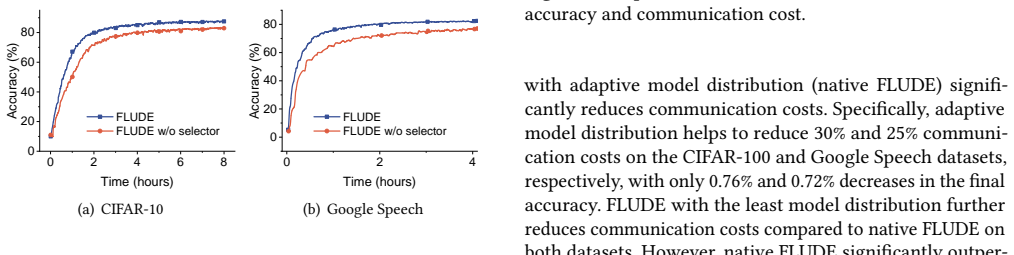
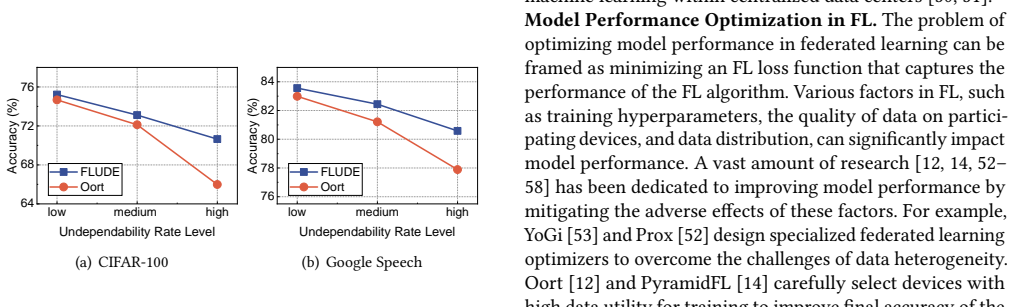
The paper's central claim is that device undependability should be treated as a measurable, learnable property rather than a reason to exclude devices. FLUDE estimates each device's dependability as the expected value of a Beta distribution over success and failure counts, re-prioritizes devices so that high-dependability devices are preferred yet no device participates too often, explores unfamiliar devices with a bandit-style fraction of selections, caches local training state so an interrupted device resumes instead of restarting, and adaptively chooses which rejoining devices must download the latest global model based on a moving staleness threshold. The paper reports that this combination, implemented on 120 physical devices across image classification, speech recognition, and click-through-rate prediction, beats four synchronous and asynchronous FL baselines in final accuracy, wall-clock time to target accuracy, and communication cost.
Load-bearing premise
The framework assumes each device has a fixed probability of finishing a round and that this probability can be learned from past successes and failures; if failures are correlated across devices or shift unexpectedly over time, the dependability estimates, the predicted upload count, and the round-termination rule can all be wrong.
Editorial extensions
If this is right
- FL systems can keep training in environments where roughly 30-40% of devices are undependable without excluding them, recovering accuracy lost to dropped updates.
- Wall-clock time to a target accuracy falls by 1.2x-3.2x, so fixed training budgets in hours buy more accuracy.
- Communication cost to reach a target accuracy falls by roughly a quarter to two-fifths, mainly because cached checkpoints remove repeated global-model downloads.
- Balancing participation frequency reduces bias toward frequently available devices, so the global model generalizes better across classes and devices with little participation.
- The same caching mechanism also reduces wasted computation from restarting local training from scratch after interruptions.
Reading between the lines
- The dependability score could double as a fairness or incentive signal: devices that prove reliable earn more selection, while operators could compensate less-dependable devices differently, something the paper does not discuss.
- The staleness-threshold adjuster could transfer to asynchronous FL protocols that currently use fixed staleness cutoffs; this paper only tests it in its own synchronous-with-deadline scheme.
- Because the evaluation generates failures from fixed per-device probabilities matching the estimator's generative model, the reported gains may shrink under correlated failures such as regional outages; a test with such correlations would be the natural next experiment.
- The Beta prior's initial parameters are a free input, and the paper suggests setting them from manufacturer statistics, so a practitioner could tune them from fleet data, making part of the benefit depend on prior quality.
Editorial analysis
A structured set of objections, weighed in public.
Referee Report
Summary. The paper proposes FLUDE, a federated learning framework designed for environments in which devices are undependable, i.e., they may drop out during local training or be offline at round start. The framework has three main mechanisms: (1) an adaptive device selector that estimates each device's dependability with a Beta-Bernoulli Bayesian model, balances participation frequency with a penalty term, and uses epsilon-greedy exploration; (2) a local model caching mechanism that preserves training progress on devices that fail mid-round; and (3) a staleness-aware model distribution strategy that decides whether a selected device receives the latest global model or resumes from its cached model. The authors implement FLUDE on 40 OPPO smartphones and 80 NVIDIA Jetson devices and evaluate it on CIFAR-10, CIFAR-100, Google Speech, and Avazu against Oort, AsyncFedED, SAFA, and FedSEA, reporting 2.28%–7.43% higher final accuracy, 1.2x–3.2x time-to-accuracy improvements, and 23.71%–40.71% communication-cost reductions. The paper also includes ablation studies of the selector and the model distributor, and robustness experiments varying offline and undependability rates.
Significance. If the reported results hold, FLUDE would be a practically valuable system for federated learning on unreliable mobile and edge fleets. The physical testbed with 120 heterogeneous devices, the four diverse tasks, and the component-wise ablations are genuine strengths: they test the framework under realistic bandwidth dynamics and device heterogeneity rather than in a pure simulator. The component ablations in Section 5.4 give some confidence that each mechanism contributes, and the robustness analysis in Section 5.5 directly targets the paper's core claim. However, the central quantitative claims are currently supported by single runs of a highly stochastic process, and the evaluation's failure model coincides with the estimator's generative assumption. These issues are load-bearing because the paper's headline contribution is precisely a quantitative improvement in accuracy, speed, and communication cost under stochastic undependability.
major comments (3)
- [Section 5.2, Table 1, Figure 4] The headline quantitative claims rest on a single run of a stochastic process. In the setup of Section 5.2, each device's undependability is randomly realized each round, online/offline states flip every 10 minutes, WiFi bandwidth fluctuates between 1 and 30 Mb/s, Algorithm 1 uses randomized epsilon-greedy exploration, and Algorithm 2 terminates rounds at a random number of received uploads. Yet no seeds, confidence intervals, or repeated runs are reported for any table or figure. Several margins are small: FLUDE exceeds FedSEA by only 0.30 percentage points on Google Speech and by 1.29 percentage points over Oort on CIFAR-100 in Table 1. If run-to-run variance is comparable to these margins, the claimed ordering of methods is not statistically established. This is load-bearing because the abstract and introduction claim specific quantitative improvements. Please report multiple independent runs per configuration with means and variances (or a similar statistical summary), and where the claim is an ordering, include a significance test or state why the process variance is negligible.
- [Section 5.2 vs. Section 4.1, Eq. (1)] The evaluation generates device failures from a model that matches the estimator's assumptions. In Section 5.2, each device is assigned a fixed undependability rate drawn from a normal distribution, and each round the device fails with that fixed probability. This is exactly the fixed-probability Beta-Bernoulli generative model assumed by the dependability estimator in Section 4.1, Eq. (1). The estimator is therefore tested on its own model class. The robustness claim in Section 5.5 would be considerably stronger if the failure process were made non-stationary (e.g., dependability rates drifting over time) or correlated across devices (e.g., regional network outages), and if the sensitivity of Algorithm 2's round termination rule, which uses predicted uploads based on the estimated dependability, were measured under such mismatch.
- [Section 5.2, Eq. (4), Algorithm 1] Several key hyperparameters that directly control the core mechanisms are hand-set, and no sensitivity analysis is reported. These include the participation-frequency penalty sigma=0.5, the staleness-adjustment coefficients lambda=1 and mu=0.5 in Eq. (4), the exploration-factor schedule, and the Beta(2,2) prior. The device selector and the staleness-aware distributor depend on these values, so it is currently unknown whether the reported gains are robust to reasonable parameter changes. Please add a sensitivity study over these parameters, or provide a theoretical argument that the framework's performance is insensitive to their values.
minor comments (6)
- [Section 5.3, Tables 1 and 2] FLUDE's own CIFAR-10 time-to-accuracy is 2.68 hours in Table 1 but 2.39 hours in Table 2 for the same final accuracy of 87.52%; please reconcile the numbers or state whether the stopping criterion differs between the two tables.
- [Section 5.3 vs. Abstract/Introduction] The text in Section 5.3 reports that FLUDE reduces communication cost by 23.71%–49.7%, while the abstract and the introduction state 23.71%–40.71%; these ranges need to be reconciled.
- [Section 5.5 vs. Section 5.2] The robustness study in Section 5.5 uses a normal distribution with variance 0.05, whereas Section 5.2 sets the variance to 0.04; please clarify whether this difference is intentional.
- [Section 4.1, Eq. (1)] In Eq. (1), s and f are described as the number of successes and failures, but it is not stated whether they are counts since the previous update or cumulative counts; if cumulative, repeated updates would double-count observations, so please state explicitly that they are the counts since the last update.
- [Section 4.3, Eq. (4)] The staleness-threshold update in Eq. (4) divides by H_old and N_old, but no handling is specified for initial rounds in which H_old or N_old is zero; please add a boundary condition.
- [Algorithm 2, Lines 6-11] The while loop for budget adjustment has no explicit termination guarantee if the predicted cost B_pred does not fall below B_max after an iteration; please add a bound on the number of iterations or a fallback when the budget cannot be met.
Circularity Check
No significant circularity: the reported improvements are measured against external baselines, and FLUDE's dependability estimator is not fitted to the target metrics.
full rationale
The paper's central claims—final accuracy, time-to-accuracy, and communication cost—are obtained by comparing FLUDE against four external baselines (Oort, AsyncFedED, SAFA, FedSEA) on the same datasets and under the same simulated undependable environment; no parameter is fitted to the reported target accuracies or to the baseline results. The dependability estimator in Eq. (1) is a standard Beta-Bernoulli Bayesian update for a device's probability of completing local training, and the selection priority in Eq. (2) and round-termination rule in Algorithm 2 use this estimate internally, but those internal quantities are not the evaluation metrics themselves. The simulation in Section 5.2 draws per-device undependability rates from a normal distribution and realizes failures as Bernoulli events; this is consistent with the estimator's likelihood, which is a reasonable test-design choice rather than a circular reduction, because all methods are evaluated under the same stochastic process and the accuracy gains are measured on held-out test data. The only overlapping-author citation, [17], is used as an example of prior FL work and is not load-bearing for any claimed result. No self-definitional relationship, fitted-input-as-prediction step, or imported uniqueness theorem can be exhibited, so there is no significant circularity.
Assumptions & free parameters
free parameters (5)
- sigma (participation frequency penalty) =
0.5
- lambda (staleness adjustment coefficient) =
1.0
- mu (communication cost adjustment coefficient) =
0.5
- exploration factor schedule =
initial 0.9, decay 0.98, floor 0.2
- Beta prior hyperparameters =
alpha=2, beta=2
assumptions (4)
- domain assumption Device dependability R(i) follows a Beta distribution and is updated by Bayesian counting of training successes and failures.
- domain assumption Training outcomes are independent Bernoulli events with a per-device success probability equal to R(i).
- domain assumption Continuing local training from a cached checkpoint is as valid as training from the latest global model as long as staleness is below the adaptive threshold.
- standard math Bayesian theorem and Beta-Bernoulli conjugacy are standard mathematics.
Cite this review
Pith. "Pith review of A Robust Federated Learning Framework for Undependable Devices at Scale." pith.science (2026). https://pith.science/paper/HX2MVHYZ
@misc{pith2026241219991,
  author       = {Pith},
  title        = {Pith review of: A Robust Federated Learning Framework for Undependable Devices at Scale},
  year         = {2026},
  howpublished = {\url{https://pith.science/paper/HX2MVHYZ}},
  note         = {Machine review of arXiv:2412.19991}
}
read the original abstract
In a federated learning (FL) system, many devices, such as smartphones, are often undependable (e.g., frequently disconnected from WiFi) during training. Existing FL frameworks always assume a dependable environment and exclude undependable devices from training, leading to poor model performance and resource wastage. In this paper, we propose FLUDE to effectively deal with undependable environments. First, FLUDE assesses the dependability of devices based on the probability distribution of their historical behaviors (e.g., the likelihood of successfully completing training). Based on this assessment, FLUDE adaptively selects devices with high dependability for training. To mitigate resource wastage during the training phase, FLUDE maintains a model cache on each device, aiming to preserve the latest training state for later use in case local training on an undependable device is interrupted. Moreover, FLUDE proposes a staleness-aware strategy to judiciously distribute the global model to a subset of devices, thus significantly reducing resource wastage while maintaining model performance. We have implemented FLUDE on two physical platforms with 120 smartphones and NVIDIA Jetson devices. Extensive experimental results demonstrate that FLUDE can effectively improve model performance and resource efficiency of FL training in undependable environments.
Figures


Figures from the paper (6 more)



Reference graph
Works this paper leans on
-
[1]
Deep learning
Yann LeCun, Yoshua Bengio, and Geoffrey Hinton. Deep learning. nature, 521(7553):436–444, 2015
2015
-
[2]
Natu- ral language processing: state of the art, current trends and challenges
Diksha Khurana, Aditya Koli, Kiran Khatter, and Sukhdev Singh. Natu- ral language processing: state of the art, current trends and challenges. Multimedia tools and applications , 82(3):3713–3744, 2023
work page 2023
-
[3]
Dif- ferentially private image classification by learning priors from random processes
Xinyu Tang, Ashwinee Panda, Vikash Sehwag, and Prateek Mittal. Dif- ferentially private image classification by learning priors from random processes. In A. Oh, T. Naumann, A. Globerson, K. Saenko, M. Hardt, and S. Levine, editors, Advances in Neural Information Processing Sys- tems, volume 36, pages 35855–35877. Curran Associates, Inc., 2023
work page 2023
-
[4]
Federated learning for generalization, robustness, fairness: A survey and benchmark
Wenke Huang, Mang Ye, Zekun Shi, Guancheng Wan, He Li, Bo Du, and Qiang Yang. Federated learning for generalization, robustness, fairness: A survey and benchmark. IEEE Transactions on Pattern Analysis and Machine Intelligence, 2024
work page 2024
-
[5]
Vertical federated learning: Concepts, advances, and challenges
Yang Liu, Yan Kang, Tianyuan Zou, Yanhong Pu, Yuanqin He, Xiaozhou Ye, Ye Ouyang, Ya-Qin Zhang, and Qiang Yang. Vertical federated learning: Concepts, advances, and challenges. IEEE Transactions on Knowledge and Data Engineering , 2024
work page 2024
-
[6]
Billion-scale federated learning on mobile clients: A submodel design with tunable privacy
Chaoyue Niu, Fan Wu, Shaojie Tang, Lifeng Hua, Rongfei Jia, Chengfei Lv, Zhihua Wu, and Guihai Chen. Billion-scale federated learning on mobile clients: A submodel design with tunable privacy. InProceedings of the 26th Annual International Conference on Mobile Computing and Networking, pages 1–14, 2020
work page 2020
-
[7]
Applications of federated learning in smart cities: recent advances, taxonomy, and open challenges
Zhaohua Zheng, Yize Zhou, Yilong Sun, Zhang Wang, Boyi Liu, and Keqiu Li. Applications of federated learning in smart cities: recent advances, taxonomy, and open challenges. Connection Science, 34(1):1– 28, 2022
work page 2022
-
[8]
Federated learning for smart healthcare: A survey
Dinh C Nguyen, Quoc-Viet Pham, Pubudu N Pathirana, Ming Ding, Aruna Seneviratne, Zihuai Lin, Octavia Dobre, and Won-Joo Hwang. Federated learning for smart healthcare: A survey. ACM Computing Surveys (Csur), 55(3):1–37, 2022
2022
Show all 72 references
-
[9]
Towards federated learning at scale: System design
Keith Bonawitz, Hubert Eichner, Wolfgang Grieskamp, Dzmitry Huba, Alex Ingerman, Vladimir Ivanov, Chloe Kiddon, Jakub Konečn`y, Ste- fano Mazzocchi, Brendan McMahan, et al. Towards federated learning at scale: System design. Proceedings of machine learning and systems , 1:374–...
2019
-
[10]
Communication-efficient learning of deep networks from decentralized data
Brendan McMahan, Eider Moore, Daniel Ramage, Seth Hampson, and Blaise Aguera y Arcas. Communication-efficient learning of deep networks from decentralized data. InArtificial intelligence and statistics, pages 1273–1282. PMLR, 2017
2017
-
[11]
Safa: A semi-asynchronous protocol for fast federated learning with low overhead.IEEE Transactions on Computers, 70(5):655– 668, 2020
Wentai Wu, Ligang He, Weiwei Lin, Rui Mao, Carsten Maple, and Stephen Jarvis. Safa: A semi-asynchronous protocol for fast federated learning with low overhead.IEEE Transactions on Computers, 70(5):655– 668, 2020
2020
-
[12]
Oort: Efficient federated learning via guided participant selection
Fan Lai, Xiangfeng Zhu, Harsha V Madhyastha, and Mosharaf Chowd- hury. Oort: Efficient federated learning via guided participant selection. In 15th{USENIX} Symposium on Operating Systems Design and Imple- mentation ({OSDI} 21), pages 19–35, 2021
2021
-
[13]
Hermes: an efficient federated learning framework for heterogeneous mobile clients
Ang Li, Jingwei Sun, Pengcheng Li, Yu Pu, Hai Li, and Yiran Chen. Hermes: an efficient federated learning framework for heterogeneous mobile clients. In Proceedings of the 27th Annual International Confer- ence on Mobile Computing and Networking , pages 420–437, 2021
2021
-
[14]
Pyramidfl: A fine-grained client selection framework for efficient federated learning
Chenning Li, Xiao Zeng, Mi Zhang, and Zhichao Cao. Pyramidfl: A fine-grained client selection framework for efficient federated learning. In Proceedings of the 28th Annual International Conference on Mobile Computing And Networking, pages 158–171, 2022
2022
-
[15]
Fedsea: A semi-asynchronous federated learning framework for extremely heterogeneous devices
Jingwei Sun, Ang Li, Lin Duan, Samiul Alam, Xuliang Deng, Xin Guo, Haiming Wang, Maria Gorlatova, Mi Zhang, Hai Li, et al. Fedsea: A semi-asynchronous federated learning framework for extremely heterogeneous devices. In Proceedings of the 20th ACM Conference on Embedded Networ...
2022
-
[16]
Asyncfeded: Asynchronous federated learning with euclidean distance based adaptive weight aggregation
Qiyuan Wang, Qianqian Yang, Shibo He, Zhiguo Shi, and Jiming Chen. Asyncfeded: Asynchronous federated learning with euclidean distance based adaptive weight aggregation. arXiv preprint arXiv:2205.13797, 2022
2022 arXiv
-
[17]
Bose: Block-wise federated learning in het- erogeneous edge computing
Lun Wang, Yang Xu, Hongli Xu, Zhida Jiang, Min Chen, Wuyang Zhang, and Chen Qian. Bose: Block-wise federated learning in het- erogeneous edge computing. IEEE/ACM Transactions on Networking, 2023
2023
-
[18]
Efficient federated learning for modern nlp
Dongqi Cai, Yaozong Wu, Shangguang Wang, Felix Xiaozhu Lin, and Mengwei Xu. Efficient federated learning for modern nlp. In Proceed- ings of the 29th Annual International Conference on Mobile Computing and Networking, pages 1–16, 2023
2023
-
[19]
Federated few-shot learning for mobile nlp
Dongqi Cai, Shangguang Wang, Yaozong Wu, Felix Xiaozhu Lin, and Mengwei Xu. Federated few-shot learning for mobile nlp. In Proceed- ings of the 29th Annual International Conference on Mobile Computing and Networking, pages 1–17, 2023
2023
-
[20]
Aut- ofed: Heterogeneity-aware federated multimodal learning for robust autonomous driving
Tianyue Zheng, Ang Li, Zhe Chen, Hongbo Wang, and Jun Luo. Aut- ofed: Heterogeneity-aware federated multimodal learning for robust autonomous driving. In Proceedings of the 29th Annual International Conference on Mobile Computing and Networking , pages 1–15, 2023
2023
-
[21]
In 2024 USENIX Annual Technical Conference (USENIX ATC 24), pages 579–596, 2024
Mengwei Xu, Dongqi Cai, Yaozong Wu, Xiang Li, and Shangguang Wang.{FwdLLM}: Efficient federated finetuning of large language models with perturbed inferences. In 2024 USENIX Annual Technical Conference (USENIX ATC 24), pages 579–596, 2024
2024
-
[22]
Federated learning with non-iid data
Yue Zhao, Meng Li, Liangzhen Lai, Naveen Suda, Damon Civin, and Vikas Chandra. Federated learning with non-iid data. arXiv preprint arXiv:1806.00582, 2018
2018 arXiv
-
[23]
Imagenet classification with deep convolutional neural networks
Alex Krizhevsky, Ilya Sutskever, and Geoffrey E Hinton. Imagenet classification with deep convolutional neural networks. Advances in neural information processing systems , 25, 2012
2012
-
[24]
Learning multiple layers of features from tiny images
Alex Krizhevsky, Geoffrey Hinton, et al. Learning multiple layers of features from tiny images. 2009
2009
-
[25]
Multitude of beta distributions with applications
Saralees Nadarajah and Samuel Kotz. Multitude of beta distributions with applications. Statistics, 41(2):153–179, 2007
2007
-
[26]
Bayesian theory, volume 405
José M Bernardo and Adrian FM Smith. Bayesian theory, volume 405. John Wiley & Sons, 2009
2009
-
[27]
Finite-time analysis of the multiarmed bandit problem
Peter Auer, Nicolo Cesa-Bianchi, and Paul Fischer. Finite-time analysis of the multiarmed bandit problem. Machine learning, 47:235–256, 2002
2002
-
[28]
Towards efficient and stable k-asynchronous federated learning with unbounded stale gradients on non-iid data
Zihao Zhou, Yanan Li, Xuebin Ren, and Shusen Yang. Towards efficient and stable k-asynchronous federated learning with unbounded stale gradients on non-iid data. IEEE Transactions on Parallel and Distributed Systems, 33(12):3291–3305, 2022. 13 25, xxxxxx/xx/xx Shilong Wang 1, ...
2022
-
[29]
Fleet: Online federated learning via staleness awareness and performance prediction
Georgios Damaskinos, Rachid Guerraoui, Anne-Marie Kermarrec, Vlad Nitu, Rhicheek Patra, and Francois Taiani. Fleet: Online federated learning via staleness awareness and performance prediction. ACM Transactions on Intelligent Systems and Technology (TIST) , 13(5):1–30, 2022
2022
-
[30]
Fedpa: An adaptively partial model aggregation strategy in federated learning
Juncai Liu, Jessie Hui Wang, Chenghao Rong, Yuedong Xu, Tao Yu, and Jilong Wang. Fedpa: An adaptively partial model aggregation strategy in federated learning. Computer Networks, 199:108468, 2021
2021
-
[31]
Robust asynchronous federated learning with time-weighted and stale model aggregation
Yinbin Miao, Ziteng Liu, Xinghua Li, Meng Li, Hongwei Li, Kim- Kwang Raymond Choo, and Robert H Deng. Robust asynchronous federated learning with time-weighted and stale model aggregation. IEEE Transactions on Dependable and Secure Computing , 2023
2023
-
[32]
Hiflash: Communication-efficient hi- erarchical federated learning with adaptive staleness control and heterogeneity-aware client-edge association
Qiong Wu, Xu Chen, Tao Ouyang, Zhi Zhou, Xiaoxi Zhang, Shusen Yang, and Junshan Zhang. Hiflash: Communication-efficient hi- erarchical federated learning with adaptive staleness control and heterogeneity-aware client-edge association. IEEE Transactions on Parallel and Distribu...
2023
-
[33]
https://www.oppo.com/en/smartphones/
Oppo smart phones. https://www.oppo.com/en/smartphones/
-
[34]
https://github.com/alibaba/MNN?tab=readme-ov-file
Mnn. https://github.com/alibaba/MNN?tab=readme-ov-file
-
[35]
https://docs.nvidia.com/jetson/
Nvidia jetson devices. https://docs.nvidia.com/jetson/
-
[36]
Docker: lightweight linux containers for consistent development and deployment
Dirk Merkel et al. Docker: lightweight linux containers for consistent development and deployment. Linux j, 239(2):2, 2014
2014
-
[37]
Pytorch: An imperative style, high-performance deep learning library
Adam Paszke, Sam Gross, Francisco Massa, Adam Lerer, James Brad- bury, Gregory Chanan, Trevor Killeen, Zeming Lin, Natalia Gimelshein, Luca Antiga, et al. Pytorch: An imperative style, high-performance deep learning library. Advances in neural information processing sys- tems,...
2019
-
[38]
http://dast.nlanr.net/ Projects/Iperf/
Iperf: The tcp/udp bandwidth measurement tool. http://dast.nlanr.net/ Projects/Iperf/
-
[39]
Deep convolutional neural net- works for image classification: A comprehensive review
Waseem Rawat and Zenghui Wang. Deep convolutional neural net- works for image classification: A comprehensive review. Neural com- putation, 29(9):2352–2449, 2017
2017
-
[40]
https://github.com/ymliao98/PS_socket/blob/main/models.py
Vgg-9. https://github.com/ymliao98/PS_socket/blob/main/models.py
-
[41]
Deep residual learning for image recognition
Kaiming He, Xiangyu Zhang, Shaoqing Ren, and Jian Sun. Deep residual learning for image recognition. In Proceedings of the IEEE conference on computer vision and pattern recognition , pages 770–778, 2016
2016
-
[42]
Biosignal sensors and deep learning-based speech recognition: A review
Wookey Lee, Jessica Jiwon Seong, Busra Ozlu, Bong Sup Shim, Azizbek Marakhimov, and Suan Lee. Biosignal sensors and deep learning-based speech recognition: A review. Sensors, 21(4):1399, 2021
2021
-
[43]
https://pytorch
A cnn network with 4 1-d convolution layers. https://pytorch. org/tutorials/intermediate/speech_command_classification_with_ torchaudio_tutorial.html
-
[44]
Speech commands: A dataset for limited-vocabulary speech recognition
Pete Warden. Speech commands: A dataset for limited-vocabulary speech recognition. arXiv preprint arXiv:1804.03209, 2018
2018 arXiv
-
[45]
On-device recommender systems: A comprehensive survey
Hongzhi Yin, Liang Qu, Tong Chen, Wei Yuan, Ruiqi Zheng, Jing Long, Xin Xia, Yuhui Shi, and Chengqi Zhang. On-device recommender systems: A comprehensive survey. arXiv preprint arXiv:2401.11441 , 2024
2024 arXiv
-
[46]
Wide & deep learning for recommender systems
Heng-Tze Cheng, Levent Koc, Jeremiah Harmsen, Tal Shaked, Tushar Chandra, Hrishi Aradhye, Glen Anderson, Greg Corrado, Wei Chai, Mustafa Ispir, et al. Wide & deep learning for recommender systems. In Proceedings of the 1st workshop on deep learning for recommender systems, pag...
2016
-
[47]
https://www.kaggle.com/c/avazu-ctr-prediction/ data
The avazu dataset. https://www.kaggle.com/c/avazu-ctr-prediction/ data
-
[48]
Decentralized federated learning: Fundamentals, state of the art, frameworks, trends, and challenges
Enrique Tomás Martínez Beltrán, Mario Quiles Pérez, Pedro Miguel Sánchez Sánchez, Sergio López Bernal, Gérôme Bovet, Manuel Gil Pérez, Gregorio Martínez Pérez, and Alberto Huertas Cel- drán. Decentralized federated learning: Fundamentals, state of the art, frameworks, trends, ...
2023
-
[49]
Fedlab: A flexible federated learning framework
Dun Zeng, Siqi Liang, Xiangjing Hu, Hui Wang, and Zenglin Xu. Fedlab: A flexible federated learning framework. Journal of Machine Learning Research, 24(100):1–7, 2023
2023
-
[50]
Federated learning for internet of things: Recent advances, taxonomy, and open challenges
Latif U Khan, Walid Saad, Zhu Han, Ekram Hossain, and Choong Seon Hong. Federated learning for internet of things: Recent advances, taxonomy, and open challenges. IEEE Communications Surveys & Tutorials, 23(3):1759–1799, 2021
2021
-
[51]
Federated learning: Opportunities and challenges
Priyanka Mary Mammen. Federated learning: Opportunities and challenges. arXiv preprint arXiv:2101.05428, 2021
2021 arXiv
-
[52]
Federated optimization in heterogeneous networks
Tian Li, Anit Kumar Sahu, Manzil Zaheer, Maziar Sanjabi, Ameet Tal- walkar, and Virginia Smith. Federated optimization in heterogeneous networks. Proceedings of Machine learning and systems , 2:429–450, 2020
2020
-
[53]
Adaptive federated optimization
Sashank J Reddi, Zachary Charles, Manzil Zaheer, Zachary Garrett, Keith Rush, Jakub Konečn`y, Sanjiv Kumar, and Hugh Brendan McMa- han. Adaptive federated optimization. In International Conference on Learning Representations
-
[54]
Fedur: Federated learning optimization through adaptive centralized learning optimizers
Hengrun Zhang, Kai Zeng, and Shuai Lin. Fedur: Federated learning optimization through adaptive centralized learning optimizers. IEEE Transactions on Signal Processing , 2023
2023
-
[55]
Fedala: Adaptive local aggregation for person- alized federated learning
Jianqing Zhang, Yang Hua, Hao Wang, Tao Song, Zhengui Xue, Ruhui Ma, and Haibing Guan. Fedala: Adaptive local aggregation for person- alized federated learning. In Proceedings of the AAAI Conference on Artificial Intelligence, volume 37, pages 11237–11244, 2023
2023
-
[56]
Towards personalized federated learning via heterogeneous model reassembly
Jiaqi Wang, Xingyi Yang, Suhan Cui, Liwei Che, Lingjuan Lyu, Dongkuan DK Xu, and Fenglong Ma. Towards personalized federated learning via heterogeneous model reassembly. Advances in Neural Information Processing Systems, 36, 2024
2024
-
[57]
Flow: per-instance personalized federated learning
Kunjal Panchal, Sunav Choudhary, Nisarg Parikh, Lijun Zhang, and Hui Guan. Flow: per-instance personalized federated learning. Ad- vances in Neural Information Processing Systems , 36, 2024
2024
-
[58]
Fedas: Bridging inconsis- tency in personalized federated learning
Xiyuan Yang, Wenke Huang, and Mang Ye. Fedas: Bridging inconsis- tency in personalized federated learning. InProceedings of the IEEE/CVF Conference on Computer Vision and Pattern Recognition , pages 11986– 11995, 2024
2024
-
[59]
Communication efficiency in federated learning: Achievements and challenges
Osama Shahid, Seyedamin Pouriyeh, Reza M Parizi, Quan Z Sheng, Gautam Srivastava, and Liang Zhao. Communication efficiency in federated learning: Achievements and challenges. arXiv preprint arXiv:2107.10996, 2021
2021 arXiv
-
[60]
Uveqfed: Universal vector quantization for federated learning
Nir Shlezinger, Mingzhe Chen, Yonina C Eldar, H Vincent Poor, and Shuguang Cui. Uveqfed: Universal vector quantization for federated learning. IEEE Transactions on Signal Processing , 69:500–514, 2020
2020
-
[61]
Adaptive quantization of model updates for communication- efficient federated learning
Divyansh Jhunjhunwala, Advait Gadhikar, Gauri Joshi, and Yonina C Eldar. Adaptive quantization of model updates for communication- efficient federated learning. In ICASSP 2021-2021 IEEE International Conference on Acoustics, Speech and Signal Processing (ICASSP) , pages 3110–3...
2021
-
[62]
Towards mitigating device heterogeneity in federated learning via adaptive model quantization
Ahmed M Abdelmoniem and Marco Canini. Towards mitigating device heterogeneity in federated learning via adaptive model quantization. In Proceedings of the 1st Workshop on Machine Learning and Systems , pages 96–103, 2021
2021
-
[63]
Neural network quantization in federated learn- ing at the edge
Nicola Tonellotto, Alberto Gotta, Franco Maria Nardini, Daniele Gadler, and Fabrizio Silvestri. Neural network quantization in federated learn- ing at the edge. Information Sciences, 575:417–436, 2021
2021
-
[64]
Federated learning with quantized global model updates
Mohammad Mohammadi Amiri, Deniz Gunduz, Sanjeev R Kulkarni, and H Vincent Poor. Federated learning with quantized global model updates. arXiv preprint arXiv:2006.10672, 2020
2006 arXiv
-
[65]
Model compression for communication efficient federated learning
Suhail Mohmad Shah and Vincent KN Lau. Model compression for communication efficient federated learning. IEEE Transactions on Neural Networks and Learning Systems , 2021
2021
-
[66]
Fedzip: A compression framework for communication- efficient federated learning
Amirhossein Malekijoo, Mohammad Javad Fadaeieslam, Hanieh Malek- ijou, Morteza Homayounfar, Farshid Alizadeh-Shabdiz, and Reza Rawassizadeh. Fedzip: A compression framework for communication- efficient federated learning. arXiv preprint arXiv:2102.01593, 2021
2021 arXiv
-
[67]
Zichen Tang, Junlin Huang, Rudan Yan, Yuxin Wang, Zhenheng Tang, Shaohuai Shi, Amelie Chi Zhou, and Xiaowen Chu. Bandwidth-aware 14 A Robust Federated Learning Framework for Undependable Devices at Scale 25, xxxxxx/xx/xx and overlap-weighted compression for communication-effic...
2024
-
[68]
Fedmd: Heterogenous federated learning via model distillation
Daliang Li and Junpu Wang. Fedmd: Heterogenous federated learning via model distillation. arXiv preprint arXiv:1910.03581, 2019
1910 arXiv
-
[69]
Data-free knowledge distillation for heterogeneous federated learning
Zhuangdi Zhu, Junyuan Hong, and Jiayu Zhou. Data-free knowledge distillation for heterogeneous federated learning. In International conference on machine learning , pages 12878–12889. PMLR, 2021
2021
-
[70]
Communication-efficient federated learning via knowledge distil- lation
Chuhan Wu, Fangzhao Wu, Lingjuan Lyu, Yongfeng Huang, and Xing Xie. Communication-efficient federated learning via knowledge distil- lation. Nature communications, 13(1):2032, 2022
2022
-
[71]
Fedfed: Feature distillation against data heterogeneity in federated learning
Zhiqin Yang, Yonggang Zhang, Yu Zheng, Xinmei Tian, Hao Peng, Tongliang Liu, and Bo Han. Fedfed: Feature distillation against data heterogeneity in federated learning. Advances in Neural Information Processing Systems, 36, 2024
2024
-
[72]
Dfrd: Data-free robustness distillation for heterogeneous federated learning
Shuai Wang, Yexuan Fu, Xiang Li, Yunshi Lan, Ming Gao, et al. Dfrd: Data-free robustness distillation for heterogeneous federated learning. Advances in Neural Information Processing Systems , 36, 2024. 15
2024
Reviewed August 10, 2026 · model on record in the stance chip above.
Discussion (0). Continue with ORCID to comment.