REVIEW 2 major objections 1 minor 31 references
Longitudinal Multimodal Sensing of Physical Activity and Well-Being in Older Adults
T0 review · 2 major / 1 minor · reviewed 2026-06-28 · grok-4.3
Pith's one-line read Sensed signals predict observable behaviors like activity levels far better than abstract clinical outcomes like sleep apnea severity.
desk verdict Small real-world older-adult sensing study shows an expected predictability gradient but the N=66 sample undercuts claims about its generality. read the letter →
The pith
A machine-rendered reading of the paper's core claim, the machinery that carries it, and where it could break.
The reading
What carries the argument
The unified evaluation framework spanning tasks with increasing levels of observability from sensed signals, which isolates the effect of signal-target alignment on model performance.
What would settle it
A replication with a larger cohort showing no performance difference across the activity, sleep duration, and sleep apnea tasks would falsify the claimed gradient.
Extended reading notes
Core claim
A unified evaluation framework applied to tasks with increasing levels of observability demonstrates a predictability gradient: highly observable behavioral targets achieve robust performance while more abstract outcomes remain challenging, with historical features consistently emerging as the most informative predictors and underscoring the central role of longitudinal information.
Load-bearing premise
The chosen tasks genuinely represent increasing levels of observability from the sensed signals and the 66-participant dataset supports general claims about predictability gradients.
Editorial extensions
If this is right
- Models achieve highest accuracy on directly observable targets such as activity levels.
- Incorporating historical features improves predictions for every task examined.
- Multimodal sensing yields consistent gains over baselines even on harder targets.
- Longitudinal data collection is required to capture the most informative predictors.
Reading between the lines
- Sensing systems for older adults may achieve more reliable results by focusing first on directly measurable behaviors rather than complex clinical scores.
- Extending the framework to include additional sensor modalities could test whether the observability gradient persists or narrows.
- Deployment in clinical decision support would likely prioritize tasks where the gradient favors high predictability.
Signed reviews
Editorial analysis
A structured set of objections, weighed in public.
Referee Report
Summary. The manuscript reports results from a longitudinal multimodal sensing study of 66 older adults in real-world conditions, combining wearable sensors, behavioral monitoring, and clinical assessments. It evaluates predictive performance on three tasks chosen to span increasing levels of observability (Activity Levels prediction with macro-F1 of 65%, Sleep Duration estimation, and Sleep Apnea Severity classification), claims a clear predictability gradient aligned with observability, and uses explainability analysis to show that historical features are the most informative predictors.
Significance. If the reported gradient holds after proper validation, the work would be useful for informing sensor-based health monitoring systems targeted at older adults, an underrepresented population in longitudinal studies. The real-world, into-the-wild data collection and unified evaluation framework across tasks are strengths; the emphasis on longitudinal information via historical features is also a constructive finding.
major comments (2)
- [Abstract] Abstract: the claim of a 'clear gradient of predictability' across the three tasks is load-bearing for the central contribution, yet the abstract (and available description) provides no statistical tests comparing task performances, no power analysis, and no external validation; with N=66 and high inter-individual variability typical in older-adult cohorts, observed differences could arise from sampling artifacts rather than systematic observability alignment.
- [Abstract] Abstract: the assumption that Activity Levels, Sleep Duration, and Sleep Apnea Severity genuinely represent increasing levels of observability from the multimodal signals is not justified or tested; without explicit mapping from sensor features to each target or ablation showing signal-target alignment, the gradient interpretation remains an unverified modeling choice.
minor comments (1)
- The abstract states 'consistent improvements over baseline models' without naming the baselines, reporting their scores, or indicating the magnitude of gains, which would help readers assess practical significance.
Simulated Author's Rebuttal
We thank the referee for their constructive comments. We address each major comment below and indicate where revisions will be made to the manuscript.
read point-by-point responses
-
Referee: [Abstract] Abstract: the claim of a 'clear gradient of predictability' across the three tasks is load-bearing for the central contribution, yet the abstract (and available description) provides no statistical tests comparing task performances, no power analysis, and no external validation; with N=66 and high inter-individual variability typical in older-adult cohorts, observed differences could arise from sampling artifacts rather than systematic observability alignment.
Authors: We agree that the abstract would be strengthened by supporting statistical evidence for the reported performance differences. The full manuscript presents the macro-F1 and other metrics for each task but does not include formal pairwise comparisons. We will add bootstrap confidence intervals or appropriate statistical tests for differences between tasks, update the abstract language to reflect only those supported by the data, and explicitly note the absence of a priori power analysis as a limitation. External validation is not possible with this single-cohort dataset; we will add a limitations paragraph on generalizability while retaining the internal unified evaluation framework as a contribution. revision: yes
-
Referee: [Abstract] Abstract: the assumption that Activity Levels, Sleep Duration, and Sleep Apnea Severity genuinely represent increasing levels of observability from the multimodal signals is not justified or tested; without explicit mapping from sensor features to each target or ablation showing signal-target alignment, the gradient interpretation remains an unverified modeling choice.
Authors: The task selection was motivated by domain considerations of how directly each outcome aligns with the available sensor modalities (accelerometry for activity, wearable-derived estimates for sleep duration, and clinical diagnosis for apnea severity). We acknowledge that the manuscript does not provide an explicit feature-to-target mapping or ablation study to validate this ordering. We will add a methods subsection with justification based on sensor characteristics and include supporting ablation or feature-importance results to ground the observability gradient interpretation. revision: yes
Circularity Check
No circularity: empirical observational study with no derivations
full rationale
The paper is a standard empirical ML study on a longitudinal dataset of 66 older adults. It reports model performance (macro-F1 scores) across three tasks and notes that historical features rank highest in explainability analysis. No equations, first-principles derivations, fitted parameters renamed as predictions, uniqueness theorems, or self-citation chains appear in the abstract or described content. The claimed predictability gradient is an observed empirical ordering, not a quantity forced by construction from the inputs. This matches the default expectation for non-circular empirical work.
Assumptions & free parameters
Cite this review
Pith. "Pith review of Longitudinal Multimodal Sensing of Physical Activity and Well-Being in Older Adults." pith.science (2026). https://pith.science/paper/HX75H5XY
@misc{pith2026260600345,
  author       = {Pith},
  title        = {Pith review of: Longitudinal Multimodal Sensing of Physical Activity and Well-Being in Older Adults},
  year         = {2026},
  howpublished = {\url{https://pith.science/paper/HX75H5XY}},
  note         = {Machine review of arXiv:2606.00345}
}
read the original abstract
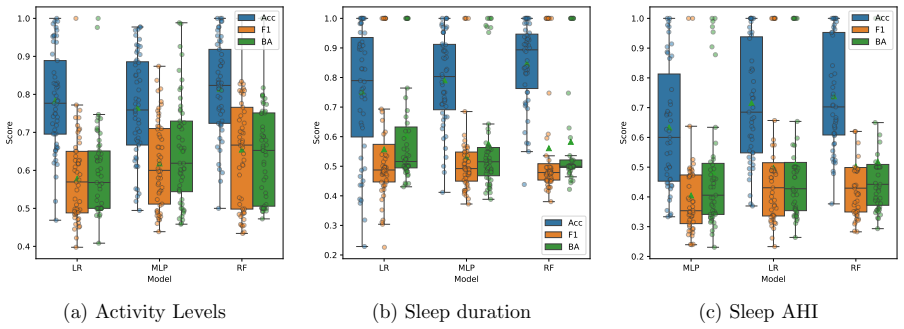
Wearable and mobile sensing technologies enable continuous monitoring of human behavior and health in real-world settings. However, predictive modeling in longitudinal multimodal data remains challenging, particularly when targeting complex or clinically derived outcomes. In this work, we present a longitudinal multimodal study of 66 older adults conducted in real-world conditions and combining wearable sensing, behavioral monitoring, and clinical assessments. This setting provides a rare opportunity to study an underrepresented population in long-term, into-the-wild conditions. Building on this dataset, we investigate how the alignment between sensed signals and target variables affects predictive performance across health-related tasks. We design a unified evaluation framework spanning tasks with increasing levels of observability, including Activity Levels prediction, Sleep Duration estimation, and Sleep Apnea Severity classification. Our results reveal a clear gradient of predictability: highly observable behavioral targets achieve robust performance (macro-F1 65%), while more abstract outcomes remain challenging despite consistent improvements over baseline models. Moreover, through explainability analysis, we show that historical features consistently emerge as the most informative predictors, highlighting the central role of longitudinal information.
Figures


Figures from the paper (9 more)




Reference graph
Works this paper leans on
-
[1]
Transformer-based recognition of activ- ities of daily living from wearable sensor data
Gabriela Augustinov, Muhammad Adeel Nisar, Fr´ ed´ eric Li, Amir Tabatabaei, Marcin Grze- gorzek, Keywan Sohrabi, and Sebastian Fudickar. Transformer-based recognition of activ- ities of daily living from wearable sensor data. InProceedings of the 7th International Workshop on Sensor-Based Activity Recognition and Artificial Intelligence, iWOAR ’22, New Y...
2023
-
[2]
Timed up and go test and risk of falls in older adults: a systematic review.The journal of nutrition, health & aging, 15(10):933–938, 2011
Olivier Beauchet, Bruno Fantino, Gilles Allali, SW Muir, Manuel Montero-Odasso, and C´ edric Annweiler. Timed up and go test and risk of falls in older adults: a systematic review.The journal of nutrition, health & aging, 15(10):933–938, 2011
2011
-
[3]
Lifetrace: A longitudinal multimodal dataset on daily 22 physical activity, well-being, and habits.Proc
Francesco Bombassei De Bona, Ioana Andreea Cˆ ampanu, Marc Langheinrich, Martin Gjoreski, and Georgiana Juravle. Lifetrace: A longitudinal multimodal dataset on daily 22 physical activity, well-being, and habits.Proc. ACM Interact. Mob. Wearable Ubiquitous Technol., 9(4), December 2025
2025
-
[4]
Cornet and Richard J
Victor P. Cornet and Richard J. Holden. Systematic review of smartphone-based passive sensing for health and wellbeing.Journal of Biomedical Informatics, 77:120–132, 2018
2018
-
[5]
The six-minute walk test.Respiratory Care, 48(8):783–785, 2003
Paul L Enright. The six-minute walk test.Respiratory Care, 48(8):783–785, 2003
2003
-
[6]
Hypertension in older adults: What is the target blood pressure?Cleve
Anu Garg and Barbara J Messinger-Rapport. Hypertension in older adults: What is the target blood pressure?Cleve. Clin. J. Med., 85(3):193–195, March 2018
2018
-
[7]
Sex differences in the association between sleep duration and frailty in older adults: evidence from the knhanes study.BMC geriatrics, 24(1):434, 2024
Beomman Ha, Mijin Han, Wi-Young So, and Seonho Kim. Sex differences in the association between sleep duration and frailty in older adults: evidence from the knhanes study.BMC geriatrics, 24(1):434, 2024
2024
-
[8]
Gabriella M Harari, Nicholas D Lane, Rui Wang, Benjamin S Crosier, Andrew T Campbell, and Samuel D Gosling. Using smartphones to collect behavioral data in psychological sci- ence: Opportunities, practical considerations, and challenges.Perspectives on Psychological Science, 11(6):838–854, 2016
2016
Show all 31 references
-
[9]
The short-form version of the depression anxiety stress scales (dass-21): Construct validity and normative data in a large non-clinical sample
Julie D Henry and John R Crawford. The short-form version of the depression anxiety stress scales (dass-21): Construct validity and normative data in a large non-clinical sample. British journal of clinical psychology, 44(2):227–239, 2005
2005
-
[10]
What is adapted physical activity?, 2020
International Federation of Adapted Physical Activity. What is adapted physical activity?, 2020
2020
-
[11]
Validity of the international physical activity questionnaire short form (ipaq-sf): A systematic review
Paul H Lee, Duncan J Macfarlane, Tai Hing Lam, and Sunita M Stewart. Validity of the international physical activity questionnaire short form (ipaq-sf): A systematic review. International journal of behavioral nutrition and physical activity, 8(1):115, 2011
2011
-
[12]
Mobile health applications for older adults: a systematic review of interface and persuasive feature design.J Am Med Inform Assoc, 28(11):2483–2501, October 2021
Na Liu, Jiamin Yin, Sharon Swee-Lin Tan, Kee Yuan Ngiam, and Hock Hai Teo. Mobile health applications for older adults: a systematic review of interface and persuasive feature design.J Am Med Inform Assoc, 28(11):2483–2501, October 2021
2021
-
[13]
Lundberg, Gabriel G
Scott M. Lundberg, Gabriel G. Erion, and Su-In Lee. Consistent individualized feature attribution for tree ensembles.CoRR, abs/1802.03888, 2018
2018 arXiv
-
[14]
A unified approach to interpreting model predictions
Scott M Lundberg and Su-In Lee. A unified approach to interpreting model predictions. Advances in neural information processing systems, 30, 2017
2017
-
[15]
Mattingly et al
S. Mattingly et al. The tesserae project: Large-scale, longitudinal, in situ, multimodal sensing of information workers. InProceedings of the CHI Conference on Human Factors in Computing Systems, 2019
2019
-
[16]
Tatyana Mollayeva, Pravheen Thurairajah, Kirsteen Burton, Shirin Mollayeva, Colin M Shapiro, and Angela Colantonio. The pittsburgh sleep quality index as a screening tool for sleep dysfunction in clinical and non-clinical samples: A systematic review and meta- analysis.Sleep m...
2016
-
[17]
Mundnich et al
K. Mundnich et al. Tiles-2018: A longitudinal physiological and behavioral dataset of hospital workers.arXiv preprint arXiv:2003.08474, 2020
2018
-
[18]
Jukka-Pekka Onnela and Scott L. Rauch. Harnessing smartphone-based digital phenotyp- ing to enhance behavioral and mental health.Neuropsychopharmacology, 41(7):1691–1696, Jun 2016. 23
2016
-
[19]
Ellis, Sally Andrews, and Adam Joinson
Lukasz Piwek, David A. Ellis, Sally Andrews, and Adam Joinson. The rise of consumer health wearables: Promises and barriers.PLOS Medicine, 13(2):1–9, 02 2016
2016
-
[20]
Towards customizable foun- dation models for human activity recognition with wearable devices.Proc
Minghui Qiu, Cekai Weng, Mingming Fan, and Kaishun Wu. Towards customizable foun- dation models for human activity recognition with wearable devices.Proc. ACM Interact. Mob. Wearable Ubiquitous Technol., 9(3), September 2025
2025
-
[21]
Unobtrusive perceived sleep quality monitoring in the wild.Proc
Alvise Dei Rossi, Davide Marzorati, Tiziano Gerosa, Radoslava ˇSvihrov´ a, Silvia Santini, and Francesca Faraci. Unobtrusive perceived sleep quality monitoring in the wild.Proc. ACM Interact. Mob. Wearable Ubiquitous Technol., 9(3), September 2025
2025
-
[22]
Multi-task self-supervised learning for human activity detection.Proc
Aaqib Saeed, Tanir Ozcelebi, and Johan Lukkien. Multi-task self-supervised learning for human activity detection.Proc. ACM Interact. Mob. Wearable Ubiquitous Technol., 3(2), June 2019
2019
-
[23]
The mini-mental state examination: a compre- hensive review.Journal of the American Geriatrics Society, 40(9):922–935, 1992
Tom N Tombaugh and Nancy J McIntyre. The mini-mental state examination: a compre- hensive review.Journal of the American Geriatrics Society, 40(9):922–935, 1992
1992
-
[24]
Vaizman, K
Y. Vaizman, K. Ellis, and G. Lanckriet. Extrasensory: A multimodal dataset for context recognition in the wild. InProceedings of the ACM on Interactive, Mobile, Wearable and Ubiquitous Technologies, 2017
2017
-
[25]
The mini nutritional assessment (mna) and its use in grading the nutritional state of elderly patients.Nutrition, 15(2):116–122, 1999
Bruno Vellas, Yves Guigoz, Philip J Garry, Fati Nourhashemi, David Bennahum, Sylvie Lauque, and Jean-Louis Albarede. The mini nutritional assessment (mna) and its use in grading the nutritional state of elderly patients.Nutrition, 15(2):116–122, 1999
1999
-
[26]
Campbell
Rui Wang, Fanglin Chen, Zhenyu Chen, Tianxing Li, Gabriella Harari, Stefanie Tignor, Xia Zhou, Dror Ben-Zeev, and Andrew T. Campbell. Studentlife: assessing mental health, academic performance and behavioral trends of college students using smartphones. In Proceedings of the 2...
2014
-
[27]
Winter, Robyn J
Jennifer E. Winter, Robyn J. MacInnis, Natalie Wattanapenpaiboon, and Caryl A. Nowson. Bmi and all-cause mortality in older adults: a meta-analysis.Obesity, 22(1):–, 2014
2014
-
[28]
Who guidelines on physical activity and sedentary behaviour, 2020
World Health Organization. Who guidelines on physical activity and sedentary behaviour, 2020
2020
-
[29]
Wearable foundation models should go beyond static encoders, 2026
Yu Yvonne Wu, Yuwei Zhang, Hyungjun Yoon, Ting Dang, Dimitris Spathis, Tong Xia, Qiang Yang, Jing Han, Dong Ma, Sung-Ju Lee, and Cecilia Mascolo. Wearable foundation models should go beyond static encoders, 2026
2026
-
[30]
Kuehn, Jeremy F
Xuhai Xu, Xin Liu, Han Zhang, Weichen Wang, Subigya Nepal, Yasaman Sefidgar, Woosuk Seo, Kevin S. Kuehn, Jeremy F. Huckins, Margaret E. Morris, Paula S. Nurius, Eve A. Riskin, Shwetak Patel, Tim Althoff, Andrew Campbell, Anind K. Dey, and Jennifer Mankoff. Globem: Cross-datase...
2023
-
[31]
D. Y. Zhang, D. W. An, Y. L. Yu, J. D. Melgarejo, J. Boggia, D. S. Martens, T. W. Hansen, K. Asayama, T. Ohkubo, K. Stolarz-Skrzypek, S. Malyutina, E. Casiglia, L. Lind, G. E. Maestre, J. G. Wang, Y. Imai, K. Kawecka-Jaszcz, E. Sandoya, M. Rajzer, T. S. Nawrot, E. O’Brien, W. ...
2025
Reviewed June 28, 2026 · model on record in the stance chip above.
Discussion (0). Continue with ORCID to comment.