REVIEW 4 major objections 5 minor 43 references
Directional bonding explains high conductance values of atomic contacts in bcc metals
T0 review · 4 major / 5 minor · reviewed 2026-08-14 · deepseek-v4-flash
Pith's one-line read Directional bonding, not a single-atom neck, explains the ~2G0 conductance of iron nanocontacts.
desk verdict A plausible MEAM-based resolution of the Fe contact conductance puzzle, but the causal mechanism rests on an unvalidated prediction of the potential. read the letter →
The pith
A machine-rendered reading of the paper's core claim, the machinery that carries it, and where it could break.
The reading
What carries the argument
The central object is the modified embedded-atom method (MEAM) potential for iron, a classical interatomic potential that adds angular directionality to the embedding energy, giving bonds a covalent character. It is the ingredient that changes the rupture path: under uniaxial tension the contact reorients from (001) to (110) planes and breaks by cleavage across a flat (110) plane, producing stable multi-atom contacts. The analysis then uses eigenchannel decomposition of the DFT transmission to compute the Fano factor, the ratio of shot noise to the Poissonian value, which counts how many partially open conductance channels a contact supports; this bridges the simulated geometries and the experimental conductance histogram.
What would settle it
Run the same (001)-oriented iron constriction under uniaxial tension with parameter-free electronic structure methods (for example, ab initio molecular dynamics or DFT-based minimum-cross-section sampling) and check whether the (001) to (110) reorientation and flat (110) cleavage actually occur without the MEAM potential's parametrization. If they do not, the multi-atom contacts and the conductance agreement are artifacts of the potential.
Extended reading notes
Core claim
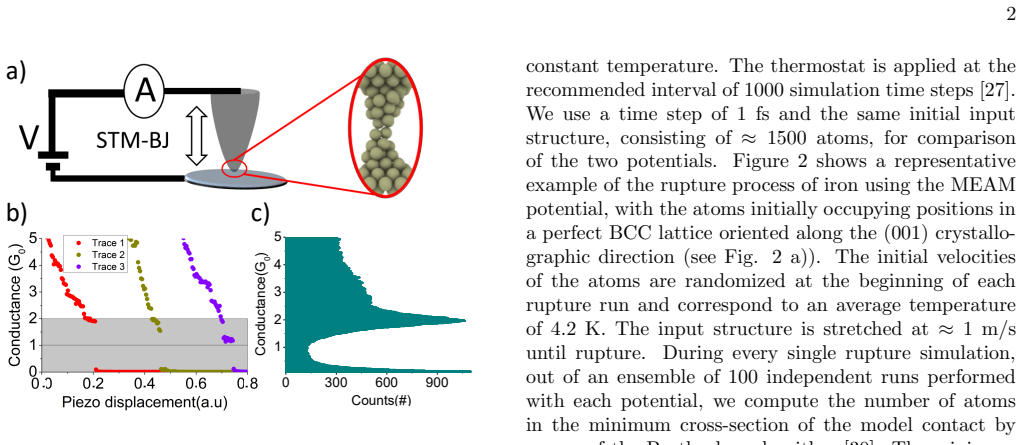
For body-centered cubic iron, the stable contact just before rupture is not the single-atom neck assumed by the standard picture. The paper finds that a modified embedded-atom potential that includes directional, partially covalent bonding predicts a crystallographic reorientation of the stretched contact from (001) to (110), followed by cleavage across (110) planes; the resulting pre-rupture structures have minimum cross-sections of three to ten atoms. Conductance calculations on these structures yield values clustered near $2G_0$, matching the experimental histogram peak, whereas structures from an isotropic EAM potential give values near $1G_0$. The comparison of Fano factors — a measurement of how many transmission channels are partially open — against experimental data from iron break junctions supports the same conclusion: the experimental contacts are multi-atom, not single-atom.
Load-bearing premise
Everything rests on the assumption that the MEAM potential chosen for iron accurately captures bonding, reorientation, and cleavage under the highly strained conditions of a nanoconstriction; the paper validates surface energies and melting point but not this reorientation mechanism directly.
Editorial extensions
If this is right
- The standard picture that a single atom forms the last stable contact in bcc metals is wrong for iron; multi-atom contacts with 3–10 atoms in the minimum cross-section can be the stable pre-rupture configuration.
- Simulations of bcc break junctions that use isotropic EAM potentials will systematically miss the conductance peak near $2G_0$, so directional-bonding potentials are needed to reproduce experiments.
- If the same mechanism operates, other bcc metals with pronounced ~$2G_0$ conductance peaks (Ta, Mo, W) should also form multi-atom, flat (110)-cleaved contacts before rupture.
- Iron break junctions may produce atomically flat electrode surfaces at rupture, making them attractive as electrodes for single-molecule junctions.
Reading between the lines
- A direct test of the reorientation mechanism would be in-situ transmission electron microscopy of a straining iron nanocontact, or low-temperature break-junction measurements combined with conductance histograms showing a substructure consistent with the three-Gaussian fit.
- The same reasoning suggests that other low-coordination metals with partially covalent bonding (not just bcc transition metals) may also show multi-atom pre-rupture contacts; the Fano factor, rather than the conductance alone, is the sharper diagnostic.
- If flat (110) faces form reproducibly at rupture, they could serve as well-defined electrode-molecule interfaces, potentially improving reproducibility in molecular electronics; this is an extension the paper only gestures at.
- The relative weight of the three Gaussian components in the experimental histogram could be compared with the simulated rupture statistics to test whether the proposed structures appear with the right frequencies.
Signed reviews
Editorial analysis
A structured set of objections, weighed in public.
Referee Report
Summary. The paper combines classical molecular dynamics (CMD) simulations of rupture of bcc Fe nanocontacts with DFT-based transport calculations to explain the experimentally observed conductance peak at about 2 G0 in Fe break junctions. Two interatomic potentials are compared: an EAM potential with isotropic bonding and a MEAM potential with directional bonding. From 100 independent CMD runs per potential, the authors report that MEAM produces stable pre-rupture structures with more than two atoms in the minimum cross-section more often than EAM, including a (001)-to-(110) crystallographic reorientation followed by cleavage across (110) planes. Snapshots from these runs are used in DFT transport calculations; the resulting conductance values and Fano factors for the MEAM structures fall near the experimental peak and the experimental Fano diagram, respectively. The paper concludes that directional bonding is essential for understanding high conductance in bcc metal atomic contacts.
Significance. If the central mechanism is correct, the paper provides a new explanation for the anomalously high conductance peak in Fe break junctions and challenges the common assumption that the last stable contact in a bcc metal is a single atom. The study has notable strengths: it uses 100 independent CMD runs for each potential, compares two independently published interatomic potentials, and reports the raw conductance values in the Supplemental Material, which allows the reader to check the main quantitative claims. The Fano-factor comparison with experiment is a meaningful, falsifiable diagnostic. However, the load-bearing link from the MEAM potential's directional bonding to the (001)-to-(110) reorientation is not independently validated, and the selection of snapshots for transport calculations is not fully specified, so the strength of the evidence is currently conditional.
major comments (4)
- [Supplemental Material, 'DFT calculations' and main-text Fig. 5] The selection of 33 of 100 MEAM snapshots and 17 of 100 EAM snapshots for conductance calculations is described only as 'representative stable pre-rupture structures'. No algorithm, criterion, or threshold is given for this selection. Since the Fano diagrams in Fig. 5 and the conductance comparisons are built entirely from these subsets, selection bias could artificially improve or worsen the agreement with experiment. The authors should specify a reproducible selection rule (e.g., all snapshots in a given time window, or snapshots satisfying a quantitative stability criterion) or report conductance values for all 100 runs per potential.
- [Main text, Fig. 2 and the discussion of the MEAM potential] The central mechanism, the (001)-to-(110) reorientation and subsequent (110) cleavage, is observed only with the MEAM potential and is the source of the high-coordination structures that give conductance near 2 G0. The authors validate the MEAM potential by its fitted melting point, near-melting-point elastic constants, and agreement of surface energies with experiment, but none of these tests constrains the specific strained-contact behavior that carries the argument. A direct test is needed, for example DFT calculations of the energy landscape for a stretched (001) Fe contact, or comparison of MEAM and DFT generalized stacking-fault or cleavage energies for (110) planes under uniaxial strain. Without such a check, the reorientation and the resulting conductance agreement could be artifacts of this particular MEAM parametrization.
- [Main text, Figs. 3 and 5 and Table SI] The paper claims to explain the experimental conductance histogram, but it does not show a simulated conductance histogram constructed from the full set of CMD snapshots. Instead, the authors highlight the 10 MEAM cases with asterisks in Table SI, which are selected partly because their conductance is close to 2 G0. This is partially circular: selecting snapshots by their conductance and then comparing the selected values to the experimental peak does not demonstrate that the simulated rupture process produces a peak at 2 G0 with the correct statistical weight. The authors should construct a conductance histogram from all snapshots (or from all snapshots weighted by their frequency in the 100 runs) and compare it directly with the experimental histogram of Fig. 1(c).
- [Main text, Fig. 3] The minimum-cross-section histograms in Fig. 3 are based on 100 runs per potential, but the tail region that distinguishes MEAM from EAM contains only about 20 and 3 events, respectively. No error bars or confidence intervals are shown. A quantitative statement about the statistical significance of the difference in the tail would strengthen the claim that MEAM systematically produces multi-atom pre-rupture contacts.
minor comments (5)
- [Main text, Fig. 2 and Table SI] The name 'Bratkovksy' is a typo; the correct spelling is 'Bratkovsky'.
- [Supplemental Material, reference [37]] The Supplemental Material link is given as the placeholder 'http://link.xxx.org/supplemental/xxxx/xxxx.xxx'; the actual DOI or arXiv link should be provided.
- [Main text, Fig. 2 caption] The time labels 't= 690 kStep' and 't= 925 kStep' use an undefined unit 'kStep'; the authors should state explicitly that this means thousands of simulation time steps.
- [Main text, reference [31]] The journal name is abbreviated inconsistently: 'Phys. Chem. Solids' should read 'J. Phys. Chem. Solids'.
- [Main text, Fig. 5 caption] The phrase 'grouped by color-coded frames according to stable structures just before rupture, shown in the insets' is not self-explanatory; the caption should define what the color-coded frames represent and identify which inset corresponds to which group.
Circularity Check
No significant circularity: the central comparison is between two independently parametrized potentials, and the DFT conductance values are computed, not fitted, from MD snapshots.
full rationale
The paper's derivation chain is: (1) choose two published empirical potentials for Fe, EAM [22] and MEAM [31], neither of which is fitted to break-junction conductance, to the ~2 G0 experimental peak, or to the (001)-to-(110) reorientation; (2) run classical MD to generate rupture structures; (3) compute conductance from those structures with the DFT transport code ANT.Gaussian; and (4) compare with experimental histograms and Fano factors from external work [4,18,19]. No step in this chain uses the target result as an input. The MEAM potential of Etesami and Asadi [31] was fitted to the melting point, near-melting-point elastic constants, and surface energies, which are independent of the transport and rupture claims made here. The EAM potential [22] is likewise an externally published parametrization, so the comparison is between two independently constructed models. The conductance values in Table SI include both matching and non-matching cases, and the asterisked entries are a post hoc identification of structures whose conductance falls near the experimental peak, not a parameter fit to that peak. The three-Gaussian fit in the Supplemental Material is a descriptive decomposition of the experimental histogram, introduced to show that a variety of structures contribute to the broad peak; it is not used to adjust the MD or DFT calculations. The concern that the specific MEAM parametrization may not accurately describe strained nanoconstrictions is a model-fidelity or correctness risk, not a circularity, because the paper does not define the reorientation mechanism in terms of the conductance result or fit the potential to the conductance. Self-citations, such as Calvo et al. [4] for the experimental peak and the ANT.Gaussian transport code, are not load-bearing: the ~2 G0 peak is also reported in independent references [18] and [19], and the transport basis set is benchmarked against OpenMX in the Supplemental Material. No equation or construction in the paper reduces a predicted quantity to an input quantity, so no circular step can be exhibited.
Assumptions & free parameters
free parameters (4)
- MEAM potential parameters =
Etesami and Asadi, Phys. Chem. Solids 112, 61 (2018)
- EAM potential parameters =
Malerba et al., J. Nucl. Mater. 406, 19 (2010)
- Gaussian fit parameters for experimental histogram =
a=(216,872,385), b=(1.60,1.99,2.39), c=(0.30,0.25,0.21) plus offset 104
- Basis-set parameters for DFT transport =
optimized in CRYSTAL14 with uncontracted Gaussian-type orbitals
assumptions (5)
- domain assumption Classical MD with empirical potentials reproduces the rupture mechanism of iron nanoconstrictions at 4.2 K
- domain assumption The MEAM potential of Etesami and Asadi captures directional bonding of BCC iron in strained nanoconstrictions
- domain assumption DFT/Landauer transport on static snapshots describes the experimentally measured conductance of break junctions at low temperature and bias
- domain assumption The experimental Fe histogram and Fano diagram of ref. [18] are reliable baselines
- domain assumption The Bratkovsky algorithm identifies the true minimum cross-section and correlates with the number of conductance channels
Cite this review
Pith. "Pith review of Directional bonding explains high conductance values of atomic contacts in bcc metals." pith.science (2026). https://pith.science/paper/HXDG22BT
@misc{pith2026190804399,
  author       = {Pith},
  title        = {Pith review of: Directional bonding explains high conductance values of atomic contacts in bcc metals},
  year         = {2026},
  howpublished = {\url{https://pith.science/paper/HXDG22BT}},
  note         = {Machine review of arXiv:1908.04399}
}
read the original abstract
Atomic-sized junctions of iron, created by controlled rupture, present unusually high values of conductance compared to other metals. This result is counter-intuitive since, at the nanoscale, body-centered cubic metals are expected to exhibit lower coordination than face-centered cubic metals. In this work, classical molecular dynamics simulations of contact rupture, using an interatomic potential that accounts for directional bonding, yield highly-coordinated stable structures before rupture, unlike an isotropic bonding potential, which results in the expected stable single-atom contacts. Density functional theory electronic transport calculations show that conductance values of these highly coordinated and highly stable structures, can explain the experimentally measured values for conductance of body-centered cubic atomic contacts, thus revealing the important role of directional bonding in these metals.
Figures


Figures from the paper (2 more)


Reference graph
Works this paper leans on
-
[1]
U. Landman, W. D. Luedtke, N. A. Burnham, and R. J. Colton, Science 248, 454 (1990)
work page 1990
-
[2]
N. Agra¨ ıt, A. L. Yeyati, and J. M. Van Ruitenbeek, Phys. Rep. 377, 81 (2003)
work page 2003
- [3]
-
[4]
M. R. Calvo, J. Fern´ andez-Rossier, J. J. Palacios, D. Ja- cob, D. Natelson, and C. Untiedt, Nature 458, 1150 EP (2009)
work page 2009
- [5]
-
[6]
A. Halbritter, S. Csonka, G. Mih´ aly, E. Jurdik, O. Y. Kolesnychenko, O. I. Shklyarevskii, S. Speller, and H. van Kempen, Phys. Rev. B 68, 035417 (2003)
work page 2003
-
[7]
R. Requist, P. P. Baruselli, A. Smogunov, M. Fabrizio, S. Modesti, and E. Tosatti, Nat. Nanotechnol. 11, 499 (2016)
work page 2016
- [8]
Show all 43 references
-
[9]
Muller, J
C. Muller, J. van Ruitenbeek, and L. de Jongh, Physica C 191, 485 (1992)
1992
-
[10]
C. J. Muller, J. M. van Ruitenbeek, and L. J. de Jongh, Phys. Rev. Lett. 69, 140 (1992)
1992
-
[11]
J. I. Pascual, J. M´ endez, J. G´ omez-Herrero, A. M. Bar´ o, N. Garc´ ıa, and V. T. Binh, Phys. Rev. Lett. 71, 1852 (1993)
1993
-
[12]
Agra¨ ıt, J
N. Agra¨ ıt, J. G. Rodrigo, and S. Vieira, Phys. Rev. B 47, 12345 (1993)
1993
-
[13]
Hasmy, A
A. Hasmy, A. J. P´ erez-Jim´ enez, J. J. Palacios, P. Garc´ ıa- Mochales, J. L. Costa-Kr¨ amer, M. D´ ıaz, E. Medina, and P. A. Serena, Phys. Rev. B 72, 245405 (2005)
2005
-
[14]
Hasmy, E
A. Hasmy, E. Medina, and P. A. Serena, Phys. Rev. Lett. 86, 5574 (2001)
2001
-
[15]
Garc´ ıa-Mochales, S
P. Garc´ ıa-Mochales, S. Pel´ aez, P. Serena, E. Medina, and A. Hasmy, Appl. Phys. A-mater. 81, 1545 (2005)
2005
-
[16]
Sabater, M
C. Sabater, M. J. Caturla, J. J. Palacios, and C. Untiedt, Nanoscale Res. Lett. 8, 257 (2013)
2013
-
[17]
Sabater, W
C. Sabater, W. Dednam, M. R. Calvo, M. A. Fern´ andez, C. Untiedt, and M. J. Caturla, Phys. Rev. B 97, 075418 (2018)
2018
-
[19]
Vardimon, M
R. Vardimon, M. Matt, P. Nielaba, J. C. Cuevas, and O. Tal, Phys. Rev. B 93, 085439 (2016)
2016
-
[20]
Untiedt, D
C. Untiedt, D. M. T. Dekker, D. Djukic, and J. M. van Ruitenbeek, Phys. Rev. B 69, 081401 (2004)
2004
-
[21]
D. C. Rapaport, The Art of Molecular Dynamics Simu- lation, 2nd ed. (Cambridge University Press, New York, 2004)
2004
-
[22]
M. S. Daw and M. I. Baskes, Phys. Rev. Lett. 50, 1285 (1983)
1983
-
[23]
Malerba et al., J
L. Malerba et al., J. Nucl. Mater. 406, 19 (2010)
2010
-
[24]
J. C. Cuevas and E. Scheer,Molecular Electronics (World Scientific, Singapore, 2010)
2010
-
[25]
D. G. Pettifor, Bonding and Structure of Molecules and Solids (Oxford University Press, Oxford, 1996)
1996
-
[26]
M. I. Baskes, Phys. Rev. B 46, 2727 (1992)
1992
-
[27]
Plimpton, J
S. Plimpton, J. Comp. Phys. 117, 1 (1995)
1995
-
[28]
Plimpton et al., (2016), ”Computer code LAMMPS, publicly available at http://lammps.sandia.gov”
S. Plimpton et al., (2016), ”Computer code LAMMPS, publicly available at http://lammps.sandia.gov”
2016
-
[29]
Nos´ e, Mol
S. Nos´ e, Mol. Phys.52, 255 (1984)
1984
-
[30]
W. G. Hoover, Phys. Rev. A 31, 1695 (1985)
1985
-
[31]
A. M. Bratkovsky, A. P. Sutton, and T. N. Todorov, Phys. Rev. B 52, 5036 (1995)
1995
-
[32]
S. A. Etesami and E. Asadi, Phys. Chem. Solids 112, 61 (2018)
2018
-
[33]
J. J. Palacios, A. J. P´ erez-Jim´ enez, E. Louis, and J. A. Verg´ es, Phys. Rev. B64, 115411 (2001)
2001
-
[34]
J. J. Palacios, A. J. P´ erez-Jim´ enez, E. Louis, E. San- Fabi´ an, and J. A. Verg´ es, Phys. Rev. B 66, 035322 (2002)
2002
-
[35]
Louis, J
E. Louis, J. A. Verg´ es, J. J. Palacios, A. J. P´ erez-Jim´ enez, and E. SanFabi´ an, Phys. Rev. B67, 155321 (2003)
2003
-
[36]
J. J. Palacios et al. , ”computer code ANT.G, publicly available at http://www.simuneatomistics.com”
-
[37]
M. J. Frisch et al., ”computer code GAUSSIAN09, Re- vision C.01, Gaussian, Inc. Wallingford, CT, 2009”
2009
-
[38]
5 of the main article
See Supplemental Material at http://link.xxx.org/ sup- plemental/xxxx/xxxx.xxx for more details of DFT calcu- lations and for conductance values of MEAM and EAM snapshots from CMD rupture simulations, plotted in the Fano diagrams of Fig. 5 of the main article
-
[39]
Jacob and J
D. Jacob and J. J. Palacios, Phys. Rev. B 73, 075429 (2006)
2006
-
[40]
M. R. Calvo, M. J. Caturla, D. Jacob, C. Untiedt, and J. J. Palacios, IEEE T. Nanotech. 7, 165 (2008)
2008
-
[41]
Garc´ ıa, M
N. Garc´ ıa, M. Mu˜ noz, and Y. W. Zhao, Appl. Phys. Lett. 76, 2586 (2000). Directional bonding explains high conductance values of atomic contacts in bcc metals W. Dednam, 1, 2,∗ C. Sabater, 2,† M. R.Calvo,2 C. Untiedt,2 J. J. Palacios, 3 A. E. Botha, 1 and M. J. Caturla 2 1D...
2000 arXiv
-
[42]
Dovesi et al., Int
R. Dovesi et al., Int. J. Quantum Chem. 114, 1287 (2014)
2014
-
[43]
Doll, Surface Science 544, 103 (2003)
K. Doll, Surface Science 544, 103 (2003)
2003
-
[44]
OpenMX (Open source package for Material eXplorer) ver. 3.8,
T. Ozaki et al., “OpenMX (Open source package for Material eXplorer) ver. 3.8,” (2017)
2017
Reviewed August 14, 2026 · model on record in the stance chip above.
Discussion (0). Continue with ORCID to comment.