REVIEW 2 major objections 5 minor 27 references
Multi-task Gaze Estimation Via Unidirectional Convolution
T0 review · 2 major / 5 minor · reviewed 2026-08-12 · deepseek-v4-flash
Pith's one-line read A 2.8M-parameter gaze estimator with factorized convolutions reports lower angular error than SUGE on two benchmarks
desk verdict Incremental lightweight gaze network with a plausible but under-specified accuracy claim; worth a careful referee only if the authors release code and protocol. read the letter →
The pith
A machine-rendered reading of the paper's core claim, the machinery that carries it, and where it could break.
The reading
What carries the argument
The load-bearing object is Unidirectional Convolution (UC): replacing a square convolution kernel $K_H\times K_W$ with two perpendicular one-dimensional convolutions, $1\times K_W$ followed by $K_H\times 1$. This factorization cuts parameters and FLOPs from $K_H K_W C_{in} C_{out}$ to $(K_H+K_W)C_{in} C_{out}$ per output position, while stacking such layers produces a receptive field comparable to or larger than the original square kernel. Around UC, the paper adds Spatial and Channel Attention (SCA) to reweight gaze-relevant features, a Global Convolution Module (GCM) that replaces pooling with convolution-based global fusion, and a Multi-task Regression Module (MRM) whose three MLP branches predict yaw, pitch, and the joint pair, fused with weights $A_1=B_1=0.5$.
What would settle it
Reproduce both models under one fixed protocol with identical ETH-XGaze pretraining, input resolution, face crop, training schedule, and test splits, and check whether Multitask-Gaze still shows lower mean angular error than SUGE on Gaze360 and MPIIFaceGaze; if the gap vanishes, the central accuracy claim collapses.
Extended reading notes
Core claim
The paper's central claim is that the small-channel bottleneck of lightweight backbones can be addressed architecturally rather than by scaling up the network. In Multitask-Gaze, each MobileNetV3 bneck block replaces its depthwise or standard convolution with UC, a factorization of a $K\times K$ kernel into a $1\times K$ followed by a $K\times 1$ convolution, so the receptive field grows without a proportional rise in parameters or FLOPs; SCA modules inserted after the 3rd, 6th, and 9th bneck blocks reweight spatial and channel features; GCM performs global fusion without pooling loss; and MRM predicts yaw and pitch both separately and jointly, combining the three MLP outputs with equal weights. Evaluated after ETH-XGaze pretraining, the model reports angular errors of 10.33° on Gaze360, 3.90° on MPIIFaceGaze, and 6.35° on RT-Gene, with a receptive-field visualization showing that UC stacks match or exceed the field of standard $5\times 5$ or $7\times 7$ convolutions at lower cost. The paper takes these numbers as evidence that the four modules jointly recover the performance that lightweight networks normally lose.
Load-bearing premise
The load-bearing premise is that SUGE and the other baselines in Table I were evaluated under the same protocol (same data splits, input resolution, preprocessing, and pretraining schedule); Section III-A gives only the pretraining dataset, with no code or hyperparameters, and no repeated-run variance is reported.
Editorial extensions
If this is right
- Deploying Multitask-Gaze uses 75.5% fewer parameters and 86.88% fewer FLOPs than SUGE while keeping or improving angular error, so embedded and mobile gaze trackers can use the same accuracy at lower cost.
- Replacing global average pooling with GCM lowers angular error on all three datasets (for example 10.33° vs 10.73° on Gaze360), indicating that pooling-free global fusion is a workable head design.
- Removing MRM raises angular error on Gaze360 and RT-Gene but slightly lowers it on MPIIFaceGaze, so the multi-task yaw–pitch coupling helps most on the larger benchmark sets.
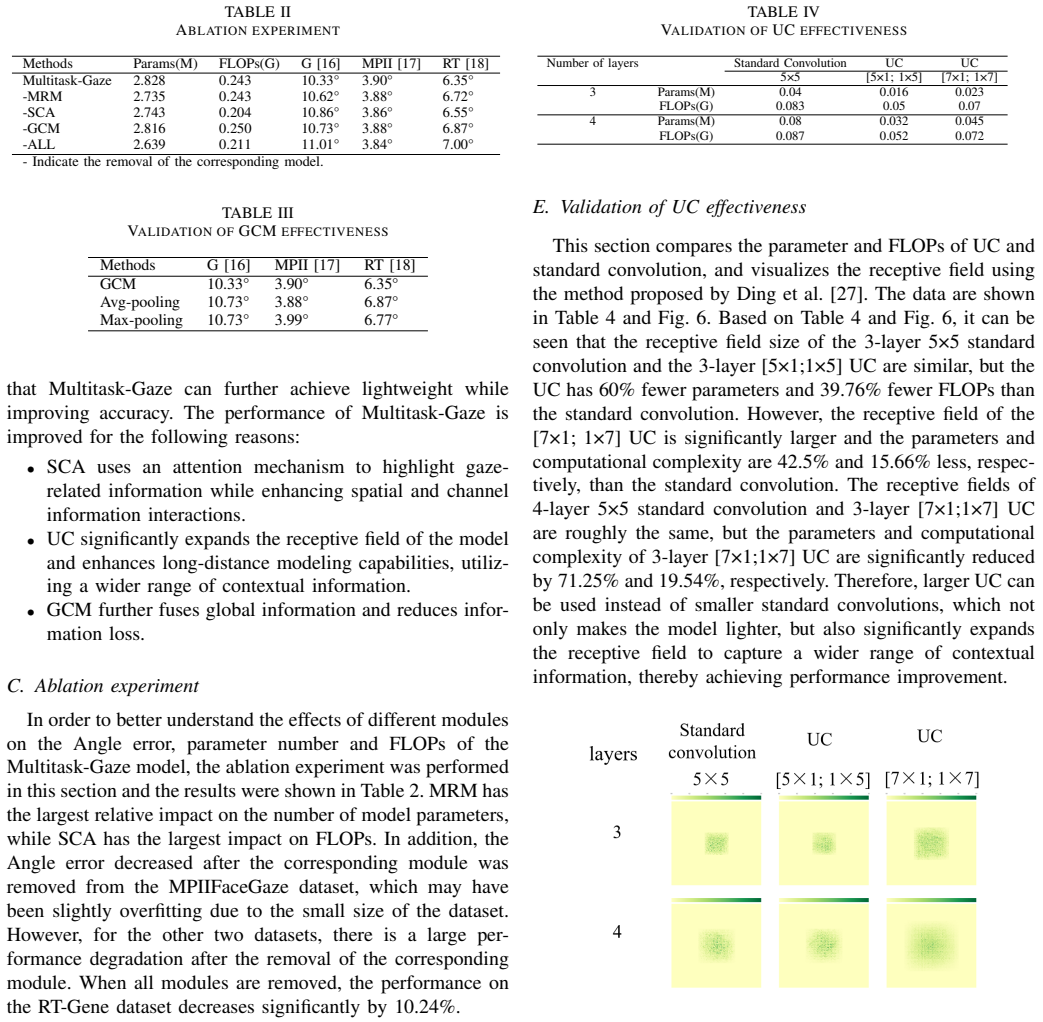
- A 3-layer $[7\times 1; 1\times 7]$ UC stack can replace a 4-layer $5\times 5$ standard stack with 71.25% fewer parameters and 19.54% fewer FLOPs, a recipe reusable in other bneck-style blocks.
Reading between the lines
- If the mechanism generalizes, the UC+SCA+GCM recipe should transfer to other lightweight backbones; a cross-backbone study on MobileNetV2-style blocks would test that directly.
- Because no variance or repeated-run statistics are reported, the gap between Multitask-Gaze and SUGE could be within run-to-run noise; re-running with multiple seeds would establish the systematic margin.
- Editorial note: the abstract's improvement percentages (1.71% for MPIIFaceGaze, 2.75% for Gaze360) are swapped relative to Table I, so readers should rely on the table's angular errors when citing the gains.
- The plug-and-play framing implies GCM and SCA could be dropped into non-gaze regression heads; testing them on head-pose or depth regression would clarify which component carries the improvement.
Editorial analysis
A structured set of objections, weighed in public.
Referee Report
Summary. The paper proposes Multitask-Gaze, a lightweight gaze-estimation network built on MobileNetV3. It replaces depthwise convolutions with unidirectional convolutions, inserts spatial-and-channel attention modules, replaces global average pooling with a Global Convolution Module, and adds a multi-task regression head with separate yaw/pitch predictors and a joint predictor. The claimed result is that Multitask-Gaze outperforms the SUGE baseline on MPIIFaceGaze (3.90° vs 4.01°) and Gaze360 (10.33° vs 10.51°) while reducing parameters by 75.5% and FLOPs by 86.88%. The paper also reports ablations and receptive-field visualizations.
Significance. The parameter and FLOP reductions versus SUGE are large and, if the accuracy numbers are reproducible, would be practically useful for real-time gaze estimation. The architectural ideas are clearly described and the module-level motivation is reasonable. However, the paper provides no code, no evaluation protocol details, no repeated-run statistics, and no public artifacts that would allow the central empirical claim to be checked. The work is not circular: it is an empirical architecture comparison, but that comparison currently rests on underspecified single-run numbers.
major comments (2)
- [III-A, Table I] The central comparison to SUGE is not verifiable because the evaluation protocol is missing. The implementation details state only that ETH-XGaze is the pretraining dataset and that MAE loss is used; they do not specify input resolution, face cropping and normalization, train/validation/test split, optimizer, learning-rate schedule, batch size, epochs, pretraining procedure, or how the SUGE baseline numbers in Table I were produced. The margins being claimed (0.11° on MPIIFaceGaze and 0.18° on Gaze360) are small enough that they could easily be explained by protocol differences or run-to-run variance. Please provide the full protocol, code or a detailed configuration, and either error bars over multiple seeds or a statistical comparison.
- [III-C, Table II] The ablation study contradicts the claim that each proposed module improves accuracy. On MPIIFaceGaze the full model has the highest error (3.90°), while removing MRM, SCA, GCM, or all modules decreases the error to 3.88°, 3.86°, 3.88°, and 3.84°, respectively. The text attributes this to slight overfitting, but no regularization details, validation protocol, or variance estimates are reported. As written, Table II does not support the paper's contribution claims on MPIIFaceGaze; the authors should either demonstrate that the differences are meaningful (e.g., with multiple runs and an actual overfitting analysis) or revise the claims.
minor comments (5)
- [Abstract] The improvement percentages are swapped. MPIIFaceGaze improves by (4.01−3.90)/4.01 ≈ 2.74%, while Gaze360 improves by (10.51−10.33)/10.51 ≈ 1.71%; the abstract states the reverse.
- [III-B] 'Gazet-Swin' should be 'Gaze-Swin'.
- [III-B] When comparing to MobileNetV3, the FLOPs actually increase from 0.233G to 0.243G; the text mentions only the 32.9% parameter reduction and should state this trade-off explicitly.
- [II-C, Eq. (2)] The text says different weight parameters are assigned to yaw and pitch, but A1 and B1 are shared by both; please clarify whether a single weight pair is intended.
- [III-D, Table III] The Avg-pooling row in Table III is identical to the -GCM row in Table II. If this is intentional because GCM replaces the pooling layer, say so explicitly and explain what additional information the table provides beyond the ablation.
Circularity Check
No circular derivation: the paper is an empirical architecture proposal evaluated against external baselines with fixed hyperparameters.
full rationale
No load-bearing circularity was found. The paper's central claims are empirical: Multitask-Gaze is a lightweight CNN whose components (UC, SCA, GCM, MRM) are defined architecturally and then compared with published baselines on MPIIFaceGaze, Gaze360, and RT-Gene. There is no fitted parameter later renamed as a prediction; the combination weights in Eq. (2) and Eq. (4) are fixed constants (A1=B1=0.5, A2=B2=0.5), not learned from the evaluation data. The parameter and FLOP reductions claimed for UC follow directly from the arithmetic in Eq. (1), which compares standard convolution with a factorized 1-D kernel pair; this is a quantitative construction, not a self-referential derivation. The angular-error metric and MAE loss in Eqs. (3)-(4) are standard definitions and do not encode the result. Ablations and GCM-replacement experiments provide independent internal checks of the proposed modules, and the baseline numbers come from external citations rather than from the authors' own prior theorems. Concerns that the evaluation protocol is underspecified (e.g., Section III-A omits input resolution, splits, and optimizer details), that the abstract's percentage gains appear swapped between MPIIFaceGaze and Gaze360, and that the ablation results on MPIIFaceGaze show slight degradation when modules are removed are legitimate reproducibility and correctness risks, but they are not circularity: the empirical comparison does not reduce by construction to its own inputs. Self-citation is not used as a load-bearing argument. Accordingly, the circularity score is 0.
Assumptions & free parameters
free parameters (3)
- A1, B1 (MRM combination weights) =
0.5, 0.5
- A2, B2 (loss weights) =
0.5, 0.5
- UC kernel sizes and SCA insertion points =
[5x1;1x5] or [7x1;1x7]; after 3rd, 6th, and 9th bneck blocks
assumptions (4)
- domain assumption ETH-XGaze pretraining transfers to Gaze360, MPIIFaceGaze, and RT-Gene datasets.
- domain assumption Reported numbers for prior methods in Table I are produced under the same evaluation protocol as Multitask-Gaze.
- standard math Angular error computed via arccos in Eq. (3) is the accepted metric and is comparable across methods.
- standard math Combining MAE losses with weights A2=0.5 and B2=0.5 is a valid optimization objective.
Cite this review
Pith. "Pith review of Multi-task Gaze Estimation Via Unidirectional Convolution." pith.science (2026). https://pith.science/paper/HXZXI6ZO
@misc{pith2026241118061,
  author       = {Pith},
  title        = {Pith review of: Multi-task Gaze Estimation Via Unidirectional Convolution},
  year         = {2026},
  howpublished = {\url{https://pith.science/paper/HXZXI6ZO}},
  note         = {Machine review of arXiv:2411.18061}
}
read the original abstract
Using lightweight models as backbone networks in gaze estimation tasks often results in significant performance degradation. The main reason is that the number of feature channels in lightweight networks is usually small, which makes the model expression ability limited. In order to improve the performance of lightweight models in gaze estimation tasks, a network model named Multitask-Gaze is proposed. The main components of Multitask-Gaze include Unidirectional Convolution (UC), Spatial and Channel Attention (SCA), Global Convolution Module (GCM), and Multi-task Regression Module(MRM). UC not only significantly reduces the number of parameters and FLOPs, but also extends the receptive field and improves the long-distance modeling capability of the model, thereby improving the model performance. SCA highlights gaze-related features and suppresses gaze-irrelevant features. The GCM replaces the pooling layer and avoids the performance degradation due to information loss. MRM improves the accuracy of individual tasks and strengthens the connections between tasks for overall performance improvement. The experimental results show that compared with the State-of-the-art method SUGE, the performance of Multitask-Gaze on MPIIFaceGaze and Gaze360 datasets is improved by 1.71% and 2.75%, respectively, while the number of parameters and FLOPs are significantly reduced by 75.5% and 86.88%.
Figures


Figures from the paper (3 more)


Reference graph
Works this paper leans on
-
[1]
A review of driver gaze estimation and application in gaze behavior understanding,
P. K. Sharma and P. Chakraborty, “A review of driver gaze estimation and application in gaze behavior understanding,” Engineering Applications of Artificial Intelligence , vol. 133, p. 108117, 2024
work page 2024
-
[2]
Neural network imple- mentation of gaze-target prediction for human-robot interaction,
V . Somashekarappa, A. Sayeed, and C. Howes, “Neural network imple- mentation of gaze-target prediction for human-robot interaction,” in2023 32nd IEEE International Conference on Robot and Human Interactive Communication (RO-MAN). IEEE, 2023, pp. 2238–2244
work page 2023
-
[3]
A field test of computer-vision-based gaze estimation in psychology,
N. V . Valtakari, R. S. Hessels, D. C. Niehorster, C. Viktorsson, P. Nystr ¨om, T. Falck-Ytter, C. Kemner, and I. T. Hooge, “A field test of computer-vision-based gaze estimation in psychology,” Behavior Research Methods, vol. 56, no. 3, pp. 1900–1915, 2024
work page 1900
-
[4]
Infant responses to direct gaze and associations to autism: A live eye-tracking study,
M. Rudling, P. Nystr ¨om, G. Bussu, S. B ¨olte, and T. Falck-Ytter, “Infant responses to direct gaze and associations to autism: A live eye-tracking study,” Autism, vol. 28, no. 7, pp. 1677–1689, 2024
work page 2024
-
[5]
Appearance-based gaze estimation for asd diagnosis,
J. Li, Z. Chen, Y . Zhong, H.-K. Lam, J. Han, G. Ouyang, X. Li, and H. Liu, “Appearance-based gaze estimation for asd diagnosis,” IEEE Transactions on Cybernetics , vol. 52, no. 7, pp. 6504–6517, 2022
work page 2022
-
[6]
3d model-based gaze tracking via iris features with a single camera and a single light source,
J. Liu, J. Chi, W. Hu, and Z. Wang, “3d model-based gaze tracking via iris features with a single camera and a single light source,” IEEE Transactions on Human-Machine Systems , vol. 51, no. 2, pp. 75–86, 2020
work page 2020
-
[7]
Real time eye gaze tracking with 3d deformable eye-face model,
K. Wang and Q. Ji, “Real time eye gaze tracking with 3d deformable eye-face model,” in Proceedings of the IEEE International Conference on Computer Vision , 2017, pp. 1003–1011
work page 2017
-
[8]
Source-free adaptive gaze estimation by uncertainty reduction,
X. Cai, J. Zeng, S. Shan, and X. Chen, “Source-free adaptive gaze estimation by uncertainty reduction,” in Proceedings of the IEEE/CVF Conference on Computer Vision and Pattern Recognition , 2023, pp. 22 035–22 045
work page 2023
Show all 27 references
-
[9]
Dvgaze: Dual-view gaze estimation,
Y . Cheng and F. Lu, “Dvgaze: Dual-view gaze estimation,” in Proceed- ings of the IEEE/CVF International Conference on Computer Vision , 2023, pp. 20 632–20 641
2023
-
[10]
Fr-net: a light-weight fft residual net for gaze estimation,
T. Xu, B. Wu, R. Fan, Y . Zhou, and D. Huang, “Fr-net: a light-weight fft residual net for gaze estimation,” arXiv preprint arXiv:2305.11875 , 2023
2023 arXiv
-
[11]
Searching efficient neural architecture with multi-resolution fusion transformer for appearance-based gaze estimation,
V . Nagpure and K. Okuma, “Searching efficient neural architecture with multi-resolution fusion transformer for appearance-based gaze estimation,” in Proceedings of the IEEE/CVF winter conference on applications of computer vision , 2023, pp. 890–899
2023
-
[12]
Xception: Deep learning with depthwise separable convolu- tions,
F. Chollet, “Xception: Deep learning with depthwise separable convolu- tions,” in Proceedings of the IEEE conference on computer vision and pattern recognition, 2017, pp. 1251–1258
2017
-
[13]
Searching for mobilenetv3,
A. Howard, M. Sandler, G. Chu, L.-C. Chen, B. Chen, M. Tan, W. Wang, Y . Zhu, R. Pang, V . Vasudevan et al. , “Searching for mobilenetv3,” in Proceedings of the IEEE/CVF international conference on computer vision, 2019, pp. 1314–1324
2019
-
[14]
Swin transformer: Hierarchical vision transformer using shifted windows,
Z. Liu, Y . Lin, Y . Cao, H. Hu, Y . Wei, Z. Zhang, S. Lin, and B. Guo, “Swin transformer: Hierarchical vision transformer using shifted windows,” in Proceedings of the IEEE/CVF international conference on computer vision, 2021, pp. 10 012–10 022
2021
-
[15]
Eth-xgaze: A large scale dataset for gaze estimation under extreme head pose and gaze variation,
X. Zhang, S. Park, T. Beeler, D. Bradley, S. Tang, and O. Hilliges, “Eth-xgaze: A large scale dataset for gaze estimation under extreme head pose and gaze variation,” in Computer Vision–ECCV 2020: 16th European Conference, Glasgow, UK, August 23–28, 2020, Proceedings, Part V 1...
2020
-
[16]
Gaze360: Physically unconstrained gaze estimation in the wild,
P. Kellnhofer, A. Recasens, S. Stent, W. Matusik, and A. Torralba, “Gaze360: Physically unconstrained gaze estimation in the wild,” in Proceedings of the IEEE/CVF international conference on computer vision, 2019, pp. 6912–6921
2019
-
[17]
It’s written all over your face: Full-face appearance-based gaze estimation,
X. Zhang, Y . Sugano, M. Fritz, and A. Bulling, “It’s written all over your face: Full-face appearance-based gaze estimation,” in Proceedings of the IEEE conference on computer vision and pattern recognition workshops, 2017, pp. 51–60
2017
-
[18]
Rt-gene: Real-time eye gaze estimation in natural environments,
T. Fischer, H. J. Chang, and Y . Demiris, “Rt-gene: Real-time eye gaze estimation in natural environments,” in Proceedings of the European conference on computer vision (ECCV) , 2018, pp. 334–352
2018
-
[19]
Dropkey for vision transformer,
B. Li, Y . Hu, X. Nie, C. Han, X. Jiang, T. Guo, and L. Liu, “Dropkey for vision transformer,” in Proceedings of the IEEE/CVF Conference on Computer Vision and Pattern Recognition , 2023, pp. 22 700–22 709
2023
-
[20]
Appearance-based gaze estimation using dilated- convolutions,
Z. Chen and B. E. Shi, “Appearance-based gaze estimation using dilated- convolutions,” inAsian Conference on Computer Vision. Springer, 2018, pp. 309–324
2018
-
[21]
Gaze estimation using transformer,
Y . Cheng and F. Lu, “Gaze estimation using transformer,” in 2022 26th International Conference on Pattern Recognition (ICPR) . IEEE, 2022, pp. 3341–3347
2022
-
[22]
Self-attention with convolution and deconvolution for efficient eye gaze estimation from a full face image,
J. O Oh, H. J. Chang, and S.-I. Choi, “Self-attention with convolution and deconvolution for efficient eye gaze estimation from a full face image,” in Proceedings of the IEEE/CVF Conference on Computer Vision and Pattern Recognition , 2022, pp. 4992–5000
2022
-
[23]
L2cs-net: Fine-grained gaze estimation in unconstrained environments,
A. A. Abdelrahman, T. Hempel, A. Khalifa, A. Al-Hamadi, and L. Dinges, “L2cs-net: Fine-grained gaze estimation in unconstrained environments,” in 2023 8th International Conference on Frontiers of Signal Processing (ICFSP) . IEEE, 2023, pp. 98–102
2023
-
[24]
Gazecaps: Gaze estimation with self-attention-routed capsules,
H. Wang, J. O. Oh, H. J. Chang, J. H. Na, M. Tae, Z. Zhang, and S.-I. Choi, “Gazecaps: Gaze estimation with self-attention-routed capsules,” in Proceedings of the IEEE/CVF conference on computer vision and pattern recognition, 2023, pp. 2669–2677
2023
-
[25]
Gaze-swin: Enhancing gaze estimation with a hybrid cnn-transformer network and dropkey mechanism,
R. Zhao, Y . Wang, S. Luo, S. Shou, and P. Tang, “Gaze-swin: Enhancing gaze estimation with a hybrid cnn-transformer network and dropkey mechanism,” Electronics, vol. 13, no. 2, p. 328, 2024
2024
-
[26]
Suppressing uncertainty in gaze estimation,
S. Wang and Y . Huang, “Suppressing uncertainty in gaze estimation,” in Proceedings of the AAAI Conference on Artificial Intelligence , vol. 38, no. 6, 2024, pp. 5581–5589
2024
-
[27]
Scaling up your kernels to 31x31: Revisiting large kernel design in cnns,
X. Ding, X. Zhang, J. Han, and G. Ding, “Scaling up your kernels to 31x31: Revisiting large kernel design in cnns,” in Proceedings of the IEEE/CVF conference on computer vision and pattern recognition , 2022, pp. 11 963–11 975
2022
Reviewed August 12, 2026 · model on record in the stance chip above.
Discussion (0). Continue with ORCID to comment.