Robust qubit interactions mediated by photonic topological edge states
Pith reviewed 2026-05-22 00:27 UTC · model grok-4.3
The pith
Two qubits couple coherently through topologically protected edge modes when placed at distinct sites in a Hofstadter lattice.
A machine-rendered reading of the paper's core claim, the machinery that carries it, and where it could break.
Core claim
The effective coupling between the qubits is highly sensitive to their placement, energy detuning, and the topological character of the edge spectrum, with an exact analytical solution that captures the full eigenstate structure and the interplay between qubits and edge modes.
What carries the argument
The full system Hamiltonian for qubits coupled to distinct edge sites, whose eigenstates determine when coherent qubit interactions emerge.
If this is right
- Coherent long-range qubit interactions emerge for specific placements and detunings mediated by the edge modes.
- The analytical solution applies outside the perturbative regime and reveals the full interplay.
- The platform provides a foundation for studying information transport and many-body effects using topological edge modes.
- The interaction strength depends on the topological character of the edge spectrum.
Where Pith is reading between the lines
- The same edge-mode mediation could be tested in other lattice models that host protected boundary states.
- Tuning qubit placement might allow on-demand switching between interacting and decoupled regimes.
- Extension to multiple qubits could reveal collective effects protected by the same topological mechanism.
Load-bearing premise
The topological protection of the edge states remains intact after the qubits are coupled to the lattice sites, with no additional loss channels or back-action that would destroy the edge-mode character.
What would settle it
If experiments show that coupling the qubits destroys the topological protection of the edge modes or eliminates coherent oscillations in the predicted detuning and placement regimes, the analytical solution would not apply.
Figures




read the original abstract
We investigate the coupling of two spatially separated qubits via topologically protected edge states in a two-dimensional Hofstadter lattice. In this hybrid platform, the qubits are coupled to distinct edge sites of the lattice, enabling long-range interactions mediated by topological edge modes. We solve the full system Hamiltonian and analyze the resulting eigenstate structure to uncover the conditions under which coherent qubit interactions emerge. Our analysis reveals that the effective coupling is highly sensitive to the qubit placement, energy detuning, and the topological character of the edge spectrum. We obtain an analytical solution that goes beyond the perturbative regime, capturing the full interplay between the qubits and edge modes. These results provide a foundation for exploring information transport and many-body effects in engineered quantum systems where interactions are mediated by topological edge modes.
Editorial analysis
A structured set of objections, weighed in public.
Referee Report
Summary. The manuscript investigates the coupling of two spatially separated qubits to distinct edge sites of a two-dimensional Hofstadter lattice, with the goal of realizing long-range interactions mediated by topological edge modes. The central claim is that the full system Hamiltonian can be solved analytically (beyond the perturbative regime) to reveal the eigenstate structure and the conditions under which coherent, robust qubit interactions emerge, with the effective coupling depending on qubit placement, energy detuning, and the topological character of the edge spectrum.
Significance. If the analytical solution is valid and the topological protection of the edge modes is shown to survive the qubit coupling, the work would provide a useful non-perturbative framework for protected interactions in hybrid topological-qubit systems. This could support explorations of information transport and many-body physics in engineered lattices, particularly if the results include falsifiable predictions or reproducible derivations.
major comments (2)
- [Abstract and eigenstate analysis section] The abstract and the section describing the eigenstate analysis state that the full Hamiltonian is solved analytically to capture the non-perturbative qubit-edge interplay. However, no explicit derivation steps, closed-form expressions for the eigenstates, or numerical checks confirming the absence of gaps or post-hoc assumptions are provided, which is load-bearing for the claim that the solution goes beyond perturbation theory.
- [Model Hamiltonian and results on effective coupling] The robustness of the interactions is attributed to the topological character of the edge modes. The model couples the qubits directly to edge sites, yet no calculation of the topological invariant (e.g., Chern number of the bulk or persistence of gapless, localized edge states) is shown for finite qubit-lattice coupling strength; local perturbations from the coupling term can in principle open gaps or induce backscattering, undermining the topological protection assumption.
minor comments (2)
- The dependence of the effective coupling on qubit placement and detuning is described qualitatively; a supplementary table or plot showing the coupling strength versus these parameters would improve clarity.
- Notation for the lattice sites, detuning, and coupling strengths should be defined consistently in the main text and any equations to avoid ambiguity for readers.
Simulated Author's Rebuttal
We thank the referee for their careful reading and constructive comments on our manuscript. We address each major comment point by point below, indicating where revisions will be made to improve clarity and rigor.
read point-by-point responses
-
Referee: [Abstract and eigenstate analysis section] The abstract and the section describing the eigenstate analysis state that the full Hamiltonian is solved analytically to capture the non-perturbative qubit-edge interplay. However, no explicit derivation steps, closed-form expressions for the eigenstates, or numerical checks confirming the absence of gaps or post-hoc assumptions are provided, which is load-bearing for the claim that the solution goes beyond perturbation theory.
Authors: We agree that greater transparency in the derivation is warranted. Although the manuscript derives and applies the analytical solution to the full Hamiltonian, the presentation would be strengthened by including the explicit algebraic steps, the resulting closed-form eigenstate expressions, and supplementary numerical validations. In the revised manuscript we will add a dedicated subsection that walks through the exact diagonalization procedure, states the closed-form eigenstates, and reports numerical checks confirming that the solution remains valid beyond the perturbative regime with no spurious gaps introduced by post-hoc assumptions. revision: yes
-
Referee: [Model Hamiltonian and results on effective coupling] The robustness of the interactions is attributed to the topological character of the edge modes. The model couples the qubits directly to edge sites, yet no calculation of the topological invariant (e.g., Chern number of the bulk or persistence of gapless, localized edge states) is shown for finite qubit-lattice coupling strength; local perturbations from the coupling term can in principle open gaps or induce backscattering, undermining the topological protection assumption.
Authors: The referee correctly identifies that an explicit verification of topological invariants at finite coupling strength would reinforce the claim of protection. Our analytical solution already demonstrates that coherent edge-mediated interactions persist for the parameter regimes examined, but to directly confirm the survival of the topological character we will compute the bulk Chern number and verify the continued existence of gapless, localized edge states in the coupled system. These results will be added to the revised manuscript, together with a brief discussion of why the local qubit coupling does not induce backscattering within the analytically solved regime. revision: yes
Circularity Check
No circularity: direct Hamiltonian solution with input parameters
full rationale
The paper derives the effective qubit coupling by solving the full system Hamiltonian and analyzing its eigenstates, treating qubit placement, detuning, and lattice parameters as independent inputs rather than quantities fitted or defined to reproduce a target output. No self-definitional loops, fitted predictions, or load-bearing self-citations appear in the derivation chain. The topological edge-mode assumption is stated as a premise but does not reduce the analytical solution to a tautology by construction. The result is therefore self-contained against the stated Hamiltonian.
Axiom & Free-Parameter Ledger
free parameters (2)
- qubit placement on edge sites
- energy detuning
axioms (2)
- domain assumption A two-dimensional Hofstadter lattice supports topologically protected edge states.
- standard math The combined qubit-lattice system is described by a time-independent Hamiltonian whose eigenstates can be obtained analytically or numerically.
Lean theorems connected to this paper
-
IndisputableMonolith/Foundation/AlexanderDuality.leanalexander_duality_circle_linking unclear?
unclearRelation between the paper passage and the cited Recognition theorem.
We solve the full system Hamiltonian and analyze the resulting eigenstate structure... effective coupling Jeff... oscillation fidelity F = ⟨|Ψ(Q1)|²⟩ + ⟨|Ψ(Q2)|²⟩
-
IndisputableMonolith/Cost/FunctionalEquation.leanwashburn_uniqueness_aczel unclear?
unclearRelation between the paper passage and the cited Recognition theorem.
f±(λ) ≈ Af π/J cot(π(λ−El)/(2ΔE)) + Bf/J
What do these tags mean?
- matches
- The paper's claim is directly supported by a theorem in the formal canon.
- supports
- The theorem supports part of the paper's argument, but the paper may add assumptions or extra steps.
- extends
- The paper goes beyond the formal theorem; the theorem is a base layer rather than the whole result.
- uses
- The paper appears to rely on the theorem as machinery.
- contradicts
- The paper's claim conflicts with a theorem or certificate in the canon.
- unclear
- Pith found a possible connection, but the passage is too broad, indirect, or ambiguous to say the theorem truly supports the claim.
Reference graph
Works this paper leans on
-
[1]
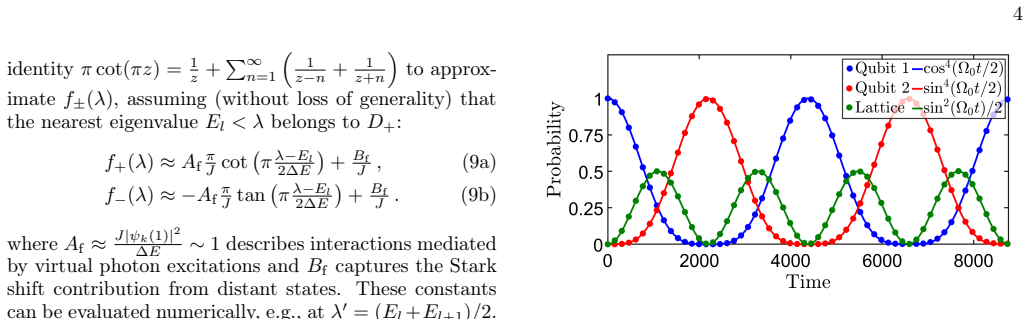
This produces a richer three-state oscillation pattern, as shown in Fig. 3: |Ψ(Q1)|2 = cos4 Ω0t 2 , (13a) |Ψ(Q2)|2 = sin4 Ω0t 2 , (13b) X lattice |Ψ(j)|2 = 1 2 sin2(Ω0t) . (13c) In this regime, a significant portion of the wavefunction amplitude periodically spreads into the main lattice. IV. NON-PERTURBATIVE SOLUTION Experimentally, one can readily exten...
-
[2]
Kiczynski, M. and Gorman, S. K. and Geng, H. and Don- nelly, M. B. and Chung, Y. and He, Y. and Keizer, J. G. and Simmons, M. Y., Engineering topological states in atom-based semiconductor quantum dots, Nature606, 694 (2022)
work page 2022
-
[3]
Zhang, Dan-Wei and Zhu, Yan-Qing and Zhao, Y. X. and Yan, Hui and Zhu, Shi-Liang, Topological quantum matter with cold atoms, Advances in Physics 67, 253 (2018)
work page 2018
-
[4]
Rachel, Stephan, Interacting topological insulators: a re- view, Reports on Progress in Physics81, 116501 (2018)
work page 2018
-
[5]
and Amo, Al- berto and Goldman, Nathan and Hafezi, Mohammad and Lu, Ling and Rechtsman, Mikael C
Ozawa, Tomoki and Price, Hannah M. and Amo, Al- berto and Goldman, Nathan and Hafezi, Mohammad and Lu, Ling and Rechtsman, Mikael C. and Schuster, David and Simon, Jonathan and Zilberberg, Oded and Caru- sotto, Iacopo, Topological photonics, Rev. Mod. Phys. 91, 015006 (2019)
work page 2019
-
[6]
Nemirovsky, Liat and Cohen, Moshe-Ishay and Lumer, Yaakov and Lustig, Eran and Segev, Mordechai, Synthetic-Space Photonic Topological Insulators Utiliz- ing Dynamically Invariant Structure, Phys. Rev. Lett. 127, 093901 (2021)
work page 2021
-
[7]
Bao, Changhua and Tang, Peizhe and Sun, Dong and Zhou, Shuyun, Light-induced emergent phenomena in 2D materials and topological materials, Nature Reviews Physics 4, 33 (2022)
work page 2022
-
[8]
Tan, Wei and Sun, Yong and Chen, Hong and Shen, Shun-Qing, Photonic simulation of topological excita- tions in metamaterials, Scientific Reports4, 3842 (2014)
work page 2014
-
[9]
Rechtsman, Mikael C. and Zeuner, Julia M. and Plotnik, Yonatan and Lumer, Yaakov and Podolsky, Daniel and Dreisow, Felix and Nolte, Stefan and Segev, Mordechai and Szameit, Alexander, Photonic Floquet topological insulators, Nature496, 196–200 (2013)
work page 2013
-
[10]
Carusotto, Iacopo and Ciuti, Cristiano, Quantum fluids of light, Rev. Mod. Phys.85, 299 (2013)
work page 2013
-
[11]
Krishnamoorthy, Harish N. S. and Dubrovkin, Alexander M. and Adamo, Giorgio and Soci, Cesare, Topological 13 Insulator Metamaterials, Chemical Reviews 123, 4416 (2023)
work page 2023
-
[12]
H., Landau-level subband structure of electrons on a square lattice, Phys
MacDonald, A. H., Landau-level subband structure of electrons on a square lattice, Phys. Rev. B 28, 6713 (1983)
work page 1983
-
[13]
Padavić, Karmela and Hegde, Suraj S. and DeGottardi, Wade and Vishveshwara, Smitha, Topological phases, edge modes, and the Hofstadter butterfly in coupled Su-Schrieffer-Heeger systems, Phys. Rev. B98, 024205 (2018)
work page 2018
-
[14]
Scaffidi, Thomas and Simon, Steven H., Exact solutions offractionalCherninsulators: Interactingparticlesinthe Hofstadter model at finite size, Phys. Rev. B90, 115132 (2014)
work page 2014
-
[15]
Wang, Lei and Hung, Hsiang-Hsuan and Troyer, Matthias, Topological phase transition in the Hofstadter- Hubbard model, Phys. Rev. B90, 205111 (2014)
work page 2014
-
[16]
Andrei, Hofstadter Topology: Noncrystalline Topological Materials at High Flux, Phys
Herzog-Arbeitman, Jonah and Song, Zhi-Da and Reg- nault, Nicolas and Bernevig, B. Andrei, Hofstadter Topology: Noncrystalline Topological Materials at High Flux, Phys. Rev. Lett.125, 236804 (2020)
work page 2020
-
[17]
Hofstadter, Douglas R., Energy levels and wave functions of Bloch electrons in rational and irrational magnetic fields, Phys. Rev. B14, 2239 (1976)
work page 1976
-
[18]
Owens, John Clai and Panetta, Margaret G. and Saxberg, Brendan and Roberts, Gabrielle and Chakram, Srivatsan and Ma, Ruichao and Vrajitoarea, Andrei and Simon, Jonathan and Schuster, David I., Chiral cav- ity quantum electrodynamics, Nature Physics18, 1048 (2022)
work page 2022
-
[19]
Owens, Clai and LaChapelle, Aman and Saxberg, Bren- dan and Anderson, Brandon M. and Ma, Ruichao and Simon, Jonathan and Schuster, David I., Quarter-flux Hofstadter lattice in a qubit-compatible microwave cav- ity array, Phys. Rev. A97, 013818 (2018)
work page 2018
-
[20]
Hetényi, Bence and Mook, Alexander and Klinovaja, Je- lena and Loss, Daniel, Long-distance coupling of spin qubits via topological magnons, Phys. Rev. B 106, 235409 (2022)
work page 2022
-
[21]
Gu, Feng-Lei and Liu, Jia and Mei, Feng and Jia, Suotang and Zhang, Dan-Wei and Xue, Zheng-Yuan, Synthetic spin–orbit coupling and topological polaritons in Janeys–Cummings lattices, npj Quantum Information 5, 36 (2019)
work page 2019
-
[22]
Mei, Feng and Chen, Gang and Tian, Lin and Zhu, Shi- Liang and Jia, Suotang, Robust quantum state trans- fer via topological edge states in superconducting qubit chains, Phys. Rev. A98, 012331 (2018)
work page 2018
-
[23]
Pakkiam, Prasanna and Kumar, N. Pradeep and Ple- tyukhov, Mikhail and Fedorov, Arkady, Qubit-controlled directional edge states in waveguide QED, npj Quantum Information 9, 53 (2023)
work page 2023
-
[24]
Mi, X. and Sonner, M. and Niu, M. Y. and Lee, K. W. and Foxen, B. and Acharya, R. and Aleiner, I. and An- dersen, T. I. and Arute, F. and Arya, K. and others, Noise-resilient edge modes on a chain of superconducting qubits, Science378, 785 (2022)
work page 2022
-
[25]
Groh, Thorsten and Brakhane, Stefan and Alt, Wolf- gang and Meschede, Dieter and Asbóth, Janos K. and Alberti, Andrea, Robustness of topologically protected edge states in quantum walk experiments with neutral atoms, Phys. Rev. A94, 013620 (2016)
work page 2016
-
[26]
Rev.106, 893 (1957); Ruder- man, M
Kasuya, Tadao, A Theory of Metallic Ferro- and Antifer- romagnetism on Zener’s Model, Progress of Theoretical Physics 16, 45 (1956); Yosida, Kei, Magnetic Properties of Cu-Mn Alloys, Phys. Rev.106, 893 (1957); Ruder- man, M. A. and Kittel, C., Indirect Exchange Coupling of Nuclear Magnetic Moments by Conduction Electrons, Phys. Rev.96, 99 (1954)
work page 1956
-
[27]
Li, Jia-Qi and Gao, Zhao-Min and Liu, Wen-Xiao and Wang, Xin, Light-matter interactions in a Hofstadter lat- tice with next-nearest-neighbor couplings, Phys. Rev. A 108, 043708 (2023)
work page 2023
-
[28]
Berti, Anna and Carusotto, Iacopo, Topological two- particle dynamics in a periodically driven lattice model with on-site interactions, Phys. Rev. A 105, 023329 (2022)
work page 2022
-
[29]
Irsigler, Bernhard and Zheng, Jun-Hui and Hofstetter, Walter,InteractingHofstadterInterface,Phys.Rev.Lett. 122, 010406 (2019)
work page 2019
-
[30]
Goldman, N. and Jotzu, G. and Messer, M. and Görg, F. and Desbuquois, R. and Esslinger, T., Creating topo- logical interfaces and detecting chiral edge modes in a two-dimensional optical lattice, Phys. Rev. A94, 043611 (2016)
work page 2016
-
[31]
Jaynes, E.T. and Cummings, F.W., Comparison of quan- tum and semiclassical radiation theories with applica- tion to the beam maser, Proceedings of the IEEE51, 89 (1963)
work page 1963
-
[32]
Karnaukhov, Igor N., Topological states in the Hofs- tadter model on a honeycomb lattice, Physics Letters A 383, 2114–2119 (2019)
work page 2019
-
[33]
Wiegmann, P. B. and Zabrodin, A. V., Bethe-ansatz for the Bloch electron in magnetic field, Phys. Rev. Lett.72, 1890 (1994)
work page 1994
-
[34]
Duncan, Callum W. and Öhberg, Patrik and Valiente, Manuel, Exact edge, bulk, and bound states of finite topological systems, Phys. Rev. B97, 195439 (2018)
work page 2018
-
[35]
Gandhi, Shaina and Bandyopadhyay, Jayendra N., Topo- logical triple phase transition in non-Hermitian qua- sicrystals with complex asymmetric hopping, Phys. Rev. B 108, 014204 (2023)
work page 2023
-
[36]
Mao, Shijun and Kuramoto, Yoshio and Imura, Ken- IchiroandYamakage, Ai,AnalyticTheoryofEdgeModes in Topological Insulators, Journal of the Physical Society of Japan79, 124709 (2010)
work page 2010
-
[37]
van Dalum, G. A. R. and Ortix, C. and Fritz, L., Mag- netic impurities along the edge of a quantum spin Hall insulator: Realizing a one-dimensional AIII insulator, Phys. Rev. B103, 075115 (2021)
work page 2021
-
[38]
McGinley, Max and Cooper, Nigel R., Elastic backscat- tering of quantum spin Hall edge modes from Coulomb interactions with nonmagnetic impurities, Phys. Rev. B 103, 235164 (2021)
work page 2021
-
[39]
and Rudner, Mark S., Anoma- lous Floquet insulators, Phys
Nathan, Frederik and Abanin, Dmitry and Berg, Erez and Lindner, Netanel H. and Rudner, Mark S., Anoma- lous Floquet insulators, Phys. Rev. B99, 195133 (2019)
work page 2019
-
[40]
Titum, Paraj and Berg, Erez and Rudner, Mark S. and Refael, Gil and Lindner, Netanel H., Anomalous Floquet- Anderson Insulator as a Nonadiabatic Quantized Charge Pump, Phys. Rev. X6, 021013 (2016)
work page 2016
-
[41]
Rout, Prasanna and Papadopoulos, Nikos and Peñaranda, Fernando and Watanabe, Kenji and Taniguchi, Takashi and Prada, Elsa and San-Jose, Pablo and Goswami, Srijit, Supercurrent mediated by helical edge modes in bilayer graphene, Nature Communications 15, 856 (2024)
work page 2024
-
[42]
Del Maestro, Adrian and Hyart, Timo and Rosenow, 14 Bernd, Backscattering between helical edge states via dynamic nuclear polarization, Phys. Rev. B87, 165440 (2013)
work page 2013
-
[43]
Murakami, Shuichi and Nagaosa, Naoto and Zhang, Shou-Cheng, Dissipationless Quantum Spin Current at Room Temperature, Science301, 1348 (2003)
work page 2003
-
[44]
Roth, Andreas and Brüne, Christoph and Buhmann, Hartmut and Molenkamp, Laurens W. and Maciejko, Joseph and Qi, Xiao-Liang and Zhang, Shou-Cheng, Nonlocal Transport in the Quantum Spin Hall State, Sci- ence 325, 294 (2009)
work page 2009
-
[45]
Brüne, Christoph and Roth, Andreas and Buhmann, Hartmut and Hankiewicz, Ewelina M. and Molenkamp, Laurens W. and Maciejko, Joseph and Qi, Xiao-Liang and Zhang, Shou-Cheng, Spin polarization of the quan- tum spin Hall edge states, Nature Physics8, 485 (2012)
work page 2012
-
[46]
W., Absence of Diffusion in Certain Ran- dom Lattices, Phys
Anderson, P. W., Absence of Diffusion in Certain Ran- dom Lattices, Phys. Rev.109, 1492 (1958)
work page 1958
-
[47]
Kramer, B. and MacKinnon, A., Localization: theory and experiment, Reports on Progress in Physics56, 1469 (1993)
work page 1993
-
[48]
and Guo, Jing and Javey, Ali, Bal- listic InAs Nanowire Transistors, Nano Letters13, 555 (2013)
Chuang, Steven and Gao, Qun and Kapadia, Rehan and Ford, Alexandra C. and Guo, Jing and Javey, Ali, Bal- listic InAs Nanowire Transistors, Nano Letters13, 555 (2013)
work page 2013
-
[49]
and Jeppesen, Sören and Wacker, Andreas and Bastard, Gerald and Wallenberg, Reine L
Kumar, Mukesh and Nowzari, Ali and Persson, Axel R. and Jeppesen, Sören and Wacker, Andreas and Bastard, Gerald and Wallenberg, Reine L. and Capasso, Federico and Maisi, Ville F. and Samuelson, Lars, Hot Carrier Nanowire Transistors at the Ballistic Limit, Nano Letters 24, 7948 (2024)
work page 2024
-
[50]
Li, Yiyi and Thompson, Jeff D., High-Rate and High- Fidelity Modular Interconnects between Neutral Atom Quantum Processors, PRX Quantum5, 020363 (2024)
work page 2024
-
[51]
and Abuzarli, Murad and Stickler, Benjamin A
Reisenbauer, Manuel and Rudolph, Henning and Egyed, Livia and Hornberger, Klaus and Zasedatelev, Anton V. and Abuzarli, Murad and Stickler, Benjamin A. and Delić, Uroš, Non-Hermitian dynamics and non- reciprocity of optically coupled nanoparticles, Nature Physics 20, 1629 (2024)
work page 2024
-
[52]
Bethe, Hans, On the theory of metals. I. Eigenvalues and eigenfunctions of the linear atomic chain, inThe Many- Body Problem: An Encyclopedia of Exactly Solved Models in One Dimension , edited by Daniel C. Mattis (World Scientific, 1993) pp. 1–20
work page 1993
discussion (0)
Sign in with ORCID, Apple, or X to comment. Anyone can read and Pith papers without signing in.