REVIEW 3 major objections 5 minor 2 cited by
AV-Deepfake1M++: A Large-Scale Audio-Visual Deepfake Benchmark with Real-World Perturbations
T0 review · 3 major / 5 minor · reviewed 2026-08-15 · deepseek-v4-flash
Pith's one-line read The paper introduces AV-Deepfake1M++, a two-million-clip audio-visual deepfake benchmark combining nine generation models and 36 real-world perturbations, and reports that prior temporal localization methods collapse on it.
desk verdict Large, genuinely useful deepfake benchmark, but the missing quality control on the generation pipeline is the load-bearing issue. read the letter →
The pith
A machine-rendered reading of the paper's core claim, the machinery that carries it, and where it could break.
The reading
What carries the argument
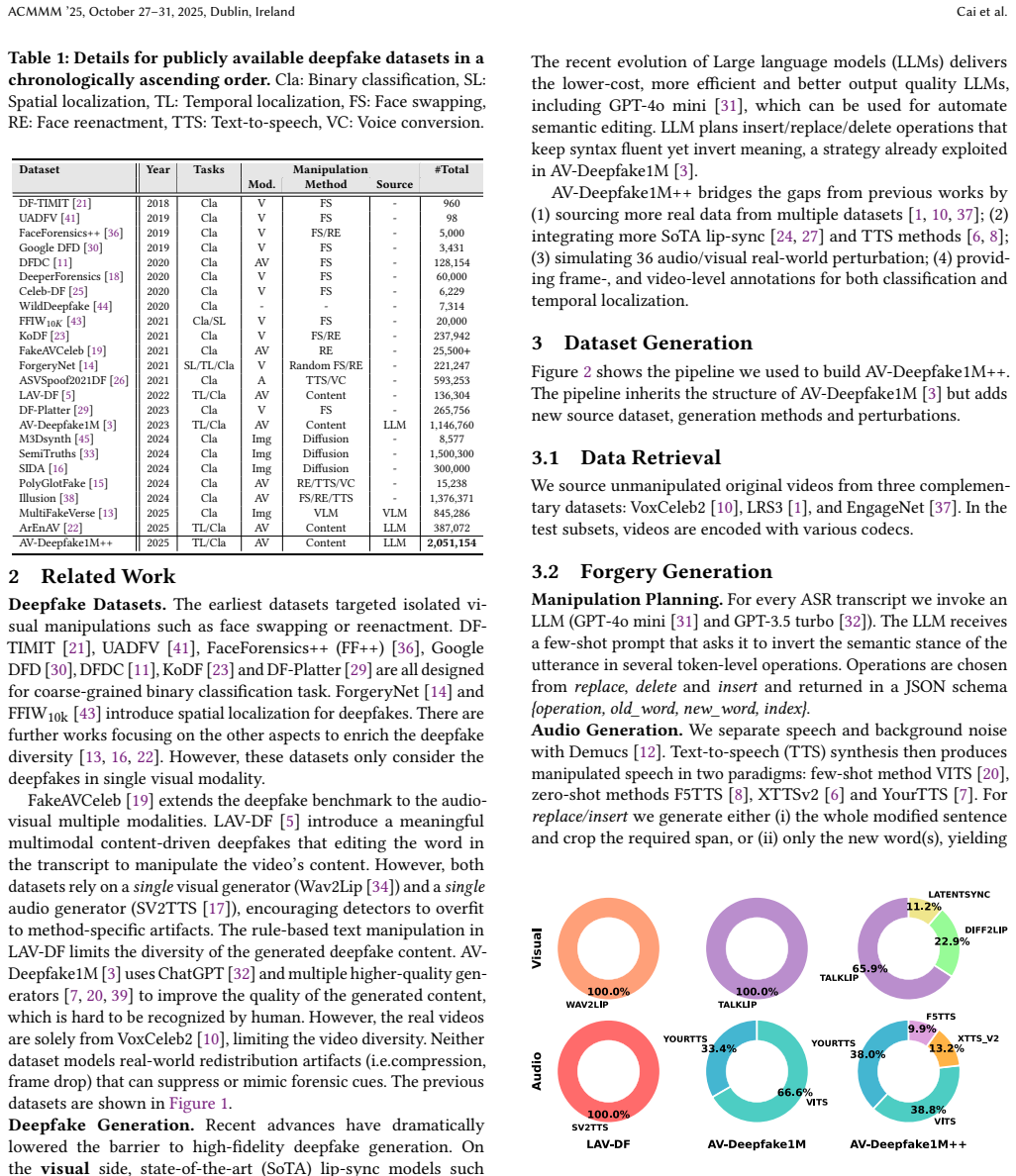
The load-bearing machinery is the automated generation pipeline: an LLM plans word-level edits, text-to-speech models synthesize the manipulated audio, lip-sync models re-render the mouth region, and post-processing assembles edited segments into untouched video and applies audio and visual perturbations. The four manipulation types separate audio and visual contributions, and the split design isolates perturbations between training and test so that testA and testB measure cross-domain generalization. Dataset statistics—2,051,154 clips, 7,109 subjects, 4,655.9 hours—and a held-out identity/source/generator separation carry the claim that this is a large, diverse benchmark rather than a simple collection of fakes.
What would settle it
Take a random sample of, say, 1,000 clips from the fake split of AV-Deepfake1M++, and have human annotators or an independently trained audio-visual synchronization model verify that each clip actually contains the intended semantic change and that the audio and visual manipulations are aligned in time. If a non-trivial fraction of clips are mislabeled or misaligned, the benchmark's labels and the leaderboard numbers derived from them would need to be recomputed.
Extended reading notes
Core claim
The central claim is that a deepfake benchmark needs scale, generation diversity, and real-world perturbations together, and that AV-Deepfake1M++ provides all three. Real clips come from VoxCeleb2, LRS3, and EngageNet, covering interviews, TED talks, and conversational meetings. Fake clips are produced by an LLM that plans token-level insert, replace, and delete edits to invert the meaning of spoken sentences, followed by one of four text-to-speech models for speech and one of three lip-sync models for video, yielding four manipulation types: real, fake audio with real video, real audio with fake video, and fully fake. After assembly, clips may receive zero to several of 36 perturbations. On this material the best challenge entry reaches 97.83 AUC on testA classification, while the strongest prior temporal-localization baseline collapses to 14.71 AP@0.5, which the paper attributes to the new perturbations and unseen synthesis pipelines.
Load-bearing premise
The automatic generation pipeline assumes every assembled clip is correctly labeled; if the language model's semantic edit, the synthesized speech, or the lip-sync alignment fails, the clip's real/fake label and segment boundaries are wrong and every benchmark score inherits that error.
Editorial extensions
If this is right
- Detectors trained on AV-Deepfake1M++ must face unseen generation methods and perturbation schedules in testA and testB, so leaderboard scores reflect cross-domain robustness rather than in-domain memorization.
- The reported collapse of BA-TFD+ from 96.30 AP@0.5 on LAV-DF to 14.71 AP@0.5 on AV-Deepfake1M++ indicates that perturbation diversity can invalidate methods tuned to artifacts of a single generator.
- The four manipulation types and frame-level annotations allow separate evaluation of audio-only, video-only, and fully cross-modal forgery detection and localization.
- With best classification AUC at 97.83 but top localization score near 67, classification appears close to saturated while temporal localization remains the open problem.
Reading between the lines
- Because every clip is labeled by an automatic pipeline with no reported verification step, a human audit of a random sample would be the natural check on label quality; all benchmark numbers inherit that pipeline's error rate until then.
- Since perturbations are separated between training and test sets, test scores measure a mixture of forgery detection and robustness to distribution shift; a detector that keys on perturbation artifacts rather than semantic manipulation could still score well without truly understanding forgeries.
- An extension the paper does not test is whether training on AV-Deepfake1M++ transfers to other benchmarks such as FaceForensics++ or DFDC; a positive transfer result would strengthen the claim that the dataset captures general forgery cues.
- The choice of LLM-planned meaning inversion points to a future in which fakes act at the level of content semantics, not low-level pixels or waveforms, which would push detection toward checking audio-visual semantic consistency across modalities.
Signed reviews
Editorial analysis
A structured set of objections, weighed in public.
Referee Report
Summary. The paper introduces AV-Deepfake1M++, a large-scale audio-visual deepfake benchmark containing 2,051,154 clips (about 4,655.9 hours) built from VoxCeleb2, LRS3, and EngageNet. The generation pipeline uses an LLM to plan token-level insert/replace/delete edits, TTS models to synthesize modified speech, and lip-sync models to synthesize modified video; 36 audio-visual perturbations are then applied. The paper defines train/validation/testA/testB splits, reports dataset statistics, and benchmarks classification and temporal-localization methods, including results from the 2025 1M-Deepfakes Detection Challenge.
Significance. If the labels and manipulated-segment boundaries are correct, AV-Deepfake1M++ is a substantial community resource: it roughly doubles the scale of AV-Deepfake1M, adds source diversity, expands generation and perturbation diversity, and provides externally evaluated held-out test sets. The arithmetic in Table 3 is internally consistent, and the use of an independent challenge leaderboard is a practical strength. The main open question is whether the fully automatic generation pipeline produces reliable ground truth, since the paper does not report any verification or failure-rate analysis.
major comments (3)
- [Section 3.2, Tables 4-6] The dataset labels clips by provenance: every clip that passes through the pipeline is 'fake', and temporal localization annotations are inherited from the LLM's token-level plan without verification. The paper reports no quality-control step and no failure-rate measurement for the TTS, lip-sync, or assembly stages. If an LLM edit is not realized, if TTS duration drifts, or if lip-sync output is misaligned, the fake/real label or the segment boundary is wrong, and every AUC/AP/AR in Tables 4-6 is affected. Please add a validation protocol, such as ASR transcript verification, SyncNet consistency scoring, a human sample study, and per-pipeline failure rates, and report the results.
- [Section 1 and Table 2] The contribution bullet states that the pipeline includes 'nine state-of-the-art models' but Section 3.2 and Table 2 enumerate only seven (TalkLip, LatentSync, Diff2Lip; VITS, F5TTS, XTTSv2, YourTTS). The introduction also names 'visual-LipSync' and 'V ALLEX', which do not appear in Table 2. Please correct the count or list all models, and remove the four blank placeholder rows from Table 2; as written, the headline diversity claim is not auditable.
- [Section 4.3 and Table 2] The abstract and introduction claim '15 video-level and 11 audio-level distortions', but Table 2 lists 21 visual and 15 audio perturbation methods (36 unique rows, with PAD_SIMULATION duplicated). Please clarify whether the counts refer to a subset of perturbations, remove duplicate rows, and align the text with the table. The '36 perturbations' claim is a central contribution and must be precisely documented.
minor comments (5)
- [Section 5.1, Tables 5-6] The 'Score' column in Tables 5 and 6 is not defined; specify how the averaged AP and AR values are combined.
- [Table 4] TestB AUC is reported only for the Xception baseline; state whether the challenge teams were evaluated on TestB and, if so, provide the results.
- [Section 5.2] The sentence 'Pindrop Labs surpasses BA-TFD+ by ≈ 0.52 of the localization score' is ambiguous; the actual difference is 52.49 points (67.20 vs 14.71).
- [Section 3.1] The claim that test videos are 'encoded with various codecs' is not supported by any details; list the codecs and encoding parameters or remove the claim.
- [General] There are several language and formatting issues (e.g., 'we require datasets that rich in type' in the abstract, and the broken running title 'A V-Deepfake1M++'); a careful copyedit is needed.
Circularity Check
No significant circularity: the benchmark is constructed from external corpora and generators and evaluated on held-out splits by independent challenge teams.
full rationale
AV-Deepfake1M++ is a dataset-construction and empirical-benchmarking paper rather than a derivation of a predicted quantity from fitted inputs. Its central claims—scale (2,051,154 clips), source diversity (VoxCeleb2, LRS3, EngageNet), generation diversity (multiple TTS and lip-sync models), and perturbation coverage—are supported by direct counts, by the described pipeline, and by held-out evaluations reported from external challenge teams (e.g., XJTU SunFlower Lab, Pindrop Labs). The forgery-generation pipeline in Section 3.2 is operational: an LLM plans token-level operations, Demucs separates speech from background noise, TTS and lip-sync pools synthesize content, and post-processing assembles the clip. Fake labels are assigned by provenance from that generation process; this is the standard definitional labeling of a synthetic benchmark, not a fitted prediction. The paper's self-citations to AV-Deepfake1M [3], LAV-DF [5], and BA-TFD+ [4] serve as pipeline ancestry and baseline methods, but they do not carry the load of the new benchmark's claims; the scores are measured on held-out TestA/TestB, and the best results come from non-author teams. The main weakness noted externally—absence of a stated quality-control or verification step for LLM/TTS/lip-sync outputs—is a genuine correctness and documentation risk for label reliability, but it is not circularity: any misalignment or failed edit would be an implementation defect, not a logical reduction of the dataset claim to its own inputs. Internal inconsistencies such as the 'nine' generation models in Section 1 versus the seven enumerated in Section 3.2 and Table 2, and the blank rows in Table 2, are documentation issues and do not constitute circular steps.
Assumptions & free parameters
assumptions (4)
- domain assumption VoxCeleb2, LRS3, and EngageNet videos are unmanipulated and correctly labeled real.
- domain assumption The LLM-generated edit plans and the TTS and lip-sync outputs faithfully implement the intended semantic manipulations.
- domain assumption The 36 perturbations are representative of real-world streaming and redistribution artifacts.
- domain assumption The benchmark splits and metrics measure cross-domain generalization as claimed.
Cite this review
Pith. "Pith review of AV-Deepfake1M++: A Large-Scale Audio-Visual Deepfake Benchmark with Real-World Perturbations." pith.science (2026). https://pith.science/paper/HYDZ4M2N
@misc{pith2026250720579,
  author       = {Pith},
  title        = {Pith review of: AV-Deepfake1M++: A Large-Scale Audio-Visual Deepfake Benchmark with Real-World Perturbations},
  year         = {2026},
  howpublished = {\url{https://pith.science/paper/HYDZ4M2N}},
  note         = {Machine review of arXiv:2507.20579}
}
read the original abstract
The rapid surge of text-to-speech and face-voice reenactment models makes video fabrication easier and highly realistic. To encounter this problem, we require datasets that rich in type of generation methods and perturbation strategy which is usually common for online videos. To this end, we propose AV-Deepfake1M++, an extension of the AV-Deepfake1M having 2 million video clips with diversified manipulation strategy and audio-visual perturbation. This paper includes the description of data generation strategies along with benchmarking of AV-Deepfake1M++ using state-of-the-art methods. We believe that this dataset will play a pivotal role in facilitating research in Deepfake domain. Based on this dataset, we host the 2025 1M-Deepfakes Detection Challenge. The challenge details, dataset and evaluation scripts are available online under a research-only license at https://deepfakes1m.github.io/2025.
Figures


Figures from the paper (1 more)

Forward citations
Cited by 2 Pith papers
-
HOLA: Enhancing Audio-visual Deepfake Detection via Hierarchical Contextual Aggregations and Efficient Pre-training
A two-stage audio-visual deepfake detector, HOLA, uses 1.81M pre-training samples and hierarchical cross-modal fusion modules to achieve first place and near-perfect AUC on AV-Deepfake1M++ video-level detection.
-
KLASSify to Verify: Audio-Visual Deepfake Detection Using SSL-based Audio and Handcrafted Visual Features
A challenge entry combining Wav2Vec-AASIST audio scores with lightweight handcrafted-feature video scores via calibration and maxout reports 92.78% AUC on AV-Deepfake1M++ testA.
Reference graph
Works this paper leans on
-
[1]
Triantafyllos Afouras, Joon Son Chung, and Andrew Zisserman. 2018. LRS3-TED: a large-scale dataset for visual speech recognition. doi:10.48550/arXiv.1809.00496 arXiv:1809.00496 [cs]
-
[2]
Zhixi Cai, Abhinav Dhall, Shreya Ghosh, Munawar Hayat, Dimitrios Kollias, Kalin Stefanov, and Usman Tariq. 2024. 1M-Deepfakes Detection Challenge. In Proceedings of the 32nd ACM International Conference on Multimedia (MM ’24). Association for Computing Machinery, New York, NY, USA, 11355–11359. doi:10.1145/3664647.3689145
arXiv 2024
-
[3]
Zhixi Cai, Shreya Ghosh, Aman Pankaj Adatia, Munawar Hayat, Abhinav Dhall, Tom Gedeon, and Kalin Stefanov. 2024. AV-Deepfake1M: A Large-Scale LLM- Driven Audio-Visual Deepfake Dataset. In Proceedings of the 32nd ACM Interna- tional Conference on Multimedia (MM ’24). Association for Computing Machinery, New York, NY, USA, 7414–7423. doi:10.1145/3664647.3680795
arXiv 2024
-
[4]
Zhixi Cai, Shreya Ghosh, Abhinav Dhall, Tom Gedeon, Kalin Stefanov, and Munawar Hayat. 2023. Glitch in the matrix: A large scale benchmark for content driven audio–visual forgery detection and localization. Computer Vision and Image Understanding 236 (Nov. 2023), 103818. doi:10.1016/j.cviu.2023.103818
arXiv 2023
-
[5]
Zhixi Cai, Kalin Stefanov, Abhinav Dhall, and Munawar Hayat. 2022. Do You Re- ally Mean That? Content Driven Audio-Visual Deepfake Dataset and Multimodal Method for Temporal Forgery Localization. In 2022 International Conference on Digital Image Computing: Techniques and Applications (DICTA). Sydney, Australia, 1–10. doi:10.1109/DICTA56598.2022.10034605
arXiv 2022
-
[6]
Edresson Casanova, Kelly Davis, Eren Gölge, Görkem Göknar, Iulian Gulea, Logan Hart, Aya Aljafari, Joshua Meyer, Reuben Morais, Samuel Olayemi, and Julian Weber. 2024. XTTS: a Massively Multilingual Zero-Shot Text-to-Speech Model. doi:10.48550/arXiv.2406.04904 arXiv:2406.04904 [cs, eess]
-
[7]
Shulby, Arnaldo Candido Junior, Eren Gölge, and Moacir A
Edresson Casanova, Julian Weber, Christopher D. Shulby, Arnaldo Candido Junior, Eren Gölge, and Moacir A. Ponti. 2022. YourTTS: Towards Zero-Shot Multi- Speaker TTS and Zero-Shot Voice Conversion for Everyone. In Proceedings of the 39th International Conference on Machine Learning . PMLR, 2709–2720. https: //proceedings.mlr.press/v162/casanova22a.html ISS...
work page 2022
-
[8]
Yushen Chen, Zhikang Niu, Ziyang Ma, Keqi Deng, Chunhui Wang, Jian Zhao, Kai Yu, and Xie Chen. 2025. F5-TTS: A Fairytaler that Fakes Fluent and Faithful Speech with Flow Matching. doi:10.48550/arXiv.2410.06885 arXiv:2410.06885 [eess]
Show all 47 references
-
[9]
Francois Chollet. 2017. Xception: Deep Learning With Depthwise Separable Convolutions. In Proceedings of the IEEE Conference on Computer Vision and Pattern Recognition. 1251–1258. https://openaccess.thecvf.com/content_cvpr_ 2017/html/Chollet_Xception_Deep_Learning_CVPR_2017_paper.html
2017
-
[10]
Joon Son Chung, Arsha Nagrani, and Andrew Zisserman. 2018. VoxCeleb2: Deep Speaker Recognition. In Interspeech 2018. ISCA, 1086–1090. doi:10.21437/ Interspeech.2018-1929
2018
-
[11]
Brian Dolhansky, Joanna Bitton, Ben Pflaum, Jikuo Lu, Russ Howes, Menglin Wang, and Cristian Canton Ferrer. 2020. The DeepFake Detection Challenge (DFDC) Dataset. http://arxiv.org/abs/2006.07397 arXiv: 2006.07397 [cs]
2020 arXiv
-
[12]
Alexandre Défossez, Gabriel Synnaeve, and Yossi Adi. 2020. Real Time Speech Enhancement in the Waveform Domain. In Interspeech 2020. Shanghai, China, 3291–3295. doi:10.21437/Interspeech.2020-2409
2020 doi
-
[13]
Parul Gupta, Shreya Ghosh, Tom Gedeon, Thanh-Toan Do, and Abhinav Dhall
-
[14]
Yinan He, Bei Gan, Siyu Chen, Yichun Zhou, Guojun Yin, Luchuan Song, Lu Sheng, Jing Shao, and Ziwei Liu. 2021. ForgeryNet: A Versatile Benchmark for Comprehensive Forgery Analysis. In Proceedings of the IEEE/CVF Conference on Computer Vision and Pattern Recognition . 4360–4369...
2021
-
[15]
Yang Hou, Haitao Fu, Chunkai Chen, Zida Li, Haoyu Zhang, and Jianjun Zhao
-
[16]
Zhenglin Huang, Jinwei Hu, Xiangtai Li, Yiwei He, Xingyu Zhao, Bei Peng, Baoyuan Wu, Xiaowei Huang, and Guangliang Cheng. 2025. SIDA: Social Media Image Deepfake Detection, Localization and Explanation with Large Multimodal Model. In Proceedings of the Computer Vision and Patt...
2025
-
[17]
In Pattern Recognition, Apostolos Antonacopoulos, Subhasis Chaudhuri, Rama Chel- lappa, Cheng-Lin Liu, Saumik Bhattacharya, and Umapada Pal (Eds.)
PolyGlotFake: A Novel Multilingual and Multimodal DeepFake Dataset. In Pattern Recognition, Apostolos Antonacopoulos, Subhasis Chaudhuri, Rama Chel- lappa, Cheng-Lin Liu, Saumik Bhattacharya, and Umapada Pal (Eds.). Springer Nature Switzerland, Cham, 180–193. doi:10.1007/978-3...
-
[18]
Liming Jiang, Ren Li, Wayne Wu, Chen Qian, and Chen Change Loy. 2020. DeeperForensics-1.0: A Large-Scale Dataset for Real-World Face Forgery Detection. In Proceedings of the IEEE/CVF Conference on Computer Vision and Pattern Recognition. 2889–2898. https://openaccess.thecvf.co...
2020
-
[19]
Weiss, Quan Wang, Jonathan Shen, Fei Ren, Zhifeng Chen, Patrick Nguyen, Ruoming Pang, Ignacio Lopez Moreno, and Yonghui Wu
Ye Jia, Yu Zhang, Ron J. Weiss, Quan Wang, Jonathan Shen, Fei Ren, Zhifeng Chen, Patrick Nguyen, Ruoming Pang, Ignacio Lopez Moreno, and Yonghui Wu. 2018. Transfer learning from speaker verification to multispeaker text-to- speech synthesis. In Proceedings of the 32nd Internat...
2018
-
[20]
Jaehyeon Kim, Jungil Kong, and Juhee Son. 2021. Conditional Variational Autoen- coder with Adversarial Learning for End-to-End Text-to-Speech. In Proceedings of the 38th International Conference on Machine Learning . PMLR, 5530–5540. https://proceedings.mlr.press/v139/kim21f.h...
2021
-
[21]
Hasam Khalid, Shahroz Tariq, Minha Kim, and Simon S. Woo. 2021. FakeAVCeleb: A Novel Audio-Video Multimodal Deepfake Dataset. In Thirty-fifth Conference on Neural Information Processing Systems Datasets and Benchmarks Track . https: //openreview.net/forum?id=TAXFsg6ZaOl
2021
- [22]
-
[23]
Pavel Korshunov and Sebastien Marcel. 2018. DeepFakes: a New Threat to Face Recognition? Assessment and Detection. http://arxiv.org/abs/1812.08685 arXiv:1812.08685 [cs]
2018 arXiv
- [24]
-
[25]
Patrick Kwon, Jaeseong You, Gyuhyeon Nam, Sungwoo Park, and Gyeongsu Chae. 2021. KoDF: A Large-Scale Korean DeepFake Detection Dataset. In Pro- ceedings of the IEEE/CVF International Conference on Computer Vision . 10744– 10753. https://openaccess.thecvf.com/content/ICCV2021/h...
2021
-
[26]
Xuechen Liu, Xin Wang, Md Sahidullah, Jose Patino, Héctor Delgado, Tomi Kinnunen, Massimiliano Todisco, Junichi Yamagishi, Nicholas Evans, Andreas Nautsch, and Kong Aik Lee. 2023. ASVspoof 2021: Towards Spoofed and Deepfake Speech Detection in the Wild. IEEE/ACM Transactions o...
2023
-
[27]
Yuezun Li, Xin Yang, Pu Sun, Honggang Qi, and Siwei Lyu. 2020. Celeb-DF: A Large-Scale Challenging Dataset for DeepFake Forensics. In Proceedings of the IEEE/CVF Conference on Computer Vision and Pattern Recognition . 3207–3216. https://openaccess.thecvf.com/content_CVPR_2020/...
2020
-
[28]
Abhijeet Narang, Parul Gupta, Liuyijia Su, and Abhinav Dhall. 2025. LayLens: Improving Deepfake Understanding through Simplified Explanations. arXiv preprint arXiv:2507.10066 (2025)
2025 arXiv
-
[29]
Soumik Mukhopadhyay, Saksham Suri, Ravi Teja Gadde, and Abhinav Shrivastava
-
[30]
Dufou Nick and Jigsaw Andrew. 2019. Contributing Data to Deepfake Detec- tion Research. http://ai.googleblog.com/2019/09/contributing-data-to-deepfake- detection.html
2019
-
[31]
OpenAI. 2024. GPT-4o System Card. http://arxiv.org/abs/2410.21276
2024 arXiv
-
[32]
Kartik Narayan, Harsh Agarwal, Kartik Thakral, Surbhi Mittal, Mayank Vatsa, and Richa Singh. 2023. DF-Platter: Multi-Face Het- erogeneous Deepfake Dataset. In Proceedings of the IEEE/CVF Confer- ence on Computer Vision and Pattern Recognition . 9739–9748. https: //openaccess.t...
2023
-
[33]
Anisha Pal, Julia Kruk, Mansi Phute, Manognya Bhattaram, Diyi Yang, Duen Horng Chau, and Judy Hoffman. 2024. Semi-Truths: A Large- Scale Dataset of AI-Augmented Images for Evaluating Robustness of AI-Generated Image detectors. In Advances in Neural Information Pro- cessing Sys...
2024
-
[34]
Namboodiri, and C.V
K R Prajwal, Rudrabha Mukhopadhyay, Vinay P. Namboodiri, and C.V. Jawahar
-
[35]
Christiano, Jan Leike, and Ryan Lowe
Long Ouyang, Jeffrey Wu, Xu Jiang, Diogo Almeida, Carroll Wainwright, Pamela Mishkin, Chong Zhang, Sandhini Agarwal, Katarina Slama, Alex Ray, John Schulman, Jacob Hilton, Fraser Kelton, Luke Miller, Maddie Simens, Amanda Askell, Peter Welinder, Paul F. Christiano, Jan Leike, ...
2022
-
[36]
Andreas Rossler, Davide Cozzolino, Luisa Verdoliva, Christian Riess, Justus Thies, and Matthias Niessner. 2019. FaceForensics++: Learning to Detect Manipulated Facial Images. In Proceedings of the IEEE/CVF International Conference on Computer Vision . 1–11. https://openaccess....
2019
-
[37]
Monisha Singh, Ximi Hoque, Donghuo Zeng, Yanan Wang, Kazushi Ikeda, and Abhinav Dhall. 2023. Do I Have Your Attention: A Large Scale Engagement Pre- diction Dataset and Baselines. In Proceedings of the 25th International Conference on Multimodal Interaction (ICMI ’23). Associa...
2023
-
[38]
Kartik Thakral, Rishabh Ranjan, Akanksha Singh, Akshat Jain, Mayank Vatsa, and Richa Singh. 2024. ILLUSION: Unveiling Truth with a Comprehensive Multi- Modal, Multi-Lingual Deepfake Dataset. In The Thirteenth International Confer- ence on Learning Representations. https://open...
2024
-
[41]
Xin Yang, Yuezun Li, and Siwei Lyu. 2019. Exposing Deep Fakes Using Incon- sistent Head Poses. In IEEE International Conference on Acoustics, Speech and Signal Processing (ICASSP). 8261–8265. doi:10.1109/ICASSP.2019.8683164 ISSN: 2379-190X
2019
-
[42]
Yi Zhang, Changtao Miao, Man Luo, Jianshu Li, Wenzhong Deng, Weibin Yao, Zhe Li, Bingyu Hu, Weiwei Feng, Tao Gong, and Qi Chu. 2024. MFMS: Learn- ing Modality-Fused and Modality-Specific Features for Deepfake Detection and Localization Tasks. In Proceedings of the 32nd ACM Int...
2024
-
[43]
Tan, and Haizhou Li
Jiadong Wang, Xinyuan Qian, Malu Zhang, Robby T. Tan, and Haizhou Li. 2023. Seeing What You Said: Talking Face Genera- tion Guided by a Lip Reading Expert. In Proceedings of the IEEE/CVF Conference on Computer Vision and Pattern Recognition . 14653–14662. https://openaccess.th...
2023
-
[44]
Bojia Zi, Minghao Chang, Jingjing Chen, Xingjun Ma, and Yu-Gang Jiang. 2020. WildDeepfake: A Challenging Real-World Dataset for Deepfake Detection. In Proceedings of the 28th ACM International Conference on Multimedia (MM ’20) . Association for Computing Machinery, New York, N...
2020
-
[45]
Zingarini, D
G. Zingarini, D. Cozzolino, R. Corvi, G. Poggi, and L. Verdoliva. 2024. M3DSYNTH: A Dataset of Medical 3D Images with AI-Generated Local Manipulations. In ICASSP 2024 - 2024 IEEE International Conference on Acoustics, Speech and Signal Processing (ICASSP). 13176–13180. doi:10....
2024
-
[47]
Tianfei Zhou, Wenguan Wang, Zhiyuan Liang, and Jianbing Shen. 2021. Face Forensics in the Wild. In Proceedings of the IEEE/CVF Conference on Computer Vi- sion and Pattern Recognition . 5778–5788. https://openaccess.thecvf.com/content/ CVPR2021/html/Zhou_Face_Forensics_in_the_W...
2021
-
[2020]
In Proceedings of the 28th ACM International Conference on Multimedia (MM ’20)
A Lip Sync Expert Is All You Need for Speech to Lip Generation In the Wild. In Proceedings of the 28th ACM International Conference on Multimedia (MM ’20). Association for Computing Machinery, New York, NY, USA, 484–492. ACMMM ’25, October 27–31, 2025, Dublin, Ireland Cai et a...
2025
-
[2024]
In Proceedings of the IEEE/CVF Winter Conference on Applications of Computer Vision
Diff2Lip: Audio Conditioned Diffusion Models for Lip-Synchronization. In Proceedings of the IEEE/CVF Winter Conference on Applications of Computer Vision. 5292–5302. https://openaccess.thecvf.com/content/WACV2024/html/ Mukhopadhyay_Diff2Lip_Audio_Conditioned_Diffusion_Models_f...
- [2025]
Reviewed August 15, 2026 · model on record in the stance chip above.
Discussion (0). Continue with ORCID to comment.