High-harmonic spin-current signatures of altermagnetic spin-group symmetry
Pith reviewed 2026-07-01 03:57 UTC · model grok-4.3
The pith
Spin current harmonics distinguish altermagnetic spin-group phases from other magnetic orders under specific laser drives.
A machine-rendered reading of the paper's core claim, the machinery that carries it, and where it could break.
Core claim
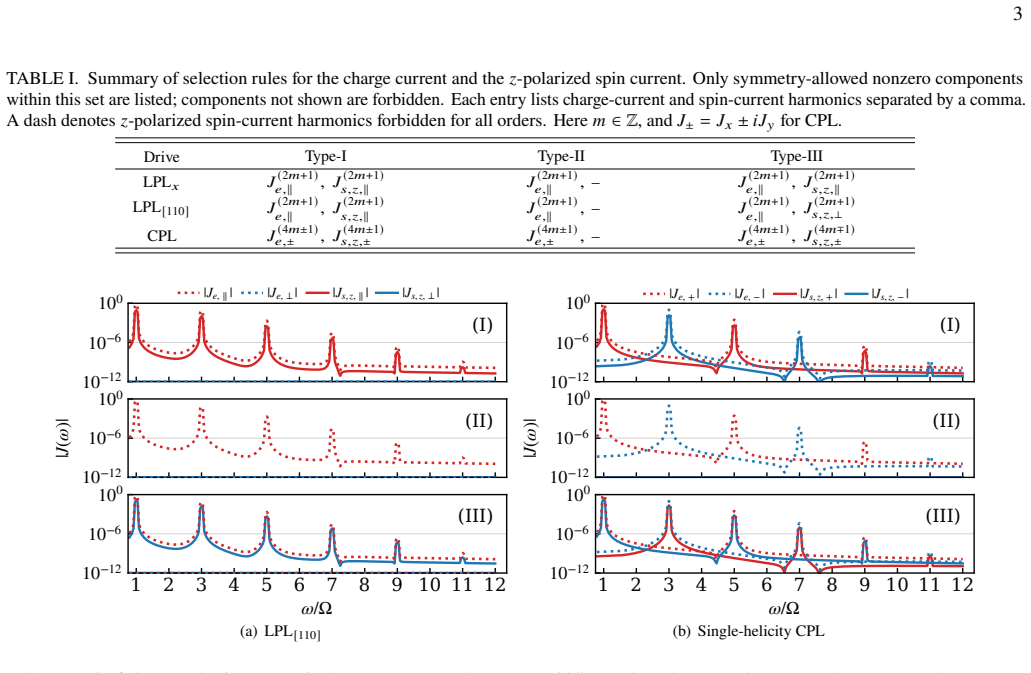
Extending dynamical symmetry to spin point group operations yields selection rules showing that spin-current harmonics under diagonal linearly polarized drive distinguish the three spin point group phases, while single-helicity circularly polarized drive distinguishes them from magnetic-point-group mimics; axis-aligned linear drive already separates the antiferromagnetic phase by the absence of harmonics.
What carries the argument
Dynamical symmetry extended to spin point group operations, which act on both real space and spin space and thereby constrain spin-current (but not charge-current) harmonics.
If this is right
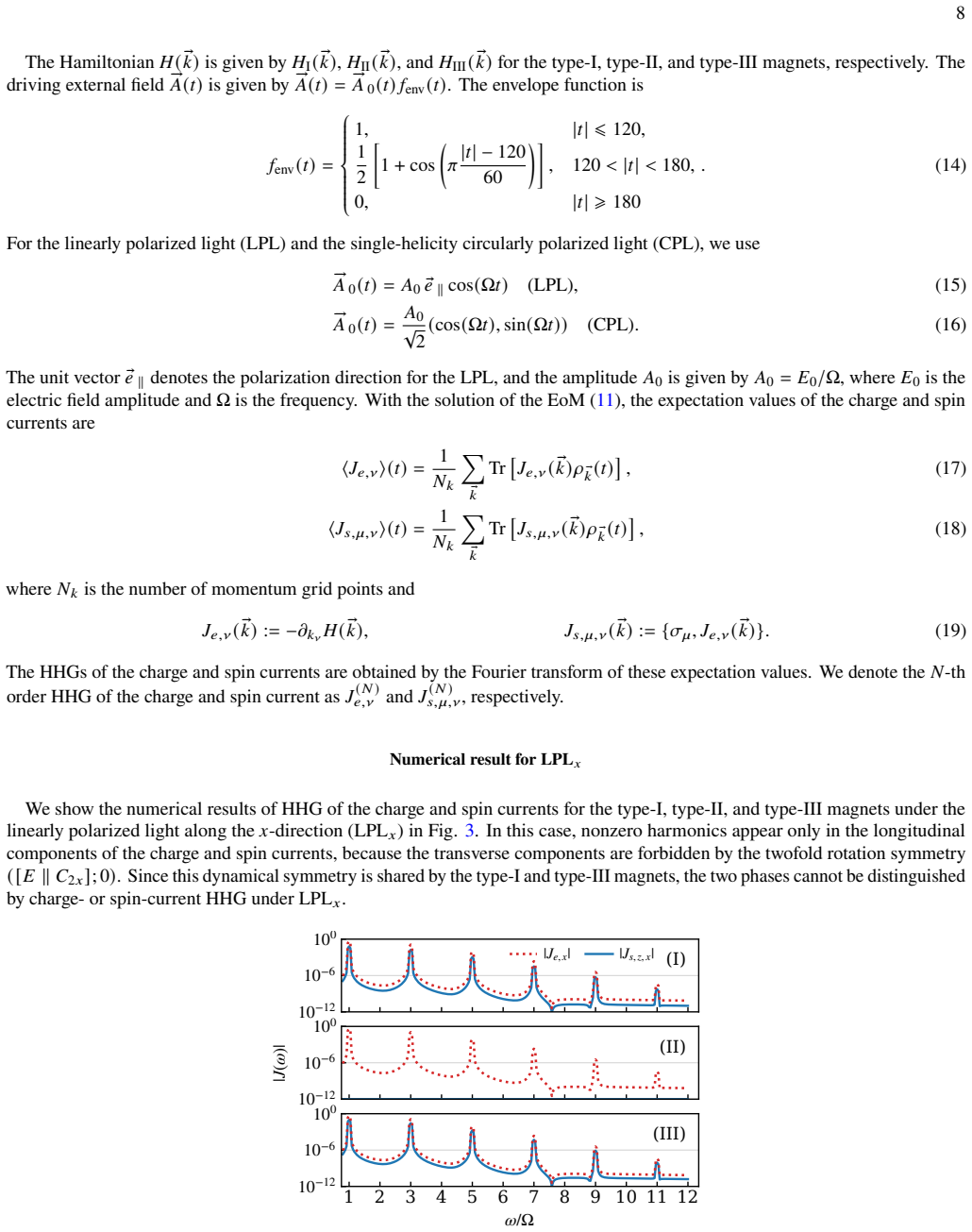
- Axis-aligned linearly polarized drive produces no spin-current harmonics in the antiferromagnetic phase while they appear in the other two phases.
- Diagonal linearly polarized drive produces distinct harmonic patterns that label each of the three spin point group phases.
- Single-helicity circularly polarized drive yields a sharper harmonic signature separating spin point group phases from magnetic point group mimics.
Where Pith is reading between the lines
- The same symmetry-extension approach could be applied to other time-periodic drives or to nonlinear responses beyond high-harmonic generation.
- Experimental mapping of spin-current harmonic intensities versus polarization angle would provide a direct test of the predicted distinctions.
- The method supplies a route to identify altermagnets in thin-film or heterostructure geometries where static probes are limited.
Load-bearing premise
The analysis assumes the weak spin-orbit coupling regime in which spin point groups classify the static properties of the magnetic phases.
What would settle it
Observation of the predicted presence or absence of specific spin-current harmonics (for example, even versus odd orders) under diagonal linear or single-helicity circular polarization in a candidate altermagnet would confirm or refute the derived selection rules.
Figures
read the original abstract
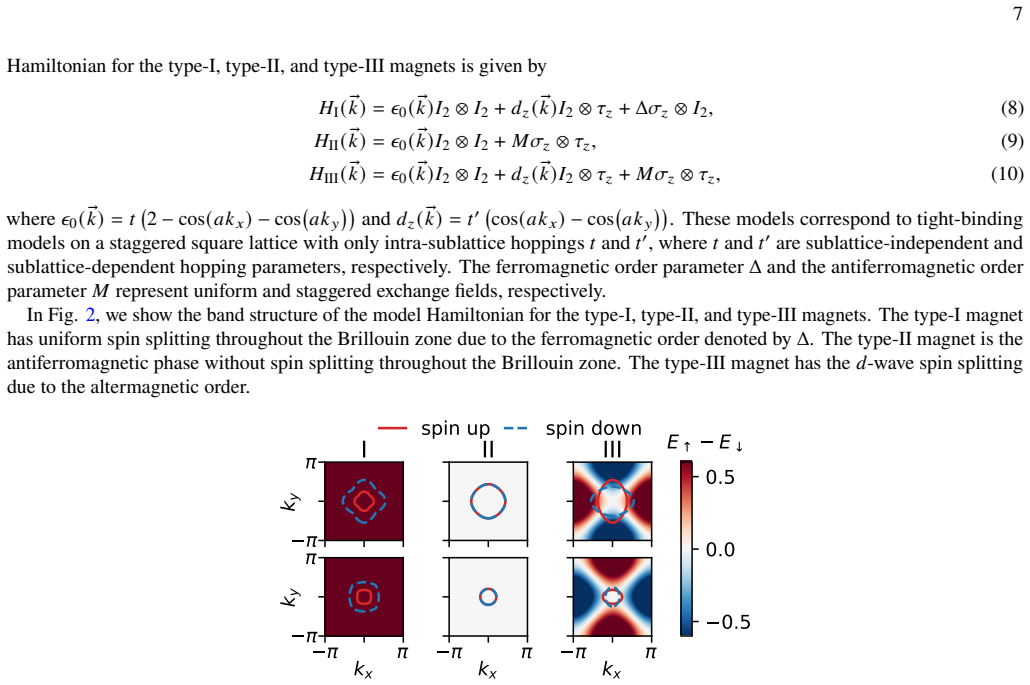
Spin point groups classify magnetic phases in the weak spin-orbit coupling regime and characterize the static properties of altermagnetic phases, but their dynamical consequences remain largely unexplored. Here, we derive selection rules for high-harmonic generation of charge and spin currents by extending dynamical symmetry to include spin point group operations. Since spin currents transform under both real and spin space operations, whereas charge currents transform only under real space operations, spin current selection rules can reveal magnetic information that is inaccessible to charge current harmonics. In a minimal altermagnetic model, an axis-aligned linearly polarized drive is non-diagnostic for distinguishing ferromagnetic and altermagnetic phases, although the antiferromagnetic phase is distinguished by the absence of the corresponding spin-current harmonics. A diagonal linearly polarized drive distinguishes the three SPG phases within the weak-SOC spin-group description, whereas a single-helicity circularly polarized drive provides a sharper spin-current-harmonic criterion for distinguishing them from magnetic-point-group mimics. These results establish spin current harmonics as a dynamical probe of spin group symmetry.
Editorial analysis
A structured set of objections, weighed in public.
Referee Report
Summary. The manuscript derives selection rules for high-harmonic generation of charge and spin currents by extending dynamical symmetry operations to include spin point group (SPG) elements. In a minimal altermagnetic model under the weak-SOC regime, an axis-aligned linearly polarized drive fails to distinguish ferromagnetic from altermagnetic phases (though antiferromagnetic is distinguished by absent spin-current harmonics), a diagonal linearly polarized drive separates the three SPG phases, and a single-helicity circularly polarized drive supplies a sharper criterion to separate SPG phases from magnetic-point-group mimics. The central result is that spin-current harmonics, which transform under both real and spin space, can serve as a dynamical probe of SPG symmetry inaccessible to charge currents.
Significance. If the symmetry extension and resulting selection rules hold, the work is significant because it supplies the first explicit dynamical probe of spin-group symmetries in altermagnets, a class whose static properties are already classified by SPGs but whose nonequilibrium responses remain largely uncharted. The derivation is parameter-free and yields concrete, falsifiable predictions for three distinct drive polarizations, which is a clear strength for guiding future HHG experiments in magnetic materials.
minor comments (3)
- The abstract states that selection rules were derived but does not reference the explicit transformation rules or the minimal-model Hamiltonian; adding one sentence with the key operator transformation or the model form would improve accessibility without lengthening the abstract.
- Notation for the three SPG phases and their MPG mimics should be introduced once with a compact table or diagram early in the text so that the drive-configuration comparisons can be followed without repeated back-referencing.
- Figure captions for any harmonic spectra should explicitly state the polarization direction, helicity, and which current component (charge or spin) is plotted, to avoid ambiguity when comparing the three drive cases.
Simulated Author's Rebuttal
We thank the referee for their positive assessment of the manuscript, the clear summary of our results on spin-current high-harmonic selection rules, and the recommendation for minor revision. No specific major comments were provided in the report.
Circularity Check
No significant circularity; derivation is self-contained symmetry extension
full rationale
The paper derives selection rules for high-harmonic spin and charge currents by extending dynamical symmetry operations to include spin point group elements. This follows directly from the stated transformation properties (spin currents under both real and spin space, charge currents under real space only) applied to a minimal altermagnetic model and specific drive polarizations. No steps reduce by construction to fitted parameters, self-citations, or redefined inputs; the distinctions between SPG phases and MPG mimics are logical consequences of the symmetry rules rather than tautological. The analysis remains within the weak-SOC regime assumption without smuggling ansatzes or renaming known results as new derivations.
Axiom & Free-Parameter Ledger
axioms (1)
- domain assumption Spin point groups classify magnetic phases in the weak spin-orbit coupling regime
Reference graph
Works this paper leans on
-
[1]
(b)Theredandbluelinescorrespondtotheright-handed (+) and left-handed (−) circular components of the charge (dotted) and spin (solid) currents, respectively
The red and blue lines correspond to the parallel and perpendicularcomponentsofthecharge(dotted)andspin(solid)currents, respectively. (b)Theredandbluelinescorrespondtotheright-handed (+) and left-handed (−) circular components of the charge (dotted) and spin (solid) currents, respectively. The LPL selection rule, however, should not be overinter- preted a...
-
[2]
Weyl, The theory of groups and quantum mechanics (Courier Corporation, 1950)
H. Weyl, The theory of groups and quantum mechanics (Courier Corporation, 1950)
1950
-
[3]
D. B. Litvin, Spin point groups, Acta Crystallographica Section A33, 279 (1977)
1977
-
[4]
P. Liu, J. Li, J. Han, X. Wan, and Q. Liu, Spin-group symmetry in magnetic materials with negligible spin-orbit coupling, Phys. Rev. X12, 10.1103/physrevx.12.021016 (2022)
-
[5]
L. Šmejkal, J. Sinova, and T. Jungwirth, Beyond conventional ferromagnetism and antiferromagnetism: A phase with nonrel- ativistic spin and crystal rotation symmetry, Phys. Rev. X12, 10.1103/physrevx.12.031042 (2022)
-
[7]
L. Bai, W. Feng, S. Liu, L. Šmejkal, Y. Mokrousov, and Y. Yao, Altermagnetism: Exploring new frontiers in mag- netism and spintronics, Advanced Functional Materials34, 10.1002/adfm.202409327 (2024)
-
[8]
R. Winkler, Spin—orbit coupling effects in two-dimensional electron and hole systems, Springer Tracts in Modern Physics 10.1007/b13586 (2003)
-
[9]
Sinova, S
J. Sinova, S. O. Valenzuela, J. Wunderlich, C. H. Back, and T. Jungwirth, Spin hall effects, Reviews of Modern Physics87, 1213 (2015)
2015
-
[10]
Žutić, J
I. Žutić, J. Fabian, and S. D. Sarma, Spintronics: Fundamentals and applications, Reviews of Modern Physics76, 323 (2004)
2004
-
[11]
C. Song, H. Bai, Z. Zhou, L. Han, H. Reichlova, J. H. Dil, J. Liu, X. Chen, and F. Pan, Altermagnets as a new class of functional materials, Nature Reviews Materials10, 473 (2025)
2025
-
[12]
Tamang, S
R. Tamang, S. Gurung, D. P. Rai, S. Brahimi, and S. Lounis, Altermagnetism and altermagnets: A brief review, Magnetism5, 17 (2025)
2025
-
[13]
Y. Zhang, H. Bai, J. Dai, L. Han, C. Chen, S. Liang, Y. Cao, Y. Zhang, Q. Wang, W. Zhu, F. Pan, and C. Song, Electrical ma- nipulation of spin splitting torque in altermagnetic ruo2, Nature Communications16, 10.1038/s41467-025-60891-2 (2025)
-
[14]
Samanta, D.-F
K. Samanta, D.-F. Shao, and E. Y. Tsymbal, Spin filtering with insulating altermagnets, Nano Letters25, 3150 (2025)
2025
-
[15]
Y. Nagae, A. P. Schnyder, and S. Ikegaya, Spin-polarized spec- ular andreev reflections in altermagnets, Phys. Rev. B111, 10.1103/physrevb.111.l100507 (2025)
-
[17]
Y. Nagae, A. P. Schnyder, and S. Ikegaya, Robust realization of spin-polarized specular andreev reflection in v2o-based alter- magnets (2026), arXiv:2604.12695
Pith/arXiv arXiv 2026
-
[18]
Y. Guo, J. Zhang, Z. Zhu, Y. Jiang, L. Jiang, C. Wu, J. Dong, X. Xu, W. He, B. He, Z. Huang, L. Du, G. Zhang, K. Wu, X. Han, D. Shao, G. Yu, and H. Wu, Direct and inverse spin splitting effects in altermagnetic ruo2, Advanced Science11, 5 10.1002/advs.202400967 (2024)
-
[19]
Ralph and M
D. Ralph and M. Stiles, Spin transfer torques, Journal of Mag- netism and Magnetic Materials320, 1190 (2008)
2008
-
[20]
Z.Li,Z.Zhang,Y.Chen,S.Hu,Y.Ji,Y.Yan,J.Du,Y.Li,L.He, X.Wang,J.Wu,R.Zhang,Y.Xu,andX.Lu,Fullyfield-freespin- orbittorqueswitchinginducedbyspinsplittingeffectinaltermag- netic ruo2, Advanced Materials37, 10.1002/adma.202416712 (2025)
-
[21]
J. Zhou and C. Zhang, Contrasting light-induced spin torque in antiferromagnetic and altermagnetic systems, Phys. Rev. Lett. 134, 10.1103/physrevlett.134.176902 (2025)
-
[23]
Y. Wu, L. Deng, X. Yin, J. Tong, F. Tian, and X. Zhang, Valley-related multipiezo effect and noncollinear spin current in an altermagnet Fe2Se2O monolayer, Nano Letters24, 10534 (2024)
2024
-
[24]
M. Ezawa, Third-order and fifth-order nonlinear spin-current generation in g -wave and i -wave altermagnets and perfectly nonreciprocal spin current in f -wave magnets, Phys. Rev. B111, 10.1103/physrevb.111.125420 (2025)
-
[25]
K. Sourounis and A. Manchon, Efficient generation of spin currents in altermagnets via magnon drag, Phys. Rev. B111, 10.1103/physrevb.111.134448 (2025)
-
[26]
Sinova, Transport theory and spin-transfer physics in d -wave altermagnets, Phys
R.Zarzuela, R.Jaeschke-Ubiergo, O.Gomonay, L.Šmejkal,and J. Sinova, Transport theory and spin-transfer physics in d -wave altermagnets, Phys. Rev. B111, 10.1103/physrevb.111.064422 (2025)
-
[27]
K. Uchino, Y. Ogawa, and S. Hayami, Analysis of spin current generation by elastic waves in f -wave altermagnets, Journal of thePhysicalSocietyofJapan95,10.7566/jpsj.95.034710(2026)
-
[28]
Ghimire and D
S. Ghimire and D. A. Reis, High-harmonic generation from solids, Nat. Phys.15, 10 (2019)
2019
-
[29]
L.YueandM.B.Gaarde,Introductiontotheoryofhigh-harmonic generation in solids: tutorial, Journal of the Optical Society of America B39, 535 (2022)
2022
-
[30]
Ly, Noncollinear antiferromagnetic textures driven high- harmonic generation from magnetic dynamics in the absence of spin-orbit coupling, J
O. Ly, Noncollinear antiferromagnetic textures driven high- harmonic generation from magnetic dynamics in the absence of spin-orbit coupling, J. Phys.: Condens. Matter35, 125802 (2023)
2023
-
[31]
P.Werner,M.Lysne,andY.Murakami,Highharmonicgeneration inaltermagnets,Phys.Rev.B110,10.1103/physrevb.110.235101 (2024)
-
[32]
M. Yarmohammadi and M. H. Kolodrubetz, Terahertz high- harmonic generation in gapped antiferromagnetic chains, Phys. Rev. B110, 10.1103/physrevb.110.134442 (2024)
-
[33]
F. Gabriele, C. Ortix, M. Cuoco, and F. Forte, Hallmarks of spin textures for high-harmonic generation in two-dimensional materials, Phys. Rev. B112, 10.1103/m4x3-fb5d (2025)
-
[35]
Ly, High-harmonic spin and charge pumping in altermagnets (2026), arXiv:2602.09738
O. Ly, High-harmonic spin and charge pumping in altermagnets (2026), arXiv:2602.09738
Pith/arXiv arXiv 2026
-
[36]
O. E. Alon, V. Averbukh, and N. Moiseyev, Selection rules for the high harmonic generation spectra, Phys. Rev. Lett.80, 3743 (1998)
1998
-
[37]
T. Morimoto, H. C. Po, and A. Vishwanath, Floquet topological phases protected by time glide symmetry, Phys. Rev. B95, 10.1103/physrevb.95.195155 (2017)
-
[38]
T. N. Ikeda and M. Sato, High-harmonic generation by electric polarization, spin current, and magnetization, Phys. Rev. B100, 10.1103/physrevb.100.214424 (2019)
-
[39]
O. Neufeld, D. Podolsky, and O. Cohen, Floquet group theory anditsapplicationtoselectionrulesinharmonicgeneration,Nat. Commun.10, 10.1038/s41467-018-07935-y (2019)
-
[40]
K. Chinzei and T. N. Ikeda, Time crystals protected by floquet dynamical symmetry in hubbard models, Phys. Rev. Lett.125, 10.1103/physrevlett.125.060601 (2020)
-
[41]
T. N. Ikeda, High-order nonlinear optical response of a twisted bilayer graphene, Phys. Rev. Res.2, 10.1103/physrevre- search.2.032015 (2020)
-
[43]
Hirori, S
H. Hirori, S. A. Sato, and Y. Kanemitsu, High-order harmonic generation in solids: The role of intraband transitions in extreme nonlinear optics, The Journal of Physical Chemistry Letters15, 2184 (2024)
2024
-
[44]
M. Kanega and M. Sato, High-harmonic generation in graphene under the application of a dc electric current: From perturbative to nonperturbative regime, Phys. Rev. B110, 10.1103/phys- revb.110.035303 (2024)
-
[45]
J.Liu,J.Zhan,T.Li,J.Liu,S.Cheng,Y.Shi,L.Deng,M.Zhang, C. Li, J. Ding, Q. Jiang, M. Ye, Z. Liu, Z. Jiang, S. Wang, Q. Li, Y. Xie, Y. Wang, S. Qiao, J. Wen, Y. Sun, and D. Shen, Absence of altermagnetic spin splitting character in rutile oxide ruo 2, Phys. Rev. Lett.133, 10.1103/physrevlett.133.176401 (2024)
-
[46]
O. Fedchenko, J. Minár, A. Akashdeep, S. W. D’Souza, D. Vasi- lyev, O. Tkach, L. Odenbreit, Q. Nguyen, D. Kutnyakhov, N. Wind, L. Wenthaus, M. Scholz, K. Rossnagel, M. Hoesch, M. Aeschlimann, B. Stadtmüller, M. Kläui, G. Schönhense, T.Jungwirth,A.B.Hellenes,G.Jakob,L.Šmejkal,J.Sinova,and H.-J. Elmers, Observation of time-reversal symmetry breaking in the ...
-
[47]
(2026), see Supplemental Material at [URL will be inserted by publisher] for the derivation of antiunitary and magnetic-point- group selection rules, additional LPL𝑥 spectra, and numerical parameters
2026
-
[48]
M. Weiler, J. M. Shaw, H. T. Nembach, and T. J. Silva, Phase- sensitive detection of spin pumping via the ac inverse spin hall effect, Phys. Rev. Lett.113, 10.1103/physrevlett.113.157204 (2014)
-
[49]
E. Saitoh, M. Ueda, H. Miyajima, and G. Tatara, Conversion of spin current into charge current at room temperature: Inverse spin-hall effect, Appl. Phys. Lett.88, 10.1063/1.2199473 (2006)
-
[50]
T. Kimura, Y. Otani, T. Sato, S. Takahashi, and S. Maekawa, Room-temperaturereversiblespinhalleffect,Phys.Rev.Lett.98, 10.1103/physrevlett.98.156601 (2007)
-
[51]
J. C. R. Sánchez, L. Vila, G. Desfonds, S. Gambarelli, J. P. Attané, J. M. D. Teresa, C. Magén, and A. Fert, Spin-to-charge conversion using rashba coupling at the interface between non- magnetic materials, Nat. Commun.4, 10.1038/ncomms3944 (2013). 6 SUPPLEMENTAL MATERIAL Antiunitary dynamical symmetries For the antiunitary dynamical symmetry𝐴𝜏 =(𝑔T;𝜏), a...
discussion (0)
Sign in with ORCID, Apple, or X to comment. Anyone can read and Pith papers without signing in.