REVIEW 3 major objections 5 minor 41 references
Guiding neutral polar molecules by electromagnetic vortex field --- a classical approach
T0 review · 3 major / 5 minor · reviewed 2026-08-14 · deepseek-v4-flash
Pith's one-line read Within classical mechanics, an electromagnetic vortex field can capture and guide neutral polar molecules along its axis.
desk verdict A careful classical treatment of vortex-beam guiding for polar molecules, internally sound but built on an idealized field whose real-beam validity remains open. read the letter →
The pith
A machine-rendered reading of the paper's core claim, the machinery that carries it, and where it could break.
The reading
What carries the argument
The central object is the idealized paraxial vortex field $\mathbf E(x,y,t)=E_0\omega_0\,[x\cos\omega_0t+y\sin\omega_0t,\;x\sin\omega_0t-y\cos\omega_0t,\;0]/c$, with the $z/c$ retardation suppressed, a field that rotates rigidly at frequency $\omega_0$ and grows linearly with radius. The molecule is treated as a symmetric top with fixed dipole magnitude $d$, so the coupling is the force $m\ddot{\mathbf r}=(\mathbf d\cdot\nabla)\mathbf E$ and the torque $\dot{\mathbf J}=\mathbf d\times\mathbf E$. The dynamics reduce to the dimensionless intensity parameter $\gamma=\alpha\beta=(E_0d)^2/(mI_\perp\omega_0^2c^2)$; the key identity is the resonance condition for the circular orbit, which becomes the virial-type relation $I_\perp(\omega_0-\omega_r)^2=E_z d$ in the presence of an added longitudinal field, where $\omega_r=\sigma\omega_0$ is the orbital angular velocity.
What would settle it
Numerically integrate the same classical equations with a realistic non-paraxial vortex profile, for example a Laguerre-Gauss or Bessel-Gauss beam with finite width and longitudinal field components, for a strongly polar molecule such as KCl at millikelvin energy and a field around $100\,\mathrm{kV/cm}$, and check whether bounded transverse orbits still occur; if every trajectory escapes or the anti-parallel ejection threshold disappears, the idealized-field trap is not a faithful prediction.
Extended reading notes
Core claim
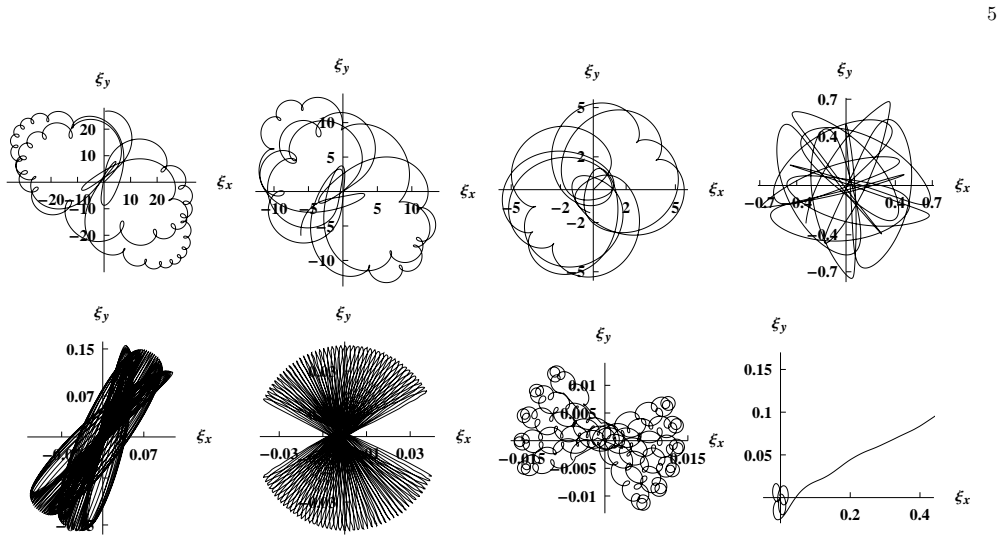
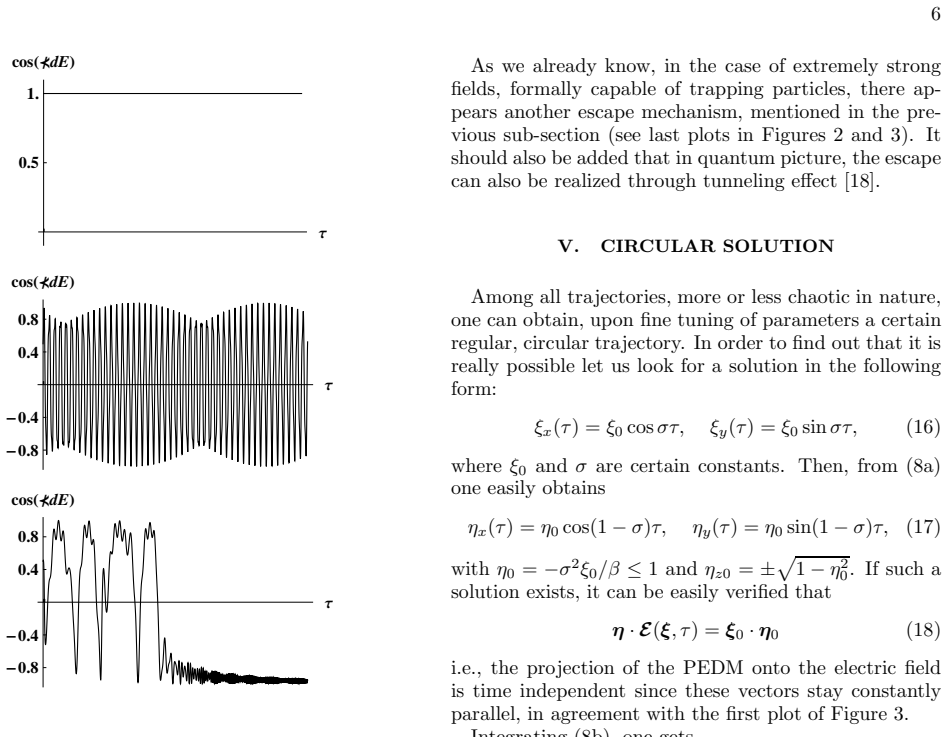
On the paper's own terms, the discovery is that a classical neutral particle with a permanent electric dipole moment can be confined and guided by the rotating electric field of an electromagnetic vortex. The transverse equations of motion, $m\ddot{\mathbf r}=(\mathbf d\cdot\nabla)\mathbf E$, produce bounded orbits around the vortex axis for a wide range of parameters, while the longitudinal motion is free, so the particle rides along the beam. The trapping is delicate: it requires field strengths that grow with the inverse dipole moment, it fails for very strong fields when the dipole locks anti-parallel to the field and is ejected, and it survives only for particles injected with low transverse kinetic energy. A special exact solution exists: a uniform circular transverse orbit, realized when the parameters satisfy a resonance condition that reduces to $I_\perp(\omega_0-\omega_r)^2=E_z d$ when a static longitudinal field is added.
Load-bearing premise
The analysis assumes that the idealized rotating, radially linear vortex field of Eq. (1a), with the $z/c$ phase retardation neglected, is a faithful model of a real electromagnetic vortex over the region where molecules move; if real vortex beams deviate from that profile, the claimed bounded orbits may not exist.
Editorial extensions
If this is right
- If the central claim holds, optical vortices become a route for guiding polar molecules without invoking magnetic moments: any rigid molecule with a permanent dipole can in principle be confined and transported along the vortex axis.
- Practical guiding requires strongly polar molecules with dipole moments around 10 Debye and above, and intense electric fields; the paper's estimates put the needed intensities in the range of kilovolts per centimetre and the temperatures in the millikelvin regime.
- The trap is destroyed at high field intensity: a dipole that locks in the anti-parallel orientation feels an outward radial force and is ejected, so there is an upper bound on usable field strength.
- A stable circular transverse orbit, a helix in three dimensions, exists under a fine-tuning condition, and adding a constant electric field along the axis widens the parameter range in which this regular motion occurs.
Reading between the lines
- An implication the paper leaves implicit is that in a real finite-width vortex beam the trap has finite depth; the paper's spatially unlimited paraxial trap should close off at large radius, so a quantitative model of escape would need the beam's actual radial profile.
- The same classical mechanism, applied to induced rather than permanent dipoles — the extension the paper itself suggests — would produce a field-strength-dependent dipole, likely shifting the trapping and ejection thresholds and making the effective potential steeper in radius.
- The resonance condition $I_\perp(\omega_0-\omega_r)^2=E_z d$ suggests a rotational-state selectivity: molecules whose moment of inertia matches the field frequency would stay in circular orbits while others escape, a possible way to filter molecules by rotation state.
- Because the paper works classically, a quantum treatment would replace the continuous dipole orientation by rotational levels; the classical chaotic and ejection thresholds may reappear as Landau-Zener-type transitions between rotational states as the field rotates.
Signed reviews
Editorial analysis
A structured set of objections, weighed in public.
Referee Report
Summary. The paper studies the classical translational and rotational dynamics of a symmetric-top molecule with a permanent electric dipole moment moving in the idealized electromagnetic vortex field of Eqs. (1)-(2), with the z/c phase variation neglected. It derives the equations of motion (8), several constants of motion (10)-(14), and auxiliary identities (15), then presents numerical trajectories in Section IV showing bounded transverse motion, a field-strength threshold, and chaotic behavior. In Section V it constructs an explicit circular/helical solution and gives a tuning condition (21), with a relaxation condition (22) when a static longitudinal field E_z is added. The central claim is that an electromagnetic vortex can capture and guide polar molecules if the field is strong enough and the molecules are cold enough.
Significance. If the idealized model faithfully represents a real vortex beam over the trapping region, the paper offers an interesting classical analog of magnetic traps for polar molecules. The analytical core is coherent: the constants of motion follow from the stated equations, the circular ansatz is explicit, and the paper is candid about the tiny dipole moments, the requirement of very strong fields, and the chaotic character of most trajectories. The significance is nevertheless tempered by the use of an unbounded, linearly growing field and by the largely illustrative numerical evidence, so the broader claim of 'guiding by an electromagnetic vortex' is stronger than what the manuscript actually establishes.
major comments (3)
- [II, after Eqs. (1)-(2)] The guiding claim is established only for the field with the z/c phase omitted, but a molecule transported along z samples the phase ω0(t - z(t)/c). Since the z-motion is free, retaining the phase gives an effective rotating-field frequency ω0(1 - v_z/c) in the molecule's frame; the constants of motion in Section III and the bounded orbits in Section IV are derived for v_z = 0 and need not persist for nonzero longitudinal velocity. The abstract should either restrict the claim to the v_z = 0 (or short-distance) case or include an estimate of the propagation length over which omitting z/c is valid, because the paper's stated picture is guiding along the beam axis.
- [IV A, Fig. 2] The trapping potential is unbounded and grows linearly with radius, so bounded orbits in this model do not automatically translate to capture in a real Laguerre-Gauss or Bessel-Gauss beam of finite transverse extent. The paper itself notes that the paraxial approximation is limited to distances of order λ and that several plotted trajectories already exceed that range, yet the abstract presents capture and guiding without this qualification. Please specify the assumed beam profile and waist and demonstrate that the confined orbits lie inside the linear region for the parameters claimed to be realistic.
- [IV, Figs. 1-5] The numerical evidence is not reproducible as reported: the figures do not state the initial conditions for ξ, ξdot, η, and Ωκ, the values of α and β (only γ is given), the integration time, or the numerical method. Because the central claim and the threshold/escape statements are supported by these trajectories, at least one fully specified example, and ideally the parameter set for every panel, is needed.
minor comments (5)
- [Eq. (15a)] From ηdot = Ωκ × η and |η| = 1 one obtains ηdot² − Ωκ² = −H5², so the sign in the displayed identity appears to be wrong unless the notation means something other than the squared derivative.
- [Eq. (12)] The term (ηxξy + ηxξy) should presumably read (ηxξy + ηyξx).
- [V, after Eq. (24)] 'Viral relation' should be 'virial relation'.
- [IV A] 'Oblaticity' should be 'oblateness'.
- [Fig. 2 caption] The panels use units of λ, but the caption does not state the common time interval or the initial kinetic energy; adding these would help the reader interpret the 'escaping' versus 'captured' classification.
Circularity Check
No circularity: the guiding model is self-contained, with analytical derivations and numerical solutions from stated equations; self-citations are contextual, not load-bearing.
full rationale
The paper's derivation chain is self-contained. The vortex field (1)-(2), equations of motion (6)/(8), and dimensionless parameters (7) are stated model inputs, not fitted to any data. The constants of motion H1-H5 are derived algebraically from these equations (Sec. III) rather than imposed as predictions. The bounded trajectories in Sec. IV are numerical solutions of Eq. (8) for chosen parameter values, so they are outputs, not pre-assigned outcomes. The circular solution in Sec. V is obtained by substituting ansatz (16) into the equations and deriving the compatibility conditions (21)-(22), an explicit construction rather than a fit. References to earlier vortex-trap work [16,17,18,30], including the author's own, are used for context and analogy (e.g., 'dimensionless quantities similarly as it was done in [17]'), but no result is justified solely by those citations; the electric-dipole trapping analysis is built from the stated ODEs. Concerns about whether the idealized paraxial field (1) accurately represents real finite-width vortex beams are external-validity or modeling-fidelity issues, not circularity.
Assumptions & free parameters
assumptions (4)
- domain assumption A neutral polar molecule can be described as a classical rigid symmetric top with a permanent electric dipole moment vector fixed to the body.
- ad hoc to paper The vortex beam's electric field is accurately represented by the paraxial linear rotating field in Eq. (1a), and the z/c phase term can be dropped.
- domain assumption The magnetic force on the molecule is negligible compared with the electric force.
- domain assumption Molecule motion is non-relativistic, so the z-motion is uniform and decouples from the transverse dynamics.
Cite this review
Pith. "Pith review of Guiding neutral polar molecules by electromagnetic vortex field --- a classical approach." pith.science (2026). https://pith.science/paper/HYT4H7NN
@misc{pith2026190802380,
  author       = {Pith},
  title        = {Pith review of: Guiding neutral polar molecules by electromagnetic vortex field --- a classical approach},
  year         = {2026},
  howpublished = {\url{https://pith.science/paper/HYT4H7NN}},
  note         = {Machine review of arXiv:1908.02380}
}
abstract
It is shown, within classical mechanics, that the field of an electromagnetic vortex is capable of capturing and guiding neutral molecules endowed with a permanent electric dipole moment (PEDM). Similarly as in the case of the magnetic field applied to elementary particles or atoms, this effect turns out to be very delicate because of the small values of PEDM observed in real molecules. They amount to $2\times10^{5}\, e{\mathrm{fm}}$ (electron charge $\times$ fermi) or less, which requires the use of very strong electric fields. It has also been observed that there exists a threshold in field strength above which the particles are ejected from the trap. Trajectories of guided particles are usually quite chaotic, which is a consequence of non-linearity of the equations of motion. With a very special and precise adjustment of parameters, a regular (i.e., circular, in the transverse plane) trajectory can be obtained. The presence of an additional constant electric field pointing along the direction of the wave propagation might help to achieve the necessary tuning and realize such trajectories.
Figures

Figures from the paper (3 more)


Reference graph
Works this paper leans on
- [1]
-
[2]
6 × 10⁻³ u fm2 for the neutron (and not very different for Λ 0) to 6 × 10⁹ u fm2 for small molecules. Due to the extremely small values of PEDM the trap- ping or guiding the particles due to the mechanism de- scribed in this work has by now rather theoretical na- ture and is limited to molecules since very intense fields would be required in experiments to ...
-
[3]
Integrating (8b), one gets Ω κ = αη z0ξ0 1 − σ [cos(1 − σ )τ, sin(1 − σ )τ, 0] + Ω κ 0
If such a solution exists, it can be easily verified that η ·E(ξ, τ ) = ξ0 ·η 0 (18) i.e., the projection of the PEDM onto the electric field is time independent since these vectors stay constantly parallel, in agreement with the first plot of Figure 3. Integrating (8b), one gets Ω κ = αη z0ξ0 1 − σ [cos(1 − σ )τ, sin(1 − σ )τ, 0] + Ω κ 0. (19) Now it stems ...
- [4]
- [5]
- [6]
- [7]
-
[8]
J.E. Bjorkholm, R.R. Freeman, A. Ashkin, and D.B. Pearson, Phys. Rev. Lett. 41, 1361(1978)
work page 1978
Show all 41 references
-
[9]
Chu, J.E
S. Chu, J.E. Bjorkholm, A. Ashkin, and A. Cable, Phys. Rev. Lett. 57, 314(1986)
1986
-
[10]
Schwerdtfeger and J.K
P. Schwerdtfeger and J.K. Nagle, Molecular Physics 117, 1200(2019)
2019
-
[11]
K¨ ugler, W
K.-J. K¨ ugler, W. Paul and U. Trinks, Phys. Lett. 72B, 422(1978)
1978
-
[12]
Migdall, J.V
A.L. Migdall, J.V. Prodan, W.D. Phillips, T.H. Berge- man, and H.J. Metcalf, Phys. Rev. Lett. 54, 2596(1985)
1985
-
[13]
Paul, Electromagnetic traps for charged and neutral particles, Rev
W. Paul, Electromagnetic traps for charged and neutral particles, Rev. Mod. Phys. 62, 531 (1990)
1990
-
[14]
Bialynicki-Birula and T
I. Bialynicki-Birula and T. Sowi´ nski,Gravity-induced res- onances in a rotating trap , Phys. Rev. A 71, 043610 (2005)
2005
-
[15]
Arldt, T
J. Arldt, T. Hitomi and K. Dholakia, Appl. Phys. B 71 , 549 (2000)
2000
-
[16]
D. P. Rhodes, D. M. Gherard, J. Livesey, D. McGloin, H. Melville, T. Freegarde and K. Dholakia, J. Mod. Opt. 53, 547 (2006)
2006
-
[17]
McGloin, G
D. McGloin, G. C. Spalding, H. Melville, W. Sibbett and K. Dholakia, Applications of spatial light modulators in atom optics , Opt. Expr. 11, 158 (2003)
2003
-
[18]
Bia/suppress lynicki-Birula, Phys
I. Bia/suppress lynicki-Birula, Phys. Rev. Lett. A 93 , 020402(2004)
2004
-
[19]
Bia/suppress lynicki-Birula and T
I. Bia/suppress lynicki-Birula and T. Rado˙ zycki, Phys. Rev.A 93 , 063402(2016)
2016
-
[20]
Rado˙ zycki, Phys
T. Rado˙ zycki, Phys. Rev.A 98 , 013424(2018)
2018
-
[21]
Khriplovich and S.K
I.B. Khriplovich and S.K. Lamoreaux, CP Violation Without Strangeness. Electric Dipole Moments of Par- ticles, Atoms, and Molecules , Springer, Berlin 1997
1997
-
[22]
Bia/suppress lynicki-Birula and S
I. Bia/suppress lynicki-Birula and S. Charzy´ nski, Phys. Rev. Lett. 121, 171101(2018)
2018
-
[23]
Rumble (ed.), CRC Handbook of Chemistry and Physics, 99th Ed
J. Rumble (ed.), CRC Handbook of Chemistry and Physics, 99th Ed. , Taylor&Francis, 2018
2018
-
[24]
Beijersbergen, R
M.W. Beijersbergen, R. Coerwinkel, M. Kristensen and J.P. Woerdman, Opt. Commun. 112, 321(1994)
1994
-
[25]
Sueda, G.Miyaji, M
K. Sueda, G.Miyaji, M. Miyanaga and M. Nakatsuka, Opt. Express 12, 3548(2004)
2004
-
[26]
Chen and Q
W. Chen and Q. Zhan, Opt. Lett. 34, 722(2009)
2009
-
[27]
Carpentier, H
A.V. Carpentier, H. Michinel and J.R Salgueiro, Am. J. Phys. 76, 916(2008)
2008
-
[28]
Jesacher, C
A. Jesacher, C. Maurer, A. Schwaighofer, S. Bernet and M. Ritsch-Marte, Opt. Express 16, 2597(2008)
2008
-
[29]
Padgett, J
M. Padgett, J. Courtial and L. Allen, Physics Today 57, 35(2004)
2004
-
[30]
Bia/suppress lynicki-Birula and Z
I. Bia/suppress lynicki-Birula and Z. Bia/suppress lynicka-Birula, Phys. Rev. A 67 , 062114(2003)
2003
-
[31]
McGloin and K
D. McGloin and K. Dholakia, Contemporary Physics 46, 15(2005)
2005
-
[32]
Bia/suppress lynicki-Birula and T
I. Bia/suppress lynicki-Birula and T. Rado˙ zycki, Phys. Rev.A 73 , 052114(2006)
2006
-
[33]
Pondrom, R
L. Pondrom, R. Handler, M. Sheaff, P.T. Cox, J. Dworkin, O.E. Overseth, T. Devlin, L. Schachinger, and K. Heller, Phys. Rev. D 23 , 814(1981)
1981
-
[34]
Pendlebury et al
J.M. Pendlebury et al. , Phys. Rev. D 92 , 092003(2015)
2015
-
[35]
S. A. Murthy, D. Krause, Jr., Z. L. Li, and L. R. Hunter Phys. Rev. Lett. 63, 965(1989)
1989
-
[36]
Parker, M.R
R.H. Parker, M.R. Dietrich, M.R. Kalita, N.D. Lemke, K.G. Bailey, M. Bishof, J.P. Greene, R.J. Holt, W. Ko- rsch, Z.-T. Lu, P. Mueller, T.P. O’Connor, and J.T. Singh, Phys. Rev. Lett. 114, 233002(2015)
2015
-
[37]
Player and P.G.H
M.A. Player and P.G.H. Sandars, J. Phys. B: At. Mol. Phys. 3, 1620(1970)
1970
-
[38]
Chupp, P
T.E. Chupp, P. Fierlinger, M.J. Ramsey-Musolf, and J.T. Singh, Rev. Mod. Phys. 91, 015001(2019)
2019
-
[39]
Adams and E
C.S. Adams and E. Rijs, Prog. Quant. Electr. 21, 1(1997)
1997
-
[40]
Ashkin, Proc
A. Ashkin, Proc. Natl. Acad. Sci. USA 94, 4853(1997)
1997
-
[41]
Balykin, V.G
V.I. Balykin, V.G. Minogin and V.S. Letokhov, Rep. Prog. Phys. 63, 1429(2000)
2000
Reviewed August 14, 2026 · model on record in the stance chip above.
Discussion (0). Continue with ORCID to comment.