REVIEW 2 major objections 4 minor 9 references
Off-Policy Evaluation for Recommendations with Missing-Not-At-Random Rewards
T0 review · 2 major / 4 minor · reviewed 2026-08-07 · deepseek-v4-flash
Pith's one-line read Dividing logged rewards by their observation probability restores unbiased off-policy evaluation when missing rewards depend on display position.
desk verdict A correct estimator for position-dependent missingness, but the MNAR label oversells it: the model is MAR, so the proof does not cover the headline claim. read the letter →
The pith
A machine-rendered reading of the paper's core claim, the machinery that carries it, and where it could break.
The reading
What carries the argument
The load-bearing object is the double propensity weight $$w(x_i,e_{a_i,k})/\$\theta$(o_k|x_i) = \frac{\pi(e_{a_k}|x)}{\pi_0(e_{a_k}|x)}\cdot\frac{1}{\$\theta$(o_k|x_i)},$$ applied only to logged positions with $o_{i,k}=1$. The first factor, the marginalized importance weight, removes the logging-policy bias; the second, the inverse reward-observation propensity, removes the position bias by cancelling the probability that the position is observed. The estimator's unbiasedness rests on the identity $\mathbb{E}[I\{o_k=1\}|x]=\theta(o_k|x)$ together with the generative model in which $o$ and $r$ are independent given $x$.
What would settle it
Generate logged data in which the observation probability is a function of the reward itself, for example $\theta(o_k=1|x,r_k)$ decreasing for low $r_k$, while keeping every other part of the model identical; if the resulting MIPS(w/ROIPS) estimate differs systematically from the true policy value across many replications, the conditional independence that carries the proof is violated.
Extended reading notes
Core claim
The central claim is a bias formula and its cure. Under Assumption 1 (no direct effect), meaning $E[r_k|x,a]=E[r_k|x,e_{a_k}]$, when logged rewards are observed through a position-dependent mechanism $\theta(o|x)$, the MIPS estimator has bias $$\mathrm{Bias}(\hat{V}^{(k)}_{\mathrm{MIPS}}(\pi;D)) = \mathbb{E}_{p(x)\pi(e_{a_k}|x)}[q_k(x,e_{a_k})(1-\$\theta$(o_k|x))].$$ The proposed estimator, $$\hat{V}^{(k)}_{\mathrm{MIPS(w/ROIPS)}}(\pi;D) = \frac{1}{n}\sum_{i:o_{i,k}=1} w(x_i,e_{a_i,k})\frac{r_{i,k}}{\$\theta$(o_k|x_i)},$$ with $w(x,e_{a_k})=\pi(e_{a_k}|x)/\pi_0(e_{a_k}|x)$, is then proved to satisfy $E_D[\hat{V}^{(k)}_{\mathrm{MIPS(w/ROIPS)}}]=V^{(k)}(\pi)$. The proof is a cancellation: the inverse observation propensity removes the factor $\theta(o_k|x)$ introduced by conditioning on $o_{i,k}=1$.
Load-bearing premise
The argument holds only if reward depends on the full ranking action just through its category embedding (the no-direct-effect assumption) and whether a reward is observed is conditionally independent of the reward value once the context is fixed.
Editorial extensions
If this is right
- Plain MIPS systematically undervalues policies that place rewards in positions with low observation probabilities, because the expectation of the estimator is $V^{(k)}(\pi)$ minus the bias term.
- With the true observation propensity, MIPS(w/ROIPS) is unbiased per position, so the sum over positions estimates the full policy value without position-bias error.
- When the true propensity is unknown, a heuristic position-only estimate from logged data keeps the estimator nearly unbiased in experiments and lowers variance enough to reduce MSE by about 88.4% at the strongest position bias tested.
- The bias theorem applies to all basic OPE/L estimators that implicitly assume full observation of rewards, so the missingness correction is not specific to MIPS.
- Because the correction uses only logged observation indicators, it can be applied in real recommendation logs without additional data collection.
Reading between the lines
- If the observation propensity truly depends on the reward value itself, the conditional-independence premise fails and the proof no longer holds; a natural extension is to model $\theta(o_k|x,r_k)$ and quantify the residual bias.
- The same double-propensity correction can be paired with a doubly robust estimator or control variate to reduce the variance that the extra inverse weight adds, especially when true propensities are used.
- Plugging MIPS(w/ROIPS) into policy learning objectives would give an unbiased gradient estimator under the same assumptions, extending the correction from evaluation to learning.
- Estimating $\theta$ with a context-dependent model rather than a position-only rate is a testable upgrade: it should reduce the heuristic estimator's bias at the cost of higher variance.
Signed reviews
Editorial analysis
A structured set of objections, weighed in public.
Referee Report
Summary. The paper studies off-policy evaluation (OPE) for recommender systems when logged data contain both logging-policy bias and display-position-induced missing rewards. It defines a position-wise policy value, reviews the marginalized IPS (MIPS) estimator, and introduces an observation indicator o into the data-generating process. The paper proves that MIPS is biased when rewards are not always observed, proposes a new estimator, MIPS(w/ROIPS), that additionally divides by the reward-observation propensity, and proves unbiasedness under a no-direct-effect assumption. Synthetic experiments compare the proposed estimator with several baselines as the strength of position bias varies, and the paper reports that the version using a heuristic observation propensity achieves the lowest mean squared error.
Significance. If the result holds for the advertised setting, the paper addresses a practically important gap: standard OPE estimators implicitly assume that all rewards are observed, which is unrealistic when display position governs visibility. The unbiasedness proof is a direct and correct calculation under the stated generative model, and the proposed estimator is a natural combination of MIPS and an observation-propensity correction. A strength is that the implementation is provided. However, the paper's headline claim of handling missing-not-at-random rewards is not supported by the assumptions actually used, because the generative model makes the observation indicator independent of the reward given the context. The experimental section also lacks error bars, so the empirical superiority is not substantiated. With an honest reframing to position-dependent missingness, the contribution is useful but incremental.
major comments (2)
- [§3.1, Proposition proof and Eq. (5)] The generative model is written as (x, a, e_a, o, r) ~ p(x)π0(a|x)θ(o|x)p(r|x,a), which makes o and r conditionally independent given x (and a). This is a missing-at-random type mechanism with respect to the observed context, not a missing-not-at-random mechanism. The proof of the Proposition relies on the identity E[r_k 1{o_k=1} | x,a] = E[r_k|x,a]·P(o_k=1|x), which is valid only under that conditional independence. Under genuine MNAR, where p(o_k|x,r_k) differs from p(o_k|x), the proof fails: E[r_k 1{o_k=1}/θ(o_k|x)] = E[r_k θ(o_k|x,r_k)/θ(o_k|x)], which is not generally equal to E[r_k]. Thus the theorem and proposition do not establish unbiasedness for the MNAR setting advertised in the title and abstract; they establish unbiasedness for position-dependent missingness that depends only on the observed context. The authors should either revise the title, abstract, and terminology to describe position-dependent MAR missingness, or extend the estimator and analysis to observation mechanisms that depend on the unobserved reward.
- [§4.3 and Figure 2] The main experimental conclusion that MIPS(w/heuristic ROIPS) achieves the lowest MSE is reported without error bars, confidence intervals, or significance tests across the S=100 logged-data replicates. Each plotted MSE is itself a random quantity estimated from a finite number of seeds, so the reader cannot determine whether the observed differences, such as the reported 88.4% improvement over MIPS at α=3.0, are reliable. The authors should report standard errors or interquartile ranges and, ideally, paired comparisons between estimators.
minor comments (4)
- [§1] The sentence 'when both bias exits in the logged data' contains a grammatical error; it should be 'when both biases exist in the logged data'.
- [§3.2] The unbiasedness Proposition applies to the estimator using the true observation propensity θ(o_k|x). The experiments, however, emphasize MIPS(w/heuristic ROIPS), which uses a context-free estimate from the logged data. The paper should state explicitly that the theoretical unbiasedness result does not apply to the heuristic version and that its performance is only empirically assessed.
- [Notation throughout] The notation e_{a,k} and e_{a_k} are used inconsistently for the embedding of the action at position k; a single consistent notation would improve readability.
- [§3.1, Theorem statement] The phrase 'although Assumption 1 holds when rewards are MNAR' is grammatically ambiguous. It should be rephrased to say that the bias arises even when Assumption 1 holds and rewards are missing due to display position.
Circularity Check
No significant circularity: the unbiasedness proof is a direct expectation calculation from explicitly stated assumptions, and no fitted quantity is relabeled as a prediction.
full rationale
The paper's central theoretical claim (Theorem and Proposition in Section 3) is derived by taking expectations under the explicitly stated generative model p(x)π0(a|x)θ(o|x)p(r|x,a) with Assumption 1. The MIPS(w/ROIPS) estimator in Eq.(5) is defined with the same θ(ok|x) that appears in the model, and the proof computes E_D[1/n Σ w r/θ] = E_{x,ea}[q · (Σ_{o':o'_k=1} θ(o'|x))/θ(ok|x)] = V^(k)(π). This is a standard importance-weighting calculation, not an assumption that the estimator is unbiased. The heuristic ROIPS used in experiments is a plug-in estimate of θ from logged data and is explicitly evaluated as an approximation rather than presented as a prediction from the theory. The paper cites prior work for the base MIPS framework, but the new estimator and its bias calculation are established within the paper. No self-citation chain, uniqueness import, or fitted-parameter-as-prediction step is load-bearing. The potential mismatch between the MAR-style generative model and the advertised MNAR setting is a correctness and scope concern, not circularity, because the derivation does not presuppose its conclusion.
Assumptions & free parameters
assumptions (5)
- domain assumption No direct effect (Assumption 1): E[r_k | x, a] = E[r_k | x, e_{a,k}].
- ad hoc to paper Observation process factorizes as theta(o|x) and is independent of reward and action given x.
- domain assumption Common support for marginalized action embeddings, pi(e_a|x) > 0 implies pi0(e_a|x) > 0.
- domain assumption Positivity of observation propensities, theta(o_k|x) > 0 whenever o_k = 1.
- domain assumption Logged data are i.i.d. from p(x)pi0(a|x)theta(o|x)p(r|x,a).
Cite this review
Pith. "Pith review of Off-Policy Evaluation for Recommendations with Missing-Not-At-Random Rewards." pith.science (2026). https://pith.science/paper/HZ3C7A3F
@misc{pith2026250208993,
  author       = {Pith},
  title        = {Pith review of: Off-Policy Evaluation for Recommendations with Missing-Not-At-Random Rewards},
  year         = {2026},
  howpublished = {\url{https://pith.science/paper/HZ3C7A3F}},
  note         = {Machine review of arXiv:2502.08993}
}
read the original abstract
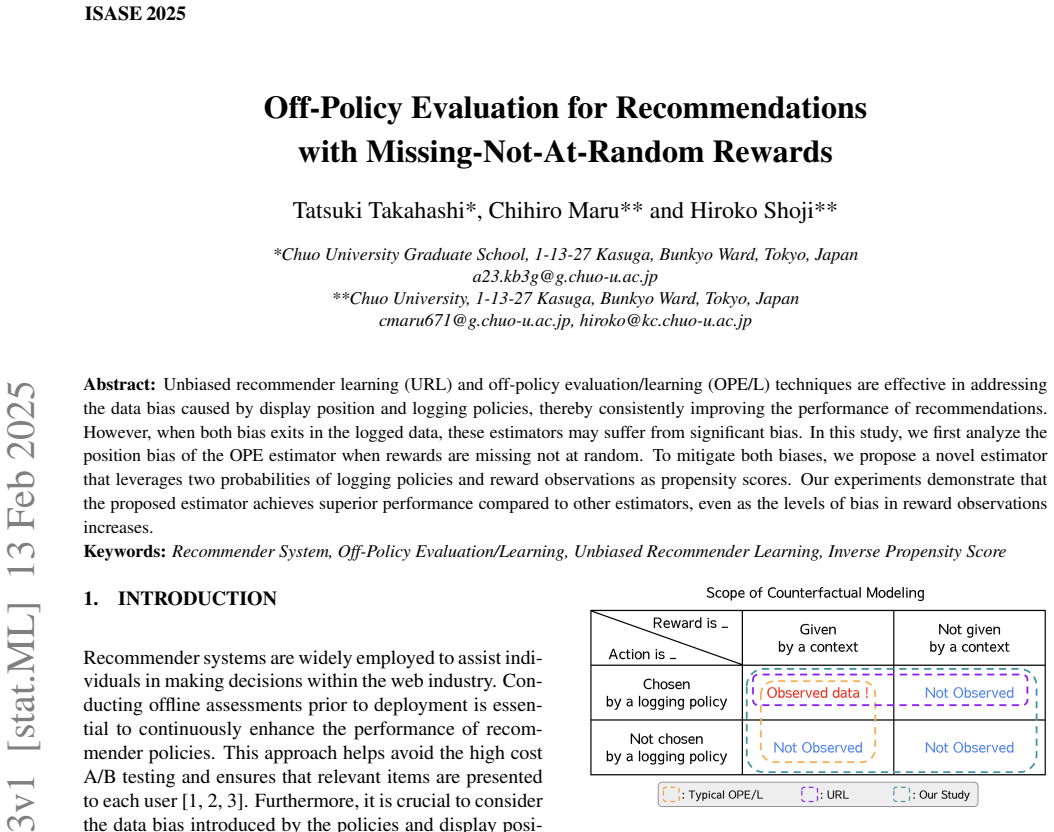
Unbiased recommender learning (URL) and off-policy evaluation/learning (OPE/L) techniques are effective in addressing the data bias caused by display position and logging policies, thereby consistently improving the performance of recommendations. However, when both bias exits in the logged data, these estimators may suffer from significant bias. In this study, we first analyze the position bias of the OPE estimator when rewards are missing not at random. To mitigate both biases, we propose a novel estimator that leverages two probabilities of logging policies and reward observations as propensity scores. Our experiments demonstrate that the proposed estimator achieves superior performance compared to other estimators, even as the levels of bias in reward observations increases.
Figures

Reference graph
Works this paper leans on
-
[1]
Open bandit dataset and pipeline: Towards realistic and reproducible off-policy evalu- ation
Yuta Saito et al. “Open bandit dataset and pipeline: Towards realistic and reproducible off-policy evalu- ation”. In: arXiv preprint arXiv:2008.07146 (2020)
arXiv 2020
-
[2]
Top-k off-policy correction for a REINFORCE recommender system
Minmin Chen et al. “Top-k off-policy correction for a REINFORCE recommender system”. In: Proceed- ings of the Twelfth ACM International Conference on Web Search and Data Mining. 2019, pp. 456–464
work page 2019
-
[3]
Offline evaluation to make de- cisions about playlistrecommendation algorithms
Alois Gruson et al. “Offline evaluation to make de- cisions about playlistrecommendation algorithms”. In: Proceedings of the Twelfth ACM International Conference on Web Search and Data Mining . 2019, pp. 420–428
work page 2019
-
[4]
Bias and debias in recommender system: A survey and future directions
Jiawei Chen et al. “Bias and debias in recommender system: A survey and future directions”. In: ACM Transactions on Information Systems 41.3 (2023), pp. 1–39
work page 2023
-
[5]
Recommendations as treat- ments: Debiasing learning and evaluation
Tobias Schnabel et al. “Recommendations as treat- ments: Debiasing learning and evaluation”. In: in- ternational conference on machine learning. PMLR. 2016, pp. 1670–1679
work page 2016
-
[6]
Unbiased recommender learning from missing-not-at-random implicit feedback
Yuta Saito et al. “Unbiased recommender learning from missing-not-at-random implicit feedback”. In: Proceedings of the 13th International Conference on Web Search and Data Mining. 2020, pp. 501–509
work page 2020
-
[7]
Coun- terfactual risk minimization: Learning from logged bandit feedback
Adith Swaminathan and Thorsten Joachims. “Coun- terfactual risk minimization: Learning from logged bandit feedback”. In: International Conference on Machine Learning. PMLR. 2015, pp. 814–823
work page 2015
-
[8]
Off-Policy Eval- uation for Large Action Spaces via Embeddings
Yuta Saito and Thorsten Joachims. “Off-Policy Eval- uation for Large Action Spaces via Embeddings”. In: Proceedings of the 39th International Conference on Machine Learning. PMLR. 2022, pp. 19089–19122
work page 2022
Show all 9 references
-
[9]
Offline evaluation of ranking poli- cies with click models
Shuai Li et al. “Offline evaluation of ranking poli- cies with click models”. In: Proceedings of the 24th ACM SIGKDD International Conference on Knowl- edge Discovery & Data Mining . 2018, pp. 1685– 1694. 4
2018
Reviewed August 7, 2026 · model on record in the stance chip above.
Discussion (0). Continue with ORCID to comment.