REVIEW 4 major objections 5 minor 14 references
TunaGAN: Interpretable GAN for Smart Editing
T0 review · 4 major / 5 minor · reviewed 2026-08-14 · deepseek-v4-flash
Pith's one-line read Auxiliary attribute predictor turns StyleGAN into a tunable face editor without retraining the generator.
desk verdict A plausible and unusually candid latent-editing paper whose quantitative core is missing: the idea is not new, but the W-vs-Z comparison and mode-collapse analysis are worth a look if the authors add real metrics. read the letter →
The pith
A machine-rendered reading of the paper's core claim, the machinery that carries it, and where it could break.
The reading
What carries the argument
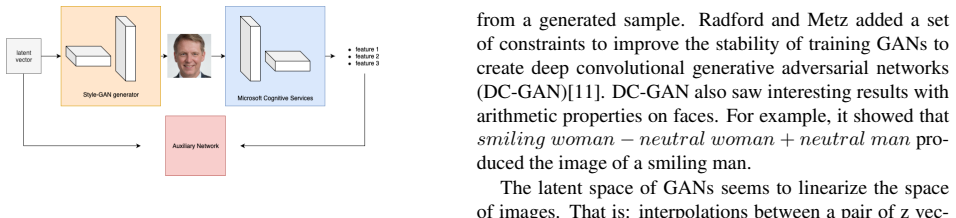
The load-bearing mechanism is the auxiliary attribute predictor \(f\) trained on (latent vector, attribute label) pairs, combined with the differentiable StyleGAN generator so that latent-space edits can be computed by gradient descent on the latent variable with a feature-space objective. The two candidate latent spaces are the Gaussian input space \(Z\) (dimension 512) and StyleGAN's intermediate space \(W\) (dimension 18×512), with W being more disentangled. Separability score, computed as \(\exp(H(Y|X))\) from conditional entropy between true and predicted attribute labels, is used to quantify disentanglement.
What would settle it
Take a trained nonlinear W-space model for beard, start from several real-face encodings, traverse along the predicted direction, and measure the beard attribute of each output with the same face-attribute API used for labels; if outputs fail to show increasing beard score before collapsing, despite high predictor accuracy, the central claim is falsified.
Extended reading notes
Core claim
The central claim is that editing a GAN face reduces to finding the correct latent displacement: given a generator that maps a latent vector to an image and a predictor that maps latent vectors to attribute values, the requested appearance change \(\$\Delta$ y\) is obtained by optimizing \(\$\Delta$ z\) or \(\$\Delta$ w\) so that the predicted attributes of the edited image move by \(\$\Delta$ y\). The paper demonstrates this with StyleGAN, using an embedding layer plus a two-layer neural network as the predictor and an external face-attribute API for labels. It reports that nonlinear traversal outperforms linear traversal in both latent spaces, that traversing the 18×512 W space is more robust and more separable than traversing the 512-dimensional Z space, and that mode collapse from starting near \(z=0\) arises because the zero vector cannot be normalized, so small perturbations saturate both latent entries and network activations.
Load-bearing premise
The auxiliary attribute predictor must be a faithful stand-in for what the generator actually changes: moving a latent code along the predictor's gradient must reliably change the requested attribute in the generated image without destroying face-likeness or entangling other attributes.
Editorial extensions
If this is right
- If the claim is correct, a fixed pre-trained generator can be made editable for arbitrary semantic attributes by attaching a small trainable predictor, avoiding weeks of generator retraining.
- W-space traversal should be preferred in practice because it is more stable under large steps and yields better attribute separability.
- Mode collapse near \(z=0\) is explained by the non-normalizable zero vector and saturation, so practical editors should either traverse W or avoid near-zero starting codes.
- Real images can be edited by first projecting them into latent space with perceptual loss, then applying the learned traversal, which the paper demonstrates for gender modification.
- The same architecture should transfer to other GANs and other attribute pools, such as pose, accessories, or background, because the editing step is decoupled from the generator internals.
Reading between the lines
- The paper's own beard-editing result indicates that high predictor accuracy does not guarantee good edits, suggesting that future designs should validate latent directions by measuring the attribute change on generated outputs, not just by predictor accuracy.
- The mode-collapse mechanism identified near \(z=0\) may generalize to other generators with normalization singularities, so the characterization could serve as a diagnostic for robustness in any latent-to-image network.
- A testable extension would be to regularize the predicted latent step to keep the trajectory inside the well-behaved region of W, which might improve both stability and disentanglement for unbalanced attributes.
- The surrogate-predictor assumption could be checked directly by comparing the predictor's Jacobian with a finite-difference estimate of the generator's actual attribute response; mismatches would localize where the method fails.
Editorial analysis
A structured set of objections, weighed in public.
Referee Report
Summary. The paper proposes TunaGAN, a method for editing face images generated by StyleGAN. Given an input image mapped to a latent vector z or w, the authors train an auxiliary network f_n to predict attribute labels (obtained from the Microsoft Cognitive Services API) from latent vectors, and then use the gradient or learned embedding of f_n to find a latent-space displacement corresponding to a requested attribute change Δy. The paper compares linear vs. nonlinear traversals and Z-space vs. W-space traversals, claiming that W-space editing is more stable and more disentangled, and that nonlinear models outperform linear ones. It also studies mode collapse when traversing near the zero latent vector, proposing saturation and oscillation of latent and activation values as an explanation. The only quantitative results reported are separability scores (SS) in Table 1; FID and IS are mentioned in Section 5.2 but never reported.
Significance. If the central claims were properly supported, the paper would offer a simple, modular way to turn a pretrained GAN into an editable image generator, and its comparison of Z-space vs. W-space traversal would be useful to practitioners. The mode-collapse analysis, with its visualizations of latent and activation dynamics, could also inform robustness studies. The paper deserves credit for running systematic qualitative comparisons across two latent spaces and two model families, and for honestly reporting failures such as the beard case and the near-zero collapse. However, the significance is currently limited because the main quantitative claims are unsupported as stated: FID/IS are absent, the separability score is computed from the same fitted predictors used to generate edits, and the core assumption that predictor gradients align with true attribute changes is not validated. These gaps are fixable with additional experiments and reporting, so the result is promising but not yet established.
major comments (4)
- [Section 5.2] The text states that FID, IS, and SS are used for quantitative evaluation, but no FID or IS values appear anywhere in the paper. Since the abstract and conclusion claim 'good quantitative performance,' the absence of these metrics leaves the image-quality claim unsupported. Please report FID (and IS if desired) on edited images, specifying the exact traversal protocol, step sizes, attributes, and number of samples, and compare against the unedited generated images.
- [Section 5.2, Table 1] The separability score is computed with the same linear and nonlinear predictors that are used to compute the edit directions, and no held-out split or repeated-seed error bars are reported. Table 1 therefore primarily measures the in-sample separability of the fitted classifiers, not the disentanglement of the resulting editing trajectories. This directly undermines the claims 'W space has lower SS than Z' and 'nonlinear model has lower SS than linear model.' Please recompute SS on a held-out set of latent vectors using evaluation predictors that were not used to construct the edits, and report confidence intervals.
- [Section 4.2 and Section 5.1] The central assumption of the method is that the gradient or learned direction provided by the auxiliary predictor f_n is aligned with the true change of the target attribute h∘g along the generator's image manifold. Training f_n for prediction accuracy does not enforce this, and the manuscript itself documents failures: beard prediction reaches 95% accuracy yet produces poor edits, and Figure 13 shows non-monotonic gender oscillation and glasses entanglement near zero. To support the editing claim, please provide direct validation that traversing along the computed direction produces monotonic change in the target attribute, measured with an independent predictor or API on the output images, and that realism is not unduly degraded.
- [Section 5.4] The mode-collapse explanation is internally incomplete. The initial explanation based on the non-normalizable zero vector is contradicted by Figure 14, where a perturbed nonzero starting vector still collapses; the later saturation/oscillation account is qualitative and does not yield a quantitative criterion for collapse. Please define a measurable collapse criterion (e.g., statistics of latent norms or gradient magnitudes, or a learned collapse detector) and show how it applies to Figures 14 and 15. Also reconcile the recommendation in Section 5.4 to use W space with the observation in Section 5.1 that W-space traversal with large steps produces non-faces.
minor comments (5)
- [Section 5.1 vs. Section 5.4] Section 5.1 reports that large step sizes in W space cause the output to stop resembling a face, while Section 5.4 states that traversing W space near zero is free from mode collapse; these statements need to be reconciled, for example by clarifying step-size regimes.
- [Section 4.1] The notation for images and latent vectors is confusing: Section 1 uses x for the input image and \hat{x} for the modified output, while Section 4.1 uses \hat{x} for the reference image and \hat{w} for the latent vector to be optimized. Please standardize the notation.
- [Introduction] There is a typo, 'NVDIA' should be 'NVIDIA', and reference [2] is cited as 'Piotr' while the author is Bojanowski; please correct the in-text citations and reference list.
- [Section 5.3] The text says 'Figure 10 demonstrates interpolation' and then 'Figure 10 demonstrates modification of real-life image,' suggesting a figure-numbering error; please check the figure references and captions.
- [Overall] No code, trained models, or exact hyperparameters (e.g., step sizes, learning rates, embedding dimensions) are provided, which limits reproducibility; please include these details or a link to an implementation.
Circularity Check
Quantitative disentanglement claim is self-referential; the editing pipeline itself is a supervised fit, not circular.
-
fitted input called prediction
[Section 5.2 (Quantitative metric), Table 1]
"We compute the conditional entropy between true labels and predicted labels by linear and nonlinear models. We use 3000 and 20000 (latent vector, feature) pairs to train SVM (linear) and shallow neural network (nonlinear) respectively. We calculate the final score as exp (H(Y|X)), where we take gender, beard and glasses as sample attributes. ... It is also shown from Table 1 that nonlinear model has lower SS than linear model since direction for nonlinear model is not only dependent on attributes but the latent vector itself."
The separability score is computed from predictions of the very same linear/nonlinear classifiers that define the edit directions, and the text does not state a held-out split for this metric. SS = exp(H(Y|X)) therefore measures how well the fitted auxiliary models separate the training labels, not an independent property of Z versus W. The conclusion that the nonlinear model has lower SS than the linear model is partly a consequence of the nonlinear model being trained to predict those same labels and having greater capacity, rather than a discovered property of the latent spaces. Because FID/IS are promised but never reported, this self-referential score is the only quantitative evidence for the paper's performance claims.
full rationale
TunaGAN's central editing pipeline is a supervised fit: an auxiliary predictor f_n is trained on (latent, API-label) pairs, and its gradient/embedding is used to compute Delta-z or Delta-w. That is not circular, since the edited images are produced by the frozen StyleGAN generator and are inspected qualitatively; the method could fail, and the paper's own beard and near-zero observations show that it sometimes does. No load-bearing self-citation chain or imported uniqueness theorem appears; the cited GAN components are external. The one genuinely self-referential step is the quantitative evaluation in Section 5.2: the separability score is defined through the fitted classifiers' own predictions, with no stated held-out evaluation, so the reported W-over-Z and nonlinear-over-linear advantages largely reflect in-sample separability of those fitted models rather than independent latent-space geometry. The missing FID/IS results leave SS as the only quantitative support, which makes the quantitative claim partially circular. The qualitative editing demonstrations and the mode-collapse characterization remain independent and are not infected by this circularity.
Assumptions & free parameters
free parameters (3)
- latent traversal step size / tuning coefficient
- number of auxiliary network training pairs =
3000 (linear/SVM), 20000 (nonlinear NN)
- VGG16 feature layer index for reconstruction =
layer 9
assumptions (4)
- domain assumption StyleGAN's pretrained generator is fixed and its latent spaces Z and W are continuous enough that small perturbations yield face-like images for most starting points.
- domain assumption Microsoft Cognitive Services attributes provide a valid ground-truth feature encoding y for generated and real face images.
- domain assumption A shallow two-layer network (with or without an embedding layer) can approximate the mapping from latent vector to attributes well enough that its gradient points in a direction that changes the true attribute.
- domain assumption Perceptual similarity in VGG16 layer 9 is a valid loss for latent reconstruction.
Cite this review
Pith. "Pith review of TunaGAN: Interpretable GAN for Smart Editing." pith.science (2026). https://pith.science/paper/HZ3YGS2S
@misc{pith2026190806163,
  author       = {Pith},
  title        = {Pith review of: TunaGAN: Interpretable GAN for Smart Editing},
  year         = {2026},
  howpublished = {\url{https://pith.science/paper/HZ3YGS2S}},
  note         = {Machine review of arXiv:1908.06163}
}
read the original abstract
In this paper, we introduce a tunable generative adversary network (TunaGAN) that uses an auxiliary network on top of existing generator networks (Style-GAN) to modify high-resolution face images according to user's high-level instructions, with good qualitative and quantitative performance. To optimize for feature disentanglement, we also investigate two different latent space that could be traversed for modification. The problem of mode collapse is characterized in detail for model robustness. This work could be easily extended to content-aware image editor based on other GANs and provide insight on mode collapse problems in more general settings.
Figures


Figures from the paper (11 more)


Reference graph
Works this paper leans on
- [1]
-
[2]
P. Bojanowski, A. Joulin, D. Lopez-Paz, and A. Szlam. Op- timizing the latent space of generative networks. arXiv preprint arXiv:1707.05776, 2017
arXiv 2017
- [3]
-
[4]
Signal Recovery from Pooling Representations
J. Bruna, A. Szlam, and Y . LeCun. Signal recovery from pooling representations. arXiv preprint arXiv:1311.4025 , 2013
work page Pith review arXiv 2013
-
[5]
X. Chen, Y . Duan, R. Houthooft, J. Schulman, I. Sutskever, and P. Abbeel. Infogan: Interpretable representation learning by information maximizing generative adversarial nets. In Advances in neural information processing systems , pages 2172–2180, 2016
2016
-
[6]
I. J. Goodfellow. NIPS 2016 tutorial: Generative adversarial networks. CoRR, abs/1701.00160, 2017
arXiv 2016
-
[7]
Johnson, A
J. Johnson, A. Alahi, and L. Fei-Fei. Perceptual losses for real-time style transfer and super-resolution. In European conference on computer vision , pages 694–711. Springer, 2016
2016
- [8]
Show all 14 references
-
[9]
Karras, S
T. Karras, S. Laine, and T. Aila. A style-based genera- tor architecture for generative adversarial networks. arXiv preprint arXiv:1812.04948, 2018
2018 arXiv
-
[10]
T. Kim, M. Cha, H. Kim, J. K. Lee, and J. Kim. Learning to discover cross-domain relations with generative adversarial networks. CoRR, abs/1703.05192, 2017
2017 arXiv
-
[11]
Radford, L
A. Radford, L. Metz, and S. Chintala. Unsupervised repre- sentation learning with deep convolutional generative adver- sarial networks. arXiv preprint arXiv:1511.06434, 2015
2015 arXiv
-
[12]
B. Zhao, B. Chang, Z. Jie, and L. Sigal. Modular generative adversarial networks. In Proceedings of the European Con- ference on Computer Vision (ECCV), pages 150–165, 2018
2018
-
[13]
J. Zhu, P. Kr ¨ahenb¨uhl, E. Shechtman, and A. A. Efros. Gen- erative visual manipulation on the natural image manifold. CoRR, abs/1609.03552, 2016
2016 arXiv
-
[14]
J.-Y . Zhu, P. Kr ¨ahenb¨uhl, E. Shechtman, and A. A. Efros. Generative visual manipulation on the natural image mani- fold. In European Conference on Computer Vision , pages 597–613. Springer, 2016. 8
2016
Reviewed August 14, 2026 · model on record in the stance chip above.
Discussion (0). Continue with ORCID to comment.