Quadratically Regularized Optimal Transport: Localization Bounds and Affine Case Analysis
Pith reviewed 2026-06-30 13:07 UTC · model grok-4.3
The pith
Quadratically regularized optimal transport cannot localize around the Monge graph faster than order ε to the power 1 over d plus 2.
A machine-rendered reading of the paper's core claim, the machinery that carries it, and where it could break.
Core claim
We establish a general lower bound showing that the support of the QOT optimizer cannot concentrate around the Monge graph faster than order ε^{1/(d+2)} in the directed Hausdorff distance, matching the conjectured optimal exponent under standard regularity assumptions. We also show that the QOT value gap controls the mean-squared deviation E_{π_ε} ||y-T(x)||^2 by the scale of ε^{2/(d+2)}. As a corollary, in the affine Brenier regime, which includes Gaussian-to-Gaussian transport, we derive a sharp pointwise tube bound of order ε^{1/(d+2)} by reducing the problem to self-transport and applying recent self-transport sparsity results.
What carries the argument
The directed Hausdorff distance between the support of the quadratically regularized coupling and the Monge graph, which quantifies the localization rate.
If this is right
- The value gap bounds expected squared deviation from the Monge map by ε^{2/(d+2)}.
- In the affine Brenier regime a pointwise tube bound holds at order ε^{1/(d+2)}.
- The lower bound matches the conjectured optimal exponent.
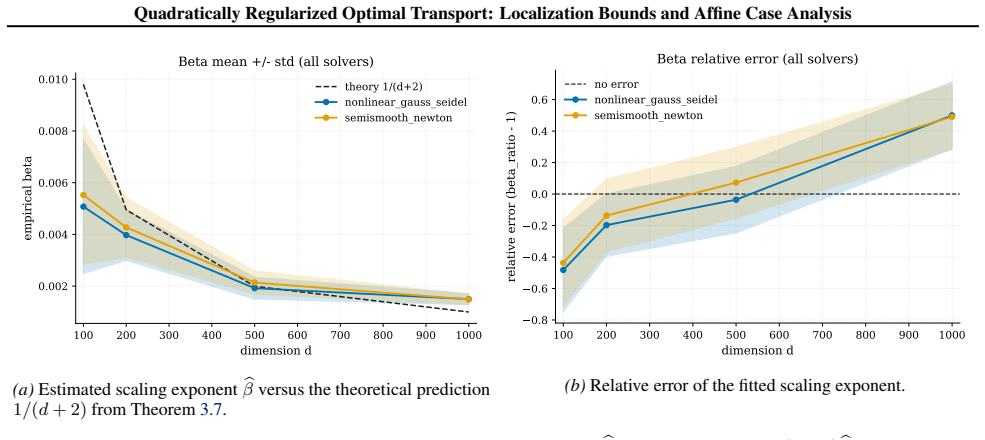
- The theoretical rates are consistent with synthetic high-dimensional experiments.
Where Pith is reading between the lines
- The dimension-dependent slowdown in high d implies that quadratic regularization may require careful ε scaling to achieve usable sparsity in practice.
- The self-transport reduction technique could be applied to other structured transport problems beyond the affine case.
- Similar lower bounds on localization might hold for other regularizers whose dual densities exhibit comparable hinge-like behavior.
- Numerical checks of the bound in non-affine settings would test how sharply the rate depends on the regularity assumptions.
Load-bearing premise
The measures and cost function satisfy the standard regularity assumptions that make the conjectured exponent optimal.
What would settle it
An explicit example or numerical case, under those regularity assumptions, where the support concentrates around the Monge graph at a rate strictly faster than ε^{1/(d+2)} in directed Hausdorff distance.
Figures
read the original abstract
Quadratic regularization has emerged as a potential alternative to the popular entropic regularization in computational optimal transport, offering the theoretical advantage of producing sparse couplings through its hinge density structure. Despite recent progress in one-dimensional settings and general upper bounds, fundamental questions about the localization rate of QOT optimizers around the Monge coupling have remained open. In this work, we establish a general lower bound showing that the support of the QOT optimizer cannot concentrate around the Monge graph faster than order $\varepsilon^{\frac{1}{d+2}}$ in the directed Hausdorff distance, matching the conjectured optimal exponent under standard regularity assumptions in \citet{wiesel2025sparsity}. We also show that the QOT value gap controls the mean-squared deviation $\mathbb E_{\pi_\varepsilon}\|y-T(x)\|^2$ by the scale of $\varepsilon^{\frac{2}{d+2}}$. As a corollary, in the affine Brenier regime, which includes Gaussian-to-Gaussian transport, we derive a sharp pointwise tube bound of order $\varepsilon^{\frac{1}{d+2}}$ by reducing the problem to self-transport and applying recent self-transport sparsity results. Finally, we validate our theoretical bound with a synthetic experiment in high-dimensional settings.
Editorial analysis
A structured set of objections, weighed in public.
Referee Report
Summary. The paper establishes a general lower bound showing that the support of the QOT optimizer cannot concentrate around the Monge graph faster than order ε^{1/(d+2)} in the directed Hausdorff distance, matching the conjectured optimal exponent under standard regularity assumptions from wiesel2025sparsity. It further shows that the QOT value gap controls the mean-squared deviation E_{π_ε} ||y - T(x)||^2 at scale ε^{2/(d+2)}. As a corollary, in the affine Brenier regime (including Gaussian-to-Gaussian transport), a sharp pointwise tube bound of order ε^{1/(d+2)} is derived by reduction to self-transport. The results are validated via a synthetic experiment in high dimensions.
Significance. If the lower bound holds, the work resolves an open question on the localization rate of QOT optimizers, providing the first matching lower bound to the conjectured exponent and new corollaries for the value gap and affine case. The reduction to self-transport sparsity results and high-dimensional numerical validation are strengths that enhance the contribution to the theory of quadratic regularization in optimal transport.
minor comments (3)
- [Abstract] Abstract: the statement of the lower bound and corollaries would benefit from explicit theorem or proposition numbers to allow immediate cross-reference to the proofs in the main text.
- The regularity assumptions on the measures and cost (referenced from wiesel2025sparsity) should be restated concisely in the main text or an appendix to make the manuscript self-contained.
- The synthetic experiment section would be strengthened by reporting the precise dimensions, sample sizes, and quantitative error metrics alongside the qualitative validation.
Simulated Author's Rebuttal
We thank the referee for their positive evaluation of the manuscript, accurate summary of the contributions, and recommendation of minor revision. No specific major comments were raised in the report.
Circularity Check
No significant circularity; derivation is self-contained
full rationale
The paper derives a new general lower bound on the directed Hausdorff distance of the QOT support to the Monge graph (order ε^{1/(d+2)}), explicitly positioned as matching an external conjecture from the cited wiesel2025sparsity under referenced regularity assumptions. The value-gap control on mean-squared deviation and the affine-case tube bound are corollaries obtained by reduction to self-transport sparsity results from the literature. No equations or steps reduce by construction to fitted inputs, self-definitions, or load-bearing self-citations; the central claim introduces independent content resolving a prior open question rather than renaming or tautologically reproducing its own assumptions.
Axiom & Free-Parameter Ledger
axioms (1)
- domain assumption standard regularity assumptions on the measures and cost function as in wiesel2025sparsity
Reference graph
Works this paper leans on
-
[1]
Balakrishnan, S. and Manole, T. Stability bounds for smooth optimal transport maps and their statistical implications. arXiv preprint arXiv:2502.12326,
-
[2]
Garriz-Molina, A., Gonz ´alez-Sanz, A., and Mordant, G. Infinitesimal behavior of quadratically regularized opti- mal transport and its relation with the porous medium equation.arXiv preprint arXiv:2407.21528,
-
[3]
Gonz´alez-Sanz, A. and Nutz, M. Sparsity of quadratically regularized optimal transport: Scalar case.arXiv preprint arXiv:2410.03353,
-
[4]
Sample complexity of quadratically regularized optimal transport
9 Quadratically Regularized Optimal Transport: Localization Bounds and Affine Case Analysis Gonz´alez-Sanz, A., del Barrio, E., and Nutz, M. Sample complexity of quadratically regularized optimal transport. arXiv preprint arXiv:2511.09807, 2025a. Gonz´alez-Sanz, A., Eckstein, S., and Nutz, M. Sparse regu- larized optimal transport without curse of dimensi...
-
[5]
T., Ben-Hamu, H., Nickel, M., and Le, M
Lipman, Y ., Chen, R. T., Ben-Hamu, H., Nickel, M., and Le, M. Flow matching for generative modeling. In11th International Conference on Learning Representations, ICLR 2023,
2023
-
[6]
Rectified Flow: A Marginal Preserving Approach to Optimal Transport
Liu, Q. Rectified flow: A marginal preserving approach to optimal transport.arXiv preprint arXiv:2209.14577,
work page internal anchor Pith review Pith/arXiv arXiv
-
[7]
A., Manns, P., and Meyer, C
Lorenz, D. A., Manns, P., and Meyer, C. Quadratically regularized optimal transport.Applied Mathematics & Optimization, 83(3):1919–1949,
1919
-
[8]
Pooladian, A.-A. and Niles-Weed, J. Entropic estimation of optimal transport maps.arXiv preprint arXiv:2109.12004,
-
[9]
Thereforem ε >0
12 Quadratically Regularized Optimal Transport: Localization Bounds and Affine Case Analysis This contradictsπ ε ≪µ⊗ν. Thereforem ε >0. Lett= √2mε. By Markov’s inequality applied toZ, πε {(x, y) :∥y−T(x)∥ ≤t} =π ε({Z≤2m ε})≥ 1 2 . Forν-a.e.y, define a(y) := Z T −1(B(y,t)) h(x, y)µ(dx). Then0≤a(y)≤1forν-a.e.y, and Z a(y)ν(dy) =π ε({(x, y) :∥y−T(x)∥ ≤t})≥ 1...
2025
-
[10]
Writing A−1(y−a)−m 0 =A −1 y−(Am 0 +a) , we may rewrite the right-hand side of (A.10) as y−(Am 0 +a) ⊤ A−⊤Σ−1 0 A−1 y−(Am 0 +a) +C
= A−1(y−a)−m 0 ⊤ Σ−1 0 A−1(y−a)−m 0 +C, (A.10) Both sides of (A.10) are quadratic polynomials in y; since Ω1 has nonempty interior, they agree as polynomials on Rd. Writing A−1(y−a)−m 0 =A −1 y−(Am 0 +a) , we may rewrite the right-hand side of (A.10) as y−(Am 0 +a) ⊤ A−⊤Σ−1 0 A−1 y−(Am 0 +a) +C. Equality of the quadratic coefficients gives Σ−1 1 =A −⊤Σ−1 ...
2021
-
[11]
17:Output:(f (k), g(k), π)
15:untilmax i |ri| ∨max j |sj| ≤tolork=K 16:Recoverπvia (B.5). 17:Output:(f (k), g(k), π). Lety ij :=c ij −g j; then this becomes the scalar monotone equation MX j=1 bj(fi −y ij)+ =ε.(B.1) If yi(1) ≤ · · · ≤y i(M) denotes the sorted list and b(1), . . . , b(M) are the corresponding permuted weights, define prefix sums Bk := kX ℓ=1 b(ℓ), Sk := kX ℓ=1 b(ℓ)y...
2021
discussion (0)
Sign in with ORCID, Apple, or X to comment. Anyone can read and Pith papers without signing in.