Hyperon (Λ) polarization along the beam axis in Pb-Pb collisions at sqrt{s_(rm NN)} = 5.36 TeV
Pith reviewed 2026-06-26 21:44 UTC · model grok-4.3
The pith
ALICE measures Lambda hyperon polarization along the beam axis relative to the third-order event plane in Pb-Pb collisions at 5.36 TeV.
A machine-rendered reading of the paper's core claim, the machinery that carries it, and where it could break.
Core claim
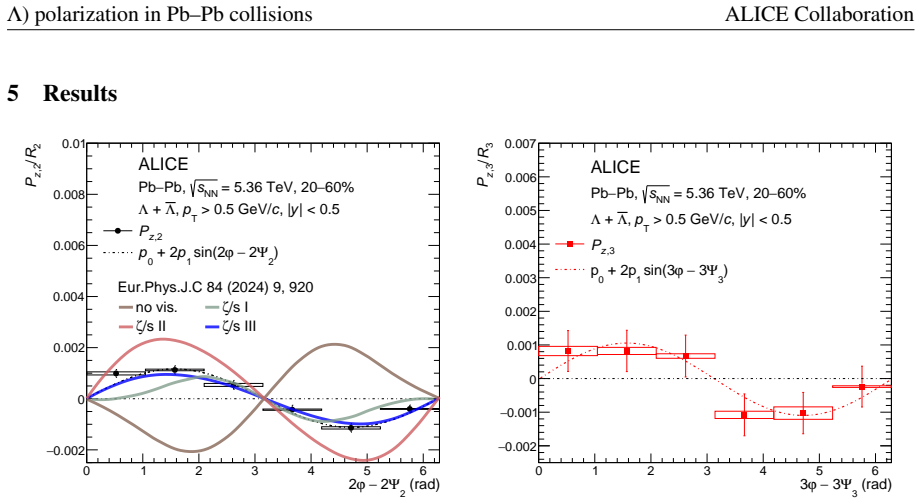
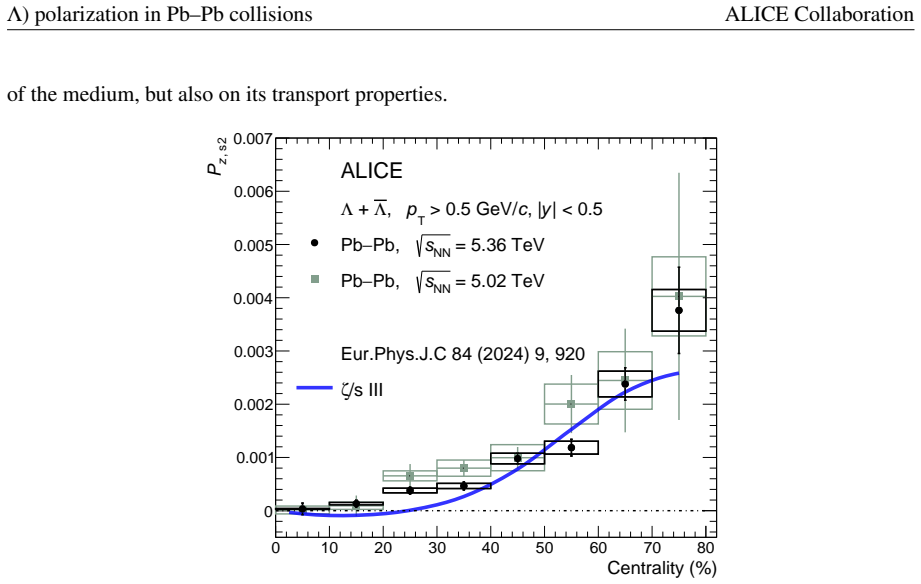
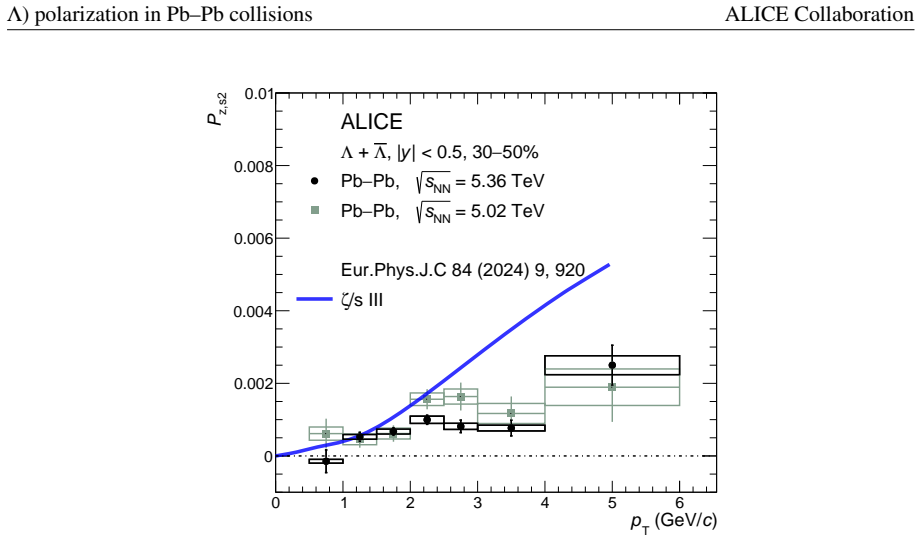
The polarization of Lambda and anti-Lambda hyperons along the beam axis exhibits clear azimuthal sine modulations with respect to both the second- and third-order event planes. Polarization values relative to the second-order event plane match those from collisions at 5.02 TeV but benefit from increased statistics. Comparisons with hydrodynamic calculations show that the measured polarization is sensitive to the bulk viscosity and the vortical structure of the quark-gluon plasma, with the third-order plane polarization expected to constrain both bulk and shear viscosities independently.
What carries the argument
Azimuthal sine modulation of beam-axis hyperon polarization relative to event planes, which encodes vorticity components induced by anisotropic flow in the quark-gluon plasma.
If this is right
- The third-order event plane polarization supplies an additional independent constraint on quark-gluon plasma transport properties.
- Consistency with hydrodynamic calculations supports the role of flow-induced vorticity in generating the observed polarization.
- Larger data sample yields improved statistical precision on the second-order polarization compared to previous measurements.
- The signal sensitivity to bulk viscosity offers a new probe of the plasma's internal dynamics.
Where Pith is reading between the lines
- If the third-order signal holds, it could help disentangle viscosity effects from initial geometry uncertainties in hydrodynamic simulations.
- Similar polarization measurements in smaller collision systems might test the scaling of vorticity with system size.
- Combining these data with elliptic flow and other observables could tighten bounds on the temperature dependence of viscosities.
Load-bearing premise
The polarization signal is produced by vorticity components induced by anisotropic flow and the hydrodynamic calculations accurately capture the vortical structure without large unaccounted systematic effects from event-plane determination or decay reconstruction.
What would settle it
A null result showing no azimuthal sine modulation relative to the third-order event plane or values lying outside the range of hydrodynamic predictions that include bulk viscosity would falsify the central interpretation.
Figures
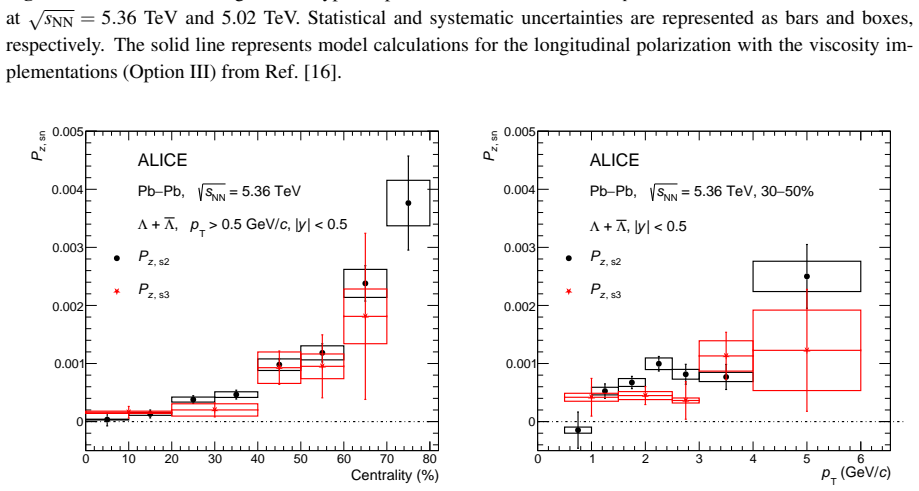
read the original abstract
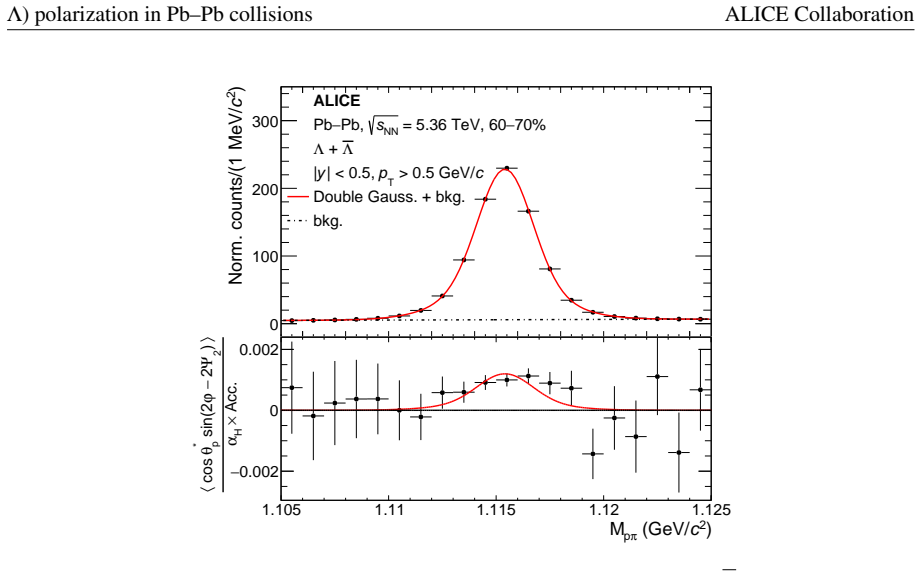
The measurement of hyperon ($\Lambda$ and $\overline{\Lambda}$) polarization along the beam axis in Pb-Pb collisions at $\sqrt{s_{\rm NN}} = 5.36$ TeV using the ALICE detector is presented. The polarization, arising from vorticity components induced by anisotropic flow, is studied relative to the second- and third-order event planes. The measured polarization exhibits clear azimuthal sine modulations, providing the first observation of polarization along the beam direction measured relative to the third-order event plane at the Large Hadron Collider. The values of the polarization measured with respect to the second-order event plane relative to the second harmonic event plane are consistent with previous measurements at $\sqrt{s_{\rm NN}} = 5.02$ TeV and show improved statistical precision owing to the larger data sample. Comparisons with hydrodynamic calculations indicate that the measured polarization is sensitive to the bulk viscosity and the vortical structure of the quark-gluon plasma, offering new constraints on its transport properties. In particular, the polarization measured relative to the third-order event plane is expected to provide an additional and independent input to constrain both bulk and shear viscosities of the quark-gluon plasma.
Editorial analysis
A structured set of objections, weighed in public.
Referee Report
Summary. The manuscript reports the measurement of beam-axis polarization of Λ and anti-Λ hyperons in Pb-Pb collisions at √s_NN = 5.36 TeV with ALICE. Polarization is extracted relative to both the second- and third-order event planes, revealing clear azimuthal sine modulations. The second-order results are stated to be consistent with prior 5.02 TeV data but with improved statistics; hydrodynamic comparisons are used to argue that the signal is sensitive to bulk viscosity and the vortical structure of the QGP, with the third-order-plane polarization providing an independent constraint on both bulk and shear viscosities.
Significance. If the measurement and model comparisons hold, the result supplies a new, independent experimental handle on QGP transport coefficients through higher-order flow-induced vorticity. The third-order event-plane channel is highlighted as particularly useful for separating bulk and shear effects, extending the existing body of polarization data at the LHC.
minor comments (2)
- The abstract states that comparisons with hydrodynamic calculations indicate sensitivity to bulk viscosity, but the manuscript should include explicit quantitative tables or plots (with χ² values or parameter variations) showing how the third-order polarization changes with bulk-viscosity settings; this would strengthen the claim that the observable supplies an independent constraint.
- Systematic uncertainties on the polarization extraction (event-plane resolution, decay reconstruction, feed-down corrections) are referenced but should be presented with a dedicated table or subsection that quantifies their contribution to the final error budget for both second- and third-order results.
Simulated Author's Rebuttal
We thank the referee for the positive summary, significance assessment, and recommendation of minor revision. The report correctly captures the key aspects of our measurement of beam-axis Λ polarization relative to the second- and third-order event planes at 5.36 TeV, including the improved precision on the second-order results and the potential of the third-order channel to constrain QGP transport coefficients. No specific major comments were provided in the report.
Circularity Check
Direct experimental measurement; no circular derivation chain
full rationale
This is a pure experimental measurement paper reporting observed hyperon polarization values extracted from collision data. The central results (polarization magnitudes and azimuthal modulations) are obtained via standard reconstruction and event-plane analysis techniques applied to detector data, with no internal equations that define a quantity in terms of itself or rename a fit as a prediction. Hydrodynamic comparisons are external model benchmarks and do not feed back into the reported data points. Self-citations to prior ALICE measurements are present for context but are not load-bearing for the new third-order event-plane result; the measurement stands independently. No steps match any of the enumerated circularity patterns.
Axiom & Free-Parameter Ledger
axioms (1)
- domain assumption Event-plane reconstruction and Lambda polarization extraction from decay angular distributions follow established methods in the field.
Reference graph
Works this paper leans on
-
[1]
Angular momentum conservation in heavy ion collisions at very high energy
F. Becattini, F. Piccinini, and J. Rizzo, “Angular momentum conservation in heavy ion collisions at very high energy”,Phys. Rev. C77(2008) 024906,arXiv:0711.1253 [nucl-th]
Pith/arXiv arXiv 2008
-
[2]
L. P. Csernai, D. J. Wang, M. Bleicher, and H. Stöcker, “V orticity in peripheral collisions at the 10 Λ) polarization in Pb–Pb collisions ALICE Collaboration Facility for Antiproton and Ion Research and at the JINR Nuclotron-based Ion Collider fAcility”, Phys. Rev. C90(2014) 021904
2014
-
[3]
Globally polarized quark-gluon plasma in non-central A+A collisions
Z.-T. Liang and X.-N. Wang, “Globally polarized quark-gluon plasma in non-central A+A collisions”,Phys. Rev. Lett.94(2005) 102301,arXiv:nucl-th/0410079. [Erratum: Phys.Rev.Lett. 96, 039901 (2006)]
Pith/arXiv arXiv 2005
-
[4]
A study of vorticity formation in high energy nuclear collisions
F. Becattini, G. Inghirami, V . Rolando, A. Beraudo, L. Del Zanna, A. De Pace, M. Nardi, G. Pagliara, and V . Chandra, “A study of vorticity formation in high energy nuclear collisions”, Eur . Phys. J. C75(2015) 406,arXiv:1501.04468 [nucl-th]. [Erratum: Eur.Phys.J.C 78, 354 (2018)]. [8]STARCollaboration, L. Adamczyket al., “GlobalΛhyperon polarization in ...
Pith/arXiv arXiv 2015
-
[5]
Polarization probes of vorticity in heavy ion collisions
B. Betz, M. Gyulassy, and G. Torrieri, “Polarization probes of vorticity in heavy ion collisions”, Phys. Rev. C76(2007) 044901,arXiv:0708.0035 [nucl-th]
Pith/arXiv arXiv 2007
-
[6]
Collective Longitudinal Polarization in Relativistic Heavy-Ion Collisions at Very High Energy
F. Becattini and I. Karpenko, “Collective Longitudinal Polarization in Relativistic Heavy-Ion Collisions at Very High Energy”,Phys. Rev. Lett.120(2018) 012302,arXiv:1707.07984 [nucl-th]
Pith/arXiv arXiv 2018
-
[7]
Y . Sun and C. M. Ko, “Azimuthal angle dependence of the longitudinal spin polarization in relativistic heavy ion collisions”,Phys. Rev. C99(2019) 011903,arXiv:1810.10359 [nucl-th]
Pith/arXiv arXiv 2019
-
[8]
V orticity and particle polarization in heavy ion collisions (experimental perspective)
S. A. V oloshin, “V orticity and particle polarization in heavy ion collisions (experimental perspective)”,EPJ Web Conf.171(2018) 07002,arXiv:1710.08934 [nucl-ex]
Pith/arXiv arXiv 2018
-
[9]
A. Palermo, E. Grossi, I. Karpenko, and F. Becattini, “Λpolarization in very high energy heavy ion collisions as a probe of the quark–gluon plasma formation and properties”,Eur . Phys. J. C84 (2024) 920,arXiv:2404.14295 [nucl-th]
arXiv 2024
-
[10]
Probing vorticity structure in heavy-ion collisions by localΛpolarization
X.-L. Xia, H. Li, Z.-B. Tang, and Q. Wang, “Probing vorticity structure in heavy-ion collisions by localΛpolarization”,Phys. Rev. C98(2018) 024905,arXiv:1803.00867 [nucl-th]
Pith/arXiv arXiv 2018
-
[11]
Hydrodynamic study of hyperon spin polarization in relativistic heavy ion collisions
B. Fu, K. Xu, X.-G. Huang, and H. Song, “Hydrodynamic study of hyperon spin polarization in relativistic heavy ion collisions”,Phys. Rev. C103(2021) 024903,arXiv:2011.03740 [nucl-th]
arXiv 2021
-
[12]
Observable implications of geometrical and dynamical aspects of freeze out in heavy ion collisions
F. Retiere and M. A. Lisa, “Observable implications of geometrical and dynamical aspects of freeze out in heavy ion collisions”,Phys. Rev. C70(2004) 044907,arXiv:nucl-th/0312024. 11 Λ) polarization in Pb–Pb collisions ALICE Collaboration [20]STARCollaboration, J. Adamet al., “Polarization ofΛ( ¯Λ) hyperons along the beam direction in Au+Au collisions at √...
Pith/arXiv arXiv 2004
-
[13]
Polarization phenomenon in heavy-ion collisions
T. Niida and S. A. V oloshin, “Polarization phenomenon in heavy-ion collisions”,Int. J. Mod. Phys. E33(2024) 2430010,arXiv:2404.11042 [nucl-ex]. [24]ALICECollaboration, S. Acharyaet al., “ALICE upgrades during the LHC Long Shutdown 2”, JINST19(2024) P05062,arXiv:2302.01238 [physics.ins-det]. [25]ALICECollaboration, P. Antonioli, A. Kluge, and W. Riegler, ...
arXiv 2024
-
[14]
General Partial Wave Analysis of the Decay of a Hyperon of Spin 1/2
T. D. Lee and C.-N. Yang, “General Partial Wave Analysis of the Decay of a Hyperon of Spin 1/2”,Phys. Rev.108(1957) 1645–1647. [31]BESIIICollaboration, M. Ablikimet al., “Polarization and Entanglement in Baryon-Antibaryon Pair Production in Electron-Positron Annihilation”,Nature Phys.15(2019) 631–634, arXiv:1808.08917 [hep-ex]
Pith/arXiv arXiv 1957
-
[15]
Methods for analyzing anisotropic flow in relativistic nuclear collisions
A. M. Poskanzer and S. A. V oloshin, “Methods for analyzing anisotropic flow in relativistic nuclear collisions”,Phys. Rev. C58(1998) 1671–1678,arXiv:nucl-ex/9805001
Pith/arXiv arXiv 1998
-
[16]
Systematic errors: Facts and fictions
R. Barlow, “Systematic errors: Facts and fictions”, inConference on Advanced Statistical Techniques in Particle Physics, pp. 134–144. 7, 2002.arXiv:hep-ex/0207026
Pith/arXiv arXiv 2002
-
[17]
Feed-down effect onΛspin polarization
X.-L. Xia, H. Li, X.-G. Huang, and H. Z. Huang, “Feed-down effect onΛspin polarization”,Phys. Rev. C100(2019) 014913,arXiv:1905.03120 [nucl-th]
arXiv 2019
-
[18]
Polarization transfer in hyperon decays and its effect in relativistic nuclear collisions
F. Becattini, G. Cao, and E. Speranza, “Polarization transfer in hyperon decays and its effect in relativistic nuclear collisions”,Eur . Phys. J. C79(2019) 741,arXiv:1905.03123 [nucl-th]
arXiv 2019
-
[19]
Running the gamut of high energy nuclear collisions
B. Schenke, C. Shen, and P. Tribedy, “Running the gamut of high energy nuclear collisions”,Phys. Rev. C102(2020) 044905,arXiv:2005.14682 [nucl-th]. 12 Λ) polarization in Pb–Pb collisions ALICE Collaboration
arXiv 2020
-
[20]
S. Ryu, J.-F. Paquet, C. Shen, G. Denicol, B. Schenke, S. Jeon, and C. Gale, “Effects of bulk viscosity and hadronic rescattering in heavy ion collisions at energies available at the BNL Relativistic Heavy Ion Collider and at the CERN Large Hadron Collider”,Phys. Rev. C97(2018) 034910,arXiv:1704.04216 [nucl-th]
Pith/arXiv arXiv 2018
-
[21]
B. Schenke, C. Shen, and P. Tribedy, “Multi-particle and charge-dependent azimuthal correlations in heavy-ion collisions at the Relativistic Heavy-Ion Collider”,Phys. Rev. C99(2019) 044908, arXiv:1901.04378 [nucl-th]. [39]ALICECollaboration, J. Adamet al., “Anisotropic flow of charged particles in Pb-Pb collisions at √sNN =5.02 TeV”,Phys. Rev. Lett.116(20...
Pith/arXiv arXiv 2019
discussion (0)
Sign in with ORCID, Apple, or X to comment. Anyone can read and Pith papers without signing in.