REVIEW 3 major objections 7 minor 237 references
Characterizing the Properties and Constitution of Compact Objects in Gravitational-Wave Binaries
T0 review · 3 major / 7 minor · reviewed 2026-08-12 · deepseek-v4-flash
Pith's one-line read Tidal heating could reveal whether black holes really have horizons
desk verdict Solid measurability and waveform modeling, but the late-inspiral horizon test is an unvalidated, self-admittedly ad hoc model. read the letter →
The pith
A machine-rendered reading of the paper's core claim, the machinery that carries it, and where it could break.
The reading
What carries the argument
The central mechanism is tidal heating: the horizon of a black hole absorbs energy and angular momentum from the companion's tidal field, altering the inspiral rate and thus the gravitational-wave phase and amplitude. The horizon parameters Heff5 and Heff8, which enter the phase at 2.5PN and 4PN order, quantify the fraction of that absorption; they are defined as mass- and spin-weighted combinations of the individual horizon parameters, and their measured values distinguish black holes from horizonless compact objects.
What would settle it
Compute the total mass change dM/dt from high-resolution numerical-relativity simulations of nonspinning binaries at frequencies between Mf = 0.01 and merger, and check whether the linear ramp of Eq. (5.22) reproduces the simulated data within errors. If the ramp fails to connect the PN and NR regimes, the late-inspiral dephasing model would be invalidated.
Extended reading notes
Core claim
Tidal heating imprints a phase and amplitude correction on gravitational-wave signals from binary black holes, characterized by two effective horizon parameters Heff5 and Heff8, which take known values for BHs and smaller values for horizonless exotic compact objects. The thesis claims that these parameters are measurable, especially in future third-generation detectors like Einstein Telescope and Cosmic Explorer, with projected 1-sigma errors as small as about 8% for Heff5 and 2% for Heff8 for a fiducial binary. It further constructs a frequency-domain waveform model, IMRPhenomD Horizon, that adds these corrections to the inspiral phase and amplitude, and shows it improves mismatch against numerical-relativity waveforms by about 4%, making tidal heating a practical discriminant for black holes.
Load-bearing premise
That the late-inspiral horizon-flux model, fitted to a narrow frequency band of numerical-relativity data, can be spliced to the low-frequency post-Newtonian result through a linear ramp—the thesis itself states this complete dephasing model is an ad hoc construction that behaves poorly at lower frequencies.
Editorial extensions
If this is right
- If the horizon parameters can be measured, gravitational-wave observations could directly test for the presence of horizons in stellar-mass binaries.
- In third-generation detectors, Heff5 and Heff8 could be constrained tightly enough to distinguish black holes from exotic compact objects for binaries out to a gigaparsec.
- Adding tidal-heating corrections to phenomenological waveforms reduces systematic errors, improving parameter estimation and tests of general relativity in strong-field regimes.
- The late-inspiral horizon-flux model could be attached to IMRPhenomD Horizon to search for deviations from the black-hole prediction in heavier binaries.
- Current and future detectors could use these methods to probe the nature of compact objects across the entire detectable mass range.
Reading between the lines
- The two effective parameters may serve as a model-independent diagnostic: measuring both simultaneously could distinguish a single-parameter deviation from general relativity from a genuine two-parameter horizon modification.
- Extending the horizon-flux modeling to spinning binaries would likely boost the signal, since higher spins strengthen the phase correction and widen the measurable parameter space.
- A practical next step would be to reanalyze existing gravitational-wave events with the new waveform model, searching for statistically significant deviations of Heff5 and Heff8 from the black-hole prediction.
- If tidal-heating corrections are as significant as modeled, this approach could complement other black-hole tests such as quasinormal-mode ringdown and tidal Love numbers, covering binaries too heavy for inspiral-only analyses and too light for ringdown-only tests.
Editorial analysis
A structured set of objections, weighed in public.
Referee Report
Summary. This manuscript, posted as a PhD thesis, develops tidal heating (TH) as a gravitational-wave discriminant for black-hole horizons. Chapter 3 forecasts the measurability of two effective horizon parameters, H_eff5 and H_eff8, using Fisher and Bayesian analyses of a TaylorF2+TH inspiral model in LIGO-Virgo, Einstein Telescope, and Cosmic Explorer, reporting projected 1-sigma constraints of about 8% (H_eff5) and 2% (H_eff8) at 1 Gpc in a fiducial fixed-spin configuration. Chapter 4 builds 'IMRPhenomD Horizon,' a frequency-domain phenomenological inspiral-merger-ringdown model that adds TH phase and amplitude corrections to IMRPhenomD, calibrates it on 20 SEOBNRv2+NR hybrids, validates it on 40 hybrids, and reports a median mismatch improvement over IMRPhenomD of about 4% (aLIGO ZDHP) and 2% (flat noise) against 219 SXS NR waveforms. Chapter 5 models the total horizon flux of nonspinning binaries from SXS apparent-horizon data using a four-parameter ansatz fitted over Mf in [0.03, 0.04], derives the corresponding frequency-domain dephasing, and proposes a linear ramp to splice this to the 4PN low-frequency expression, as a route to testing horizonless exotic compact objects in the late inspiral.
Significance. The Ch. 3 forecasts are useful, internally consistent benchmarks for 3G detectors, and the Bayesian cross-checks (Sec. 3.5) support the Fisher results. Ch. 4 delivers a concrete, self-contained IMR waveform with TH included and benchmarked against external SXS NR data; the full coefficient tables (Appendix C, Eq. 5.11) and the use of public toolkits (GWBENCH, Bilby, the SXS catalog) make the quantitative claims reproducible in principle. The thesis is also commendably transparent: it discloses that the headline errors rise by about an order of magnitude when spins are included (Fig. 3.6), that the amplitude correction is subdominant (Sec. 4.7), and that the Ch. 5 flux model deviates from the PN limit by orders of magnitude outside its fitted band (Sec. 5.3.2). If the Ch. 5 splicing were validated, the framework would be a genuine step toward late-inspiral horizon tests; as it stands, the Ch. 5 demonstration is a proposal with an unquantified error budget, and the abstract's horizon-test claim rests on that unvalidated ground.
major comments (3)
- [Sec. 5.3; Eqs. (5.9), (5.15)-(5.22)] The late-inspiral horizon-flux model that underpins the paper's horizon-test proposal is not validated at either end of its frequency range. The four-parameter ansatz (5.9) is calibrated to apparent-horizon data from only six SXS simulations over the narrow band Mf in [0.03, 0.04], and Sec. 5.3.2 states that outside this band the model 'behaves extremely poorly at lower frequencies,' with orders of magnitude of deviation from the 4PN term. The complete dephasing is then assembled by the linear ramp (5.22) on {a_i} between Mf = 0.022 and 0.032. No test is presented that the spliced dM/dt (and hence delta_PSI_TH in Eqs. (5.15)-(5.21)) reproduces either the NR horizon data at Mf approximately 0.032 or the 4PN expression at Mf approximately 0.022, and no held-out SXS simulation is used to check the fit. The concern is compounded by the fact that the low-frequency anchor itself is applied at v approximately 0.41, where truncated 4PN is not expected to be accurate. Because delta_PSI_TH is constructed directly from this flux model, the claim that the late inspiral can be leveraged to test for horizonless compact objects inherits an unquantified error budget. I recommend: (i) validating the spliced model against one or two nonspinning SXS binaries not in Table 5.1; (ii) checking continuity of dM/dt and delta_PSI_TH at both interfaces; and (iii) propagating the 1-sigma fit errors of Fig. 5.1 into the dephasing, together with a report on the conditioning of the four-parameter fit over such a short band.
- [Secs. 3.4.2, 3.7, and 6] The headline measurability numbers, Delta_H_eff5 approximately 0.05 (8.3%) and Delta_H_eff8 approximately 0.2 (2%) for M = 30 M_sun, q = 1.5, DL = 1 Gpc, are obtained in the reduced five-parameter space {Mc, eta, DL, Heff5, Heff8} with the spins held fixed at chi1 = chi2 = 0.8. The paper's own Sec. 3.4.2 reports that adding the spins together with tc and phi_c (Fig. 3.6) raises the errors by roughly an order of magnitude relative to the seven-parameter Fig. 3.5, and describes Fig. 3.6 as the more realistic estimate. This disclosure is commendable, but Sec. 3.7 and Ch. 6 restate the five-parameter numbers without that qualification, and the abstract's general claim of tight constraints inherits the same framing. The summary should present the spin-marginalized errors as the primary benchmark, or clearly label the 8% and 2% values as fixed-spin, idealized projections.
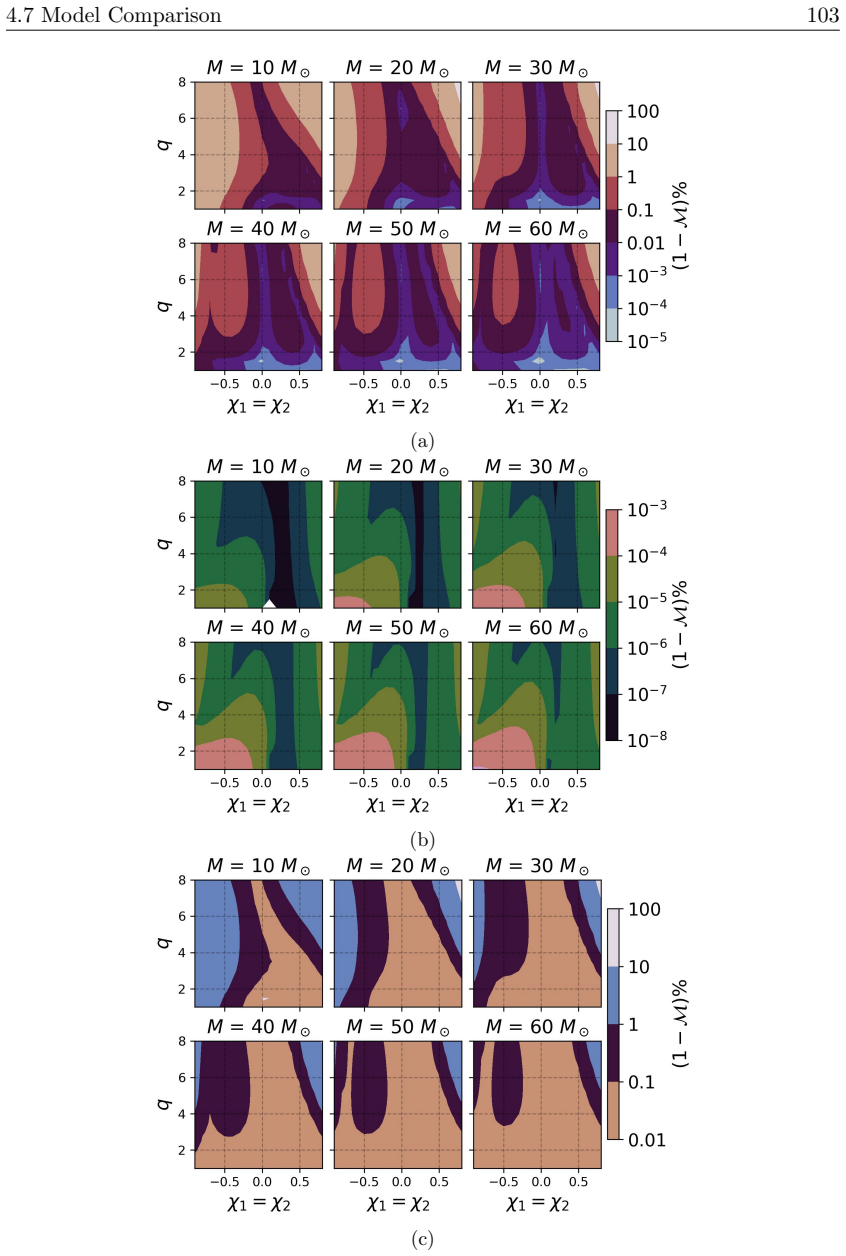
- [Sec. 4.7; Eq. (4.37), Figs. 4.7-4.8] The central accuracy claim of Ch. 4, a roughly 4% (ZDHP) and 2% (flat noise) improvement in median mismatch against 219 SXS waveforms, is reported without a significance statement, and the comparison set includes the 20 hybrids used to calibrate the model (Table 4.1). The two histograms in Figs. 4.7 and 4.8 overlap substantially, so the shift in medians could be within sampling error or driven by the calibration subset; the single outlier noted in Sec. 4.6 (q = 4, chi1 = 0, chi2 = 0.8; 1.21% at 70 M_sun) shows that the model is not uniformly better. Please report the median improvement computed on the 199 non-calibration waveforms only, add an uncertainty on the median shift (e.g., a bootstrap over the SXS set), and state the fraction of the 219 waveforms for which PhenomD Horizon is the better template.
minor comments (7)
- [Various] There are several typos and notation slips that should be cleaned up: 'fequencies' (Sec. 3.4.2, first paragraph), 'covarinaces' (Sec. 3.6), 'IMRPheonmD' (Sec. 5.4), and 'post-Newtonain' (Sec. 4.4).
- [Fig. 3.7 caption] The instruction that '14.65 is to be added to the tick labels of Mc' is confusing; the chirp-mass axis should simply be relabeled with the correct values.
- [Sec. 4.4, Eqs. (4.18)-(4.20)] For reproducibility, please state the actual values of the Planck-taper window parameters (x1, x2, x3, x4) used in the hybridization, rather than only the functional form.
- [Sec. 5.3] The restriction to nonspinning binaries and the simplifying assumption H1 = H2 = H should be stated at the beginning of Sec. 5.3, where the modeling strategy is set, rather than appearing in the middle of the paragraph describing the mass-flux data.
- [Eq. (5.11)] The entries of the beta_ij matrix are quoted to inconsistent precision (four entries to two or three significant figures, the rest to six or more), and no uncertainties are given for the coefficients despite the 1-sigma error bars displayed on the individual a_i fits in Fig. 5.1.
- [Table 4.1] The column labeled 'chi_PN' should be defined in the caption as the effective spin parameter of Eq. (4.25), since the table otherwise appears to list only component spins.
- [Secs. 3.2 and 4.3.1] The manuscript should state explicitly at first use that the TH phase expressions, Eqs. (3.4), (3.7), and (4.10)-(4.12), are taken from the authors' own Ref. [114], so that the reader can distinguish restated published material from new derivations in this thesis.
Circularity Check
No significant circularity: the measurability forecasts and waveform model rest on a previously published, parameter-free tidal-heating phase and are benchmarked against external SXS NR waveforms, not against the paper's own fitting targets.
full rationale
The thesis's three analysis chapters are each self-contained in the sense required here. Chapter 3 injects TaylorF2 waveforms augmented with the tidal-heating phase of Eq. (3.7) and uses Fisher/Bayesian parameter estimation to forecast errors on Heff5 and Heff8; the phase is taken from the authors' earlier Ref. [114], but that reference is a published derivation from horizon-flux expressions and is parameter-free with respect to the measurability question, so citing it is evidence, not circularity. Chapter 4 constructs hybrids by stitching SEOBNRv2 plus TH corrections to SXS NR waveforms, recalibrates the PhenomD-style pseudo-PN coefficients against those hybrids, and then validates the model against an independent set of test hybrids and 219 SXS NR waveforms; the claimed ~4% median mismatch improvement is an externally measured comparison, not an identity imposed by construction. Chapter 5 explicitly fits the phenomenological flux ansatz Eq. (5.9) to NR horizon data over Mf in [0.03,0.04] and derives the dephasing Eqs. (5.15)-(5.21) from that fit; this is model calibration, not a disguised prediction. The paper's own admission that the NR-fitted flux model 'behaves extremely poorly at lower frequencies' and the linear ramp Eq. (5.22) are ad hoc, but that is a correctness and robustness limitation, not a circular step: the fitted parameters are not renamed as a prediction of the target claim. No equation in the paper reduces to its output by definition, and no load-bearing conclusion is justified solely by a self-citation chain. The appropriate verdict is therefore no circularity, with the Chapter 5 splice flagged as a validation concern outside the circularity category.
Assumptions & free parameters
free parameters (2)
- sigma_0..sigma_4 (pseudo-PN inspiral phase parameters) =
Coefficients lambda in Table C.1, fit to 20 hybrids
- a_1..a_4 (phenomenological horizon-flux parameters) =
beta matrix in Eq. (5.11), fit to 6 SXS simulations
assumptions (4)
- domain assumption The total gravitational-wave phase separates as point-particle plus tidal deformability plus tidal heating, with the tidal-heating phase given by Eq. (3.7) computed from the flux Eq. (3.2) with horizon parameters H1, H2 scaling the BBH flux linearly.
- domain assumption SEOBNRv2 can serve as the point-particle baseline, and tidal-heating corrections can be added in the frequency domain without double-counting the NR calibrations present in SEOBNRv2.
- ad hoc to paper The ansatz Eq. (5.9) with parameters a1..a4 describes the total horizon flux, and the piecewise splicing Eq. (5.22) connects it to the PN result.
- standard math Fisher matrix error forecasts are valid for the high-SNR, Gaussian-noise regime.
Cite this review
Pith. "Pith review of Characterizing the Properties and Constitution of Compact Objects in Gravitational-Wave Binaries." pith.science (2026). https://pith.science/paper/HZJ7A3OF
@misc{pith2026241119481,
  author       = {Pith},
  title        = {Pith review of: Characterizing the Properties and Constitution of Compact Objects in Gravitational-Wave Binaries},
  year         = {2026},
  howpublished = {\url{https://pith.science/paper/HZJ7A3OF}},
  note         = {Machine review of arXiv:2411.19481}
}
read the original abstract
Astrophysical observations point toward strong evidence for the existence of black holes (BHs). Nevertheless, it is yet to be established or ruled out with confidence whether some exotic compact objects (ECOs), capable of mimicking black holes from an observational point of view, are indeed doing so. In classical General Relativity (GR), a horizon is the defining feature of a black hole, which prevents any event inside from causally affecting the outside Universe. The quest for distinguishing black holes from horizonless compact objects using gravitational wave (GW) signals from compact binary coalescences (CBCs) can be helped by utilizing the phenomenon of tidal heating (TH), which leaves its imprint on the binary waveforms through the horizon parameters. First, we study the measurabilities of these parameters within the inspiral regime. Then, to extend our investigation for heavier binaries, we construct an inspiral-merger-ringdown waveform by using post-Newtonian calculations for the inspiral and numerical relativity data for the merger-ringdown part that incorporates the effects of tidal heating of black holes in the phase and the amplitude. The new model shows improvements in waveform accuracy when compared to numerical relativity data. In the late inspiral phase when the compact objects are closer to each other, the effects of tidal heating are stronger, opening up the possibility of identifying the objects more precisely. We demonstrate, from numerical relativity data of binary black holes, how one can model tidal heating in the late inspiral regime and leverage this knowledge to test for horizonless compact objects mimicking black holes. These studies bear significance in determining the nature of compact objects having masses in the entire range that LIGO and future ground-based gravitational-wave detectors can detect.
Figures


Figures from the paper (23 more)




Reference graph
Works this paper leans on
-
[1]
Kormendy, J. & Richstone, D. Inward bound: The Search for supermassive black holes in galactic nuclei. Ann. Rev. Astron. Astrophys. 33, 581. doi: 10 . 1146 / annurev.aa.33.090195.003053 (1995)
arXiv 1995
-
[2]
in The Physics of Accretion onto Black Holes (eds Falanga, M
King, A. in The Physics of Accretion onto Black Holes (eds Falanga, M. et al. ) 427–451 (2015). doi: 10.1007/978-1-4939-2227-7_21
-
[3]
Gravitational collapse: The role of general relativity
Penrose, R. Gravitational collapse: The role of general relativity. Riv. Nuovo Cim. 1, 252–276. doi:10.1023/A:1016578408204 (1969)
-
[4]
Chrusciel, P. T., Lopes Costa, J. & Heusler, M. Stationary Black Holes: Uniqueness and Beyond. Living Rev. Rel. 15, 7. doi:10.12942/lrr-2012-7. arXiv: 1205.6112 [gr-qc] (2012)
arXiv 2012
-
[5]
Giddings, S. B., Koren, S. & Trevi˜ no, G. Exploring strong-field deviations from general relativity via gravitational waves.Phys. Rev. D 100, 044005. doi:10.1103/ PhysRevD.100.044005. arXiv: 1904.04258 [gr-qc] (2019)
arXiv 2019
-
[6]
Unruh, W. G. & Wald, R. M. Information Loss. Rept. Prog. Phys. 80, 092002. doi:10.1088/1361-6633/aa778e. arXiv: 1703.02140 [hep-th] (2017)
arXiv 2017
-
[7]
Barack, L. et al. Black holes, gravitational waves and fundamental physics: a roadmap. Class. Quant. Grav. 36, 143001. doi: 10 . 1088 / 1361 - 6382 / ab0587. arXiv: 1806.05195 [gr-qc] (2019)
arXiv 2019
-
[8]
Marsh, D. J. E. Axion Cosmology. Phys. Rept. 643, 1–79. doi: 10 . 1016 / j . physrep.2016.06.005. arXiv: 1510.07633 [astro-ph.CO] (2016)
arXiv 2016
Show all 237 references
-
[11]
Abbott, B. P. et al. GWTC-1: A Gravitational-Wave Transient Catalog of Com- pact Binary Mergers Observed by LIGO and Virgo during the First and Second Observing Runs. Phys. Rev. X9, 031040. doi: 10 . 1103 / PhysRevX . 9 . 031040. arXiv: 1811.12907 [astro-ph.HE] (2019)
2019 arXiv
-
[12]
Abbott, R. et al. GWTC-2: Compact Binary Coalescences Observed by LIGO and Virgo During the First Half of the Third Observing Run. Phys. Rev. X 11, 021053. doi:10.1103/PhysRevX.11.021053. arXiv: 2010.14527 [gr-qc] (2021)
2021 arXiv
-
[13]
Abbott, B. P. et al. Tests of General Relativity with the Binary Black Hole Signals from the LIGO-Virgo Catalog GWTC-1. Phys. Rev. D100, 104036. doi:10.1103/ PhysRevD.100.104036. arXiv: 1903.04467 [gr-qc] (2019)
2019 arXiv
-
[14]
Abbott, B. P. et al. Tests of General Relativity with GW170817. Phys. Rev. Lett. 123, 011102. doi: 10.1103/PhysRevLett.123.011102 . arXiv: 1811.00364 [gr-qc] (2019)
2019 arXiv
-
[15]
& Raposo, G
Cardoso, V., Franzin, E., Maselli, A., Pani, P. & Raposo, G. Testing strong-field gravity with tidal Love numbers. Phys. Rev. D 95. [Addendum: Phys.Rev.D 95, 089901 (2017)], 084014. doi: 10.1103/PhysRevD.95.084014 . arXiv: 1701.01116 [gr-qc] (2017). 141 142 References
2017 arXiv
-
[16]
Abbott, B. P. et al. GW170817: Observation of Gravitational Waves from a Binary Neutron Star Inspiral. Phys. Rev. Lett. 119, 161101. doi:10.1103/PhysRevLett. 119.161101. arXiv: 1710.05832 [gr-qc] (2017)
2017 arXiv
-
[17]
Abbott, B. et al. GW190425: Observation of a Compact Binary Coalescence with Total Mass ∼ 3.4M⊙. Astrophys. J. Lett. 892, L3. doi: 10 . 3847 / 2041 - 8213 / ab75f5. arXiv: 2001.01761 [astro-ph.HE] (2020)
2020 arXiv
-
[18]
Abbott, R. et al. Observation of Gravitational Waves from Two Neutron Star–Black Hole Coalescences. Astrophys. J. Lett. 915, L5. doi:10.3847/2041-8213/ac082e. arXiv: 2106.15163 [astro-ph.HE] (2021)
2021 arXiv
-
[19]
The many definitions of a black hole
Curiel, E. The many definitions of a black hole. Nature Astron. 3, 27–34. doi:10. 1038/s41550-018-0602-1 . arXiv: 1808.01507 [physics.hist-ph] (2019)
2019 arXiv
-
[20]
& Miller, J
Helou, A., Musco, I. & Miller, J. C. Causal Nature and Dynamics of Trapping Horizons in Black Hole Collapse. Class. Quant. Grav. 34, 135012. doi:10.1088/ 1361-6382/aa6d8f. arXiv: 1601.05109 [gr-qc] (2017)
2017 arXiv
-
[21]
& Krishnan, B
Ashtekar, A. & Krishnan, B. Isolated and dynamical horizons and their applica- tions. Living Rev. Rel. 7, 10. doi:10.12942/lrr-2004-10. arXiv: gr-qc/0407042 (2004)
2004 arXiv
-
[22]
Event and apparent horizon finders for 3+1 numerical relativity
Thornburg, J. Event and apparent horizon finders for 3+1 numerical relativity. Living Rev. Rel. 10, 3. doi:10.12942/lrr-2007-3. arXiv: gr-qc/0512169 (2007)
2007 arXiv
-
[23]
Wald, R. M. The thermodynamics of black holes. Living Rev. Rel. 4, 6. doi: 10. 12942/lrr-2001-6. arXiv: gr-qc/9912119 (2001)
2001 arXiv
-
[24]
Bekenstein, J. D. Black holes and the second law. Lett. Nuovo Cim. 4, 737–740. doi:10.1007/BF02757029 (1972)
1972 doi
-
[25]
Hawking, S. W. Gravitational radiation from colliding black holes. Phys. Rev. Lett. 26, 1344–1346. doi:10.1103/PhysRevLett.26.1344 (1971)
1971 doi
-
[26]
& Ferrara, A
Valentini, M., Gallerani, S. & Ferrara, A. Host galaxies of high-redshift quasars: SMBH growth and feedback. Mon. Not. Roy. Astron. Soc. 507, 1–26. doi: 10 . 1093/mnras/stab1992. arXiv: 2107.05638 [astro-ph.GA] (2021)
2021 arXiv
-
[27]
Latif, M. A. & Ferrara, A. Formation of supermassive black hole seeds. Publ. Astron. Soc. Austral. 33, e051. doi:10.1017/pasa.2016.41 . arXiv: 1605.07391 [astro-ph.GA] (2016)
2016 arXiv
-
[28]
Abbott, R. et al. GW190521: A Binary Black Hole Merger with a Total Mass of 150M⊙. Phys. Rev. Lett. 125, 101102. doi: 10.1103/PhysRevLett.125.101102 . arXiv: 2009.01075 [gr-qc] (2020)
2020
-
[29]
Abbott, R. et al. Properties and Astrophysical Implications of the 150 M ⊙ Binary Black Hole Merger GW190521. Astrophys. J. Lett. 900, L13. doi:10.3847/2041- 8213/aba493. arXiv: 2009.01190 [astro-ph.HE] (2020)
2020
-
[30]
Gibbons, G. W. Vacuum Polarization and the Spontaneous Loss of Charge by Black Holes. Commun. Math. Phys. 44, 245–264. doi:10.1007/BF01609829 (1975)
1975 doi
-
[31]
Schutz, B. F. A FIRST COURSE IN GENERAL RELATIVITY isbn: 978-0-511- 98418-1. doi:10.1017/CBO9780511984181 (Cambridge Univ. Pr., Cambridge, UK, 1985)
1985 doi
-
[32]
K., Chakraborty, S
Mishra, A. K., Chakraborty, S. & Sarkar, S. Understanding photon sphere and black hole shadow in dynamically evolving spacetimes. Phys. Rev. D 99, 104080. doi:10.1103/PhysRevD.99.104080. arXiv: 1903.06376 [gr-qc] (2019). References 143
2019 arXiv
-
[33]
& Joshi, P
Shaikh, R., Kocherlakota, P., Narayan, R. & Joshi, P. S. Shadows of spherically symmetric black holes and naked singularities. Mon. Not. Roy. Astron. Soc. 482, 52–64. doi:10.1093/mnras/sty2624. arXiv: 1802.08060 [astro-ph.HE] (2019)
2019 arXiv
-
[34]
Akiyama, K. et al. First M87 Event Horizon Telescope Results. I. The Shadow of the Supermassive Black Hole. Astrophys. J. Lett. 875, L1. doi: 10.3847/2041- 8213/ab0ec7. arXiv: 1906.11238 [astro-ph.GA] (2019)
2019 arXiv
-
[35]
Akiyama, K. et al. First Sagittarius A* Event Horizon Telescope Results. I. The Shadow of the Supermassive Black Hole in the Center of the Milky Way. Astro- phys. J. Lett. 930, L12. doi: 10.3847/2041- 8213/ac6674 . arXiv: 2311.08680 [astro-ph.HE] (2022)
2022 arXiv
-
[36]
Hawking, S. W. Black holes in general relativity. Commun. Math. Phys. 25, 152–
-
[37]
& Ruffini, R
Christodoulou, D. & Ruffini, R. Reversible transformations of a charged black hole. Phys. Rev. D 4, 3552–3555. doi:10.1103/PhysRevD.4.3552 (1971)
1971 doi
-
[38]
Buchdahl, H. A. General Relativistic Fluid Spheres. Phys. Rev. 116, 1027. doi:10. 1103/PhysRev.116.1027 (1959)
1959
-
[39]
Kaup, D. J. Klein-Gordon Geon. Phys. Rev. 172, 1331–1342. doi: 10 . 1103 / PhysRev.172.1331 (1968)
1968
-
[40]
& Bonazzola, S
Ruffini, R. & Bonazzola, S. Systems of selfgravitating particles in general relativity and the concept of an equation of state. Phys. Rev. 187, 1767–1783. doi:10.1103/ PhysRev.187.1767 (1969)
1969
-
[41]
Y., Malomed, B
Khlopov, M. Y., Malomed, B. A., Zeldovich, I. B. & Zeldovich, Y. B. Gravitational instability of scalar fields and formation of primordial black holes. Mon. Not. Roy. Astron. Soc. 215, 575–589. doi:10.1093/mnras/215.4.575 (1985)
1985 doi
-
[42]
& Bose, S
Mukherjee, A., Shah, S. & Bose, S. Observational constraints on spinning, rela- tivistic Bose-Einstein condensate stars. Phys. Rev. D 91, 084051. doi: 10.1103/ PhysRevD.91.084051. arXiv: 1409.6490 [astro-ph.HE] (2015)
2015 arXiv
-
[43]
Schunck, F. E. & Mielke, E. W. General relativistic boson stars. Class. Quant. Grav. 20, R301–R356. doi: 10.1088/0264- 9381/20/20/201 . arXiv: 0801.0307 [astro-ph] (2003)
2003 arXiv
-
[44]
& Kamionkowski, M
Kesden, M., Gair, J. & Kamionkowski, M. Gravitational-wave signature of an inspiral into a supermassive horizonless object. Phys. Rev. D 71, 044015. doi:10. 1103/PhysRevD.71.044015. arXiv: astro-ph/0411478 (2005)
2005 arXiv
-
[45]
Macedo, C. F. B., Pani, P., Cardoso, V. & Crispino, L. C. B. Astrophysical sig- natures of boson stars: quasinormal modes and inspiral resonances. Phys. Rev. D 88, 064046. doi: 10.1103/PhysRevD.88.064046 . arXiv: 1307.4812 [gr-qc] (2013)
2013 arXiv
-
[46]
Light rings and light points of boson stars
Grandcl´ ement, P. Light rings and light points of boson stars. Phys. Rev. D 95, 084011. doi:10.1103/PhysRevD.95.084011. arXiv: 1612.07507 [gr-qc] (2017)
2017 arXiv
-
[47]
P., Tremaine, S
Hui, L., Ostriker, J. P., Tremaine, S. & Witten, E. Ultralight scalars as cosmolog- ical dark matter. Phys. Rev. D 95, 043541. doi:10.1103/PhysRevD.95.043541 . arXiv: 1610.08297 [astro-ph.CO] (2017)
2017 arXiv
-
[48]
Sharp bounds on 2m/r of general spherically symmetric static objects
Andreasson, H. Sharp bounds on 2m/r of general spherically symmetric static objects. J. Diff. Eq. 245, 2243–2266. doi: 10.1016/j.jde.2008.05.010 . arXiv: gr-qc/0702137 (2008). 144 References
2008 arXiv
-
[49]
& Weiss, A
Kippenhahn, R., Weigert, A. & Weiss, A. Stellar structure and evolution doi:10. 1007/978-3-642-30304-3 (Springer, Aug. 2012)
2012
-
[50]
Pulsars: structure and dynamics
Ruderman, M. Pulsars: structure and dynamics. Ann. Rev. Astron. Astrophys. 10, 427–476. doi:10.1146/annurev.aa.10.090172.002235 (1972)
1972
-
[51]
Bowers, R. L. & Liang, E. P. T. Anisotropic Spheres in General Relativity. Astro- phys. J. 188, 657–665. doi:10.1086/152760 (1974)
1974 doi
-
[52]
Letelier, P. S. Anisotropic fluids with two-perfect-fluid components. Phys. Rev. D 22, 807. doi:10.1103/PhysRevD.22.807 (1980)
1980 doi
-
[53]
Bayin, S. S. Anisotropic Fluid Spheres in General Relativity. Phys. Rev. D 26,
-
[54]
& Gleiser, M
Dev, K. & Gleiser, M. Anisotropic stars: Exact solutions. Gen. Rel. Grav. 34, 1793–1818. doi:10.1023/A:1020707906543. arXiv: astro-ph/0012265 (2002)
2002 arXiv
-
[55]
Mak, M. K. & Harko, T. Anisotropic stars in general relativity. Proc. Roy. Soc. Lond. A 459, 393–408. doi: 10.1098/rspa.2002.1014 . arXiv: gr- qc/0110103 (2003)
2003
-
[56]
Herrera, L. et al. Spherically symmetric dissipative anisotropic fluids: A General study. Phys. Rev. D 69, 084026. doi: 10 . 1103 / PhysRevD . 69 . 084026. arXiv: gr-qc/0403006 (2004)
2004 arXiv
-
[57]
O., Macedo, C
Silva, H. O., Macedo, C. F. B., Berti, E. & Crispino, L. C. B. Slowly rotating anisotropic neutron stars in general relativity and scalar–tensor theory. Class. Quant. Grav. 32, 145008. doi:10.1088/0264-9381/32/14/145008 . arXiv: 1411. 6286 [gr-qc] (2015)
2015 doi
-
[58]
& Yunes, N
Yagi, K. & Yunes, N. I-Love-Q anisotropically: Universal relations for compact stars with scalar pressure anisotropy. Phys. Rev. D 91, 123008. doi: 10 . 1103 / PhysRevD.91.123008. arXiv: 1503.02726 [gr-qc] (2015)
2015 arXiv
-
[59]
& Yunes, N
Yagi, K. & Yunes, N. I-Love-Q Relations: From Compact Stars to Black Holes. Class. Quant. Grav. 33, 095005. doi:10.1088/0264-9381/33/9/095005 . arXiv: 1601.02171 [gr-qc] (2016)
2016 arXiv
-
[60]
& Bose, S
Biswas, B. & Bose, S. Tidal deformability of an anisotropic compact star: Implica- tions of GW170817. Phys. Rev. D 99, 104002. doi:10.1103/PhysRevD.99.104002. arXiv: 1903.04956 [gr-qc] (2019)
2019 arXiv
-
[61]
T., Romani, R
Gould, A., Draine, B. T., Romani, R. W. & Nussinov, S. Neutron Stars: Grave- yard of Charged Dark Matter. Phys. Lett. B 238, 337–343. doi: 10.1016/0370- 2693(90)91745-W (1990)
1990 doi
-
[62]
Giudice, G. F. Hunting for dark particles with gravitational waves. EPJ Web Conf. 164 (eds Bravina, L., Foka, Y. & Kabana, S.) 02004. doi: 10 . 1051 / epjconf / 201716402004 (2017)
2017
-
[63]
& Lin, F.-L
Zhang, K., Luo, L.-W., Tsao, J.-S., Chen, C.-S. & Lin, F.-L. Dark stars and gravitational waves: Topical review. Results Phys. 53, 106967. doi: 10.1016/j. rinp.2023.106967. arXiv: 2303.03266 [astro-ph.HE] (2023)
2023
-
[64]
Johnson-Mcdaniel, N. K. et al. Constraining black hole mimickers with gravita- tional wave observations. Phys. Rev. D 102, 123010. doi: 10 . 1103 / PhysRevD . 102.123010. arXiv: 1804.08026 [gr-qc] (2020)
2020 arXiv
-
[65]
Mazur, P. O. & Mottola, E. Gravitational Condensate Stars: An Alternative to Black Holes. Universe 9, 88. doi: 10 . 3390 / universe9020088. arXiv: gr - qc / 0109035 (2023). References 145
2023
-
[66]
Mazur, P. O. & Mottola, E. Gravitational vacuum condensate stars. Proc. Nat. Acad. Sci. 101, 9545–9550. doi: 10 . 1073 / pnas . 0402717101. arXiv: gr - qc / 0407075 [gr-qc] (2004)
2004
-
[67]
& Chirenti, C
Posada, C. & Chirenti, C. On the radial stability of ultra compact Schwarzschild stars beyond the Buchdahl limit. Class. Quant. Grav. 36, 065004. doi:10.1088/ 1361-6382/ab0526. arXiv: 1811.09589 [gr-qc] (2019)
2019 arXiv
-
[68]
& Piao, Y.-S
Wang, Y.-T., Zhang, J. & Piao, Y.-S. Primordial gravastar from inflation. Phys. Lett. B 795, 314–318. doi: 10.1016/j.physletb.2019.06.036 . arXiv: 1810. 04885 [gr-qc] (2019)
2019 doi
-
[69]
& Rosen, N
Einstein, A. & Rosen, N. The Particle Problem in the General Theory of Rela- tivity. Phys. Rev. 48, 73–77. doi:10.1103/PhysRev.48.73 . https://link.aps. org/doi/10.1103/PhysRev.48.73 (1 July 1935)
1935 doi
-
[70]
Lemos, J. P. S., Lobo, F. S. N. & Quinet de Oliveira, S. Morris-Thorne wormholes with a cosmological constant. Phys. Rev. D 68, 064004. doi:10.1103/PhysRevD. 68.064004. arXiv: gr-qc/0302049 (2003)
2003 arXiv
-
[71]
& Popov, F
Maldacena, J., Milekhin, A. & Popov, F. Traversable wormholes in four dimen- sions. Class. Quant. Grav. 40, 155016. doi:10.1088/1361-6382/acde30 . arXiv: 1807.04726 [hep-th] (2023)
2023 arXiv
-
[72]
Lemos, J. P. S. & Weinberg, E. J. Quasiblack holes from extremal charged dust. Phys. Rev. D 69, 104004. doi: 10. 1103/PhysRevD. 69.104004. arXiv: gr- qc / 0311051 (2004)
2004
-
[73]
Lemos, J. P. S. & Zaslavskii, O. B. Black hole mimickers: Regular versus singular behavior. Phys. Rev. D 78, 024040. doi: 10.1103/PhysRevD.78.024040 . arXiv: 0806.0845 [gr-qc] (2008)
2008 arXiv
-
[74]
& Visser, M
Barcel´ o, C., Liberati, S., Sonego, S. & Visser, M. Black stars, not holes. Scientific American 301, 38–45 (2009)
2009
-
[75]
& Yokokura, Y
Kawai, H., Matsuo, Y. & Yokokura, Y. A Self-consistent Model of the Black Hole Evaporation. Int. J. Mod. Phys. A 28, 1350050. doi:10.1142/S0217751X13500504. arXiv: 1302.4733 [hep-th] (2013)
2013 arXiv
-
[76]
Baccetti, V., Mann, R. B. & Terno, D. R. Do event horizons exist? Int. J. Mod. Phys. D 26, 1743008. doi: 10 . 1142 / S0218271817170088. arXiv: 1706 . 01180 [gr-qc] (2017)
2017
-
[77]
Bekenstein, J. D. & Mukhanov, V. F. Spectroscopy of the quantum black hole. Phys. Lett. B 360, 7–12. doi: 10 . 1016 / 0370 - 2693(95 ) 01148 - J. arXiv: gr - qc/9505012 (1995)
1995
-
[78]
& Krasnov, K
Ashtekar, A., Baez, J., Corichi, A. & Krasnov, K. Quantum geometry and black hole entropy. Phys. Rev. Lett. 80, 904–907. doi:10.1103/PhysRevLett.80.904 . arXiv: gr-qc/9710007 (1998)
1998 arXiv
-
[79]
& Pani, P
Cardoso, V. & Pani, P. Testing the nature of dark compact objects: a status report. Living Rev. Rel. 22, 4. doi: 10.1007/s41114- 019- 0020- 4. arXiv: 1904.05363 [gr-qc] (2019)
2019 arXiv
-
[80]
& Norte, R
Pani, P., Berti, E., Cardoso, V., Chen, Y. & Norte, R. Gravitational wave signa- tures of the absence of an event horizon. I. Nonradial oscillations of a thin-shell gravastar. Phys. Rev. D 80, 124047. doi:10.1103/PhysRevD.80.124047 . arXiv: 0909.0287 [gr-qc] (2009). 146 References
2009 arXiv
-
[81]
Mazur, P. O. & Mottola, E. Surface tension and negative pressure interior of a non-singular ‘black hole’. Class. Quant. Grav. 32, 215024. doi: 10.1088/0264- 9381/32/21/215024. arXiv: 1501.03806 [gr-qc] (2015)
2015 arXiv
-
[82]
& Rezzolla, L
Chirenti, C. & Rezzolla, L. Did GW150914 produce a rotating gravastar? Phys. Rev. D 94, 084016. doi: 10 . 1103 / PhysRevD . 94 . 084016. arXiv: 1602 . 08759 [gr-qc] (2016)
2016
-
[83]
K., Izmailov, R
Nandi, K. K., Izmailov, R. N., Yanbekov, A. A. & Shayakhmetov, A. A. Ring-down gravitational waves and lensing observables: How far can a wormhole mimic those of a black hole? Phys. Rev. D 95, 104011. doi: 10.1103/PhysRevD.95.104011 . arXiv: 1611.03479 [gr-qc] (2017)
2017 arXiv
-
[84]
Abbott, B. P. et al. Tests of general relativity with GW150914. Phys. Rev. Lett
-
[85]
& Yunes, N
Berti, E., Yagi, K., Yang, H. & Yunes, N. Extreme Gravity Tests with Gravita- tional Waves from Compact Binary Coalescences: (II) Ringdown. Gen. Rel. Grav. 50, 49. doi:10.1007/s10714-018-2372-6 . arXiv: 1801.03587 [gr-qc] (2018)
2018 arXiv
-
[86]
& Pani, P
Cardoso, V. & Pani, P. Tests for the existence of black holes through gravitational wave echoes. Nature Astron. 1, 586–591. doi: 10 . 1038 / s41550 - 017 - 0225 - y. arXiv: 1709.01525 [gr-qc] (2017)
2017 arXiv
-
[87]
Probing the Horizon of Black Holes with Gravitational Waves
Maggio, E. Probing the Horizon of Black Holes with Gravitational Waves. Lect. Notes Phys. 1017, 333–346. doi:10.1007/978-3-031-31520-6_9 . arXiv: 2310. 07368 [gr-qc] (2023)
2023 doi
-
[88]
Uchikata, N. et al. Searching for gravitational wave echoes from black hole binary events in the third observing run of LIGO, Virgo, and KAGRA collaborations. Phys. Rev. D 108, 104040. doi: 10.1103/PhysRevD.108.104040 . arXiv: 2309. 01894 [gr-qc] (2023)
2023 doi
-
[89]
& Chakraborty, S
Biswas, S., Rahman, M. & Chakraborty, S. Echoes from braneworld wormholes. Phys. Rev. D 106, 124003. doi: 10.1103/PhysRevD.106.124003 . arXiv: 2205. 14743 [gr-qc] (2022)
2022 doi
-
[90]
Gravitational Radiation from Post-Newtonian Sources and Inspi- ralling Compact Binaries
Blanchet, L. Gravitational Radiation from Post-Newtonian Sources and Inspi- ralling Compact Binaries. Living Rev. Rel. 17, 2. doi: 10 . 12942 / lrr - 2014 - 2. arXiv: 1310.1528 [gr-qc] (2014)
2014 arXiv
-
[91]
V., Arun, K
Krishnendu, N. V., Arun, K. G. & Mishra, C. K. Testing the binary black hole nature of a compact binary coalescence. Phys. Rev. Lett. 119, 091101. doi: 10. 1103/PhysRevLett.119.091101. arXiv: 1701.06318 [gr-qc] (2017)
2017 arXiv
-
[92]
Probes and Tests of Strong-Field Gravity with Observations in the Electromagnetic Spectrum
Psaltis, D. Probes and Tests of Strong-Field Gravity with Observations in the Electromagnetic Spectrum. Living Rev. Rel. 11, 9. doi: 10.12942/lrr- 2008- 9. arXiv: 0806.1531 [astro-ph] (2008)
2008 arXiv
-
[93]
R., Vallisneri, M., Larson, S
Gair, J. R., Vallisneri, M., Larson, S. L. & Baker, J. G. Testing General Relativity with Low-Frequency, Space-Based Gravitational-Wave Detectors.Living Rev. Rel. 16, 7. doi:10.12942/lrr-2013-7. arXiv: 1212.5575 [gr-qc] (2013)
2013 arXiv
-
[94]
Laarakkers, W. G. & Poisson, E. Quadrupole moments of rotating neutron stars. Astrophys. J. 512, 282–287. doi:10.1086/306732. arXiv: gr-qc/9709033 (1999)
1999 arXiv
-
[95]
Ryan, F. D. Spinning boson stars with large selfinteraction. Phys. Rev. D 55, 6081–6091. doi:10.1103/PhysRevD.55.6081 (1997). References 147
1997 doi
-
[96]
V., Mishra, C
Krishnendu, N. V., Mishra, C. K. & Arun, K. G. Spin-induced deformations and tests of binary black hole nature using third-generation detectors.Phys. Rev. D99, 064008. doi:10.1103/PhysRevD.99.064008. arXiv: 1811.00317 [gr-qc] (2019)
2019 arXiv
-
[97]
Krishnendu, N. V. et al. Constraints on the binary black hole nature of GW151226 and GW170608 from the measurement of spin-induced quadrupole moments.Phys. Rev. D 100, 104019. doi: 10.1103/PhysRevD.100.104019 . arXiv: 1908.02247 [gr-qc] (2019)
2019 arXiv
-
[98]
Saleem, M. et al. Population inference of spin-induced quadrupole moments as a probe for non-black hole compact binaries. arXiv: 2111.04135 [gr-qc] (Nov. 2021)
2021 arXiv
-
[99]
& Krishnendu, N
Saini, P. & Krishnendu, N. V. Constraining the nature of dark compact objects with spin-induced octupole moment measurement. Phys. Rev. D 109, 024009. doi:10.1103/PhysRevD.109.024009. arXiv: 2308.01309 [gr-qc] (2024)
2024 arXiv
-
[100]
Flanagan, E. E. & Hinderer, T. Constraining neutron star tidal Love numbers with gravitational wave detectors. Phys. Rev. D 77, 021502. doi:10.1103/PhysRevD. 77.021502. arXiv: 0709.1915 [astro-ph] (2008)
2008 arXiv
-
[101]
D., Lang, R
Hinderer, T., Lackey, B. D., Lang, R. N. & Read, J. S. Tidal deformability of neu- tron stars with realistic equations of state and their gravitational wave signatures in binary inspiral. Phys. Rev. D 81, 123016. doi:10.1103/PhysRevD.81.123016. arXiv: 0911.3535 [astro-ph.HE] (2010)
2010 arXiv
-
[102]
& Lovelace, G
Fang, H. & Lovelace, G. Tidal coupling of a Schwarzschild black hole and circularly orbiting moon. Phys. Rev. D 72, 124016. doi: 10 . 1103 / PhysRevD . 72 . 124016. arXiv: gr-qc/0505156 (2005)
2005 arXiv
-
[103]
& Poisson, E
Binnington, T. & Poisson, E. Relativistic theory of tidal Love numbers. Phys. Rev. D80, 084018. doi: 10 . 1103 / PhysRevD . 80 . 084018. arXiv: 0906 . 1366 [gr-qc] (2009)
2009
-
[104]
No-hair theorem for Black Holes in Astrophysical Environments
G¨ urlebeck, N. No-hair theorem for Black Holes in Astrophysical Environments. Phys. Rev. Lett. 114, 151102. doi: 10 . 1103 / PhysRevLett . 114 . 151102. arXiv: 1503.03240 [gr-qc] (2015)
2015 arXiv
-
[105]
The Overlap of Numerical Relativity, Perturbation Theory and Post- Newtonian Theory in the Binary Black Hole Problem
Le Tiec, A. The Overlap of Numerical Relativity, Perturbation Theory and Post- Newtonian Theory in the Binary Black Hole Problem. Int. J. Mod. Phys. D 23, 1430022. doi:10.1142/S0218271814300225. arXiv: 1408.5505 [gr-qc] (2014)
2014 arXiv
-
[106]
Chia, H. S. Tidal Deformation and Dissipation of Rotating Black Holes. arXiv: 2010.07300 [gr-qc] (Oct. 2020)
2010 arXiv
-
[107]
P., Chakraborty, S
Bhatt, R. P., Chakraborty, S. & Bose, S. Addressing issues in defining the Love numbers for black holes. Phys. Rev. D 108, 084013. doi:10.1103/PhysRevD.108. 084013. arXiv: 2306.13627 [gr-qc] (2023)
2023 arXiv
-
[108]
& Pani, P
Uchikata, N., Yoshida, S. & Pani, P. Tidal deformability and I-Love-Q relations for gravastars with polytropic thin shells. Phys. Rev. D 94, 064015. doi:10.1103/ PhysRevD.94.064015. arXiv: 1607.03593 [gr-qc] (2016)
2016 arXiv
-
[109]
& Ferrari, V
Pani, P., Gualtieri, L., Maselli, A. & Ferrari, V. Tidal deformations of a spinning compact object. Phys. Rev. D 92, 024010. doi: 10.1103/PhysRevD.92.024010 . arXiv: 1503.07365 [gr-qc] (2015). 148 References
2015 arXiv
-
[110]
& Ossokine, S
Sennett, N., Hinderer, T., Steinhoff, J., Buonanno, A. & Ossokine, S. Distinguish- ing Boson Stars from Black Holes and Neutron Stars from Tidal Interactions in Inspiraling Binary Systems. Phys. Rev. D96, 024002. doi:10.1103/PhysRevD.96. 024002. arXiv: 1704.08651 [gr-qc] (2017)
2017 arXiv
-
[111]
H., Henning, W
Tyler, R. H., Henning, W. G. & Hamilton, C. W. Tidal heating in a magma ocean within Jupiter’s moon Io. The Astrophysical Journal Supplement Series 218, 22. doi:10.1088/0067-0049/218/2/22 (2015)
2015 doi
-
[112]
Hartle, J. B. Tidal Friction in Slowly Rotating Black Holes. Phys. Rev. D8, 1010–
-
[113]
& Hughes, S
Datta, S., Brito, R., Bose, S., Pani, P. & Hughes, S. A. Tidal heating as a dis- criminator for horizons in extreme mass ratio inspirals. Phys. Rev. D101, 044004. doi:10.1103/PhysRevD.101.044004. arXiv: 1910.07841 [gr-qc] (2020)
2020 arXiv
-
[115]
Energy and angular momentum flow into a black hole in a binary
Alvi, K. Energy and angular momentum flow into a black hole in a binary. Phys. Rev. D64, 104020. doi: 10.1103/PhysRevD.64.104020 . arXiv: gr- qc/0107080 [gr-qc] (2001)
2001
-
[116]
[Erratum: Phys. Rev. Lett.121,no.12,129902(2018)], 221101. doi: 10.1103/ PhysRevLett.116.221101, 10.1103/PhysRevLett.121.129902 . arXiv: 1602. 03841 [gr-qc] (2016)
2018 doi
-
[117]
& Yunes, N
Chatziioannou, K., Poisson, E. & Yunes, N. Tidal heating and torquing of a Kerr black hole to next-to-leading order in the tidal coupling. Phys. Rev. D87, 044022. doi:10.1103/PhysRevD.87.044022. arXiv: 1211.1686 [gr-qc] (2013)
2013 arXiv
-
[118]
& Yunes, N
Chatziioannou, K., Poisson, E. & Yunes, N. Improved next-to-leading order tidal heating and torquing of a Kerr black hole. Phys. Rev. D94, 084043. doi:10.1103/ PhysRevD.94.084043. arXiv: 1608.02899 [gr-qc] (2016)
2016 arXiv
-
[119]
Maggiore, M. et al. Science case for the Einstein telescope. Journal of Cosmology and Astroparticle Physics 2020, 050. doi: https : / / doi . org / 10 . 1088 / 1475 - 7516/2020/03/050 (2020)
2020
-
[120]
Absorption of mass and angular momentum by a black hole: Time- domain formalisms for gravitational perturbations, and the small-hole / slow- motion approximation
Poisson, E. Absorption of mass and angular momentum by a black hole: Time- domain formalisms for gravitational perturbations, and the small-hole / slow- motion approximation. Phys. Rev. D70, 084044. doi: 10 . 1103 / PhysRevD . 70 . 084044. arXiv: gr-qc/0407050 [gr-qc] (2004)
2004 arXiv
-
[121]
S., Price, R
Thorne, K. S., Price, R. & Macdonald, D. Black holes: the membrane paradigm (ed Thorne, K. S.) (Yale University Press, 1986)
1986
-
[122]
Pulsating relativistic stars in Proceedings of the Second Marcel Gross- mann Meeting ofGeneral Relativity, edited by R
Damour, T. Pulsating relativistic stars in Proceedings of the Second Marcel Gross- mann Meeting ofGeneral Relativity, edited by R. Ruffini, North Holland, Amster- dam, 1982 pp 587-608 (1982)
1982
-
[123]
Tidal interaction of black holes and Newtonian viscous bodies
Poisson, E. Tidal interaction of black holes and Newtonian viscous bodies. Phys. Rev. D80, 064029. doi:10.1103/PhysRevD.80.064029. arXiv: 0907.0874 [gr-qc] (2009)
2009 arXiv
-
[124]
Reitze, D. et al. Cosmic Explorer: The U.S. Contribution to Gravitational-Wave Astronomy beyond LIGO. Bull. Am. Astron. Soc. 51, 035. arXiv: 1907.04833 [astro-ph.IM] (2019)
2019 arXiv
-
[125]
Hughes, S. A. Evolution of circular, nonequatorial orbits of Kerr black holes due to gravitational wave emission. II. Inspiral trajectories and gravitational wave forms. Phys. Rev. D64. [Erratum: Phys. Rev.D88,no.10,109902(2013)], 064004. doi:10 . 1103 / PhysRevD . 64 . 064004...
2013 arXiv
-
[126]
& Will, C
Poisson, E. & Will, C. Gravity: Newtonian, Post-Newtonian, Relativistic (Cam- bridge University Press, Cambridge, UK, 1953)
1953
-
[127]
Maselli, A. et al. Probing Planckian corrections at the horizon scale with LISA binaries. Phys. Rev. Lett. 120, 081101. doi:10.1103/PhysRevLett.120.081101 . arXiv: 1703.10612 [gr-qc] (2018)
2018 arXiv
-
[128]
& Pani, P
Cardoso, V. & Pani, P. Tidal acceleration of black holes and superradiance. Class. Quant. Grav. 30, 045011. doi:10.1088/0264-9381/30/4/045011 . arXiv: 1205. 3184 [gr-qc] (2013). References 149
2013 doi
-
[129]
Tidal heating of Quantum Black Holes and their imprints on gravita- tional waves
Datta, S. Tidal heating of Quantum Black Holes and their imprints on gravita- tional waves. Phys. Rev. D 102, 064040. doi: 10.1103/PhysRevD.102.064040 . arXiv: 2002.04480 [gr-qc] (2020)
2020 arXiv
-
[130]
D., Maggiore, M
Agullo, I., Cardoso, V., Rio, A. D., Maggiore, M. & Pullin, J. Potential Grav- itational Wave Signatures of Quantum Gravity. Phys. Rev. Lett. 126, 041302. doi:10.1103/PhysRevLett.126.041302. arXiv: 2007.13761 [gr-qc] (2021)
2021 arXiv
-
[131]
& Sau, S
Chakraborty, S., Datta, S. & Sau, S. Tidal heating of black holes and exotic compact objects on the brane. Phys. Rev. D 104, 104001. doi:10.1103/PhysRevD. 104.104001. arXiv: 2103.12430 [gr-qc] (2021)
2021 arXiv
-
[132]
& Bose, S
Datta, S. & Bose, S. Probing the nature of central objects in extreme-mass-ratio in- spirals with gravitational waves.Phys. Rev. D99, 084001. doi:10.1103/PhysRevD. 99.084001. arXiv: 1902.01723 [gr-qc] (2019)
2019 arXiv
-
[133]
& Phukon, K
Datta, S. & Phukon, K. S. Imprint of black hole area quantization and Hawking ra- diation on inspiraling binary. Phys. Rev. D 104, 124062. doi:10.1103/PhysRevD. 104.124062. arXiv: 2105.11140 [gr-qc] (2021)
2021 arXiv
-
[134]
& Tanaka, T
Sago, N. & Tanaka, T. Oscillations in the extreme mass-ratio inspiral gravitational wave phase correction as a probe of a reflective boundary of the central black hole. Phys. Rev. D 104, 064009. doi: 10 . 1103 / PhysRevD . 104 . 064009. arXiv: 2106.07123 [gr-qc] (2021)
2021 arXiv
-
[135]
& Pani, P
Maggio, E., van de Meent, M. & Pani, P. Extreme mass-ratio inspirals around a spinning horizonless compact object. Phys. Rev. D 104, 104026. doi: 10.1103/ PhysRevD.104.104026. arXiv: 2106.07195 [gr-qc] (2021)
2021 arXiv
-
[136]
Tidal-heating and viscous dissipation correspondence in black holes and viscous compact objects
Sherf, Y. Tidal-heating and viscous dissipation correspondence in black holes and viscous compact objects. Phys. Rev. D 103, 104003. doi:10.1103/PhysRevD.103. 104003. arXiv: 2104.03766 [gr-qc] (2021)
2021 arXiv
-
[137]
& Talbot, C
Thrane, E. & Talbot, C. An introduction to Bayesian inference in gravitational- wave astronomy: Parameter estimation, model selection, and hierarchical models. Publications of the Astronomical Society of Australia 36. issn: 1448-6083. doi:10. 1017/pasa.2019.2. http://dx.doi.or...
2019 doi
-
[138]
Use and abuse of the Fisher information matrix in the assessment of gravitational-wave parameter-estimation prospects
Vallisneri, M. Use and abuse of the Fisher information matrix in the assessment of gravitational-wave parameter-estimation prospects. Phys. Rev. D 77, 042001. doi:10.1103/PhysRevD.77.042001. arXiv: gr-qc/0703086 (2008). 150 References
2008 arXiv
-
[139]
Binary Black Hole Coalescence
Pretorius, F. Binary Black Hole Coalescence. arXiv: 0710.1338 [gr-qc] (Aug. 2007)
2007 arXiv
-
[140]
& Tanaka, T
Sago, N. & Tanaka, T. Efficient search method of anomalous reflection by the central object in an EMRI system by future space gravitational wave detectors. arXiv: 2202.04249 [gr-qc] (Feb. 2022)
2022 arXiv
-
[141]
Glampedakis, K., Kapadia, S. J. & Kennefick, D. Superradiance-tidal friction cor- respondence. Phys. Rev. D89, 024007. doi:10.1103/PhysRevD.89.024007. arXiv: 1312.1912 [gr-qc] (2014)
2014 arXiv
-
[142]
& Corrigan, E
Poisson, E. & Corrigan, E. Nonrotating black hole in a post-Newtonian tidal environment II. Phys. Rev. D97, 124048. doi: 10 . 1103 / PhysRevD . 97 . 124048. arXiv: 1804.01848 [gr-qc] (2018)
2018 arXiv
-
[143]
& Akcay, S
Nagar, A. & Akcay, S. Horizon-absorbed energy flux in circularized, nonspinning black-hole binaries and its effective-one-body representation. Phys. Rev. D85, 044025. doi:10.1103/PhysRevD.85.044025. arXiv: 1112.2840 [gr-qc] (2012)
2012 arXiv
-
[144]
& Tagoshi, H
Sasaki, M. & Tagoshi, H. Analytic black hole perturbation approach to gravi- tational radiation. Living Rev. Rel. 6, 6. doi: 10 . 12942 / lrr - 2003 - 6. arXiv: gr-qc/0306120 (2003)
2003 arXiv
-
[145]
Coalescence of two spinning black holes: an effective one-body ap- proach
Damour, T. Coalescence of two spinning black holes: an effective one-body ap- proach. Phys. Rev. D64, 124013. doi: 10 . 1103 / PhysRevD . 64 . 124013. arXiv: gr-qc/0103018 [gr-qc] (2001)
2001 arXiv
-
[146]
Addressing the spin question in gravitational-wave searches: Waveform templates for inspiralling compact binaries with nonprecessing spins
Ajith, P. Addressing the spin question in gravitational-wave searches: Waveform templates for inspiralling compact binaries with nonprecessing spins. Phys. Rev. D84, 084037. doi: 10 . 1103 / PhysRevD . 84 . 084037. arXiv: 1107 . 1267 [gr-qc] (2011)
2011
-
[147]
Tichy, W., Flanagan, E. E. & Poisson, E. Can the postNewtonian gravitational wave form of an inspiraling binary be improved by solving the energy balance equation numerically? Phys. Rev. D61, 104015. doi: 10 . 1103 / PhysRevD . 61 . 104015. arXiv: gr-qc/9912075 [gr-qc] (2000)
2000 arXiv
-
[148]
& Zenginoglu, A
Bernuzzi, S., Nagar, A. & Zenginoglu, A. Horizon-absorption effects in coalesc- ing black-hole binaries: An effective-one-body study of the non-spinning case. Phys. Rev. D86, 104038. doi:10.1103/PhysRevD.86.104038 . arXiv: 1207.0769 [gr-qc] (2012)
2012 arXiv
-
[149]
R., Ochsner, E., Pan, Y
Buonanno, A., Iyer, B. R., Ochsner, E., Pan, Y. & Sathyaprakash, B. S. Compari- son of post-Newtonian templates for compact binary inspiral signals in gravitational- wave detectors. Phys. Rev. D 80, 084043. doi: 10.1103/PhysRevD.80.084043 . https://link.aps.org/doi/10.1103/Phy...
-
[150]
& Flanagan, ´E
Cutler, C. & Flanagan, ´E. E. Gravitational waves from merging compact binaries: How accurately can one extract the binary’s parameters from the inspiral wave- form? Phys. Rev. D 49, 2658–2697. doi: 10 .1103 / PhysRevD. 49 . 2658. https : //link.aps.org/doi/10.1103/PhysRevD.49...
-
[151]
Owen, B. J. Search templates for gravitational waves from inspiraling binaries: Choice of template spacing. Phys. Rev. D 53, 6749–6761. doi:10.1103/PhysRevD. 53.6749 . https://link.aps.org/doi/10.1103/PhysRevD.53.6749 (12 June 1996). References 151
-
[152]
& Nakano, H
Isoyama, S. & Nakano, H. Post-Newtonian templates for binary black-hole inspi- rals: the effect of the horizon fluxes and the secular change in the black-hole masses and spins. Class. Quant. Grav. 35, 024001. doi: 10 . 1088 / 1361 - 6382 / aa96c5. arXiv: 1705.03869 [gr-qc] (2018)
2018 arXiv
-
[153]
Regimbau, T. et al. Digging deeper: Observing primordial gravitational waves be- low the binary-black-hole-produced stochastic background. Physical review letters 118, 151105. doi:10.1103/PhysRevLett.118.151105 (2017)
2017 doi
-
[154]
& Evans, M
Vitale, S. & Evans, M. Parameter estimation for binary black holes with networks of third-generation gravitational-wave detectors. Physical Review D 95, 064052. doi:10.1103/PhysRevD.95.064052 (2017)
2017 doi
-
[155]
GWBENCH: a novel Fisher information package for gravitational- wave benchmarking
Borhanian, S. GWBENCH: a novel Fisher information package for gravitational- wave benchmarking. Class. Quant. Grav. 38, 175014. doi: 10.1088/1361-6382/ ac1618. arXiv: 2010.15202 [gr-qc] (2021)
2021 arXiv
-
[156]
& Will, C
Poisson, E. & Will, C. M. Gravitational waves from inspiraling compact binaries: Parameter estimation using second-post-Newtonian waveforms. Phys. Rev. D 52, 848–855. doi: 10 . 1103 / PhysRevD . 52 . 848. https : / / link . aps . org / doi / 10 . 1103/PhysRevD.52.848 (2 July 1995)
1995
-
[157]
G., Kim, J
Favata, M., Kim, C., Arun, K. G., Kim, J. & Lee, H. W. Constraining the orbital eccentricity of inspiralling compact binary systems with Advanced LIGO. Phys. Rev. D 105, 023003. doi: 10.1103/PhysRevD.105.023003 . arXiv: 2108.05861 [gr-qc] (2022)
2022 arXiv
-
[158]
M., Press, W
Bardeen, J. M., Press, W. H. & Teukolsky, S. A. Rotating black holes: Locally non- rotating frames, energy extraction, and scalar synchrotron radiation. Astrophys. J. 178, 347. doi:10.1086/151796 (1972)
1972 doi
-
[159]
Husa, S. et al. Frequency-domain gravitational waves from nonprecessing black- hole binaries. I. New numerical waveforms and anatomy of the signal. Phys. Rev. D 93, 044006. doi:10.1103/PhysRevD.93.044006. https://link.aps.org/doi/ 10.1103/PhysRevD.93.044006 (4 Feb. 2016)
-
[160]
Sathyaprakash, B. S. & Schutz, B. F. Physics, Astrophysics and Cosmology with Gravitational Waves. Living Rev. Rel. 12, 2. doi:10.12942/lrr-2009-2 . arXiv: 0903.0338 [gr-qc] (2009)
2009 arXiv
-
[161]
Aasi, J. et al. Advanced LIGO. Class. Quant. Grav. 32, 074001. doi: 10.1088/ 0264-9381/32/7/074001. arXiv: 1411.4547 [gr-qc] (2015)
2015 arXiv
-
[163]
& Fritschel, P
Barsotti, L., Gras, S., Evans, M. & Fritschel, P. Updated Advanced LIGO sensi- tivity design curve. https: // dcc. ligo. org/ LIGO-T1800044/ public
-
[164]
L., Mandel, I
Rodriguez, C. L., Mandel, I. & Gair, J. R. Verifying the no-hair property of massive compact objects with intermediate-mass-ratio inspirals in advanced gravitational- wave detectors. Phys. Rev. D 85, 062002. doi: 10.1103/PhysRevD.85.062002 . https://link.aps.org/doi/10.1103/Ph...
-
[165]
Hild, S. et al. Sensitivity Studies for Third-Generation Gravitational Wave Obser- vatories. Class. Quant. Grav. 28, 094013. doi:10.1088/0264-9381/28/9/094013. arXiv: 1012.0908 [gr-qc] (2011)
2011 arXiv
-
[166]
doi:10.1007/BF01877517 (1972)
1972 doi
-
[167]
Abbott, B. P. et al. Exploring the Sensitivity of Next Generation Gravitational Wave Detectors. Class. Quant. Grav. 34, 044001. doi: 10 . 1088 / 1361 - 6382 / aa51f4. arXiv: 1607.08697 [astro-ph.IM] (2017)
2017 arXiv
-
[168]
Prospects for Observing and Localizing Gravitational- Wave Transients with Advanced LIGO, Advanced Virgo and KAGRA
LIGO Virgo Collaboration. Prospects for Observing and Localizing Gravitational- Wave Transients with Advanced LIGO, Advanced Virgo and KAGRA. https : // dcc. ligo. org/ LIGO-P1200087-v47/ public
-
[169]
& Dal Canton, T
Toubiana, A., Marsat, S., Babak, S., Baker, J. & Dal Canton, T. Parameter esti- mation of stellar-mass black hole binaries with LISA. Phys. Rev. D 102, 124037. doi:10.1103/PhysRevD.102.124037. arXiv: 2007.08544 [gr-qc] (2020)
2020 arXiv
-
[170]
Kuns, K. et al. Cosmic Explorer Strain Sensitivity. https: // dcc. cosmicexplorer. org/ public/ 0163/ T2000017/ 004/ ce_ strain. txt 152 References
-
[171]
B., Keppel, D
Ohme, F., Nielsen, A. B., Keppel, D. & Lundgren, A. Statistical and system- atic errors for gravitational-wave inspiral signals: A principal component analysis. Phys. Rev. D 88, 042002. doi:10.1103/PhysRevD.88.042002. arXiv: 1304.7017 [gr-qc] (2013)
2013 arXiv
-
[172]
Ashton, G. et al. BILBY: A user-friendly Bayesian inference library for gravitational- wave astronomy. Astrophys. J. Suppl. 241, 27. doi:10.3847/1538-4365/ab06fc . arXiv: 1811.02042 [astro-ph.IM] (2019)
2019 arXiv
-
[173]
Bose, S., Chakravarti, K., Rezzolla, L., Sathyaprakash, B. S. & Takami, K. Neutron- star Radius from a Population of Binary Neutron Star Mergers. Phys. Rev. Lett. 120, 031102. doi:10.1103/PhysRevLett.120.031102. arXiv: 1705.10850 [gr-qc] (2018)
2018 arXiv
-
[174]
& Bose, S
Ajith, P. & Bose, S. Estimating the parameters of non-spinning binary black holes using ground-based gravitational-wave detectors: Statistical errors. Phys. Rev. D 79, 084032. doi: 10 . 1103 / PhysRevD . 79 . 084032. arXiv: 0901 . 4936 [gr-qc] (2009)
2009
-
[175]
Nitz, A. H. et al. 4-OGC: Catalog of Gravitational Waves from Compact Binary Mergers. Astrophys. J. 946, 59. doi: 10.3847/1538-4357/aca591 . arXiv: 2112. 06878 [astro-ph.HE] (2023)
2023 doi
-
[176]
Yang, H. et al. Black hole spectroscopy with coherent mode stacking. Phys. Rev. Lett. 118, 161101. doi: 10.1103/PhysRevLett.118.161101 . arXiv: 1701.05808 [gr-qc] (2017)
2017 arXiv
-
[177]
Acernese, F. et al. Advanced Virgo: a second-generation interferometric gravita- tional wave detector. Classical and Quantum Gravity 32, 024001. doi: 10.1088/ 0264-9381/32/2/024001. arXiv: 1408.3978 [gr-qc] (Jan. 2015)
2015 arXiv
-
[179]
Owen, B. J. & Sathyaprakash, B. S. Matched filtering of gravitational waves from inspiraling compact binaries: Computational cost and template placement. Phys. Rev. D 60, 022002. doi: 10.1103/PhysRevD.60.022002 . arXiv: gr-qc/9808076 (1999)
1999 arXiv
-
[180]
Olsen, S. et al. New binary black hole mergers in the LIGO-Virgo O3a data. Phys. Rev. D 106, 043009. doi: 10.1103/PhysRevD.106.043009 . arXiv: 2201.02252 [astro-ph.HE] (2022)
2022 arXiv
-
[181]
Romero-Shaw, I. M. et al. Bayesian inference for compact binary coalescences with bilby: validation and application to the first LIGO–Virgo gravitational-wave transient catalogue. Mon. Not. Roy. Astron. Soc. 499, 3295–3319. doi:10.1093/ mnras/staa2850. arXiv: 2006.00714 [astro...
2020 arXiv
-
[182]
Akutsu, T. et al. KAGRA: 2.5 Generation Interferometric Gravitational Wave Detector. Nature Astron. 3, 35–40. doi: 10 . 1038 / s41550 - 018 - 0658 - y. arXiv: 1811.08079 [gr-qc] (2019)
2019
-
[183]
Boh´ e, A. et al. Improved effective-one-body model of spinning, nonprecessing bi- nary black holes for the era of gravitational-wave astrophysics with advanced detectors. Phys. Rev. D 95, 044028. doi: 10.1103/PhysRevD.95.044028 . arXiv: 1611.03703 [gr-qc] (2017)
2017 arXiv
-
[184]
Veitch, J. et al. Parameter estimation for compact binaries with ground-based gravitational-wave observations using the LALInference software library. Phys. Rev. D91, 042003. doi:10.1103/PhysRevD.91.042003. arXiv: 1409.7215 [gr-qc] (2015). References 153
2015 arXiv
-
[185]
Taracchini, A. et al. Prototype effective-one-body model for nonprecessing spin- ning inspiral-merger-ringdown waveforms. Phys. Rev. D 86, 024011. doi:10.1103/ PhysRevD.86.024011. arXiv: 1202.0790 [gr-qc] (2012)
2012 arXiv
-
[186]
& Damour, T
Buonanno, A. & Damour, T. Effective one-body approach to general relativis- tic two-body dynamics. Phys. Rev. D 59, 084006. doi: 10.1103/PhysRevD.59. 084006. arXiv: gr-qc/9811091 (1999)
1999 arXiv
-
[187]
Nagar, A. et al. Time-domain effective-one-body gravitational waveforms for co- alescing compact binaries with nonprecessing spins, tides and self-spin effects. Phys. Rev. D98, 104052. doi:10.1103/PhysRevD.98.104052. arXiv: 1806.01772 [gr-qc] (2018)
2018 arXiv
-
[188]
& Rettegno, P
Nagar, A. & Rettegno, P. Efficient effective one body time-domain gravitational waveforms. Phys. Rev. D 99, 021501. doi:10.1103/PhysRevD.99.021501. arXiv: 1805.03891 [gr-qc] (2019)
2019 arXiv
-
[189]
& Messina, F
Nagar, A., Riemenschneider, G., Pratten, G., Rettegno, P. & Messina, F. Multipo- lar effective one body waveform model for spin-aligned black hole binaries. Phys. Rev. D 102, 024077. doi: 10.1103/PhysRevD.102.024077 . arXiv: 2001.09082 [gr-qc] (2020)
2020 arXiv
-
[190]
Taracchini, A. et al. Effective-one-body model for black-hole binaries with generic mass ratios and spins. Phys. Rev. D 89, 061502. doi: 10 . 1103 / PhysRevD . 89 . 061502. arXiv: 1311.2544 [gr-qc] (2014)
2014 arXiv
-
[191]
Santamaria, L. et al. Matching post-Newtonian and numerical relativity wave- forms: systematic errors and a new phenomenological model for non-precessing black hole binaries. Phys. Rev. D 82, 064016. doi:10.1103/PhysRevD.82.064016. arXiv: 1005.3306 [gr-qc] (2010)
2010 arXiv
-
[192]
& Williams, J
Gamba, R., Ak¸ cay, S., Bernuzzi, S. & Williams, J. Effective-one-body waveforms for precessing coalescing compact binaries with post-Newtonian twist. Phys. Rev. D 106, 024020. doi:10.1103/PhysRevD.106.024020. arXiv: 2111.03675 [gr-qc] (2022)
2022 arXiv
-
[193]
Pratten, G. et al. Setting the cornerstone for a family of models for gravitational waves from compact binaries: The dominant harmonic for nonprecessing quasicir- cular black holes. Phys. Rev. D 102, 064001. doi:10.1103/PhysRevD.102.064001. arXiv: 2001.11412 [gr-qc] (2020). 15...
2020 arXiv
-
[194]
Ajith, P. et al. A Template bank for gravitational waveforms from coalescing bi- nary black holes. I. Non-spinning binaries.Phys. Rev. D 77. [Erratum: Phys.Rev.D 79, 129901 (2009)], 104017. doi:10.1103/PhysRevD.77.104017. arXiv: 0710.2335 [gr-qc] (2008)
2009 arXiv
-
[195]
Khan, S. et al. Frequency-domain gravitational waves from nonprecessing black- hole binaries. II. A phenomenological model for the advanced detector era. Phys. Rev. D93, 044007. doi: 10 . 1103 / PhysRevD . 93 . 044007. arXiv: 1508 . 07253 [gr-qc] (2016)
2016
-
[196]
Hannam, M. et al. Simple Model of Complete Precessing Black-Hole-Binary Grav- itational Waveforms. Phys. Rev. Lett. 113, 151101. doi: 10.1103/PhysRevLett. 113.151101. arXiv: 1308.3271 [gr-qc] (2014)
2014 arXiv
-
[197]
E., Galley, C
Field, S. E., Galley, C. R., Hesthaven, J. S., Kaye, J. & Tiglio, M. Fast prediction and evaluation of gravitational waveforms using surrogate models. Phys. Rev. X 4, 031006. doi:10.1103/PhysRevX.4.031006. arXiv: 1308.3565 [gr-qc] (2014)
2014 arXiv
-
[198]
Husa, S. et al. Frequency-domain gravitational waves from nonprecessing black- hole binaries. I. New numerical waveforms and anatomy of the signal. Phys. Rev. D93, 044006. doi: 10.1103/PhysRevD.93.044006 . arXiv: 1508.07250 [gr-qc] (2016)
2016 arXiv
-
[199]
Kumar, P. et al. Accuracy of binary black hole waveform models for aligned-spin binaries. Phys. Rev. D 93, 104050. doi: 10.1103/PhysRevD.93.104050 . arXiv: 1601.05396 [gr-qc] (2016)
2016 arXiv
-
[200]
& Villanueva, A
Tiglio, M. & Villanueva, A. Reduced order and surrogate models for gravitational waves. Living Rev. Rel. 25, 2. doi:10.1007/s41114-022-00035-w . arXiv: 2101. 11608 [gr-qc] (2022)
2022 doi
-
[201]
Varma, V. et al. Surrogate model of hybridized numerical relativity binary black hole waveforms. Phys. Rev. D 99, 064045. doi: 10.1103/PhysRevD.99.064045 . arXiv: 1812.07865 [gr-qc] (2019)
2019 arXiv
-
[202]
Blackman, J. et al. Numerical relativity waveform surrogate model for generically precessing binary black hole mergers. Phys. Rev. D 96, 024058. doi: 10 . 1103 / PhysRevD.96.024058. arXiv: 1705.07089 [gr-qc] (2017)
2017 arXiv
-
[203]
D., Bernuzzi, S., Galley, C
Lackey, B. D., Bernuzzi, S., Galley, C. R., Meidam, J. & Van Den Broeck, C. Effective-one-body waveforms for binary neutron stars using surrogate models. Phys. Rev. D 95, 104036. doi:10.1103/PhysRevD.95.104036. arXiv: 1610.04742 [gr-qc] (2017)
2017 arXiv
-
[204]
Blackman, J. et al. Fast and Accurate Prediction of Numerical Relativity Wave- forms from Binary Black Hole Coalescences Using Surrogate Models. Phys. Rev. Lett. 115, 121102. doi: 10.1103/PhysRevLett.115.121102 . arXiv: 1502.07758 [gr-qc] (2015)
2015 arXiv
-
[205]
Barkett, K. et al. Gravitational waveforms for neutron star binaries from binary black hole simulations. Phys. Rev. D 93, 044064. doi: 10 . 1103 / PhysRevD . 93 . 044064. arXiv: 1509.05782 [gr-qc] (2016)
2016 arXiv
-
[206]
Frequency domain reduced order model of aligned-spin effective-one- body waveforms with generic mass-ratios and spins
P¨ urrer, M. Frequency domain reduced order model of aligned-spin effective-one- body waveforms with generic mass-ratios and spins. Phys. Rev. D 93, 064041. doi:10.1103/PhysRevD.93.064041. arXiv: 1512.02248 [gr-qc] (2016)
2016 arXiv
-
[207]
Cardoso, V., Hopper, S., Macedo, C. F. B., Palenzuela, C. & Pani, P. Gravitational- wave signatures of exotic compact objects and of quantum corrections at the hori- zon scale. Phys. Rev. D94, 084031. doi: 10.1103/PhysRevD.94.084031 . arXiv: 1608.08637 [gr-qc] (2016)
2016 arXiv
-
[208]
D., P¨ urrer, M., Taracchini, A
Lackey, B. D., P¨ urrer, M., Taracchini, A. & Marsat, S. Surrogate model for an aligned-spin effective one body waveform model of binary neutron star inspirals using Gaussian process regression. Phys. Rev. D 100, 024002. doi: 10 . 1103 / PhysRevD.100.024002. arXiv: 1812.08643 ...
2019 arXiv
-
[209]
& Nagar, A
Damour, T. & Nagar, A. New effective-one-body description of coalescing non- precessing spinning black-hole binaries. Phys. Rev. D 90, 044018. doi: 10.1103/ PhysRevD.90.044018. arXiv: 1406.6913 [gr-qc] (2014)
2014 arXiv
-
[210]
Dietrich, T. et al. Matter imprints in waveform models for neutron star binaries: Tidal and self-spin effects. Phys. Rev. D 99, 024029. doi:10.1103/PhysRevD.99. 024029. arXiv: 1804.02235 [gr-qc] (2019). References 155
2019 arXiv
-
[211]
Mukherjee, S., Datta, S., Tiwari, S., Phukon, K. S. & Bose, S. Toward establishing the presence or absence of horizons in coalescing binaries of compact objects by using their gravitational wave signals. Phys. Rev. D 106, 104032. doi: 10.1103/ PhysRevD.106.104032. arXiv: 2202....
2022 arXiv
-
[212]
& Bernuzzi, S
Damour, T., Nagar, A. & Bernuzzi, S. Improved effective-one-body description of coalescing nonspinning black-hole binaries and its numerical-relativity completion. Phys. Rev. D 87, 084035. doi:10.1103/PhysRevD.87.084035. arXiv: 1212.4357 [gr-qc] (2013)
2013 arXiv
-
[213]
Buonanno, A. et al. Effective-one-body waveforms calibrated to numerical relativ- ity simulations: Coalescence of non-spinning, equal-mass black holes. Phys. Rev. D 79, 124028. doi: 10.1103/PhysRevD.79.124028 . arXiv: 0902.0790 [gr-qc] (2009)
2009 arXiv
-
[214]
Datta, S., Phukon, K. S. & Bose, S. Recognizing black holes in gravitational-wave observations: Challenges in telling apart impostors in mass-gap binaries. Phys. Rev. D 104, 084006. doi: 10.1103/PhysRevD.104.084006 . arXiv: 2004.05974 [gr-qc] (2021)
2021 arXiv
-
[215]
O., Marronetti, P
Campanelli, M., Lousto, C. O., Marronetti, P. & Zlochower, Y. Accurate evolu- tions of orbiting black-hole binaries without excision. Phys. Rev. Lett. 96, 111101. doi:10.1103/PhysRevLett.96.111101. arXiv: gr-qc/0511048 (2006)
2006 arXiv
-
[216]
Boyle, M. et al. The SXS Collaboration catalog of binary black hole simulations. Class. Quant. Grav. 36, 195006. doi:10.1088/1361-6382/ab34e2 . arXiv: 1904. 04831 [gr-qc] (2019)
2019 doi
-
[217]
Pfeiffer, H. P. Numerical simulations of compact object binaries. Class. Quant. Grav. 29 (eds Hannam, M., Sutton, P., Hild, S. & van den Broeck, C.) 124004. doi:10.1088/0264-9381/29/12/124004. arXiv: 1203.5166 [gr-qc] (2012)
2012 arXiv
-
[218]
Evolution of binary black hole spacetimes
Pretorius, F. Evolution of binary black hole spacetimes. Phys. Rev. Lett. 95, 121101. doi:10.1103/PhysRevLett.95.121101. arXiv: gr-qc/0507014 (2005)
2005 arXiv
-
[219]
Modelling gravitational waves from precessing black-hole binaries: Progress, challenges and prospects
Hannam, M. Modelling gravitational waves from precessing black-hole binaries: Progress, challenges and prospects. Gen. Rel. Grav. 46, 1767. doi: 10 . 1007 / s10714-014-1767-2 . arXiv: 1312.3641 [gr-qc] (2014)
2014 arXiv
-
[220]
G., Centrella, J., Choi, D.-I., Koppitz, M
Baker, J. G., Centrella, J., Choi, D.-I., Koppitz, M. & van Meter, J. Gravitational wave extraction from an inspiraling configuration of merging black holes. Phys. Rev. Lett. 96, 111102. doi: 10 . 1103 / PhysRevLett . 96 . 111102. arXiv: gr - qc / 0511103 (2006)
2006
-
[221]
Ossokine, S., Kidder, L. E. & Pfeiffer, H. P. Precession-tracking coordinates for simulations of compact-object-binaries. Phys. Rev. D 88, 084031. doi: 10.1103/ PhysRevD.88.084031. arXiv: 1304.3067 [gr-qc] (2013)
2013 arXiv
-
[222]
G., Kelly, B
Centrella, J., Baker, J. G., Kelly, B. J. & van Meter, J. R. Black-hole binaries, gravitational waves, and numerical relativity. Rev. Mod. Phys. 82, 3069. doi:10. 1103/RevModPhys.82.3069. arXiv: 1010.5260 [gr-qc] (2010)
2010 arXiv
-
[223]
Cook, G. B. & Whiting, B. F. Approximate Killing Vectors on S**2. Phys. Rev. D 76, 041501. doi: 10.1103/PhysRevD.76.041501 . arXiv: 0706.0199 [gr-qc] (2007)
2007 arXiv
-
[224]
Scheel, M. A. et al. High-accuracy waveforms for binary black hole inspiral, merger, and ringdown. Phys. Rev. D 79, 024003. doi: 10 . 1103 / PhysRevD . 79 . 024003. arXiv: 0810.1767 [gr-qc] (2009). 156 References
2009 arXiv
-
[225]
& Trias, M
Damour, T., Nagar, A. & Trias, M. Accuracy and effectualness of closed-form, frequency-domain waveforms for non-spinning black hole binaries. Phys. Rev. D 83, 024006. doi: 10 . 1103 / PhysRevD . 83 . 024006. arXiv: 1009 . 5998 [gr-qc] (2011)
2011
-
[226]
Scheel, M. A. et al. Improved methods for simulating nearly extremal binary black holes. Class. Quant. Grav. 32, 105009. doi:10.1088/0264-9381/32/10/105009 . arXiv: 1412.1803 [gr-qc] (2015)
2015 arXiv
-
[227]
Lindblom, L., Owen, B. J. & Brown, D. A. Model Waveform Accuracy Standards for Gravitational Wave Data Analysis. Phys. Rev. D 78, 124020. doi: 10.1103/ PhysRevD.78.124020. arXiv: 0809.3844 [gr-qc] (2008)
2008 arXiv
-
[228]
MacDonald, I., Nissanke, S., Pfeiffer, H. P. & Pfeiffer, H. P. Suitability of post- Newtonian/numerical-relativity hybrid waveforms for gravitational wave detec- tors. Class. Quant. Grav. 28 (eds Lehner, L., Pfeiffer, H. P. & Poisson, E.) 134002. doi:10.1088/0264-9381/28/13/13...
2011 arXiv
-
[229]
Abbott, B. P. et al. Prospects for observing and localizing gravitational-wave transients with Advanced LIGO, Advanced Virgo and KAGRA. Living Rev. Rel. 21, 3. doi:10.1007/s41114-020-00026-9 . arXiv: 1304.0670 [gr-qc] (2018)
2018 arXiv
-
[230]
Bruegmann, B. et al. Calibration of Moving Puncture Simulations. Phys. Rev. D 77, 024027. doi:10.1103/PhysRevD.77.024027. arXiv: gr-qc/0610128 (2008)
2008 arXiv
-
[231]
Jim´ enez-Forteza, X. et al. Hierarchical data-driven approach to fitting numerical relativity data for nonprecessing binary black holes with an application to final spin and radiated energy. Phys. Rev. D 95, 064024. doi:10.1103/PhysRevD.95. 064024. arXiv: 1611.00332 [gr-qc] (2017)
2017 arXiv
-
[232]
& Sathyaprakash, B
Buonanno, A., Iyer, B., Ochsner, E., Pan, Y. & Sathyaprakash, B. S. Comparison of post-Newtonian templates for compact binary inspiral signals in gravitational- wave detectors. Phys. Rev. D80, 084043. doi: 10 . 1103 / PhysRevD . 80 . 084043. arXiv: 0907.0700 [gr-qc] (2009)
2009 arXiv
-
[233]
Abbott, R. et al. GWTC-3: Compact Binary Coalescences Observed by LIGO and Virgo during the Second Part of the Third Observing Run. Phys. Rev. X 13, 041039. doi:10.1103/PhysRevX.13.041039. arXiv: 2111.03606 [gr-qc] (2023)
2023 arXiv
-
[234]
Pratten, G. et al. Computationally efficient models for the dominant and subdom- inant harmonic modes of precessing binary black holes. Phys. Rev. D 103, 104056. doi:10.1103/PhysRevD.103.104056. arXiv: 2004.06503 [gr-qc] (2021)
2021 arXiv
-
[235]
G., Buonanno, A., Faye, G
Arun, K. G., Buonanno, A., Faye, G. & Ochsner, E. Higher-order spin effects in the amplitude and phase of gravitational waveforms emitted by inspiraling compact binaries: Ready-to-use gravitational waveforms. Phys. Rev. D79. [Erratum: Phys. Rev.D84,049901(2011)], 104023. doi: ...
2011 arXiv
-
[236]
& Flanagan, E
Cutler, C. & Flanagan, E. E. Gravitational waves from merging compact binaries: How accurately can one extract the binary’s parameters from the inspiral wave form? Phys. Rev. D49, 2658–2697. doi: 10 . 1103 / PhysRevD . 49 . 2658. arXiv: gr-qc/9402014 [gr-qc] (1994)
1994 arXiv
-
[237]
Wade, M., Creighton, J. D. E., Ochsner, E. & Nielsen, A. B. Advanced LIGO’s ability to detect apparent violations of the cosmic censorship conjecture and the no-hair theorem through compact binary coalescence detections. Phys. Rev. D 88, 083002. doi:10.1103/PhysRevD.88.083002....
2013 arXiv
-
[238]
Saketh, M. V. S., Steinhoff, J., Vines, J. & Buonanno, A. Modeling horizon ab- sorption in spinning binary black holes using effective worldline theory.Phys. Rev. D 107, 084006. doi:10.1103/PhysRevD.107.084006. arXiv: 2212.13095 [gr-qc] (2023). References 157
2023 arXiv
-
[240]
K., Kela, A., Arun, K
Mishra, C. K., Kela, A., Arun, K. G. & Faye, G. Ready-to-use post-Newtonian gravitational waveforms for binary black holes with nonprecessing spins: An up- date. Phys. Rev. D93, 084054. doi:10.1103/PhysRevD.93.084054. arXiv: 1601. 05588 [gr-qc] (2016)
2016 doi
-
[242]
Nakano, H. et al. Comparison of various methods to extract ringdown frequency from gravitational wave data. Phys. Rev. D 99, 124032. doi:10.1103/PhysRevD. 99.124032. arXiv: 1811.06443 [gr-qc] (2019)
2019 arXiv
-
[1024]
doi:10.1103/PhysRevD.8.1010 (1973)
1973 doi
-
[1262]
doi:10.1103/PhysRevD.26.1262 (1982)
1982 doi
Reviewed August 12, 2026 · model on record in the stance chip above.
Discussion (0). Continue with ORCID to comment.