REVIEW 3 major objections 5 minor 38 references
Intrinsic superconducting instabilities of a solvable model for an incoherent metal
T0 review · 3 major / 5 minor · reviewed 2026-08-14 · deepseek-v4-flash
Pith's one-line read In a translationally invariant large-N lattice model, repulsive random local interactions alone can make an incoherent metal superconducting—at the interaction scale, not via Fermi-surface Cooper logs.
desk verdict Model A gives a controlled large-N example of non-BCS pairing in an incoherent metal; Model B's headline Tc ~ W* is an admitted extrapolation, not a derivation. read the letter →
The pith
A machine-rendered reading of the paper's core claim, the machinery that carries it, and where it could break.
The reading
What carries the argument
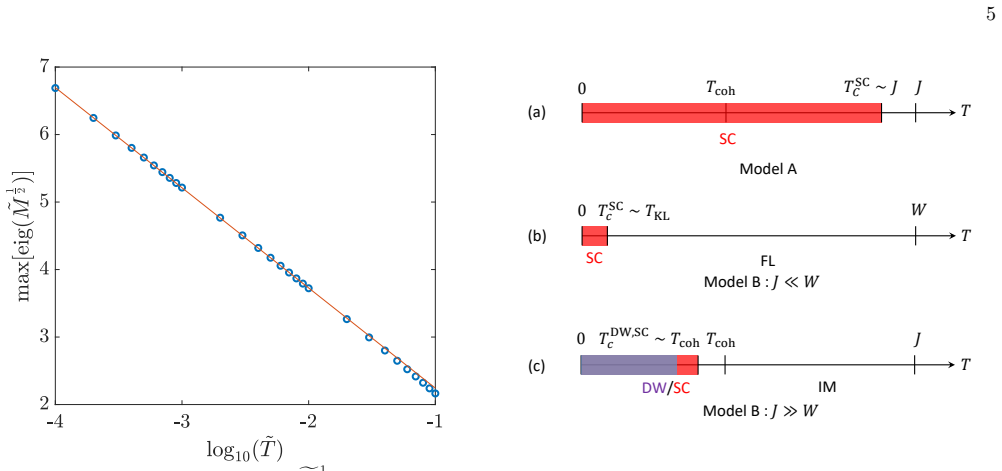
The load-bearing object is the disorder contraction in the pairing channel, $J_{ijkl}J_{ikjl}=\pm J^2$, which enters the Bethe-Salpeter equation as an effective interaction $J^2\Pi(k-q,i\omega-i\Omega)$; the sign is fixed by the permutation symmetry of the random interaction, and the polarization bubble $\Pi$ supplies the only momentum dependence. In Model-A the plus sign makes the single-site (momentum-independent) kernel self-amplify in the incoherent metal, producing a divergent eigenvalue $\sim\log^2(1/T)$ and hence $T_c\sim J$ with no Fermi surface at all. In Model-B the minus sign forbids on-site pairing, so the mechanism shifts to the momentum dependence of $\Pi$, which is the same physics as the weak-coupling Kohn-Luttinger effect; the strong-coupling statement $T_c\sim W^*$ comes from rescaling the Eliashberg equation by $W^*$ and using $Z\nu_0 J\sim 1$ to make the dimensionless pairing eigenvalue order one.
What would settle it
Solve the full large-$N$ Bethe-Salpeter equation for Model-B in the strong-coupling limit at temperatures approaching $W^*$ without the sharp-Fermi-surface approximation; if the largest eigenvalue at $T\sim W^*$ is of order one and crosses unity, the claim $T_c\sim W^*$ is confirmed, whereas if it stays below unity until temperatures are exponentially small in the inverse coupling, the claimed scale collapses and the instability is a conventional Kohn-Luttinger one.
Extended reading notes
Core claim
The central claim is that sign-correlated random interactions generate an effective pairing attraction at leading order in $1/N$ while the same interactions destroy coherent quasiparticles. For Model-A, the linearized Bethe-Salpeter kernel in the spin-singlet particle-particle channel contains the contraction $J_{ijkl}J_{ikjl}=+J^2$, and in the single-site limit its largest eigenvalue diverges like $\sim\log^2(1/T)$ as $T\to0$; since all eigenvalues vanish as $T\to\infty$, the eigenvalue crosses unity at a finite $T_c$ of order $J$. Long-range order is then established by inter-site Josephson coupling of order $N T_{\rm coh}$. For Model-B, the contraction has the opposite sign, so there is no single-site instability; after rescaling all energies by the renormalized bandwidth $W^*\sim W^2/J$, the strong-coupling Eliashberg equation becomes dimensionless and at low temperature reduces to a conventional Fermi-liquid gap equation. Because the quasiparticle residue is small, $Z\sim W/J$, the effective pairing eigenvalue is of order unity, which the paper takes to imply $T_c\sim W^*$; it explicitly notes that at this scale the Fermi surface is no longer sharp and the scattering rate is of order $W^*$, leaving the extrapolation as an assumption beyond the paper's strict control.
Load-bearing premise
Model-B's strongest claim rests on treating a pairing eigenvalue computed in the low-temperature Fermi-liquid regime, where quasiparticles are ordinary, as if it stayed of order unity when extrapolated up to temperatures of order the renormalized bandwidth $W^*$, where the Fermi surface is not sharp, the scattering rate is of order $W^*$, and the quasiparticle residue is no longer frequency independent; the paper explicitly says this step is beyond its scope.
Editorial extensions
If this is right
- Superconductivity can appear in a parent state with no quasiparticles: Model-A orders at $T_c\sim J$ from a locally critical metal whose single-electron spectral function has no coherent peak.
- In Model-B, the superconducting instability occurs at the same scale as the renormalized bandwidth, so it preempts the formation of the Fermi liquid rather than developing inside it.
- Neither example relies on nesting or on time-reversed Cooper pairs at $\pm k$; the pairing scale is set by the local interaction, so the mechanism is genuinely non-BCS.
- Pair-hopping repulsion $U$ suppresses Model-A's on-site pairing for $U\gtrsim J$; increasing $U$ moves the system toward the Model-B behavior.
- In strong coupling, density-wave order with $T_c^{\rm DW}\sim W^*$ may coexist or compete with superconductivity, with the precise ratio set by microscopic details.
Reading between the lines
- If Model-B's extrapolation to $T\sim W^*$ fails, the strong-coupling example would collapse to a weak-coupling Kohn-Luttinger instability with exponentially small $T_c$; the sign structure guarantees that no single-site pairing can rescue it.
- A controlled numerical solution of the full large-$N$ Bethe-Salpeter eigenvalue for Model-B at $T\sim W^*$, keeping the full frequency-dependent self-energy and incoherent spectral weight, would settle whether $T_c\sim W^*$ or only an exponentially small scale exists.
- The same sign-correlation construction should extend to other solvable building blocks; the appendix already shows $T_c\sim J$ for SYK$_q$ with $q>4$, so the mechanism is presumably insensitive to the specific operator content.
Signed reviews
Editorial analysis
A structured set of objections, weighed in public.
Referee Report
Summary. The paper studies a translationally invariant lattice generalization of the SYK model with N orbitals per site and a spin-1/2 label, focusing on pairing instabilities of the strongly coupled incoherent metal. In the large-N limit the authors obtain self-consistent saddle-point equations for the Green's function and linearized Bethe-Salpeter equations in the spin-singlet (and, in a polarized example, spin-triplet) pairing channel. They distinguish two models by the permutation symmetry of the random interaction tensor: Model-A, with Jijkl=Jikjl, is claimed to have an intrinsic superconducting instability of the incoherent non-Fermi liquid at Tc~J, driven not by a Cooper logarithm but by the local SYK quantum-critical dynamics; Model-B, with Jijkl=-Jikjl, is claimed to show a Kohn-Luttinger-type instability at weak coupling with exponentially small Tc, and at strong coupling a superconducting transition at Tc~W*~Tcoh, the renormalized bandwidth. A q>4 generalization is treated in an appendix.
Significance. If the Model-A result is correct, it is a rare exact large-N example in which pairing arises from an incoherent, locally critical metal without any Fermi-surface nesting or quasiparticle Cooper instability; the dimensionless Bethe-Salpeter kernel, the trial-function proof, and the numerical eigenvalue plot make this part of the paper credible and essentially parameter-free. The Model-B strong-coupling claim, if correct, would show that an incipient heavy Fermi liquid can become superconducting at a scale comparable to its renormalized bandwidth, which would be of considerable conceptual interest. However, as discussed below, that second claim is currently an extrapolation rather than a derivation, and the paper itself states that the assumptions break down at the relevant scale. The manuscript is clearly written and openly flags its main limitation, which is a strength, but the abstract and Section V state the strong-coupling Model-B result more definitively than the body of the paper supports.
major comments (3)
- [Section IV.A, Eq. (14)] The claim that Model-B has Tc~W* at strong coupling is not established by the arguments given. The proof of a divergent pairing eigenvalue uses the low-temperature Fermi-liquid form Gi~1/(iω−εk), which is valid only for ω,T<<W*. It shows that a pairing instability exists at some finite Tc, as already stated in footnote 5, but it does not locate the crossing scale. Extrapolating the logarithmic growth all the way to T~W* is precisely the regime where Section IV states that 'the scattering rate is large... it is not sufficient to focus only on the low-energy states near the Fermi surface' and that the calculation is 'beyond the scope of this work.' The high-temperature estimate δχpair~Tcoh/T becomes O(1) at T~Tcoh, but that does not by itself imply that the Bethe-Salpeter eigenvalue reaches unity at that scale. The abstract's claim that Tc is 'comparable to its renormalized bandwidth' therefore remains an extrapolation.
- [Section IV.B, Eqs. (22)-(25)] The explicit polarized example uses a weak-coupling expression for the pairing eigenvalue, |λ1,↑|=Z^2ν0^2J^2 α(1−α), and then promotes it to strong coupling by setting Zν0J~1. This promotion is not justified within the calculation: the static-polarization approximation and the frequency-independent quasiparticle residue Z are controlled only when the dimensionless coupling is small. At strong coupling, Zν0J~1 means the ladder kernel is not small, the frequency dependence of Π and the incoherent part of the spectral function can substantially modify the eigenvalue, and even a conservative BCS-style estimate with |λ1|≤1/4 gives Tc/W*~e^(−1/|λ1|)≤e^(−4), which is not O(1). To support the strong-coupling claim the authors would need to solve the scaled Bethe-Salpeter equation (14) at T~W* using the full self-consistent Green's function, or explicitly revise the abstract and Section V to present Tc~W* as a conjecture.
- [Section V] The discussion repeats the strong-coupling claim as a result: 'we therefore find that Tc is of the order of W*.' This overstates what Section IV.A has shown, which is that W* is the only scale in the dimensionless Eliashberg equation and that a Cooper-log instability exists. Dimensional analysis alone does not determine the prefactor of Tc, and the admitted breakdown of the Fermi-liquid assumptions at T~W* leaves the magnitude of Tc unproven. The wording of the abstract should be aligned with the actual evidence.
minor comments (5)
- [Fig. 3] The vertical axis is labeled as the eigenvalue of M^(1/2), while the text and Eq. (10) refer to the largest eigenvalue of M itself; the notation should be made consistent.
- [Eq. (10)] The displayed trial-function ratio contains an unbalanced parenthesis in the numerator; this is a typographical error that should be fixed.
- [Section IV.A, Eqs. (12)-(13)] The rescaled Green's function in Eq. (13) omits the bare iω term, but Eq. (4) includes a quasiparticle pole with residue Z; the relation between these two forms in the strong-coupling scaling limit should be stated explicitly to avoid confusion.
- [Section III] The statement that 'all the eigenvalues of M go to zero in the opposite limit T→∞' is plausible but not shown; a one-sentence justification would make the intermediate-value argument rigorous.
- [Footnote 5] The important caveat that a Cooper logarithm guarantees a pairing instability in Model-B appears only in a footnote; it should be integrated into the main text because it materially qualifies the distinction between models A and B.
Circularity Check
No significant circularity: Model-A and Model-B derivations are self-contained large-N analyses whose only cited inputs are prior published results that are independent of the target pairing-instability conclusions.
full rationale
The paper's central derivations do not reduce to their own inputs. For Model-A, the Tc~J prediction follows from rescaling the local Bethe-Salpeter equation (Eq. 8) into a manifestly dimensionless form, with the existence of a crossing established by an explicit trial-function argument whose largest eigenvalue diverges as log^2(1/T) (Eq. 10). This is a direct mathematical argument, not a fitted parameter or a definitional restatement. For Model-B, the predicted scale Tc~W* follows from the same non-dimensionalization of the Eliashberg equation (Eq. 14), and the existence of a pairing instability is imported from the independent weak-coupling Hubbard-model literature (Refs. 29, 30), which is a borrowed external result rather than a self-citation. The Green's functions quoted in Eq. (4) are taken from the authors' earlier Ref. [25], but that prior work is a published, independently checkable saddle-point solution whose stated assumptions do not include the present paper's pairing instability; citing it is legitimate background support, not circularity. The paper itself flags the principal limitation in Sec. IV: 'at these scales that are comparable to the renormalized bandwidth, many of our underlying assumptions are not strictly applicable... This is beyond the scope of this work.' That caveat concerns the validity of extrapolating the low-temperature Fermi-liquid pairing eigenvalue to T~W*, which is a correctness risk, not a definitional equivalence, a fitted-input-renamed-as-prediction, or a self-citation chain. No step was found where an output equals an input by construction, and no load-bearing conclusion depends solely on a self-citation. Accordingly the circularity score is 0.
Assumptions & free parameters
assumptions (6)
- domain assumption Large-N self-consistent 'watermelon' diagrams (Eqs. 2-3) give the exact electron Green's function at leading order in 1/N.
- domain assumption A single realization of the translationally invariant random couplings behaves like the disorder-averaged large-N solution.
- domain assumption SYK scaling forms G(i omega) ~ i sgn(omega)/sqrt(|omega|) and Pi(Omega) ~ -log(1/max(|Omega|,T)) hold in the incoherent regime for omega,T << J.
- standard math Eq. (14) in the low-frequency FL limit is identical to the weak-coupling Hubbard model gap equation, and the known d-wave solution of Refs. [29,30] applies.
- domain assumption The partially polarized Fermi sea can be treated with parabolic, rotationally invariant dispersions with spin-dependent Fermi momenta kF,s.
- domain assumption The linearized Bethe-Salpeter equation at zero center-of-mass momentum determines the superconducting transition temperature, and long-range order in Model-A follows from Josephson coupling between sites.
Cite this review
Pith. "Pith review of Intrinsic superconducting instabilities of a solvable model for an incoherent metal." pith.science (2026). https://pith.science/paper/HZNVYVUJ
@misc{pith2026190802757,
  author       = {Pith},
  title        = {Pith review of: Intrinsic superconducting instabilities of a solvable model for an incoherent metal},
  year         = {2026},
  howpublished = {\url{https://pith.science/paper/HZNVYVUJ}},
  note         = {Machine review of arXiv:1908.02757}
}
abstract
We construct a family of translationally invariant lattice models with a large number ($N$) of orbitals at every site coupled together via single electron tunneling. By tuning the relative strength of the electronic bandwidth and on-site interactions, that have a modified Sachdev-Ye-Kitaev (SYK) form, we demonstrate a number of unusual features at strong coupling and in the large$-N$ limit. We find examples of (i) an intrinsic non-BCS superconducting instability arising out of an incoherent non-Fermi liquid metal, and, (ii) an instability of an incipient heavy Fermi liquid metal to superconductivity with transition temperatures comparable to its renormalized bandwidth. At strong-coupling, these solvable models display pairing instabilities that are not driven by any special "nesting" properties associated with an underlying Fermi surface.
Figures


Reference graph
Works this paper leans on
-
[1]
From quantum matter to high- temperature superconductivity in copper oxides,
B. Keimer, S. A. Kivelson, M. R. Norman, S. Uchida, and J. Zaanen, “From quantum matter to high- temperature superconductivity in copper oxides,” Nature 518, 179 (2015)
2015
-
[2]
A common thread: The pairing inter- action for unconventional superconductors,
D. J. Scalapino, “A common thread: The pairing inter- action for unconventional superconductors,” Rev. Mod. Phys. 84, 1383 (2012)
work page 2012
-
[3]
Non-fermi-liquid behavior in d- and f- electron metals,
G. R. Stewart, “Non-fermi-liquid behavior in d- and f- electron metals,” Rev. Mod. Phys. 73, 797 (2001)
work page 2001
-
[4]
shows similar physics, as discussed in Appendix A. IV. MODEL −B: GENERALIZED KOHN-LUTTINGER MECHANISM It is clear from the discussion in the previous section that in model-B, as a result of the sign of JijklJikjl = −J2, the corresponding Bethe-Salpeter equation in the incoherent regime (i.e. Eqn. 6b) does not have a non- trivial solution at the level of a...
-
[5]
Angle- resolved photoemission studies of the cuprate supercon- ductors,
A. Damascelli, Z. Hussain, and Z.-X. Shen, “Angle- resolved photoemission studies of the cuprate supercon- ductors,” Rev. Mod. Phys. 75, 473 (2003)
work page 2003
-
[6]
Quasiparticle line shape of sr 2ruo4 and its relation to anisotropic transport,
S.-C. Wang, H.-B. Yang, A. K. P. Sekharan, H. Ding, J. R. Engelbrecht, X. Dai, Z. Wang, A. Kaminski, T. Valla, T. Kidd, A. V. Fedorov, and P. D. John- son, “Quasiparticle line shape of sr 2ruo4 and its relation to anisotropic transport,” Phys. Rev. Lett. 92, 137002 (2004)
work page 2004
-
[7]
Systematic evolution of temperature-dependent resistivity in la 2−xsrxcuo4,
H. Takagi, B. Batlogg, H. L. Kao, J. Kwo, R. J. Cava, J. J. Krajewski, and W. F. Peck, “Systematic evolution of temperature-dependent resistivity in la 2−xsrxcuo4,” Phys. Rev. Lett. 69, 2975 (1992)
work page 1992
-
[8]
Quantum critical behaviour in a high-tc superconductor,
D. v. d. Marel, H. J. A. Molegraaf, J. Zaanen, Z. Nussi- nov, F. Carbone, A. Damascelli, H. Eisaki, M. Greven, P. H. Kes, and M. Li, “Quantum critical behaviour in a high-tc superconductor,” Nature 425, 271 (2003)
work page 2003
Show all 38 references
-
[9]
Giant electron-electron scattering in the fermi-liquid state of na0.7Coo2,
S. Y. Li, L. Taillefer, D. G. Hawthorn, M. A. Tanatar, J. Paglione, M. Sutherland, R. W. Hill, C. H. Wang, and X. H. Chen, “Giant electron-electron scattering in the fermi-liquid state of na0.7Coo2,” Phys. Rev. Lett. 93, 056401 (2004)
2004
-
[10]
Normal-state magnetore- sistance of sr 2ruo4,
N. E. Hussey, A. P. Mackenzie, J. R. Cooper, Y. Maeno, S. Nishizaki, and T. Fujita, “Normal-state magnetore- sistance of sr 2ruo4,” Phys. Rev. B 57, 5505 (1998)
1998
-
[11]
Universal- ity of the mott ioffe regel limit in metals,
N. E. Hussey, K. Takenaka, and H. Takagi, “Universal- ity of the mott ioffe regel limit in metals,” Philosophical Magazine 84, 2847 (2004)
2004
-
[12]
Superconductivity in bad metals,
V. J. Emery and S. A. Kivelson, “Superconductivity in bad metals,” Phys. Rev. Lett. 74, 3253 (1995)
1995
-
[13]
Gapless spin-fluid ground state in a random quantum heisenberg magnet,
S. Sachdev and J. Ye, “Gapless spin-fluid ground state in a random quantum heisenberg magnet,” Phys. Rev. Lett. 70, 3339 (1993)
1993
-
[14]
A simple model of quantum holography, talk given at kitp program: entanglement in strongly- correlated quantum matter,
A. Kitaev, “A simple model of quantum holography, talk given at kitp program: entanglement in strongly- correlated quantum matter,” USA April 2015
2015
-
[15]
A bound on chaos,
J. Maldacena, S. H. Shenker, and D. Stanford, “A bound on chaos,” Journal of High Energy Physics 2016, 106 (2016)
2016
-
[16]
The soft mode in the Sachdev- Ye-Kitaev model and its gravity dual,
A. Kitaev and S. J. Suh, “The soft mode in the Sachdev- Ye-Kitaev model and its gravity dual,” ArXiv e-prints (2017), arXiv:1711.08467 [hep-th]
2017 arXiv
-
[17]
Non-fermi-liquid regime of a doped mott insulator,
O. Parcollet and A. Georges, “Non-fermi-liquid regime of a doped mott insulator,” Phys. Rev. B 59, 5341 (1999)
1999
-
[18]
Quantum fluctuations of a nearly critical heisenberg spin glass,
A. Georges, O. Parcollet, and S. Sachdev, “Quantum fluctuations of a nearly critical heisenberg spin glass,” Phys. Rev. B 63, 134406 (2001)
2001
-
[19]
Local criticality, dif- fusion and chaos in generalized sachdev-ye-kitaev mod- els,
Y. Gu, X.-L. Qi, and D. Stanford, “Local criticality, dif- fusion and chaos in generalized sachdev-ye-kitaev mod- els,” Journal of High Energy Physics 2017, 125 (2017)
2017
-
[20]
Thermoelectric transport in disordered met- als without quasiparticles: The sachdev-ye-kitaev models and holography,
R. A. Davison, W. Fu, A. Georges, Y. Gu, K. Jensen, and S. Sachdev, “Thermoelectric transport in disordered met- als without quasiparticles: The sachdev-ye-kitaev models and holography,” Phys. Rev. B 95, 155131 (2017). 10
2017
-
[21]
Strongly corre- lated metal built from sachdev-ye-kitaev models,
X.-Y. Song, C.-M. Jian, and L. Balents, “Strongly corre- lated metal built from sachdev-ye-kitaev models,” Phys. Rev. Lett. 119, 216601 (2017)
2017
-
[22]
Dispersive sachdev-ye-kitaev model: Band structure and quantum chaos,
P. Zhang, “Dispersive sachdev-ye-kitaev model: Band structure and quantum chaos,” Phys. Rev. B 96, 205138 (2017)
2017
-
[23]
Magnetotransport in a model of a disordered strange metal,
A. A. Patel, J. McGreevy, D. P. Arovas, and S. Sachdev, “Magnetotransport in a model of a disordered strange metal,” Phys. Rev. X 8, 021049 (2018)
2018
-
[24]
Thickening and sickening the SYK model,
D. V. Khveshchenko, “Thickening and sickening the SYK model,” ArXiv e-prints (2017), arXiv:1705.03956 [cond- mat.str-el]
2017 arXiv
-
[25]
Quantum criticality and duality in the Sachdev-Ye-Kitaev/ads2 chain,
S.-K. Jian, Z.-Y. Xian, and H. Yao, “Quantum criticality and duality in the Sachdev-Ye-Kitaev/ads2 chain,” Phys. Rev. B 97, 205141 (2018)
2018
-
[26]
Translationally invariant non-fermi-liquid metals with critical fermi surfaces: Solvable models,
D. Chowdhury, Y. Werman, E. Berg, and T. Senthil, “Translationally invariant non-fermi-liquid metals with critical fermi surfaces: Solvable models,” Phys. Rev. X 8, 031024 (2018)
2018
-
[27]
Coherent superconductivity with a large gap ratio from incoherent metals,
A. A. Patel, M. J. Lawler, and E.-A. Kim, “Coherent superconductivity with a large gap ratio from incoherent metals,” Phys. Rev. Lett. 121, 187001 (2018)
2018
-
[28]
New mechanism for su- perconductivity,
W. Kohn and J. M. Luttinger, “New mechanism for su- perconductivity,” Phys. Rev. Lett. 15, 524 (1965)
1965
-
[29]
Kohn-luttinger effect and the instabil- ity of a two-dimensional repulsive fermi liquid at t=0,
A. V. Chubukov, “Kohn-luttinger effect and the instabil- ity of a two-dimensional repulsive fermi liquid at t=0,” Phys. Rev. B 48, 1097 (1993)
1993
-
[30]
d-wave pair- ing near a spin-density-wave instability,
D. J. Scalapino, E. Loh, and J. E. Hirsch, “ d-wave pair- ing near a spin-density-wave instability,” Phys. Rev. B 34, 8190 (1986)
1986
-
[31]
Super- conductivity in the repulsive hubbard model: An asymp- totically exact weak-coupling solution,
S. Raghu, S. A. Kivelson, and D. J. Scalapino, “Super- conductivity in the repulsive hubbard model: An asymp- totically exact weak-coupling solution,” Phys. Rev. B81, 224505 (2010)
2010
-
[32]
Superconductivity from re- pulsive interactions in the two-dimensional electron gas,
S. Raghu and S. A. Kivelson, “Superconductivity from re- pulsive interactions in the two-dimensional electron gas,” Phys. Rev. B 83, 094518 (2011)
2011
-
[33]
Co- herent vs. incoherent pairing in 2d systems near magnetic instability,
A. Abanov, A. V. Chubukov, and A. Finkel’stein, “Co- herent vs. incoherent pairing in 2d systems near magnetic instability,” EPL (Europhysics Letters) 54, 488 (2001)
2001
-
[34]
Quantum critical effects on transition temperature of magnetically mediated p-wave superconductivity,
R. Roussev and A. J. Millis, “Quantum critical effects on transition temperature of magnetically mediated p-wave superconductivity,” Phys. Rev. B 63, 140504 (2001)
2001
-
[35]
Cooper pairing in non-fermi liquids,
M. A. Metlitski, D. F. Mross, S. Sachdev, and T. Senthil, “Cooper pairing in non-fermi liquids,” Phys. Rev. B 91, 115111 (2015)
2015
-
[36]
A Solvable Random Model With Quantum- critical Points for Non-Fermi-liquid Pairing,
Y. Wang, “A Solvable Random Model With Quantum- critical Points for Non-Fermi-liquid Pairing,” arXiv e-prints , arXiv:1904.07240 (2019), arXiv:1904.07240 [cond-mat.str-el]
2019 arXiv
-
[37]
Cooper pairing of incoher- ent electrons: an electron-phonon version of the Sachdev- Ye-Kitaev model,
I. Esterlis and J. Schmalian, “Cooper pairing of incoher- ent electrons: an electron-phonon version of the Sachdev- Ye-Kitaev model,” arXiv e-prints , arXiv:1906.04747 (2019), arXiv:1906.04747 [cond-mat.str-el]
2019 arXiv
-
[38]
A generalization of sachdev-ye-kitaev,
D. J. Gross and V. Rosenhaus, “A generalization of sachdev-ye-kitaev,” Journal of High Energy Physics 2017, 93 (2017). Appendix A: Generalization to translationally invariant SYK q models In this appendix, we consider a generalization of the model originally introduced in Ref....
2017
Reviewed August 14, 2026 · model on record in the stance chip above.
Discussion (0). Continue with ORCID to comment.