REVIEW 4 major objections 6 minor 1 cited by
First-Place Solution to NeurIPS 2024 Invisible Watermark Removal Challenge
T0 review · 4 major / 6 minor · reviewed 2026-08-05 · deepseek-v4-flash
Pith's one-line read The paper shows that adaptive attacks can strip invisible watermarks from images while keeping them visually near-identical, defeating both a known-algorithm and an unknown-algorithm detector at the 0.1% false-positive threshold.
desk verdict First place on both tracks is real and externally measured, but the headline claim of 'watermark removal' is overstated because the core VAE attack flips the message rather than destroying it. read the letter →
The pith
A machine-rendered reading of the paper's core claim, the machinery that carries it, and where it could break.
The reading
What carries the argument
The paired-message VAE fine-tuning is the central object: a variational autoencoder (an encoder/decoder pair) trained with an MSE loss to map a StegaStamp-watermarked image carrying message m to the same image watermarked with the inverted message 1−m. The inversion forces the latent bottleneck to drop the message-dependent signal, so on unseen images the fine-tuned VAE outputs a watermark-free reconstruction. Around this core, the paper adds test-time optimization (refining the VAE on the specific input using MSE + LPIPS + SSIM losses) and a CIELAB color/contrast transfer to restore fidelity, plus a spatial translation for Fourier-phase watermarks and a cluster-conditioned diffusion purific
What would settle it
Generate a new test set with a StegaStamp variant whose encoder uses a message-dependent key, so that the same image watermarked with m and with 1−m differ not only in the additive watermark component but also in the transformation itself; run the paired-VAE attack and measure the detection score at the 0.1% false-positive threshold. If the detection score stays near 1.0 while image-quality metrics remain unchanged, the central separability assumption is false.
Extended reading notes
Core claim
On the NeurIPS 2024 challenge's two tracks, the paper's attack lowers detection scores to 0.037 (beige-box) and 0.043 (black-box) at a 0.1% false-positive rate, meaning more than 95% of watermarked images pass as clean. The key technical move is a paired-message VAE: the adversary fine-tunes a pretrained variational autoencoder on pairs of the same image watermarked with a random 100-bit message and its complement, training it to reconstruct the complement image from the original. Because the only difference between the pair is the message, the VAE learns to discard the message-dependent watermark component and re-synthesize the content. After a test-time optimization step that aligns the re
Load-bearing premise
The beige-box attack relies on the assumption that the challenge's StegaStamp variant is close enough to the public StegaStamp model used to generate paired training data, and that fine-tuning on (message, inverse-message) pairs cancels the watermark on unseen images; if the actual encoder is substantially different or the message signal is not separable this way, the VAE cancellation would not transfer.
Editorial extensions
If this is right
- At the challenge's 0.1% false-positive threshold, both detectors flag fewer than 5% of attacked images, so an attacker can strip the watermark from roughly 19 of every 20 images.
- The StegaStamp VAE attack transfers from a paired training set built with a public StegaStamp encoder to the challenge's modified StegaStamp variant without retraining on challenge images.
- TreeRing-style Fourier-phase watermarks are broken by a trivial 7-pixel spatial translation, with boundary columns restored to hide the shift; no model or training is needed.
- The black-box attack is effective only because images are clustered by artifact signatures; a single global diffusion setting would not erase all four watermark families.
- The success of these attacks implies watermark robustness claims should be tested under adaptive, cluster-aware adversaries rather than fixed corruption sets.
Reading between the lines
- The inverse-message cancellation trick should generalize to any learned watermark whose encoder is roughly symmetric under logical message inversion; testing it against other message-embedding schemes would be a direct extension.
- Attack traces such as the 7-pixel translation or diffusion-induced smoothing could themselves be fingerprinted; a defender might build a detector that recognizes these removal artifacts and flags images as 'cleaned'.
- The CIELAB color/contrast restoration is a model-agnostic quality booster that could be bolted onto other watermark-removal pipelines, potentially raising their quality scores without sacrificing removal rate.
- Because the clustering step was based on 300 images and manual inspection, a larger challenge with more diverse watermarks could shift the artifact types; an automated artifact classifier would be needed to scale this approach.
Editorial analysis
A structured set of objections, weighed in public.
Referee Report
Summary. The paper presents the authors' first-place solution to the NeurIPS 2024 Erasing the Invisible challenge. For the beige-box track, the method fine-tunes an SDXL VAE on pairs of images watermarked with complementary StegaStamp messages, then applies test-time optimization and CIELAB color/contrast transfer, and removes TreeRing watermarks with a 7-pixel spatial translation. For the black-box track, the 300 test images are manually clustered into four artifact classes, and cluster-specific diffusion-based purification with ChatGPT captions and tuned noise strengths is applied. The reported official leaderboard detection scores are 0.037 (beige-box) and 0.043 (black-box), and the paper claims near-perfect watermark removal (95.7%).
Significance. The official first-place result is externally measured on the competition leaderboard, giving the central empirical claim credibility. The paper also contains useful ablations, a clear description of the attack components, and an honest account of unsuccessful approaches. However, the paper's own text and equations reveal two load-bearing problems. First, the VAE in Eq. (1) is trained to map a StegaStamp image with message m to the same image with message 1-m, so it is a message-flip evasion attack, not demonstrated watermark destruction; no experiment checks whether the output still contains a valid StegaStamp message. Second, the method was selected and tuned using repeated leaderboard queries on the same 300 test images, and the manual clustering is test-specific, so the reported 95.7% is a test-set-tuned score without holdout validation. These issues limit the paper's scientific generality and need to be addressed before the claimed 'watermark removal' is accepted.
major comments (4)
- [3.1.1, Eq. (1), Algorithm 1] The training target in Eq. (1) is x_i = StegaStamp(x, 1-m), not a clean image. Thus the VAE learns a message-complementing map, not a watermark-removal map. The abstract's 'near-perfect watermark removal' and the text's 'effectively strip away the watermark' are inconsistent with this objective. The leaderboard detection score only checks distance from the original message m; it does not test whether the output still contains a valid StegaStamp message. No experiment decodes the attacked images. Please reframe the contribution as a message-evasion attack or add a decoding experiment showing that no valid message remains.
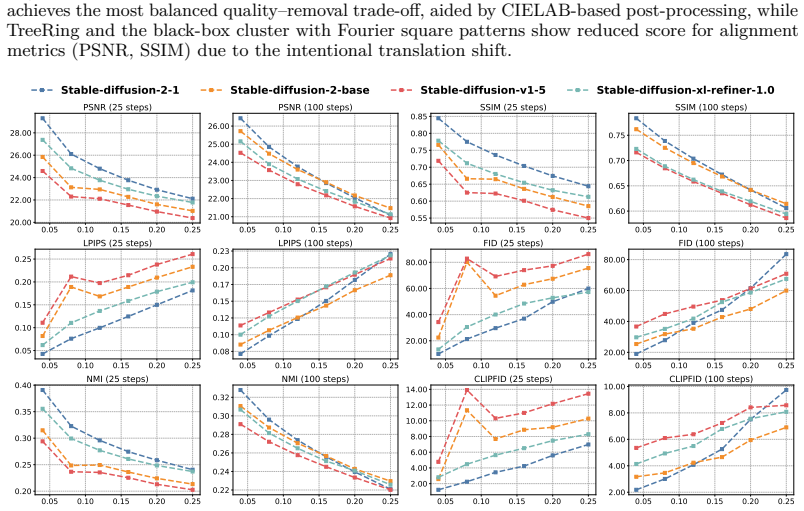
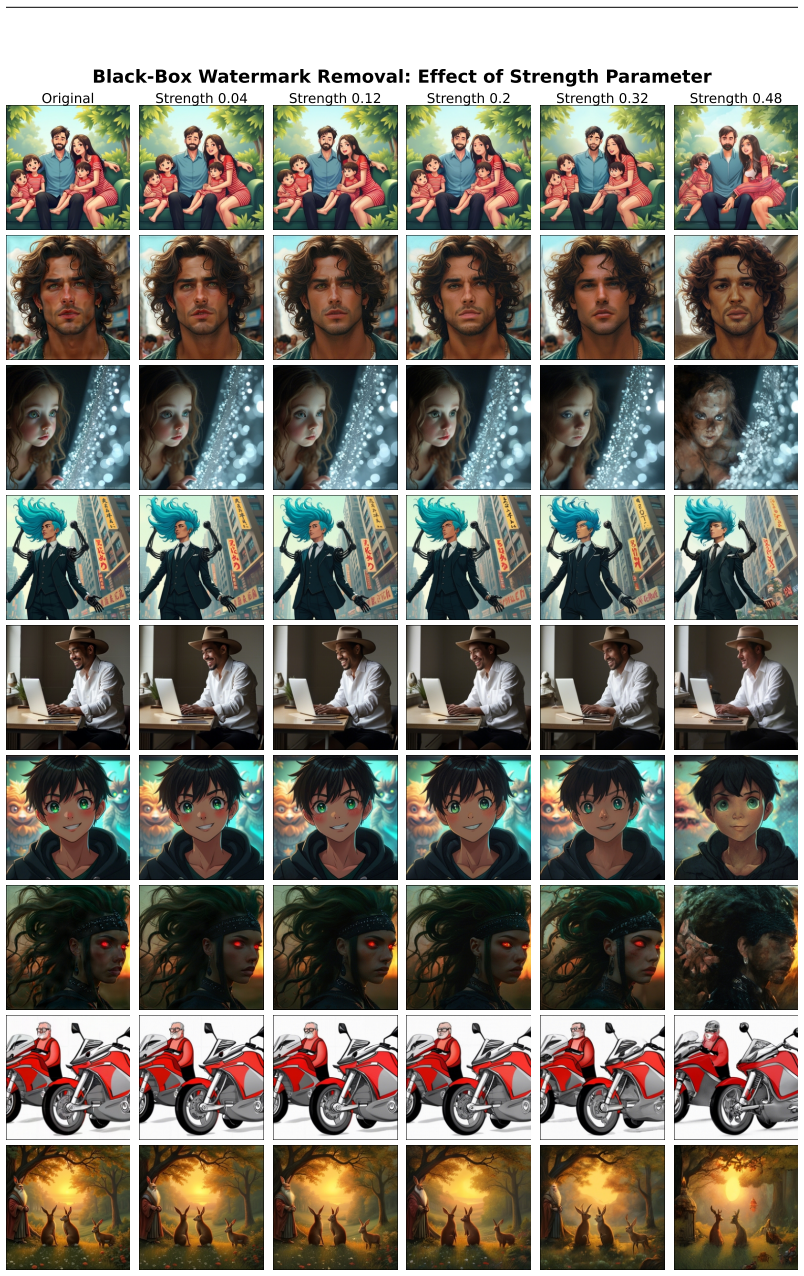
- [3.2/3.3, Algorithm 3, Table 5, Figure 9] The paper states that leaderboard queries were allowed up to five times per day, and Figure 9 says the diffusion model choice was made 'from leaderboard submissions'; Section 3.3 says hyperparameters (especially s) were tuned to balance removal and fidelity. The 300 test images were manually clustered and the cluster assignments are listed by index in Table 5, so the method is not an algorithm that can be applied to new images without manual inspection. No holdout validation, cross-validation, or error bars are reported. The reported 95.7% is therefore a test-set-tuned score, not evidence of generalizable watermark removal. Please add a validation split or explicitly label the result as a leaderboard score.
- [3.1.1, Eq. (2), Algorithm 2, Table 3] Test-time optimization minimizes MSE, LPIPS, and SSIM against the original watermarked image x_w. This should encourage the output to retain the watermark, and Table 3 indeed shows the detection score worsens from 0.023 to 0.033 when this step is added. The text's claim that 'this step effectively removes the watermark signal' is not supported. Please revise the description or provide evidence that the step removes rather than re-introduces the watermark.
- [3.1.1 'Paired Dataset Generation'] The beige-box attack is built on pairs generated with the public WAVES StegaStamp model, while the challenge uses a modified StegaStamp whose parameters are unknown. The paper does not directly verify that the public model's artifacts transfer to the challenge variant. Since the beige-box adversary knows the algorithm but not its hyperparameters, this assumption is load-bearing for the VAE attack and for the two black-box clusters that reuse the VAE pipeline. Please provide a transfer analysis, e.g., decoding rates on challenge images with the public model before and after the attack.
minor comments (6)
- [Algorithm 3] The cluster numbering in Algorithm 3 is inconsistent with Section 3.3 and Figure 5: Algorithm 3 maps Cluster 1 to boundary artifacts and Cluster 2 to circular Fourier patterns, whereas Section 3.3 lists Cluster 1 as no artifacts, Cluster 2 as boundary, Cluster 3 as circular, and Cluster 4 as square. This makes the pipeline ambiguous.
- [Figure 2 and Section 3.1.1] The Figure 2 caption says the VAE minimizes MSE loss 'effectively suppressing watermark artifacts', but Eq. (1) minimizes reconstruction to the inverse-message image. Rephrase to avoid implying clean-image reconstruction.
- [References] References [28] and [29] are the same paper; merge them.
- [Reproducibility] No code or trained models are linked. Since the contribution is an attack pipeline with many engineering components, releasing code/models would materially improve reproducibility.
- [Table 6] Ours has lower PSNR than 'w/o Pixel Restoration' (14.353 vs. 14.878), while the text says restoration improves fidelity. Clarify that PSNR is lower because of the global shift and that the improvement claim refers to perceptual and distribution metrics.
- [Various] Typos: 'Invisible W atermark' in the title, 'invese' in Figure 2, and 'oundary' in the Figure 4 caption.
Circularity Check
Beige-box StegaStamp 'removal' is trained to output the inverse-message watermarked image, so beating the detection metric is by construction; actual watermark destruction is never verified.
-
self definitional
[Section 3.1.1 (Adaptive VAE Finetuning), Eq. (1) and Algorithm 1; cf. detection-score definition in Section 3 (Challenge Overview)]
"Given a watermarked image x_w and its inverse message counterpart x_i, the VAE - consisting of encoder E_theta and decoder D_phi - was optimized to reconstruct x_i from x_w, using the following MSE loss: L(θ,ϕ) = ∥D_ϕ(E_θ(x_w))−x_i∥². ... This adaptive fine-tuning stage enabled the model to effectively strip away the watermark while preserving image structure. ... An attacked image is flagged as watermarked if its decoded message falls below this threshold."
The training target x_i is not a clean image: it is StegaStamp(x, 1−m), i.e., the same watermarking scheme carrying the bitwise complement of the original message. If Eq. (1) is minimized, D(E(x_w)) ≈ StegaStamp(x, 1−m), so the output still lies on the StegaStamp-watermarked manifold and decodes to 1−m rather than to no message. The challenge's detection score, however, only checks whether the decoded message is close to the known original m; decoding to 1−m maximizes the distance d(m,1−m) and therefore counts as 'removed.' Thus the claimed near-perfect removal is achieved by constructing the inverse-message image, exactly the quantity used as the training label. The paper reports no decoding experiment on attacked images to show the StegaStamp signal is absent, so the 'removal' result is
full rationale
The paper's core beige-box StegaStamp attack (which is reused for black-box clusters 2 and 3) trains a VAE to map a StegaStamp image carrying message m to a StegaStamp image carrying message 1−m. The competition's detection metric is defined by the decoded-message distance d(m,m′); an image is 'removed' if m′ is far from m. Hence the low detection score of the VAE output is guaranteed along the message axis by the choice of training labels, not by demonstrated removal of the watermark signal. This is a self-definitional reduction: the thing called 'removal' is exactly the inverse-message reconstruction target. The paper's own quality numbers (PSNR 28.06, SSIM 0.82) are consistent with remaining on the StegaStamp manifold rather than projecting to clean images. The TreeRing translation attack and black-box diffusion purification are empirical and not circular; they are validated by the external leaderboard. Overall, the external ranking is not fabricated, but the central 'near-perfect watermark removal' claim for the VAE-based component reduces by construction to message-flip evasion, so partial circularity (score 6) is warranted.
Assumptions & free parameters
free parameters (3)
- Diffusion strength s per black-box cluster =
s=0.16 (No Artifacts), s=0.04 (Square Fourier), VAE for Boundary/Circular
- TreeRing translation shift Δx =
7 pixels
- SSIM loss weight in test-time optimization =
0.5
assumptions (5)
- ad hoc to paper Fine-tuning a VAE on image pairs watermarked with message m and inverse 1-m suppresses the watermark signal while preserving content.
- domain assumption The competition's modified StegaStamp and TreeRing variants are close enough to the public WAVES StegaStamp model and the described TreeRing method that pretrained models and priors transfer.
- standard math Spatial translation with a 7-pixel shift disrupts TreeRing's Fourier phase watermark (Fourier shift theorem).
- ad hoc to paper Manual visual clustering of the 300 test images into four artifact classes is exhaustive and each class is homogeneous in watermark behavior.
- domain assumption Pretrained diffusion models conditioned on ChatGPT captions project watermarked images onto the clean image manifold while preserving semantics.
Cite this review
Pith. "Pith review of First-Place Solution to NeurIPS 2024 Invisible Watermark Removal Challenge." pith.science (2026). https://pith.science/paper/HZOZHYRL
@misc{pith2026250821072,
  author       = {Pith},
  title        = {Pith review of: First-Place Solution to NeurIPS 2024 Invisible Watermark Removal Challenge},
  year         = {2026},
  howpublished = {\url{https://pith.science/paper/HZOZHYRL}},
  note         = {Machine review of arXiv:2508.21072}
}
read the original abstract
Content watermarking is an important tool for the authentication and copyright protection of digital media. However, it is unclear whether existing watermarks are robust against adversarial attacks. We present the winning solution to the NeurIPS 2024 Erasing the Invisible challenge, which stress-tests watermark robustness under varying degrees of adversary knowledge. The challenge consisted of two tracks: a black-box and beige-box track, depending on whether the adversary knows which watermarking method was used by the provider. For the beige-box track, we leverage an adaptive VAE-based evasion attack, with a test-time optimization and color-contrast restoration in CIELAB space to preserve the image's quality. For the black-box track, we first cluster images based on their artifacts in the spatial or frequency-domain. Then, we apply image-to-image diffusion models with controlled noise injection and semantic priors from ChatGPT-generated captions to each cluster with optimized parameter settings. Empirical evaluations demonstrate that our method successfully achieves near-perfect watermark removal (95.7%) with negligible impact on the residual image's quality. We hope that our attacks inspire the development of more robust image watermarking methods.
Figures


Figures from the paper (19 more)






Forward citations
Cited by 1 Pith paper
-
Watermarks Attack Watermarks: Re-Watermarking as a Generic Removal Strategy
Re-watermarking reliably removes existing watermarks across 96 dataset-victim-attack combinations and pairs with a classifier achieving 0.878-0.953 accuracy, cutting bit accuracy by 25-48%.
Reference graph
Works this paper leans on
-
[1]
Digital image and video watermarking: methodologies, attacks, applications, and future directions
P Aberna and Loganathan Agilandeeswari. Digital image and video watermarking: methodologies, attacks, applications, and future directions. Multimedia Tools and Applications, 83(2):5531–5591, 2024
work page 2024
-
[2]
Gpt-4 technical report.arXiv preprint arXiv:2303.08774, 2023
Josh Achiam, Steven Adler, Sandhini Agarwal, Lama Ahmad, Ilge Akkaya, Floren- cia Leoni Aleman, Diogo Almeida, Janko Altenschmidt, Sam Altman, Shyamal Anadkat, et al. Gpt-4 technical report.arXiv preprint arXiv:2303.08774, 2023
arXiv 2023
-
[3]
Combined dwt-dct digital image watermarking.Journal of computer science, 3(9):740–746, 2007
Ali Al-Haj. Combined dwt-dct digital image watermarking.Journal of computer science, 3(9):740–746, 2007
work page 2007
-
[4]
Waves: Benchmarking the robustness of image watermarks
Bang An, Mucong Ding, Tahseen Rabbani, Aakriti Agrawal, Yuancheng Xu, Chenghao Deng, Sicheng Zhu, Abdirisak Mohamed, Yuxin Wen, Tom Goldstein, et al. Waves: Benchmarking the robustness of image watermarks. InForty-first International Confer- ence on Machine Learning, 2024
work page 2024
-
[5]
Toluwani Aremu, Noor Hussein, Munachiso Nwadike, Samuele Poppi, Jie Zhang, Karthik Nandakumar, Neil Gong, and Nils Lukas. Mitigating watermark stealing attacks in generative models via multi-key watermarking.arXiv preprint arXiv:2507.07871, 2025
arXiv 2025
-
[6]
Muhammad Asim, Fahad Shamshad, and Ali Ahmed. Blind image deconvolution using deep generative priors.IEEE Transactions on Computational Imaging, 6:1493–1506, 2020
work page 2020
-
[7]
Image watermarking using dct domain constraints
Adrian G Bors and Ioannis Pitas. Image watermarking using dct domain constraints. In Proceedings of 3rd IEEE International Conference on Image Processing, volume 3, pp. 231–234. IEEE, 1996
work page 1996
-
[8]
Image watermarking of generative diffusion models.arXiv preprint arXiv:2502.10465, 2025
Yunzhuo Chen, Jordan Vice, Naveed Akhtar, Nur Al Hasan Haldar, and Ajmal Mian. Image watermarking of generative diffusion models.arXiv preprint arXiv:2502.10465, 2025
arXiv 2025
Show all 66 references
-
[9]
Optimizing adaptive attacks against content watermarks for language models.arXiv preprint arXiv:2410.02440, 2024
Abdulrahman Diaa, Toluwani Aremu, and Nils Lukas. Optimizing adaptive attacks against content watermarks for language models.arXiv preprint arXiv:2410.02440, 2024
2024 arXiv
-
[10]
Erasing the invisible: A stress-test challenge for image watermarks
Mucong Ding, Tahseen Rabbani, Bang An, Souradip Chakraborty, Chenghao Deng, Mehrdad Saberi, Yuxin Wen, Xuandong Zhao, Mo Zhou, Anirudh Satheesh, et al. Erasing the invisible: A stress-test challenge for image watermarks. InNeurIPS 2024 Competition Track, 2024
2024
-
[11]
Visual watermarking in the era of diffusion models: Advances and challenges.arXiv preprint arXiv:2505.08197, 2025
Junxian Duan, Jiyang Guan, Wenkui Yang, and Ran He. Visual watermarking in the era of diffusion models: Advances and challenges.arXiv preprint arXiv:2505.08197, 2025
2025 arXiv
-
[12]
On the difficulty of constructing a robust and publicly-detectable watermark.arXiv preprint arXiv:2502.04901, 2025
Jaiden Fairoze, Guillermo Ortiz-JimÊnez, Mel Vecerik, Somesh Jha, and Sven Gowal. On the difficulty of constructing a robust and publicly-detectable watermark.arXiv preprint arXiv:2502.04901, 2025
2025 arXiv
-
[13]
Creating, using, misusing, and detecting deep fakes.Journal of Online Trust and Safety, 1(4), 2022
Hany Farid. Creating, using, misusing, and detecting deep fakes.Journal of Online Trust and Safety, 1(4), 2022
2022
-
[14]
The good, the bad and the ugly: Watermarks, transferable attacks and adversarial defenses
Grzegorz Głuch, Berkant Turan, Sai Ganesh Nagarajan, and Sebastian Pokutta. The good, the bad and the ugly: Watermarks, transferable attacks and adversarial defenses. arXiv preprint arXiv:2410.08864, 2024
2024
-
[15]
Generative adversarial networks
Ian Goodfellow, Jean Pouget-Abadie, Mehdi Mirza, Bing Xu, David Warde-Farley, Sherjil Ozair, Aaron Courville, and Yoshua Bengio. Generative adversarial networks. Communications of the ACM, 63(11):139–144, 2020. 14
2020
-
[16]
Stable diffusion prompts dataset.https://huggingface.co/datasets/ Gustavosta/Stable-Diffusion-Prompts, 2024
Gustavosta. Stable diffusion prompts dataset.https://huggingface.co/datasets/ Gustavosta/Stable-Diffusion-Prompts, 2024. Accessed: February 2025
2024
-
[17]
Denoising diffusion probabilistic models
Jonathan Ho, Ajay Jain, and Pieter Abbeel. Denoising diffusion probabilistic models. Advances in neural information processing systems, 33:6840–6851, 2020
2020
-
[18]
Security benefits and side effects of labeling ai-generated images.arXiv preprint arXiv:2505.22845, 2025
Sandra Höltervennhoff, Jonas Ricker, Maike M Raphael, Charlotte Schwedes, Rebecca Weil, Asja Fischer, Thorsten Holz, Lea Schönherr, and Sascha Fahl. Security benefits and side effects of labeling ai-generated images.arXiv preprint arXiv:2505.22845, 2025
2025
-
[19]
Digital image watermarking using deep learning: A survey.Computer Science Review, 53:100662, 2024
Khalid M Hosny, Amal Magdi, Osama ElKomy, and Hanaa M Hamza. Digital image watermarking using deep learning: A survey.Computer Science Review, 53:100662, 2024
2024
-
[20]
Robin: Robust and invisible watermarks for diffusion models with adversarial optimization.Advances in Neural Information Processing Systems, 37:3937–3963, 2024
Huayang Huang, Yu Wu, and Qian Wang. Robin: Robust and invisible watermarks for diffusion models with adversarial optimization.Advances in Neural Information Processing Systems, 37:3937–3963, 2024
2024
-
[21]
Invisible watermarks: Attacks and robustness.arXiv preprint arXiv:2412.12511, 2024
Dongjun Hwang, Sungwon Woo, Tom Gao, Raymond Luo, and Sunghwan Baek. Invisible watermarks: Attacks and robustness.arXiv preprint arXiv:2412.12511, 2024
2024 arXiv
-
[22]
Forging and removing latent- noise diffusion watermarks using a single image
Anubhav Jain, Yuya Kobayashi, Naoki Murata, Yuhta Takida, Takashi Shibuya, Yuki Mitsufuji, Niv Cohen, Nasir Memon, and Julian Togelius. Forging and removing latent- noise diffusion watermarks using a single image. arXiv preprint arXiv:2504.20111, 2025
2025 arXiv
-
[23]
A dwt-dft composite watermarking scheme robust to both affine transform and jpeg compression.IEEE transactions on circuits and systems for video technology, 13(8):776–786, 2003
Xiangui Kang, Jiwu Huang, Yun Q Shi, and Yan Lin. A dwt-dft composite watermarking scheme robust to both affine transform and jpeg compression.IEEE transactions on circuits and systems for video technology, 13(8):776–786, 2003
2003
-
[24]
Auto-encoding variational bayes, 2013
Diederik P Kingma, Max Welling, et al. Auto-encoding variational bayes, 2013
2013
-
[25]
The role of imagenet classes in fr\’echet inception distance
Tuomas Kynkäänniemi, Tero Karras, Miika Aittala, Timo Aila, and Jaakko Lehti- nen. The role of imagenet classes in fr\’echet inception distance. arXiv preprint arXiv:2203.06026, 2022
2022 arXiv
-
[26]
A baseline method for removing invisible image watermarks using deep image prior.arXiv preprint arXiv:2502.13998, 2025
Hengyue Liang, Taihui Li, and Ju Sun. A baseline method for removing invisible image watermarks using deep image prior.arXiv preprint arXiv:2502.13998, 2025
2025 arXiv
-
[27]
A survey of text watermarking in the era of large language models
Aiwei Liu, Leyi Pan, Yijian Lu, Jingjing Li, Xuming Hu, Xi Zhang, Lijie Wen, Irwin King, Hui Xiong, and Philip Yu. A survey of text watermarking in the era of large language models. ACM Computing Surveys, 57(2):1–36, 2024
2024
-
[29]
Image watermarks are removable using controllable regeneration from clean noise
Yepeng Liu, Yiren Song, Hai Ci, Yu Zhang, Haofan Wang, Mike Zheng Shou, and Yuheng Bu. Image watermarks are removable using controllable regeneration from clean noise. arXiv preprint arXiv:2410.05470, 2024
2024 arXiv
-
[30]
Analyzing Threats of Large-Scale Machine Learning Systems
Nils Lukas. Analyzing Threats of Large-Scale Machine Learning Systems. PhD thesis, University of Waterloo, 2024
2024
-
[31]
In32nd USENIX Security Symposium (USENIX Security 23), pp
Nils Lukas and Florian Kerschbaum.{PTW}: Pivotal tuning watermarking for{Pre- Trained} image generators. In32nd USENIX Security Symposium (USENIX Security 23), pp. 2241–2258, 2023
2023
-
[32]
Leveraging optimization for adaptive attacks on image watermarks
Nils Lukas, Abdulrahman Diaa, Lucas Fenaux, and Florian Kerschbaum. Leveraging optimization for adaptive attacks on image watermarks. InThe Twelfth International Conference on Learning Representations, 2024. URLhttps://openreview.net/forum? id=O9PArxKLe1. 15
2024
-
[33]
Are semantic watermarks for diffusion models resilient to layout control? InThe 1st Workshop on GenAI Watermarking
Denis Lukovnikov, Andreas Müller, Jonas Thietke, Erwin Quiring, and Asja Fischer. Are semantic watermarks for diffusion models resilient to layout control? InThe 1st Workshop on GenAI Watermarking
-
[34]
Safety at scale: A comprehensive survey of large model safety.arXiv preprint arXiv:2502.05206, 2025
Xingjun Ma, Yifeng Gao, Yixu Wang, Ruofan Wang, Xin Wang, Ye Sun, Yifan Ding, Hengyuan Xu, Yunhao Chen, Yunhan Zhao, et al. Safety at scale: A comprehensive survey of large model safety.arXiv preprint arXiv:2502.05206, 2025
2025 arXiv
-
[35]
Sdedit: Guided image synthesis and editing with stochastic differential equations
Chenlin Meng, Yutong He, Yang Song, Jiaming Song, Jiajun Wu, Jun-Yan Zhu, and Stefano Ermon. Sdedit: Guided image synthesis and editing with stochastic differential equations. arXiv preprint arXiv:2108.01073, 2021
2021 arXiv
-
[36]
Black-box forgery attacks on semantic watermarks for diffusion models
Andreas Müller, Denis Lukovnikov, Jonas Thietke, Asja Fischer, and Erwin Quiring. Black-box forgery attacks on semantic watermarks for diffusion models. InProceedings of the Computer Vision and Pattern Recognition Conference, pp. 20937–20946, 2025
2025
-
[37]
Diffusion models for adversarial purification.arXiv preprint arXiv:2205.07460, 2022
Weili Nie, Brandon Guo, Yujia Huang, Chaowei Xiao, Arash Vahdat, and Anima Anand- kumar. Diffusion models for adversarial purification.arXiv preprint arXiv:2205.07460, 2022
2022 arXiv
-
[38]
A survey of digital image watermarking techniques
Vidyasagar M Potdar, Song Han, and Elizabeth Chang. A survey of digital image watermarking techniques. InINDIN’05. 2005 3rd IEEE International Conference on Industrial Informatics, 2005., pp. 709–716. IEEE, 2005
2005
-
[39]
Single-shot retinal image enhancement using deep image priors
Adnan Qayyum, Waqas Sultani, Fahad Shamshad, Junaid Qadir, and Rashid Tufail. Single-shot retinal image enhancement using deep image priors. In International Conference on Medical Image Computing and Computer-Assisted Intervention, pp. 636–646. Springer, 2020
2020
-
[40]
Untrained neural network priors for inverse imaging problems: A survey
Adnan Qayyum, Inaam Ilahi, Fahad Shamshad, Farid Boussaid, Mohammed Bennamoun, and Junaid Qadir. Untrained neural network priors for inverse imaging problems: A survey. IEEE Transactions on Pattern Analysis and Machine Intelligence, 45(5):6511– 6536, 2022
2022
-
[41]
An overview on digital content watermarking
Wang Qi, Bei Yue, Chen Wangdu, Pan Xinghao, Cheng Zhipeng, Wang Shaokang, Wang Yizhao, and Wang Chenwei. An overview on digital content watermarking. In Signal and Information Processing, Networking and Computers: Proceedings of the 8th International Conference on Signal and I...
2022
-
[42]
Sok: On the role and future of aigc watermarking in the era of gen-ai
Kui Ren, Ziqi Yang, Li Lu, Jian Liu, Yiming Li, Jie Wan, Xiaodi Zhao, Xianheng Feng, and Shuo Shao. Sok: On the role and future of aigc watermarking in the era of gen-ai. arXiv preprint arXiv:2411.11478, 2024
2024 arXiv
-
[43]
Iconmark: Robust inter- pretable concept-based watermark for ai images
Vinu Sankar Sadasivan, Mehrdad Saberi, and Soheil Feizi. Iconmark: Robust inter- pretable concept-based watermark for ai images. arXiv preprint arXiv:2507.13407, 2025
2025 arXiv
-
[44]
Defense-gan: Protect- ing classifiers against adversarial attacks using generative models
Pouya Samangouei, Maya Kabkab, and Rama Chellappa. Defense-gan: Protect- ing classifiers against adversarial attacks using generative models. arXiv preprint arXiv:1805.06605, 2018
2018 arXiv
-
[45]
U can’t gen this? a survey of intellectual property protection methods for data in generative ai.arXiv preprint arXiv:2406.15386, 2024
Tanja Šarčević, Alicja Karlowicz, Rudolf Mayer, Ricardo Baeza-Yates, and Andreas Rauber. U can’t gen this? a survey of intellectual property protection methods for data in generative ai.arXiv preprint arXiv:2406.15386, 2024
2024 arXiv
-
[46]
Compressed sensing-based robust phase retrieval via deep generative priors.IEEE Sensors Journal, 21(2):2286–2298, 2020
Fahad Shamshad and Ali Ahmed. Compressed sensing-based robust phase retrieval via deep generative priors.IEEE Sensors Journal, 21(2):2286–2298, 2020
2020
-
[47]
Deep ptych: Subsampled fourier ptychography using generative priors
Fahad Shamshad, Farwa Abbas, and Ali Ahmed. Deep ptych: Subsampled fourier ptychography using generative priors. In ICASSP 2019-2019 IEEE International Conference on Acoustics, Speech and Signal Processing (ICASSP), pp. 7720–7724. IEEE, 2019. 16
2019
-
[48]
Adaptive ptych: Leveraging image adaptive generative priors for subsampled fourier ptychogra- phy
FahadShamshad, AsifHanif, FarwaAbbas, MuhammadAwais, andAliAhmed. Adaptive ptych: Leveraging image adaptive generative priors for subsampled fourier ptychogra- phy. InProceedings of the IEEE/CVF International Conference on Computer Vision Workshops, pp. 0–0, 2019
2019
-
[49]
Subsampled fourier ptychography via pretrained invertible and untrained network priors
Fahad Shamshad, Asif Hanif, and Ali Ahmed. Subsampled fourier ptychography via pretrained invertible and untrained network priors. InNeurIPS 2019 Workshop on Solving Inverse Problems with Deep Networks, 2019
2019
-
[50]
Clip2protect: Protect- ing facial privacy using text-guided makeup via adversarial latent search
Fahad Shamshad, Muzammal Naseer, and Karthik Nandakumar. Clip2protect: Protect- ing facial privacy using text-guided makeup via adversarial latent search. InProceedings of the IEEE/CVF Conference on Computer Vision and Pattern Recognition, pp. 20595– 20605, 2023
2023
-
[51]
Evading forensic classifiers with attribute-conditioned adversarial faces
Fahad Shamshad, Koushik Srivatsan, and Karthik Nandakumar. Evading forensic classifiers with attribute-conditioned adversarial faces. InProceedings of the IEEE/CVF Conference on Computer Vision and Pattern Recognition, pp. 16469–16478, 2023
2023
-
[52]
Rethinking oversaturation in classifier-free guidance via low frequency.arXiv preprint arXiv:2506.21452, 2025
Kaiyu Song and Hanjiang Lai. Rethinking oversaturation in classifier-free guidance via low frequency.arXiv preprint arXiv:2506.21452, 2025
2025 arXiv
-
[53]
Stegastamp: Invisible hyperlinks in physical photographs
Matthew Tancik, Ben Mildenhall, and Ren Ng. Stegastamp: Invisible hyperlinks in physical photographs. InProceedings of the IEEE/CVF conference on computer vision and pattern recognition, pp. 2117–2126, 2020
2020
-
[54]
Elevating defenses: Bridging adversarial training and watermarking for model resilience.arXiv preprint arXiv:2312.14260, 2023
Janvi Thakkar, Giulio Zizzo, and Sergio Maffeis. Elevating defenses: Bridging adversarial training and watermarking for model resilience.arXiv preprint arXiv:2312.14260, 2023
2023 arXiv
-
[55]
Deep image prior
Dmitry Ulyanov, Andrea Vedaldi, and Victor Lempitsky. Deep image prior. InProceed- ings of the IEEE conference on computer vision and pattern recognition, pp. 9446–9454, 2018
2018
-
[56]
Security and privacy on generative data in aigc: A survey.ACM Computing Surveys, 57(4):1–34, 2024
Tao Wang, Yushu Zhang, Shuren Qi, Ruoyu Zhao, Zhihua Xia, and Jian Weng. Security and privacy on generative data in aigc: A survey.ACM Computing Surveys, 57(4):1–34, 2024
2024
-
[57]
Image quality assessment: from error visibility to structural similarity.IEEE transactions on image processing, 13(4):600–612, 2004
Zhou Wang, Alan C Bovik, Hamid R Sheikh, and Eero P Simoncelli. Image quality assessment: from error visibility to structural similarity.IEEE transactions on image processing, 13(4):600–612, 2004
2004
-
[58]
Tree-rings wa- termarks: Invisible fingerprints for diffusion images.Advances in Neural Information Processing Systems, 36, 2024
Yuxin Wen, John Kirchenbauer, Jonas Geiping, and Tom Goldstein. Tree-rings wa- termarks: Invisible fingerprints for diffusion images.Advances in Neural Information Processing Systems, 36, 2024
2024
-
[59]
Copyrightmeter: Revisiting copyright protection in text-to-image models.arXiv preprint arXiv:2411.13144, 2024
Naen Xu, Changjiang Li, Tianyu Du, Minxi Li, Wenjie Luo, Jiacheng Liang, Yuyuan Li, Xuhong Zhang, Meng Han, Jianwei Yin, et al. Copyrightmeter: Revisiting copyright protection in text-to-image models.arXiv preprint arXiv:2411.13144, 2024
2024 arXiv
-
[60]
Can simple averaging defeat modern watermarks? Advances in Neural Information Processing Systems, 37:56644–56673, 2024
Pei Yang, Hai Ci, Yiren Song, and Mike Zheng Shou. Can simple averaging defeat modern watermarks? Advances in Neural Information Processing Systems, 37:56644–56673, 2024
2024
-
[61]
Gaussian shading: Provable performance-lossless image watermarking for diffusion models
Zijin Yang, Kai Zeng, Kejiang Chen, Han Fang, Weiming Zhang, and Nenghai Yu. Gaussian shading: Provable performance-lossless image watermarking for diffusion models. In Proceedings of the IEEE/CVF Conference on Computer Vision and Pattern Recognition, pp. 12162–12171, 2024
2024
-
[62]
Protecting intellectual property of deep neural networks with watermark- ing
Jialong Zhang, Zhongshu Gu, Jiyong Jang, Hui Wu, Marc Ph Stoecklin, Heqing Huang, and Ian Molloy. Protecting intellectual property of deep neural networks with watermark- ing. In Proceedings of the 2018 on Asia conference on computer and communications security, pp. 159–172, 2018. 17
2018
-
[63]
Adding conditional control to text-to- image diffusion models
Lvmin Zhang, Anyi Rao, and Maneesh Agrawala. Adding conditional control to text-to- image diffusion models. InProceedings of the IEEE/CVF international conference on computer vision, pp. 3836–3847, 2023
2023
-
[64]
The unreasonable effectiveness of deep features as a perceptual metric
Richard Zhang, Phillip Isola, Alexei A Efros, Eli Shechtman, and Oliver Wang. The unreasonable effectiveness of deep features as a perceptual metric. InProceedings of the IEEE conference on computer vision and pattern recognition, pp. 586–595, 2018
2018
-
[65]
Sok: Watermarking for ai-generated content.arXiv preprint arXiv:2411.18479, 2024
Xuandong Zhao, Sam Gunn, Miranda Christ, Jaiden Fairoze, Andres Fabrega, Nicholas Carlini, Sanjam Garg, Sanghyun Hong, Milad Nasr, Florian Tramer, et al. Sok: Watermarking for ai-generated content.arXiv preprint arXiv:2411.18479, 2024
2024 arXiv
-
[66]
Invisible image watermarks are provably removable using generative ai.Advances in neural information processing systems, 37:8643–8672, 2024
Xuandong Zhao, Kexun Zhang, Zihao Su, Saastha Vasan, Ilya Grishchenko, Christopher Kruegel, Giovanni Vigna, Yu-Xiang Wang, and Lei Li. Invisible image watermarks are provably removable using generative ai.Advances in neural information processing systems, 37:8643–8672, 2024
2024
-
[67]
tree-ring
Zhizhen Zhao, Jong Chul Ye, and Yoram Bresler. Generative models for inverse imaging problems: From mathematical foundations to physics-driven applications.IEEE Signal Processing Magazine, 40(1):148–163, 2023. 18 Appendix This appendix provides background information and exten...
2023
Reviewed August 5, 2026 · model on record in the stance chip above.
Discussion (0). Sign in to comment.