Fidelity bounds for adiabatic gates and other quantum operations with time-dependent dissipation
Pith reviewed 2026-06-26 16:49 UTC · model grok-4.3
The pith
Generalizing fidelity bounds to time-dependent dissipation shows flux-dependent noise significantly reduces adiabatic CZ gate fidelity in superconducting qubits.
A machine-rendered reading of the paper's core claim, the machinery that carries it, and where it could break.
Core claim
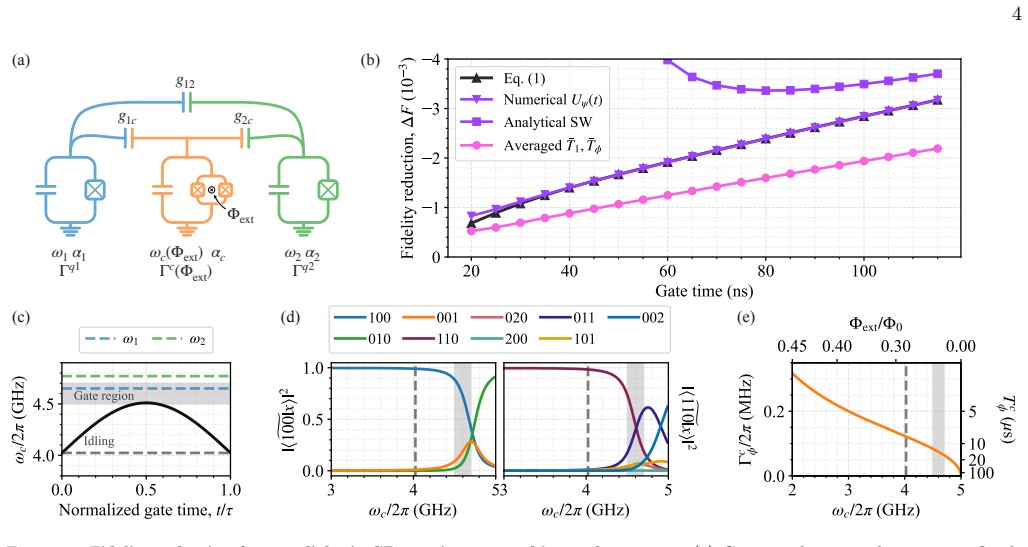
We generalize the fidelity-reduction formulae to encompass time-dependent dissipation. Applying our generalized formula, we obtain a fidelity bound for adiabatic operations and demonstrate that flux-dependent noise sensitivity, combined with qubit-coupler hybridization, significantly reduces the fidelity of adiabatic controlled-Z (CZ) gates in superconducting quantum computers. Our work thus provides essential theoretical tools for evaluating error budgets and optimizing the design of quantum operations in tunable quantum-computing architectures, and may also find applications in quantum-sensing and quantum-communication protocols that are affected by time-dependent dissipation.
What carries the argument
The generalized fidelity-reduction formula that accounts for time-dependent dissipation rates in the average gate fidelity under Markovian noise.
If this is right
- Provides a fidelity bound for adiabatic operations under time-dependent noise.
- Reveals significant fidelity reduction in adiabatic CZ gates due to flux-dependent noise sensitivity and hybridization.
- Supplies tools for error budget evaluation in tunable quantum architectures.
- May extend to quantum-sensing and quantum-communication protocols affected by time-dependent dissipation.
Where Pith is reading between the lines
- Gate designers could select frequency trajectories that minimize the integrated effect of varying dissipation rates.
- The same extension might apply to other control protocols that modulate system parameters over time.
- Numerical simulations of specific device parameters could test how much the bound tightens when hybridization strength increases.
Load-bearing premise
The Markovian and perturbative assumptions from the static-noise case continue to hold when dissipation rates become time-dependent.
What would settle it
An experiment measuring the average fidelity of an adiabatic CZ gate while varying flux tuning parameters and comparing results to the time-dependent bound.
Figures
read the original abstract
As quantum-computing platforms are susceptible to noise, the fidelity of quantum operations is limited by decoherence. Understanding this limitation is crucial for building utility-scale quantum processors. In previous works [Phys. Rev. Lett. 129, 150504 (2022); Quantum 9, 1684 (2025)], we presented analytical formulae for the average gate fidelity of multi-qubit operations under static Markovian noise processes, including operations that temporarily leave the computational subspace. However, some quantum-computing architectures dynamically modulate qubit or coupler frequencies to implement two-qubit gates, e.g., baseband flux gates; such modulation can lead to dissipation rates varying in time. In this Letter, we therefore generalize the fidelity-reduction formulae to encompass time-dependent dissipation. Applying our generalized formula, we obtain a fidelity bound for adiabatic operations and demonstrate that flux-dependent noise sensitivity, combined with qubit-coupler hybridization, significantly reduces the fidelity of adiabatic controlled-Z (CZ) gates in superconducting quantum computers. Our work thus provides essential theoretical tools for evaluating error budgets and optimizing the design of quantum operations in tunable quantum-computing architectures, and may also find applications in quantum-sensing and quantum-communication protocols that are affected by time-dependent dissipation.
Editorial analysis
A structured set of objections, weighed in public.
Referee Report
Summary. The paper generalizes analytical formulae for average gate fidelity of multi-qubit operations under static Markovian noise (from prior PRL and Quantum works) to time-dependent dissipation rates γ(t). It derives a fidelity bound for adiabatic operations and applies the result to demonstrate that flux-dependent noise sensitivity combined with qubit-coupler hybridization significantly reduces the fidelity of adiabatic CZ gates in superconducting quantum computers.
Significance. If the generalization is valid, the work supplies practical tools for error budgeting and optimization in tunable architectures that modulate frequencies during gates. It extends the static-noise results to realistic time-varying dissipation and identifies a concrete fidelity limitation in adiabatic CZ implementations.
major comments (1)
- [derivation of generalized fidelity formula and adiabatic CZ application] The generalization of the static-noise fidelity formulae (replacing constant rates with γ(t) inside the perturbative integrals) does not state or derive an explicit slow-variation condition on γ(t) relative to the gate timescale. This assumption is load-bearing for the central claim and for the adiabatic CZ application, where flux modulation simultaneously changes hybridization and noise sensitivity; without it, memory effects or higher-order terms may invalidate the first-order Markovian integral (see the section deriving the time-dependent bound and its application to adiabatic gates).
Simulated Author's Rebuttal
We thank the referee for their careful reading of the manuscript and for identifying an important point regarding the conditions of validity. We address the major comment below.
read point-by-point responses
-
Referee: The generalization of the static-noise fidelity formulae (replacing constant rates with γ(t) inside the perturbative integrals) does not state or derive an explicit slow-variation condition on γ(t) relative to the gate timescale. This assumption is load-bearing for the central claim and for the adiabatic CZ application, where flux modulation simultaneously changes hybridization and noise sensitivity; without it, memory effects or higher-order terms may invalidate the first-order Markovian integral (see the section deriving the time-dependent bound and its application to adiabatic gates).
Authors: We agree that the derivation of the time-dependent fidelity bound relies on the Markovian master equation remaining valid when the rates γ(t) are time-dependent. This requires that γ(t) varies slowly relative to the bath correlation time (typically ≪ 1 ns in superconducting devices), so that non-Markovian memory effects and higher-order corrections remain negligible. Although this condition is implicit in our use of the time-local Lindblad form, we did not state it explicitly or derive its implications for the adiabatic CZ case. We will revise the manuscript to add an explicit statement of the slow-variation condition, with a brief derivation sketch and a discussion of its applicability to flux-modulated gates. revision: yes
Circularity Check
No circularity; generalization is a direct perturbative extension
full rationale
The paper extends the static-noise fidelity formulae (cited from prior works) by substituting time-dependent rates γ(t) into the existing perturbative integrals for average fidelity. This step is a straightforward mathematical replacement under preserved Markovian/perturbative assumptions and does not reduce the new bound to a self-defined quantity, fitted parameter, or self-citation chain. The application to adiabatic CZ gates follows from the generalized expression without additional load-bearing self-references that would force the result. The derivation remains self-contained against the static base case.
Axiom & Free-Parameter Ledger
Reference graph
Works this paper leans on
-
[1]
M. A. Nielsen and I. L. Chuang,Quantum Computation and Quantum Information(Cambridge University Press, 2000)
2000
-
[2]
M. Mohseniet al., How to Build a Quantum Super- computer: Scaling from Hundreds to Millions of Qubits (2025), arXiv:2411.10406
Pith/arXiv arXiv 2025
-
[3]
Wendin, Quantum information processing with su- perconducting circuits: a review, Reports on Progress in Physics80, 106001 (2017)
G. Wendin, Quantum information processing with su- perconducting circuits: a review, Reports on Progress in Physics80, 106001 (2017)
2017
-
[4]
Krantz, M
P. Krantz, M. Kjaergaard, F. Yan, T. P. Orlando, S. Gus- tavsson, and W. D. Oliver, A quantum engineer’s guide to superconducting qubits, Applied Physics Reviews6, 021318 (2019)
2019
-
[5]
Acharyaet al., Quantum error correction below the surface code threshold, Nature638, 920 (2025)
R. Acharyaet al., Quantum error correction below the surface code threshold, Nature638, 920 (2025)
2025
-
[6]
H ¨affner, C
H. H ¨affner, C. F. Roos, and R. Blatt, Quantum comput- ing with trapped ions, Physics Reports469, 155 (2008)
2008
-
[7]
C. D. Bruzewicz, J. Chiaverini, R. McConnell, and J. M. Sage, Trapped-ion quantum computing: Progress and challenges, Applied Physics Reviews6, 021314 (2019)
2019
- [8]
-
[9]
Ransfordet al., Helios: A 98-qubit trapped-ion quan- tum computer (2025), arXiv:2511.05465
A. Ransfordet al., Helios: A 98-qubit trapped-ion quan- tum computer (2025), arXiv:2511.05465
Pith/arXiv arXiv 2025
-
[10]
Saffman, T
M. Saffman, T. G. Walker, and K. Mølmer, Quantum information with Rydberg atoms, Reviews of Modern Physics82, 2313 (2010)
2010
-
[11]
Wintersperger, F
K. Wintersperger, F. Dommert, T. Ehmer, A. Hour- sanov, J. Klepsch, W. Mauerer, G. Reuber, T. Strohm, M. Yin, and S. Luber, Neutral atom quantum computing hardware: performance and end-user perspective, EPJ 6 Quantum Technology10, 32 (2023)
2023
-
[12]
Bluvsteinet al., A fault-tolerant neutral-atom archi- tecture for universal quantum computation, Nature649, 39 (2026)
D. Bluvsteinet al., A fault-tolerant neutral-atom archi- tecture for universal quantum computation, Nature649, 39 (2026)
2026
-
[13]
Chatterjee, P
A. Chatterjee, P. Stevenson, S. De Franceschi, A. Morello, N. P. de Leon, and F. Kuemmeth, Semicon- ductor qubits in practice, Nature Reviews Physics3, 157 (2021)
2021
-
[14]
Burkard, T
G. Burkard, T. D. Ladd, A. Pan, J. M. Nichol, and J. R. Petta, Semiconductor spin qubits, Reviews of Modern Physics95, 025003 (2023)
2023
-
[15]
Members of the HRL Quantum Team and Collabora- tors, A digitally controlled silicon quantum processing unit (2026), arXiv:2604.16216
Pith/arXiv arXiv 2026
-
[16]
Flamini, N
F. Flamini, N. Spagnolo, and F. Sciarrino, Photonic quantum information processing: a review, Reports on Progress in Physics82, 016001 (2019)
2019
-
[17]
Slussarenko and G
S. Slussarenko and G. J. Pryde, Photonic quantum in- formation processing: A concise review, Applied Physics Reviews6, 041303 (2019)
2019
-
[18]
Aghaee Radet al., Scaling and networking a modular photonic quantum computer, Nature638, 912 (2025)
H. Aghaee Radet al., Scaling and networking a modular photonic quantum computer, Nature638, 912 (2025)
2025
-
[19]
Kinoset al., Roadmap for Rare-earth Quantum Com- puting (2021), arXiv:2103.15743
A. Kinoset al., Roadmap for Rare-earth Quantum Com- puting (2021), arXiv:2103.15743
arXiv 2021
-
[20]
Schlosshauer, Quantum decoherence, Physics Reports 831, 1 (2019)
M. Schlosshauer, Quantum decoherence, Physics Reports 831, 1 (2019)
2019
-
[21]
B. M. Terhal, Quantum error correction for quantum memories, Reviews of Modern Physics87, 307 (2015)
2015
-
[22]
S. M. Girvin, Introduction to quantum error correction and fault tolerance, SciPost Physics Lecture Notes , 70 (2023)
2023
-
[23]
C. L. Degen, F. Reinhard, and P. Cappellaro, Quantum sensing, Reviews of Modern Physics89, 035002 (2017)
2017
-
[24]
Montenegro, C
V. Montenegro, C. Mukhopadhyay, R. Yousefjani, S. Sarkar, U. Mishra, M. G. Paris, and A. Bayat, Re- view: Quantum metrology and sensing with many-body systems, Physics Reports1134, 1 (2025)
2025
-
[25]
S. A. Khan, S. Prabhu, L. G. Wright, and P. L. McMahon, Quantum Computational-Sensing Advantage (2025), arXiv:2507.16918
arXiv 2025
-
[26]
Gisin and R
N. Gisin and R. Thew, Quantum communication, Nature Photonics1, 165 (2007)
2007
-
[27]
M. Hajduˇ sek and R. Van Meter, Quantum Communica- tions (2023), arXiv:2311.02367
arXiv 2023
-
[28]
Sunget al., Realization of High-Fidelity CZ and ZZ- Free iSWAP Gates with a Tunable Coupler, Physical Re- view X11, 021058 (2021)
Y. Sunget al., Realization of High-Fidelity CZ and ZZ- Free iSWAP Gates with a Tunable Coupler, Physical Re- view X11, 021058 (2021)
2021
-
[29]
Dinget al., High-Fidelity, Frequency-Flexible Two- Qubit Fluxonium Gates with a Transmon Coupler, Phys- ical Review X13, 031035 (2023)
L. Dinget al., High-Fidelity, Frequency-Flexible Two- Qubit Fluxonium Gates with a Transmon Coupler, Phys- ical Review X13, 031035 (2023)
2023
-
[30]
R. Li, K. Kubo, Y. Ho, Z. Yan, Y. Nakamura, and H. Goto, Realization of High-Fidelity CZ Gate Based on a Double-Transmon Coupler, Physical Review X14, 041050 (2024)
2024
-
[31]
Hyypp ¨aet al., Reducing Leakage of Single-Qubit Gates for Superconducting Quantum Processors Using Analytical Control Pulse Envelopes, PRX Quantum5, 030353 (2024)
E. Hyypp ¨aet al., Reducing Leakage of Single-Qubit Gates for Superconducting Quantum Processors Using Analytical Control Pulse Envelopes, PRX Quantum5, 030353 (2024)
2024
-
[32]
T. Abad, J. Fern´ andez-Pend´ as, A. Frisk Kockum, and G. Johansson, Universal fidelity reduction of quantum operations from weak dissipation, Physical Review Let- ters129, 150504 (2022)
2022
-
[33]
T. Abad, Y. Schattner, A. Frisk Kockum, and G. Johans- son, Impact of decoherence on the fidelity of quantum gates leaving the computational subspace, Quantum9, 1684 (2025)
2025
-
[34]
Neeleyet al., Generation of three-qubit entangled states using superconducting phase qubits, Nature467, 570 (2010)
M. Neeleyet al., Generation of three-qubit entangled states using superconducting phase qubits, Nature467, 570 (2010)
2010
-
[35]
Chenet al., Qubit Architecture with High Coherence and Fast Tunable Coupling, Physical Review Letters113, 220502 (2014)
Y. Chenet al., Qubit Architecture with High Coherence and Fast Tunable Coupling, Physical Review Letters113, 220502 (2014)
2014
-
[36]
S. A. Caldwellet al., Parametrically Activated Entan- gling Gates Using Transmon Qubits, Physical Review Applied10, 034050 (2018)
2018
-
[37]
Barendset al., Diabatic Gates for Frequency-Tunable Superconducting Qubits, Physical Review Letters123, 210501 (2019)
R. Barendset al., Diabatic Gates for Frequency-Tunable Superconducting Qubits, Physical Review Letters123, 210501 (2019)
2019
-
[38]
Q. Ding, A. V. Oppenheim, P. T. Boufounos, S. Gustavs- son, J. A. Grover, T. A. Baran, and W. D. Oliver, Pulse design of baseband flux control for adiabatic controlled- phase gates in superconducting circuits, Physical Review Applied23, 064013 (2025)
2025
-
[39]
F. Marxeret al., Above 99.9% Fidelity Single-Qubit Gates, Two-Qubit Gates, and Readout in a Single Super- conducting Quantum Device (2025), arXiv:2508.16437
Pith/arXiv arXiv 2025
-
[40]
A. Q. Chen, X. Wu, S. Strong, and S. Poletto, Unlocking a fast adiabatic CZ gate and exact residual ZZ cancella- tion between fixed-frequency transmons using a floating tunable coupler (2026), arXiv:2604.05048
Pith/arXiv arXiv 2026
-
[41]
M. A. Nielsen, A simple formula for the average gate fi- delity of a quantum dynamical operation, Physics Letters A303, 249 (2002)
2002
-
[42]
Lindblad, On the generators of quantum dynamical semigroups, Communications in Mathematical Physics 48, 119 (1976)
G. Lindblad, On the generators of quantum dynamical semigroups, Communications in Mathematical Physics 48, 119 (1976)
1976
-
[43]
Supplementary Material
-
[44]
J. R. Schrieffer and P. A. Wolff, Relation between the Anderson and Kondo Hamiltonians, Physical Review149, 491 (1966)
1966
-
[45]
Bravyi, D
S. Bravyi, D. P. DiVincenzo, and D. Loss, Schrieffer– Wolff transformation for quantum many-body systems, Annals of Physics326, 2793 (2011)
2011
-
[46]
Chu and F
J. Chu and F. Yan, Coupler-Assisted Controlled-Phase Gate with Enhanced Adiabaticity, Physical Review Ap- plied16, 054020 (2021)
2021
-
[47]
S. Pettersson Fors, J. Fern´ andez-Pend´ as, and A. Frisk Kockum, Comprehensive explanation of ZZ coupling in superconducting qubits (2024), arXiv:2408.15402
arXiv 2024
-
[48]
Ithier, E
G. Ithier, E. Collin, P. Joyez, P. J. Meeson, D. Vion, D. Esteve, F. Chiarello, A. Shnirman, Y. Makhlin, J. Schriefl, and G. Sch¨on, Decoherence in a superconduct- ing quantum bit circuit, Physical Review B72, 134519 (2005)
2005
-
[49]
C. J. Wood and J. M. Gambetta, Quantification and characterization of leakage errors, Physical Review A97, 032306 (2018)
2018
-
[50]
J. An, H. Zhang, Q. Ding, L. Ding, Y. Sung, R. Winik, J. Kim, I. T. Rosen, K. Azar, R. D. Pi˜ nero, J. M. Gertler, M. Gingras, B. M. Niedzielski, H. Stickler, M. E. Schwartz, J. ˆI. j. Wang, T. P. Orlando, S. Gustavsson, M. Hays, J. A. Grover, K. Serniak, and W. D. Oliver, ZZ-Free Two-Transmon CZ Gate Mediated by a Fluxo- nium Coupler (2025), arXiv:2511.02115
arXiv 2025
-
[51]
Burkard, Non-Markovian qubit dynamics in the pres- ence of 1/f noise, Physical Review B79, 125317 (2009)
G. Burkard, Non-Markovian qubit dynamics in the pres- ence of 1/f noise, Physical Review B79, 125317 (2009). 7
2009
-
[52]
Connolly, P
T. Connolly, P. D. Kurilovich, S. Diamond, H. Nho, C. G. L. Bøttcher, L. I. Glazman, V. Fatemi, and M. H. Devoret, Coexistence of Nonequilibrium Density and Equilibrium Energy Distribution of Quasiparticles in a Superconducting Qubit, Physical Review Letters132, 217001 (2024)
2024
-
[53]
Gullans, M
M. Gullans, M. Caranti, A. Mills, and J. Petta, Com- pressed Gate Characterization for Quantum Devices with Time-Correlated Noise, PRX Quantum5, 010306 (2024)
2024
-
[54]
K. X. Wei, E. Pritchett, D. M. Zajac, D. C. McKay, and S. Merkel, Characterizing non-Markovian off-resonant er- rors in quantum gates, Physical Review Applied21, 024018 (2024)
2024
-
[55]
M. Odeh, K. Godeneli, E. Li, R. Tangirala, H. Zhou, X. Zhang, Z.-H. Zhang, and A. Sipahigil, Non-Markovian dynamics of a superconducting qubit in a phononic bandgap, Nature Physics21, 406 (2025)
2025
-
[56]
Zhuang, D
Z.-T. Zhuang, D. Rosenstock, B.-J. Liu, A. Somoroff, V. E. Manucharyan, and C. Wang, Non-Markovian re- laxation spectroscopy of fluxonium qubits, Nature Com- munications17, 3209 (2026)
2026
-
[57]
J. J. Sakurai and J. Napolitano,Modern Quantum Me- chanics(Cambridge University Press, 2020). 1 S1. DERIV ATION OF A VERAGE GATE FIDELITY WITH TIME-DEPENDENT DISSIPATION Here we present the details of the derivation leading to Eq. (3) in the main text for a system with a time-dependent Hamiltonian and time-dependent dissipation. We start from the Lindblad...
2020
-
[58]
In this system, the interaction leads to hybridization between the modes, such that each dressed operator acquires contributions from the others
coupled via a tunable coupler (c), such that the indicesi,j∈{1,2,c}. In this system, the interaction leads to hybridization between the modes, such that each dressed operator acquires contributions from the others. Using the expansion above, we express the dressed annihilation operators in terms of the bare modes. To second order in the coupling strengths...
discussion (0)
Sign in with ORCID, Apple, or X to comment. Anyone can read and Pith papers without signing in.