REVIEW 2 major objections 5 minor 195 references
Imaging with quantum states of light
T0 review · 2 major / 5 minor · reviewed 2026-08-14 · deepseek-v4-flash
Pith's one-line read Quantum states of light can push imaging past classical noise and resolution limits.
desk verdict A competent, broad review of quantum imaging, useful for newcomers; the abstract's 'exceed the classical limit' claim is under-specified, but the body is balanced. read the letter →
The pith
A machine-rendered reading of the paper's core claim, the machinery that carries it, and where it could break.
The reading
What carries the argument
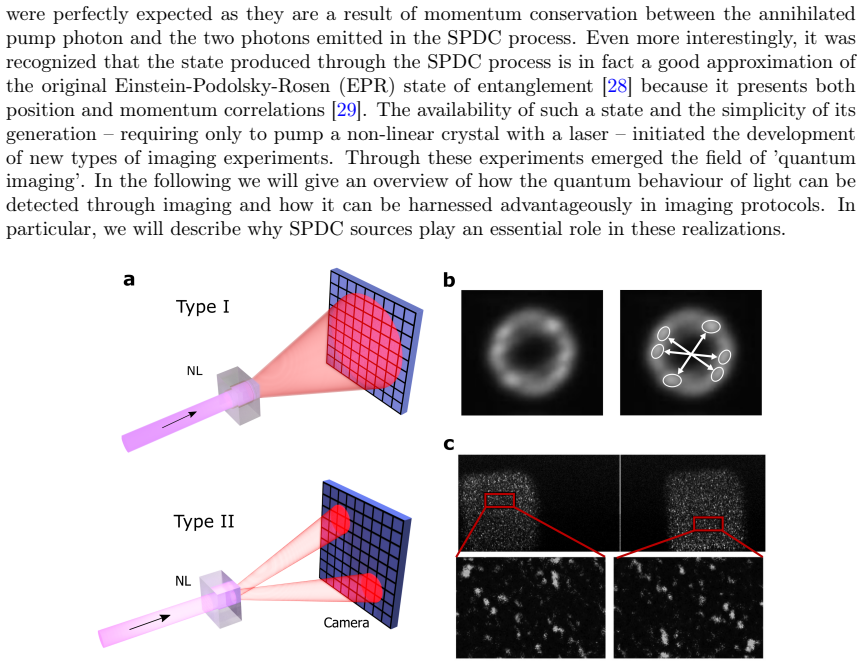
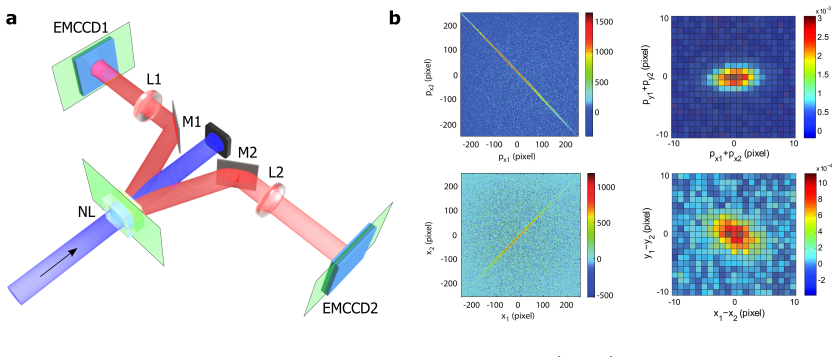
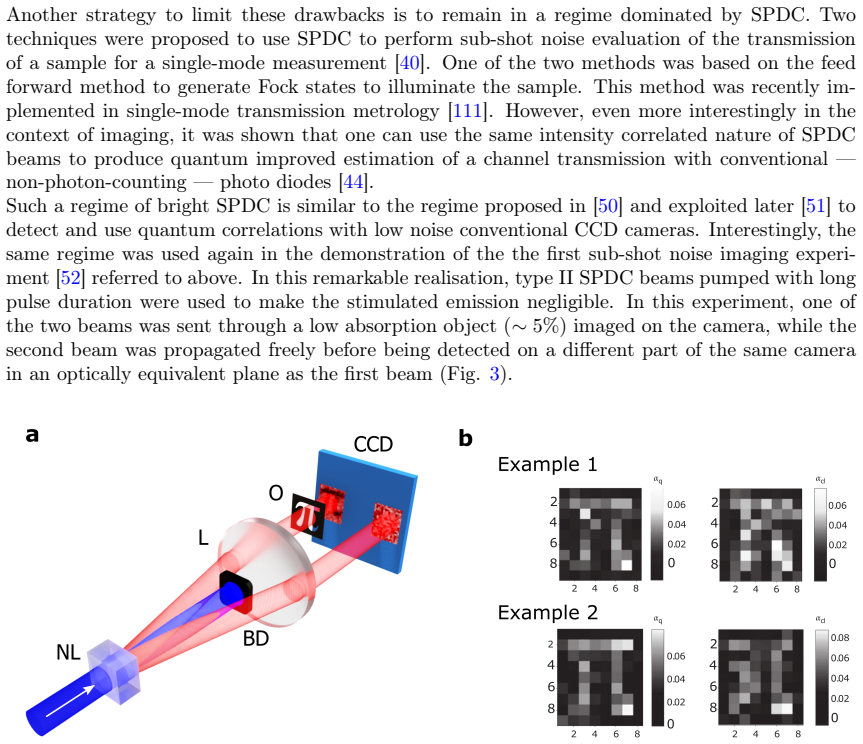
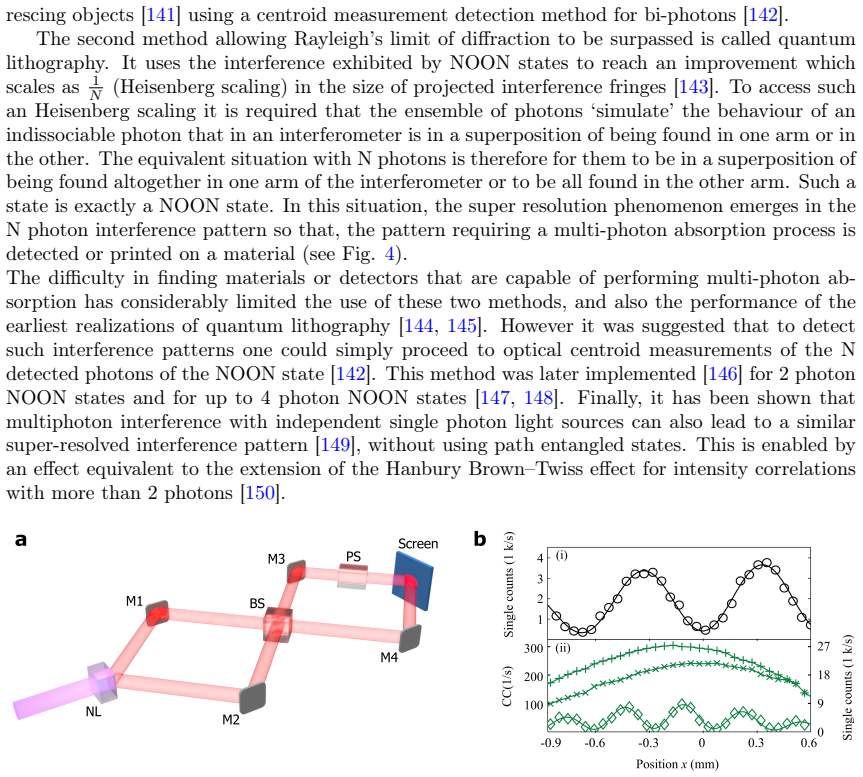
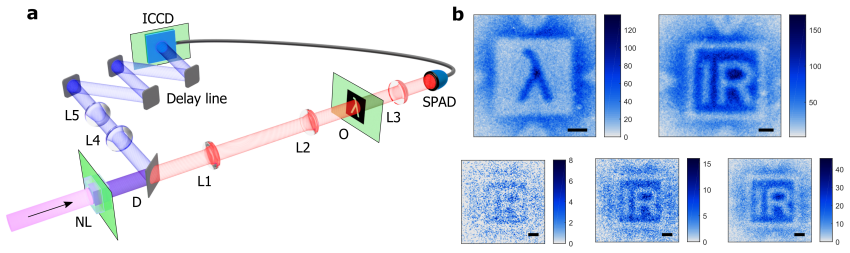
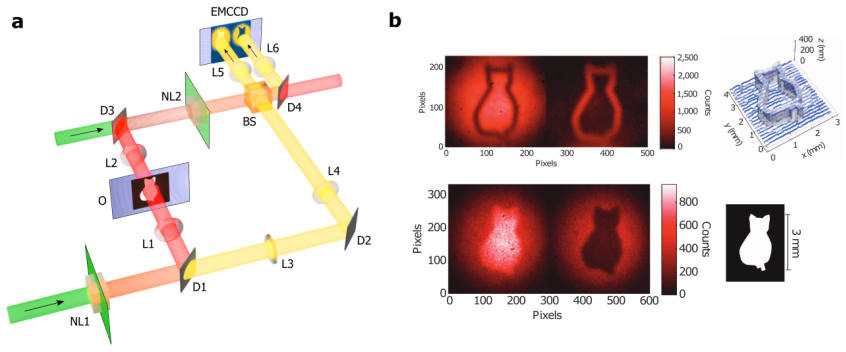
The central object is the SPDC photon pair, created when a pump photon splits into two correlated photons, signal and idler, in a nonlinear crystal with conservation of energy and momentum. These pairs carry EPR-like correlations in position and momentum, and the correlations are detected by single-photon-sensitive cameras such as electron-multiplying CCDs, intensified CCD and CMOS systems, and emerging photon-number-resolving arrays. For noise improvement, the workhorse mechanism is twin-beam subtraction: because the intensity fluctuations of the two beams are correlated, subtracting one image from the other cancels common-mode shot noise and gives a sub-shot-noise estimate of the object's transmission. For resolution, the workhorse mechanism is centroid detection of biphotons and NOON-state interference, in which the center-of-mass position of $N$ detected photons gives an effective fringe period or point-spread function reduced by a factor of $N$ relative to the classical wavelength limit.
What would settle it
Re-analyse the raw camera data behind the two cornerstone experiments: compute the variance of the difference image in the object region and compare it to an independently calibrated shot-noise level obtained with a coherent source on the same camera; and measure the point-spread function of the centroid histogram under identical illumination with a classical source. If the variance is not below the calibrated shot-noise floor, or if the centroid histogram is not narrower than the classical diffraction-limited response, the central claim fails.
Extended reading notes
Core claim
The paper claims that SPDC twin beams form an EPR-type state with correlations in both position and momentum, and that detecting these correlations with spatially resolving single-photon cameras is what converts quantum resources into imaging advantage. For noise, the key demonstration is sub-shot-noise imaging of a low-absorption object: because the intensity fluctuations in the two beams are common-mode, subtracting one detected image from the other removes part of the shot noise and yields a transmission image whose noise floor is below that of a coherent-state measurement. For resolution, the claim is that detecting the centroid of photon pairs, or exploiting the effective de Broglie wavelength of NOON states, produces fringes and point-spread functions narrower than the classical Rayleigh or Abbe limit, with the advantage scaling as $1/\sqrt{N}$ for standard quantum limited measurements and $1/N$ for Heisenberg-limited NOON interferometry. The review further claims that nonlinear interferometers can image an object with photons that have never interacted with it, and that non-degenerate down-conversion shifts imaging to wavelengths where no efficient detector exists.
Load-bearing premise
The review's conclusion that quantum light outperforms classical light depends on the accuracy of the cited experiments, particularly the demonstration of images with noise below the photon-counting floor and the demonstration of resolution beyond the diffraction limit; if either result is flawed, the claimed advantage collapses.
Editorial extensions
If this is right
- Low-light imaging of light-sensitive samples becomes practical: twin-beam subtraction can image low-absorption objects while exposing them to fewer photons than a shot-noise-limited classical measurement.
- Wavelength-shifting imaging becomes possible: non-degenerate ghost imaging and imaging with undetected photons let cameras designed for visible light image objects at infrared or other wavelengths where efficient cameras do not exist.
- Full-field superresolution becomes accessible: centroid-based biphoton detection yields resolution beyond the diffraction limit without scanning, and NOON-state interference can in principle reach Heisenberg scaling in resolution.
- Quantum-enhanced metrology extends to images: optimized twin-beam estimators give an unconditional advantage in absorption estimation, and NOON and SU(1,1) interferometers promise phase images with precision beyond the standard quantum limit.
- As single-photon camera technology matures, the proof-of-principle demonstrations in this review should become practical instruments for low-noise and high-resolution imaging.
Reading between the lines
- Editorial inference: the twin-beam subtraction that cancels intensity noise for absorption imaging could be extended to phase imaging by subtracting correlated quadrature-noise measurements, which the review only gestures at through interferometric schemes.
- Editorial inference: because centroid resolution only needs the detected positions of $N$ photons, a version of the superresolution effect may be achievable with classical light by post-selecting $N$-photon events, an idea the paper mentions for photon-counting strategies but does not develop into a general recipe.
- Editorial inference: combining non-degenerate SPDC with the undetected-photon interferometer could yield multispectral or hyperspectral imaging in hard-to-detect bands, provided the interferometric stability issues acknowledged in the review are overcome.
- Editorial inference: a quantitative comparison of the centroid method with classical structured-illumination superresolution at equal photon budgets would clarify how much of the reported advantage is genuinely quantum rather than a benefit of post-selecting rare multi-photon events.
Signed reviews
Editorial analysis
A structured set of objections, weighed in public.
Referee Report
Summary. The manuscript is a review of quantum imaging using spontaneous parametric down-conversion (SPDC) sources, with emphasis on camera technologies, quantum-enhanced measurements, and quantum-inspired imaging protocols. It begins by reviewing single-photon-sensitive camera technologies and their use in detecting spatial quantum correlations and high-dimensional entanglement, including EPR-type demonstrations. It then discusses quantum improvements to conventional imaging, specifically sub-shot-noise amplitude imaging, phase imaging with NOON and SU(1,1) interferometry, and resolution enhancement via biphoton centroid estimation and quantum lithography. The second half covers new imaging modalities: ghost imaging, imaging with undetected photons, and interaction-free measurement. The abstract claims that quantum approaches can improve conventional imaging systems through image contrast, resolution enhancement that exceeds the classical limit, and sub-shot-noise phase or amplitude images. The review also states several limitations, including the low-absorption constraint in sub-shot-noise subtraction imaging, the interferometric complexity of imaging with undetected photons, and the lack of resolution advantage in ghost imaging over classical methods.
Significance. If its claims are stated with appropriate precision, this is a useful and broadly scoped review for a quantum-optics or imaging audience. Its strengths are the breadth of coverage, the balanced treatment of classical and quantum ghost imaging, and the explicit acknowledgment of practical limitations such as low-absorption constraints, detector noise, and interferometric complexity. The discussion of camera technologies and the comparison of their operating regimes is practical and informative. The review is not a source of new derivations or falsifiable predictions, but it serves as a synthesis of recent experimental progress. Its main weakness is that the headline resolution-enhancement claim is not tied to a clearly specified classical benchmark, and the text itself cites classical schemes that access the same class of advantages. This ambiguity affects the central claim of the abstract and the 'Superresolution in quantum imaging' section.
major comments (2)
- [Abstract and 'Superresolution in quantum imaging'] The central claim in the abstract that quantum approaches provide 'resolution enhancement that exceed the classical limit' is underspecified and is not established by the cited experiments. The superresolution section never defines the classical benchmark: if 'classical limit' means the Rayleigh resolution of a direct-intensity image, then the claim is weaker than the abstract suggests; if it means the best classical measurement strategy, the paper itself provides counter-evidence by noting that post-selected photon counting with classical light can access the same N-photon advantage (Refs. [80,133]) and that photon-counting strategies yield resolution enhancement for non-fluorescing objects (Ref. [140]). In particular, the description of Ref. [141] does not compare against the optimal classical measurement, such as spatial-mode demultiplexing. Please specify the benchmark and qualify the abstract and the section accordingly.
- [Superresolution in quantum imaging] The sentence 'The first method allows the standard quantum limit in resolution to be reached and goes beyond the diffraction limit by detecting quantum correlations between N photons; such a limit scales as 1/N (Ref. [132])' conflates a metrological precision scaling with a resolution limit. The standard quantum limit for phase estimation is a different concept from the Abbe/Rayleigh resolution limit, and the review does not define a 'standard quantum limit in resolution'. This distinction is load-bearing for the section's taxonomy of resolution enhancement and should be clarified.
minor comments (5)
- [Table 1] Table 1 appears to merge cells or columns; for example, the entries 'Overall detection efficiency up to∼95% ∼60%after thresholding' and 'Quantum efficiency>80%, (at−90oC) ∼10−20%after thresholding' are hard to parse, and 'per pixel par frame' should read 'per pixel per frame'.
- [Figure 2 caption and 'Intensified cameras'] The text and caption refer to an 'ERP paradox'; this should be 'EPR paradox'.
- [References] Reference [166] duplicates Reference [154]; both list the same 'Photon-sparse microscopy' article, so the duplicate should be removed or renumbered.
- [References] Reference [129] is listed as 'Under consideration, 2019'; this should be updated to a published citation or given a stable preprint identifier.
- ['Superresolution in quantum imaging'] The sentence 'we have demonstrated a resolution enhancement in full-field imaging under of non fluorescing objects' contains a typo ('under of'); it should read 'of non-fluorescing objects'.
Circularity Check
No significant circularity: this review article summarizes independent experimental results and does not derive its claims from its own definitions.
full rationale
The paper is a review article with no derivation chain, no fitted parameters, and no construction in which an output quantity is defined in terms of the input quantity. Its central claims are literature summaries supported by cited experimental demonstrations, such as the sub-shot-noise imaging of Ref. [52] and the centroid-based resolution enhancement of Ref. [141]. Several of these citations are to the authors' own previous papers, but they are pointers to free-standing, peer-reviewed experimental results rather than premises whose content is being smuggled into the conclusion. The review does not invoke a uniqueness theorem, does not present a new ansatz as forced by prior work, and does not rename an empirical pattern as a derivation. The abstract's phrase 'exceed the classical limit' is arguably imprecise because the review does not specify whether the classical benchmark is the Rayleigh criterion of a standard camera or the optimal classical measurement; however, that is a correctness or precision concern about the benchmark, not a circularity. No equation or definition in the paper reduces the claimed improvements to its own inputs. Therefore the circularity score is 0.
Assumptions & free parameters
assumptions (2)
- domain assumption SPDC produces photon pairs with EPR-type correlations in position and momentum.
- domain assumption The cited experimental papers are correct and their interpretations are sound, especially Refs. [52] and [141].
Cite this review
Pith. "Pith review of Imaging with quantum states of light." pith.science (2026). https://pith.science/paper/I25LJWZJ
@misc{pith2026190803034,
  author       = {Pith},
  title        = {Pith review of: Imaging with quantum states of light},
  year         = {2026},
  howpublished = {\url{https://pith.science/paper/I25LJWZJ}},
  note         = {Machine review of arXiv:1908.03034}
}
read the original abstract
The production of pairs of entangled photons simply by focusing a laser beam onto a crystal with a non-linear optical response was used to test quantum mechanics and to open new approaches in imaging. The development of the latter was enabled by the emergence of single photon sensitive cameras able to characterize spatial correlations and high-dimensional entanglement. Thereby new techniques emerged such as the ghost imaging of objects - where the quantum correlations between photons reveal the image from photons that have never interacted with the object - or the imaging with undetected photons by using nonlinear interferometers. Additionally, quantum approaches in imaging can also lead to an improvement in the performance of conventional imaging systems. These improvements can be obtained by means of image contrast, resolution enhancement that exceed the classical limit and acquisition of sub-shot noise phase or amplitude images. In this review we discuss the application of quantum states of light for advanced imaging techniques.
Figures
Figures from the paper (3 more)
Reference graph
Works this paper leans on
-
[80]
Sub-Rayleigh imaging via N-photon detection,
F. Guerrieri, L. Maccone, F. N. Wong, J. H. Shapiro, S. Tisa, and F. Zappa, “Sub-Rayleigh imaging via N-photon detection,”Physical Review Letters, vol. 105, no. 16, p. 163602, 2010
2010
-
[133]
Achieving sub-Rayleigh resolution via thresh- olding,
S. Mouradian, F. N. Wong, and J. H. Shapiro, “Achieving sub-Rayleigh resolution via thresh- olding,”Optics Express, vol. 19, no. 6, pp. 5480–5488, 2011
work page 2011
-
[140]
Quantum theory of superresolution for two incoherent optical point sources,
M. Tsang, R. Nair, and X.-M. Lu, “Quantum theory of superresolution for two incoherent optical point sources,”Physical Review X, vol. 6, no. 3, p. 031033, 2016
work page 2016
-
[129]
Phase and amplitude imaging with quantum correlations through fourier ptychography,
T. Aidukas, P. C. Konda, A. R. Harvey, , M. J. Padgett, and P.-A. Moreau, “Phase and amplitude imaging with quantum correlations through fourier ptychography,”Under consid- eration, 2019
work page 2019
-
[141]
Resolution-enhanced quantum imaging by centroid estimation of biphotons,
E. Toninelli, P.-A. Moreau, T. Gregory, A. Mihalyi, M. Edgar, N. Radwell, and M. Padgett, “Resolution-enhanced quantum imaging by centroid estimation of biphotons,”Optica, vol. 6, no. 3, pp. 347–353, 2019
work page 2019
-
[132]
Sub-Rayleigh-diffraction-bound quantum imaging,
V. Giovannetti, S. Lloyd, L. Maccone, and J. H. Shapiro, “Sub-Rayleigh-diffraction-bound quantum imaging,”Physical Review A, vol. 79, no. 1, p. 013827, 2009
work page 2009
-
[1]
Generation of optical harmonics,
P. A. Franken, A. E. Hill, C. W. Peters, and G. Weinreich, “Generation of optical harmonics,” Physical Review Letters, vol. 7, no. 4, p. 118, 1961
1961
-
[2]
Measurement of parametric gain accompanying optical difference frequency generation,
C. C. Wang and G. W. Racette, “Measurement of parametric gain accompanying optical difference frequency generation,”Applied Physics Letters, vol. 6, no. 8, pp. 169–171, 1965
1965
Show all 195 references
-
[3]
Tunable coherent parametric oscillation in LiNbO3 at optical frequencies,
J. Giordmaine and R. C. Miller, “Tunable coherent parametric oscillation in LiNbO3 at optical frequencies,”Physical Review Letters, vol. 14, no. 24, p. 973, 1965
1965
-
[4]
Polarization correlation of photons emitted in an atomic cascade,
C. A. Kocher and E. D. Commins, “Polarization correlation of photons emitted in an atomic cascade,”Physical Review Letters, vol. 18, no. 15, p. 575, 1967
1967
-
[5]
Experimental test of local hidden-variable theories,
S. J. Freedman and J. F. Clauser, “Experimental test of local hidden-variable theories,” Physical Review Letters, vol. 28, no. 14, p. 938, 1972
1972
-
[6]
Experimental test of Bell’s inequalities using time- varying analyzers,
A. Aspect, J. Dalibard, and G. Roger, “Experimental test of Bell’s inequalities using time- varying analyzers,”Physical Review Letters, vol. 49, no. 25, p. 1804, 1982
1982
-
[7]
Quantum fluctuations and noise in parametric processes. I.,
W. Louisell, A. Yariv, and A. Siegman, “Quantum fluctuations and noise in parametric processes. I.,”Physical Review, vol. 124, no. 6, p. 1646, 1961
1961
-
[8]
Quantum noise in linear amplifiers,
H. A. Haus and J. Mullen, “Quantum noise in linear amplifiers,”Physical Review, vol. 128, no. 5, p. 2407, 1962
1962
-
[9]
Scattering of light in a medium with nonlinear polarizability,
D. Klyshko, “Scattering of light in a medium with nonlinear polarizability,”Sov. Phys. JETP, vol. 28, p. 522, 1969
1969
-
[10]
Observation of tunable optical parametric fluorescence,
S. Harris, M. Oshman, and R. Byer, “Observation of tunable optical parametric fluorescence,” Physical Review Letters, vol. 18, no. 18, p. 732, 1967
1967
-
[11]
Quantum noise in parametric light amplifiers,
S. Akhmanov, V. Fadeev, R. Khokhlov, and O. Chunaev, “Quantum noise in parametric light amplifiers,”ZhETF Pisma Redaktsiiu, vol. 6, p. 575, 1967
1967
-
[12]
Observation of simultaneity in parametric production of optical photon pairs,
D. C. Burnham and D. L. Weinberg, “Observation of simultaneity in parametric production of optical photon pairs,”Physical Review Letters, vol. 25, no. 2, p. 84, 1970
1970
-
[13]
Observation of nonclassical effects in the interference of two photons,
R. Ghosh and L. Mandel, “Observation of nonclassical effects in the interference of two photons,”Physical Review Letters, vol. 59, no. 17, p. 1903, 1987. 15
1903
-
[14]
Violation of Bell’s inequality and classical probability in a two-photon correlation experiment,
Z. Ou and L. Mandel, “Violation of Bell’s inequality and classical probability in a two-photon correlation experiment,”Physical Review Letters, vol. 61, no. 1, p. 50, 1988
1988
-
[15]
New high- intensity source of polarization-entangled photon pairs,
P. G. Kwiat, K. Mattle, H. Weinfurter, A. Zeilinger, A. V. Sergienko, and Y. Shih, “New high- intensity source of polarization-entangled photon pairs,”Physical Review Letters, vol. 75, no. 24, p. 4337, 1995
1995
-
[16]
Entangled biphoton source-property and preparation,
Y. Shih, “Entangled biphoton source-property and preparation,”Reports on Progress in Physics, vol. 66, no. 6, p. 1009, 2003
2003
-
[17]
Research on hidden variable theories: A review of recent progresses,
M. Genovese, “Research on hidden variable theories: A review of recent progresses,”Physics Reports, vol. 413, no. 6, pp. 319–396, 2005
2005
-
[18]
Measurement of subpicosecond time intervals between two photons by interference,
C.-K. Hong, Z.-Y. Ou, and L. Mandel, “Measurement of subpicosecond time intervals between two photons by interference,”Physical Review Letters, vol. 59, no. 18, p. 2044, 1987
1987
-
[19]
Delayed “choice
Y.-H. Kim, R. Yu, S. P. Kulik, Y. Shih, and M. O. Scully, “Delayed “choice” quantum eraser,” Physical Review Letters, vol. 84, no. 1, p. 1, 2000
2000
-
[20]
Delayed-choice gedanken experiments and their real- izations,
X.-S. Ma, J. Kofler, and A. Zeilinger, “Delayed-choice gedanken experiments and their real- izations,”Reviews of Modern Physics, vol. 88, no. 1, p. 015005, 2016
2016
-
[21]
Ground-to-satellite quantum teleportation,
J.-G. Ren, P. Xu, H.-L. Yong, L. Zhang, S.-K. Liao, J. Yin, W.-Y. Liu, W.-Q. Cai, M. Yang, L. Li,et al., “Ground-to-satellite quantum teleportation,”Nature, vol. 549, no. 7670, p. 70, 2017
2017
-
[22]
Demonstration of an all-optical quantum controlled-not gate,
J. L. O’Brien, G. J. Pryde, A. G. White, T. C. Ralph, and D. Branning, “Demonstration of an all-optical quantum controlled-not gate,”Nature, vol. 426, no. 6964, p. 264, 2003
2003
-
[23]
Large-scale silicon quantum photonics implementing arbitrary two-qubit processing,
X. Qiang, X. Zhou, J. Wang, C. M. Wilkes, T. Loke, S. O’Gara, L. Kling, G. D. Mar- shall, R. Santagati, T. C. Ralph,et al., “Large-scale silicon quantum photonics implementing arbitrary two-qubit processing,”Nature Photonics, vol. 12, no. 9, p. 534, 2018
2018
-
[24]
Secure quantum key distribution,
H.-K. Lo, M. Curty, and K. Tamaki, “Secure quantum key distribution,”Nature Photonics, vol. 8, no. 8, p. 595, 2014
2014
-
[25]
Strong loophole-free test of local realism,
L. K. Shalm, E. Meyer-Scott, B. G. Christensen, P. Bierhorst, M. A. Wayne, M. J. Stevens, T. Gerrits, S. Glancy, D. R. Hamel, M. S. Allman, K. J. Coakley, S. D. Dyer, C. Hodge, A. E. Lita, V. B. Verma, C. Lambrocco, E. Tortorici, A. L. Migdall, Y. Zhang, D. R. Kumor, W. H. Far...
2015
-
[26]
Significant-loophole-free test of Bell’s theorem with entangled photons,
M. Giustina, M. A. M. Versteegh, S. Wengerowsky, J. Handsteiner, A. Hochrainer, K. Phelan, F. Steinlechner, J. Kofler, J.-A. Larsson, C. Abellán, W. Amaya, V. Pruneri, M. W. Mitchell, J. Beyer, T. Gerrits, A. E. Lita, L. K. Shalm, S. W. Nam, T. Scheidl, R. Ursin, B. Wittmann, a...
2015
-
[27]
RealizationoftheEinstein-Podolsky- Rosen paradox using momentum-and position-entangled photons from spontaneous paramet- ric down conversion,
J.C.Howell, R.S.Bennink, S.J.Bentley, andR.Boyd, “RealizationoftheEinstein-Podolsky- Rosen paradox using momentum-and position-entangled photons from spontaneous paramet- ric down conversion,”Physical Review Letters, vol. 92, no. 21, p. 210403, 2004
2004
-
[28]
Can quantum-mechanical description of physical reality be considered complete?,
A. Einstein, B. Podolsky, and N. Rosen, “Can quantum-mechanical description of physical reality be considered complete?,”Physical Review, vol. 47, no. 10, p. 777, 1935
1935
-
[29]
Klyshko,Photons and Nonlinear Optics
D. Klyshko,Photons and Nonlinear Optics. CRC Press, 1988
1988
-
[30]
Spatial and temporal properties of parametric fluorescence around degeneracy in a type I LBO crystal,
F. Devaux and E. Lantz, “Spatial and temporal properties of parametric fluorescence around degeneracy in a type I LBO crystal,”The European Physical Journal D, vol. 8, no. 1, p. 117, 2000
2000
-
[31]
Detection of sub-shot-noise spatial correlation in high-gain parametric down conversion,
O. Jedrkiewicz, Y.-K. Jiang, E. Brambilla, A. Gatti, M. Bache, L. Lugiato, and P. Di Trapani, “Detection of sub-shot-noise spatial correlation in high-gain parametric down conversion,” Physical Review Letters, vol. 93, no. 24, p. 243601, 2004. 16
2004
-
[32]
Spatial correlations of spontaneously down-converted photon pairs detected with a single-photon- sensitive CCD camera,
B. M. Jost, A. V. Sergienko, A. F. Abouraddy, B. E. Saleh, and M. C. Teich, “Spatial correlations of spontaneously down-converted photon pairs detected with a single-photon- sensitive CCD camera,”Optics Express, vol. 3, no. 2, pp. 81–88, 1998
1998
-
[33]
Photon counting strategies with low-light-level CCDs,
A. G. Basden, C. Haniff, and C. Mackay, “Photon counting strategies with low-light-level CCDs,”Monthly Notices of the Royal Astronomical Society, vol. 345, no. 3, pp. 985–991, 2003
2003
-
[34]
Experimental violation of bell’s inequality based on phase and momentum,
J. Rarity and P. Tapster, “Experimental violation of bell’s inequality based on phase and momentum,”Physical Review Letters, vol. 64, no. 21, p. 2495, 1990
1990
-
[35]
Optical imaging by means of two- photon quantum entanglement,
T. Pittman, Y. Shih, D. Strekalov, and A. Sergienko, “Optical imaging by means of two- photon quantum entanglement,”Physical Review A, vol. 52, no. 5, p. R3429, 1995
1995
-
[36]
Observation of Two-Photon “Ghost
D. V. Strekalov, A. V. Sergienko, D. N. Klyshko, and Y. H. Shih, “Observation of Two-Photon “Ghost” Interference and Diffraction,”Physical Review Letters, vol. 74, no. 18, pp. 3600–3603, 1995
1995
-
[37]
Spontaneous parametric down-conversion,
C. Couteau, “Spontaneous parametric down-conversion,”Contemporary Physics, vol. 59, no. 3, pp. 291–304, 2018
2018
-
[38]
R. W. Boyd,Nonlinear optics. Elsevier, 2003
2003
-
[39]
Analysis of a method for the generation of light with sub- poissonian photon statistics,
E. Jakeman and J. Walker, “Analysis of a method for the generation of light with sub- poissonian photon statistics,”Optics Communications, vol. 55, pp. 219–222, 1985
1985
-
[40]
The use of pair production processes to reduce quantum noise in transmission measurements,
E. Jakeman and J. Rarity, “The use of pair production processes to reduce quantum noise in transmission measurements,”Optics Communications, vol. 59, no. 3, pp. 219–223, 1986
1986
-
[41]
Observation of sub-poissonian light in parametric downconversion,
J. Rarity, P. Tapster, and E. Jakeman, “Observation of sub-poissonian light in parametric downconversion,”Optics Communications, vol. 62, no. 3, pp. 201–206, 1987
1987
-
[42]
Observation of quantum noise reduction on twin laser beams,
A. Heidmann, R. Horowicz, S. Reynaud, E. Giacobino, C. Fabre, and G. Camy, “Observation of quantum noise reduction on twin laser beams,”Physical Review Letters, vol. 59, no. 22, p. 2555, 1987
1987
-
[43]
Two-color squeezing and sub-shot-noise signal recovery in doubly resonant optical parametric oscillators,
C. Nabors and R. Shelby, “Two-color squeezing and sub-shot-noise signal recovery in doubly resonant optical parametric oscillators,”Physical Review A, vol. 42, no. 1, p. 556, 1990
1990
-
[44]
Sub-shot-noise measurement of modulated absorption using parametric down-conversion,
P. Tapster, S. Seward, and J. Rarity, “Sub-shot-noise measurement of modulated absorption using parametric down-conversion,”Physical Review A, vol. 44, no. 5, p. 3266, 1991
1991
-
[45]
Sub-shot-noise high-sensitivity spec- troscopy with optical parametric oscillator twin beams,
P. S. Ribeiro, C. Schwob, A. Maître, and C. Fabre, “Sub-shot-noise high-sensitivity spec- troscopy with optical parametric oscillator twin beams,”Optics Letters, vol. 22, no. 24, pp. 1893–1895, 1997
1997
-
[46]
Sub-shot-noise photon- number correlation in a mesoscopic twin beam of light,
M. Bondani, A. Allevi, G. Zambra, M. G. Paris, and A. Andreoni, “Sub-shot-noise photon- number correlation in a mesoscopic twin beam of light,”Physical Review A, vol. 76, no. 1, p. 013833, 2007
2007
-
[47]
Generation and direct detection of broad- band mesoscopic polarization-squeezed vacuum,
T. Iskhakov, M. V. Chekhova, and G. Leuchs, “Generation and direct detection of broad- band mesoscopic polarization-squeezed vacuum,”Physical Review Letters, vol. 102, no. 18, p. 183602, 2009
2009
-
[48]
Quantum spatial correlations in high-gain parametric down-conversion measured by means of a CCD camera,
O. Jedrkiewicz, E. Brambilla, M. Bache, A. Gatti, L. Lugiato, and P. D. Trapani, “Quantum spatial correlations in high-gain parametric down-conversion measured by means of a CCD camera,”Journal of Modern Optics, vol. 53, no. 5-6, pp. 575–595, 2006
2006
-
[49]
Measurement of sub-shot-noise correla- tions of spatial fluctuations in the photon-counting regime,
J.-L. Blanchet, F. Devaux, L. Furfaro, and E. Lantz, “Measurement of sub-shot-noise correla- tions of spatial fluctuations in the photon-counting regime,”Physical Review Letters, vol. 101, no. 23, p. 233604, 2008
2008
-
[50]
High-sensitivity imaging with multi-mode twin beams,
E. Brambilla, L. Caspani, O. Jedrkiewicz, L. Lugiato, and A. Gatti, “High-sensitivity imaging with multi-mode twin beams,”Physical Review A, vol. 77, no. 5, p. 053807, 2008. 17
2008
-
[51]
Measurement of sub-shot-noise spatial correlations without background subtraction,
G. Brida, L. Caspani, A. Gatti, M. Genovese, A. Meda, and I. R. Berchera, “Measurement of sub-shot-noise spatial correlations without background subtraction,”Physical Review Letters, vol. 102, no. 21, p. 213602, 2009
2009
-
[52]
Experimental realization of sub-shot-noise quan- tum imaging,
G. Brida, M. Genovese, and I. R. Berchera, “Experimental realization of sub-shot-noise quan- tum imaging,”Nature Photonics, vol. 4, no. 4, p. 227, 2010
2010
-
[53]
The LLCCD: low-light imaging without the need for an inten- sifier,
P. Jerram, P. J. Pool, R. Bell, D. J. Burt, S. Bowring, S. Spencer, M. Hazelwood, I. Moody, N. Catlett, and P. S. Heyes, “The LLCCD: low-light imaging without the need for an inten- sifier,” inSensors and Camera Systems for Scientific, Industrial, and Digital Photography Applica...
2001
-
[54]
Multi-imaging and bayesian estimation for photon counting with EMCCDs,
E. Lantz, J.-L. Blanchet, L. Furfaro, and F. Devaux, “Multi-imaging and bayesian estimation for photon counting with EMCCDs,”Monthly Notices of the Royal Astronomical Society, vol. 386, no. 4, pp. 2262–2270, 2008
2008
-
[55]
A characterization of the single- photon sensitivity of an electron multiplying charge-coupled device,
L. Zhang, L. Neves, J. S. Lundeen, and I. A. Walmsley, “A characterization of the single- photon sensitivity of an electron multiplying charge-coupled device,”Journal of Physics B: Atomic, Molecular and Optical Physics, vol. 42, no. 11, p. 114011, 2009
2009
-
[56]
Purely spatial coincidences of twin photons in parametric spontaneous down-conversion,
J.-L. Blanchet, F. Devaux, L. Furfaro, and E. Lantz, “Purely spatial coincidences of twin photons in parametric spontaneous down-conversion,”Physical Review A, vol. 81, no. 4, p. 043825, 2010
2010
-
[57]
Sub-shot-noise shadow sensing with quantum correlations,
E. Toninelli, M. P. Edgar, P.-A. Moreau, G. M. Gibson, G. D. Hammond, and M. J. Pad- gett, “Sub-shot-noise shadow sensing with quantum correlations,”Optics Express, vol. 25, pp. 21826–21840, Sept. 2017
2017
-
[58]
Biphoton transmission through non-unitary objects,
M. Reichert, H. Defienne, X. Sun, and J. W. Fleischer, “Biphoton transmission through non-unitary objects,”Journal of Optics, vol. 19, no. 4, p. 044004, 2017
2017
-
[59]
Massively parallel coincidence counting of high-dimensional entangled states,
M. Reichert, H. Defienne, and J. W. Fleischer, “Massively parallel coincidence counting of high-dimensional entangled states,”Scientific Reports, vol. 8, no. 1, p. 7925, 2018
2018
-
[60]
Towards the evidence of a purely spatial einstein-podolsky-rosen paradox in images: measurement scheme and first experimen- tal results,
F. Devaux, J. Mougin-Sisini, P.-A. Moreau, and E. Lantz, “Towards the evidence of a purely spatial einstein-podolsky-rosen paradox in images: measurement scheme and first experimen- tal results,”The European Physical Journal D, vol. 66, no. 7, p. 192, 2012
2012
-
[61]
Realization of the purely spa- tial einstein-podolsky-rosen paradox in full-field images of spontaneous parametric down- conversion,
P.-A. Moreau, J. Mougin-Sisini, F. Devaux, and E. Lantz, “Realization of the purely spa- tial einstein-podolsky-rosen paradox in full-field images of spontaneous parametric down- conversion,”Physical Review A, vol. 86, no. 1, p. 010101, 2012
2012
-
[62]
Imaging high-dimensional spatial entanglement with a camera,
M. P. Edgar, D. S. Tasca, F. Izdebski, R. E. Warburton, J. Leach, M. Agnew, G. S. Buller, R. W. Boyd, and M. J. Padgett, “Imaging high-dimensional spatial entanglement with a camera,”Nature Communications, vol. 3, p. 984, 2012
2012
-
[63]
Einstein-podolsky-rosen paradox in twin images,
P.-A. Moreau, F. Devaux, and E. Lantz, “Einstein-podolsky-rosen paradox in twin images,” Physical Review Letters, vol. 113, no. 16, 2014
2014
-
[64]
Einstein-podolsky-rosen paradox in single pairs of images,
E. Lantz, S. Denis, P.-A. Moreau, and F. Devaux, “Einstein-podolsky-rosen paradox in single pairs of images,”Optics Express, vol. 23, no. 20, pp. 26472–26478, 2015
2015
-
[65]
A new compressive imaging camera architecture using optical-domain compression,
D. Takhar, J. N. Laska, M. B. Wakin, M. F. Duarte, D. Baron, S. Sarvotham, K. F. Kelly, and R. G. Baraniuk, “A new compressive imaging camera architecture using optical-domain compression,” inComputational Imaging IV, vol. 6065, p. 606509, International Society for Optics and ...
2006
-
[66]
Single-pixel imaging via compressive sampling,
M. F. Duarte, M. A. Davenport, D. Takhar, J. N. Laska, T. Sun, K. F. Kelly, and R. G. Baraniuk, “Single-pixel imaging via compressive sampling,”IEEE Signal Processing Maga- zine, vol. 25, no. 2, pp. 83–91, 2008
2008
-
[67]
Efficient high-dimensional entanglement imaging with a compressive-sensing double-pixel camera,
G. A. Howland and J. C. Howell, “Efficient high-dimensional entanglement imaging with a compressive-sensing double-pixel camera,”Physical review X, vol. 3, no. 1, p. 011013, 2013. 18
2013
-
[68]
Violation of continuous-variable Einstein-Podolsky-Rosen steering with discrete measurements,
J. Schneeloch, P. B. Dixon, G. A. Howland, C. J. Broadbent, and J. C. Howell, “Violation of continuous-variable Einstein-Podolsky-Rosen steering with discrete measurements,”Physical Review Letters, vol. 110, no. 13, p. 130407, 2013
2013
-
[69]
The microchannel image intensifier,
M. Lampton, “The microchannel image intensifier,”Scientific American, vol. 245, no. 5, pp. 62–71, 1981
1981
-
[70]
Demonstration of the complementarity of one-and two-photon interference,
A. F. Abouraddy, M. Nasr, B. E. Saleh, A. V. Sergienko, and M. C. Teich, “Demonstration of the complementarity of one-and two-photon interference,”Physical Review A, vol. 63, no. 6, p. 063803, 2001
2001
-
[71]
Direct measurement of transverse-mode entanglement in two-photon states,
H. D. L. Pires, C. H. Monken, and M. P. van Exter, “Direct measurement of transverse-mode entanglement in two-photon states,”Physical Review A, vol. 80, no. 2, p. 022307, 2009
2009
-
[72]
EPR-based ghost imaging using a single-photon-sensitive camera,
R. S. Aspden, D. S. Tasca, R. W. Boyd, and M. J. Padgett, “EPR-based ghost imaging using a single-photon-sensitive camera,”New Journal of Physics, vol. 15, no. 7, p. 073032, 2013
2013
-
[73]
Real-time imaging of quantum entanglement,
R. Fickler, M. Krenn, R. Lapkiewicz, S. Ramelow, and A. Zeilinger, “Real-time imaging of quantum entanglement,”Scientific reports, vol. 3, p. 1914, 2013
1914
-
[74]
Shot-by-shot imaging of Hong–Ou–Mandel interference with an intensified sCMOS camera,
M. Jachura and R. Chrapkiewicz, “Shot-by-shot imaging of Hong–Ou–Mandel interference with an intensified sCMOS camera,”Optics Letters, vol. 40, no. 7, pp. 1540–1543, 2015
2015
-
[75]
High-fidelity spatially resolved multi- photon counting for quantum imaging applications,
R. Chrapkiewicz, W. Wasilewski, and K. Banaszek, “High-fidelity spatially resolved multi- photon counting for quantum imaging applications,”Optics Letters, vol. 39, no. 17, pp. 5090– 5093, 2014
2014
-
[76]
Hologram of a single pho- ton,
R. Chrapkiewicz, M. Jachura, K. Banaszek, and W. Wasilewski, “Hologram of a single pho- ton,”Nature Photonics, vol. 10, no. 9, p. 576, 2016
2016
-
[77]
Mode engineering for realistic quantum-enhanced interferometry,
M. Jachura, R. Chrapkiewicz, R. Demkowicz-Dobrzański, W. Wasilewski, and K. Banaszek, “Mode engineering for realistic quantum-enhanced interferometry,”Nature Communications, vol. 7, p. 11411, 2016
2016
-
[78]
Wavevector multiplexed atomic quantum memory via spatially-resolved single-photon de- tection,
M. Parniak, M. Dąbrowski, M. Mazelanik, A. Leszczyński, M. Lipka, and W. Wasilewski, “Wavevector multiplexed atomic quantum memory via spatially-resolved single-photon de- tection,”Nature Communications, vol. 8, no. 1, p. 2140, 2017
2017
-
[79]
Two-dimensional spad imaging camera for photon counting,
F. Guerrieri, S. Tisa, A. Tosi, and F. Zappa, “Two-dimensional spad imaging camera for photon counting,”IEEE Photonics Journal, vol. 2, no. 5, pp. 759–774, 2010
2010
-
[81]
A 160× 128 single-photon image sensor with on-pixel 55ps 10b time-to-digital converter,
C.Veerappan, J.Richardson, R.Walker, D.-U.Li, M.W.Fishburn, Y.Maruyama, D.Stoppa, F. Borghetti, M. Gersbach, R. K. Henderson,et al., “A 160× 128 single-photon image sensor with on-pixel 55ps 10b time-to-digital converter,” inSolid-State Circuits Conference Digest of Technical ...
2011
-
[82]
Single-photon sensitive light-in-fight imaging,
G. Gariepy, N. Krstajić, R. Henderson, C. Li, R. R. Thomson, G. S. Buller, B. Heshmat, R. Raskar, J. Leach, and D. Faccio, “Single-photon sensitive light-in-fight imaging,”Nature Communications, vol. 6, p. 6021, 2015
2015
-
[83]
A 64-pixel nbtin superconducting nanowire single-photon detector array for spatially resolved photon detection,
S. Miki, T. Yamashita, Z. Wang, and H. Terai, “A 64-pixel nbtin superconducting nanowire single-photon detector array for spatially resolved photon detection,”Optics Express, vol. 22, no. 7, pp. 7811–7820, 2014
2014
-
[84]
A near-infrared 64-pixel superconducting nanowire single photon detector array with integrated multiplexed readout,
M. S. Allman, V. B. Verma, M. Stevens, T. Gerrits, R. D. Horansky, A. E. Lita, F. Marsili, A. Beyer, M. Shaw, D. Kumor,et al., “A near-infrared 64-pixel superconducting nanowire single photon detector array with integrated multiplexed readout,”Applied Physics Letters, vol. 106...
2015
-
[85]
Photon-number-resolving megapixel image sensor at room temperature without avalanche gain,
J. Ma, S. Masoodian, D. A. Starkey, and E. R. Fossum, “Photon-number-resolving megapixel image sensor at room temperature without avalanche gain,”Optica, vol. 4, no. 12, pp. 1474– 1481, 2017. 19
2017
-
[86]
Optimizing the signal-to-noise ratio in the mea- surement of photon pairs with detector arrays,
E. Lantz, P.-A. Moreau, and F. Devaux, “Optimizing the signal-to-noise ratio in the mea- surement of photon pairs with detector arrays,”Physical Review A, vol. 90, no. 6, p. 063811, 2014
2014
-
[87]
Optimizing the use of detector arrays for measuring intensity correlations of photon pairs,
D. S. Tasca, M. P. Edgar, F. Izdebski, G. S. Buller, and M. J. Padgett, “Optimizing the use of detector arrays for measuring intensity correlations of photon pairs,”Physical Review A, vol. 88, no. 1, p. 013816, 2013
2013
-
[88]
30 years of squeezed light generation,
U. L. Andersen, T. Gehring, C. Marquardt, and G. Leuchs, “30 years of squeezed light generation,”Physica Scripta, vol. 91, no. 5, p. 053001, 2016
2016
-
[89]
Squeezed states of light and their applications in laser interferometers,
R. Schnabel, “Squeezed states of light and their applications in laser interferometers,”Physics Reports, vol. 684, pp. 1–51, 2017
2017
-
[90]
Physical significance of operators in quantum optics,
L. Mandel, “Physical significance of operators in quantum optics,”Physical Review, vol. 136, no. 4B, p. B1221, 1964
1964
-
[91]
Photon antibunching and possible ways to observe it,
D. Stoler, “Photon antibunching and possible ways to observe it,”Physical Review Letters, vol. 33, no. 23, p. 1397, 1974
1974
-
[92]
Quantum limits on resonant-mass gravitational-radiation detectors,
J. N. Hollenhorst, “Quantum limits on resonant-mass gravitational-radiation detectors,” Physical Review D, vol. 19, no. 6, p. 1669, 1979
1979
-
[93]
Quantum-mechanical noise in an interferometer,
C. M. Caves, “Quantum-mechanical noise in an interferometer,”Physical Review D, vol. 23, no. 8, p. 1693, 1981
1981
-
[94]
Sub-shot-noise mea- surements using the beat note between quantum-correlated photon beams,
J. J. Snyder, E. Giacobino, C. Fabre, A. Heidmann, and M. Ducloy, “Sub-shot-noise mea- surements using the beat note between quantum-correlated photon beams,”JOSA B, vol. 7, no. 10, pp. 2132–2136, 1990
1990
-
[95]
Quantum-enhanced measurements: beating the standard quantum limit,
V. Giovannetti, S. Lloyd, and L. Maccone, “Quantum-enhanced measurements: beating the standard quantum limit,”Science, vol. 306, no. 5700, pp. 1330–1336, 2004
2004
-
[96]
Quantumsensing,
C.L.Degen, F.Reinhard, andP.Cappellaro, “Quantumsensing,”Reviews of Modern Physics, vol. 89, no. 3, p. 035002, 2017
2017
-
[97]
On the measurement of a weak classical force coupled to a quantum-mechanical oscillator. I. issues of principle,
C. M. Caves, K. S. Thorne, R. W. Drever, V. D. Sandberg, and M. Zimmermann, “On the measurement of a weak classical force coupled to a quantum-mechanical oscillator. I. issues of principle,”Reviews of Modern Physics, vol. 52, no. 2, p. 341, 1980
1980
-
[98]
A gravitational wave observatory operating beyond the quantum shot-noise limit,
J. Abadie, B. Abbott, R. Abbott, T. Abbott, M. Abernathy, C. Adams, R. Adhikari, C. Af- feldt, B. Allen, G. Allen, et al., “A gravitational wave observatory operating beyond the quantum shot-noise limit,”Nature Physics, vol. 7, no. 12, p. 962, 2011
2011
-
[99]
Enhanced sensitivity of the ligo gravitational wave detector by using squeezed states of light,
J. Aasi, J. Abadie, B. Abbott, R. Abbott, T. Abbott, M. Abernathy, C. Adams, T. Adams, P. Addesso, R. Adhikari,et al., “Enhanced sensitivity of the ligo gravitational wave detector by using squeezed states of light,”Nature Photonics, vol. 7, no. 8, p. 613, 2013
2013
-
[100]
Quantum metrology and its application in biology,
M. A. Taylor and W. P. Bowen, “Quantum metrology and its application in biology,”Physics Reports, vol. 615, pp. 1–59, 2016
2016
-
[101]
Entanglement- enhanced probing of a delicate material system,
F. Wolfgramm, C. Vitelli, F. A. Beduini, N. Godbout, and M. W. Mitchell, “Entanglement- enhanced probing of a delicate material system,”Nature Photonics, vol. 7, no. 1, p. 28, 2013
2013
-
[102]
Sub-poissonian processes in quantum optics,
L. Davidovich, “Sub-poissonian processes in quantum optics,”Reviews of Modern Physics, vol. 68, no. 1, p. 127, 1996
1996
-
[103]
Detection of amplitude modulation with squeezed light for sensitivity beyond the shot-noise limit,
M. Xiao, L.-A. Wu, and H. Kimble, “Detection of amplitude modulation with squeezed light for sensitivity beyond the shot-noise limit,”Optics Letters, vol. 13, no. 6, pp. 476–478, 1988
1988
-
[104]
Detection of 15 dB squeezed states of light and their application for the absolute calibration of photoelectric quantum efficiency,
H. Vahlbruch, M. Mehmet, K. Danzmann, and R. Schnabel, “Detection of 15 dB squeezed states of light and their application for the absolute calibration of photoelectric quantum efficiency,”Physical review letters, vol. 117, no. 11, p. 110801, 2016. 20
2016
-
[105]
Quantum limits on optical resolution,
M. I. Kolobov and C. Fabre, “Quantum limits on optical resolution,”Physical Review Letters, vol. 85, no. 18, p. 3789, 2000
2000
-
[106]
Surpassing the standard quantum limit for optical imaging using nonclassical multimode light,
N. Treps, U. Andersen, B. Buchler, P. K. Lam, A. Maitre, H.-A. Bachor, and C. Fabre, “Surpassing the standard quantum limit for optical imaging using nonclassical multimode light,”Physical review letters, vol. 88, no. 20, p. 203601, 2002
2002
-
[107]
A quantum laser pointer,
N. Treps, N. Grosse, W. P. Bowen, C. Fabre, H.-A. Bachor, and P. K. Lam, “A quantum laser pointer,”Science, vol. 301, no. 5635, pp. 940–943, 2003
2003
-
[108]
Entangled images from four-wave mixing,
V. Boyer, A. M. Marino, R. C. Pooser, and P. D. Lett, “Entangled images from four-wave mixing,”Science, vol. 321, no. 5888, pp. 544–547, 2008
2008
-
[109]
Continuous variable entanglement and squeezing of orbital angular momentum states,
M. Lassen, G. Leuchs, and U. L. Andersen, “Continuous variable entanglement and squeezing of orbital angular momentum states,”Physical Review Letters, vol. 102, no. 16, p. 163602, 2009
2009
-
[110]
Entangling the spatial properties of laser beams,
K. Wagner, J. Janousek, V. Delaubert, H. Zou, C. Harb, N. Treps, J. F. Morizur, P. K. Lam, and H. A. Bachor, “Entangling the spatial properties of laser beams,”Science, vol. 321, no. 5888, pp. 541–543, 2008
2008
-
[111]
Sub-shot-noise transmission measurement enabled by active feed-forward of heralded single photons,
J. Sabines-Chesterking, R. Whittaker, S. Joshi, P. Birchall, P.-A. Moreau, A. McMillan, H. Cable, J. O’Brien, J. Rarity, and J. Matthews, “Sub-shot-noise transmission measurement enabled by active feed-forward of heralded single photons,”Physical Review Applied, vol. 8, no. 1,...
2017
-
[112]
Realization of the first sub- shot-noise wide field microscope,
N. Samantaray, I. Ruo-Berchera, A. Meda, and M. Genovese, “Realization of the first sub- shot-noise wide field microscope,”Light: Science & Applications, vol. 6, no. 7, p. e17005, 2017
2017
-
[113]
Demonstrating an absolute quantum advantage in direct absorption measurement,
P.-A.Moreau, J.Sabines-Chesterking, R.Whittaker, S.K.Joshi, P.M.Birchall, A.McMillan, J. G. Rarity, and J. C. Matthews, “Demonstrating an absolute quantum advantage in direct absorption measurement,”Scientific Reports, vol. 7, no. 1, p. 6256, 2017
2017
-
[114]
Unbiased estimation of an optical loss at the ultimate quantum limit with twin-beams,
E. Losero, I. Ruo-Berchera, A. Meda, A. Avella, and M. Genovese, “Unbiased estimation of an optical loss at the ultimate quantum limit with twin-beams,”Scientific Reports, vol. 8, no. 1, p. 7431, 2018
2018
-
[115]
Her- alded source of bright multi-mode mesoscopic sub-poissonian light,
T. S.Iskhakov, V. C. Usenko, U.L. Andersen, R.Filip, M. V.Chekhova, andG. Leuchs, “Her- alded source of bright multi-mode mesoscopic sub-poissonian light,”Optics Letters, vol. 41, no. 10, pp. 2149–2152, 2016
2016
-
[116]
Beating the standard quantum limit with four-entangled photons,
T. Nagata, R. Okamoto, J. L. O’brien, K. Sasaki, and S. Takeuchi, “Beating the standard quantum limit with four-entangled photons,”Science, vol. 316, no. 5825, pp. 726–729, 2007
2007
-
[117]
Photonic de Broglie waves,
J. Jacobson, G. Björk, I. Chuang, and Y. Yamamoto, “Photonic de Broglie waves,”Physical Review Letters, vol. 74, no. 24, p. 4835, 1995
1995
-
[118]
Measurement of the de Broglie wavelength of a multiphoton wave packet,
E. Fonseca, C. Monken, and S. Pádua, “Measurement of the de Broglie wavelength of a multiphoton wave packet,”Physical Review Letters, vol. 82, no. 14, p. 2868, 1999
1999
-
[119]
An entanglement-enhanced microscope,
T. Ono, R. Okamoto, and S. Takeuchi, “An entanglement-enhanced microscope,”Nature Communications, vol. 4, p. ncomms3426, 2013
2013
-
[120]
SU(2) and SU(1,1) interferometers,
B. Yurke, S. L. McCall, and J. R. Klauder, “SU(2) and SU(1,1) interferometers,”Physical Review A, vol. 33, no. 6, p. 4033, 1986
1986
-
[121]
Quantum statistics of a two-mode SU(1,1) interferometer,
U. Leonhardt, “Quantum statistics of a two-mode SU(1,1) interferometer,”Physical Review A, vol. 49, no. 2, p. 1231, 1994
1994
-
[122]
Coherent-light-boosted, sub-shot noise, quantum interferometry,
W. N. Plick, J. P. Dowling, and G. S. Agarwal, “Coherent-light-boosted, sub-shot noise, quantum interferometry,”New Journal of Physics, vol. 12, no. 8, p. 083014, 2010
2010
-
[123]
Effect of losses on the performance of an SU(1,1) interferometer,
A. M. Marino, N. C. Trejo, and P. D. Lett, “Effect of losses on the performance of an SU(1,1) interferometer,”Physical Review A, vol. 86, no. 2, p. 023844, 2012. 21
2012
-
[124]
Enhancement of the phase-measurement sensitivity beyond the standard quantum limit by a nonlinear interferometer,
Z. Ou, “Enhancement of the phase-measurement sensitivity beyond the standard quantum limit by a nonlinear interferometer,”Physical Review A, vol. 85, no. 2, p. 023815, 2012
2012
-
[125]
Realization of a nonlinear interferometer with parametric amplifiers,
J. Jing, C. Liu, Z. Zhou, Z. Ou, and W. Zhang, “Realization of a nonlinear interferometer with parametric amplifiers,”Applied Physics Letters, vol. 99, no. 1, p. 011110, 2011
2011
-
[126]
Quantum metrology with para- metric amplifier-based photon correlation interferometers,
F. Hudelist, J. Kong, C. Liu, J. Jing, Z. Ou, and W. Zhang, “Quantum metrology with para- metric amplifier-based photon correlation interferometers,”Nature Communications, vol. 5, p. 3049, 2014
2014
-
[127]
Detection loss tolerant supersensitive phasemeasurementwithanSU(1,1)interferometer,
M. Manceau, G. Leuchs, F. Khalili, and M. Chekhova, “Detection loss tolerant supersensitive phasemeasurementwithanSU(1,1)interferometer,” Physical Review Letters, vol.119, no.22, p. 223604, 2017
2017
-
[128]
Imaging with a small number of photons,
P. A. Morris, R. S. Aspden, J. E. Bell, R. W. Boyd, and M. J. Padgett, “Imaging with a small number of photons,”Nature Communications, vol. 6, p. 5913, 2015
2015
-
[130]
Quantum radar,
M. Lanzagorta, “Quantum radar,”Synthesis Lectures on Quantum Computing, vol. 3, no. 1, pp. 1–139, 2011
2011
-
[131]
Enhanced sensitivity of photodetection via quantum illumination,
S. Lloyd, “Enhanced sensitivity of photodetection via quantum illumination,” Science, vol. 321, no. 5895, pp. 1463–1465, 2008
2008
-
[134]
Improved resolution in fluorescence microscopy using quantum correlations,
O. Schwartz and D. Oron, “Improved resolution in fluorescence microscopy using quantum correlations,”Physical Review A, vol. 85, no. 3, p. 033812, 2012
2012
-
[135]
Superresolution microscopy with quantum emitters,
O. Schwartz, J. M. Levitt, R. Tenne, S. Itzhakov, Z. Deutsch, and D. Oron, “Superresolution microscopy with quantum emitters,”Nano Letters, vol. 13, no. 12, pp. 5832–5836, 2013
2013
-
[136]
Quantum correlation enhanced super- resolution localization microscopy enabled by a fibre bundle camera,
Y. Israel, R. Tenne, D. Oron, and Y. Silberberg, “Quantum correlation enhanced super- resolution localization microscopy enabled by a fibre bundle camera,”Nature Communica- tions, vol. 8, p. 14786, 2017
2017
-
[137]
Beating the Abbe diffraction limit in confo- cal microscopy via nonclassical photon statistics,
D. G. Monticone, K. Katamadze, P. Traina, E. Moreva, J. Forneris, I. Ruo-Berchera, P. Oliv- ero, I. Degiovanni, G. Brida, and M. Genovese, “Beating the Abbe diffraction limit in confo- cal microscopy via nonclassical photon statistics,”Physical Review Letters, vol. 113, no. 14,...
2014
-
[138]
Superresolution via structured illumination quantum correlation microscopy,
A. Classen, J. von Zanthier, M. O. Scully, and G. S. Agarwal, “Superresolution via structured illumination quantum correlation microscopy,”Optica, vol. 4, no. 6, pp. 580–587, 2017
2017
-
[139]
Super-resolution enhancement by quantum image scanning microscopy,
R.Tenne, U.Rossman, B.Rephael, Y.Israel, A.Krupinski-Ptaszek, R.Lapkiewicz, Y.Silber- berg, and D. Oron, “Super-resolution enhancement by quantum image scanning microscopy,” Nature Photonics, vol. 13, no. 2, p. 116, 2019
2019
-
[142]
Quantum imaging beyond the diffraction limit by optical centroid measurements,
M. Tsang, “Quantum imaging beyond the diffraction limit by optical centroid measurements,” Physical Review Letters, vol. 102, no. 25, p. 253601, 2009. 22
2009
-
[143]
Quantuminterferometricopticallithography: exploitingentanglementtobeatthediffraction limit,
A. N. Boto, P. Kok, D. S. Abrams, S. L. Braunstein, C. P. Williams, and J. P. Dowling, “Quantuminterferometricopticallithography: exploitingentanglementtobeatthediffraction limit,”Physical Review Letters, vol. 85, no. 13, p. 2733, 2000
2000
-
[144]
Two-photon diffraction and quantum lithogra- phy,
M. D’Angelo, M. V. Chekhova, and Y. Shih, “Two-photon diffraction and quantum lithogra- phy,”Physical Review Letters, vol. 87, no. 1, p. 013602, 2001
2001
-
[145]
Implementation of sub- Rayleigh-resolution lithography using an N-photon absorber,
H. J. Chang, H. Shin, M. N. O’Sullivan-Hale, and R. W. Boyd, “Implementation of sub- Rayleigh-resolution lithography using an N-photon absorber,”Journal of Modern Optics, vol. 53, no. 16-17, pp. 2271–2277, 2006
2006
-
[146]
Quantum spatial superresolution by optical centroid measurements,
H. Shin, K. W. C. Chan, H. J. Chang, and R. W. Boyd, “Quantum spatial superresolution by optical centroid measurements,”Physical Review Letters, vol. 107, no. 8, p. 083603, 2011
2011
-
[147]
Scalable spatial superresolution using entangled photons,
L. A. Rozema, J. D. Bateman, D. H. Mahler, R. Okamoto, A. Feizpour, A. Hayat, and A. M. Steinberg, “Scalable spatial superresolution using entangled photons,”Physical Review Letters, vol. 112, no. 22, p. 223602, 2014
2014
-
[148]
Scalable imaging of superresolution,
J. C. Matthews, “Scalable imaging of superresolution,”Physics, vol. 7, p. 59, 2014
2014
-
[149]
Quantum imaging with incoherent photons,
C. Thiel, T. Bastin, J. Martin, E. Solano, J. Von Zanthier, and G. S. Agarwal, “Quantum imaging with incoherent photons,”Physical review letters, vol. 99, no. 13, p. 133603, 2007
2007
-
[150]
Superresolving multiphoton interferences with independent light sources,
S. Oppel, T. Büttner, P. Kok, and J. von Zanthier, “Superresolving multiphoton interferences with independent light sources,”Physical Review Letters, vol. 109, no. 23, p. 233603, 2012
2012
-
[151]
Ghost imaging using optical correlations,
P.-A. Moreau, E. Toninelli, T. Gregory, and M. J. Padgett, “Ghost imaging using optical correlations,”Laser & Photonics Reviews, vol. 12, no. 1, p. 1700143, 2018
2018
-
[152]
A simple method of preparing pure states of an optical field, of implement- ing the Einstein–Podolsky–Rosen experiment, and of demonstrating the complementarity principle,
D. N. Klyshko, “A simple method of preparing pure states of an optical field, of implement- ing the Einstein–Podolsky–Rosen experiment, and of demonstrating the complementarity principle,”Soviet Physics Uspekhi, vol. 31, no. 1, pp. 74–85, 1988
1988
-
[153]
Two-photon geometric optics,
T. B. Pittman, D. V. Strekalov, D. N. Klyshko, M. H. Rubin, A. V. Sergienko, and Y. H. Shih, “Two-photon geometric optics,”Physical Review A, vol. 53, no. 4, pp. 2804–2815, 1996
1996
-
[154]
Photon-sparse microscopy: visible light imaging using infrared illumination,
R. S. Aspden, N. R. Gemmell, P. A. Morris, D. S. Tasca, L. Mertens, M. G. Tanner, R. A. Kirkwood, A. Ruggeri, A. Tosi, R. W. Boyd, G. S. Buller, R. H. Hadfield, and M. J. Padgett, “Photon-sparse microscopy: visible light imaging using infrared illumination,”Optica, vol. 2, no. ...
2015
-
[155]
Two-photon coincidence imaging with a classical source,
R. S. Bennink, S. J. Bentley, and R. W. Boyd, “Two-photon coincidence imaging with a classical source,”Physical Review Letters, vol. 89, no. 11, p. 113601, 2002
2002
-
[156]
Ghost imaging with thermal light: comparing entanglement and classicalcorrelation,
A. Gatti, E. Brambilla, M. Bache, and L. A. Lugiato, “Ghost imaging with thermal light: comparing entanglement and classicalcorrelation,”Physical Review Letters, vol. 93, no. 9, p. 093602, 2004
2004
-
[157]
Quantum imaging,
A. Gatti, E. Brambilla, and L. Lugiato, “Quantum imaging,”Progress in Optics, vol. 51, pp. 251–348, 2008
2008
-
[158]
Resolution limits of quantum ghost imaging,
P.-A. Moreau, E. Toninelli, P. A. Morris, R. S. Aspden, T. Gregory, G. Spalding, R. W. Boyd, and M. J. Padgett, “Resolution limits of quantum ghost imaging,”Optics Express, vol. 26, p. 7528, Mar. 2018
2018
-
[159]
System- atic analysis of signal-to-noise ratio in bipartite ghost imaging with classical and quantum light,
G. Brida, M. Chekhova, G. Fornaro, M. Genovese, E. Lopaeva, and I. R. Berchera, “System- atic analysis of signal-to-noise ratio in bipartite ghost imaging with classical and quantum light,”Physical Review A, vol. 83, no. 6, p. 063807, 2011
2011
-
[160]
Correlated imaging with shaped spatially par- tially coherent light,
E. Baleine, A. Dogariu, and G. S. Agarwal, “Correlated imaging with shaped spatially par- tially coherent light,”Optics Letters, vol. 31, no. 14, pp. 2124–2126, 2006
2006
-
[161]
Diffraction-limited plenoptic imaging with correlated light,
F. V. Pepe, F. Di Lena, A. Mazzilli, E. Edrei, A. Garuccio, G. Scarcelli, and M. D’Angelo, “Diffraction-limited plenoptic imaging with correlated light,”Physical Review Letters, vol. 119, no. 24, p. 243602, 2017. 23
2017
-
[162]
Quantum-inspired computational imaging,
Y. Altmann, S. McLaughlin, M. J. Padgett, V. K. Goyal, A. O. Hero, and D. Faccio, “Quantum-inspired computational imaging,”Science, vol. 361, no. 6403, p. eaat2298, 2018
2018
-
[163]
The physics of ghost imaging,
J. H. Shapiro and R. W. Boyd, “The physics of ghost imaging,”Quantum Information Pro- cessing, vol. 11, no. 4, pp. 949–993, 2012
2012
-
[164]
Real applications of quantum imaging,
M. Genovese, “Real applications of quantum imaging,”Journal of Optics, vol. 18, no. 7, p. 073002, 2016
2016
-
[165]
Compressive object tracking using entangled photons,
O. S. Magana-Loaiza, G. A. Howland, M. Malik, J. C. Howell, and R. W. Boyd, “Compressive object tracking using entangled photons,”Applied Physics Letters, vol. 102, no. 23, p. 231104, 2013
2013
-
[166]
Photon-sparse microscopy: visible light imaging using infrared illumination,
R. S. Aspden, N. R. Gemmell, P. A. Morris, D. S. Tasca, L. Mertens, M. G. Tanner, R. A. Kirkwood, A. Ruggeri, A. Tosi, R. W. Boyd,et al., “Photon-sparse microscopy: visible light imaging using infrared illumination,”Optica, vol. 2, no. 12, pp. 1049–1052, 2015
2015
-
[167]
Terahertz imaging: applications and perspectives,
C.Jansen, S.Wietzke, O.Peters, M.Scheller, N.Vieweg, M.Salhi, N.Krumbholz, C.Jördens, T. Hochrein, and M. Koch, “Terahertz imaging: applications and perspectives,”Applied Optics, vol. 49, no. 19, pp. E48–E57, 2010
2010
-
[168]
Resolution of ghost imaging for nondegenerate spontaneous parametric down-conversion,
M. H. Rubin and Y. Shih, “Resolution of ghost imaging for nondegenerate spontaneous parametric down-conversion,”Physical Review A, vol. 78, Sept. 2008
2008
-
[169]
Two-color ghost imaging,
K. W. C. Chan, M. N. O’Sullivan, and R. W. Boyd, “Two-color ghost imaging,”Physical Review A, vol. 79, no. 3, p. 033808, 2009
2009
-
[170]
Temporal ghost imaging with twin pho- tons,
S. Denis, P.-A. Moreau, F. Devaux, and E. Lantz, “Temporal ghost imaging with twin pho- tons,”Journal of Optics, vol. 19, no. 3, p. 034002, 2017
2017
-
[171]
Ghost imaging with paired x-ray photons,
A. Schori, D. Borodin, K. Tamasaku, and S. Shwartz, “Ghost imaging with paired x-ray photons,”Physical Review A, vol. 97, no. 6, p. 063804, 2018
2018
-
[172]
Ghost imaging with atoms,
R. I. Khakimov, B. Henson, D. Shin, S. Hodgman, R. Dall, K. Baldwin, and A. Truscott, “Ghost imaging with atoms,”Nature, vol. 540, no. 7631, p. 100, 2016
2016
-
[173]
Quantum imaging with undetected photons,
G. B. Lemos, V. Borish, G. D. Cole, S. Ramelow, R. Lapkiewicz, and A. Zeilinger, “Quantum imaging with undetected photons,”Nature, vol. 512, no. 7515, p. 409, 2014
2014
-
[174]
Theory of quantum imaging with undetected photons,
M. Lahiri, R. Lapkiewicz, G. B. Lemos, and A. Zeilinger, “Theory of quantum imaging with undetected photons,”Physical Review A, vol. 92, July 2015
2015
-
[175]
Induced coherence and indistinguishability in optical interference,
X. Y. Zou, L. J. Wang, and L. Mandel, “Induced coherence and indistinguishability in optical interference,”Physical Review Letters, vol. 67, no. 3, p. 318, 1991
1991
-
[176]
Induced coherence without induced emission,
L. J. Wang, X. Y. Zou, and L. Mandel, “Induced coherence without induced emission,” Physical Review A, vol. 44, no. 7, p. 4614, 1991
1991
-
[177]
Coherence in two-photon down-conversion induced by a laser,
Z. Y. Ou, L. J. Wang, X.-B. Zou, and L. Mandel, “Coherence in two-photon down-conversion induced by a laser,”Physical Review A, vol. 41, no. 3, pp. 1597–1601, 1990
1990
-
[178]
Infrared spectroscopy with visible light,
D. A. Kalashnikov, A. V. Paterova, S. P. Kulik, and L. A. Krivitsky, “Infrared spectroscopy with visible light,”Nature Photonics, vol. 10, no. 2, p. 98, 2016
2016
-
[179]
Quantifying the momentum correlation between two light beams by detecting one,
A. Hochrainer, M. Lahiri, R. Lapkiewicz, G. B. Lemos, and A. Zeilinger, “Quantifying the momentum correlation between two light beams by detecting one,”Proceedings of the Na- tional Academy of Sciences, vol. 114, no. 7, pp. 1508–1511, 2017
2017
-
[180]
Quantum mechanical interaction-free measurements,
A. C. Elitzur and L. Vaidman, “Quantum mechanical interaction-free measurements,”Foun- dations of Physics, vol. 23, no. 7, pp. 987–997, 1993
1993
-
[181]
OntheRealizationofInteraction-FreeMeasurements,
Vaidman, L., “OntheRealizationofInteraction-FreeMeasurements,”Quantum Optics: Jour- nal of the European Optical Society Part B, vol. 6, pp. 119–126, 1994
1994
-
[182]
Experimental and theoretical progress in interaction-free measurements,
P. G. Kwiat, “Experimental and theoretical progress in interaction-free measurements,”Phys- ica Scripta, vol. 1998, no. T76, p. 115, 1998. 24
1998
-
[183]
Are interaction-free measurements interaction free?,
L. Vaidman, “Are interaction-free measurements interaction free?,”Optics and Spectroscopy, vol. 91, no. 3, pp. 352–357, 2001
2001
-
[184]
Interaction-free measurement and forward scattering,
T. Geszti, “Interaction-free measurement and forward scattering,”Physical Review A, vol. 58, no. 5, p. 4206, 1998
1998
-
[185]
The Zeno’s paradox in quantum theory,
B. Misra and E. C. G. Sudarshan, “The Zeno’s paradox in quantum theory,”Journal of Mathematical Physics, vol. 18, pp. 756–763, Apr. 1977
1977
-
[186]
Interaction-Free Mea- surement,
Kwiat P, Weinfurter H, Herzog T, Zeilinger A, and Kasevich M. A., “Interaction-Free Mea- surement,”Physical Review Letters, vol. 74, no. 24, pp. 4763–4766, 1995
1995
-
[187]
Efficient interaction-free measurements in a high-finesse interferometer,
T. Tsegaye, E. Goobar, A. Karlsson, G. Björk, M. Y. Loh, and K. H. Lim, “Efficient interaction-free measurements in a high-finesse interferometer,”Physical Review A, vol. 57, no. 5, p. 3987, 1998
1998
-
[188]
High-efficiency quantum interrogation measurements via the quantum Zeno effect,
P. G. Kwiat, A. G. White, J. R. Mitchell, O. Nairz, G. Weihs, H. Weinfurter, and A. Zeilinger, “High-efficiency quantum interrogation measurements via the quantum Zeno effect,”Physical Review Letters, vol. 83, no. 23, p. 4725, 1999
1999
-
[189]
Interaction-free imaging,
A. G. White, J. R. Mitchell, O. Nairz, and P. G. Kwiat, “Interaction-free imaging,”Physical Review A, vol. 58, no. 1, p. 605, 1998
1998
-
[190]
Interaction-free ghost-imaging of structured objects,
Y. Zhang, A. Sit, F. Bouchard, H. Larocque, F. Grenapin, E. Cohen, A. C. Elitzur, J. L. Harden, R. W. Boyd, and E. Karimi, “Interaction-free ghost-imaging of structured objects,” Optics Express, vol. 27, no. 3, pp. 2212–2224, 2019
2019
-
[191]
Quantum image processing: a review of advances in its security technologies,
F. Yan, A. M. Iliyasu, and P. Q. Le, “Quantum image processing: a review of advances in its security technologies,”International Journal of Quantum Information, vol. 15, no. 03, p. 1730001, 2017
2017
-
[192]
Correlation plenoptic imaging: An overview,
F. Di Lena, F. Pepe, A. Garuccio, and M. D’Angelo, “Correlation plenoptic imaging: An overview,”Applied Sciences, vol. 8, no. 10, p. 1958, 2018
1958
-
[193]
Quantum technology: from research to applica- tion,
W. P. Schleich, K. S. Ranade, C. Anton, M. Arndt, M. Aspelmeyer, M. Bayer, G. Berg, T. Calarco, H. Fuchs, E. Giacobino,et al., “Quantum technology: from research to applica- tion,”Applied Physics B, vol. 122, no. 5, p. 130, 2016
2016
-
[194]
Journeys from quantum optics to quantum technology,
S. M. Barnett, A. Beige, A. Ekert, B. M. Garraway, C. H. Keitel, V. Kendon, M. Lein, G. J. Milburn, H. M. Moya-Cessa, M. Murao,et al., “Journeys from quantum optics to quantum technology,”Progress in Quantum Electronics, vol. 54, pp. 19–45, 2017
2017
-
[195]
Commercialize quantum technologies in five years,
M. Mohseni, P. Read, H. Neven, S. Boixo, V. Denchev, R. Babbush, A. Fowler, V. Smelyan- skiy, and J. Martinis, “Commercialize quantum technologies in five years,”Nature News, vol. 543, no. 7644, p. 171, 2017. Acknowledgements This work was funded by the UK EPSRC (QuantIC EP/M01...
2017
Reviewed August 14, 2026 · model on record in the stance chip above.
Discussion (0). Continue with ORCID to comment.