CEDAR-42001: From ISO/IEC 42001 Conformity to Architecture-Aware, Audit-Visible Assurance Posture for AI Cyber-Physical Systems
Pith reviewed 2026-06-26 13:02 UTC · model grok-4.3
The pith
CEDAR-42001 converts ISO/IEC 42001 conformity into architecture-specific maturity assessments and action recommendations for AI cyber-physical systems.
A machine-rendered reading of the paper's core claim, the machinery that carries it, and where it could break.
Core claim
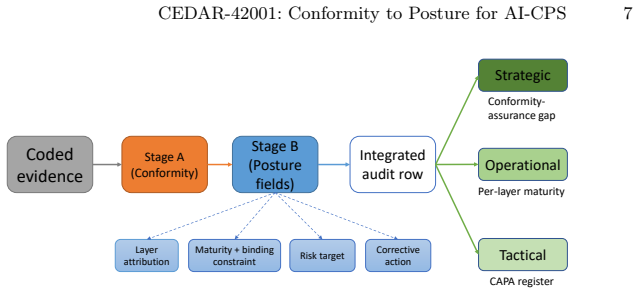
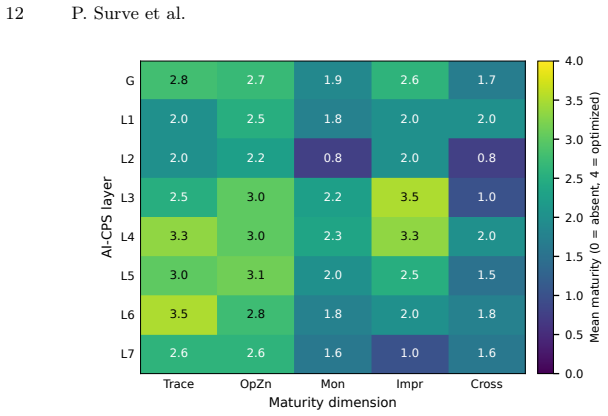
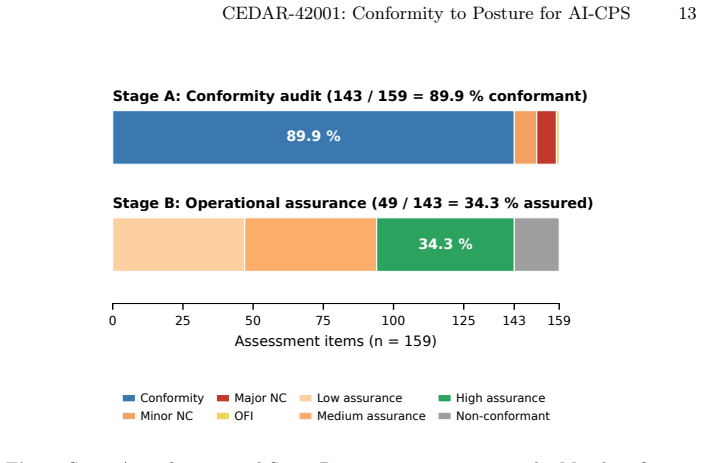
CEDAR-42001 preserves the original conformity determination in stage A and then in stage B attributes each audit row to a governance stratum or one of seven AI-CPS layers, assigns a five-dimensional maturity profile that identifies binding constraints, sets a risk-proportionate target maturity, and derives an action recommendation from a rulebook. These enriched rows aggregate into decision products at strategic, operational, and tactical levels. In evaluation, 89.9 percent conformity contrasted with only 34.3 percent high-assurance attainment, with the range 22.4 to 46.2 percent under alternatives, and the Cruise case mapped concerns to layer-specific actions.
What carries the argument
The two-stage CEDAR-42001 process that enriches each audit row with layer attribution, five-dimensional maturity profile, binding-constraint identification, risk-proportionate target, and rulebook action.
If this is right
- Conformity assessments alone do not reveal the distribution of assurance across architectural layers or maturity shortfalls.
- The method produces actionable recommendations traceable to specific audit evidence.
- Application to incidents like the Cruise robotaxi can identify layer-specific gaps in perception, decision-making, and oversight.
- Aggregation of enriched rows supports decisions at multiple organizational levels.
Where Pith is reading between the lines
- The approach could help regulators or operators prioritize technical testing on layers flagged as low maturity.
- It implies that standard conformity may need supplementation with architecture-aware analysis for high-risk systems.
- Extending the method to other standards beyond ISO 42001 could broaden its use in safety-critical domains.
Load-bearing premise
The seven AI-CPS layers and five-dimensional maturity profile, along with the binding-constraint rules and risk targets, accurately reflect the assurance needs of real systems and can be applied consistently.
What would settle it
Independent expert review of multiple AI-CPS systems where the CEDAR-42001 layer attributions and maturity ratings are checked against observed system failures or performance metrics.
Figures
read the original abstract
AI-enabled cyber-physical systems (AI-CPS) turn data-driven decisions into physical actions, creating assurance challenges across sensing, computation, control, human oversight, and governance. ISO/IEC 42001:2023 specifies requirements for an artificial intelligence management system (AIMS), but conformity assessment alone does not show which architectural layers are affected, whether practices are mature enough for the risk context, or what actions should follow. We present CEDAR-42001 (Control-Evidence Decision and Action Reasoning), a two-stage method that converts ISO/IEC 42001 audit evidence into an architecture-aware assurance posture traceable to the audit record. Stage A preserves the conformity determination. Stage B adds four outputs to each audit row: (i) attribution to a governance stratum or one of seven AI-CPS layers; (ii) a five-dimensional maturity profile with binding-constraint identification; (iii) a risk-proportionate target maturity; and (iv) a rulebook-derived action recommendation. The enriched rows are aggregated into strategic, operational, and tactical decision products. We evaluate CEDAR-42001 using a synthetic autonomous-fleet AIMS and by comparing conformity-only results with the enriched outputs. Although 89.9 percent of audit rows were conforming, only 34.3 percent of conforming rows reached the baseline High-assurance category; across alternative operationalizations, this proportion ranged from 22.4 percent to 46.2 percent. A retrospective application to the 2023 Cruise robotaxi incident shows how the method captures documented concerns across governance, perception, decision-making, and human oversight and maps them to layer-specific actions. CEDAR-42001 does not estimate exploitability or replace technical CPS-security testing; it identifies where audit evidence warrants deeper technical assurance, organizational improvement, or remediation.
Editorial analysis
A structured set of objections, weighed in public.
Referee Report
Summary. The manuscript introduces CEDAR-42001, a two-stage method that converts ISO/IEC 42001 audit evidence for AI cyber-physical systems into an architecture-aware assurance posture. Stage A preserves the original conformity determination; Stage B augments each row with attribution to one of seven AI-CPS layers or governance, a five-dimensional maturity profile with binding-constraint identification, a risk-proportionate target, and a rulebook-derived action. Enriched rows are aggregated into strategic, operational, and tactical products. Evaluation on a synthetic autonomous-fleet AIMS reports 89.9% conformity but only 34.3% high-assurance (sensitivity range 22.4–46.2% under alternatives); a retrospective mapping is performed on the 2023 Cruise robotaxi incident.
Significance. If the seven-layer taxonomy, five-dimensional maturity scales, and binding-constraint rules accurately reflect assurance requirements, the method could supply auditors and operators with traceable, layer-specific guidance that extends beyond binary conformity to identify where deeper technical or organizational work is warranted. The procedural traceability to the audit record and the explicit sensitivity analysis on operationalizations are constructive features for a method paper in this domain.
major comments (2)
- [Section 4 (Evaluation)] Section 4 (Evaluation): the central quantitative claim that only 34.3% of conforming rows reach the baseline High-assurance category (with alternative-operationalization range 22.4–46.2%) is produced entirely by applying the seven AI-CPS layers and five-dimensional maturity profile defined in Section 3 to the synthetic dataset; the manuscript provides no inter-rater reliability data, correlation with observed safety outcomes, or validation against independent real-world audit corpora, so the reported gap cannot yet be separated from an artifact of the chosen operationalization.
- [Section 3 (CEDAR-42001 Method)] Section 3 (CEDAR-42001 Method): the binding-constraint identification rules, risk-proportionate target definitions, and action-derivation rulebook are introduced as procedural extensions of ISO/IEC 42001 and the seven-layer taxonomy without derivation from empirical incident data or expert-consensus validation studies; this makes the method's ability to produce assurance postures that accurately reflect real AI-CPS risk contexts an untested modeling assumption that bears directly on the utility of the enriched outputs.
Simulated Author's Rebuttal
We thank the referee for the constructive comments on the scope of our claims. We address each major point below, agree where the manuscript requires clarification, and will make the indicated revisions.
read point-by-point responses
-
Referee: [Section 4 (Evaluation)] Section 4 (Evaluation): the central quantitative claim that only 34.3% of conforming rows reach the baseline High-assurance category (with alternative-operationalization range 22.4–46.2%) is produced entirely by applying the seven AI-CPS layers and five-dimensional maturity profile defined in Section 3 to the synthetic dataset; the manuscript provides no inter-rater reliability data, correlation with observed safety outcomes, or validation against independent real-world audit corpora, so the reported gap cannot yet be separated from an artifact of the chosen operationalization.
Authors: We agree that the 34.3% figure and its sensitivity range are produced solely by applying the Section 3 operationalizations to the synthetic AIMS dataset, and that the manuscript reports neither inter-rater reliability, correlation with safety outcomes, nor validation on external real-world audit corpora. The sensitivity analysis is included precisely to illustrate dependence on modeling choices. In revision we will reframe Section 4 results as an illustration of method mechanics and sensitivity rather than an empirical claim about real-world gaps, add a dedicated Limitations subsection, and qualify all quantitative language accordingly. revision: yes
-
Referee: [Section 3 (CEDAR-42001 Method)] Section 3 (CEDAR-42001 Method): the binding-constraint identification rules, risk-proportionate target definitions, and action-derivation rulebook are introduced as procedural extensions of ISO/IEC 42001 and the seven-layer taxonomy without derivation from empirical incident data or expert-consensus validation studies; this makes the method's ability to produce assurance postures that accurately reflect real AI-CPS risk contexts an untested modeling assumption that bears directly on the utility of the enriched outputs.
Authors: The binding-constraint rules, targets, and rulebook are constructed as logical extensions of ISO/IEC 42001 requirements together with the seven-layer taxonomy; no separate empirical derivation from incident data or expert-consensus validation is reported. The Cruise retrospective supplies only a single qualitative mapping. We will revise Section 3 to label these elements explicitly as proposed operationalizations, add a statement on the modeling assumption, and incorporate the point into the new Limitations section. Future empirical validation studies are noted as required. revision: yes
Circularity Check
No significant circularity; method is a self-contained procedural definition.
full rationale
The paper defines CEDAR-42001 as a two-stage procedural mapping from ISO/IEC 42001 audit evidence to layer attributions, five-dimensional maturity profiles, risk-proportionate targets, and action recommendations. All outputs are produced by applying author-specified rules (seven AI-CPS layers, binding-constraint identification, etc.) to a synthetic dataset; the reported figures (89.9 % conforming, 34.3 % high-assurance) are direct consequences of those rules rather than independent predictions or fitted quantities. No equations, statistical models, or first-principles derivations appear. No self-citation load-bearing steps, uniqueness theorems, or ansatzes imported from prior work are present in the provided text. The framework is therefore self-contained as an explicit operationalization rather than a reduction of outputs to inputs by construction.
Axiom & Free-Parameter Ledger
axioms (1)
- domain assumption Seven AI-CPS layers and five-dimensional maturity profile provide a valid and complete basis for attributing and rating audit evidence.
Reference graph
Works this paper leans on
-
[1]
Bloomfield, R., Rushby, J.: Assurance of AI systems from a dependability per- spective. Tech. Rep. SRI-CSL-2024-02R3, SRI International, Computer Science Laboratory (2025), also available as arXiv:2407.13948 CEDAR-42001: Conformity to Posture for AI-CPS 17
arXiv 2024
-
[2]
Rulemaking R.12-12-011 (Dec 2023)
California Public Utilities Commission: Ruling ordering cruise llc to show cause why it should not be sanctioned for failing to provide complete information and for making misleading public comments. Rulemaking R.12-12-011 (Dec 2023)
2023
-
[3]
IEC, standard series (2018)
International Electrotechnical Commission: IEC 62443 — security for industrial automation and control systems. IEC, standard series (2018)
2018
-
[4]
ISO/IEC: ISO/IEC 27001:2022 — information security, cybersecurity and privacy protection — information security management systems — requirements (2022)
2022
-
[5]
ISO/IEC: ISO/IEC 42001:2023 information technology – artificial intelligence – management system (2023)
2023
-
[6]
In: Computer Safety, Reliability, and Security (SAFECOMP
Koopman, P.: Anatomy of a robotaxi crash: Lessons from the cruise pedestrian dragging mishap. In: Computer Safety, Reliability, and Security (SAFECOMP
-
[7]
(2024), preprint, arXiv:2402.06046
arXiv 2024
-
[8]
In: Proceedings of the 2024 ACM Conference on Fairness, Accountability, and Transparency
Lam, K., Lange, B., Blili-Hamelin, B., Davidovic, J., Brown, S., Hasan, A.: A framework for assurance audits of algorithmic systems. In: Proceedings of the 2024 ACM Conference on Fairness, Accountability, and Transparency. pp. 1078–1092. FAccT ’24, Association for Computing Machinery (2024).https://doi.org/10. 1145/3630106.3658957
arXiv 2024
-
[9]
In: 33rd USENIX Security Symposium (USENIX Security 24)
Lou, Y., Zhu, Y., Song, Q., Tan, R., Qiao, C., Lee, W.B., Wang, J.: A first {Physical-World}trajectory prediction attack via{LiDAR-induced}deceptions in autonomous driving. In: 33rd USENIX Security Symposium (USENIX Security 24). pp. 6291–6308 (2024)
2024
-
[10]
AI and Ethics (2023).https://doi.org/10.1007/ s43681-023-00289-2
Mökander, J., Schuett, J., Kirk, H.R., Floridi, L.: Auditing large language mod- els: A three-layered approach. AI and Ethics (2023).https://doi.org/10.1007/ s43681-023-00289-2
2023
-
[11]
National Highway Traffic Safety Administration: Part 573 safety recall report 23e- 086: Cruise collision detection subsystem. Tech. Rep. 23E-086, U.S. Department of Transportation (Nov 2023)
2023
-
[12]
National Highway Traffic Safety Administration: Consent order: In re cruise, llc, standing general order 2021-01 reporting. Tech. rep., U.S. Department of Trans- portation (2024)
2021
-
[13]
National Institute of Standards and Technology: Artificial intelligence risk man- agement framework (AI RMF 1.0). Tech. Rep. NIST AI 100-1, NIST (2023)
2023
-
[14]
National Institute of Standards and Technology: Guide to operational technology (OT) security. Tech. Rep. NIST Special Publication 800-82 Revision 3, National Institute of Standards and Technology (2023).https://doi.org/10.6028/NIST. SP.800-82r3
-
[15]
IEEE Software10(4), 18–27 (1993).https://doi.org/10.1109/52
Paulk, M.C., Curtis, B., Chrissis, M.B., Weber, C.V.: Capability maturity model, version 1.1. IEEE Software10(4), 18–27 (1993).https://doi.org/10.1109/52. 219617
work page doi:10.1109/52 1993
-
[16]
Quinn Emanuel Urquhart & Sullivan, LLP: Report to the boards of directors of cruise llc, gm cruise holdings llc, and general motors holdings llc regarding the october 2, 2023 accident in san francisco. Tech. rep., Quinn Emanuel Urquhart & Sullivan, LLP (Jan 2024)
2023
-
[17]
In: Proceedings of the 2020 Conference on Fairness, Accountability, and Transparency
Raji, I.D., Smart, A., White, R.N., Mitchell, M., Gebru, T., Hutchinson, B., Smith- Loud, J., Theron, D., Barnes, P.: Closing the AI accountability gap: Defining an end-to-end framework for internal algorithmic auditing. In: Proceedings of the 2020 Conference on Fairness, Accountability, and Transparency. pp. 33–44. FAT* ’20, Association for Computing Mac...
arXiv 2020
-
[18]
In: 2025 55th Annual IEEE/IFIP International Conference on Dependable Systems and Networks Workshops (DSN-W)
Srinivasan, T., Patapati, S., Musku, H., Gode, I., Arora, A., Bhattacharya, S., Nazriev, A., Hirave, S., Kanjiani, Z., Ghose, S.: Dura-cps: A multi-role orches- trator for dependability assurance in llm-enabled cyber-physical systems. In: 2025 55th Annual IEEE/IFIP International Conference on Dependable Systems and Networks Workshops (DSN-W). pp. 63–70. I...
2025
-
[19]
Surve, P.P., Shabtai, A., Elovici, Y.: Sok: Cybersecurity assessment of humanoid ecosystem. arXiv preprint arXiv:2508.17481 (2025), accepted for presentation at the 2026 IEEE European Symposium on Security and Privacy (EuroS&P)
arXiv 2025
-
[20]
Department of Transportation, Office of Inspector General: California au- tonomous vehicle company charged for making false statements
U.S. Department of Transportation, Office of Inspector General: California au- tonomous vehicle company charged for making false statements. DOT OIG Inves- tigations (Nov 2024)
2024
-
[21]
In: Proceedings of the IEEE/CVF international conference on computer vision
Wang,N.,Luo,Y.,Sato,T.,Xu,K.,Chen,Q.A.:Doesphysicaladversarialexample really matter to autonomous driving? towards system-level effect of adversarial object evasion attack. In: Proceedings of the IEEE/CVF international conference on computer vision. pp. 4412–4423 (2023) A Artifact and Data Availability The CEDAR-42001 instrument, rulebook, execution engin...
2023
discussion (0)
Sign in with ORCID, Apple, or X to comment. Anyone can read and Pith papers without signing in.