REVIEW 2 major objections 3 minor 129 references
Quantum communication and fault-tolerance
T0 review · 2 major / 3 minor · reviewed 2026-08-10 · deepseek-v4-flash
Pith's one-line read This thesis proves that entanglement-assisted communication survives faulty encoder and decoder gates: below a gate-error threshold the achievable rate is within $f(p)$ of the noiseless capacity, with $f(p)\to0$, and it bounds the rate…
desk verdict Useful thesis with a real gap in the AVP proof: the stated δ does not make Eq. (2.4) vanish, so the explicit capacity bound in Chapter 2 is unsupported as written, though the qualitative recovery likely survives a repair. read the letter →
The pith
A machine-rendered reading of the paper's core claim, the machinery that carries it, and where it could break.
The reading
What carries the argument
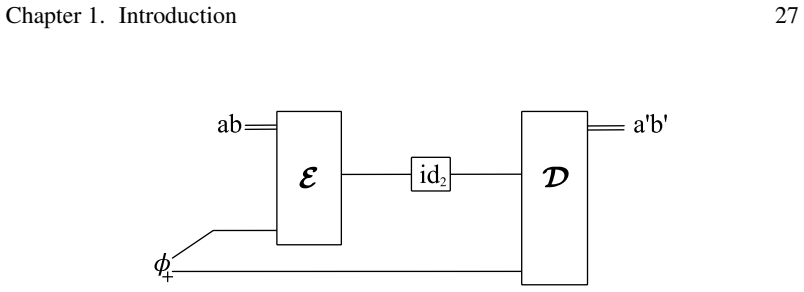
The load-bearing mechanism is the effective-channel reduction. A noiseless entanglement-assisted coding scheme is compiled into fault-tolerant circuits in a concatenated seven-qubit code; interface circuits, whose failure probability is imported as at most $2cp$ under the i.i.d. Pauli model, move qubits between the code space and the physical channel. The effective-interface lemmas show that the noisy compiled circuit is close, in induced 1-to-1 norm, to the ideal circuit acting on an effective channel $T_{p,\mathcal N}=(1-q)(T\otimes \mathrm{Tr}_S)+q\mathcal N$ with $q=2(j_1+j_2)cp$, fed with an arbitrary syndrome state $\sigma_S$. The thesis then proves a coding theorem for entanglement-assisted communication under 'arbitrarily varying perturbation'—an infimum over syndrome states and perturbations $\mathcal N$—giving $C^{\mathrm{ea}}_{\mathrm{AVP}}(p,T)\ge C^{\mathrm{ea}}(T)-g(p)$ with $g(p)=O(p\log p)$. A fault-tolerant entanglement distillation subroutine, based on a one-way distillation protocol and using some channel copies for the classical communication it needs, converts the noisy resource states produced by the interfaces into near-perfect maximally entangled states in the code space.
What would settle it
Simulate the interface circuits of the concatenated seven-qubit code under the i.i.d. Pauli noise model and measure the probability that an encoding or decoding interface is incorrect as a function of $p$; if this probability does not scale as $O(p)$ for small $p$, the bound $\mathrm{Prob}(\text{interface incorrect})\le 2cp$ that carries the effective-channel theorem and the capacity theorem is false. Alternatively, on a channel such as the qubit depolarizing channel, compute the explicit lower bound of the main capacity theorem and search for gate errors $p$ below threshold where the bound is violated by a numerical estimate of the fault-tolerant capacity.
Extended reading notes
Core claim
On the paper's own terms, the main discovery is a threshold-type coding theorem for fault-tolerant entanglement-assisted communication. For every finite-dimensional quantum channel $T$ and every target accuracy $\eta>0$, there is a gate-error threshold $p_{\mathrm{th}}(\eta,T)>0$ such that for all $0\le p\le p_{\mathrm{th}}$, $C^{\mathrm{ea}}_{F(p)}(T)\ge C^{\mathrm{ea}}(T)-\eta$, where $F(p)$ is the i.i.d. Pauli noise model on the encoder and decoder circuits; equivalently, $\lim_{p\to0}C^{\mathrm{ea}}_{F(p)}(T)=C^{\mathrm{ea}}(T)$. The theorem is proved by exhibiting explicit fault-tolerant encoders and decoders: a noiseless entanglement-assisted scheme is first approximated by circuits, then implemented in a concatenated seven-qubit code whose level grows with the block length, with interface circuits converting between the code space and the physical channel. After the fault-tolerant compilation, the whole setup is close to a noiseless scheme for an effective channel of the form $(1-q)(T\otimes\mathrm{Tr}_S)+q\mathcal N$ with a correlated syndrome input, and the thesis proves a coding theorem showing that such 'arbitrarily varying perturbations' reduce the rate by at most a function $g(q)=O(q\log q)$. Fault-tolerant entanglement distillation, run through a subset of channel uses, supplies the clean entanglement needed by the assisted scheme.
Load-bearing premise
The whole argument borrows an imported guarantee that the interface circuits moving qubits in and out of the error-correcting code fail with probability at most a constant times the gate error $p$; the thesis does not re-prove that guarantee, and if it fails the effective-channel reduction collapses.
Editorial extensions
If this is right
- For any finite-dimensional quantum channel, fault-tolerant encoder and decoder circuits achieve entanglement-assisted communication at rates arbitrarily close to the noiseless capacity once the local gate error is below a threshold.
- The communication channel itself does not need to be below the fault-tolerance threshold; only the local gates in the encoder and decoder do, so the result applies to on-chip communication and to links that are noisier than the local hardware.
- As $p\to0$, the fault-tolerant entanglement-assisted capacity equals the standard entanglement-assisted capacity, recovering the noiseless quantum Shannon-theoretic limit.
- The same modular construction yields fault-tolerant entanglement distillation: noisy resource states entering the code space through faulty interfaces can be purified at the price of a fraction of channel uses, rather than being unusable.
- The resource-inequality version of the coding theorem expresses the trade-off as $\langle T\rangle + H(A)(T\otimes\mathrm{id})(\varphi)[qq]\ge_{\mathrm{FT}(p)} I(A':B)(T\otimes\mathrm{id})(\varphi)[c\to c]$ up to $O(p\log p)$ corrections.
Reading between the lines
- The effective-channel reduction is modular in the error-correcting code: any family of concatenated codes whose interface circuits fail with probability $O(p)$ and whose extended rectangles satisfy a threshold theorem would inherit the same capacity-recovery result, so verifying such interface bounds for topological or LDPC constructions is a natural next test.
- Because the loss bound depends on the ratio $C^{\mathrm{ea}}(T)/C(T)$, the thesis's own conjecture that this ratio is bounded by a dimension-dependent factor would upgrade the threshold result from channel-dependent to uniform in dimension; the thesis explicitly notes this dependence.
- On real hardware the explicit rate loss is dominated by a $p\log p$ term and is far too large for practical finite-block-length use; the thesis's plots suggest the proof-of-principle nature and point toward tighter continuity bounds or different codes as the route to practical rates.
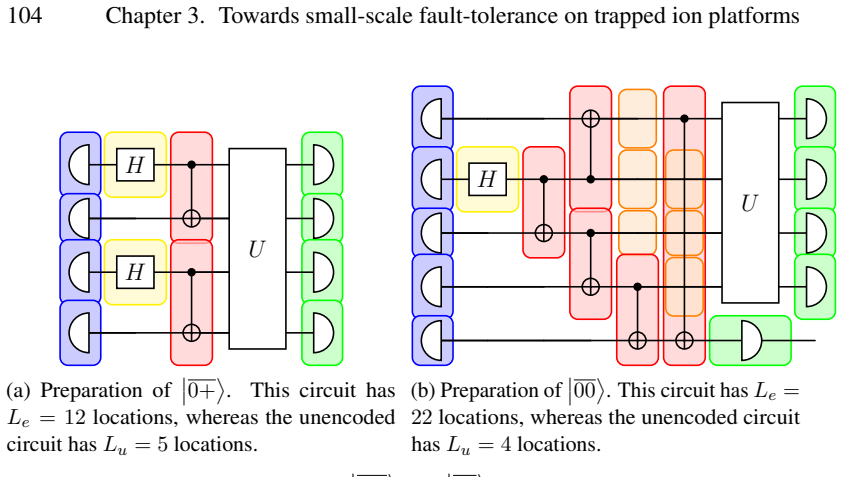
- The trapped-ion comparison offers a device-level check of the i.i.d. Pauli assumption: a newer device with lower gate error but no observed encoded gain is consistent with correlated errors that the model excludes, so hardware experiments can directly inform which noise models the capacity theorem should be extended to.
Editorial analysis
A structured set of objections, weighed in public.
Referee Report
Summary. This PhD thesis studies the limits of quantum communication under noise, with and without entanglement assistance. Chapter 2, reproducing arXiv:2210.02939, introduces the fault-tolerant entanglement-assisted capacity C^ea_F(p)(T) for the i.i.d. Pauli gate-error model and develops the technical machinery: effective interface lemmas, an entanglement-assisted capacity under arbitrarily varying perturbation (AVP), fault-tolerant entanglement distillation, and finally a lower bound C^ea_F(p)(T) >= C^ea(T) - ..., with a threshold theorem recovering C^ea(T) as p tends to zero. Chapter 3 reports on experimental investigations of the [[4,2,2]] error-detection code on trapped-ion hardware and states a threshold theorem for demonstrations of fault-tolerance. Chapter 4, explicitly in preparation, proposes bounding the ratio C^ea(T)/C(T) for a large class of finite-dimensional channels via channel-divergence techniques. The thesis is honest about which parts are published, ongoing, or in preparation.
Significance. If the main result is established, Chapter 2 provides a meaningful fault-tolerant analogue of the entanglement-assisted capacity, extending Christandl-Muller-Hermes' unassisted results to the entanglement-assisted setting and showing that noisy encoder/decoder circuits need not reduce the asymptotic rate. The modular proof structure--separating circuit-level fault-tolerance, the AVP information-theoretic model, and distillation--is a genuine strength, and the explicit interface lemmas and theorem statements make the dependence on prior work clear. The quantitative claims in Theorem 2.4.4 and Theorem 2.6.3 are, however, not proved as written because of the rate-balance error described below; the qualitative threshold theorem appears likely repairable. Chapters 3 and 4 are ongoing/in preparation and therefore carry less weight in the evaluation, though they are clearly labeled as such.
major comments (2)
- [§2.4.2, Theorem 2.4.4 and Eq. (2.4)] The proof's rate balance is not valid as written. After applying [27, Lem. IV.10], Eq. (2.4) requires d_B^{(p+\tildeδ)n} e^{-n δ^2/(2 log^2 λ_min)} -> 0. With the stated δ = sqrt(2 log(d_B) p |log λ_min|) and λ_min >= p^2/(d_A d_B), the decay rate is δ^2/(2 log^2 λ_min) ≈ (log d_B) p / (2 log(1/p)) per channel use, while the prefactor contributes at least (p + \tildeδ) n log d_B; even for \tildeδ -> 0 the prefactor outruns the exponential, so Eq. (2.4) does not vanish and the rate condition (2.6) does not imply Eq. (2.5). A choice δ = Θ(√p |log λ_min|) would restore the convergence with a penalty Θ(√p log^2(1/p)), but then the stated bound g(p) = O(p log p) in Theorem 2.4.4 is no longer what is proved. Independently of the balance issue, the displayed g(p) is Θ(√p log^(3/2)(1/p)) rather than O(p log p), so the asymptotic claim in Theorem 2.4.4 and the scaling discussion in §2.8.2 need correction. The qualitative continuity in Theorem 2.4.5 and Corollary 2.4.6 may survive such a repair.
- [§2.6, Theorem 2.6.3] The statement and proof of Theorem 2.6.3 disagree on the definition of f1(p): the displayed theorem has f1(p) = (h(4cp) + 4cp log(3)) j2 / (1 - h(4cp) - 4cp log(3)), while the proof derives f1(p) = (h(4cp) + 4cp log(3)) log(2) / (1 - h(4cp) - 4cp log(3)). Since the final lower bound uses 4 f1(p) C^ea(T)/C(T), the stated bound is not the bound actually proved when j2 ≠ 1. Moreover, because the proof invokes Theorem 2.4.4 at perturbation strength 2(j1+j2)cp, the quantitative bound in Theorem 2.6.3 inherits the unresolved AVP gap from the first comment. The threshold formulation in Theorem 2.6.1 is qualitative and may be recoverable, but Theorem 2.6.3 as printed is not established.
minor comments (3)
- [Throughout] There are several typographical issues, including 'comparitive', 'occuring', and 'architechtures' (e.g., Chapter 3 and §2.8.3), and expressions like '2j1+j2' in Theorem 2.6.3 should be typeset as 2^{j1+j2} to avoid ambiguity.
- [§2.5, Theorem 2.5.4] The proof of Theorem 2.5.4 is only a sketch; since this theorem is a load-bearing subroutine in Section 2.6, the final version should expand the proof or give a precise citation/statement of the underlying threshold argument.
- [Chapter 4] The class of channels to which the claimed capacity-ratio bound applies is introduced only through a far/near-replacer dichotomy; the boundary of this class should be stated formally in the main text, not only in the chapter's opening discussion.
Circularity Check
No significant circularity: the capacity bound is derived from external benchmark capacities and antecedent fault-tolerance theorems, not from a fitted or self-defined input.
full rationale
The central result C_F^ea(p)(T) >= C_ea(T) - f(p) is a lower bound expressed in terms of externally defined, established capacities C_ea(T) and C(T), which are not fitted or constructed from the paper's own target claim. The proof reduces fault-tolerant entanglement-assisted communication to an arbitrarily varying perturbation (AVP) coding problem and then to a standard entanglement-assisted coding theorem for a slightly depolarized effective channel; the lower bound C_AVP^ea(p,T) >= C_ea(T) - g(p) is obtained by an explicit code construction and continuity estimates, not by definition. The imported interface circuits, threshold theorem, postselection-type lemma, and classical fault-tolerant capacity results from [27,80] are stated theorems with their own assumptions (i.i.d. Pauli noise, concatenated 7-qubit Steane code) and are used as building blocks; they are parameter-free with respect to the target result and are not fitted to the capacities being bounded. The fact that several of these citations share authors with the thesis is a normal research continuity, and under the stated rules self-citation is not circular when the cited result is an independent theorem with stated assumptions that do not include the paper's conclusion. The reviewer's separate concern about the delta-rate balance in Eq. (2.4) is a potential correctness gap in the AVP proof, not a circularity: the theorem is not being made true by definition, by renaming a fitted quantity, or by an unverified self-citation chain. No circular step can be exhibited in the derivation chain.
Assumptions & free parameters
assumptions (5)
- domain assumption Concatenated 7-qubit Steane code has fault-tolerant interfaces with failure probability at most 2cp under i.i.d. Pauli noise for p below threshold.
- domain assumption Circuit noise is i.i.d. Pauli: each gate location independently suffers a Pauli error with probability p.
- domain assumption Postselection-type domination bound for arbitrarily varying perturbation channels (T_p,N versus T_p) from [27, Lemma IV.10].
- domain assumption One-way entanglement distillation protocol from [32] converts noisy Bell-diagonal states to maximally entangled states with the stated fidelity and rate.
- ad hoc to paper The class of channels in Chapter 4 is partitioned into those far from a replacer channel and those near one, and the boundary of the class is set by this division.
Cite this review
Pith. "Pith review of Quantum communication and fault-tolerance." pith.science (2026). https://pith.science/paper/I2RYKAYU
@misc{pith2026241220736,
  author       = {Pith},
  title        = {Pith review of: Quantum communication and fault-tolerance},
  year         = {2026},
  howpublished = {\url{https://pith.science/paper/I2RYKAYU}},
  note         = {Machine review of arXiv:2412.20736}
}
read the original abstract
In this thesis, we are interested in the limits of quantum communication with and without entanglement, and with and without noise assumptions on the communication setup. When a sender and a receiver are connected by a communication line that is governed by noise which is modelled by a quantum channel, they hope to design a coding scheme, i.e. messages and message decoders, in such a way that they are robust to this noise. The amount of message bits per channel use is called the achievable rate of the coding scheme, and the maximal achievable rate for a given quantum channel is called capacity of the quantum channel. Here, we are interested in coding schemes and capacities under various assumptions, in particular in the case where the sender and the receiver share quantum entanglement, which turns out to be the most natural generalization of the classical communication analogue that lies at the basis of many of our modern technologies.
Figures


Figures from the paper (25 more)




Reference graph
Works this paper leans on
-
[27]
Fault-tolerant Coding for Quantum Communication
M. Christandl and A. Müller-Hermes. “Fault-tolerant Coding for Quantum Communication”. IEEE Transactions on Information Theory pages 1–1 (2022)
2022
-
[1]
Suppressing quantum errors by scaling a surface code logical qubit
R. Acharya, I. Aleiner, R. Allen, et al.“Suppressing quantum errors by scaling a surface code logical qubit”, (2023). DOI: 10.1038/s41586-022-05434-1
-
[2]
Taylor Expansion and Derivative Formulas for Matrix Logarithms
S. Adler. “Taylor Expansion and Derivative Formulas for Matrix Logarithms”. Available online: https://www.ias.edu/sites/ default/files/sns/files/1-matrixlog_tex(1).pdf
-
[3]
Fault-Tolerant Quantum Computation with Constant Error Rate
D. Aharonov and M. Ben-Or. “Fault-Tolerant Quantum Computation with Constant Error Rate”. SIAM Journal on Computing 38(4): 1207–1282 (2008)
2008
-
[4]
Quantum Capacity under Adversarial Quantum Noise: Arbitrarily Varying Quantum Channels
R. Ahlswede, I. Bjelakovi´c, H. Boche, and J. Nötzel. “Quantum Capacity under Adversarial Quantum Noise: Arbitrarily Varying Quantum Channels”. Communications in Mathematical Physics 317(1): 103–156 (2012)
2012
-
[5]
Continuity of quantum conditional information
R. Alicki and M. Fannes. “Continuity of quantum conditional information”. Journal of Physics A: Mathematical and General 37(5): L55–L57 (2004)
2004
-
[6]
Quantum accuracy threshold for concatenated distance-3 codes
P. Aliferis, D. Gottesman, and J. Preskill. “Quantum accuracy threshold for concatenated distance-3 codes”. Quantum information and computation 6 (2005)
2005
-
[7]
Accuracy threshold for postselected quantum computation
P. Aliferis, D. Gottesman, and J. Preskill.“Accuracy threshold for postselected quantum computation”, (2007). arXiv: quant-ph/0703264
arXiv 2007
Show all 129 references
-
[8]
Continuity bounds on the quantum relative entropy
K. M. R. Audenaert and J. Eisert. “Continuity bounds on the quantum relative entropy”. Journal of Mathematical Physics 46(10): 102104 (2005)
2005
-
[9]
Fault-tolerant Coding for Entanglement-Assisted Communication
P. Belzig, M. Christandl, and A. Müller-Hermes. “Fault-tolerant Coding for Entanglement-Assisted Communication”, (2022). arXiv: 2210.02939
2022 arXiv
-
[10]
Fault-Tolerant Cod- ing for Entanglement-Assisted Communication
P. Belzig, M. Christandl, and A. Müller-Hermes. “Fault-Tolerant Cod- ing for Entanglement-Assisted Communication” . In 2023 IEEE Inter- national Symposium on Information Theory (ISIT) , pages 84–89, (2023), DOI: 10.1109/ISIT54713.2023.10206950
2023
-
[11]
Teleporting an unknown quantum state via dual classical and Einstein- Podolsky-Rosen channels
C. H. Bennett, G. Brassard, C. Crépeau, R. Jozsa, A. Peres, and W. K. Woot- ters. “Teleporting an unknown quantum state via dual classical and Einstein- Podolsky-Rosen channels”. Phys. Rev. Lett. 70: 1895–1899 (1993). 145 146 Bibliography
1993
-
[12]
The Quantum Reverse Shannon Theorem and Resource Tradeoffs for Simulating Quantum Channels
C. H. Bennett, I. Devetak, A. W. Harrow, P. W. Shor, and A. Winter. “The Quantum Reverse Shannon Theorem and Resource Tradeoffs for Simulating Quantum Channels”. IEEE Transactions on Information Theory 60(5): 2926– 2959 (2014)
2014
-
[13]
Mixed- state entanglement and quantum error correction
C. H. Bennett, D. P. DiVincenzo, J. A. Smolin, and W. K. Wootters.“Mixed- state entanglement and quantum error correction” . Physical Review A 54(5): 3824–3851 (1996)
1996
-
[14]
Entanglement- assisted capacity of a quantum channel and the reverse Shannon theorem
C. H. Bennett, P. W. Shor, J. A. Smolin, and A. Thapliyal. “Entanglement- assisted capacity of a quantum channel and the reverse Shannon theorem”. Information Theory, IEEE Transactions on 48: 2637–2655 (2002)
2002
-
[15]
Entanglement- Assisted Classical Capacity of Noisy Quantum Channels
C. H. Bennett, P. W. Shor, J. A. Smolin, and A. V . Thapliyal.“Entanglement- Assisted Classical Capacity of Noisy Quantum Channels”. Physical Review Letters 83(15): 3081–3084 (1999)
1999
-
[16]
Communication via one- and two-particle operators on Einstein-Podolsky-Rosen states
C. H. Bennett and S. J. Wiesner. “Communication via one- and two-particle operators on Einstein-Podolsky-Rosen states”. Phys. Rev. Lett.69: 2881–2884 (1992)
1992
-
[17]
Fully Quantum Arbitrarily Varying Channels: Random Coding Capacity and Capacity Dichotomy
H. Boche, C. Deppe, J. Nötzel, and A. Winter. “Fully Quantum Arbitrarily Varying Channels: Random Coding Capacity and Capacity Dichotomy”. In 2018 IEEE International Symposium on Information Theory (ISIT) , page 2012–2016, Vail, CO, USA(2018), DOI: 10.1109/ISIT.2018.8437610
2018
-
[18]
Mixed state dense coding and its relation to entanglement measures
S. Bose, M. B. Plenio, and V . Vedral. “Mixed state dense coding and its relation to entanglement measures”, (1999). arXiv: quant-ph/9810025
1999 arXiv
-
[19]
Classical information capacity of superdense coding
G. Bowen. “Classical information capacity of superdense coding” . Phys. Rev. A 63: 022302 (2001)
2001
-
[20]
Toric codes and quantum doubles from two-body Hamiltonians
C. G. Brell, S. T. Flammia, S. D. Bartlett, and A. C. Doherty. “Toric codes and quantum doubles from two-body Hamiltonians”. New Journal of Physics 13(5): 053039 (2011)
2011
-
[21]
Quantum Low-Density Parity-Check Codes
N. P. Breuckmann and J. N. Eberhardt. “Quantum Low-Density Parity-Check Codes”. PRX Quantum 2(4) (2021)
2021
-
[22]
Single-qubit-gate error below 10−4 in a trapped ion
K. R. Brown, A. C. Wilson, Y . Colombe, C. Ospelkaus, A. M. Meier, E. Knill, D. Leibfried, and D. J. Wineland. “Single-qubit-gate error below 10−4 in a trapped ion”. Physical Review A 84(3) (2011)
2011
-
[23]
Experimental Characteriza- tion of Fault-Tolerant Circuits in Small-Scale Quantum Processors
R. Cane, D. Chandra, S. X. Ng, and L. Hanzo. “Experimental Characteriza- tion of Fault-Tolerant Circuits in Small-Scale Quantum Processors”, (2021). arXiv: 2112.04076
2021 arXiv
-
[24]
The Entanglement- Assisted Communication Capacity over Quantum Trajectories
D. Chandra, M. Caleffi, and A. S. Cacciapuoti. “The Entanglement- Assisted Communication Capacity over Quantum Trajectories” , (2021). arXiv: 2110.08078. Bibliography 147
2021 arXiv
-
[25]
Exponential suppression of bit or phase flip errors with repetitive error correction
Z. Chen, K. J. Satzinger, J. Atalaya, et al. “Exponential suppression of bit or phase flip errors with repetitive error correction”. Nature 595(7867): 383–387 (2021)
2021
-
[26]
Co- herent Quantum Dynamics of a Superconducting Flux Qubit
I. Chiorescu, Y . Nakamura, C. J. P. M. Harmans, and J. E. Mooij. “Co- herent Quantum Dynamics of a Superconducting Flux Qubit” . Science 299(5614): 1869–1871 (2003)
2003
-
[28]
Strong Converse Exponents for a Quantum Channel Discrimination Problem and Quantum-Feedback-Assisted Communication
T. Cooney, M. Mosonyi, and M. M. Wilde.“Strong Converse Exponents for a Quantum Channel Discrimination Problem and Quantum-Feedback-Assisted Communication”. Communications in Mathematical Physics 344(3): 797–829 (2016)
2016
-
[29]
Noise Thresholds for the [[4, 2, 2]]-concatenated Toric Code
B. Criger and B. Terhal. “Noise Thresholds for the [[4, 2, 2]]-concatenated Toric Code”, (2016). DOI: 10.26421/qic16.15-16
2016 doi
-
[30]
The private classical capacity and quantum capacity of a quantum channel
I. Devetak. “The private classical capacity and quantum capacity of a quantum channel”. IEEE Transactions on Information Theory 51(1): 44–55 (2005)
2005
-
[31]
A Resource Framework for Quantum Shannon Theory
I. Devetak, A. W. Harrow, and A. J. Winter. “A Resource Framework for Quantum Shannon Theory” . IEEE Transactions on Information Theory 54(10): 4587–4618 (2008)
2008
-
[32]
Distillation of secret key and entanglement from quantum states
I. Devetak and A. Winter. “Distillation of secret key and entanglement from quantum states”. Proceedings of the Royal Society A: Mathematical, Physical and Engineering Sciences 461 (2003)
2003
-
[33]
The Physical Implementation of Quantum Computation
D. P. DiVincenzo. “The Physical Implementation of Quantum Computation”. Fortschritte der Physik 48(9-11): 771–783 (2000)
2000
-
[34]
Constant Overhead Quan- tum Fault-Tolerance with Quantum Expander Codes
O. Fawzi, A. Grospellier, and A. Leverrier. “Constant Overhead Quan- tum Fault-Tolerance with Quantum Expander Codes”. In 2018 IEEE 59th Annual Symposium on Foundations of Computer Science (FOCS) , (2018), DOI: 10.1109/focs.2018.00076
2018
-
[35]
Cryptographic Distinguishability Measures for Quantum-Mechanical States
C. Fuchs and J. van de Graaf. “Cryptographic Distinguishability Measures for Quantum-Mechanical States”. Information Theory, IEEE Transactions on 45: 1216 – 1227 (1999)
1999
-
[36]
Comments on Hastings’ Additivity Counterexamples
M. Fukuda, C. King, and D. K. Moser. “Comments on Hastings’ Additivity Counterexamples”. Communications in Mathematical Physics 296(1): 111– 143 (2010). 148 Bibliography
2010
-
[37]
Building logical qubits in a superconducting quantum computing system
J. M. Gambetta, J. M. Chow, and M. Steffen. “Building logical qubits in a superconducting quantum computing system”. npj Quantum Information 3(1) (2017)
2017
-
[38]
Stabilizer Codes and Quantum Error Correction
D. Gottesman. “Stabilizer Codes and Quantum Error Correction”, (1997). arXiv: quant-ph/9705052
1997 arXiv
-
[39]
An Introduction to Quantum Error Correction and Fault- Tolerant Quantum Computation
D. Gottesman. “An Introduction to Quantum Error Correction and Fault- Tolerant Quantum Computation”, (2009). arXiv: 0904.2557
2009 arXiv
-
[40]
Fault-Tolerant Quantum Computation with Constant Over- head
D. Gottesman. “Fault-Tolerant Quantum Computation with Constant Over- head”, (2014). arXiv: 1310.2984
2014 arXiv
-
[41]
Quantum fault tolerance in small experiments
D. Gottesman. “Quantum fault tolerance in small experiments” , (2016). arXiv: 1610.03507
2016 arXiv
-
[42]
Demonstrating the viability of univer- sal quantum computation using teleportation and single-qubit operations
D. Gottesman and I. L. Chuang. “Demonstrating the viability of univer- sal quantum computation using teleportation and single-qubit operations”. Nature 402(6760): 390–393 (1999)
1999
-
[43]
Codes for the quantum erasure chan- nel
M. Grassl, T. Beth, and T. Pellizzari. “Codes for the quantum erasure chan- nel”. Physical Review A 56(1): 33–38 (1997)
1997
-
[44]
Multiplicativity of Completely Bounded p-Norms Implies a Strong Converse for Entanglement-Assisted Capacity
M. K. Gupta and M. M. Wilde. “Multiplicativity of Completely Bounded p-Norms Implies a Strong Converse for Entanglement-Assisted Capacity” . Communications in Mathematical Physics 334(2): 867–887 (2014)
2014
-
[45]
Notes on the Matrix Exponential and Logarithm
H. E. Haber. “Notes on the Matrix Exponential and Logarithm” . Available online: http://scipp.ucsc.edu/~haber/webpage/ MatrixExpLog.pdf
-
[46]
Fault-Tolerant Logical Gates in the IBM Quantum Experience
R. Harper and S. T. Flammia. “Fault-Tolerant Logical Gates in the IBM Quantum Experience”. Physical Review Letters 122(8) (2019)
2019
-
[47]
A Tight Lower Bound on the Classical Communi- cation Cost of Entanglement Dilution
A. Harrow and H.-K. Lo. “A Tight Lower Bound on the Classical Communi- cation Cost of Entanglement Dilution”. IEEE Transactions on Information Theory 50: 319–327 (2004)
2004
-
[48]
Superadditivity of communication capacity using entangled inputs
M. B. Hastings. “Superadditivity of communication capacity using entangled inputs”. Nature Physics 5(4): 255–257 (2009)
2009
-
[49]
Implementing a universal gate set on a logical qubit encoded in an oscillator
R. W. Heeres, P. Reinhold, N. Ofek, L. Frunzio, L. Jiang, M. H. Devoret, and R. J. Schoelkopf. “Implementing a universal gate set on a logical qubit encoded in an oscillator”. Nature Communications 8(1) (2017)
2017
-
[50]
On Deriving the Inverse of a Sum of Matrices
H. V . Henderson and S. R. Searle. “On Deriving the Inverse of a Sum of Matrices”. SIAM Review 23(1): 53–60 (1981). Bibliography 149
1981
-
[51]
Sufficiency, KMS condition and relative entropy in von Neumann algebras
F. Hiai, M. Ohya, and M. Tsukada. “Sufficiency, KMS condition and relative entropy in von Neumann algebras”. Pacific Journal of Mathematics 96: 99– 109 (1981)
1981
-
[52]
Probability Inequalities for Sums of Bounded Random Vari- ables
W. Hoeffding. “Probability Inequalities for Sums of Bounded Random Vari- ables”. Journal of the American Statistical Association 58(301): 13–30 (1963)
1963
-
[53]
The capacity of the quantum channel with general signal states
A. S. Holevo. “The capacity of the quantum channel with general signal states”. IEEE Transactions on Information Theory 44(1): 269–273 (1998)
1998
-
[54]
On entanglement-assisted classical capacity
A. S. Holevo. “On entanglement-assisted classical capacity” . Journal of Mathematical Physics 43(9): 4326–4333 (2002)
2002
-
[55]
Information capacity of a quantum observable
A. S. Holevo. “Information capacity of a quantum observable”. Problems of Information Transmission 48(1): 1–10 (2012)
2012
-
[56]
A. S. Holevo. Quantum Systems, Channels, Information. De Gruyter (2013)
2013
-
[57]
Classical Capacity of a Noiseless Quantum Channel Assisted by Noisy Entanglement
M. Horodecki, P. Horodecki, R. Horodecki, D. W. Leung, and B. M. Ter- hal. “Classical Capacity of a Noiseless Quantum Channel Assisted by Noisy Entanglement”. Quantum Info. Comput. 1(3): 70–78 (2001)
2001
-
[58]
Entanglement-Assisted Capacity of Quantum Multiple-Access Channels
M.-H. Hsieh, I. Devetak, and A. Winter. “Entanglement-Assisted Capacity of Quantum Multiple-Access Channels”. IEEE Transactions on Information Theory 54(7): 3078–3090 (2008)
2008
-
[59]
Quantum Benchmarking on the [ [ 4 , 2 , 2 ] ] Code
A. Hu, J. Li, and R. Shapiro. “Quantum Benchmarking on the [ [ 4 , 2 , 2 ] ] Code”. (2018). Available online: https://services.math.duke. edu/DOmath/DOmath2018/hu-li-shapiro.pdf
2018
-
[60]
Quantum computing with trapped ions
H. Häffner, C. Roos, and R. Blatt. “Quantum computing with trapped ions”. Physics Reports 469(4): 155–203 (2008)
2008
-
[61]
IonQ Aria - Specifications
IonQ. “IonQ Aria - Specifications” , (2023). Available online: https: //ionq.com/quantum-systems/aria
2023
-
[62]
IonQ Harmony - Specifications
IonQ. “IonQ Harmony - Specifications”, (2023). Available online: https: //ionq.com/quantum-systems/harmony
2023
-
[63]
A Structured Method for Compilation of QAOA Circuits in Quantum Computing
Y . Jin, J. Luo, L. Fong, Y . Chen, A. B. Hayes, C. Zhang, F. Hua, and E. Z. Zhang. “A Structured Method for Compilation of QAOA Circuits in Quantum Computing”, (2022). arXiv: 2112.06143
2022 arXiv
-
[64]
Notes on the equivalence of norms
S. G. Johnson. “Notes on the equivalence of norms” . Lecture notes, MIT course 18.335, (2012). Available online: https://math.mit.edu/ ~stevenj/18.335/norm-equivalence.pdf. 150 Bibliography
2012
-
[65]
Computing Stabilized Norms for Quantum Operations via the Theory of Completely Bounded Maps
N. Johnston, D. W. Kribs, and V . I. Paulsen.“Computing Stabilized Norms for Quantum Operations via the Theory of Completely Bounded Maps”, (2007). arXiv: 0711.3636
2007 arXiv
-
[66]
Additivity for unital qubit channels
C. King. “Additivity for unital qubit channels” . Journal of Mathematical Physics 43(10): 4641 (2002)
2002
-
[67]
Quantum computations: algorithms and error correction
A. Y . Kitaev.“Quantum computations: algorithms and error correction” . Russian Mathematical Surveys 52(6): 1191 (1997)
1997
-
[68]
Fault-tolerant quantum computation by anyons
A. Y . Kitaev.“Fault-tolerant quantum computation by anyons”. Annals of Physics 303(1): 2–30 (2003)
2003
-
[69]
Concatenated Quantum Codes
E. Knill and R. Laflamme. “Concatenated Quantum Codes”. arXiv:quant- ph/9608012 (1996)
1996
-
[70]
Resilient quantum computation: error models and thresholds
E. Knill, R. Laflamme, and W. H. Zurek. “Resilient quantum computation: error models and thresholds”, (1998). DOI: 10.1098/rspa.1998.0166
1998
-
[71]
Tema con variazioni: quantum channel capacity
D. Kretschmann and R. F. Werner. “Tema con variazioni: quantum channel capacity”. New Journal of Physics 6: 26–26 (2004)
2004
-
[72]
Perfect Quantum Error Correcting Code
R. Laflamme, C. Miquel, J. P. Paz, and W. H. Zurek. “Perfect Quantum Error Correcting Code”. Phys. Rev. Lett. 77: 198–201 (1996)
1996
-
[73]
Timing and Resource-Aware Mapping of Quantum Circuits to Superconducting Proces- sors
L. Lao, H. van Someren, I. Ashraf, and C. G. Almudever. “Timing and Resource-Aware Mapping of Quantum Circuits to Superconducting Proces- sors”. IEEE Transactions on Computer-Aided Design of Integrated Circuits and Systems 41(2): 359–371 (2022)
2022
-
[74]
Concatenation Schemes for Topological Fault-tolerant Quantum Error Correction
Z. Li, I. Kim, and P. Hayden. “Concatenation Schemes for Topological Fault-tolerant Quantum Error Correction”, (2022). arXiv: 2209.09390
2022 arXiv
-
[75]
E. H. Lieb and M. B. Ruskai. Proof of the strong subadditivity of quantum- mechanical entropy, pages 63–66. Springer Berlin Heidelberg (2002)
2002
-
[76]
Fault-tolerant quantum error detection
N. M. Linke, M. Gutierrez, K. A. Landsman, C. Figgatt, S. Debnath, K. R. Brown, and C. Monroe. “Fault-tolerant quantum error detection”. Science Advances 3(10) (2017)
2017
-
[77]
Capacity of the noisy quantum channel
S. Lloyd. “Capacity of the noisy quantum channel” . Physical Review A 55(3): 1613–1622 (1997)
1997
-
[78]
Classical Communication Cost of Entanglement Manipulation: Is Entanglement an Interconvertible Resource?
H.-K. Lo and S. Popescu. “Classical Communication Cost of Entanglement Manipulation: Is Entanglement an Interconvertible Resource?” . Physical Review Letters 83(7): 1459–1462 (1999)
1999
-
[79]
Basic circuit compilation techniques for an ion-trap quantum machine
D. Maslov. “Basic circuit compilation techniques for an ion-trap quantum machine”. New Journal of Physics 19(2): 023035 (2017). Bibliography 151
2017
-
[80]
Long-distance quantum communication over noisy networks without long-time quantum memory
P. Mazurek, A. Grudka, M. Horodecki, P. Horodecki, J. Łodyga, L. Pankowski, and A. Przysi˛ e˙zna. “Long-distance quantum communication over noisy networks without long-time quantum memory” . Physical Review A 90(6) (2014)
2014
-
[81]
Decoherence of quantum superpositions through coupling to engineered reservoirs
C. Myatt, B. King, Q. Turchette, C. Sackett, D. Kielpinski, W. Itano, C. Mon- roe, and D. Wineland. “Decoherence of quantum superpositions through coupling to engineered reservoirs”. Nature 403: 269–73 (2000)
2000
-
[82]
Pauli diagonal channels constant on axes
M. Nathanson and M. B. Ruskai. “Pauli diagonal channels constant on axes”. Journal of Physics A: Mathematical and Theoretical 40(28): 8171 (2007)
2007
-
[83]
Nicolaidis
M. Nicolaidis. Soft Errors in Modern Electronic Systems. Springer, Boston, MA (2011)
2011
-
[84]
M. A. Nielsen and I. L. Chuang. Quantum Computation and Quantum Information: 10th Anniversary Edition. Cambridge University Press (2010)
2010
-
[85]
Demonstrating Quantum Error Correction that Extends the Lifetime of Quantum Information
N. Ofek, A. Petrenko, R. Heeres, P. Reinhold, Z. Leghtas, B. Vlastakis, Y . Liu, L. Frunzio, S. M. Girvin, L. Jiang, M. Mirrahimi, M. H. Devoret, and R. J. Schoelkopf. “Demonstrating Quantum Error Correction that Extends the Lifetime of Quantum Information”, (2016). arXiv: 1602.04768
2016 arXiv
-
[86]
Fault-tolerant ancilla preparation and noise threshold lower bounds for the 23-qubit Golay code
A. Paetznick and B. W. Reichardt. “Fault-tolerant ancilla preparation and noise threshold lower bounds for the 23-qubit Golay code” , (2013). arXiv: 1106.2190
2013 arXiv
-
[87]
Capacities of the covariant Pauli channel
A. Poshtvan and V . Karimipour.“Capacities of the covariant Pauli channel”. Physical Review A 106(6) (2022)
2022
-
[88]
Fault-tolerant quantum computation
J. Preskill. “Fault-tolerant quantum computation” , (1997). arXiv: quant-ph/9712048
1997 arXiv
-
[89]
Quantum Computing in the NISQ era and beyond
J. Preskill. “Quantum Computing in the NISQ era and beyond”. Quantum 2: 79 (2018)
2018
-
[90]
Functional inequalities in quantum information theory
C. Rouzé. “Functional inequalities in quantum information theory”. Apollo - University of Cambridge Repository (2019)
2019
-
[91]
An Analysis of Completely-Positive Trace-Preserving Maps on 2x2 Matrices
M. B. Ruskai, S. Szarek, and E. Werner. “An Analysis of Completely-Positive Trace-Preserving Maps on 2x2 Matrices”, (2001). arXiv: quant-ph/0101003
2001 arXiv
-
[92]
On Reverse Pinsker Inequalities
I. Sason. “On Reverse Pinsker Inequalities”, (2015). arXiv: 1503.07118
2015 arXiv
-
[93]
Quantum decoherence
M. Schlosshauer. “Quantum decoherence”. Physics Reports 831: 1–57 (2019)
2019
-
[94]
Quantum coding
B. Schumacher. “Quantum coding”. Phys. Rev. A 51: 2738–2747 (1995). 152 Bibliography
1995
-
[95]
Sending classical information via noisy quantum channels
B. Schumacher and M. D. Westmoreland. “Sending classical information via noisy quantum channels”. Physical Review A 56(1): 131–138 (1997)
1997
-
[96]
Optimal signal ensembles
B. Schumacher and M. D. Westmoreland. “Optimal signal ensembles”. Phys. Rev. A 63: 022308 (2001)
2001
-
[97]
A mathematical theory of communication
C. E. Shannon. “A mathematical theory of communication”. The Bell System Technical Journal 27(3): 379–423 (1948)
1948
-
[98]
Conditions for Coincidence of the Classical Capacity and Entanglement-Assisted Capacity of a Quantum Channel
M. E. Shirokov. “Conditions for Coincidence of the Classical Capacity and Entanglement-Assisted Capacity of a Quantum Channel”. Probl. Inf. Transm. 48(2): 85–101 (2012)
2012
-
[99]
Tight uniform continuity bounds for the quantum conditional mutual information, for the Holevo quantity, and for capacities of quantum channels
M. E. Shirokov.“Tight uniform continuity bounds for the quantum conditional mutual information, for the Holevo quantity, and for capacities of quantum channels”. Journal of Mathematical Physics 58(10): 102202 (2017)
2017
-
[100]
Towards Demonstrat- ing Fault Tolerance in Small Circuits Using Bacon-Shor Codes
A. Shlosberg, A. M. Polloreno, and G. Smith. “Towards Demonstrat- ing Fault Tolerance in Small Circuits Using Bacon-Shor Codes” , (2021). arXiv: 2108.02079
2021 arXiv
-
[101]
Scheme for reducing decoherence in quantum computer memory
P. W. Shor.“Scheme for reducing decoherence in quantum computer memory”. Phys. Rev. A 52: R2493–R2496 (1995)
1995
-
[102]
Additivity of the classical capacity of entanglement-breaking quantum channels
P. W. Shor. “Additivity of the classical capacity of entanglement-breaking quantum channels”. Journal of Mathematical Physics 43(9): 4334–4340 (2002)
2002
-
[103]
The quantum channel capacity and coherent information
P. W. Shor. “The quantum channel capacity and coherent information” . Lecture notes, MSRI Workshop on Quantum Computation, (2002). Available online: www.msri.org/programs/53
2002
-
[104]
Classical capacity of generalized Pauli channels
K. Siudzi´nska. “Classical capacity of generalized Pauli channels”. Journal of Physics A: Mathematical and Theoretical 53(44): 445301 (2020)
2020
-
[105]
Quantum Computation with Ions in Thermal Motion
A. Sørensen and K. Mølmer. “Quantum Computation with Ions in Thermal Motion”. Phys. Rev. Lett. 82: 1971–1974 (1999)
1999
-
[106]
Multiple-particle interference and quantum error correction
A. Steane. “Multiple-particle interference and quantum error correction”. Proceedings of the Royal Society of London. Series A: Mathematical, Physical and Engineering Sciences 452(1954): 2551–2577 (1996)
1954
-
[107]
A tutorial on quantum error correction
A. M. Steane. “A tutorial on quantum error correction” . Proceedings of the International School of Physics “Enrico Fermi" - "Quantum Computers, Algorithms and Chaos" pages 1–31 (2006)
2006
-
[108]
Experimental Demonstration of Fault-Tolerant State Preparation with Super- conducting Qubits
M. Takita, A. W. Cross, A. Córcoles, J. M. Chow, and J. M. Gambetta. “Experimental Demonstration of Fault-Tolerant State Preparation with Super- conducting Qubits”. Physical Review Letters 119(18) (2017). Bibliography 153
2017
-
[109]
Fault tolerance
B. Terhal. “Fault tolerance”. QIP Tutorial, (2023). Available online: https: //www.youtube.com/watch?v=Je7sVJGKMgU
2023
-
[110]
The Error Correction Zoo
The Zoo Team. “The Error Correction Zoo” , (2023). Available online: https://errorcorrectionzoo.org/
2023
-
[111]
Second-Order Asymptotics for the Clas- sical Capacity of Image-Additive Quantum Channels
M. Tomamichel and V . Y . F. Tan.“Second-Order Asymptotics for the Clas- sical Capacity of Image-Additive Quantum Channels”. Communications in Mathematical Physics 338(1): 103–137 (2015)
2015
-
[112]
Decoherence and decay of motional quantum states of a trapped atom coupled to engineered reservoirs
Q. A. Turchette, C. J. Myatt, B. E. King, C. A. Sackett, D. Kielpinski, W. M. Itano, C. Monroe, and D. J. Wineland. “Decoherence and decay of motional quantum states of a trapped atom coupled to engineered reservoirs”. Phys. Rev. A 62: 053807 (2000)
2000
-
[113]
The “transition probability
A. Uhlmann. “The “transition probability” in the state space of a ∗-algebra”. Reports on Mathematical Physics 9(2): 273–279 (1976)
1976
-
[114]
Error prevention scheme with four particles
L. Vaidman, L. Goldenberg, and S. Wiesner. “Error prevention scheme with four particles”. Physical Review A 54(3): R1745–R1748 (1996)
1996
-
[115]
Temporal Planning for Compilation of Quantum Approximate Optimization Circuits
D. Venturelli, M. Do, E. Rieffel, and J. Frank. “Temporal Planning for Compilation of Quantum Approximate Optimization Circuits”. In Proceedings of the Twenty-Sixth International Joint Conference on Artificial Intelligence, IJCAI-17, pages 4440–4446, (2017), DOI: 10.24963/ijca...
2017 doi
-
[116]
Manipulating the Quantum State of an Electrical Circuit
D. Vion, A. Aassime, A. Cottet, P. Joyez, H. Pothier, C. Urbina, D. Esteve, and M. H. Devoret. “Manipulating the Quantum State of an Electrical Circuit”. Science 296(5569): 886–889 (2002)
2002
-
[117]
Is error detection helpful on IBM 5Q chips ?
C. Vuillot. “Is error detection helpful on IBM 5Q chips ?” , (2018). DOI: 10.26421/qic18.11-12
2018 doi
-
[118]
Notes on super-operator norms induced by Schatten norms
J. Watrous. “Notes on super-operator norms induced by Schatten norms”, (2004). arXiv: quant-ph/0411077
2004 arXiv
-
[119]
The Theory of Quantum Information
J. Watrous. “The Theory of Quantum Information”, (2018). Available online: https://cs.uwaterloo.ca/~watrous/TQI/TQI.pdf
2018
-
[120]
M. M. Wilde. Quantum Information Theory. Cambridge University Press (2013)
2013
-
[121]
Gate-error analysis in simulations of quantum computers with transmon qubits
D. Willsch, M. Nocon, F. Jin, H. D. Raedt, and K. Michielsen. “Gate-error analysis in simulations of quantum computers with transmon qubits”. Physical Review A 96(6) (2017)
2017
-
[122]
Testing quantum fault tolerance on small systems
D. Willsch, M. Willsch, F. Jin, H. D. Raedt, and K. Michielsen. “Testing quantum fault tolerance on small systems”. Physical Review A 98(5) (2018). 154 Bibliography
2018
-
[123]
Concepts and conditions for error suppression through randomized compiling
A. Winick, J. J. Wallman, D. Dahlen, I. Hincks, E. Ospadov, and J. Emer- son. “Concepts and conditions for error suppression through randomized compiling”, (2022). arXiv: 2212.07500
2022 arXiv
-
[124]
Benchmarking an 11-qubit quantum computer
K. Wright, K. M. Beck, Debnath, et al. “Benchmarking an 11-qubit quantum computer”. Nature Communications 10(1) (2019)
2019
-
[125]
Time-Efficient Constant-Space-Overhead Fault-Tolerant Quantum Computation
H. Yamasaki and M. Koashi. “Time-Efficient Constant-Space-Overhead Fault-Tolerant Quantum Computation”, (2022). arXiv: 2207.08826
2022 arXiv
-
[126]
On the interpretation of measurement in quantum theory
H. D. Zeh. “On the interpretation of measurement in quantum theory”. Found. Phys. 1: 69–76 (1970)
1970
-
[127]
Error- mitigated quantum gates exceeding physical fidelities in a trapped-ion system
S. Zhang, Y . Lu, K. Zhang, W. Chen, Y . Li, J.-N. Zhang, and K. Kim.“Error- mitigated quantum gates exceeding physical fidelities in a trapped-ion system”. Nature Communications 11(1) (2020)
2020
-
[128]
Efficient preparation of large-block- code ancilla states for fault-tolerant quantum computation
Y .-C. Zheng, C.-Y . Lai, and T. A. Brun.“Efficient preparation of large-block- code ancilla states for fault-tolerant quantum computation”. Physical Review A 97(3) (2018)
2018
-
[129]
Additive Classical Capacity of Quan- tum Channels Assisted by Noisy Entanglement
Q. Zhuang, E. Y . Zhu, and P. W. Shor.“Additive Classical Capacity of Quan- tum Channels Assisted by Noisy Entanglement”. Phys. Rev. Lett. 118: 200503 (2017). Acknowledgements The final part of this thesis concerns itself with how to most efficiently and effec- tively communic...
2017
Reviewed August 10, 2026 · model on record in the stance chip above.
Discussion (0). Continue with ORCID to comment.