Absorption capacity of separable noise: Bell-mixing thresholds on separability and teleportation
Pith reviewed 2026-07-01 05:47 UTC · model grok-4.3
The pith
Separable two-qubit noise absorbs a definite amount of Bell state before entanglement or teleportation advantage emerges.
A machine-rendered reading of the paper's core claim, the machinery that carries it, and where it could break.
Core claim
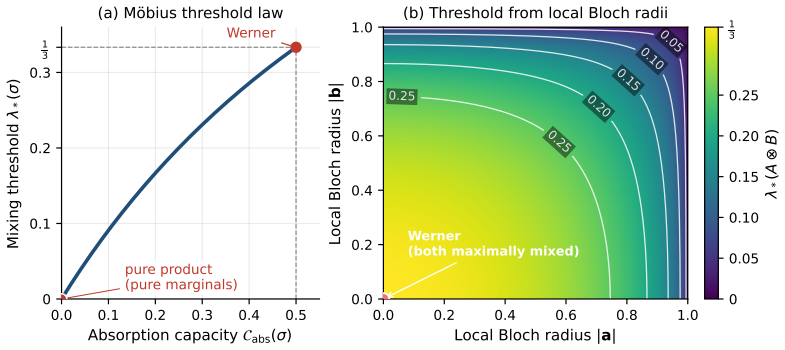
For separable two-qubit noise σ the entanglement absorption capacity C_abs(σ) is the largest coefficient such that λ Φ⁺ + (1-λ) σ remains positive under partial transpose, and the fidelity absorption capacity C_F(σ) is the largest coefficient such that the mixture keeps maximal teleportation fidelity ≤ 2/3; both thresholds are recovered from the map λ = C/(1+C).
What carries the argument
The Bell-mixing line ρ_λ = λ Φ⁺ + (1-λ) σ together with the partial-transpose positivity test and the maximum teleportation fidelity, packaged as the two absorption capacities C_abs and C_F.
Load-bearing premise
The noise state σ is separable so that partial-transpose positivity exactly locates the entanglement threshold for these two-qubit states.
What would settle it
For a concrete product noise state with known marginal purities, compute the formula for C_abs, then numerically locate the smallest λ where the partial transpose of the mixture acquires a negative eigenvalue and check whether that λ equals C_abs/(1+C_abs).
Figures
read the original abstract
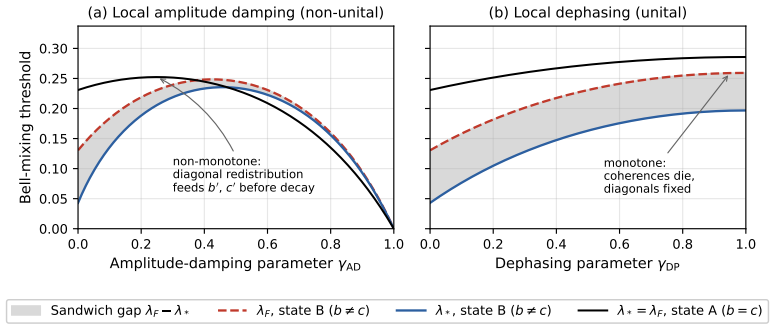
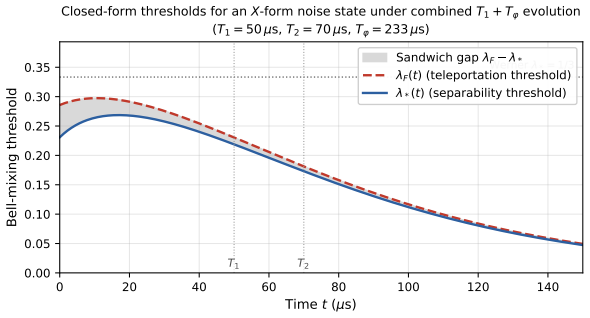
We study Bell-mixing lines $\rho_\lambda=\lambda\Phi^+ +(1-\lambda)\sigma$, where $\Phi^+$ is a fixed Bell reference and $\sigma$ is a separable two-qubit noise state. Along this line there are two operational crossings: the state becomes entangled, and it reaches quantum teleportation advantage over classical strategies. We package these crossings as capacities of the noise state. The entanglement absorption capacity $C_{\rm abs}(\sigma)$ is the largest amount of Bell reference that $\sigma$ can absorb while the partial transpose remains positive. The fidelity absorption capacity $C_F(\sigma)$ is the largest amount of Bell reference that $\sigma$ can absorb while keeping the maximal teleportation fidelity at or below the classical bound $2/3$. The thresholds corresponding to the two crossing points are obtained from the same M\"obius map, $\lambda_* = C_{\rm abs}/(1+C_{\rm abs})$ and $\lambda_F = C_F/(1+C_F)$. We derive closed-form capacities and thresholds for product noise states and separable complex $X$ noise states. For product noise, $C_{\rm abs}$ depends only on local marginal purities, while $C_F$ also depends on orientation relative to the maximally entangled reference. For $X$ noise states, both capacities are explicit in all four Bell frames. We also study three extensions: arbitrary pure-state references, the evolution of $X$ noise states and their capacities under local amplitude-damping and dephasing channels, and decomposition certificates that give lower bounds on the capacities, hence on the thresholds, for general separable noise.
Editorial analysis
A structured set of objections, weighed in public.
Referee Report
Summary. The paper defines entanglement absorption capacity C_abs(σ) and fidelity absorption capacity C_F(σ) for separable two-qubit noise σ along Bell-mixing lines ρ_λ = λ Φ^+ + (1-λ) σ. These capacities quantify the maximum λ such that the mixture remains PPT-positive or has teleportation fidelity ≤ 2/3. Closed-form expressions are derived for product noise (C_abs depending only on local purities) and separable complex X noise (explicit in Bell frames) via the Möbius map λ_* = C/(1+C); extensions cover pure references, local channel evolution of X states, and decomposition-based lower bounds.
Significance. If the closed-form derivations hold, the work supplies explicit, computable thresholds for noise tolerance in entanglement and teleportation that depend only on measurable marginals or Bell-frame coefficients for the treated classes. The reliance on PPT=separability for two qubits and the standard 2/3 fidelity bound is correctly applied; the parameter-free character for product states and the four-frame expressions for X states are concrete strengths.
minor comments (2)
- [product noise section] § on product states: the dependence of C_F on orientation is stated but the explicit formula relating the reference Bell state to the local bases of the product state could be written out for direct verification.
- [decomposition certificates] The decomposition certificates for general separable σ are presented as lower bounds; a brief remark on how tight they are for the X and product cases already treated would clarify their added value.
Simulated Author's Rebuttal
We thank the referee for the positive assessment of the manuscript and the recommendation to accept.
Circularity Check
No significant circularity; derivations are self-contained
full rationale
The paper defines C_abs(σ) and C_F(σ) operationally from the crossing points of the Bell-mixing line ρ_λ = λ Φ⁺ + (1-λ)σ where PPT positivity or teleportation fidelity hits its bound. The Möbius reparametrization λ = C/(1+C) is applied uniformly to convert those independently computed λ_* thresholds into capacities; this is a definitional packaging step, not a reduction of any result to its inputs. Closed-form expressions for product states (depending on marginal purities) and separable X-states (explicit in Bell bases) follow from direct application of the PPT criterion and fidelity formula to the two-qubit density matrix, with no fitted parameters, self-citations, or ansatzes invoked as load-bearing premises. Standard external facts (PPT ⇔ separability for 2 qubits; classical fidelity bound 2/3) are used correctly and do not create internal circularity.
Axiom & Free-Parameter Ledger
axioms (2)
- standard math For two-qubit states, positive partial transpose is equivalent to separability
- domain assumption The classical bound for maximal teleportation fidelity is 2/3
Reference graph
Works this paper leans on
-
[2]
Artur K. Ekert. Quantum cryptography based on Bell’s theorem.Phys. Rev. Lett., 67:661– 663, Aug 1991. DOI: 10.1103/PhysRevLett.67.661. URLhttps://link.aps.org/doi/10. 1103/PhysRevLett.67.661
-
[3]
Ting Yu and J. H. Eberly. Finite-time disentanglement via spontaneous emission.Phys. Rev. Lett., 93:140404, Sep 2004. DOI: 10.1103/PhysRevLett.93.140404. URLhttps://link.aps. org/doi/10.1103/PhysRevLett.93.140404
-
[4]
M. P. Almeida, F. de Melo, M. Hor-Meyll, A. Salles, S. P. Walborn, P. H. Souto Ribeiro, and L. Davidovich. Environment-induced sudden death of entanglement.Science, 316(5824): 579–582, 2007. DOI: 10.1126/science.1139892. URLhttps://www.science.org/doi/abs/ 10.1126/science.1139892
-
[5]
Ting Yu and J. H. Eberly. Sudden death of entanglement.Science, 323(5914):598–601, 2009. DOI: 10.1126/science.1167343. URLhttps://doi.org/10.1126/science.1167343
-
[6]
Marcelo O. Terra Cunha. The geometry of entanglement sudden death.New Journal of Physics, 9(7):237, Jul 2007. DOI: 10.1088/1367-2630/9/7/237. URLhttps://doi.org/10. 1088/1367-2630/9/7/237
-
[7]
Leandro Aolita, Fernando de Melo, and Luiz Davidovich. Open-system dynamics of en- tanglement: A key issues review.Reports on Progress in Physics, 78(4):042001, mar 2015. DOI: 10.1088/0034-4885/78/4/042001. URLhttps://doi.org/10.1088/0034-4885/78/4/ 042001
-
[8]
Separability criterion for density matrices.Phys
Asher Peres. Separability criterion for density matrices.Phys. Rev. Lett., 77:1413–1415, Aug 1996. DOI: 10.1103/PhysRevLett.77.1413. URLhttps://link.aps.org/doi/10.1103/ PhysRevLett.77.1413
-
[9]
Micha l Horodecki, Pawe l Horodecki, and Ryszard Horodecki. Separability of mixed states: necessary and sufficient conditions.Physics Letters A, 223(1):1–8, 1996. ISSN 0375-9601. DOI: 10.1016/S0375-9601(96)00706-2. URLhttps://www.sciencedirect.com/science/ article/pii/S0375960196007062
-
[10]
Bell’s inequalities versus teleportation: What is nonlocality?Phys
Sandu Popescu. Bell’s inequalities versus teleportation: What is nonlocality?Phys. Rev. Lett., 72:797–799, Feb 1994. DOI: 10.1103/PhysRevLett.72.797. URLhttps://link.aps. org/doi/10.1103/PhysRevLett.72.797
-
[11]
S. Massar and S. Popescu. Optimal extraction of information from finite quantum ensembles. Phys. Rev. Lett., 74:1259–1263, Feb 1995. DOI: 10.1103/PhysRevLett.74.1259. URLhttps: //link.aps.org/doi/10.1103/PhysRevLett.74.1259
-
[12]
General teleportation channel, singlet fraction, and quasidistillation.Phys
Micha l Horodecki, Pawe l Horodecki, and Ryszard Horodecki. General teleportation channel, singlet fraction, and quasidistillation.Phys. Rev. A, 60:1888–1898, Sep 1999. DOI: 10.1103/PhysRevA.60.1888. URLhttps://link.aps.org/doi/10.1103/PhysRevA. 60.1888
-
[13]
Reinhard F. Werner. Quantum states with Einstein-Podolsky-Rosen correlations admit- ting a hidden-variable model.Phys. Rev. A, 40:4277–4281, Oct 1989. DOI: 10.1103/Phys- RevA.40.4277. URLhttps://link.aps.org/doi/10.1103/PhysRevA.40.4277
-
[14]
Charles H. Bennett, David P. DiVincenzo, John A. Smolin, and William K. Wootters. Mixed- state entanglement and quantum error correction.Phys. Rev. A, 54:3824–3851, Nov 1996. DOI: 10.1103/PhysRevA.54.3824. URLhttps://link.aps.org/doi/10.1103/PhysRevA. 54.3824
-
[15]
Ryszard Horodecki, Pawe l Horodecki, Micha l Horodecki, and Karol Horodecki. Quantum entanglement.Rev. Mod. Phys., 81:865–942, Jun 2009. DOI: 10.1103/RevModPhys.81.865. URLhttps://link.aps.org/doi/10.1103/RevModPhys.81.865
-
[16]
Ting Yu and J. H. Eberly. Evolution from entanglement to decoherence of bipartite mixedX states.Quantum Information and Computation, 7(5-6):459–468, 2007. DOI: 10.26421/QIC7.5- 6-3. URLhttps://doi.org/10.26421/QIC7.5-6-3
-
[17]
Mazhar Ali, A. R. P. Rau, and G. Alber. Quantum discord for two-qubitXstates.Phys. Rev. A, 81:042105, Apr 2010. DOI: 10.1103/PhysRevA.81.042105. URLhttps://link.aps. org/doi/10.1103/PhysRevA.81.042105
-
[18]
N. Quesada, A. Al-Qasimi, and D. F. V. James. Quantum properties and dynamics ofXstates. Journal of Modern Optics, 59(15):1322–1329, 2012. DOI: 10.1080/09500340.2012.713130. URL https://doi.org/10.1080/09500340.2012.713130. 22
-
[19]
Ming-Liang Hu. Relations between entanglement, Bell-inequality violation and teleportation fidelity for the two-qubitXstates.Quantum Information Processing, 12:229–236, 2013. DOI: 10.1007/s11128-012-0371-1. URLhttps://doi.org/10.1007/s11128-012-0371-1
-
[20]
William K. Wootters. Entanglement of formation of an arbitrary state of two qubits.Phys. Rev. Lett., 80:2245–2248, Mar 1998. DOI: 10.1103/PhysRevLett.80.2245. URLhttps:// link.aps.org/doi/10.1103/PhysRevLett.80.2245
-
[21]
Robustness of entanglement.Phys
Guifr´ e Vidal and Rolf Tarrach. Robustness of entanglement.Phys. Rev. A, 59:141–155, Jan 1999. DOI: 10.1103/PhysRevA.59.141. URLhttps://link.aps.org/doi/10.1103/ PhysRevA.59.141
-
[22]
P. Krantz, M. Kjaergaard, F. Yan, T. P. Orlando, S. Gustavsson, and W. D. Oliver. A quantum engineer’s guide to superconducting qubits.Applied Physics Reviews, 6(2):021318, 06 2019. ISSN 1931-9401. DOI: 10.1063/1.5089550. URLhttps://doi.org/10.1063/1.5089550
-
[23]
Generalized robustness of entanglement.Phys
Michael Steiner. Generalized robustness of entanglement.Phys. Rev. A, 67:054305, May 2003. DOI: 10.1103/PhysRevA.67.054305. URLhttps://link.aps.org/doi/10.1103/PhysRevA. 67.054305
-
[24]
Negative entanglement measure for bipartite separable mixed states.Phys
Cheng-Jie Zhang, Yong-Jian Han, Yong-Sheng Zhang, Yu-Chun Wu, Xiang-Fa Zhou, and Guang-Can Guo. Negative entanglement measure for bipartite separable mixed states.Phys. Rev. A, 82:062312, 2010. DOI: 10.1103/PhysRevA.82.062312. URLhttps://doi.org/10. 1103/PhysRevA.82.062312
-
[25]
Teleportation, Bell’s inequal- ities and inseparability.Physics Letters A, 222(1):21–25, 1996
Ryszard Horodecki, Micha l Horodecki, and Pawe l Horodecki. Teleportation, Bell’s inequal- ities and inseparability.Physics Letters A, 222(1):21–25, 1996. ISSN 0375-9601. DOI: 10.1016/0375-9601(96)00639-1. URLhttps://www.sciencedirect.com/science/article/ pii/0375960196006391
-
[26]
Mary Beth Ruskai, Stanislaw Szarek, and Elisabeth Werner. An analysis of completely-positive trace-preserving maps onM 2.Linear Algebra and its Applications, 347(1):159–187, 2002. ISSN 0024-3795. DOI: 10.1016/S0024-3795(01)00547-X. URLhttps://www.sciencedirect.com/ science/article/pii/S002437950100547X. Overview of the appendices The appendices contain th...
-
[27]
On thed(η)<0branch, derive Eq.(67)forηfrom the conditionf(ρ η) = 1/2, then substitute the explicit polynomialsν1,ν2, andd(η)inηto obtain the quartic equation(65)
-
[28]
Check thatC ψ= 1recovers the Bell-reference formula
-
[29]
Show thatd(η)>0gives no teleportation threshold. On thed(η)<0branch of(60)the fully entangled fraction isf(ρ η) = 1 4 ( 1+(s 1 +s 2 +s 3)/L ) , with s1≥s2≥s3≥0the singular values ofMψ, sof(ρη) = 1 2 is the sum-of-singular-values condition s1 +s 2 +s 3 =L. We now rewrite this condition using the following quantities fromS:=M ψMT ψ(the entries of Mψare real...
-
[30]
equal middle populations
The root check removes roots introduced by squaring. In the Bell case, for instance, the extra factor 4η2 + 4η+ (1−h2)has no positive roots, and its possible zero root ath= 1is just the starting point. In the Bell-reference case and the structured subfamilies considered next the selected root satisfiesd(η)≤0, and the formulas reduce to the closed forms qu...
-
[31]
Each such direction sets its own bound: every|x⟩with⟨x|Q|x⟩<0forcesη≤⟨x|σTB|x⟩/(−⟨x|Q|x⟩), while directions with⟨x|Q|x⟩≥0 impose no bound
Positivity can fail only along directions whereQhas a negative expectation. Each such direction sets its own bound: every|x⟩with⟨x|Q|x⟩<0forcesη≤⟨x|σTB|x⟩/(−⟨x|Q|x⟩), while directions with⟨x|Q|x⟩≥0 impose no bound. Taking the tightest of these bounds gives the capacity, Cabs(σ) = min ⟨x|Q|x⟩<0 ⟨x|σTB|x⟩ −⟨x|Q|x⟩.(73) In the interior of the separable set, ...
-
[32]
For product noise, letA= (I+⃗ a·σ)/2andB= (I+⃗b·σ)/2
The reductions to the closed forms can be seen directly from this expression. For product noise, letA= (I+⃗ a·σ)/2andB= (I+⃗b·σ)/2. IfRis the correlation matrix of the maximally entangled witness|β⟩, Lemma 3 givesR∈O(3)withdetR=−1. Since maximally entangled states have maximally mixed one-qubit marginals, only the correlation tensors enter: ⟨β|A⊗B|β⟩=1 4 ...
-
[33]
In the|Φ+⟩frame the resulting crossing gives(37)
Section 4.2 evaluates this maximization directly on theXfamily. In the|Φ+⟩frame the resulting crossing gives(37). E Additional closed forms The two main families are not the only noise states with closed-form thresholds. This appendix records two additional closed forms: noise diagonal in the computational basis, states with a rank-one correlation tensor....
discussion (0)
Sign in with ORCID, Apple, or X to comment. Anyone can read and Pith papers without signing in.