REVIEW 3 major objections 6 minor 3 cited by
This paper claims that a fluid antenna system can be built without moving parts by switching the excitation current vectors of a fixed multi-port antenna, and demonstrates a cascaded pixel-based beamforming network that reproduces the requi
Reviewed by Pith at T0; open to challenge. T0 means a machine referee read the full paper against a public rubric. the ladder, T0–T4 →
T0 review · deepseek-v4-flash
2026-08-03 18:42 UTC pith:I3NXS7OW
load-bearing objection A serious hardware paper with real prototypes and a promising Tx-capable FAS architecture, but the equivalence claim rests on magnitude-only correlation matching, which is thinner than the paper admits. the 3 major comments →
Pixel-based Reconfigurable Beamforming Networks Emulating Physical Movement in FAS
The pith
A machine-rendered reading of the paper's core claim, the machinery that carries it, and where it could break.
Core claim
The central discovery is that choosing N beamforming current vectors B for a fixed multi-port antenna produces N radiation patterns whose correlation matrix is approximately |B^H B|, and this matrix can be shaped to reproduce the Bessel-function spatial correlation of a physically swept antenna. Because the multi-port antenna is designed with near-ideal port isolation, its own pattern-correlation matrix K_M is close to identity, so the PRBFN alone controls the FAS correlation. The paper derives a backward iterative synthesis for the cascaded unit cells, assuming lossless matched cells, and verifies the resulting hardware: a 2-port PRBFN emulates W=0.5λ, N=11; a 4-port PRBFN emulates W=1.5λ,
What carries the argument
The enabling identity is C = |B^H K_M B| ≈ |B^H B|, which converts the FAS spatial-correlation objective into a constraint on the beamforming current matrix B. The PRBFN realizing B is a cascade of identical unit cells, each a 3 dB power divider followed by a pixel-based reconfigurable coupler whose PIN-diode states set the output amplitude and phase; the backward iterative synthesis relies on the lossless matching condition H^H_{M,n} H_{M,n} = I to peel off stages from the final output back to the input.
Load-bearing premise
The backward iterative synthesis of the cascaded network assumes each unit cell is lossless and perfectly matched, so that H^H H = I; the fabricated four-port prototype has about 5.3 dB insertion loss, so the realized current matrix is only approximately ideal, and if loss or mismatch grows unevenly with cascade depth the correlation would deviate from Bessel and the FAS equivalence would break.
What would settle it
Build a five-stage PRBFN-FAS (NA=8, equivalent W≈3.5) and compare its measured correlation matrix against the Bessel target across the band; if the relative error grows well beyond the 0.035–0.062 range reported for the 2- and 4-port prototypes, the scaling claim fails. A second check: remove the amplifiers compensating the ~5.3 dB insertion loss and repeat the correlation measurement; a large error increase would show that the lossless-assumption is load-bearing.
If this is right
- Fluid antenna ports can be switched in microseconds because only diode states change, with no mechanical inertia.
- The same hardware can serve as a transmitter because the reconfigurable network sits before the power amplifiers, keeping the diodes in their linear operating region.
- Aperture size W scales by cascading more unit cells; the authors argue insertion loss is the only limit and can be compensated by additional amplifiers.
- The pattern-domain interpretation reveals that earlier pixel-antenna FAS implicitly performed beamforming, and it lets PRA-FAS and BFN-FAS be designed under one framework.
- The PRBFN-FAS acts as a single reconfigurable antenna element and can be embedded in conventional digital and analog beamforming arrays.
Where Pith is reading between the lines
- If the lossless assumption degrades at higher cascade depth, the Gram identity breaks and the synthesized B drifts; a promising test is to extend to W=3 or W=3.5 and check whether the correlation error grows faster than the current prototypes suggest.
- Because the equivalence depends only on pattern correlation, the same PRBFN could emulate other target correlation functions, such as those for non-isotropic scattering, by replacing the Bessel objective in the optimization—an extension the paper does not pursue.
- The 5% bandwidth is demonstrated at 2.6 GHz; scaling to millimeter-wave frequencies would require pixel switches with lower parasitic capacitance, and the paper's loss-compensation logic would face tougher power budgets.
- The system experiment measured 2×2 channels with sequential state scanning; a direct simultaneous measurement of all 18 ports would be a stronger validation that the quasi-static channel assumption holds.
Editorial analysis
A structured set of objections, weighed in public.
Referee Report
Summary. The paper proposes a pixel-based reconfigurable beamforming network (PRBFN) as a hardware implementation of a Fluid Antenna System (FAS). The central idea is that switching the physical position of a fluid antenna port is equivalent to switching the excitation current vector that feeds a fixed multi-port antenna, provided the resulting radiation patterns have the same spatial correlation as a physically moving antenna. The authors formulate an optimization problem (Eq. 15) that selects an excitation current matrix B so that |B^H B| approximates the absolute Bessel correlation |J0| of Clarke's model. A scalable cascaded architecture of unit cells (power divider plus pixel-based reconfigurable coupler) is synthesized by a backward iterative procedure. Two prototypes are fabricated and measured: a 2-port PRBFN-FAS with W=0.5, N=11, and a 4-port PRBFN-FAS with W=1.5, N=18. The measured S-parameters, radiation-pattern correlations, and over-the-air channel measurements show relative correlation errors of 0.035–0.062 across a 5% bandwidth, and the system experiments report FAMA SIR above 10 dB. The paper also discusses scalability, Tx operation, and compatibility with existing beamforming architectures.
Significance. If the equivalence claim is accepted, this is a significant hardware advance for FAS: it provides a single-RF-chain, high-speed, Tx-capable, and in principle scalable implementation without mechanical motion. The experimental work is unusually complete—full S-parameter characterization, radiation-pattern correlation matrices for all states, and system-level channel measurements—and the release of E-field data is a clear plus. The design examples are well chosen to demonstrate different aperture sizes. The main gap is theoretical: the optimization matches only the magnitude of the correlation matrix, and the complex phase/rank structure of the realized covariance is not examined. Since the joint fading statistics that determine FAS performance depend on the full complex covariance for N>2, the measured magnitude agreement is necessary but not yet sufficient to establish full behavioral equivalence to physical movement. This is fixable within the scope of the paper by adding a complex-covariance or end-to-end performance comparison.
major comments (3)
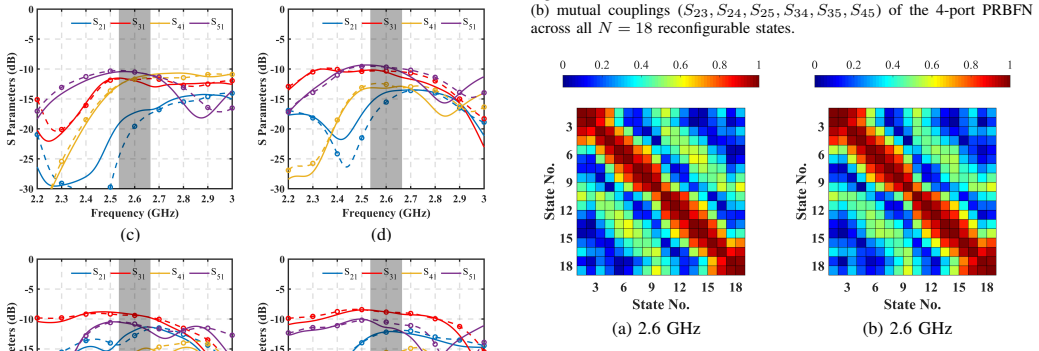
- [§II.A–II.B, Eq. (7)–(15)] The paper redefines the FAS correlation as the absolute value (Eq. 7) and optimizes B using only the objective || |B^H B| − C_obj ||_F in Eq. (15). The justification in §II.A that 'the phase of the correlation coefficient is not critical' is valid for a pair of ports, where a per-port phase rotation removes the phase of a single correlation coefficient. For N>2, the joint distribution of the N port envelopes—which is what sets selection gain, outage, and FAMA SIR—depends on the full complex covariance matrix up to diagonal unitary rotations. Gauge-invariant phase combinations such as Re(G12 G23 G31) are not captured by |G|. Moreover, G = B^H B has rank at most N_A (2 or 4 in the examples), whereas the ideal Bessel covariance of a moving antenna is an N×N matrix of full rank. Thus the measured agreement between |G| and |J0| in Figs. 15, 22, and 26 is a necessary but not sufficient validat
- [§III.C, Eq. (28)] The backward iterative synthesis of the cascaded PRBFN assumes lossless, perfectly matched unit cells so that H^H_{M,n} H_{M,n} = U_{2(M-1)} (Eq. 28). In the fabricated 4-port PRBFN, the measured total insertion loss reaches about 5.3 dB (Fig. 20(j)), so the Gram matrices of the actual unit stages are not identity. Although the final measured correlation errors are small (0.035–0.062), Eq. (28) is load-bearing for the synthesis of the earlier stages: the target currents for stage M−1 are computed from H^H_{M,n} i_n under this assumption. The paper does not report the measured Gram matrices of the individual stages or quantify how loss/gain imbalance propagates through the cascade. Please add this characterization and state the loss budget for which the backward-synthesis procedure remains valid, especially for larger cascades.
- [§V, Eq. (36)–(37)] The system-level correlation measurement is based on only U=2 users and K locations (four locations are shown in Fig. 25), and the estimator in Eqs. (36)–(37) averages autocorrelation products over an unspecified number of channel snapshots. This is a very small sample for validating a correlation model. The radiation-pattern measurements already provide the primary validation; the channel-derived correlation in Fig. 26 is supportive but should be presented with confidence intervals or a statement of the number of independent samples used, or it should be explicitly labeled as illustrative.
minor comments (6)
- [§III.B, Eq. (21)] The notation f_1(ˆB′) in Eq. (21) and Eq. (35) is undefined; please define B′ as the optimum for N_A=1 or write the denominator explicitly.
- [Algorithm 1, line 7] The variable name 'i2_norm' suggests a squared norm, but the subsequent normalization divides by the norm. Rename to avoid confusion.
- [§IV.B, Fig. 15 and §IV.C, Fig. 23] Captions contain typos: 'with idea antenna' should be 'with ideal antenna', and 'reconfigurbale' should be 'reconfigurable'.
- [§IV.C, first sentence] The sentence '...with W = 0.5, N = 11 and N = 1.5, N = 18' should read 'W = 1.5' instead of 'N = 1.5'.
- [Table III] The port density for the 2-port case is listed as 22, and the text earlier states N/W = 10 is sufficient. Please clarify whether N/W is a minimum, and define the port-density values for both prototypes consistently.
- [§II.A, Eq. (2)–(3)] The notation Cov(g_i,g_j) is used for the unnormalized correlation E[g_i g_j^*]; this is not the usual statistical covariance. Consider using 'cross-correlation' consistently.
Circularity Check
Bessel-correlation match is partly designed in via Eq. (15); the independent content is the hardware realization, so the circularity is partial.
specific steps
-
fitted input called prediction
[Section III-B (Eq. 15) and Section IV-B (Eq. 35), Figs. 15/22]
"we formulate the following optimization problem ... min_B f_NA(B)=∥|B^H B|−Cobj∥^2_F (15) ... Based on the measured outputs of the PRBFN and under the assumption of an ideal antenna (K_M=U_2) connected to its output, the correlation of the 2-port PRBFN can be derived using formula (13). ... The low relative errors demonstrate that the measured correlation results exhibit strong agreement with both the ideal Bessel correlation Cobj shown in Fig. 4(a) and the target correlation Ĉ calculated by B̂ given in Fig. 4(c)."
The quantity reported as the demonstrated Bessel correlation is the same quantity that was minimized when choosing B. Because C=|B^H B| (Eq. 13) and the optimization (Eq. 15) minimizes ∥ |B^H B| − Cobj ∥_F, any B from Algorithm 1 is constructed to make |B^H B|≈Cobj. The measured S-parameters are then inserted back into Eq. (13) and compared to Cobj via Eq. (35); this chiefly verifies that the fabricated unit cells can approximate the pre-selected B, not that the Bessel relation emerges independently. The genuinely independent content is the hardware realization—measured S-parameters, radiation patterns, and system-level channels—so the circularity is partial rather than total.
full rationale
The paper's central engineering claim is the realization of a PRBFN that can produce prescribed excitation currents for a multiport antenna, thereby emulating FAS port correlation. The optimization in Eq. (15) legitimately synthesizes B to match the Bessel target Cobj, and the later measured agreement between |B^H B| (derived from fabricated S-parameters) and Cobj is a hardware-compliance check. That check is not fully independent because the Bessel target was the design objective; however, the fabricated prototypes, radiation-pattern measurements, and system-level channel experiments provide external evidence that the hardware really does produce the designed currents, so the central claim does not reduce to a pure fit or self-citation chain. No load-bearing self-citation was found: the equivalence framework is re-derived in the paper, and citations to prior work by the same group (e.g., [20], [35]) are supporting rather than the sole basis. The magnitude-only/phase-correlation limitation noted by skeptics is a correctness or sufficiency concern about whether |J0| matching fully captures FAS joint statistics, not a circularity. Overall, there is one partial fitted-input-as-validation step, giving a score of 3.
Axiom & Free-Parameter Ledger
free parameters (4)
- Beamforming current matrix B =
optimized numerically via PGD
- Relative-error threshold epsilon_0 =
0.01
- Optimization weights c1, c2 in unit-cell design =
not specified
- FAS port density N/W =
10
axioms (5)
- domain assumption Rich-scattering environment with independent, equally likely polarizations and isotropic PAS S(Ω)=S0 U2
- domain assumption Multiport antenna pattern-correlation matrix K_M ≈ identity due to high isolation and matching
- ad hoc to paper Unit cells are lossless and matched in backward synthesis, so Gram matrices equal identity
- domain assumption FAS performance depends only on the magnitudes of port correlations, not their phase
- standard math Standard Bessel/Clarke model J0 for spatial correlation under 2D isotropic scattering
Cite this review
Pith. "Pith review of Pixel-based Reconfigurable Beamforming Networks Emulating Physical Movement in FAS." pith.science (2026). https://pith.science/paper/I3NXS7OW
@misc{pith2026251203703,
  author       = {Pith},
  title        = {Pith review of: Pixel-based Reconfigurable Beamforming Networks Emulating Physical Movement in FAS},
  year         = {2026},
  howpublished = {\url{https://pith.science/paper/I3NXS7OW}},
  note         = {Machine review of arXiv:2512.03703}
}
read the original abstract
The concept of Fluid Antenna Systems (FAS) has emerged as an attractive new system technology for use in sixth-generation (6G) wireless systems. However, most FAS implementations rely on mechanical antenna movement and thus are too slow to be useful. In this paper, a novel pixel-based reconfigurable beamforming network (PRBFN) is used to emulate movement in Fluid Antenna Systems (FASs). Using the insight that changing an antenna's physical position is equivalent to changing radiation patterns that satisfy the desired pattern correlation, the PRBFN is used to control the excitation current vectors of a multi-port antenna, thereby governing the pattern correlation. Key novelties of our work involve the selection of current vectors, and the methodology for scaling the PRBFN to realize large-aperture FAS. Results are provided for our PRBFN combined with an FAS (denoted as a PRBFN-FAS) when the equivalent physical movement is set to 1.5 wavelengths. Measurements demonstrate that the PRBFN-FAS provides the desired spatial correlation, including the Bessel function relation from Clarke's model across a 5\% bandwidth, satisfying FAS requirements. System-level experiments confirm the viability of the PRBFN-FAS in communication scenarios.
Figures




Forward citations
Cited by 3 Pith papers
-
Implementing Fluid Antennas in the Beamspace: Performance Evaluation and Codebook Design
Metasurface-based fluid antennas outperform conceptual fluid antennas in interference-heavy multi-user scenarios by exploiting projection onto the interference null space.
-
Hybrid Multiport Receivers for Slow Fluid Antenna Multiple Access
A fluid-antenna hybrid multiport receiver achieves performance close to full-digital multiport schemes using only 2 RF chains and cuts computational load by over 60 percent in slow multiuser scenarios.
-
Hybrid Multiport Receivers for Slow Fluid Antenna Multiple Access
Proposes FAHM receiver using analog combining and a port-selection stopping criterion that achieves comparable performance to fully-digital multiport schemes with only 2 RF chains and over 60% computational reduction ...
Reference graph
Works this paper leans on
-
[1]
Framework and overall objectives of the future devel- opment of imt for 2030 and beyond,
I.-R. M.2160-0, “Framework and overall objectives of the future devel- opment of imt for 2030 and beyond,” ITU-R Recommendation M.2160.0, 11, 2023
2030
-
[2]
A vision of 6G wireless systems: Applications, trends, technologies, and open research problems,
W. Saad, M. Bennis, and M. Chen, “A vision of 6G wireless systems: Applications, trends, technologies, and open research problems,” IEEE Network, vol. 34, no. 3, pp. 134–142, 2020
2020
-
[3]
On the road to 6G: Visions, requirements, key technologies, and testbeds,
C.-X. Wang, X. You, X. Gao, X. Zhu, Z. Li, C. Zhang, H. Wang, Y . Huang, Y . Chen, H. Haas, J. S. Thompson, E. G. Larsson, M. D. Renzo, W. Tong, P. Zhu, X. Shen, H. V . Poor, and L. Hanzo, “On the road to 6G: Visions, requirements, key technologies, and testbeds,”IEEE Communications Surveys and Tutorials , vol. 25, no. 2, pp. 905–974, 2023
2023
-
[4]
Massive MIMO for next generation wireless systems,
E. G. Larsson, O. Edfors, F. Tufvesson, and T. L. Marzetta, “Massive MIMO for next generation wireless systems,” IEEE Communications Magazine, vol. 52, no. 2, pp. 186–195, 2014
2014
-
[5]
Fluid antenna systems,
K.-K. Wong, A. Shojaeifard, K.-F. Tong, and Y . Zhang, “Fluid antenna systems,” IEEE Transactions on Wireless Communications , vol. 20, no. 3, pp. 1950–1962, 2021
1950
-
[6]
A tutorial on fluid antenna system for 6G networks: Encompassing communication theory, optimization methods and hardware designs,
W. K. New, K.-K. Wong, H. Xu, C. Wang, F. R. Ghadi, J. Zhang, J. Rao, R. Murch, P. Ram ´ırez-Espinosa, D. Morales-Jimenez, C.-B. Chae, and K.-F. Tong, “A tutorial on fluid antenna system for 6G networks: Encompassing communication theory, optimization methods and hardware designs,” IEEE Communications Surveys & Tutorials , vol. 27, no. 4, pp. 2325–2377, 2025
2025
-
[7]
Massive MIMO for maximal spectral efficiency: How many users and pilots should be allocated?
E. Bj ¨ornson, E. G. Larsson, and M. Debbah, “Massive MIMO for maximal spectral efficiency: How many users and pilots should be allocated?” IEEE Transactions on Wireless Communications , vol. 15, no. 2, pp. 1293–1308, 2016
2016
-
[8]
Precoding and power optimization in cell-free massive MIMO sys- tems,
E. Nayebi, A. Ashikhmin, T. L. Marzetta, H. Yang, and B. D. Rao, “Precoding and power optimization in cell-free massive MIMO sys- tems,” IEEE Transactions on Wireless Communications , vol. 16, no. 7, pp. 4445–4459, 2017
2017
-
[9]
Fluid antenna multiple access,
K.-K. Wong and K.-F. Tong, “Fluid antenna multiple access,” IEEE Transactions on Wireless Communications , vol. 21, no. 7, pp. 4801– 4815, 2022
2022
-
[10]
Bruce lee-inspired fluid antenna system: Six research topics and the potentials for 6G,
K.-K. Wong, K.-F. Tong, Y . Shen, Y . Chen, and Y . Zhang, “Bruce lee-inspired fluid antenna system: Six research topics and the potentials for 6G,” Frontiers in Communications and Networks , vol. 3, 2022. [Online]. Available: https://www.frontiersin.org/articles/10.3389/frcmn. 2022.853416
arXiv 2022
-
[11]
Shifting the ISAC trade-off with fluid antenna systems,
J. Zou, H. Xu, C. Wang, L. Xu, S. Sun, K. Meng, C. Masouros, and K.-K. Wong, “Shifting the ISAC trade-off with fluid antenna systems,” IEEE Wirel. Commun. Lett. , vol. 13, no. 12, pp. 3479–3483, 2024
2024
-
[12]
DBRAA: Sub-6 GHz and millimeter wave dual-band reconfigurable antenna array for ISAC,
K. Chen, C. Qi, and O. A. Dobre, “DBRAA: Sub-6 GHz and millimeter wave dual-band reconfigurable antenna array for ISAC,” IEEE Trans. Commun., early access , 2025
2025
-
[13]
On performance of RIS-aided fluid antenna systems,
F. Rostami G., K.-K. Wong, W. K. New, H. Xu, R. Murch, and Y . Zhang, “On performance of RIS-aided fluid antenna systems,” IEEE Wirel. Commun. Lett., vol. 13, no. 8, pp. 2175–2179, 2024
2024
-
[14]
Movable antenna for wireless communications: Prototyping and experimental results,
Z. Dong, Z. Zhou, Z. Xiao, C. Zhang, X. Li, H. Min, Y . Zeng, S. Jin, and R. Zhang, “Movable antenna for wireless communications: Prototyping and experimental results,” 2024
2024
-
[15]
A review on reconfigurable liquid dielectric antennas,
E. Motovilova and S. Y . Huang, “A review on reconfigurable liquid dielectric antennas,” Materials, vol. 13, no. 8, 2020. [Online]. Available: https://www.mdpi.com/1996-1944/13/8/1863
2020
-
[16]
Design and implementation of mmwave surface wave enabled fluid antennas and experimental results for fluid antenna multiple access,
Y . Shen, B. Tang, S. Gao, K.-F. Tong, H. Wong, K.-K. Wong, and Y . Zhang, “Design and implementation of mmwave surface wave enabled fluid antennas and experimental results for fluid antenna multiple access,” 2024. [Online]. Available: https://arxiv.org/abs/2405. 09663
2024
-
[17]
Advances towards programmable droplet transport on solid surfaces and its applications,
R. Malinowski, I. P. Parkin, and G. V olpe, “Advances towards programmable droplet transport on solid surfaces and its applications,” Chem. Soc. Rev. , vol. 49, pp. 7879–7892, 2020. [Online]. Available: http://dx.doi.org/10.1039/D0CS00268B
-
[18]
Slow fluid antenna multiple access,
K.-K. Wong, D. Morales-Jimenez, K.-F. Tong, and C.-B. Chae, “Slow fluid antenna multiple access,” IEEE Transactions on Communications , vol. 71, no. 5, pp. 2831–2846, 2023
2023
-
[19]
Pro- grammable meta-fluid antenna for spatial multiplexing in fast fluctuating radio channels,
B. Liu, K.-F. Tong, K.-K. Wong, C.-B. Chae, and H. Wong, “Pro- grammable meta-fluid antenna for spatial multiplexing in fast fluctuating radio channels,” Optics Express, vol. 33, no. 13, p. 28898 – 28915, 2025
2025
-
[20]
A novel pixel-based reconfigurable antenna applied in fluid antenna systems with high switching speed,
J. Zhang, J. Rao, Z. Li, Z. Ming, C.-Y . Chiu, K.-K. Wong, K.-F. Tong, and R. Murch, “A novel pixel-based reconfigurable antenna applied in fluid antenna systems with high switching speed,” IEEE Open Journal of Antennas and Propagation , vol. 6, no. 1, pp. 212–228, 2025
2025
-
[22]
REMAA: Reconfigurable pixel antenna-based electronic movable-antenna arrays for multiuser communications,
K. Chen, C. Qi, Y . Hong, and C. Yuen, “REMAA: Reconfigurable pixel antenna-based electronic movable-antenna arrays for multiuser communications,” IEEE Trans. Commun., early access , 2025
2025
-
[23]
Printed endfire beam-steerable pixel antenna,
P. Lotfi, S. Soltani, and R. D. Murch, “Printed endfire beam-steerable pixel antenna,” IEEE Transactions on Antennas and Propagation , vol. 65, no. 8, pp. 3913–3923, 2017
2017
-
[24]
Compact design of planar quadrature coupler with improved phase responses and wide tunable coupling ratios,
F. Lin, “Compact design of planar quadrature coupler with improved phase responses and wide tunable coupling ratios,” IEEE Transactions on Microwave Theory and Techniques , vol. 66, no. 3, pp. 1263–1272, 2018
2018
-
[25]
Phase reconfigurable microwave power divider,
L. Guo, H. Zhu, and A. Abbosh, “Phase reconfigurable microwave power divider,” IEEE Transactions on Circuits and Systems II: Express Briefs , vol. 66, no. 1, pp. 21–25, 2019
2019
-
[26]
A fully reconfigurable 1×4filtering beamforming network with continuous phase and amplitude control,
Z. Wei, X. Zhu, P.-L. Chi, R. Xu, and T. Yang, “A fully reconfigurable 1×4filtering beamforming network with continuous phase and amplitude control,” IEEE Transactions on Microwave Theory and Techniques , vol. 72, no. 1, pp. 348–362, 2024
2024
-
[27]
Simultaneous amplitude- and phase-tunable power divider with wide tunable ranges,
B. W. Xu, S. Y . Zheng, Y . X. Li, and W. Hong, “Simultaneous amplitude- and phase-tunable power divider with wide tunable ranges,” IEEE Transactions on Microwave Theory and Techniques , vol. 72, no. 8, pp. 4744–4756, 2024
2024
-
[28]
A novel reconfigurable intelligent surface for wide-angle passive beam- forming,
J. Rao, Y . Zhang, S. Tang, Z. Li, S. Shen, C.-Y . Chiu, and R. Murch, “A novel reconfigurable intelligent surface for wide-angle passive beam- forming,” IEEE Transactions on Microwave Theory and Techniques , vol. 70, no. 12, pp. 5427–5439, 2022
2022
-
[29]
Design of polarization-reconfigurable pixel antennas with optimized pin-diode implementation,
W. Zheng, Y . Yang, and H. Li, “Design of polarization-reconfigurable pixel antennas with optimized pin-diode implementation,” IEEE Trans- actions on Antennas and Propagation, vol. 73, no. 2, pp. 851–862, 2025
2025
-
[30]
A pattern- reconfigurable antenna for single-RF 5G millimeter-wave communica- 18 tions,
S. Tang, Y . Zhang, Z. Han, C.-Y . Chiu, and R. Murch, “A pattern- reconfigurable antenna for single-RF 5G millimeter-wave communica- 18 tions,” IEEE Antennas and Wireless Propagation Letters, vol. 20, no. 12, pp. 2344–2348, 2021
2021
-
[31]
Cost-effective enhancement of rf switch performance utilizing novel coupling struc- tures,
J. Rao, Z. Ming, J. Zhang, C.-Y . Chiu, and R. Murch, “Cost-effective enhancement of rf switch performance utilizing novel coupling struc- tures,” IEEE Transactions on Microwave Theory and Techniques , pp. 1–17, 2025
2025
-
[32]
Antenna diversity in mobile communica- tions,
R. Vaughan and J. Andersen, “Antenna diversity in mobile communica- tions,” IEEE Transactions on Vehicular Technology , vol. 36, no. 4, pp. 149–172, 1987
1987
-
[33]
R. E. Collin and F. J. Zucker, Antenna theory, Part 1. Antenna theory, 1969
1969
-
[34]
A new analytical approximation of the fluid antenna system channel,
M. Khammassi, A. Kammoun, and M.-S. Alouini, “A new analytical approximation of the fluid antenna system channel,” IEEE Transactions on Wireless Communications, vol. 22, no. 12, pp. 8843–8858, 2023
2023
-
[35]
A pattern correlation decomposition method for analysis of ESPAR in single- RF MIMO systems,
Z. Han, S. Shen, Y . Zhang, C.-Y . Chiu, and R. Murch, “A pattern correlation decomposition method for analysis of ESPAR in single- RF MIMO systems,” IEEE Transactions on Wireless Communications , vol. 21, no. 7, pp. 4654–4668, 2022
2022
-
[36]
The complex gradient operator and the cr- calculus,
K. Kreutz-Delgado, “The complex gradient operator and the cr- calculus,” 2009. [Online]. Available: https://arxiv.org/abs/0906.4835
Pith/arXiv arXiv 2009
-
[37]
Zur formalen theorie der funktionen von mehr komplexen ver¨anderlichen,
W. Wirtinger, “Zur formalen theorie der funktionen von mehr komplexen ver¨anderlichen,” Mathematische Annalen , vol. 97, no. 1, pp. 357–375, Dec 1927. [Online]. Available: https://doi.org/10.1007/BF01447872
-
[38]
Beam- forming network design utilizing node microstrip architectures for dual- polarized endfire millimeter-wave antenna arrays,
S. Tang, Y . Zhang, J. Rao, Z. Han, C.-Y . Chiu, and R. Murch, “Beam- forming network design utilizing node microstrip architectures for dual- polarized endfire millimeter-wave antenna arrays,” IEEE Transactions on Antennas and Propagation , vol. 71, no. 6, pp. 4862–4873, 2023
2023
-
[39]
coilcraft.com,
“coilcraft.com,” https://www.coilcraft.com/getmedia/b3553702-9a56-/ 4386-b513-fcddf8709240/0402dc.pdf, [Accessed 29-05-2024]
2024
-
[40]
murata.com,
“murata.com,” https://search.murata.co.jp/Ceramy/image/img/A01X/ G101/ENG/GJM1555C1H130GB01-01A.pdf, [Accessed 29-05-2024]
2024
-
[41]
An efficient approach for optimizing frequency reconfigurable pixel antennas using genetic algorithms,
S. Song and R. D. Murch, “An efficient approach for optimizing frequency reconfigurable pixel antennas using genetic algorithms,” IEEE Transactions on Antennas and Propagation, vol. 62, no. 2, pp. 609–620, 2014
2014
-
[42]
A compact shared-aperture antenna with 2-transmit and 2-receive highly-isolated ports for full-duplex MIMO systems,
J. Rao, Z. Ming, J. Zhang, Z. Li, C.-Y . Chiu, and R. Murch, “A compact shared-aperture antenna with 2-transmit and 2-receive highly-isolated ports for full-duplex MIMO systems,” IEEE Open Journal of Antennas and Propagation, vol. 6, no. 2, pp. 422–432, 2025
2025
-
[43]
Multiport pixel antenna optimization using characteristic mode analysis and sequential feeding port search,
F. Jiang, Z. Zhang, M. Li, S. Shen, C.-Y . Chiu, Y . Zhang, Q. S. Cheng, and R. Murch, “Multiport pixel antenna optimization using characteristic mode analysis and sequential feeding port search,” IEEE Transactions on Antennas and Propagation , vol. 70, no. 10, pp. 9160–9174, 2022
2022
-
[44]
Design of low-profile compact MIMO antenna on a single radiating patch using simple and systematic characteristic modes method,
J.-F. Lin, H. Deng, and L. Zhu, “Design of low-profile compact MIMO antenna on a single radiating patch using simple and systematic characteristic modes method,” IEEE Transactions on Antennas and Propagation, vol. 70, no. 3, pp. 1612–1622, 2022
2022
-
[45]
Wideband back cover microstrip antenna with multi- ple shorting vias for mobile 5G MIMO applications,
M. Hu and Y . Li, “Wideband back cover microstrip antenna with multi- ple shorting vias for mobile 5G MIMO applications,” IEEE Transactions on Antennas and Propagation , vol. 71, no. 10, pp. 8290–8295, 2023
2023
-
[46]
Low-profile four-port patch antenna with wide isolation bandwidth and same polarization: Principle and design approach,
N.-W. Liu, B.-B. Huang, L. Zhu, and G. Fu, “Low-profile four-port patch antenna with wide isolation bandwidth and same polarization: Principle and design approach,” IEEE Antennas and Wireless Propagation Letters, vol. 22, no. 10, pp. 2407–2411, 2023
2023
-
[47]
Design of a flat fading 4 x 4 MIMO testbed for antenna characterization using a modular approach,
C. Y . Chiu, C. H. Cheng, Y . S. Wan, C. R. Rowell, and R. D. Murch, “Design of a flat fading 4 x 4 MIMO testbed for antenna characterization using a modular approach,” in 2007 IEEE Wireless Communications and Networking Conference, 2007, pp. 2913–2918
2007
-
[48]
l- and s-band compact octave bandwidth 4-bit mmic phase shifters,
I. J. Bahl and D. Conway, “ l- and s-band compact octave bandwidth 4-bit mmic phase shifters,” IEEE Transactions on Microwave Theory and Techniques, vol. 56, no. 2, pp. 293–299, 2008
2008
-
[49]
A 6- bit cmos phase shifter for s-band,
M. Meghdadi, M. Azizi, M. Kiani, A. Medi, and M. Atarodi, “A 6- bit cmos phase shifter for s-band,” IEEE Transactions on Microwave Theory and Techniques, vol. 58, no. 12, pp. 3519–3526, 2010
2010
-
[50]
Designs and challenges in fluid antenna system hardware,
K.-F. Tong, B. Liu, and K.-K. Wong, “Designs and challenges in fluid antenna system hardware,” Electronics, vol. 14, no. 7, 2025. [Online]. Available: https://www.mdpi.com/2079-9292/14/7/1458
2025
-
[51]
Hybrid beamforming for ris-assisted multiuser fluid antenna systems,
J. Chen, Y . Xiao, Z. Peng, J. Zhu, X. Lei, C. Masouros, and K.-K. Wong, “Hybrid beamforming for ris-assisted multiuser fluid antenna systems,” IEEE Transactions on Wireless Communications , pp. 1–1, 2025
2025
-
[52]
Multi-target beamforming optimization for fluid antenna-enabled multi-static isac,
X. Lou, W. Xia, Y . Zhu, K.-K. Wong, and C.-B. Chae, “Multi-target beamforming optimization for fluid antenna-enabled multi-static isac,” IEEE Transactions on Cognitive Communications and Networking , pp. 1–1, 2025
2025
-
[53]
H. Guo, J. Zhang, J. Rao, R. Murch, and V . K. N. Lau, “Channel estimation and analog precoding for pixel-based fluid-antenna- assisted multiuser mimo-ofdm systems,” 2025. [Online]. Available: https://arxiv.org/abs/2509.09373
Pith/arXiv arXiv 2025
-
[54]
The tri-hybrid mimo architecture,
J. Robert W. Heath, J. Carlson, N. V . Deshpande, M. R. Castellanos, M. Akrout, and C.-B. Chae, “The tri-hybrid mimo architecture,” 2025. [Online]. Available: https://arxiv.org/abs/2505.21971
Pith/arXiv arXiv 2025
discussion (0)
Sign in with ORCID, Apple, or X to comment. Anyone can read and Pith papers without signing in.