REVIEW 4 major objections 5 minor 49 references
Concept Learning in the Wild: Towards Algorithmic Understanding of Neural Networks
T0 review · 4 major / 5 minor · reviewed 2026-08-11 · deepseek-v4-flash
Pith's one-line read NeuroSAT's message-passing dynamics reproduce the 'support' concept at the heart of human SAT heuristics, and the concept lives in the embedding's top principal components.
desk verdict NeuroSAT's support-in-PC1 observation is real and new, but the paper's own appendix contradicts its headline teachability claim, so it needs major revision before the central argument can be believed. read the letter →
The pith
A machine-rendered reading of the paper's core claim, the machinery that carries it, and where it could break.
The reading
What carries the argument
The load-bearing object is the covariance matrix of NeuroSAT's literal and clause embeddings, averaged over all instances and iterations; its top two eigenvectors, PC1 and PC2, are the place where concepts live. PC1 does the main work: its sign yields the assignment $\phi_t$, its magnitude encodes the support count, its $[-2,2]$ interval marks the flip-prone 'zero support' zone, and its distance from zero flags backbone variables. PC2 adds the second axis of the parabolic shape that encodes appearance count, so every identified concept has a geometric home in one two-dimensional reduction. Sparse PCA (keeping the top 16 of 128 entries per component) demonstrates minimality, and a teacher-student loss over the 64-dimensional encoding of the teacher's top PCs makes the concepts teachable to DetangledNeuroSAT.
What would settle it
Run NeuroSAT on DENSE or PLANTED instances, compute each literal's support with respect to a ground-truth satisfying assignment produced by an exact solver, and test whether PC1 magnitude still separates support counts with the same $[-2,2]$ zero-support zone; if the separation depends on using the PC1-derived assignment, the support-encoding claim is not an independent discovery. A second check holds out densities and backbone fractions and tests whether the fixed sparse 16-dimension support and the $[-2,2]$ threshold transfer without post-hoc re-fitting.
Extended reading notes
Core claim
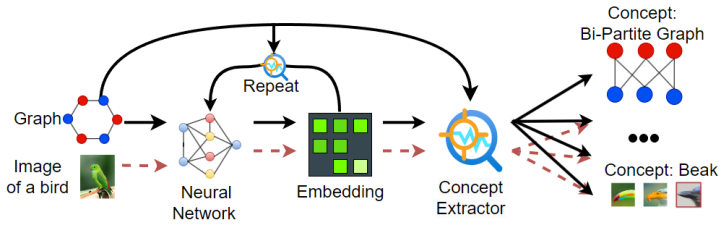
On the paper's own terms: NeuroSAT, a GNN that alternates message passing between clause nodes and literal nodes of a formula's factor graph, stores its working concepts in the top two principal components (PC1, PC2) of the covariance matrix of its literal and clause embeddings, averaged over instances and iterations. The sign of a literal's PC1 value defines a consistent Boolean assignment $\phi_t$ at every iteration, and the magnitude of PC1 encodes support: how many clauses that literal satisfies single-handedly under $\phi_t$, with the interval $[-2,2]$ marking the low-support 'uncertainty' zone whose variables are the ones flipped. The same geometric reduction encodes the majority-vote starting assignment (after one iteration NeuroSAT's assignment coincides with MAJ(F)), the appearance count of variables (via a parabolic PC1-vs-PC2 arrangement), and the backbone variables of a formula (their PC1 values never enter the zero-support zone when NeuroSAT finds a satisfying assignment). Because the leading PCs carry the concepts, discovery is unsupervised, and sparse PCA shows each concept needs only about 16 of the 128 embedding dimensions. The authors establish minimality and teachability by distilling the concepts into DetangledNeuroSAT, which matches NeuroSAT's accuracy with 91% fewer weights and biases, and by using the support concept to build SupportSAT-01, a WalkSAT variant that converges about 1.5 times faster.
Load-bearing premise
The weakest load-bearing premise is that the support measurements are independent of the encoding they validate: the assignment $\phi_t$ used to compute support is itself read from the sign of PC1, and the claim that PC1 encodes support is then checked by PC1 ranges separating support counts, so the match is partly built into the measuring procedure.
Editorial extensions
If this is right
- Rewriting the network as a textbook algorithm becomes possible: initialize with the majority vote, spend about 30 iterations computing supports, then flip only variables whose PC1 lies in the $[-2,2]$ zone.
- The support concept transfers to a classical solver: SupportSAT-01, which flips a support-0 variable with probability 2/3 and a support-1 variable with probability 1/3, converges to a satisfying assignment roughly 1.5 times faster than WalkSAT on dense instances.
- The concepts are minimal: sparsifying PC1 and PC2 to their top 16 entries preserves the success rates and concept-abiding percentages, so the explainable structure is not spread across all 128 dimensions.
- A concept-defined loss can train an architecture that the original loss cannot: DetangledNeuroSAT was not trainable with cross-entropy for satisfiability, but trained on teacher-student concept reconstruction it matches NeuroSAT's performance with 91% fewer weights and biases.
- The concepts are robust to architectural change: replacing both LSTMs with single-layer RNNs and removing recurrence in the detangled version preserves the support encoding and the accuracy statistics.
Reading between the lines
- If the encoding claim is right, the same averaged-covariance trick should expose comparable concepts in other recurrent message-passing solvers, such as GNNs trained for graph coloring or maximum cut, where a scalar 'confidence' coordinate may play a similar role.
- The teacher-student recipe is a general compression strategy: compress the teacher's top-PC concept space to a low-dimensional bottleneck, then train the student to reproduce that bottleneck; the paper shows this works where direct task-loss training fails.
- The paper's own tables leave an open test: the support ranges and the sparse dimension 16 are selected post hoc, so a held-out prediction of support ranges across densities and distributions would determine whether the measurements are concepts or fits.
- Because the $[-2,2]$ zone identifies which variables the network flips, the same concept could seed better initialization and restart heuristics for classical local search, not just the single flip rule demonstrated in SupportSAT-01.
Editorial analysis
A structured set of objections, weighed in public.
Referee Report
Summary. The paper analyzes NeuroSAT, a GNN trained for SAT, and claims to discover algorithmically meaningful concepts — assignment consistency, support, backbone, majority vote, and appearance count — encoded in the top principal components of the embedding covariance. It further claims that these concepts are minimal (via sparse PCA), teachable through a simplified DetangledNeuroSAT that 'achieves the same performance' with 91% fewer weights and biases, transferable to a SupportSAT-01 heuristic that accelerates WalkSAT, and sufficient to rewrite NeuroSAT as a textbook algorithm. The claims are supported by experiments on Random 3SAT (SPARSE and DENSE) and Planted 3SAT datasets, with additional results in Tables A.8–A.13.
Significance. If the central claims held, the paper would be a significant advance in concept-based XAI for algorithmic tasks: it would show unsupervised discovery of human-comprehensible, state-dependent concepts in a GNN, demonstrate transfer of those concepts to a smaller model and to a classical heuristic, and provide a roadmap for mechanistically interpreting combinatorial-optimization networks. The paper has genuine strengths: it studies a nontrivial algorithmic network, uses out-of-distribution PLANTED and SATLIB benchmarks, provides extensive appendix tables, and makes concrete falsifiable predictions about PC1 behavior. However, the advertised teachability result is contradicted by the paper's own appendix, and the support-concept validation is partly circular and heavily post hoc. These problems bear directly on the paper's main claims.
major comments (4)
- [Section 7.2 / Abstract] The statement that DetangledNeuroSAT 'achieves the same performance as NeuroSAT' is contradicted by Table A.9. For RANDOM formulas with the full covariance, the success rates are Original 100% vs Detangled 84% for c<3.75, 67% vs 45% at c=4.0, 58% vs 23% at c=4.2, and 43% vs 16% at c=4.25. The gap is largest exactly in the density regime where NeuroSAT does nontrivial work, so 'same performance' is false as stated. The authors must either restrict the teachability claim to PLANTED instances, where Detangled roughly matches, or report and discuss the corrected comparison; as written, the abstract's central bullet cannot be accepted.
- [Sections 6.1–6.2] The support concept is validated in a circular way. The assignment phi_t is read from the sign of PC1 (Section 6.1), support is computed with respect to that phi_t, and the encoding of support is then confirmed by checking that PC1 ranges separate support groups (Table 5). Since both the assignment and the validating coordinate derive from the same PC1 axis, the high percentages in Table 5 partly measure self-consistency rather than an independent representation of support. A decisive test would use an externally defined assignment (e.g., an exact satisfying assignment for planted instances, or NeuroSAT's own voting-based assignment from the original paper) and then check whether PC1 magnitude predicts support relative to that assignment.
- [Section 6 / Table 5] The concept thresholds are fitted post hoc. The PC1 ranges for support groups, the zero-support interval [-2,2], and the sparse-PC dimension 16 (chosen 'by analyzing the distribution... details omitted') are all selected from the same data used to report the percentages. To support the claim of unsupervised, distribution-level concepts, the authors should split instances into fitting and hold-out sets, or provide out-of-sample percentages; otherwise the reported 80–97% figures are in-sample descriptions, not predictions.
- [Sections 7.1 and 8] The 'identical' performance claim for the RNN replacement is also contradicted by Table A.9 (e.g., RANDOM c=4.25: Original 43% vs RNN 26%; c=4.1: 48% vs 32%), and the WalkSAT speedup is not quantified. Figure 8 shows averages over 40 instances without error bars or a paired test, and the text never states the actual '~1.5x' convergence-time ratio or its significance. In addition, Algorithm 2 is not a full white-box rewrite: line 2 ('Compute the support') is implemented by the unexplained first-30-iteration behavior, which the authors explicitly disclaim understanding.
minor comments (5)
- [Section 4, Eqs. (1)–(2)] The LSTM hidden states C_t^h and L_t^h are used in the architecture description in the appendix but dropped in the main equations, making the update rules hard to follow; define them in the main text.
- [Section 6.5, Table 7] The 'closest to the regression line' criterion is not fully defined, and no null baseline is given; the text's claim that 'even an accuracy of 50% is telling' needs a comparison to random assignment among the buckets.
- [Table 5] The DENSE row is repeated three times for successful, FAILED, and FAR-FAILED conditions; separate row headers would make the comparison readable.
- [Section 8] The abstract says SupportSAT-01 converges '~1.5 times faster', but Figure 8 is the only support and contains no error bars, no per-instance paired comparison, and no timing measurement; please quantify the claim.
- [Throughout] Several typos and formatting issues remain (e.g., 'Neuorsat', 'di fferent', 'out work', and the duplicated DENSE rows in Table 5); these should be corrected in revision.
Circularity Check
The support concept is validated against an assignment that is itself read off PC1, and the sparse dimension and support ranges are fit post hoc; the teachability claim is independently contradicted by the appendix, though that is a correctness issue rather than circularity.
-
self definitional
[Section 6.1-6.2; Table 5]
""In what follows, we use ϕt for the assignment at iteration t. If ϕt contains inconsistencies, we solve them by assigning the literal with the larger PC1 value True and the other False." ... "Every clause C contains one, two, or three literals that evaluate to True under ϕt." ... "We call a support clause with positive PC1 value a 'concept abiding' clause.""
The support labels used to validate the support concept are computed with respect to an assignment ϕt that is itself read off the sign of PC1. Testing whether 'PC1 encodes support' is therefore partly a self-consistency check of PC1, not an independent discovery: the support counts inherit the same coordinate that is later reported as the encoder of support. The magnitude-vs-support separation in Table 5 is not fully tautological, since clause-PC1 and literal-PC1 are different projections and magnitude is not determined by sign, but the 'unsupervised discovery' claim is weakened by this definitional coupling.
-
fitted input called prediction
[Section 6, minimality paragraph; Table 5; Tables A.8-A.13]
""we computed sparse versions of PC1 and PC2 by zeroing all but the top 16 entries (out of 128) with the largest absolute value. The number 16 was chosen by analyzing the distribution of the different embedding dimensions (details omitted).""
The minimality claim, stated as 'using sparse PCA, we establish the minimality of these concepts,' relies on a sparsity level selected post hoc from the same data, with the selection procedure omitted. The support ranges in Table 5 are likewise hand-fitted per support group and then evaluated in-sample. The reported percentages are descriptive fits rather than predictions that test whether the concepts are minimal or whether PC1 ranges forecast support. This does not refute the concepts, but it presents a fitted choice as a finding.
full rationale
The central support claim is partly circular because ϕt is defined from PC1 sign, while support is measured using ϕt and then PC1 values are reported as encoding support. The sparse dimension is chosen post hoc. However, the paper does not rely on self-citations for these claims, and the majority-vote and appearance-count concepts are independent of the circularity. The teachability claim is contradicted by Table A.9 (DetangledNeuroSAT solves 16% of RANDOM instances at c=4.25 vs NeuroSAT's 43%), but that is a numerical correctness issue, not a circularity. Overall, partial circularity in validation methodology.
Assumptions & free parameters
free parameters (7)
- Number of top principal components =
2
- Sparse PC support size =
16 of 128 dimensions
- Support-range thresholds (PC1) =
e.g., support 0: [0,2], support 1: [2.1,3.3], support 2: [2.7,3.5], support 3: [3,3.7]
- Zero-support interval =
[-2,2]
- SupportSAT-01 flip probabilities =
2/3 for support 0, 1/3 for support 1
- Teacher-student bottleneck dimension =
64
- Number of NeuroSAT iterations =
500
assumptions (5)
- domain assumption Random 3SAT has a sharp SAT/UNSAT phase transition near c=4.26.
- domain assumption Planted SAT instances at density above 4.26 are satisfiable and have backbones; the heuristic of [47] recovers them.
- ad hoc to paper Averaging covariance matrices over instances and iterations, then taking top PCs, yields distribution-level concepts.
- ad hoc to paper NeuroSAT's assignment phi_t can be read from the sign of PC1, with inconsistencies resolved by larger PC1.
- ad hoc to paper All concepts are learned by iteration 30 and the flip process after that follows the empirical distribution in Figure 7.
Cite this review
Pith. "Pith review of Concept Learning in the Wild: Towards Algorithmic Understanding of Neural Networks." pith.science (2026). https://pith.science/paper/I4264EFQ
@misc{pith2026241211205,
  author       = {Pith},
  title        = {Pith review of: Concept Learning in the Wild: Towards Algorithmic Understanding of Neural Networks},
  year         = {2026},
  howpublished = {\url{https://pith.science/paper/I4264EFQ}},
  note         = {Machine review of arXiv:2412.11205}
}
read the original abstract
Explainable AI (XAI) methods typically focus on identifying essential input features or more abstract concepts for tasks like image or text classification. However, for algorithmic tasks like combinatorial optimization, these concepts may depend not only on the input but also on the current state of the network, like in the graph neural networks (GNN) case. This work studies concept learning for an existing GNN model trained to solve Boolean satisfiability (SAT). \textcolor{black}{Our analysis reveals that the model learns key concepts matching those guiding human-designed SAT heuristics, particularly the notion of 'support.' We demonstrate that these concepts are encoded in the top principal components (PCs) of the embedding's covariance matrix, allowing for unsupervised discovery. Using sparse PCA, we establish the minimality of these concepts and show their teachability through a simplified GNN. Two direct applications of our framework are (a) We improve the convergence time of the classical WalkSAT algorithm and (b) We use the discovered concepts to "reverse-engineer" the black-box GNN and rewrite it as a white-box textbook algorithm. Our results highlight the potential of concept learning in understanding and enhancing algorithmic neural networks for combinatorial optimization tasks.
Figures


Figures from the paper (4 more)


Reference graph
Works this paper leans on
-
[1]
A unified approach to interpreting model predictions
Scott M Lundberg and Su-In Lee. A unified approach to interpreting model predictions. Advances in neural information processing systems , 30, 2017
2017
-
[2]
”why should I trust you?” explaining the predictions of any classifier
Marco T ´ulio Ribeiro, Sameer Singh, and Carlos Guestrin. ”why should I trust you?” explaining the predictions of any classifier. In Balaji Krishna- puram, Mohak Shah, Alexander J Smola, Charu C Aggarwal, Dou Shen, and Rajeev Rastogi, editors, Proceedings of the 22nd ACM SIGKDD In- ternational Conference on Knowledge Discovery and Data Mining, pages 1135–...
work page 2016
-
[3]
Grad-cam: Visual ex- planations from deep networks via gradient-based localization
Ramprasaath R Selvaraju, Michael Cogswell, Abhishek Das, Ramakr- ishna Vedantam, Devi Parikh, and Dhruv Batra. Grad-cam: Visual ex- planations from deep networks via gradient-based localization. In Pro- ceedings of the IEEE international conference on computer vision, pages 618–626, 2017
work page 2017
-
[4]
A comprehensive and reliable feature attribution method: Double-sided remove and reconstruct (dorar)
Dong Qin, George T Amariucai, Daji Qiao, Yong Guan, and Shen Fu. A comprehensive and reliable feature attribution method: Double-sided remove and reconstruct (dorar). Neural Networks, 173:106166, 2024
work page 2024
-
[5]
Towards better explanations of class activation mapping
Hyungsik Jung and Youngrock Oh. Towards better explanations of class activation mapping. In Proceedings of the IEEE/CVF International Con- ference on Computer Vision , pages 1316–1324, Montreal, QC, Canada, October 10-17 2021. IEEE
work page 2021
-
[6]
On completeness-aware concept-based explana- tions in deep neural networks
Chih-Kuan Yeh, Been Kim, Sercan Arik, Chun-Liang Li, Tomas Pfister, and Pradeep Ravikumar. On completeness-aware concept-based explana- tions in deep neural networks. 33:20554–20565, 2020
work page 2020
-
[7]
Towards automatic concept-based explanations
Amirata Ghorbani, James Wexler, James Y Zou, and Been Kim. Towards automatic concept-based explanations. 32, 2019
work page 2019
-
[8]
Reduan Achtibat, Maximilian Dreyer, Ilona Eisenbraun, Sebastian Bosse, Thomas Wiegand, Wojciech Samek, and Sebastian Lapuschkin. From “where” to “what”: Towards human-understandable explanations through concept relevance propagation. arXiv preprint arXiv:2206.03208, 2022
arXiv 2022
Show all 49 references
-
[9]
Towards robust interpretabil- ity with self-explaining neural networks
David Alvarez Melis and Tommi Jaakkola. Towards robust interpretabil- ity with self-explaining neural networks. 31, 2018
2018
-
[10]
Bridging the Human-AI knowledge gap: Concept discovery and transfer in alphazero
Lisa Schut, Nenad Tomasev, Tom McGrath, Demis Hassabis, Ulrich Pa- quet, and Been Kim. Bridging the Human-AI knowledge gap: Concept discovery and transfer in alphazero. arXiv preprint arXiv:2310.16410 , 2023
2023 arXiv
-
[11]
Interpretability beyond feature attribution: Quan- titative testing with concept activation vectors (tcav)
Been Kim, Martin Wattenberg, Justin Gilmer, Carrie Cai, James Wexler, and Fernanda Viegas. Interpretability beyond feature attribution: Quan- titative testing with concept activation vectors (tcav). In International conference on machine learning, pages 2668–2677. PMLR, 2018
2018
-
[12]
Network dissection: Quantifying interpretability of deep visual representations
David Bau, Bolei Zhou, Aditya Khosla, Aude Oliva, and Antonio Tor- ralba. Network dissection: Quantifying interpretability of deep visual representations. In Proceedings of the IEEE conference on computer vi- sion and pattern recognition, pages 6541–6549, 2017
2017
-
[13]
A general reinforcement learning algo- rithm that masters chess, shogi, and go through self-play
David Silver, Thomas Hubert, Julian Schrittwieser, Ioannis Antonoglou, Matthew Lai, Arthur Guez, Marc Lanctot, Laurent Sifre, Dharshan Ku- maran, and Thore Graepel. A general reinforcement learning algo- rithm that masters chess, shogi, and go through self-play. Science, 362(6...
2018
-
[14]
Progress measures for grokking via mechanistic interpretability
Neel Nanda, Lawrence Chan, Tom Liberum, Jess Smith, and Jacob Stein- hardt. Progress measures for grokking via mechanistic interpretability. arXiv preprint arXiv:2301.05217, 2023
2023 arXiv
-
[15]
Explainable ar- tificial intelligence (XAI): What we know and what is left to attain trust- worthy artificial intelligence
Sajid Ali, Tamer Abuhmed, Shaker El-Sappagh, Khan Muhammad, Jose M Alonso-Moral, Roberto Confalonieri, Riccardo Guidotti, Javier Del Ser, Natalia D´ıaz-Rodr´ıguez, and Francisco Herrera. Explainable ar- tificial intelligence (XAI): What we know and what is left to attain trust...
2023
-
[16]
Learning a SAT solver from single-bit su- pervision
Daniel Selsam, Matthew Lamm, Benedikt B ¨unz, Percy Liang, Leonardo de Moura, and David L Dill. Learning a SAT solver from single-bit su- pervision. In 7th International Conference on Learning Representations, ICLR. OpenReview.net, 2019
2019
-
[17]
Concept learners for few- shot learning
Kaidi Cao, Maria Brbi ´c, and Jure Leskovec. Concept learners for few- shot learning. In International Conference on Learning Representations (ICLR), 2021
2021
-
[18]
Concept-cognitive learning sur- vey: Mining and fusing knowledge from data
Doudou Guo, Weihua Xu, Weiping Ding, Yiyu Yao, Xizhao Wang, Witold Pedrycz, and Yuhua Qian. Concept-cognitive learning sur- vey: Mining and fusing knowledge from data. Information Fusion , 109:102426, 2024
2024
-
[19]
Efficient graph coloring with neural networks: A physics-inspired approach for large graphs
Lorenzo Colantonio, Andrea Cacioppo, Federico Scarpati, and Stefano Giagu. Efficient graph coloring with neural networks: A physics-inspired approach for large graphs. CoRR, abs/2408.01503, 2024
2024
-
[20]
Can hybrid geometric scattering networks help solve the maximum clique problem? In Sanmi Koyejo, S
Yimeng Min, Frederik Wenkel, Michael Perlmutter, and Guy Wolf. Can hybrid geometric scattering networks help solve the maximum clique problem? In Sanmi Koyejo, S. Mohamed, A. Agarwal, Danielle Bel- grave, K. Cho, and A. Oh, editors, Advances in Neural Information Pro- cessing ...
2022
-
[21]
Pan, and Bei Yu
Wei Li, Ruxuan Li, Yuzhe Ma, Siu On Chan, David Z. Pan, and Bei Yu. Rethinking graph neural networks for the graph coloring problem.CoRR, abs/2208.06975, 2022
2022 arXiv
-
[22]
A spectral technique for random satisfiable 3 cnf formulas
Abraham Flaxman. A spectral technique for random satisfiable 3 cnf formulas. In SODA, volume 3, pages 357–363, 2003
2003
-
[23]
Algorithms for random 3-sat
Abraham Flaxman. Algorithms for random 3-sat. Encyclopedia of Algo- rithms, pages 742–744, 2008. 11
2008
-
[24]
Algorithmic barriers from phase transitions
Dimitris Achlioptas and Amin Coja-Oghlan. Algorithmic barriers from phase transitions. In 49th Annual IEEE Symposium on Foundations of Computer Science, pages 793–802. IEEE, 2008
2008
-
[25]
Local search strategies for satisfiability testing
Bart Selman, Henry A Kautz, and Bram Cohen. Local search strategies for satisfiability testing. In David S Johnson and Michael A Trick, editors, Cliques, Coloring, and Satisfiability, Proceedings of a DIMACS Work- shop, New Brunswick, New Jersey, USA, October 11-13, 1993, volu...
1993
-
[26]
Insta- bility of one-step replica-symmetry-broken phase in satisfiability prob- lems
Andrea Montanari, Giorgio Parisi, and Federico Ricci-Tersenghi. Insta- bility of one-step replica-symmetry-broken phase in satisfiability prob- lems. CoRR, cond-mat/0308147, 2003
2003 arXiv
-
[27]
Focused local search for random 3-satisfiability
Sakari Seitz, Mikko Alava, and Pekka Orponen. Focused local search for random 3-satisfiability. CoRR, abs/cond-mat/0501707, 2005
2005 arXiv
-
[28]
Axiomatic attribu- tion for deep networks
Mukund Sundararajan, Ankur Taly, and Qiqi Yan. Axiomatic attribu- tion for deep networks. In International conference on machine learning, pages 3319–3328. PMLR, 2017
2017
-
[29]
Dissect: Disentangled simultaneous expla- nations via concept traversals
Asma Ghandeharioun, Been Kim, Chun-Liang Li, Brendan Jou, Brian Eoff, and Rosalind W Picard. Dissect: Disentangled simultaneous expla- nations via concept traversals. arXiv preprint arXiv:2105.15164, 2021
2021 arXiv
-
[30]
Concept learning through deep reinforcement learning with memory-augmented neural networks
Jing Shi, Jiaming Xu, Yiqun Yao, and Bo Xu. Concept learning through deep reinforcement learning with memory-augmented neural networks. Neural Networks, 110:47–54, 2019
2019
-
[31]
In-context learning and in- duction heads
Catherine Olah, Nelson Elhage, Neel Nanda, Nicholas Joseph, Nova Das- Sarma, Tom Henighan, Ben Mann, Amanda Askell, Yuntao Bai, Anna Chen, Tom Conerly, Dawn Drain, Deep Ganguli, Zac Hatfield-Dodds, Danny Hernandez, Scott Johnston, Andy Jones, Jackson Kernion, Liane Lovitt, Kam...
2022 arXiv
-
[32]
The quanti- zation model of neural scaling
Eric J Michaud, Ziming Liu, Uzay Girit, and Max Tegmark. The quanti- zation model of neural scaling. CoRR, abs/2303.13506, 2023
2023 arXiv
-
[33]
Interpretability in the wild: a circuit for indirect object identification in gpt-2 small
Kevin Ro Wang, Alexandre Variengien, Arthur Conmy, Buck Shlegeris, and Jacob Steinhardt. Interpretability in the wild: a circuit for indirect object identification in gpt-2 small. OpenReview.net, 2023
2023
-
[34]
Zoom in: An introduction to circuits
Chris Olah, Nick Cammarata, Ludwig Schubert, Gabriel Goh, Michael Petrov, and Shan Carter. Zoom in: An introduction to circuits. Distill, 5(3):e00024–001, 2020
2020
-
[35]
Reinforced continual learning for graphs
Appan Rakaraddi, Siew-Kei Lam, Mahardhika Pratama, and Marcus de Carvalho. Reinforced continual learning for graphs. In Moham- mad Al Hasan and Li Xiong, editors, Proceedings of the 31st ACM Inter- national Conference on Information & Knowledge Management, Atlanta, GA, USA, Oc...
2022
-
[36]
Conlearn: Contextual-knowledge- aware concept prerequisite relation learning with graph neural network
Hao Sun, Yuntao Li, and Yan Zhang. Conlearn: Contextual-knowledge- aware concept prerequisite relation learning with graph neural network. In Arindam Banerjee, Zhi-Hua Zhou, Evangelos E. Papalexakis, and Mat- teo Riondato, editors, Proceedings of the 2022 SIAM International Co...
2022
-
[37]
Gonzalez, Lawrence B
Jesus A. Gonzalez, Lawrence B. Holder, and Diane J. Cook. Graph-based relational concept learning. In Claude Sammut and Achim G. Hoffmann, editors, Machine Learning, Proceedings of the Nineteenth International Conference (ICML 2002), University of New South Wales, Sydney, Aus-...
2002
-
[38]
Zcha ff2004: An ef- ficient sat solver
Yogesh S Mahajan, Zhaohui Fu, and Sharad Malik. Zcha ff2004: An ef- ficient sat solver. In Theory and Applications of Satisfiability Testing: 7th International Conference, SAT 2004, Vancouver, BC, Canada, May 10-13, 2004, Revised Selected Papers 7, pages 360–375. Springer, 2005
2004
-
[39]
Guiding high-performance sat solvers with unsat-core predictions
Daniel Selsam and Nikolaj Bjørner. Guiding high-performance sat solvers with unsat-core predictions. In Theory and Applications of Satisfiability Testing–SAT 2019: 22nd International Conference, SAT 2019, Lisbon, Portugal, July 9–12, 2019, Proceedings 22 , pages 336–353. Sprin...
2019
-
[40]
Learning local search heuristics for boolean satisfiability
Emre Yolcu and Barnab ´as P ´oczos. Learning local search heuristics for boolean satisfiability. Advances in Neural Information Processing Sys- tems, 32, 2019
2019
-
[41]
Satzilla: Portfolio-based algorithm selection for sat
Lin Xu, Frank Hutter, Holger H Hoos, and Kevin Leyton-Brown. Satzilla: Portfolio-based algorithm selection for sat. CoRR, abs/1111.2249, 2011
2011 arXiv
-
[42]
Combinatorial optimization and rea- soning with graph neural networks
Quentin Cappart, Didier Ch ´etelat, Elias B Khalil, Andrea Lodi, Christo- pher Morris, and Petar Veli ˇckovi´c. Combinatorial optimization and rea- soning with graph neural networks. Journal of Machine Learning Re- search, 24(130):1–61, 2023
2023
-
[43]
Rnns, cnns and transformers in human action recognition: A survey and a hybrid model
Khaled Alomar, Halil Ibrahim Aysel, and Xiaohao Cai. Rnns, cnns and transformers in human action recognition: A survey and a hybrid model. arXiv preprint arXiv:2407.06162, 2024
2024 arXiv
-
[44]
Exact combinatorial optimization with graph convolutional neural networks
Maxime Gasse, Didier Ch ´etelat, Nicola Ferroni, Laurent Charlin, and An- drea Lodi. Exact combinatorial optimization with graph convolutional neural networks. Advances in neural information processing systems, 32, 2019
2019
-
[45]
Threshold val- ues of random k-sat from the cavity method
Stephan Mertens, Marc M ´ezard, and Riccardo Zecchina. Threshold val- ues of random k-sat from the cavity method. Random Structures & Algo- rithms, 28(3):340–373, 2006
2006
-
[46]
Gibbs states and the set of solutions of random constraint satisfaction problems
Florent Krzakala, Andrea Montanari, Federico Ricci-Tersenghi, Guilhem Semerjian, and Lenka Zdeborov ´a. Gibbs states and the set of solutions of random constraint satisfaction problems. Proceedings of the National Academy of Sciences, 104(25):10318–10323, 2007
2007
-
[47]
Why al- most all satisfiable k-cnf formulas are easy
Amin Coja-Oghlan, Michael Krivelevich, and Dan Vilenchik. Why al- most all satisfiable k-cnf formulas are easy. In Discrete Mathematics and Theoretical Computer Science, pages 95–108. Discrete Mathematics and Theoretical Computer Science, 2007
2007
-
[48]
Satlib: An online resource for re- search on sat
Holger H Hoos and Thomas St ¨utzle. Satlib: An online resource for re- search on sat. Sat, 2000:283–292, 2000
2000
-
[49]
Beyond interpretability: developing a language to shape our relationships with ai
Been Kim. Beyond interpretability: developing a language to shape our relationships with ai. In 10th Int. Conf. on Learning Representations , 2022. 12 Appendix A. Figure A.9: The instance F = (x1∨ ¯x2∨ x3)∧ (x1∨ x2∨ ¯x3) is transformed into an input graph for NeuroSAT. A node ...
2022
Reviewed August 11, 2026 · model on record in the stance chip above.
Discussion (0). Continue with ORCID to comment.