REVIEW 3 major objections 5 minor 1 cited by
Neural-operator element method: Efficient and scalable finite element method enabled by reusable neural operators
T0 review · 3 major / 5 minor · reviewed 2026-08-06 · deepseek-v4-flash
Pith's one-line read NOEM replaces dense finite-element meshes with pretrained neural-operator elements in a variational framework.
desk verdict NOEM is a genuinely new hybrid FEM/neural-operator construction with broad experiments; its main weakness is the unproven interface continuity that the authors disclose but do not resolve. read the letter →
The pith
A machine-rendered reading of the paper's core claim, the machinery that carries it, and where it could break.
The reading
What carries the argument
The central object is the neural-operator element (NOE), defined as $\phi_j^{\mathrm{NOE}}(x;\beta_j) = G[u|_{\partial \Omega_j^{\mathrm{NOE}}}](x)$: a pretrained neural operator $G$ that maps the discretized Dirichlet boundary values $\beta_j$ on a subdomain to the PDE solution inside that subdomain. The method's mechanism is the mixed variational representation $q(x;c) = \sum_i \phi_i^{\mathrm{FE}}(x;\alpha_i) + \sum_j \phi_j^{\mathrm{NOE}}(x;\beta_j)$, with coefficients $c$ found by minimizing the energy functional $J[q(\cdot;c)]$ via Newton's method, using automatic differentiation to assemble the gradient and Hessian of the NOE contributions. The NOE carries the argument because it converts a densely meshed region into a single element whose internal degrees of freedom are eliminated, leaving only boundary values as optimization variables.
What would settle it
Solve a problem with a strong solution gradient or a coefficient discontinuity aligned with the NOE-FE interface—for example, a Darcy flow whose permeability jumps sharply exactly at the interface—using a soft-constraint NOE, and check whether the NOEM solution converges to the FEM reference as the NO is trained to progressively smaller error. If the global error stagnates or the jump in the solution and its flux across the interface fails to vanish as NO training error goes to zero, the empirical regularity assumption is falsified.
Extended reading notes
Core claim
The central claim is that the solution of a PDE can be represented as a sum of standard finite-element shape functions and neural-operator elements (NOEs), where each NOE is the output of a pretrained neural operator mapping the Dirichlet data on a subdomain boundary to the solution inside that subdomain. The coefficients—FE nodal values and the boundary data feeding the NOs—are found by minimizing the same energy functional that FEM minimizes. Because one NOE replaces many finite elements, the number of optimization variables no longer grows with the mesh density inside the subdomain. The paper further claims this makes trained operators reusable: the same DeepONet trained on a single hole is reused for domains with many holes, and a single MIONet handles many different coefficient functions.
Load-bearing premise
The load-bearing premise is that a neural operator trained with soft boundary constraints still produces a subdomain solution consistent enough, in the continuity sense implicit in the variational formulation, to assemble with standard finite elements and yield a correct global solution; the paper relies on numerical observation for this, not a proof.
Editorial extensions
If this is right
- Pretrained NOs become reusable building blocks: the same NOE trained on one subdomain geometry can be placed into many larger domains without retraining, as demonstrated by reusing the single-hole DeepONet for domains with up to 100 holes.
- Computational cost for complex-geometry problems can drop by about an order of magnitude at scale, with the demonstrated 14x speedup over FEM for the 100-hole case.
- The mixed FE/NOE variational framework extends to nonlinear PDEs, multiscale coefficients, discontinuous permeability fields, and non-polygonal geometries.
- Because NOEs are differentiable, the assembled model supports downstream tasks such as design optimization once trained operators are available.
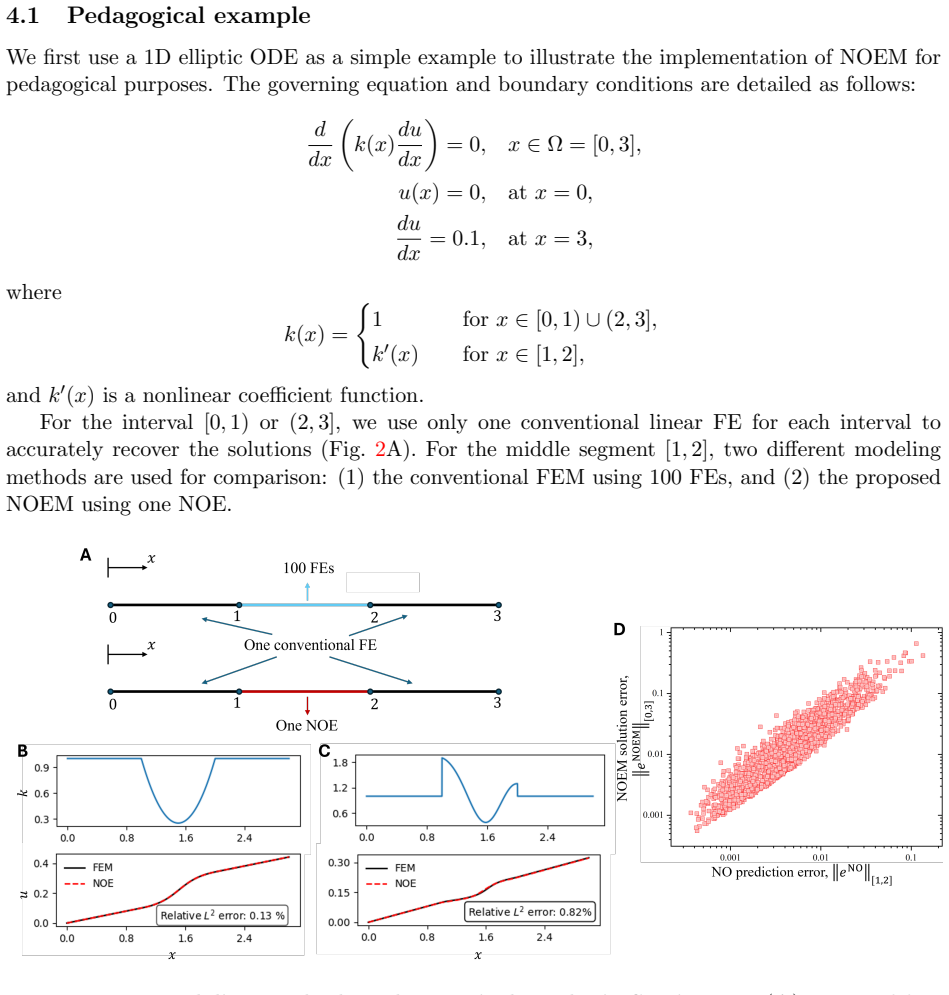
- The accuracy of the global NOEM solution is controlled by the accuracy of the subdomain NO: experiments show a strong linear correlation between NO prediction error and final solution error.
Reading between the lines
- A sharper practical rule suggested by the error-correlation experiments is to certify the subdomain operator's error before assembly, since the global solution error appears unlikely to be much better than the local operator error.
- One stress test left implicit is to push NOEM into regimes where the formal $C^0$/$C^1$ continuity requirement matters most—strong solution gradients or higher-order PDEs such as the biharmonic equation—where soft-constraint NOs may not match the accuracy seen in the tested elliptic examples.
- Because training a subdomain operator is cheaper than training a full-domain operator, NOEM could be combined with adaptive refinement, retraining or refining NOEs only where an error indicator is large, though adaptivity is not explored in the paper.
Editorial analysis
A structured set of objections, weighed in public.
Referee Report
Summary. The manuscript proposes the neural-operator element method (NOEM), a hybrid solver that partitions a computational domain into subdomains represented either by classical finite elements or by a single neural-operator element (NOE) built from a pretrained DeepONet, MIONet, or CNN. The trial space is the sum of standard FE shape functions and NO outputs, and the approximate solution is obtained by minimizing the energy functional in Eq. (7). Ten numerical experiments in 1D and 2D cover multiscale coefficients, complex geometries, and Darcy flow with discontinuous and nonlinear permeability fields, reporting relative L2 errors of roughly 0.1% to 2% and a claimed speedup of about 14 times over a fine-mesh FEM baseline for a 100-hole domain.
Significance. The core idea is practically attractive: pretrained neural operators are used as reusable 'super-elements' that absorb fine-scale or geometrically complex behavior, potentially reducing the number of degrees of freedom substantially. The numerical section is broad, and the reuse of a single trained NO across 2000 coefficient samples and across domains with different numbers of holes is a genuine strength that demonstrates the intended reusability. The paper also provides useful details for constructing hard-constraint DeepONets and promises public code. However, the mathematical consistency of the mixed variational formulation is not established, and the efficiency claims are not benchmarked against the nearest existing hybrid FEM/operator-learning methods. If these gaps are closed, NOEM would be a valuable contribution to computational methods; in its current form, the central methodological promise rests on empirical demonstration rather than on a verified variational principle.
major comments (3)
- [Section 3.3, Appendix C] The central variational claim is not supported by a consistency argument. As the paper itself states in Section 3.3, the trial functions in Eq. (6) must satisfy C0/C1 regularity for the formulation to be conforming, and that hard-constraint NOs 'should be used' for NOEs; however, the main experiments use soft-constraint NOs, which do not enforce interface boundary values. Appendix C evaluates the energy as a sum of independent element quadratures, so the minimized functional is a broken energy with no interface penalty or numerical flux. Invoking the discontinuous-Galerkin analogy does not replace the missing analysis: no Strang-type lemma, no consistency estimate, and no bound showing that the broken-energy minimizer approaches the true PDE solution as the NO boundary error tends to zero. The correlations in Figs. 2D and 3D show that NOEM error tracks NO error, but correlation is not convergence. This issue is load-bearing because Eq. (7) is the definition of the NOEM solution.
- [Section 4.3.2] The headline efficiency claim--'around 14 times speedup in the computational cost for 100 holes'--is a runtime comparison against a single fine-mesh FEM baseline. The NO training cost is not reported, and no comparison to the cited hybrid methods of Refs. [54] and [55] is provided. Without this information, the reader cannot determine whether the apparent speedup is a property of NOEM or an artifact of the chosen FEM baseline and the exclusion of training and data-generation costs. I ask for (i) an explicit accounting of NO training cost and data-generation cost with the amortization assumptions stated, (ii) a clear definition of the measured solve time (mesh generation, assembly, Newton iterations, tolerances), and (iii) at least one comparison with an established domain-decomposition or reduced-order hybrid method on the same benchmark.
- [Section 4.4, Section 3.2] For the nonlinear examples in Section 4.4, the functional J in Eq. (7) is not specified. In particular, for the nonlinear permeability field K'(x,y) = 1/(|u|+0.1) of Section 4.4.4, no energy functional is written down, and the linear variational framework of Eqs. (3)-(4) does not cover this case. It is not immediate that an energy of the form (1/2) ∫ K(u)|∇u|^2 has the stated PDE as its Euler-Lagrange equation when K depends on u. The manuscript should state the functional being minimized for each nonlinear case and verify the Euler-Lagrange equivalence, or explain why the mismatch is negligible. Without this, the nonlinear-PDE claims are not reproducible.
minor comments (5)
- [Section 4.1.2] The Gaussian-process kernel is written as k_l(x,x') = -(1/2)((x-x')/l)^2, which cannot be a valid covariance function; it should presumably be the squared-exponential form exp(-(1/2)((x-x')/l)^2).
- [Section 3.2] The notation α'_j appears in the paragraph after Eq. (6) without being defined; the comparison between the DOF count for finite elements and the boundary parametrization β_j should be stated more carefully.
- [Section 4.3] The paper claims model reusability for varying geometries, but all NOE subdomains share the same rectangular-with-hole geometry; the limitation to a single pre-trained geometry should be stated explicitly in the results section.
- [Section 4.3.2, Fig. 6D] The 'computational cost' shown in Fig. 6D should specify whether wall-clock time or CPU time is reported, and the FEM solver details (linear solver, tolerance, mesh size) should be given so the speedup can be reproduced.
- [Section 3.2] The nonconvexity of Eq. (7) is acknowledged, but no initialization sensitivity study is presented; a brief experiment varying the initial guess of Newton's method would make the accuracy claims more robust.
Circularity Check
No circularity: NOEM's variational assembly is self-contained; pretrained neural operators are inputs to a genuine energy minimization, not renamed predictions.
full rationale
NOEM's derivation chain is self-contained. The pretrained neural operator (NO) is an input surrogate: it is trained on FEM-generated pairs (boundary data -> subdomain solution) for a fixed PDE family, then frozen and embedded in the mixed ansatz q(x;c) = sum of finite elements plus sum of NOEs (Eq. 6). The new-instance solve is the energy minimization (Eq. 7) over the boundary DOFs c, so the predicted solution for a new instance is the minimizer of a genuine variational problem, not a renamed training output. No fitted constant is relabeled a prediction: the correlation studies in Secs. 4.1.2 and 4.2.1 compare NO error with NOEM error post hoc as a diagnostic, and the 'around 14 times speedup' is an inference-time comparison with offline training amortized, which is standard surrogate practice. Section 3.3 explicitly concedes that soft-constraint NOs violate the C0/C1 regularity assumed by the variational form and that only empirical evidence is offered ('we show that NOs with soft-constraint boundary conditions also yield satisfactory performance'); this is a consistency and convergence risk, not a circularity. Citations to DeepONet and MIONet by the same group are architectural references and are not used to forbid alternatives or to supply the target result. Therefore no load-bearing step reduces by construction to its own input.
Assumptions & free parameters
free parameters (3)
- Pretrained NO weights (DeepONet, MIONet, CNN), fitted to FEM-generated training data =
not reported in detail; architectures use 3-4 hidden layers with 50-200 neurons or 2 convolutional layers with kernel…
- Gaussian process correlation length l=0.3 for training data generation =
0.3
- Quadrature rule for NOE energy integrals =
unspecified
assumptions (4)
- standard math Lax-Milgram and energy-minimization equivalence (Eqs. 3-4)
- domain assumption NOE generalization: the pretrained NO, trained on subdomain BC distributions, is accurate on the BCs arising in the global solve
- ad hoc to paper Soft-constraint NOEs yield a valid global solution despite lacking the required C0/C1 regularity
- domain assumption The global energy minimization in Eq. (7) reaches an acceptable minimizer
invented entities (1)
-
Neural-operator element (NOE)
Cite this review
Pith. "Pith review of Neural-operator element method: Efficient and scalable finite element method enabled by reusable neural operators." pith.science (2026). https://pith.science/paper/I44QR3VN
@misc{pith2026250618427,
  author       = {Pith},
  title        = {Pith review of: Neural-operator element method: Efficient and scalable finite element method enabled by reusable neural operators},
  year         = {2026},
  howpublished = {\url{https://pith.science/paper/I44QR3VN}},
  note         = {Machine review of arXiv:2506.18427}
}
read the original abstract
The finite element method (FEM) is a well-established numerical method for solving partial differential equations (PDEs). However, its mesh-based nature gives rise to substantial computational costs, especially for complex multiscale simulations. Emerging machine learning-based methods (e.g., neural operators) provide data-driven solutions to PDEs, yet they present challenges, including high training cost and low model reusability. Here, we propose the neural-operator element method (NOEM) by synergistically combining FEM with operator learning to address these challenges. NOEM leverages neural operators (NOs) to simulate subdomains where a large number of finite elements would be required if FEM was used. In each subdomain, an NO is used to build a single element, namely a neural-operator element (NOE). NOEs are then integrated with standard finite elements to represent the entire solution through the variational framework. Thereby, NOEM does not necessitate dense meshing and offers efficient simulations. We demonstrate the accuracy, efficiency, and scalability of NOEM by performing extensive and systematic numerical experiments, including nonlinear PDEs, multiscale problems, PDEs on complex geometries, and discontinuous coefficient fields.
Figures


Figures from the paper (4 more)


Forward citations
Cited by 1 Pith paper
-
RAMS: Residual-based adversarial-gradient moving sample method for scientific machine learning in solving partial differential equations
Treating training samples as trainable parameters and moving them along the residual's adversarial gradient improves accuracy across PINN and operator learning benchmarks.
Reference graph
Works this paper leans on
-
[54]
Minglang Yin, Enrui Zhang, Yue Yu, and George Em Karniadakis. Interfacing finite elements with deep neural operators for fast multiscale modeling of mechanics problems.Computer methods in applied mechanics and engineering, 402:115027, 2022
work page 2022
-
[55]
Seung Whan Chung, Youngsoo Choi, Pratanu Roy, Thomas Moore, Thomas Roy, Tiras Y Lin, Du T Nguyen, Christopher Hahn, Eric B Duoss, and Sarah E Baker. Train small, model big: Scalable physics simulators via reduced order modeling and domain decomposition.Computer Methods in Applied Mechanics and Engineering, 427:117041, 2024
work page 2024
-
[52]
Shahed Rezaei, Reza Najian Asl, Kianoosh Taghikhani, Ahmad Moeineddin, Michael Kaliske, and Markus Apel. Finite operator learning: Bridging neural operators and numerical methods for efficient parametric solution and optimization of pdes.arXiv preprint arXiv:2407.04157, 2024
-
[1]
Finite volume methods.Handbook of numerical analysis, 7:713–1018, 2000
Robert Eymard, Thierry Gallou¨ et, and Rapha` ele Herbin. Finite volume methods.Handbook of numerical analysis, 7:713–1018, 2000
work page 2000
-
[2]
Klaus-J¨ urgen Bathe.Finite element procedures. Klaus-Jurgen Bathe, 2006
work page 2006
-
[3]
SIAM, 2007
Randall J LeVeque.Finite difference methods for ordinary and partial differential equations: steady-state and time-dependent problems. SIAM, 2007
2007
-
[4]
Joseph J Monaghan. Smoothed particle hydrodynamics and its diverse applications.Annual Review of Fluid Mechanics, 44(1):323–346, 2012
work page 2012
-
[5]
A quasi-linear reproducing kernel particle method
Edouard Yreux and Jiun-Shyan Chen. A quasi-linear reproducing kernel particle method. International Journal for Numerical Methods in Engineering, 109(7):1045–1064, 2017
work page 2017
Show all 67 references
-
[6]
Quantifying total uncertainty in physics-informed neural networks for solving forward and inverse stochastic problems.Jour- nal of Computational Physics, 397:108850, 2019
Dongkun Zhang, Lu Lu, Ling Guo, and George Em Karniadakis. Quantifying total uncertainty in physics-informed neural networks for solving forward and inverse stochastic problems.Jour- nal of Computational Physics, 397:108850, 2019. 22
2019
-
[7]
fpinns: Fractional physics-informed neural networks.SIAM Journal on Scientific Computing, 41(4):A2603–A2626, 2019
Guofei Pang, Lu Lu, and George Em Karniadakis. fpinns: Fractional physics-informed neural networks.SIAM Journal on Scientific Computing, 41(4):A2603–A2626, 2019
2019
-
[8]
Deepxde: A deep learning library for solving differential equations.SIAM review, 63(1):208–228, 2021
Lu Lu, Xuhui Meng, Zhiping Mao, and George Em Karniadakis. Deepxde: A deep learning library for solving differential equations.SIAM review, 63(1):208–228, 2021
2021
-
[9]
Gradient-enhanced physics- informed neural networks for forward and inverse pde problems.Computer Methods in Applied Mechanics and Engineering, 393:114823, 2022
Jeremy Yu, Lu Lu, Xuhui Meng, and George Em Karniadakis. Gradient-enhanced physics- informed neural networks for forward and inverse pde problems.Computer Methods in Applied Mechanics and Engineering, 393:114823, 2022
2022
-
[10]
Physics-informed machine learning.Nature Reviews Physics, 3(6):422–440, 2021
George Em Karniadakis, Ioannis G Kevrekidis, Lu Lu, Paris Perdikaris, Sifan Wang, and Liu Yang. Physics-informed machine learning.Nature Reviews Physics, 3(6):422–440, 2021
2021
-
[11]
A comprehensive study of non-adaptive and residual-based adaptive sampling for physics-informed neural networks
Chenxi Wu, Min Zhu, Qinyang Tan, Yadhu Kartha, and Lu Lu. A comprehensive study of non-adaptive and residual-based adaptive sampling for physics-informed neural networks. Computer Methods in Applied Mechanics and Engineering, 403:115671, 2023
2023
-
[12]
VG Belardi, Pierluigi Fanelli, and F Vivio. Analysis of multi-bolt composite joints with a user- defined finite element for the evaluation of load distribution and secondary bending.Composites Part B: Engineering, 227:109378, 2021
2021
-
[13]
An improved 2d finite element model for bolt load distribution analysis of composite multi-bolt single-lap joints.Composite Structures, 253:112770, 2020
Fengrui Liu, Wanting Yao, Libin Zhao, Hao Wu, Xi Zhang, and Jianyu Zhang. An improved 2d finite element model for bolt load distribution analysis of composite multi-bolt single-lap joints.Composite Structures, 253:112770, 2020
2020
-
[14]
Modeling strategies of finite element simulation of reinforced concrete beams strengthened with frp: A review.Journal of Compos- ites Science, 5(1):19, 2021
MZ Naser, Rami Antoun Hawileh, and Jamal Abdalla. Modeling strategies of finite element simulation of reinforced concrete beams strengthened with frp: A review.Journal of Compos- ites Science, 5(1):19, 2021
2021
-
[15]
Finite element analysis of slope stability using a nonlinear failure criterion.Computers and Geotechnics, 34(3):127–136, 2007
X Li. Finite element analysis of slope stability using a nonlinear failure criterion.Computers and Geotechnics, 34(3):127–136, 2007
2007
-
[16]
On the convergence of overlapping elements and overlapping meshes.Computers & Structures, 244:106429, 2021
Junbin Huang and Klaus-J¨ urgen Bathe. On the convergence of overlapping elements and overlapping meshes.Computers & Structures, 244:106429, 2021
2021
-
[17]
Reduced-order modeling: new approaches for computational physics.Progress in aerospace sciences, 40(1-2):51–117, 2004
David J Lucia, Philip S Beran, and Walter A Silva. Reduced-order modeling: new approaches for computational physics.Progress in aerospace sciences, 40(1-2):51–117, 2004
2004
-
[18]
Reduced-order methods for dynamic problems in topology optimization: A comparative study.Computer Methods in Applied Mechanics and Engineering, 387:114149, 2021
Quhao Li, Ole Sigmund, Jakob Søndergaard Jensen, and Niels Aage. Reduced-order methods for dynamic problems in topology optimization: A comparative study.Computer Methods in Applied Mechanics and Engineering, 387:114149, 2021
2021
-
[19]
John Wiley & Sons, 2009
Usik Lee.Spectral element method in structural dynamics. John Wiley & Sons, 2009
2009
-
[20]
A review: Applications of the spectral finite element method.Archives of Computational Methods in Engineering, 30(5):3453–3465, 2023
Muhammad Bilal Hafeez and Marek Krawczuk. A review: Applications of the spectral finite element method.Archives of Computational Methods in Engineering, 30(5):3453–3465, 2023
2023
-
[21]
Weihang Ouyang, Rui Bai, Si-Wei Liu, and Siu-Lai Chan. Refined three-dimensional pile ele- ment formulation for second-order analysis of pile-supported structures accounting for complex loading conditions.Engineering Structures, 301:117281, 2024
2024
-
[22]
Plastic hinge integration methods for force-based beam–column elements.Journal of Structural Engineering, 132(2):244–252, 2006
Michael H Scott and Gregory L Fenves. Plastic hinge integration methods for force-based beam–column elements.Journal of Structural Engineering, 132(2):244–252, 2006. 23
2006
-
[23]
A new mitc4+ shell element.Com- puters & Structures, 182:404–418, 2017
Yeongbin Ko, Phill-Seung Lee, and Klaus-J¨ urgen Bathe. A new mitc4+ shell element.Com- puters & Structures, 182:404–418, 2017
2017
-
[24]
Galerkin formulations of isogeo- metric shell analysis: Alleviating locking with greville quadratures and higher-order elements
Z Zou, TJR Hughes, MA Scott, RA Sauer, and EJ Savitha. Galerkin formulations of isogeo- metric shell analysis: Alleviating locking with greville quadratures and higher-order elements. Computer Methods in Applied Mechanics and Engineering, 380:113757, 2021
2021
-
[25]
Mionet: Learning multiple-input operators via tensor product.SIAM Journal on Scientific Computing, 44(6):A3490–A3514, 2022
Pengzhan Jin, Shuai Meng, and Lu Lu. Mionet: Learning multiple-input operators via tensor product.SIAM Journal on Scientific Computing, 44(6):A3490–A3514, 2022
2022
-
[26]
Learning nonlinear operators via deeponet based on the universal approximation theorem of operators
Lu Lu, Pengzhan Jin, Guofei Pang, Zhongqiang Zhang, and George Em Karniadakis. Learning nonlinear operators via deeponet based on the universal approximation theorem of operators. Nature machine intelligence, 3(3):218–229, 2021
2021
-
[27]
Tianping Chen and Hong Chen. Universal approximation to nonlinear operators by neural networks with arbitrary activation functions and its application to dynamical systems.IEEE transactions on neural networks, 6(4):911–917, 1995
1995
-
[28]
One-shot learning for solution operators of partial differential equations.arXiv preprint arXiv:2104.05512, 2021
Anran Jiao, Haiyang He, Rishikesh Ranade, Jay Pathak, and Lu Lu. One-shot learning for solution operators of partial differential equations.arXiv preprint arXiv:2104.05512, 2021
2021 arXiv
-
[29]
Coast: Intelligent time-adaptive neural operators.arXiv preprint arXiv:2502.08574, 2025
Zhikai Wu, Shiyang Zhang, Sizhuang He, Sifan Wang, Min Zhu, Anran Jiao, Lu Lu, and David van Dijk. Coast: Intelligent time-adaptive neural operators.arXiv preprint arXiv:2502.08574, 2025
2025
-
[30]
Fundiff: Diffusion models over function spaces for physics-informed generative modeling.arXiv preprint arXiv:2506.07902, 2025
Sifan Wang, Zehao Dou, Tong-Rui Liu, and Lu Lu. Fundiff: Diffusion models over function spaces for physics-informed generative modeling.arXiv preprint arXiv:2506.07902, 2025
2025
-
[31]
Lu Lu, Rapha¨ el Pestourie, Steven G Johnson, and Giuseppe Romano. Multifidelity deep neural operators for efficient learning of partial differential equations with application to fast inverse design of nanoscale heat transport.Physical Review Research, 4(2):023210, 2022
2022
-
[32]
A physics-informed variational deeponet for predicting crack path in quasi-brittle materials.Computer Methods in Applied Mechanics and Engineering, 391:114587, 2022
Somdatta Goswami, Minglang Yin, Yue Yu, and George Em Karniadakis. A physics-informed variational deeponet for predicting crack path in quasi-brittle materials.Computer Methods in Applied Mechanics and Engineering, 391:114587, 2022
2022
-
[33]
Neural operators for accelerating scientific simulations and design
Kamyar Azizzadenesheli, Nikola Kovachki, Zongyi Li, Miguel Liu-Schiaffini, Jean Kossaifi, and Anima Anandkumar. Neural operators for accelerating scientific simulations and design. Nature Reviews Physics, pages 1–9, 2024
2024
-
[34]
Junyan He, Seid Koric, Shashank Kushwaha, Jaewan Park, Diab Abueidda, and Iwona Jasiuk. Novel deeponet architecture to predict stresses in elastoplastic structures with variable complex geometries and loads.Computer Methods in Applied Mechanics and Engineering, 415:116277, 2023
2023
-
[35]
Learning nonlinear operators in latent spaces for real-time predictions of complex dynamics in physical systems.Nature Communications, 15(1):5101, 2024
Katiana Kontolati, Somdatta Goswami, George Em Karniadakis, and Michael D Shields. Learning nonlinear operators in latent spaces for real-time predictions of complex dynamics in physical systems.Nature Communications, 15(1):5101, 2024
2024
-
[36]
On the training and generalization of deep operator net- works.SIAM Journal on Scientific Computing, 46(4):C273–C296, 2024
Sanghyun Lee and Yeonjong Shin. On the training and generalization of deep operator net- works.SIAM Journal on Scientific Computing, 46(4):C273–C296, 2024. 24
2024
-
[37]
Zhongyi Jiang, Min Zhu, and Lu Lu. Fourier-mionet: Fourier-enhanced multiple-input neural operators for multiphase modeling of geological carbon sequestration.Reliability Engineering & System Safety, 251:110392, 2024
2024
-
[38]
Efficient and generalizable nested fourier-deeponet for three-dimensional geological carbon sequestration
Jonathan E Lee, Min Zhu, Ziqiao Xi, Kun Wang, Yanhua O Yuan, and Lu Lu. Efficient and generalizable nested fourier-deeponet for three-dimensional geological carbon sequestration. Engineering Applications of Computational Fluid Mechanics, 18(1):2435457, 2024
2024
-
[39]
A scalable framework for learning the geometry-dependent solution operators of partial differential equations.Nature Computational Science, 4(12):928–940, 2024
Minglang Yin, Nicolas Charon, Ryan Brody, Lu Lu, Natalia Trayanova, and Mauro Mag- gioni. A scalable framework for learning the geometry-dependent solution operators of partial differential equations.Nature Computational Science, 4(12):928–940, 2024
2024
-
[40]
Quantum deeponet: Neural operators accelerated by quantum computing.Quantum, 9:1761, 2025
Pengpeng Xiao, Muqing Zheng, Anran Jiao, Xiu Yang, and Lu Lu. Quantum deeponet: Neural operators accelerated by quantum computing.Quantum, 9:1761, 2025
2025
-
[41]
Sina Amini Niaki, Ehsan Haghighat, Trevor Campbell, Anoush Poursartip, and Reza Vaziri. Physics-informed neural network for modelling the thermochemical curing process of composite-tool systems during manufacture.Computer Methods in Applied Mechanics and Engineering, 384:113959, 2021
2021
-
[42]
A framework based on physics-informed neural networks and extreme learning for the analysis of composite structures.Computers & Structures, 265:106761, 2022
Chao A Yan, Riccardo Vescovini, and Lorenzo Dozio. A framework based on physics-informed neural networks and extreme learning for the analysis of composite structures.Computers & Structures, 265:106761, 2022
2022
-
[43]
Efficient neural topology optimization via active learning for enhancing turbulent mass transfer in fluid channels.arXiv preprint arXiv:2503.03997, 2025
Chenhui Kou, Yuhui Yin, Min Zhu, Shengkun Jia, Yiqing Luo, Xigang Yuana, and Lu Lu. Efficient neural topology optimization via active learning for enhancing turbulent mass transfer in fluid channels.arXiv preprint arXiv:2503.03997, 2025
2025 arXiv
-
[44]
Federated scientific machine learning for approxi- mating functions and solving differential equations with data heterogeneity.arXiv preprint arXiv:2410.13141, 2024
Handi Zhang, Langchen Liu, and Lu Lu. Federated scientific machine learning for approxi- mating functions and solving differential equations with data heterogeneity.arXiv preprint arXiv:2410.13141, 2024
2024 arXiv
-
[45]
Ameya D Jagtap, Ehsan Kharazmi, and George Em Karniadakis. Conservative physics- informed neural networks on discrete domains for conservation laws: Applications to forward and inverse problems.Computer Methods in Applied Mechanics and Engineering, 365:113028, 2020
2020
-
[46]
Solving forward and inverse pde problems on unknown manifolds via physics-informed neural operators.arXiv preprint arXiv:2407.05477, 2024
Anran Jiao, Qile Yan, Jhn Harlim, and Lu Lu. Solving forward and inverse pde problems on unknown manifolds via physics-informed neural operators.arXiv preprint arXiv:2407.05477, 2024
2024 arXiv
-
[47]
Ameya D Jagtap and George Em Karniadakis. Extended physics-informed neural networks (xpinns): A generalized space-time domain decomposition based deep learning framework for nonlinear partial differential equations.Communications in Computational Physics, 28(5), 2020
2020
-
[48]
hp-vpinns: Variational physics-informed neural networks with domain decomposition.Computer Methods in Applied Mechanics and Engineering, 374:113547, 2021
Ehsan Kharazmi, Zhongqiang Zhang, and George Em Karniadakis. hp-vpinns: Variational physics-informed neural networks with domain decomposition.Computer Methods in Applied Mechanics and Engineering, 374:113547, 2021
2021
-
[49]
Active Neuron Least Squares: A training method for multivariate rectified neural networks.SIAM Journal on Scientific Computing, 44(4):A2253– A2275, 2022
Mark Ainsworth and Yeonjong Shin. Active Neuron Least Squares: A training method for multivariate rectified neural networks.SIAM Journal on Scientific Computing, 44(4):A2253– A2275, 2022. 25
2022
-
[50]
Hierarchical deep learning neural network (hidenn): an artificial intelligence (ai) framework for computational science and engineering
Sourav Saha, Zhengtao Gan, Lin Cheng, Jiaying Gao, Orion L Kafka, Xiaoyu Xie, Hengyang Li, Mahsa Tajdari, H Alicia Kim, and Wing Kam Liu. Hierarchical deep learning neural network (hidenn): an artificial intelligence (ai) framework for computational science and engineering. Co...
2021
-
[51]
Exact dirichlet boundary physics- informed neural network epinn for solid mechanics.Computer Methods in Applied Mechanics and Engineering, 414:116184, 2023
Jiaji Wang, YL Mo, Bassam Izzuddin, and Chul-Woo Kim. Exact dirichlet boundary physics- informed neural network epinn for solid mechanics.Computer Methods in Applied Mechanics and Engineering, 414:116184, 2023
2023
-
[53]
Weak adversarial networks for high-dimensional partial differential equations.Journal of Computational Physics, 411:109409, 2020
Yaohua Zang, Gang Bao, Xiaojing Ye, and Haomin Zhou. Weak adversarial networks for high-dimensional partial differential equations.Journal of Computational Physics, 411:109409, 2020
2020
-
[56]
Why it is difficult to solve helmholtz problems with classical iterative methods.Numerical analysis of multiscale problems, pages 325–363, 2011
Oliver G Ernst and Martin J Gander. Why it is difficult to solve helmholtz problems with classical iterative methods.Numerical analysis of multiscale problems, pages 325–363, 2011
2011
-
[57]
Critical success factors for modular in- tegrated construction projects: A review.Building research & information, 48(7):763–784, 2020
Ibrahim Yahaya Wuni and Geoffrey Qiping Shen. Critical success factors for modular in- tegrated construction projects: A review.Building research & information, 48(7):763–784, 2020
2020
-
[58]
A comprehensive and fair comparison of two neural operators (with practical extensions) based on fair data.Computer Methods in Applied Mechanics and Engineering, 393:114778, 2022
Lu Lu, Xuhui Meng, Shengze Cai, Zhiping Mao, Somdatta Goswami, Zhongqiang Zhang, and George Em Karniadakis. A comprehensive and fair comparison of two neural operators (with practical extensions) based on fair data.Computer Methods in Applied Mechanics and Engineering, 393:114...
2022
-
[59]
Fully convolutional network enhanced deeponet-based surrogate of predicting the travel-time fields.IEEE Trans- actions on Geoscience and Remote Sensing, 2024
Yifan Mei, Yijie Zhang, Xueyu Zhu, Rongxi Gou, and Jinghuai Gao. Fully convolutional network enhanced deeponet-based surrogate of predicting the travel-time fields.IEEE Trans- actions on Geoscience and Remote Sensing, 2024
2024
-
[60]
Improving physics- informed deeponets with hard constraints.arXiv preprint arXiv:2309.07899, 2023
R¨ udiger Brecht, Dmytro R Popovych, Alex Bihlo, and Roman O Popovych. Improving physics- informed deeponets with hard constraints.arXiv preprint arXiv:2309.07899, 2023
2023 arXiv
-
[61]
Bayesian deep operator learning for homogenized to fine-scale maps for multiscale pde.Multiscale Modeling & Simulation, 22(3):956–972, 2024
Zecheng Zhang, Christian Moya, Wing Tat Leung, Guang Lin, and Hayden Schaeffer. Bayesian deep operator learning for homogenized to fine-scale maps for multiscale pde.Multiscale Modeling & Simulation, 22(3):956–972, 2024
2024
-
[62]
Prose: Predicting operators and symbolic expressions using multimodal transformers.arXiv preprint arXiv:2309.16816, 2023
Yuxuan Liu, Zecheng Zhang, and Hayden Schaeffer. Prose: Predicting operators and symbolic expressions using multimodal transformers.arXiv preprint arXiv:2309.16816, 2023. 26
2023 arXiv
-
[63]
Gnot: A general neural operator transformer for operator learning
Zhongkai Hao, Zhengyi Wang, Hang Su, Chengyang Ying, Yinpeng Dong, Songming Liu, Ze Cheng, Jian Song, and Jun Zhu. Gnot: A general neural operator transformer for operator learning. InInternational Conference on Machine Learning, pages 12556–12569. PMLR, 2023
2023
-
[64]
Pfnn: A penalty-free neural network method for solving a class of second-order boundary-value problems on complex geometries.Journal of Computational Physics, 428:110085, 2021
Hailong Sheng and Chao Yang. Pfnn: A penalty-free neural network method for solving a class of second-order boundary-value problems on complex geometries.Journal of Computational Physics, 428:110085, 2021
2021
-
[65]
Exact imposition of boundary conditions with distance functions in physics-informed deep neural networks.Computer Methods in Applied Mechanics and Engineering, 389:114333, 2022
Natarajan Sukumar and Ankit Srivastava. Exact imposition of boundary conditions with distance functions in physics-informed deep neural networks.Computer Methods in Applied Mechanics and Engineering, 389:114333, 2022
2022
-
[66]
Systems biology informed deep learning for inferring parameters and hidden dynamics.PLoS computational biology, 16(11):e1007575, 2020
Alireza Yazdani, Lu Lu, Maziar Raissi, and George Em Karniadakis. Systems biology informed deep learning for inferring parameters and hidden dynamics.PLoS computational biology, 16(11):e1007575, 2020
2020
-
[67]
Physics-informed neural networks with hard constraints for inverse design.SIAM Journal on Scientific Computing, 43(6):B1105–B1132, 2021
Lu Lu, Raphael Pestourie, Wenjie Yao, Zhicheng Wang, Francesc Verdugo, and Steven G Johnson. Physics-informed neural networks with hard constraints for inverse design.SIAM Journal on Scientific Computing, 43(6):B1105–B1132, 2021. 27
2021
Reviewed August 6, 2026 · model on record in the stance chip above.
Discussion (0). Continue with ORCID to comment.