REVIEW 3 major objections 6 minor 64 references
RAMS: Residual-based adversarial-gradient moving sample method for scientific machine learning in solving partial differential equations
T0 review · 3 major / 6 minor · reviewed 2026-08-05 · deepseek-v4-flash
Pith's one-line read By treating collocation points and function samples as trainable parameters and moving them up the PDE-residual gradient, RAMS concentrates sampling where models err, improving PINN and operator-learning accuracy without adding data.
desk verdict A genuinely new sample-movement idea for PINNs and operators, broadly benchmarked, but the data-driven operator-learning claim is confounded by a missing RAR-G-only control and the 'first' framing oversells. read the letter →
The pith
A machine-rendered reading of the paper's core claim, the machinery that carries it, and where it could break.
The reading
What carries the argument
The central mechanism is the adversarial-gradient sample move: for each sample ξ (a collocation point in PINN, or a function parameter vector in DeepONet), compute the gradient ∇_ξ(F[N_θ](ξ))² by automatic differentiation, update ξ by gradient ascent for n_RAMS steps to maximize the physics residual, then project back with P—a nearest-point or clamping projection for spatial coordinates, and a kernel-smoothing operation P(f)=Kf⊘k′ for Gaussian-random-field-parameterized functions. This converts sample selection from a global search over a high-dimensional domain into a local optimization against the current network, which is cheap because the number of sample parameters is small relative to
What would settle it
Run RAMS on a d=10 PDE whose exact solution has a narrow isolated spike (or several isolated spikes) and compare final test error and achieved residual against uniform random sampling at equal wall-clock time; if the gradient ascent pulls samples into a few sharp maxima while average test error does not improve, or if random sampling matches RAMS once compute is equalized, the load-bearing assumption fails. A second check: in operator learning, compare RAMS with and without the kernel-smoothing projector; if unsmoothed moved functions train just as well, then the projection is not the reason t
Extended reading notes
Core claim
The paper claims that the costly search for high-residual regions—the bottleneck of adaptive sampling for PINNs and the reason no adaptive sampler existed for operator learning—can be replaced by a cheap local move: treat the samples as trainable parameters and run a short gradient ascent on the squared PDE residual with respect to the sample coordinates. Moving samples along this adversarial gradient concentrates them where the current network most violates the PDE, and a projection step keeps them in the valid domain; for operator inputs, kernel smoothing keeps the moved functions within the Gaussian-random-field family. The paper reports that this mechanism, bolted onto random, LHS, Halto
Load-bearing premise
A short run of gradient ascent on the physics residual with respect to the current sample coordinates finds regions whose denser sampling improves the network's true test error, and for operator learning the kernel-smoothed moved functions remain legitimate samples from the intended random-field distribution; the paper checks this empirically on its test problems but gives no distributional or generalization argument.
Editorial extensions
If this is right
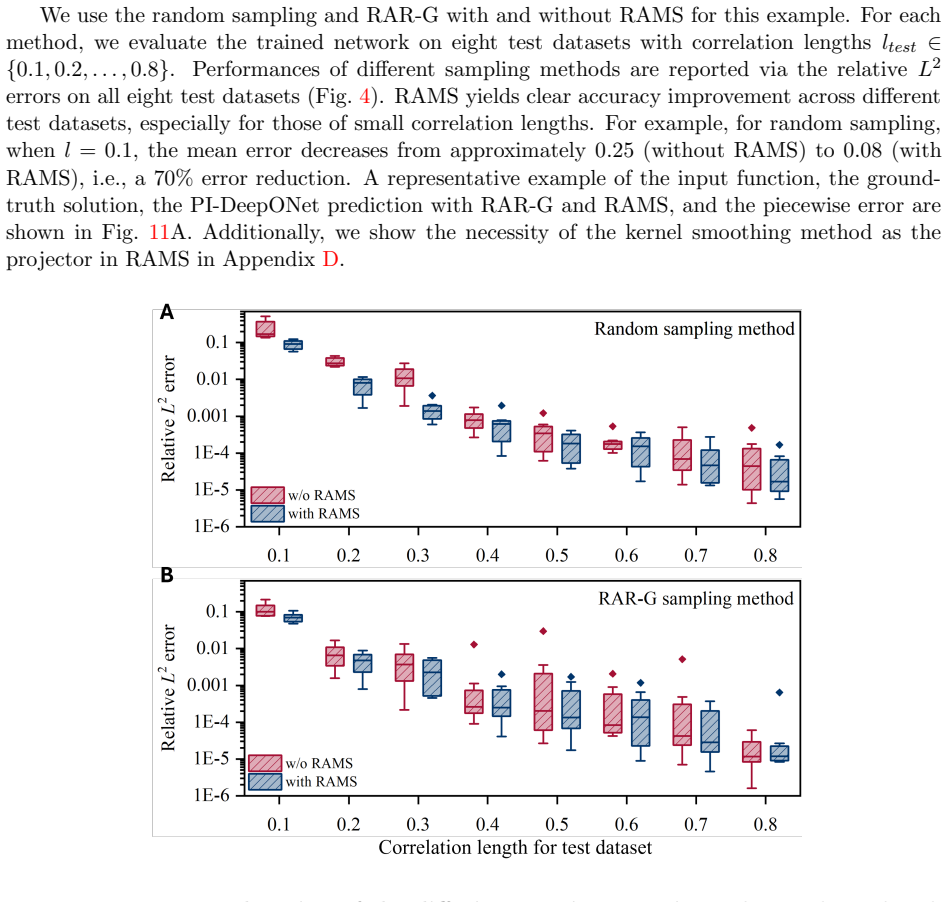
- With the same number of collocation points, RAMS reduces PINN relative L2 error by about an order of magnitude for non-adaptive samplers and by roughly 40–95% for adaptive samplers on the Burgers, wave, and Poisson tests.
- On high-dimensional PDEs, random sampling with RAMS stays below 10^-2 relative error at d=10 where plain random sampling saturates near error 1, and its measured training cost grows approximately linearly in dimension rather than exponentially.
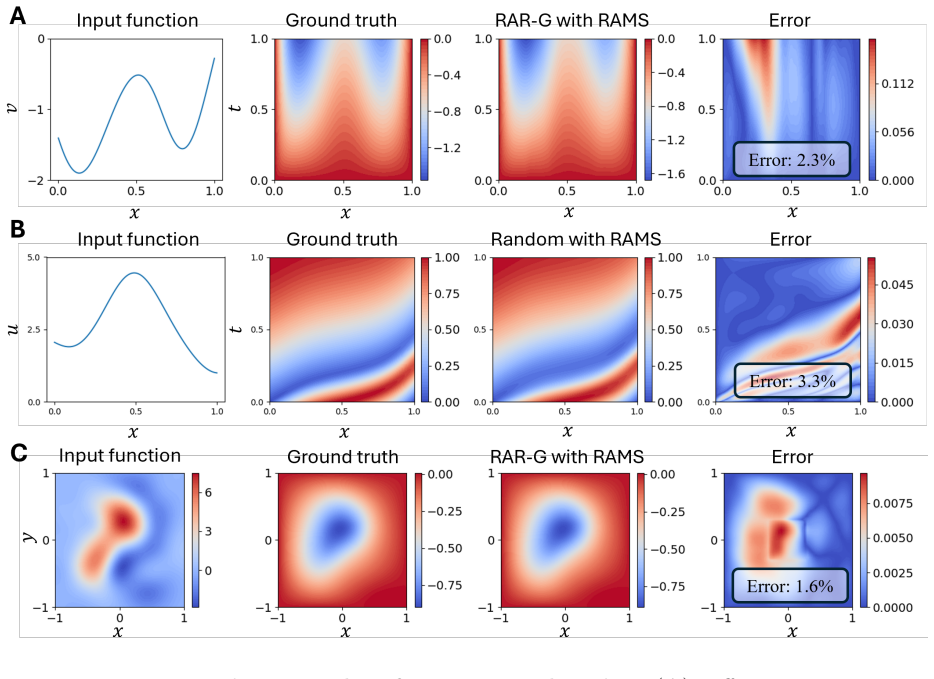
- For operator learning, RAMS provides the first efficient adaptive sampling strategy, with physics-informed DeepONets matching the accuracy of a flow-based sampler using roughly 3% of its training samples on the dynamic-system benchmark.
- In data-driven operator learning, RAMS acts as an active-learning rule, reducing error by up to 63% on the wave-equation problem and about 40% on both 2D Burgers cases with the same total dataset size.
- The extra cost of RAMS is small relative to network training: at n_RAMS=400 the reported overhead is about 2.1% of training time.
Reading between the lines
- An implication left implicit in the paper is that the same residual-gradient moving-sample loop should transfer to other operator architectures and to boundary or initial-condition residual losses, since it only requires differentiability with respect to sample inputs; a cheap test would be running RAMS on a Fourier-neural-operator training loop with the same physics loss.
- The gain presumably depends on the residual landscape being smooth enough for local gradient ascent to locate informative regions; in problems with oscillatory or measure-zero residual maxima, a wall-clock-matched comparison against uniform sampling would show whether the move pays for itself.
- For operator inputs, RAMS optimizes only the sensor values and then projects by kernel smoothing, which biases moved functions toward the covariance kernel's smoothness; a testable extension is to move samples in a whitened or latent function representation that respects the Gaussian-random-field prior exactly.
- If the heuristic is right, it suggests a broader principle: sample adaptation can be framed as an inner maximization against the current model, so the same loop could drive active data collection in other scientific machine learning settings, not just collocation-point selection.
Editorial analysis
A structured set of objections, weighed in public.
Referee Report
Summary. The paper introduces RAMS (residual-based adversarial-gradient moving sample), a sampling strategy for physics-informed and data-driven neural PDE solvers. Samples—collocation points in PINN or input functions in operator learning—are treated as trainable parameters and moved by gradient ascent on the PDE residual, optionally projected back to the admissible domain (e.g., by kernel smoothing for GRF-based operator inputs). The method is integrated with random, LHS, Halton, RAR-G, RAR-D, and R3 sampling, and is evaluated on a broad set of problems: 1D Burgers, 1D wave, 2D Poisson, a high-dimensional (up to d=10) Poisson-type PDE, physics-informed operator learning for four PDEs, and data-driven operator learning for two PDEs. The central claim is that RAMS improves accuracy without increasing the number of training samples, and that it is the first efficient adaptive sampling approach for operator learning. The paper reports large error reductions in many settings, e.g., random PINN Burgers error dropping from 0.181 to 0.010, and high-dimensional random sampling remaining below 10^-2 at d=10 with 20,000 points.
Significance. If the claims hold, RAMS would be a valuable, easily integrable plug-in for several sampling schemes, with demonstrated benefits across PINN, physics-informed operator learning, and data-driven operator learning. The manuscript's strengths are its broad benchmark suite, repeated independent runs, explicit hyperparameter tables, the projector-ablation study in Appendix D, and the direct with/without-RAMS comparisons in the PINN and physics-informed operator-learning sections. These elements support the accuracy-improvement claim more strongly than is typical for a new sampling heuristic. However, the data-driven operator-learning experiments contain a missing control that prevents attribution of the reported gains to the RAMS movement step specifically. The high-dimensional cost comparison is also weakened by per-method normalization and early termination of the baseline. No code or data are provided, which is a reproducibility concern given the number of tunable hyperparameters. Overall, the central idea is plausible and the empirical evidence is substantial for two of the three claimed application areas, but the third pillar and the cost-scaling claim need additional support befor
major comments (3)
- [§3.3, Algorithm 6, Figs. 8–9] The data-driven operator-learning experiments compare 'RAR-G with RAMS' against vanilla random sampling only. Algorithm 6 bundles two mechanisms: RAR-G's residual-based selection of m candidates from a pool of M, and RAMS's gradient-ascent movement of those selected candidates. With no arm that runs RAR-G without RAMS (n_RAMS=0) under the same nini, M, m, and tr, the reported reductions—up to 63% in Fig. 8C and about 40% in Fig. 9—cannot be attributed specifically to the RAMS movement step. The residual-selection step alone may account for a large share of the gain. Since the abstract and title credit RAMS, not the combined RAR-G+RAMS pipeline, a proper ablation (RAR-G without RAMS, with n_RAMS=0) is load-bearing and should be added.
- [§3.2.3, §3.3.1, Table 3–8] The method's performance depends on several hyperparameters whose optimal values vary by problem: n_RAMS gives best results at 300 in §3.2.3 (Fig. 6A) but at 200 in §3.3.1 (Fig. 8B), while tr, p, and the trainable fraction differ across all experiments. The paper notes that tuning is important but gives no selection criterion or default heuristic. This makes the 'consistent improvement' claim conditional on problem-specific tuning and complicates fair comparison, especially because the 'same sample count' comparisons do not count the extra computational cost of the RAMS gradient-ascent iterations. The paper should provide a sensitivity analysis or a principled way to set these parameters, and report the relative wall-clock overhead of RAMS for each experiment (not only Fig. 5D).
- [§3.1.4, Fig. 3B] The claim that RAMS reduces computational cost and scales 'approximately linearly' in dimension is based on a comparison where each method's cost is normalized by its own cost at d=2, the stopping criteria differ (doubling |T| versus tuning tr and n_RAMS), and the random-sampling baseline was not run for d≥7 due to prohibitive runtime. These choices make the normalized growth curves not directly comparable and leave the linear-scaling claim without a direct wall-clock comparison. Reporting absolute runtimes or total numbers of network forward/backward passes for both methods across d would provide the needed evidence.
minor comments (6)
- [§2.1] Typo: 'spatial-temperate coordinate' should be 'spatial-temporal coordinate'.
- [§3.2.1, equation] The diffusion-reaction equation is written as ∂u/∂t = D ∂²u/∂t² + ku² + v(x); the second derivative should be with respect to x, not t.
- [Appendix D, Fig. 14] The text in Appendix D says the ablation is for the diffusion-reaction equation, but the caption of Fig. 14 says 'advection equation'. Please correct the inconsistency.
- [§3.3.1, Fig. 8] The claim of 'up to 63%' error reduction is based on three independent runs with error bars only for RAR-G with RAMS. Given the small number of runs, adding the mean and spread for the random baseline (or reporting the underlying values) would improve the presentation.
- [Abstract] The statement that RAMS is 'the first efficient adaptive sampling approach for operator learning' is strong. The paper compares with DAS2 only in one setting and does not survey all prior adaptive operator-learning samplers; consider softening to 'the first efficient' or adding a more systematic comparison.
- [Reproducibility] No code or data are provided. Given the many hyperparameter choices and the custom algorithms, releasing code and the generated datasets would substantially strengthen reproducibility.
Circularity Check
No significant circularity: RAMS's residual-maximization objective is the algorithm itself and all reported claims are tested on independent test sets; the §3.3 missing-control issue is an attribution concern, not circularity.
full rationale
No load-bearing circular step is present. RAMS is defined as gradient ascent on the physics residual with respect to sample coordinates (Algorithm 2 and Section 2.4.1: "we treat the samples ... as trainable parameters. These trainable samples are optimized to maximize L_phy via gradient ascent based on the gradient ∇ξ(F[Nθ](ξ))²"). This is the method's definition, not a fitted target relabeled as a prediction. The central accuracy claims are measured on independent test data, e.g., Section 3.1.4 evaluates on two disjoint test sets (“E computed over two disjoint test sets [51]”), and the operator-learning examples test on held-out correlation lengths not used in training. No equation reduces by construction to a quantity fitted from the data, and no pre-fit parameter is renamed as a prediction. The many self-citations (DeepXDE [16], DeepONet [28], the sampling study [47], and related operator-learning papers) supply infrastructure, baselines, and background rather than a uniqueness theorem or a forced choice; none is invoked to rule out alternative explanations for RAMS's performance. The one legitimate methodological concern is in Section 3.3: Algorithm 6 bundles RAR-G's residual-based selection with RAMS's gradient movement, and the baselines in Figures 8-9 are vanilla random sampling only, so the marginal contribution of the movement step is not isolated. That is an experimental attribution weakness, not circularity, because no step in the derivation is equivalent to its input by construction. A score of 1 reflects the presence of ordinary self-citation in related work, not load-bearing circularity.
Assumptions & free parameters
free parameters (4)
- n_RAMS (sample-movement iterations) =
5 to 400, tuned per problem
- tr (number of resampling stages) =
20 to 160; tuned from 10 upward in the high-dimensional cost test
- trainable sample fraction (|T2| or p) =
e.g., 10-50% of samples; p=0.1, 0.2, 0.4 for 2D Burgers
- RAMS and network Adam learning rates =
1e-2 for sample movement, 1e-3 for network training
assumptions (4)
- domain assumption PDE residual magnitude is a reliable proxy for where additional training samples reduce generalization error.
- ad hoc to paper Gradient ascent on the residual with respect to sample coordinates finds globally informative high-residual regions.
- domain assumption Kernel smoothing keeps optimized input functions in the Gaussian random field prior class.
- domain assumption Numerical solvers that generate labels for data-driven operator learning are exact enough.
Cite this review
Pith. "Pith review of RAMS: Residual-based adversarial-gradient moving sample method for scientific machine learning in solving partial differential equations." pith.science (2026). https://pith.science/paper/PBAOWENI
@misc{pith2026250901234,
  author       = {Pith},
  title        = {Pith review of: RAMS: Residual-based adversarial-gradient moving sample method for scientific machine learning in solving partial differential equations},
  year         = {2026},
  howpublished = {\url{https://pith.science/paper/PBAOWENI}},
  note         = {Machine review of arXiv:2509.01234}
}
read the original abstract
Physics-informed neural networks (PINNs) and neural operators, two leading scientific machine learning (SciML) paradigms, have emerged as powerful tools for solving partial differential equations (PDEs). Although increasing the training sample size generally enhances network performance, it also increases computational costs for physics-informed or data-driven training. To address this trade-off, different sampling strategies have been developed to sample more points in regions with high PDE residuals. However, existing sampling methods are computationally demanding for high-dimensional problems, such as high-dimensional PDEs or operator learning tasks. Here, we propose a residual-based adversarial-gradient moving sample (RAMS) method, which moves samples according to the adversarial gradient direction to maximize the PDE residual via gradient-based optimization. RAMS can be easily integrated into existing sampling methods. Extensive experiments, ranging from PINN applied to high-dimensional PDEs to physics-informed and data-driven operator learning problems, have been conducted to demonstrate the effectiveness of RAMS. Notably, RAMS represents the first efficient adaptive sampling approach for operator learning, marking a significant advancement in the SciML field.
Figures


Figures from the paper (11 more)




Reference graph
Works this paper leans on
-
[52]
Deep adaptive sampling for surrogate modeling without labeled data
Xili Wang, Kejun Tang, Jiayu Zhai, Xiaoliang Wan, and Chao Yang. Deep adaptive sampling for surrogate modeling without labeled data. arXiv:2402.11283, 2024
work page Pith review arXiv 2024
-
[1]
Highly accurate protein structure prediction with alphafold
John Jumper, Richard Evans, Alexander Pritzel, Tim Green, Michael Figurnov, Olaf Ron- neberger, Kathryn Tunyasuvunakool, Russ Bates, Augustin ˇZ ´ ıdek, Anna Potapenko, et al. Highly accurate protein structure prediction with alphafold. Nature, 596(7873):583–589, 2021
work page 2021
-
[2]
Prob- abilistic weather forecasting with machine learning
Ilan Price, Alvaro Sanchez-Gonzalez, Ferran Alet, Tom R Andersson, Andrew El-Kadi, Do- minic Masters, Timo Ewalds, Jacklynn Stott, Shakir Mohamed, Peter Battaglia, et al. Prob- abilistic weather forecasting with machine learning. Nature, 637(8044):84–90, 2025
work page 2025
-
[3]
Denoising diffusion probabilistic models
Jonathan Ho, Ajay Jain, and Pieter Abbeel. Denoising diffusion probabilistic models. Advances in Neural Information Processing Systems , 33:6840–6851, 2020
2020
-
[4]
Operator learning for predicting multiscale bubble growth dynamics
Chensen Lin, Zhen Li, Lu Lu, Shengze Cai, Martin Maxey, and George Em Karniadakis. Operator learning for predicting multiscale bubble growth dynamics. The Journal of Chemical Physics, 154(10), 2021
work page 2021
-
[5]
Systems biology informed deep learning for inferring parameters and hidden dynamics
Alireza Yazdani, Lu Lu, Maziar Raissi, and George Em Karniadakis. Systems biology informed deep learning for inferring parameters and hidden dynamics. PLoS Computational Biology , 16(11):e1007575, 2020
work page 2020
-
[6]
Promising directions of machine learning for partial differential equations
Steven L Brunton and J Nathan Kutz. Promising directions of machine learning for partial differential equations. Nature Computational Science , 4(7):483–494, 2024
work page 2024
-
[7]
Artifi- cial intelligence for partial differential equations in computational mechanics: A review
Yizheng Wang, Jinshuai Bai, Zhongya Lin, Qimin Wang, Cosmin Anitescu, Jia Sun, Mo- hammad Sadegh Eshaghi, Yuantong Gu, Xi-Qiao Feng, Xiaoying Zhuang, et al. Artifi- cial intelligence for partial differential equations in computational mechanics: A review. arXiv:2410.19843, 2024
Show all 64 references
-
[8]
Neural operator prediction of linear instability waves in high-speed boundary layers
Patricio Clark Di Leoni, Lu Lu, Charles Meneveau, George Em Karniadakis, and Tamer A Zaki. Neural operator prediction of linear instability waves in high-speed boundary layers. Journal of Computational Physics , 474:111793, 2023
2023
-
[9]
Identifying heterogeneous micromechanical properties of biological tissues via physics-informed neural networks
Wensi Wu, Mitchell Daneker, Kevin T Turner, Matthew A Jolley, and Lu Lu. Identifying heterogeneous micromechanical properties of biological tissues via physics-informed neural networks. Small Methods , 9(1):2400620, 2025. 29
2025
-
[10]
A noninvasive method for determining elastic parameters of valve tissue using physics-informed neural networks
Wensi Wu, Mitchell Daneker, Christian Herz, Hannah Dewey, Jeffrey A Weiss, Alison M Pouch, Lu Lu, and Matthew A Jolley. A noninvasive method for determining elastic parameters of valve tissue using physics-informed neural networks. Acta Biomaterialia, 2025
2025
-
[11]
Neural-operator element method: Efficient and scalable finite element method enabled by reusable neural operators
Weihang Ouyang, Yeonjong Shin, Si-Wei Liu, and Lu Lu. Neural-operator element method: Efficient and scalable finite element method enabled by reusable neural operators. arXiv:2506.18427, 2025
2025 arXiv
-
[12]
Data-driven iden- tification of parametric partial differential equations
Samuel Rudy, Alessandro Alla, Steven L Brunton, and J Nathan Kutz. Data-driven iden- tification of parametric partial differential equations. SIAM Journal on Applied Dynamical Systems, 18(2):643–660, 2019
2019
-
[13]
Data-driven deep learning of partial differential equations in modal space
Kailiang Wu and Dongbin Xiu. Data-driven deep learning of partial differential equations in modal space. Journal of Computational Physics , 408:109307, 2020
2020
-
[14]
Data driven approximation of parametrized PDEs by reduced basis and neural networks
Niccol` o Dal Santo, Simone Deparis, and Luca Pegolotti. Data driven approximation of parametrized PDEs by reduced basis and neural networks. Journal of Computational Physics , 416:109550, 2020
2020
-
[15]
Physics-informed neural networks: A deep learning framework for solving forward and inverse problems involving nonlinear partial differential equations
Maziar Raissi, Paris Perdikaris, and George E Karniadakis. Physics-informed neural networks: A deep learning framework for solving forward and inverse problems involving nonlinear partial differential equations. Journal of Computational Physics , 378:686–707, 2019
2019
-
[16]
DeepXDE: A deep learning library for solving differential equations
Lu Lu, Xuhui Meng, Zhiping Mao, and George Em Karniadakis. DeepXDE: A deep learning library for solving differential equations. SIAM Review, 63(1):208–228, 2021
2021
-
[17]
Physics-informed machine learning
George Em Karniadakis, Ioannis G Kevrekidis, Lu Lu, Paris Perdikaris, Sifan Wang, and Liu Yang. Physics-informed machine learning. Nature Reviews Physics , 3(6):422–440, 2021
2021
-
[18]
Scientific machine learning through physics–informed neural networks: Where we are and what’s next
Salvatore Cuomo, Vincenzo Schiano Di Cola, Fabio Giampaolo, Gianluigi Rozza, Maziar Raissi, and Francesco Piccialli. Scientific machine learning through physics–informed neural networks: Where we are and what’s next. Journal of Scientific Computing , 92(3):88, 2022
2022
-
[19]
Physics-informed neural networks for inverse problems in nano-optics and metamaterials
Yuyao Chen, Lu Lu, George Em Karniadakis, and Luca Dal Negro. Physics-informed neural networks for inverse problems in nano-optics and metamaterials. Optics Express, 28(8):11618– 11633, 2020
2020
-
[20]
PINNacle: A comprehensive benchmark of physics- informed neural networks for solving PDEs
Hao Zhongkai, Jiachen Yao, Chang Su, Hang Su, Ziao Wang, Fanzhi Lu, Zeyu Xia, Yichi Zhang, Songming Liu, Lu Lu, et al. PINNacle: A comprehensive benchmark of physics- informed neural networks for solving PDEs. Advances in Neural Information Processing Sys- tems, 37:76721–76774, 2024
2024
-
[21]
Automatic differentiation in PyTorch
Adam Paszke, Sam Gross, Soumith Chintala, Gregory Chanan, Edward Yang, Zachary DeVito, Zeming Lin, Alban Desmaison, Luca Antiga, and Adam Lerer. Automatic differentiation in PyTorch. 2017
2017
-
[22]
fPINNs: Fractional physics-informed neural networks
Guofei Pang, Lu Lu, and George Em Karniadakis. fPINNs: Fractional physics-informed neural networks. SIAM Journal on Scientific Computing , 41(4):A2603–A2626, 2019
2019
-
[23]
Quantifying total uncertainty in physics-informed neural networks for solving forward and inverse stochastic problems
Dongkun Zhang, Lu Lu, Ling Guo, and George Em Karniadakis. Quantifying total uncertainty in physics-informed neural networks for solving forward and inverse stochastic problems. Jour- nal of Computational Physics , 397:108850, 2019. 30
2019
-
[24]
Physics-informed neural networks with hard constraints for inverse design
Lu Lu, Raphael Pestourie, Wenjie Yao, Zhicheng Wang, Francesc Verdugo, and Steven G Johnson. Physics-informed neural networks with hard constraints for inverse design. SIAM Journal on Scientific Computing , 43(6):B1105–B1132, 2021
2021
-
[25]
Dive into deep learning
Aston Zhang, Zachary C Lipton, Mu Li, and Alexander J Smola. Dive into deep learning. arXiv:2106.11342, 2021
2021 arXiv
-
[26]
Physics-informed multi-LSTM networks for meta- modeling of nonlinear structures
Ruiyang Zhang, Yang Liu, and Hao Sun. Physics-informed multi-LSTM networks for meta- modeling of nonlinear structures. Computer Methods in Applied Mechanics and Engineering , 369:113226, 2020
2020
-
[27]
Approximation theory of the MLP model in neural networks
Allan Pinkus. Approximation theory of the MLP model in neural networks. Acta Numerica, 8:143–195, 1999
1999
-
[28]
Learning nonlinear operators via DeepONet based on the universal approximation theorem of operators
Lu Lu, Pengzhan Jin, Guofei Pang, Zhongqiang Zhang, and George Em Karniadakis. Learning nonlinear operators via DeepONet based on the universal approximation theorem of operators. Nature Machine Intelligence , 3(3):218–229, 2021
2021
-
[29]
Koop- man neural operator as a mesh-free solver of non-linear partial differential equations
Wei Xiong, Xiaomeng Huang, Ziyang Zhang, Ruixuan Deng, Pei Sun, and Yang Tian. Koop- man neural operator as a mesh-free solver of non-linear partial differential equations. Journal of Computational Physics , page 113194, 2024
2024
-
[30]
Approximations of continuous functionals by neural networks with application to dynamic systems
Tianping Chen and Hong Chen. Approximations of continuous functionals by neural networks with application to dynamic systems. IEEE Transactions on Neural networks , 4(6):910–918, 1993
1993
-
[31]
A comprehensive and fair comparison of two neural operators (with practical extensions) based on F AIR data.Computer Methods in Applied Mechanics and Engineering, 393:114778, 2022
Lu Lu, Xuhui Meng, Shengze Cai, Zhiping Mao, Somdatta Goswami, Zhongqiang Zhang, and George Em Karniadakis. A comprehensive and fair comparison of two neural operators (with practical extensions) based on F AIR data.Computer Methods in Applied Mechanics and Engineering, 393:11...
2022
-
[32]
Multifidelity deep neural operators for efficient learning of partial differential equations with application to fast inverse design of nanoscale heat transport
Lu Lu, Rapha¨ el Pestourie, Steven G Johnson, and Giuseppe Romano. Multifidelity deep neural operators for efficient learning of partial differential equations with application to fast inverse design of nanoscale heat transport. Physical Review Research, 4(2):023210, 2022
2022
-
[33]
Fourier-DeepONet: Fourier-enhanced deep operator networks for full waveform inversion with improved accuracy, generalizability, and robustness
Min Zhu, Shihang Feng, Youzuo Lin, and Lu Lu. Fourier-DeepONet: Fourier-enhanced deep operator networks for full waveform inversion with improved accuracy, generalizability, and robustness. Computer Methods in Applied Mechanics and Engineering , 416:116300, 2023
2023
-
[34]
A scalable framework for learning the geometry-dependent solution operators of partial differential equations
Minglang Yin, Nicolas Charon, Ryan Brody, Lu Lu, Natalia Trayanova, and Mauro Mag- gioni. A scalable framework for learning the geometry-dependent solution operators of partial differential equations. Nature Computational Science , 4(12):928–940, 2024
2024
-
[35]
DeepM&Mnet: Inferring the electroconvection multiphysics fields based on operator approxi- mation by neural networks
Shengze Cai, Zhicheng Wang, Lu Lu, Tamer A Zaki, and George Em Karniadakis. DeepM&Mnet: Inferring the electroconvection multiphysics fields based on operator approxi- mation by neural networks. Journal of Computational Physics , 436:110296, 2021
2021
-
[36]
DeepM&Mnet for hypersonics: Predicting the coupled flow and finite-rate chemistry behind a normal shock using neural-network approximation of operators
Zhiping Mao, Lu Lu, Olaf Marxen, Tamer A Zaki, and George Em Karniadakis. DeepM&Mnet for hypersonics: Predicting the coupled flow and finite-rate chemistry behind a normal shock using neural-network approximation of operators. Journal of Computational Physics , 447:110698, 2021. 31
2021
-
[37]
Stochastic operator network: A stochastic maximum principle based approach to operator learning
Ryan Bausback, Jingqiao Tang, Lu Lu, Feng Bao, and Toan Huynh. Stochastic operator network: A stochastic maximum principle based approach to operator learning. arXiv preprint arXiv:2507.10401, 2025
2025
-
[38]
Fundiff: Diffusion models over function spaces for physics-informed generative modeling
Sifan Wang, Zehao Dou, Tong-Rui Liu, and Lu Lu. Fundiff: Diffusion models over function spaces for physics-informed generative modeling. arXiv preprint arXiv:2506.07902 , 2025
2025
-
[39]
Quantum DeepONet: Neural operators accelerated by quantum computing
Pengpeng Xiao, Muqing Zheng, Anran Jiao, Xiu Yang, and Lu Lu. Quantum DeepONet: Neural operators accelerated by quantum computing. Quantum, 9:1761, 2025
2025
-
[40]
MIONet: Learning multiple-input operators via tensor product
Pengzhan Jin, Shuai Meng, and Lu Lu. MIONet: Learning multiple-input operators via tensor product. SIAM Journal on Scientific Computing , 44(6):A3490–A3514, 2022
2022
-
[41]
Fourier neural operator for parametric partial differential equations
Zongyi Li, Nikola Kovachki, Kamyar Azizzadenesheli, Burigede Liu, Kaushik Bhattacharya, Andrew Stuart, and Anima Anandkumar. Fourier neural operator for parametric partial differential equations. arXiv:2010.08895, 2020
2010 arXiv
-
[42]
Efficient and generalizable nested Fourier-DeepONet for three-dimensional geological carbon sequestration
Jonathan E Lee, Min Zhu, Ziqiao Xi, Kun Wang, Yanhua O Yuan, and Lu Lu. Efficient and generalizable nested Fourier-DeepONet for three-dimensional geological carbon sequestration. Engineering Applications of Computational Fluid Mechanics , 18(1):2435457, 2024
2024
-
[43]
Wavelet neural operator for solving parametric partial differential equations in computational mechanics problems
Tapas Tripura and Souvik Chakraborty. Wavelet neural operator for solving parametric partial differential equations in computational mechanics problems. Computer Methods in Applied Mechanics and Engineering , 404:115783, 2023
2023
-
[44]
Laplace neural operator for solving differential equations
Qianying Cao, Somdatta Goswami, and George Em Karniadakis. Laplace neural operator for solving differential equations. Nature Machine Intelligence , 6(6):631–640, 2024
2024
-
[45]
Efficient training of physics-informed neural networks via importance sampling
Mohammad Amin Nabian, Rini Jasmine Gladstone, and Hadi Meidani. Efficient training of physics-informed neural networks via importance sampling. Computer-Aided Civil and Infras- tructure Engineering, 36(8):962–977, 2021
2021
-
[46]
Gradient-enhanced physics- informed neural networks for forward and inverse pde problems
Jeremy Yu, Lu Lu, Xuhui Meng, and George Em Karniadakis. Gradient-enhanced physics- informed neural networks for forward and inverse pde problems. Computer Methods in Applied Mechanics and Engineering , 393:114823, 2022
2022
-
[47]
A comprehensive study of non-adaptive and residual-based adaptive sampling for physics-informed neural networks
Chenxi Wu, Min Zhu, Qinyang Tan, Yadhu Kartha, and Lu Lu. A comprehensive study of non-adaptive and residual-based adaptive sampling for physics-informed neural networks. Computer Methods in Applied Mechanics and Engineering , 403:115671, 2023
2023
-
[48]
Residual-based adaptivity for two-phase flow simulation in porous media using physics-informed neural networks
John M Hanna, Jose V Aguado, Sebastien Comas-Cardona, Ramzi Askri, and Domenico Borzacchiello. Residual-based adaptivity for two-phase flow simulation in porous media using physics-informed neural networks. Computer Methods in Applied Mechanics and Engineering , 396:115100, 2022
2022
-
[49]
Mitigating propaga- tion failures in physics-informed neural networks using retain-resample-release (R3) sampling
Arka Daw, Jie Bu, Sifan Wang, Paris Perdikaris, and Anuj Karpatne. Mitigating propaga- tion failures in physics-informed neural networks using retain-resample-release (R3) sampling. arXiv:2207.02338, 2022
2022 arXiv
-
[50]
Importance sampling: a review
Surya T Tokdar and Robert E Kass. Importance sampling: a review. Wiley Interdisciplinary Reviews: Computational Statistics , 2(1):54–60, 2010. 32
2010
-
[51]
DAS-PINNs: A deep adaptive sampling method for solving high-dimensional partial differential equations
Kejun Tang, Xiaoliang Wan, and Chao Yang. DAS-PINNs: A deep adaptive sampling method for solving high-dimensional partial differential equations. Journal of Computational Physics , 476:111868, 2023
2023
-
[53]
Annealed adaptive importance sampling method in PINNs for solving high dimensional partial differential equations
Zhengqi Zhang, Jing Li, and Bin Liu. Annealed adaptive importance sampling method in PINNs for solving high dimensional partial differential equations. Journal of Computational Physics, 521:113561, 2025
2025
-
[54]
Adam: A method for stochastic optimization
Diederik P Kingma. Adam: A method for stochastic optimization. arXiv:1412.6980, 2014
2014 arXiv
-
[55]
PhyGeoNet: Physics-informed geometry-adaptive convolutional neural networks for solving parameterized steady-state PDEs on irregular do- main
Han Gao, Luning Sun, and Jian-Xun Wang. PhyGeoNet: Physics-informed geometry-adaptive convolutional neural networks for solving parameterized steady-state PDEs on irregular do- main. Journal of Computational Physics , 428:110079, 2021
2021
-
[56]
Machine learning-based soil– structure interaction analysis of laterally loaded piles through physics-informed neural net- works
Weihang Ouyang, Guanhua Li, Liang Chen, and Si-Wei Liu. Machine learning-based soil– structure interaction analysis of laterally loaded piles through physics-informed neural net- works. Acta Geotechnica, pages 1–26, 2024
2024
-
[57]
Physics-informed neural net- works for large deflection analysis of slender piles incorporating non-differentiable soil-structure interaction
Weihang Ouyang, Guan-Hua Li, Liang Chen, and Si-Wei Liu. Physics-informed neural net- works for large deflection analysis of slender piles incorporating non-differentiable soil-structure interaction. International Journal for Numerical and Analytical Methods in Geomechanics , ...
2024
-
[58]
Kernel smoothing
Matt P Wand and M Chris Jones. Kernel smoothing. CRC press, 1994
1994
-
[59]
Neural topology optimization via active learning for efficient channel design in turbulent mass transfer
Chenhui Kou, Yuhui Yin, Min Zhu, Shengkun Jia, Yiqing Luo, Xigang Yuan, and Lu Lu. Neural topology optimization via active learning for efficient channel design in turbulent mass transfer. Advanced Science, page e08386, 2025
2025
-
[60]
Active operator learning with predictive uncertainty quantification for partial differential equations
Nick Winovich, Mitchell Daneker, Lu Lu, and Guang Lin. Active operator learning with predictive uncertainty quantification for partial differential equations. arXiv:2503.03178, 2025
2025
-
[61]
A collection of 2D elliptic problems for testing adaptive grid refinement algorithms
William F Mitchell. A collection of 2D elliptic problems for testing adaptive grid refinement algorithms. Applied Mathematics and Computation , 220:350–364, 2013
2013
-
[62]
Learning the solution operator of para- metric partial differential equations with physics-informed DeepONets
Sifan Wang, Hanwen Wang, and Paris Perdikaris. Learning the solution operator of para- metric partial differential equations with physics-informed DeepONets. Science Advances, 7(40):eabi8605, 2021
2021
-
[63]
Global stabilization of two dimensional viscous Burg- ers’ equation by nonlinear Neumann boundary feedback control and its finite element analysis
Sudeep Kundu and Amiya Kumar Pani. Global stabilization of two dimensional viscous Burg- ers’ equation by nonlinear Neumann boundary feedback control and its finite element analysis. Journal of Scientific Computing , 84(3):45, 2020
2020
-
[64]
PROSE: Predicting multiple operators and symbolic expressions using multimodal transformers
Yuxuan Liu, Zecheng Zhang, and Hayden Schaeffer. PROSE: Predicting multiple operators and symbolic expressions using multimodal transformers. Neural Networks, 180:106707, 2024. 33
2024
Reviewed August 5, 2026 · model on record in the stance chip above.
Discussion (0). Sign in to comment.