REVIEW 2 major objections 6 minor 1 cited by
Study of kaon structure using the light-cone quark model
T0 review · 2 major / 6 minor · reviewed 2026-08-14 · deepseek-v4-flash
Pith's one-line read The paper claims that the light-cone quark model, with the Brodsky-Huang-Lepage wavefunction, maps the kaon's multi-dimensional parton structure and predicts opposite spin-orbit correlations for the u quark (-0.234) and the anti-s quark…
desk verdict A competent LCQM extension from pion to kaon; the spin-orbit numbers are fine under the Section VII convention, but the summary reverses their meaning and must be corrected. read the letter →
The pith
A machine-rendered reading of the paper's core claim, the machinery that carries it, and where it could break.
The reading
What carries the argument
The load-bearing object is the Brodsky-Huang-Lepage momentum-space wavefunction of Eq. (11), an exponential in the quark transverse momentum $k_\perp$, the longitudinal momentum fraction $x$, the quark masses $m_1=0.25$ GeV and $m_2=0.5$ GeV, and the harmonic-scale parameter $\beta=0.393$ GeV. Because the wavefunction is written in the same $x$ and $k_\perp$ variables that appear in the quark-field correlators, every distribution in the paper—GPDs, impact-parameter GPDs, Wigner distributions, and GTMDs—is obtained as an overlap integral of this single object with its initial- and final-state momentum arguments shifted by the skewedness and transverse momentum transfer. The machinery is completed by the flavor-reversal relation that maps $u$-quark distributions to $\bar{s}$-quark distributions by exchanging the masses and reversing $x$ and $k_\perp$.
What would settle it
Measure the kaon's leading-twist GTMDs, for instance the $\tilde{G}_1$ that enters the spin-orbit correlation, through an exclusive double Drell-Yan process with a kaon beam, and compare the $x$ and transverse-momentum dependence as well as the integrated signs of $C^u_z$ and $C^{\bar{s}}_z$; if the measured signs are not opposite, or the GPD peak shifts with $\zeta$ and $-t$ are absent, the BHL wavefunction's extrapolation to these sectors is ruled out.
Extended reading notes
Core claim
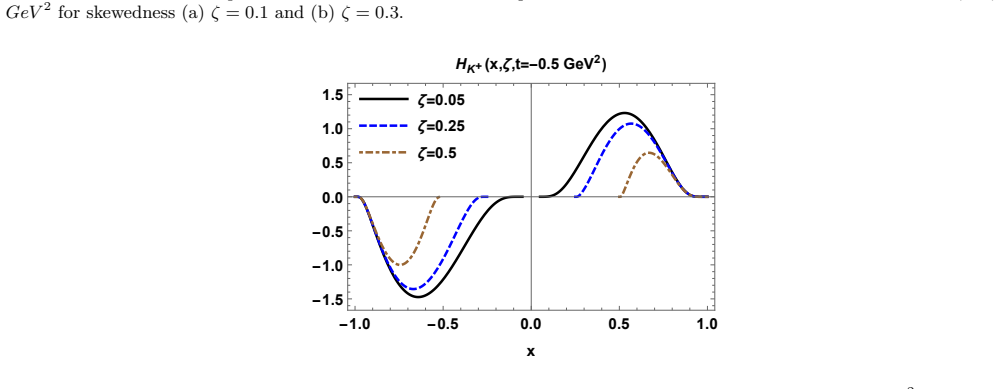
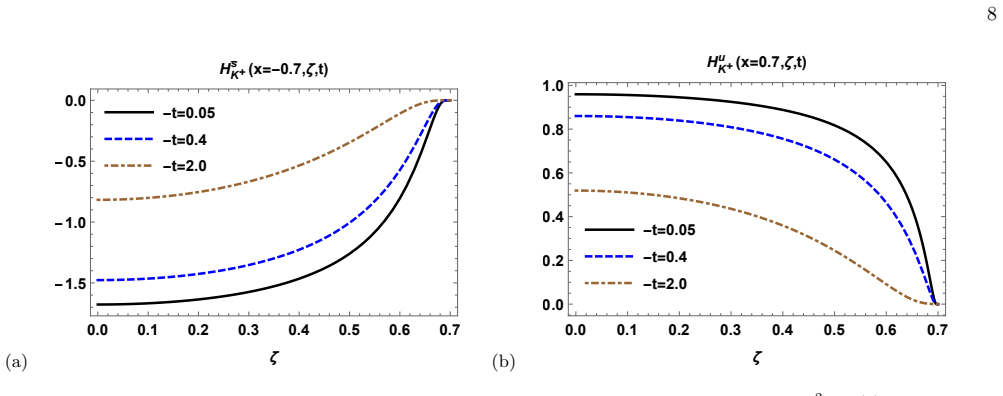
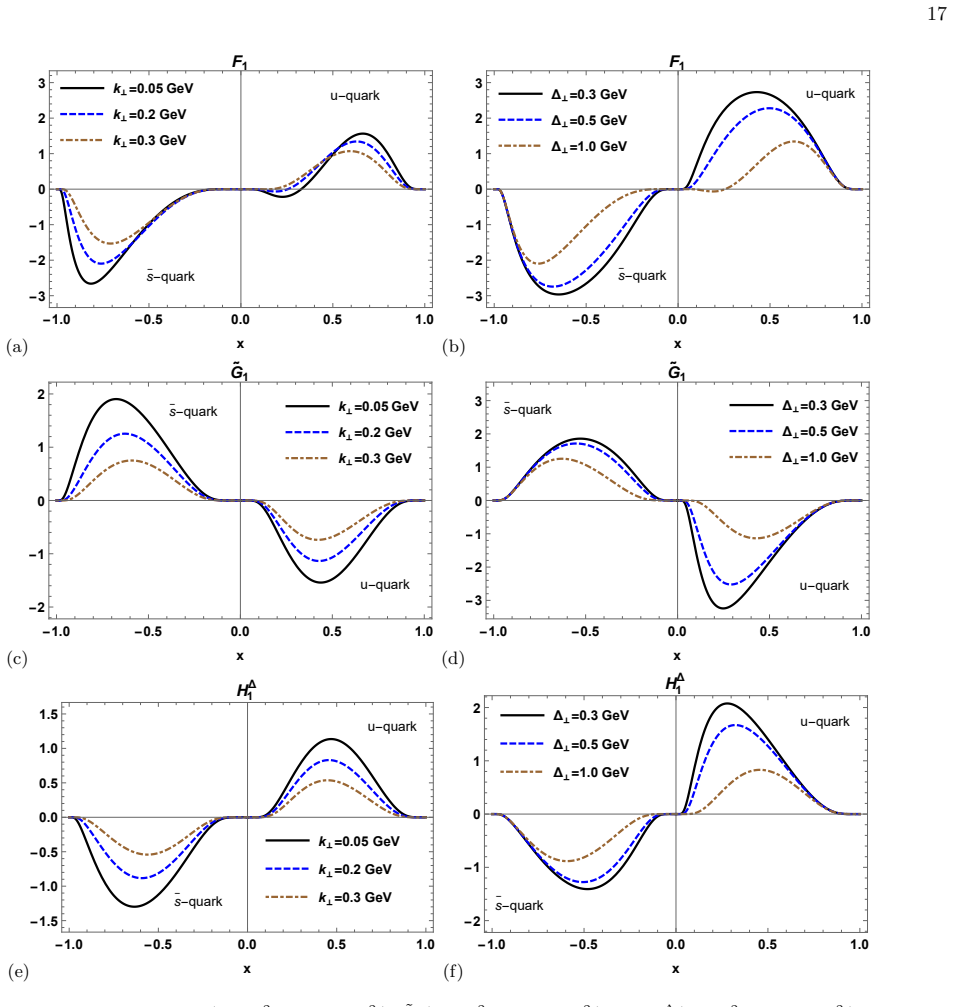
Using the overlap representation of the two-particle light-cone Fock state, the paper derives the kaon's unpolarized GPD $H(x,\zeta,t)$ for both $u$ and $\bar{s}$ in the DGLAP regions, with the $\bar{s}$ acting as spectator when the $u$ is active and vice versa. The GPDs peak at low longitudinal momentum fraction and low momentum transfer, shift toward higher $|x|$ as $\zeta$ or $-t$ grows, and vanish at $x=\zeta$ for the quark and $x=-\zeta$ for the antiquark. Fourier transforming in the transverse momentum transfer gives impact-parameter dependent GPDs that are maximal at the transverse center and migrate to lower $|x|$ with increasing $b_\perp$. The Wigner distributions $\rho_{UU}$, $\rho_{UL}$, and $\rho_{UT}$ in the impact-parameter, transverse-momentum, and mixed planes show respectively symmetric, dipolar/quadrupolar, and dipolar patterns, with the heavier $\bar{s}$ more concentrated at the center. The mother GTMDs $F_1$, $\tilde{G}_1$, $H^k_1$, and $H^\Delta_1$ are computed for $\zeta=0$ and $\zeta\neq 0$; $H^k_1$ vanishes at $\zeta=0$, and $\tilde{G}_1$ feeds the spin-orbit correlation. The central numerical result is $C^u_z=-0.234$ and $C^{\bar{s}}_z=+0.176$, which the paper reads as opposite spin-orbit alignment for the two valence partons.
Load-bearing premise
The load-bearing premise is that the Brodsky-Huang-Lepage wavefunction, with masses and $\beta$ fixed by the kaon electromagnetic form factor, also fixes the full transverse- and longitudinal-momentum dependence of the Wigner and GTMD sectors, which no data constrains; if that extrapolation fails, the quoted distribution shapes and the spin-orbit correlation values are not reliable.
Editorial extensions
If this is right
- The computed GPDs predict that the kaon's valence $u$ and $\bar{s}$ distributions respond oppositely to longitudinal momentum transfer, with the heavier $\bar{s}$ showing smaller amplitude shifts; future deeply virtual Compton scattering on kaon targets can check this asymmetry.
- The impact-parameter dependent GPDs imply that both valence partons sit near the transverse center of the kaon, with the $\bar{s}$ concentrated at slightly higher $|x|$ than the $u$, giving a spatial image of the mass asymmetry.
- The GTMD $F_1$ reduces in the appropriate limits to the ordinary GPD $H$ and TMD $f_1$, so the model derives longitudinal and transverse momentum structure from a single wavefunction.
- In the paper's sign convention, $C^{\bar{s}}_z=+0.176$ and $C^u_z=-0.234$ mean the heavy strange quark's orbital motion aligns with its spin while the light up quark's opposes it.
- Because gluon and sea-quark contributions are omitted, the model predicts that the T-odd TMDs and GPDs connected to $H^k_1$ and $H^\Delta_1$ vanish at leading twist.
Reading between the lines
- If the opposite spin-orbit signs survive in data, the sign flip is naturally tied to the valence mass asymmetry; the same mechanism would predict that in other heavy-light pseudoscalars, such as $D$ or $B$ mesons, the heavy quark's correlation stays positive while the light quark's is negative.
- A direct test would extract $\tilde{G}_1$ from an exclusive double Drell-Yan measurement on a kaon; because the model's parameters are fixed by the form factor, even the sign pattern of $C_z$ is a discriminating observable.
- The pion comparison in the paper suggests a flavor-symmetric limit: as $m_1 \to m_2$, the two kaon correlations should merge into the single pion value $C_z=-0.159$; computing the full mass-ratio dependence would show whether the $u$-quark sign flips continuously or jumps.
Signed reviews
Editorial analysis
A structured set of objections, weighed in public.
Referee Report
Summary. The paper uses the light-cone quark model with the Brodsky-Huang-Lepage momentum-space wavefunction to compute a broad set of leading-twist distributions for the valence u quark and ¯s antiquark in the kaon: GPDs with nonzero skewedness, impact-parameter dependent GPDs, Wigner distributions in various polarization configurations, GTMDs for zero and nonzero skewedness, and spin-orbit correlations C_z for the u and ¯s constituents. The main numerical results are the integrated spin-orbit correlations C_u = -0.234 and C_¯s = 0.176, which the authors interpret as indicating opposite alignment of spin and orbital angular momentum for the u and ¯s quarks.
Significance. If the calculations are correct, the paper provides the first extensive model survey of multi-dimensional parton distributions for the kaon in a light-cone quark model, extending prior pion studies to the unequal-mass case and making specific falsifiable predictions for the sign and magnitude of the spin-orbit correlations. The analytic overlap expressions, the explicit flavor-decomposition relations, and the graphical maps in impact-parameter, momentum, and mixed planes are useful reference results for model comparisons and for planning future exclusive kaon measurements. However, the central quantitative claim is undermined by an internal contradiction in the sign interpretation of C_z between Sections VII and VIII, and the derivation of the key GTMD formula is not shown.
major comments (2)
- [§VII and §VIII, Eq. (65), Fig. 11] The paper contains a direct contradiction in the interpretation of the spin-orbit correlation. Section VII states that C_z > 0 favors alignment of quark spin and OAM and C_z < 0 favors anti-alignment, and after reporting C_¯s = 0.176 and C_u = -0.234 it concludes that the ¯s OAM is parallel to the ¯s spin while the u OAM is anti-parallel to the u spin. Section VIII, in the summary, asserts the opposite: "¯s quark's spin and OAM are anti-aligned whereas u quark's spin and OAM are aligned." Both statements cannot be correct. Since the opposite signs of C_u and C_¯s are the principal new physics claim of the paper, this inconsistency is load-bearing and must be resolved, either by correcting the sign convention or by fixing the summary.
- [§VII, Eqs. (66)-(68)] The step leading from the Wigner-distribution expression for C_z in Eq. (66) to the GTMD expression in Eq. (68) is not shown. The integration over b⊥ involves an integration by parts of the derivative acting on ˜G1, and the sign of the resulting expression depends on the boundary terms and on the sign convention in Eq. (66). Because a sign error in this derivation would flip which quark is aligned with its OAM, the authors should provide the full derivation or a precise reference for the transformation. As written, the reader cannot verify that the quoted numbers C_u = -0.234 and C_¯s = 0.176 actually follow from the definition stated in Eq. (65).
minor comments (6)
- [Eq. (38)] There is a typo in the last term of Eq. (38): "ψv0" should be "ψ↓,↓0". The same equation also has a missing subscript on the second wavefunction in the third term.
- [§V, Fig. 7 and surrounding text] The text states that ρUL is positive for bx > 0 in the impact-parameter plane, while in the momentum plane it "reverses the direction" and is positive for bx < 0; the notation bx is used for a momentum-space coordinate in the latter discussion, which is confusing. The authors should consistently distinguish b⊥ and k⊥ coordinates when describing the dipole orientations.
- [§II, Eq. (11) and §III, parameters] The parameter values m1, m2, β, and A are stated to reproduce the kaon electromagnetic form factor, but no uncertainty estimates or sensitivity checks are provided for the quoted C_z values. A brief discussion of how the results vary with reasonable parameter changes would strengthen the model predictions.
- [§V after Fig. 8] The sentence "The distribution shows a dipolar behaviour in mixed space due to its symmetry in the momentum plane as well as in in the impact-parameter plane" contains a duplicated "in" and the reasoning is unclear.
- [§VIII] The phrase "which is because of the heavier active quark mass in case of bars quark" contains a typo: "bars quark" should be "¯s quark".
- [§VI, Eq. (58) and relation to Eq. (20)] The flavor relation in Eq. (58) is written for the GTMDs but the paper does not explicitly state whether the other ¯s-quark GTMD expressions (59)-(62) are obtained from this relation or by direct overlap calculation; a short explanation of the derivation would avoid ambiguity.
Circularity Check
No significant circularity; the kaon distributions and spin-orbit correlations are explicit outputs of the BHL wavefunction with externally fixed parameters.
full rationale
The paper's derivation chain is self-contained in the sense that no predicted quantity is fed back into the model. The BHL momentum-space wavefunction, Eq. (11), uses the parameters m1 = 0.25 GeV, m2 = 0.5 GeV, beta = 0.393 GeV, and A = 74.2, which are taken from the earlier external form-factor study [67] rather than fitted to the GPD, Wigner, GTMD, or spin-orbit results presented here. The GPD overlap formula Eq. (13), Wigner overlap expressions Eqs. (37)-(39), and GTMD expressions Eqs. (54)-(62) are direct evaluations from this same wavefunction with stated kinematics; none of the target distributions appear as inputs. The flavor relations Eq. (20), Eq. (43), and Eq. (58) are algebraic symmetry relations connecting quark and antiquark distributions, not independent fitted inputs. The spin-orbit correlation is obtained by integrating the longitudinally-polarized Wigner distribution, via Eq. (65), and then expressed in terms of the GTMD G~1 through the standard integration by parts leading to Eq. (68); the quoted values C_sbar_z = 0.176 and C_u_z = -0.234 are computed from the model, not imposed by any input. The self-citations [58] and [60] appear only as contextual references to earlier model studies and are not load-bearing for the present derivation. The internal inconsistency noted between Section VII and the summary regarding whether C_sbar_z = 0.176 means aligned or anti-aligned spin and OAM is a physical-sign interpretation or sign-convention issue, not a circularity: both sections use the same computed numbers, and neither treats the conclusion as an input to the calculation. Because the central claims are derived explicitly from an externally parameterized wavefunction rather than from the results themselves, there is no significant circularity.
Assumptions & free parameters
free parameters (4)
- m1 (u quark constituent mass) =
0.25 GeV
- m2 (strange antiquark constituent mass) =
0.5 GeV
- beta (harmonic scale) =
0.393 GeV
- A (normalization constant) =
74.2
assumptions (5)
- domain assumption The kaon is described by the minimal |q qbar> Fock state, with no sea quarks or gluons.
- ad hoc to paper The BHL prescription (Eq. 11) gives the correct momentum-space wavefunction.
- domain assumption The spectator quark is on-shell, and the overlap formalism in the symmetric frame applies.
- domain assumption The distributions are computed only in DGLAP regions; ERBL contributions are zero or omitted.
- standard math Standard light-cone quantum field theory definitions of GPDs, Wigner distributions, and GTMDs (e.g., from Diehl [9], Meissner et al. [33]) hold.
Cite this review
Pith. "Pith review of Study of kaon structure using the light-cone quark model." pith.science (2026). https://pith.science/paper/I4GSMBPG
@misc{pith2026190801939,
  author       = {Pith},
  title        = {Pith review of: Study of kaon structure using the light-cone quark model},
  year         = {2026},
  howpublished = {\url{https://pith.science/paper/I4GSMBPG}},
  note         = {Machine review of arXiv:1908.01939}
}
abstract
We investigate the various distributions explaining multi-dimensional structure of kaon at the level of its constituents ($u$ and $\bar{s}$) using the light-cone quark model. The overlap form of wavefunctions associated with the light-cone quark model is adopted for the calculations. The generalized parton distributions(GPDs)of $u$ and $\bar{s}$ quarks are presented for the case when the momentum transfer in the longitudinal direction is non-zero. The dependence of kaon GPDs is studied in terms of variation of quark longitudinal momentum fraction, momentum transfer in longitudinal direction and total momentum transfer to the final state of hadron. The transverse impact-parameter dependent GPDs are also studied by taking the Fourier transformation of general GPDs. Further, the quantum phase-space distributions; Wigner distributions are studied for the case of unpolarized, longitudinally-polarized and transversely-polarized parton in an unpolarized kaon. The Wigner distributions are analysed in the transverse impact-parameter plane, the transverse momentum plane and the mixed plane. Further, to get a complete picture of kaon in terms of its valence quarks, the variation of longitudinal momentum fraction carried by quark and antiquark in the generalized transverse momentum-dependent parton distributions (GTMDs) is studied for different values of transverse quark and antiquark momentum $({\bf k}_\perp)$ as well as for different values of momentum transferred to the kaon in transverse direction $({\bf \Delta}_\perp)$. This has been done for zero as well as non-zero skewedness representing respectively the absence and presence of momentum transfer to the final state of kaon in longitudinal direction. Furthermore, the possible spin-orbit correlation for $u$ and $\bar{s}$ in kaon is elaborated in context of Wigner distributions and GTMDs.
Figures

Figures from the paper (8 more)



Forward citations
Cited by 1 Pith paper
-
Six-dimensional light-front Wigner distributions of the proton
All 16 leading-twist six-dimensional light-front quark Wigner distributions for the proton are computed in a spectator-diquark model, extending earlier five-dimensional and unpolarized-only results.
Reference graph
Works this paper leans on
-
[1]
carried by struck quark in symmetric frame in DGLAP domains ζ <x< 1 and−1<x< −ζ are given as k′ ⊥ = k⊥1 + (1−x′ 1)∆⊥ 2 ; x′ 1 = x1 +ζ 1 +ζ , (14) and k′′ ⊥ = k⊥1− (1−x′′ 1)∆⊥ 2 ; x′′ 1 = x1−ζ 1−ζ . (15) For the spectator, which is an antiquark here, the initial and final states of momenta and corresponding longitu- dinal momentum fractions are given as k′ ...
work page 2017
-
[2]
J. C. Collins and D. E. Soper, Nucl. Phys. B 194, 445 (1982)
1982
-
[3]
A. D. Martin, W. J. Stirling, R. S. Thorne, and G. Watt, Eur. Phys. J. C 63, 189 (2009)
work page 2009
-
[4]
C. F. Perdrisat, V. Punjabi, and M. Vanderhaeghen, Prog. Part. Nucl. Phys. 59, 694 (2007)
work page 2007
- [5]
- [6]
- [7]
- [8]
Show all 73 references
-
[9]
Ji, Phys
X. Ji, Phys. Rev. Lett. 78, 610 (1997)
1997
-
[10]
Diehl, Phys
M. Diehl, Phys. Rept. 388, 41 (2003)
2003
-
[11]
A. V. Belitsky and A. V. Radyushkin, Phys. Rept. 418, 1 (2005)
2005
-
[12]
Sigfrido and B
B. Sigfrido and B. Pasquini, Riv. Nuovo Cim. 30, 387 (2007)
2007
-
[13]
Collins, Int
J. Collins, Int. J. Mod. Phys. Conf. Ser. 4, 85 (2011)
2011
-
[14]
Meissner, A
S. Meissner, A. Metz, and K. Geoke, Phys. Rev. D 76, 034002 (2007)
2007
-
[15]
Diehl, Eur
M. Diehl, Eur. Phys. J. C 25, 223 (2002); Erratum-ibid. C 31, 277 (2003)
2002
-
[16]
Burkardt, Phys
M. Burkardt, Phys. Rev. D 62, 071503 (2000)
2000
-
[17]
Bl¨ umlein, Prog
J. Bl¨ umlein, Prog. Part. Nucl. Phys.69, 28 (2013)
2013
-
[18]
Ji, Phys
X. Ji, Phys. Rev. D 55, 7114 (1997)
1997
-
[19]
Mazouz, A
M. Mazouz, A. Camsonne, C. Mu˜ oz Camacho,et al. , for the Jefferson Lab Hall A collaboration, Phys. Rev. Lett. 99, 242501 (2007)
2007
-
[20]
Defurne, et al
M. Defurne, et al. , Nature Commun. 8, 1408 (2017)
2017
-
[21]
Kumericki, S
K. Kumericki, S. Liuti, and H. Moutarde, Eur. Phys. J. A 52, 157 (2016)
2016
-
[22]
Dupre, M
R. Dupre, M. Guidal, and M. Vanderhaeghen, Phys. Rev. D 95, 011501 (2017)
2017
-
[23]
Kroll, EPJ Web Conf
P. Kroll, EPJ Web Conf. 85, 01005 (2015)
2015
-
[24]
Hadjidakis, with the CLAS collaboration, Phys
C. Hadjidakis, with the CLAS collaboration, Phys. Lett. B 605, 256 (2005)
2005
-
[25]
Chekanov, with the ZEUS collaboration, Nucl
S. Chekanov, with the ZEUS collaboration, Nucl. Phys. B 718, 3 (2005)
2005
-
[26]
Airapetian, with the HERMES collaboration, Phys
A. Airapetian, with the HERMES collaboration, Phys. Lett. B 659, 486 (2008)
2008
-
[27]
Bacchetta, Eur
A. Bacchetta, Eur. Phys. J. A 52, 163 (2016)
2016
-
[28]
Ent, Eur
R. Ent, Eur. Phys. J. A 52, 162 (2016)
2016
-
[29]
R. A. Martinez et al. , Acta Phys. Polon. B 46, 2501 (2015)
2015
-
[30]
Boglione and A
M. Boglione and A. Prokudin, Eur. Phys. J. A 52, 154 (2016)
2016
-
[31]
C. A. Aidala, S. D. Bass, D. Hasch and G. K. Mallot, Rev. Mod. Phys. 85, 655 (2013)
2013
-
[32]
Ji, Phys
X. Ji, Phys. Rev. Lett. 91, 062001 (2003)
2003
-
[33]
A. V. Belitsky, X. Ji, and F. Yuan, Phys. Rev. D 69, 074014 (2004)
2004
-
[34]
Meissner, A
S. Meissner, A. Metz, M. Schlegel, and K. Goeke, JHEP 0808, 038 (2008)
2008
-
[35]
Meissner, A
S. Meissner, A. Metz, and M. Schlegel, JHEP 0908, 056 (2009)
2009
-
[36]
Bhattacharya, A
S. Bhattacharya, A. Metz, and Jian Zhou, Phys. Lett. B 771, 396 (2017)
2017
-
[37]
X. Ji, W. Melnitchouk, and X. Song, Phys. Rev. D 56, 5511 (1997)
1997
-
[38]
Scopetta and V
S. Scopetta and V. Vento, Eur. Phys. J. A16, 527 (2003). 20
2003
-
[39]
Scopetta and V
S. Scopetta and V. Vento, Phys. Rev. D 69, 094004 (2004)
2004
-
[40]
S. Boffi, B. Pasquini, and M. Traini, Nucl. Phys. B 649, 243 (2003)
2003
-
[41]
S. Boffi, B. Pasquini, and M. Traini, Nucl. Phys. B 680, 147 (2004)
2004
-
[42]
Pasquini and S
B. Pasquini and S. Boffi, Phys. Rev. D73, 094001 (2006)
2006
-
[43]
Mondal and D
C. Mondal and D. Chakrabarti, Eur. Phys. J. C 75, 261 (2015)
2015
-
[44]
Gutsche, V
T. Gutsche, V. E. Lyubovitskij, I. Schmidt, and A. Vega, J. Phys. G 42, 095005 (2015)
2015
-
[45]
N. Kaur, N. Kumar, C. Mondal, and H. Dahiya, Nucl. Phys. B 934, 80 (2018)
2018
-
[46]
Theussl, S
L. Theussl, S. Noguera, and V. Vento, Eur. Phys. J. A 20, 483 (2004)
2004
-
[47]
B. C. Tiburzi, G. A. Miller, Phys. Rev. D 67, 054014 (2003)
2003
-
[48]
Broniowski and E
W. Broniowski and E. R. Arriola, Phys. Lett. B 574, 57 (2003)
2003
-
[49]
A. E. Dorokhov, W. Broniowski, and E. R. Arriola, Phys. Rev. D 84, 074015 (2011)
2011
-
[50]
Kumar and H
N. Kumar and H. Dahiya, Phys. Rev. D 91, 114031 (2015)
2015
-
[51]
Kumar and H
N. Kumar and H. Dahiya, Int. J. Mod. Phys. A 30, 1550010 (2015)
2015
-
[52]
Dahiya, A
H. Dahiya, A. Mukherjee, and S. Ray, Phys. Rev. D 76, 034010 (2007)
2007
-
[53]
Lorc´ e, B, Pasquini, and M
C. Lorc´ e, B, Pasquini, and M. Vanderhaeghen, JHEP, 05, 041 (2011)
2011
-
[54]
Lorc´ e, B
C. Lorc´ e, B. Pasquini, X, Xiong, and F. Yuan, Phys. Rev. D 85, 114006 (2012)
2012
-
[55]
Liu and B
T. Liu and B. -Q. Ma, Phys. Rev. D 91, 034019 (2015)
2015
-
[56]
Chakrabarti, T
D. Chakrabarti, T. Maji, C. Mondal, and A. Mukherjee, Phys. Rev. D 95, 074028 (2017)
2017
-
[57]
J. More, A. Mukherjee, and S. Nair, Phys. Rev. D 95, 074039 (2017)
2017
-
[58]
Kumar and C
N. Kumar and C. Mondal, Nucl. Phys. B931, 226 (2018)
2018
-
[59]
Kaur and H
S. Kaur and H. Dahiya, Nucl. Phys. B 937, 272 (2018)
2018
-
[60]
Chakrabarti, T
D. Chakrabarti, T. Maji, C. Mondal, and A. Mukherjee, Eur. Phys. J. C 76, 409 (2016)
2016
- [61]
-
[62]
Z. -L. Ma, Z. Lu, Phys. Rev. D 98, 054024 (2018)
2018
-
[63]
P. T. P. Hutaurak, Non-Perturbative Aspects of Kaon Structure, PhD Thesis, The University of Adelaide (2016)
2016
-
[64]
J. T. Londergan, G. Q. Liu, and A. W. Thomas, Phys. Lett. B 380, 393 (1996)
1996
-
[65]
P. A. M. Dirac, Rev. Mod. Phys. 21, 392 (1949)
1949
-
[66]
W. -M. Zhang, Chin. J. Phys. 32, 717808 (1994)
1994
-
[67]
S. J. Brodsky, D. S. Hwang, B. -Q. Ma, and I. Schmidt, Nucl. Phys. B 593, 311 (2001)
2001
-
[68]
B. -W. Xiao, X. Qian, and B. -Q. Ma, Eur. Phys. J. A 15, 523 (2002)
2002
-
[69]
Qian and B
W. Qian and B. -Q. Ma, Phys. Rev. D 78, 074002 (2008)
2008
-
[70]
S. J. Brodsky, M. Diehl, and D. S. Hwang, Nucl. Phys. B 596, 99 (2001)
2001
-
[71]
S. J. Brodsky and G. F. de Teramond, Phys. Rev. D 77, 056007 (2008)
2008
-
[72]
Lorc´ e and B
C. Lorc´ e and B. Pasquini, Phys. Rev. D 84, 014015 (2011)
2011
-
[73]
Lorc´ e, Int
C. Lorc´ e, Int. J. Mod. Phys. Conf. Ser. 37, 1560036 (2015)
2015
Reviewed August 14, 2026 · model on record in the stance chip above.
Discussion (0). Continue with ORCID to comment.