REVIEW 4 major objections 5 minor 76 references
Universal Wong formula for capture cross sections from light to super-heavy systems
T0 review · 4 major / 5 minor · reviewed 2026-08-12 · deepseek-v4-flash
Pith's one-line read A single Wong-type formula now reproduces heavy-ion capture cross sections from carbon to super-heavy systems.
desk verdict Solid incremental upgrade with a real predictive success in Cr+U vs Ti+Pu, but the universal FDIS factor is only a four-point fit and the 'universal' label oversells it. read the letter →
The pith
A machine-rendered reading of the paper's core claim, the machinery that carries it, and where it could break.
The reading
What carries the argument
The machinery is the universal Wong formula $\sigma_{\rm cap}(E)=\int_0^\infty D(B)\sigma_{\rm Wong}(E,B)\,dB$ with a two-Gaussian barrier distribution whose centroid and width are set by the frozen Skyrme potential barrier height $B_0$. Two modifications carry the new results: the width constraint $w \geq \mathrm{FWHM} \approx 0.56\hbar\omega$, which supplies the quantum broadening missing for light systems, and the deep-inelastic-scattering factor $F_{\rm DIS}=\tfrac{1}{2}[1+\mathrm{erf}(\sqrt{B_{\rm cap}/c_1}-1)]$ with $c_1=2.0$ MeV, which shrinks the effective barrier radius $R_m=R_0F_{\rm DIS}$ when the capture pocket depth $B_{\rm cap}$ is small. This last factor is what converts the TDHF contact-time picture into a one-line analytic correction and is responsible for the super-heavy suppression.
What would settle it
Measure the capture excitation function for 54Cr+243Am at about 10% above the barrier: the deep-inelastic-suppressed formula gives values roughly a factor of two below estimates without that suppression, so the data would distinguish them. Alternatively, extract (Rm/R0)^2 from a measured capture-to-touching ratio for a shallow-pocket system not used in the fit and check it against 1/2[1+erf($\sqrt$(Bcap/2.0 MeV)-1)].
Extended reading notes
Core claim
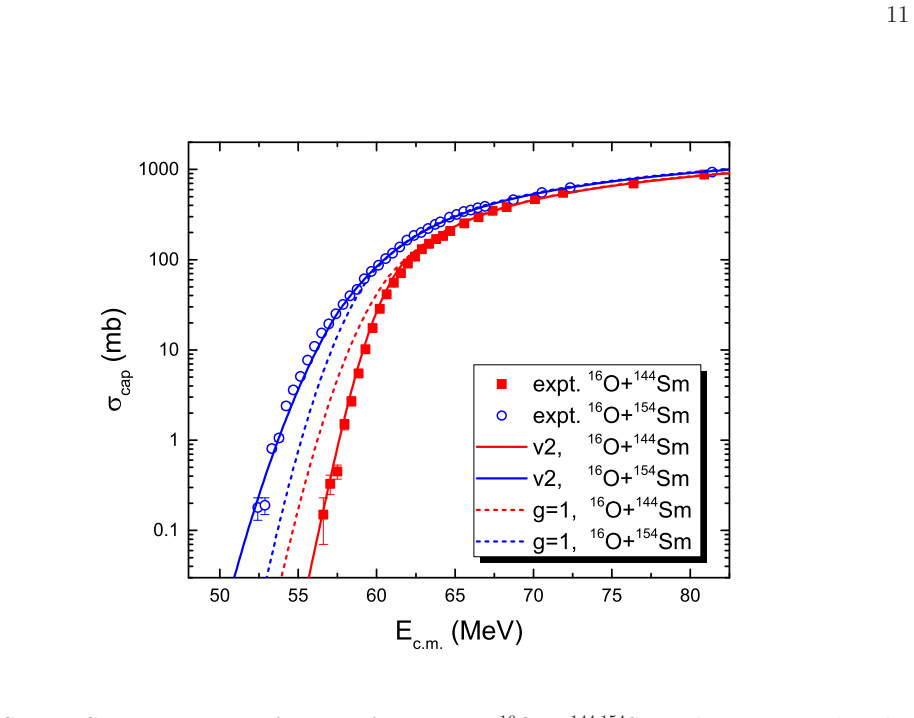
The central claim is that the universal Wong formula, with barrier parameters from the Skyrme-energy-density-functional nucleus-nucleus potential, becomes genuinely universal once two corrections are added. The first is a constraint on the barrier-distribution width, $w \geq \mathrm{FWHM} \approx 0.56\hbar\omega$, which supplies the finite quantum width missing for light systems and restores the sub-barrier capture data for $^{14}$N+$^{16}$O, $^{16}$O+$^{16}$O, $^{12}$C+$^{14}$C, and $^{12}$C+$^{20}$Ne. The second is a capture-pocket-depth-dependent factor $F_{\rm DIS}=\tfrac{1}{2}[1+\mathrm{erf}(\sqrt{B_{\rm cap}/c_1}-1)]$ with $c_1=2.0$ MeV, which multiplies the barrier radius and the structure factor; TDHF simulations of heavy systems show the ratio of capture to touching cross section falling with decreasing pocket depth, and the formula tracks that ratio. With these changes, capture excitation functions for thirty systems from carbon to uranium are reproduced with fixed parameters, and the formula predicts that $^{54}$Cr+$^{238}$U capture lies below $^{50}$Ti+$^{242}$Pu capture because the Cr+U pocket is shallower, an ordering consistent with the measured evaporation residues.
Load-bearing premise
The whole super-heavy part of the argument rests on the assumption that the suppression of capture caused by deep inelastic scattering is the same universal error-function of the capture-pocket depth for every projectile-target combination, with a fixed scale c1=2.0 MeV and a TDHF contact-time cutoff near 600 fm/c.
Editorial extensions
If this is right
- For unmeasured super-heavy reactions, capture cross sections can be obtained with the same fixed parameters used for light systems, removing the need to re-fit the potential per system.
- The formula predicts that above-barrier capture for massive systems decreases as the capture pocket becomes shallower, so geometric radius alone is not a reliable scale for super-heavy capture.
- The deep-inelastic-scattering suppression will reduce predicted evaporation-residue cross sections for super-heavy synthesis compared with estimates that ignore that suppression.
- For light well-bound systems, the minimum-width constraint restores agreement with measured sub-barrier fusion data, notably for $^{14}$N+$^{16}$O and $^{16}$O+$^{16}$O.
- The parabolic-barrier assumption limits the formula to energies not far below the barrier; deep sub-barrier fusion is outside its domain.
Reading between the lines
- If the claimed universality is real, the same error-function suppression should appear in shallow-pocket systems outside the super-heavy mass region, and a few measured capture-to-touching ratios for such systems would test whether one scale, $c_1=2.0$ MeV, is sufficient.
- The paper's comparison of $^{54}$Cr+$^{238}$U and $^{50}$Ti+$^{242}$Pu implies a strategy for searches for new super-heavy isotopes: among entrance channels forming the same compound nucleus, the more asymmetric combination with the deeper capture pocket should be favored in evaporation-residue experiments.
- A natural test of the width constraint is to extract the experimental barrier distribution for a very light system such as $^{16}$O+$^{16}$O; the constrained formula effectively uses a single broadened Gaussian, whereas the unconstrained version uses a narrow two-Gaussian shape.
- Extending the formula to radioactive or neutron-rich beams could be done without new parameters, since the structure factor already responds to $Q$-value and neutron-shell closures; data from such systems would provide a sharper check of the claimed universality.
Signed reviews
Editorial analysis
A structured set of objections, weighed in public.
Referee Report
Summary. The paper presents FUSION-v2, an extension of the universal Wong formula for capture cross sections based on a frozen Skyrme-density-functional nucleus-nucleus potential. Relative to FUSION-v1, two modifications are introduced: (i) a lower bound on the barrier-distribution width, w >= FWHM = 0.56 hbar omega, for light systems; and (ii) a pocket-depth-dependent reduction factor F_DIS, Eq. (8), calibrated to TDHF contact-time ratios and applied to the barrier radius and to the structure factor for heavy and super-heavy systems. The formula is compared with measured excitation functions for light systems and for a set of 30 systems induced by 12C, 16O, 32S, 48Ca and 64Ni, and it is used to predict that 54Cr+238U capture cross sections lie below those of 50Ti+242Pu, a trend consistent with the evaporation-residue data reported in Ref. [72].
Significance. If the claimed universality is established, the formula would be a practical single-parameter-set tool for estimating capture cross sections across the nuclear chart, which is particularly useful for planning super-heavy-element experiments. The paper has genuine strengths: the code is publicly available; the model ingredients are stated explicitly; the 54Cr+238U versus 50Ti+242Pu ordering is a falsifiable prediction consistent with later evaporation-residue data; and the parabolic-barrier limitation is acknowledged. However, the quantitative support for the central claim is not yet at the level of the claim: agreement is assessed visually without residuals or uncertainties, and the new F_DIS ingredient rests on only four TDHF points at a single energy. The empirical calibration is also not separated from the validation data, which weakens the word 'universal' as used in the title.
major comments (4)
- [Sec. III, Eq. (8), Fig. 2] The universal suppression factor F_DIS is calibrated with only four TDHF systems (86Kr+208Pb, 64Ni+208Pb, 58Fe+208Pb, 40Ca+96Zr), all at E = 1.05 EBass, using the criterion that contact time longer than 600 fm/c defines capture. The manuscript does not show that this TDHF criterion reproduces measured capture cross sections for these systems, does not test the sensitivity of the result to the contact-time cutoff or to the fitted value c1 = 2.0 MeV, and does not show that suppression depends only on Bcap rather than on mass asymmetry, deformation, or incident energy. Since the super-heavy predictions, including the 54Cr+238U versus 50Ti+242Pu ordering, use Eq. (8) at shallow pocket depths near or beyond the calibrated range, this is a load-bearing point that needs direct validation.
- [Sec. III, paragraph after Eq. (8)] The text states that 'the barrier radius R0 ... and the structure factor g are multiplied by FDIS in the calculations'. Only the relation Rm = R0 F_DIS is compared with the TDHF ratio in Fig. 2; the additional scaling of g by F_DIS is an independent assumption that changes the shape and normalization of the barrier distribution D1(B) in Eq. (3) and therefore affects sub-barrier cross sections. The effect of the g scaling should be shown separately, or g should be left unchanged until a specific justification is provided.
- [Sec. III, paragraph before Fig. 4] The statement that 'for all reactions under consideration the values of the model parameters are fixed and no additional adjustable parameter is introduced' is misleading as a claim of universality: f, c0 (with its two values), the neutron shell-closure flags delta_n, the cap 0 < g <= 2, the FWHM constraint, and c1 are all chosen constants. The paper does not identify which of the 30 reactions were used for calibration and which are genuine tests, and no numerical residual (average ratio, chi-square per point, or similar) is reported for the comparisons in Fig. 4. Visual agreement of a formula whose constants are tuned on the same class of data is not independent evidence of universality; a transparent training/test statement and a quantitative error measure are needed.
- [Sec. III, Fig. 6] The predicted capture cross sections in Fig. 6 are presented as point curves without any uncertainty estimate. Because the ordering of 54Cr+238U and 50Ti+242Pu depends on the difference between Bcap = 3.80 MeV and Bcap = 4.58 MeV through the rather flat erf function in Eq. (8), it would be helpful to show how stable the ordering is under reasonable variations of c1 and of the TDHF calibration. At present the reader cannot judge whether the predicted difference is significantly larger than the model uncertainty.
minor comments (5)
- [Title and abstract] The word 'ligh t' in the title and abstract is a typo and should read 'light'.
- [Sec. III, text discussing Fig. 6] The text refers to 'Fig. 5(a)' and 'Fig. 5(b)' when discussing the panels of the figure that is captioned as Fig. 6; these cross-references should be corrected.
- [Eq. (3)] The word 'Guassian' should be 'Gaussian'.
- [Sec. II, paragraph on reference systems] The rule for reference nuclei is stated as 'A0 - 1 < M_a.m. <= A0 (with a few exceptions which will be discussed later)', but the exceptions are never precisely specified; they should be listed or removed.
- [Sec. II, Eq. (5)] The min[ integral, integral ] rule in Eq. (5) is introduced without explanation; a short justification of why the smaller of the two integrals is chosen would improve the readability of the model definition.
Circularity Check
No significant circularity: the FDIS suppression is a calibrated extrapolation, and the final ordering is checked against external data.
full rationale
The paper's derivation chain is self-contained in the sense required by the circularity rules. The frozen Skyrme-EDF potential supplies B0, R0, hbar-omega, and Bcap without per-reaction adjustment; the two-Gaussian barrier distribution and f=0.926 come from FUSION-v1 [20] and the 443-system systematics [42]; the width constraint Eq. (7) is motivated by the standard quantum FWHM approx 0.56 hbar-omega; and the FDIS factor Eq. (8) is calibrated to four TDHF sigma_cap/sigma_T points at E=1.05 EBass. The highlighted prediction that 54Cr+238U capture lies below 50Ti+242Pu is then obtained by inserting computed pocket depths Bcap=3.80 MeV and Bcap=4.58 MeV into the fitted monotonic FDIS, and the measured evaporation-residue ordering [72] is used afterward as a check, not as a fitting input. The self-citations [20, 34, 42, 51] are load-bearing as prior model elements, but they are empirically or microscopically supported inputs rather than assumed uniqueness theorems, and the final validation is against external measured capture and evaporation-residue data. No equation in the paper makes a predicted quantity equal, by construction, to its fitting input, so no circular step is established.
Assumptions & free parameters
free parameters (5)
- f =
0.926
- c1 =
2.0 MeV
- c0 =
0.5 MeV^-1 for delta Q < 0, 0.1 MeV^-1 for delta Q > 0
- shell-closure flags delta_n =
1 or 0 per projectile and target
- g cap =
2
assumptions (6)
- domain assumption Wong parabolic-barrier formula Eq. (1) is a valid representation of fusion penetration.
- ad hoc to paper Capture is governed by a two-Gaussian barrier distribution with centroids B1=fB0+w/2 and B2=fB0+w and the min() rule in Eq. (5).
- domain assumption Entrance-channel nucleus-nucleus potential V(R) from the Skyrme energy density functional under the frozen-density approximation with ETF2 kinetic and spin-orbit densities.
- ad hoc to paper A TDHF contact time of about 600 fm/c separates capture from deep inelastic scattering.
- ad hoc to paper Constraint w >= FWHM = 0.56 hbar omega is imposed for light systems.
- ad hoc to paper Reference-system mass numbers and the lanthanide rule A0=(A0+A0')/2 determine the structure factor baseline.
Cite this review
Pith. "Pith review of Universal Wong formula for capture cross sections from light to super-heavy systems." pith.science (2026). https://pith.science/paper/I4PMVSYM
@misc{pith2026241117019,
  author       = {Pith},
  title        = {Pith review of: Universal Wong formula for capture cross sections from light to super-heavy systems},
  year         = {2026},
  howpublished = {\url{https://pith.science/paper/I4PMVSYM}},
  note         = {Machine review of arXiv:2411.17019}
}
abstract
A universal Wong formula is proposed with refined model parameters for a systematic description of the capture cross sections for heavy-ion fusion reactions from C+C to Ni+U, in which the barrier parameters and the barrier distribution are determined by the entrance-channel nucleus-nucleus potential based on the Skyrme energy density functional. With introducing a constraint to the width of the barrier distribution and a pocket-depth dependent barrier radius, the capture excitation functions for a number of fusion reactions involving different nuclear structure effects are remarkably well reproduced, particularly for the reactions between light nuclei and those forming super-heavy nuclei. The systematic decreasing behavior of the geometric radii with the depth of capture pocket due to the influence of deep inelastic scattering is clearly observed in the TDHF calculations for super-heavy systems. The predicted capture cross sections for $^{54}$Cr + $^{238}$U at above barrier energies are evidently smaller than the corresponding results of more asymmetric projectile-target combination $^{50}$Ti + $^{242}$Pu due to the shallower capture pocket in Cr+U.
Figures


Figures from the paper (3 more)


Reference graph
Works this paper leans on
- [72]
- [1]
-
[2]
61 MeV. With the constraint being considered for 14N + 16O, one sees that the experimental data can be remarkably well reproduced. The better reproductio n of the experimental data for these light systems indicate the constraint to the value of w is necessary and reasonable. For the fusion reactions leading to the synthesis of super-heavy n uclei, the dep...
- [3]
-
[4]
S. Hofmann, F.P. Hessberger, D. Ackermanna et al., Nucl. Phys. A 734, 93 (2004)
work page 2004
-
[5]
Yu. Ts. Oganessian, V.K. Utyonkov, Nucl. Phys. A 944, 62 (2015)
work page 2015
-
[6]
Yu. Ts. Oganessian, F.Sh. Abdullin, P.D. Bailey et al., P hys. Rev. Lett. 104, 142502 (2010)
work page 2010
-
[7]
A. Sobiczewski, Yu.A. Litvinov, M. Palczewski, Atom. Da ta Nucl. Data Tables 119, 1 (2018)
work page 2018
Show all 76 references
-
[8]
Yu. Ts. Oganessian, V.K. Utyonkov, N.D. Kovrizhnykh et a l., Phys. Rev. C 106, L031301 (2022)
2022
-
[9]
Pomorski, B
K. Pomorski, B. Nerlo-Pomorska, J. Bartel et al., Phys. R ev. C 97, 034319 (2018)
2018
-
[10]
Tanaka, K
T. Tanaka, K. Morita, K. Morimoto et al., Phys. Rev. Lett. 124, 052502 (2020)
2020
-
[11]
Wang, S.J
Y.Z. Wang, S.J. Wang, Z.Y. Hou et al., Phys. Rev. C 92, 064301 (2015)
2015
-
[12]
Adamian, N.V
G.G. Adamian, N.V. Antonenko, and W. Scheid, Phys. Rev. C 69, 011601(R) (2004)
2004
-
[13]
T. A. Weaver, S.E. Woosley, Phys. Rep. 227, 65 (1993)
1993
-
[14]
Guan, J.C
D.W. Guan, J.C. Pei, Phys. Lett. B 851, 138578 (2024)
2024
-
[15]
Dasgupta, D.J
M. Dasgupta, D.J. Hinde, N. Rowley et al., Annu. Rev. Nuc l. Part. Sci. 48, 401 (1998)
1998
-
[16]
X. Fang, W. P. Tan, M. Beard, et al., Phys. Rev. C 96, 045804 (2017)
2017
-
[17]
Dasso, S
C.H. Dasso, S. Landowne, Comput. Phys. Commun. 46, 187 (1987)
1987
-
[18]
Hagino, N
K. Hagino, N. Rowley, and A.T. Kruppa, Comput. Phys. Com mun. 123, 143 (1999)
1999
-
[19]
Siwek-Wilczy´ nska and J
K. Siwek-Wilczy´ nska and J. Wilczy´ nski, Phys. Rev. C 69, 024611 (2004)
2004
-
[20]
Zagrebaev, Y
V.I. Zagrebaev, Y. Aritomo, M.G. Itkis et al., Phys. Rev . C 65, 014607 (2001)
2001
-
[21]
N. Wang, M. Liu, Y.X. Yang, Sci. China Ser. G - Phys. Mech. Astron. 52, 1554 (2009)
2009
-
[22]
M. Liu, N. Wang, Z.X. Li et al., Nucl. Phys. A 768, 80 (2006)
2006
-
[23]
Jiang and B.P
C.L. Jiang and B.P. Kay, Phys. Rev. C 105, 064601 (2022)
2022
-
[24]
B. Wang, K. Wen, W.J. Zhao et al., At. Data Nucl. Data Tabl es 114, 281 (2017)
2017
-
[25]
Bass, Nucl
R. Bass, Nucl. Phys. A 231, 45 (1974)
1974
-
[26]
Wong, Phys
C.Y. Wong, Phys. Rev. Lett. 31, 766 (1973)
1973
-
[27]
Broglia, A
R.A. Broglia, A. Winther, Heavy Ion Reactions , Frontiers in Physics, Vol. 84, (Addison- Wesley) (1991)
1991
-
[28]
Bass, Lecture Notes in Physics , 117 (Berlin: Springer) 281 (1980)
R. Bass, Lecture Notes in Physics , 117 (Berlin: Springer) 281 (1980)
1980
-
[29]
Wen, C.J
P.W. Wen, C.J. Lin, H.M. Jia et al., Phys. Rev. C 105, 034606 (2022)
2022
-
[30]
Puri and Raj K
Rajeev K. Puri and Raj K. Gupta, Phys. Rev. C 45, 1837 (1992)
1992
-
[31]
Maruhn, P.G
J.A. Maruhn, P.G. Reinhard, P.D. Stevenson et al., Phys . Rev. C 74, 027601 (2006)
2006
-
[32]
N. Wang, W. Scheid, Phys. Rev. C 78, 014607 (2008). 15
2008
-
[33]
Simenel, J
C. Simenel, J. Phys. G: Nucl. Part. Phys. 41, 094007 (2014); arXiv:1403.3246v1
2014 arXiv
-
[34]
Maruhn, and P.G
Lu Guo, J.A. Maruhn, and P.G. Reinhard, Phys. Rev. C 76, 014601 (2007)
2007
-
[35]
N. Wang, L. Ou, Y.X. Zhang and Z.X. Li, Phys. Rev. C 89, 064601 (2014)
2014
-
[36]
H. Yao, H. Yang, N. Wang, Phys. Rev. C 110, 014602 (2024)
2024
-
[37]
Vautherin, D.M
D. Vautherin, D.M. Brink, Phys. Rev. C 5, 626 (1972)
1972
-
[38]
N. Wang, K. Zhao and Z.X. Li, Phys. ReV. C 90, 054610 (2014)
2014
-
[39]
V. Yu. Denisov and W. Noerenberg, Eur. Phys. J. A15, 375 (2002)
2002
-
[40]
approach for the kinetic energy density and the spin-orbit densit y. The distribution function D(B) is expressed as a superposition of two Gaussian functions D1(B) and D2(B), D1(B) = 1√gπw exp [ −(B − B1)2 gw 2 ] (3) and D2(B) = 1 2√πw exp [ −(B − B2)2 (2w)2 ] . (4) In the rea...
-
[41]
Shorto, P.R.S
J.M.B. Shorto, P.R.S. Gomes, J. Lubian, L.F. Canto, S. M ukherjee, L.C. Chamon, Phys. Lett. B 678, 77 (2009)
2009
-
[42]
Bartel and K
J. Bartel and K. Bencheikh, Eur. Phys. J, A14, 179 (2002)
2002
-
[43]
Bartel, Ph
J. Bartel, Ph. Quentin, M. Brack et al., Nucl. Phys. A 386, 79 (1982)
1982
-
[44]
Y. Chen, H. Yao, M. Liu et al., Atom. Data Nucl. Data Table s 154, 101587 (2023)
2023
-
[45]
Stokstad, Z
R.G. Stokstad, Z. E. Switkowski, R.A. Dayras et al., Phy s. Rev. Lett. 37, 888 (1976)
1976
-
[46]
Thomas, Y
J. Thomas, Y. T. Chen, S. Hinds et al.,Phys. Rev. C 31, 1980(R) (1985)
1985
-
[47]
Dasmahapatra, B
B. Dasmahapatra, B. ˘Cujec, Nucl. Phys. A 565, 657 (1993)
1993
-
[48]
Hulke, C
G. Hulke, C. Rolfs, H. P. Trautvetter, Z. Phys. A 297, 161 (1980)
1980
-
[49]
P. A. DeYoung, J. J. Kolata, R. C. Luhn et al., Phys. Rev. C 25, 1420 (1982)
1982
-
[50]
Kozulin, G.N
E.M. Kozulin, G.N. Knyazheva, I.M. Itkis et al., Phys. L ett. B 686, 227 (2010)
2010
-
[51]
Itkis, G.N
M.G. Itkis, G.N. Knyazheva, I.M. Itkisa et al., Eur. Phy s. J. A 58, 178 (2022)
2022
-
[52]
H. Lee, P. McGlynn, and C. Simenel, Phys. Rev. C 110, 024606 (2024)
2024
-
[53]
H. Yao, C. Li, H.B. Zhou, and N. Wang, Phys. Rev. C 109, 034608 (2024)
2024
-
[54]
Newton, C.R
J.O. Newton, C.R. Morton, M. Dasgupta et al., Phys. Rev. C 64, 064608 (2001)
2001
-
[55]
Abriola, A.A
D. Abriola, A.A. Sonzogni, M. di Tada et al., Phys. Rev. C 46, 244 (1992)
1992
-
[56]
S. Gil, R. Vandenbosch, A. J. Lazzarini et al., Phys. Rev . C 31, 1752 (1985)
1985
-
[57]
Mukherjee, D.J
A. Mukherjee, D.J. Hinde, M. Dasgupta et al., Phys. Rev. C 75, 044608 (2007)
2007
-
[58]
Viola, Torbjorn Sikkeland, Phys
Victor E. Viola, Torbjorn Sikkeland, Phys. Rev. 128, 767 (1962)
1962
-
[59]
Leigh, M
J.R. Leigh, M. Dasgupta, D.J. Hinde et al., Phys. Rev. C 52, 3151 (1995)
1995
-
[60]
H. Q. Zhang, Z. H. Liu, J. C. Xu et al., Phys. Rev. C 49, 926 (1994)
1994
-
[61]
Gomes, I.C
P.R.S. Gomes, I.C. Charret, R. Wanis et al., Phys. Re. C 49, 245 (1994)
1994
-
[62]
D. J. Hinde, M. Dasgupta, N. Herrald et al., Phys. Rev. C 75, 054603 (2007). 16
2007
-
[63]
Freifelder, P
R. Freifelder, P. Braun–Munzinger, P. DeYoung et al., P hys. Rev. C 35, 2097 (1987)
1987
-
[64]
Kolata, A
J.J. Kolata, A. Roberts, A.M. Howard et al., Phys. Rev. C 85, 054603 (2012)
2012
-
[65]
Trotta, A.M
M. Trotta, A.M. Stefanini, S. Beghini et al., Euro. Phys . J. A 25, 615 (2005)
2005
-
[66]
Prokhorova, A.A
E.V. Prokhorova, A.A. Bogachev, M.G. Itkis et al., Nucl . Phys. A 802, 45 (2008)
2008
-
[67]
Stefanini, L
A.M. Stefanini, L. Corradi, H. Moreno et al., Phys. Lett . B 252, 43 (1990)
1990
-
[68]
Wolfs, R.V.F
F.L.H. Wolfs, R.V.F. Janssens, R. Holzmann et al., Phys . Rev. C 39, 865 (1989)
1989
-
[69]
J. F. Liang, D. Shapira, J. R. Beene et al., Phys. Rev. C 75, 054607 (2007)
2007
-
[70]
E. M. Kozulin, G. N. Knyazheva, K. V. Novikov, et al., Phy s. Rev. C 94, 054613 (2016)
2016
-
[71]
Misicu and H
S. Misicu and H. Esbensen, Phys. Rev. Lett. 96, 112701 (2006)
2006
-
[73]
X.-J. Lv, Z. Y. Yue, W.-J. Zhao, B. Wang, Phys. Rev. C 103, 064616 (2021)
2021
-
[74]
Oganessian, Eur
Y. Oganessian, Eur. Phys. J. A 60, 227 (2024)
2024
-
[75]
H. L¨ u, A. Marchix, Y. Abe, D. Boilley, Comp. Phys. Comm. 200, 381 (2016)
2016
-
[76]
B. Mei, D. L. Balabanski, et al., Chin. Phys. C 45, 054001 (2021)
2021
Reviewed August 12, 2026 · model on record in the stance chip above.
Discussion (0). Continue with ORCID to comment.