REVIEW 3 major objections 4 minor 23 references
Coulomb explosion of CD3I induced by single photon deep inner-shell ionisation
T0 review · 3 major / 4 minor · reviewed 2026-08-14 · deepseek-v4-flash
Pith's one-line read A two-parameter charge build-up model ($\tau=7$ fs, $R=0.37$ fs$^{-1}$) reproduces the Coulomb explosion of CD3I for intermediate fragment charges, and efficiency-corrected data place the L1 ionisation charge distribution about two units…
desk verdict New L-subshell-resolved data worth knowing about, but the high-charge charge-state distributions are biased by using the failing model's own efficiency corrections. read the letter →
The pith
A machine-rendered reading of the paper's core claim, the machinery that carries it, and where it could break.
The reading
What carries the argument
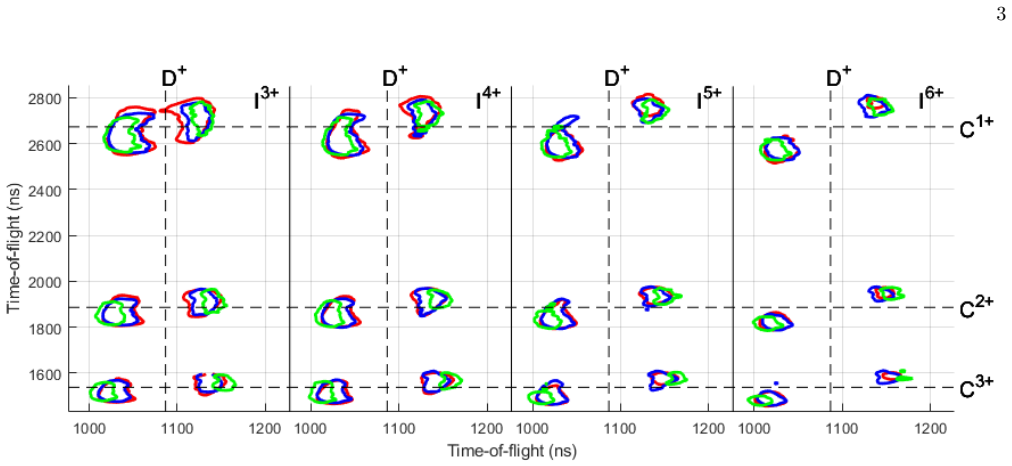
The central object is the two-parameter charge build-up model with charge transfer (Eqs. 1–3): total charge grows exponentially at the iodine site as $Q_{\mathrm{tot}}(t) = (m+n+3)(1-e^{-t/\tau})$, while electrons move from the methyl group to the iodine at a rate $R$ proportional to the iodine charge. These two parameters, $\tau$ and $R$, generate time-dependent partial charges whose trajectories under mutual Coulomb repulsion are integrated and then fed through a numerical model of the spectrometer's fields and apertures to produce simulated coincidence patterns. The same instrument model supplies the channel-specific detection efficiencies used to correct the raw coincidence intensities. A second mechanism, the subtraction scheme (Eqs. 4–6), uses theoretical relative L-subshell photoionisation cross-sections with an $E^{-7/2}$-dominated energy dependence to isolate the charge distributions created by L1, L2 and L3 ionisation from four blended data sets.
What would settle it
Measure the relative L1, L2 and L3 photoionisation cross-sections of iodine at photon energies around 4.3–5.3 keV by an independent method; if the ratios differ from the fitted polynomial used in Eqs. (4)–(6), the extracted pure L1 distribution and its two-charge-unit shift are not established.
Extended reading notes
Core claim
The paper's central claim is that Coulomb explosion of CD3I after single-photon L-shell ionisation of iodine is governed by gradual charge build-up on the iodine atom with concurrent electron transfer from the methyl group, not by instantaneous deposition of the final charges. Using $Q_{\mathrm{tot}}(t) = (m+n+3)(1-e^{-t/\tau})$ and $dQ_{\mathrm{CD}_3}/dt = R\,Q_{\mathrm{I}}$, with $\tau = 7$ fs and $R = 0.37$ fs$^{-1}$, the simulated flight-time islets match experiment for intermediate charge states while the instantaneous model does not. Deviations at high carbon or iodine charges are interpreted as a need to include nuclear motion during the cascade. The second claim is that after correcting coincidence intensities with simulated collection efficiencies, the true molecular charge state distributions from pure L1, L2 and L3 ionisation can be recovered; L1 sits about two charge units higher than L2/L3, consistent with an L1-to-L3 Coster–Kronig transition that leaves an additional M-shell hole.
Load-bearing premise
The separation of the three iodine inner-shell contributions rests on theoretical ratios for how often each shell absorbs the X-ray; if those ratios are wrong, the extracted 'pure' L1, L2 and L3 charge distributions are wrong.
Editorial extensions
If this is right
- The two-parameter charge build-up model, originally fitted to multiphoton X-ray free-electron laser data, applies to single-photon deep inner-shell ionisation, at least for intermediate charge states.
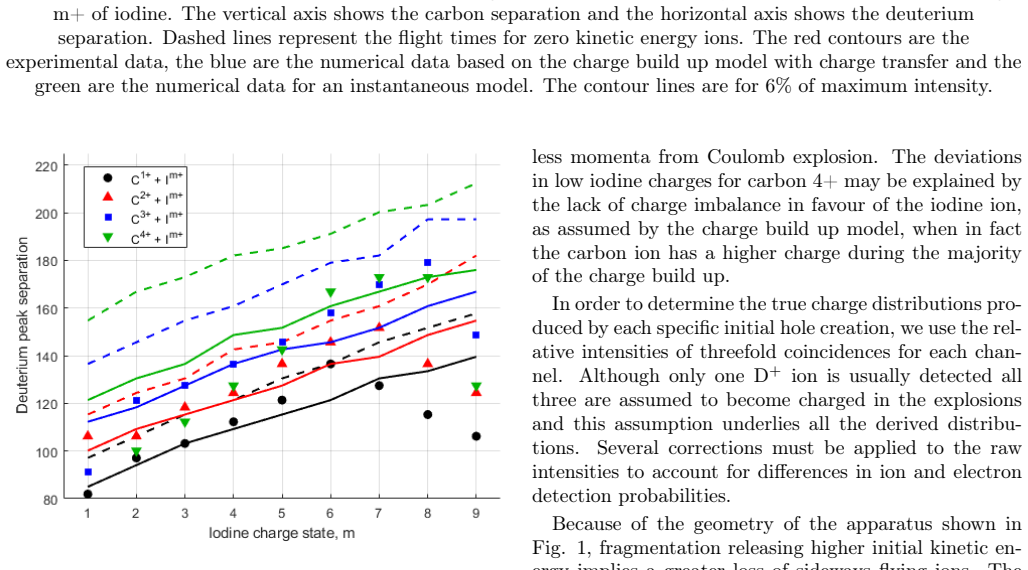
- For high carbon or iodine charges the model systematically predicts too much kinetic energy release, so a complete description of Coulomb explosion must include nuclear motion during the Auger cascade and possibly neutral fragments.
- The efficiency-corrected subtraction analysis yields pure L1, L2 and L3 molecular charge state distributions for CD3I, with L1 shifted about two charge units higher than L2 and L3.
- For the lighter isotopologue CH3I, stronger deviations from the model's kinetic-energy predictions are expected because hydrogen's faster motion amplifies the nuclear-dynamics effect.
- The simulation-based efficiency corrections offer a general way to recover true charge state abundances from multi-ion coincidence spectrometers whose collection efficiency depends on kinetic energy.
Reading between the lines
- A testable extension the paper leaves implicit: applying the same $\tau$ and $R$ to other iodinated methyl compounds would show whether the charge build-up parameters are transferable or molecule-specific.
- The roughly two-charge-unit gap between the L1 and L2/L3 distributions could serve as an experimental check on theoretical iodine L-subshell cross-section ratios, since any error in those ratios would shift this gap.
- If the efficiency-correction scheme is robust, it could be used to reanalyse existing coincidence data from other spectrometers and extract true charge distributions that are currently biased toward low-kinetic-energy fragments.
- A direct time-resolved X-ray pump-probe measurement of charge build-up in CD3I would test whether $\tau = 7$ fs and $R = 0.37$ fs$^{-1}$ are dynamical realities or simply effective fitting parameters, a question the paper leaves open.
Signed reviews
Editorial analysis
A structured set of objections, weighed in public.
Referee Report
Summary. The paper reports an experimental and numerical study of Coulomb explosion of CD3I after single-photon L-shell ionisation of iodine by hard X-rays, using multi-ion coincidence time-of-flight spectroscopy. The authors compare the measured ion time-of-flight patterns with numerical simulations based on a two-parameter charge build-up model introduced by Motomura et al. (Eqs. 1-3). They report best agreement for intermediate charge states (Cn+ with n=1-3 and Im+ with m=3-6) using tau=7 fs and R=0.37 fs^-1, whereas an instantaneous charge model overestimates kinetic energy release and higher charge states deviate from the model. The authors also use simulated collection efficiencies to correct raw coincidence intensities and then apply a subtraction method (Eqs. 4-6) to extract molecular charge state distributions produced by L1, L2 and L3 ionisation, concluding that L1 ionisation yields a distribution shifted about two charge units higher than L2 and L3.
Significance. If the results hold, the paper provides valuable evidence that a very simple parametric description of charge build-up and charge transfer can capture the main features of Coulomb explosion for intermediate charge states in single-photon deep inner-shell ionisation, not only in the multi-photon XFEL case for which it was originally proposed. The paper also offers a plausible interpretation of the L1 versus L2/L3 difference in terms of a fast Coster-Kronig transition. However, the quantitative charge-state distribution extraction rests on a circular use of the same model that the paper itself shows fails for high charge states; this compromises the main quantitative output (Fig. 4) and the associated comparison of L1, L2 and L3. The work is clearly presented and the numerical simulations are described in reproducible detail, but the central quantitative claim requires additional robustness checks.
major comments (3)
- [Numerical Methods; Fig. 4]
- [Model equations (Eqs. 1-3)]
- [Eqs. (4)-(6), Fig. 4]
minor comments (4)
- [Abstract and Introduction]
- [Fig. 2 and Fig. 3]
- [Experimental Methods]
- [Data Availability]
Circularity Check
The model is fitted to the experimental TOF data and then, with the same fitted parameters, supplies the efficiency corrections used to extract the 'true' charge-state distributions—although the paper itself says the model fails for high charge states.
-
fitted input called prediction
[Model comparison paragraph (after Eq. 3) and Figs. 2-3]
"Using the model described above in comparison with our experimental results, starting from the parameters in [9], we find the best overall agreement with τ = 7 fs and R = 0.37 fs−1. ... The parameters are determined by comparing the experimental and numerical time-of-flight distributions from triple coincidence detections from different fragmentation channels D++Cn++Im+."
The two model parameters are determined by fitting to the same triple-coincidence TOF data that Figs. 2 and 3 then display as evidence that the charge build-up model 'matches well' and is preferable to the instantaneous model. The agreement is therefore a goodness-of-fit property, not an independent confirmation; the conclusion that the model is 'applicable to the single photon case' is drawn from the very data used to set its parameters.
-
fitted input called prediction
[Numerical Methods section (final sentence), 'Detection efficiency corrections' paragraph, and Fig. 4]
"Once the simulated data resemble the experimental data set sufficiently closely the initial charge state abundances can be extracted. Detection efficiency corrections from the simulations are used to determine the true distributions of molecular charge state produced by initial L1, L2 and L3 ionisation. Decay channels involving high carbon or iodine charge show a systematically lower kinetic energy release than predicted by the model."
The collection efficiencies applied to the raw coincidence intensities come from a SIMION simulation whose explosion kinematics are generated by the same Motomura model with the same fitted τ and R. Aperture acceptance is set by kinetic energy, and the paper itself states that the model deviates for high carbon/iodine charge states ('lower kinetic energy release than predicted'), i.e., exactly the high-charge channels whose efficiencies the simulation must supply. The 'true' L1/L2/L3 abundances in Fig. 4 are therefore not independent measurements; they are outputs of a model already tuned to the same data and acknowledged to fail in the relevant regime, so the L1-versus-L2/L3 charge-shift conclusion is partly model-forced.
full rationale
The paper is self-contained and does not rely on a load-bearing self-citation chain or an imported uniqueness theorem; the Motomura model is cited as external prior work. However, the derivation chain has two related circular moments. First, τ and R are fitted to the experimental triple-coincidence TOF distributions, and the same distributions are then shown as evidence that the charge build-up model reproduces the data; this is calibration, not prediction. Second—and more important—the 'true' charge-state distributions of Fig. 4 are obtained by applying collection efficiencies simulated with that same fitted model, even though the paper reports that the model systematically deviates for high carbon and iodine charge states, which are precisely the high-kinetic-energy channels where the aperture acceptance correction is largest and most channel-dependent. The subtraction algebra in Eqs. (4)-(6) is not circular by itself—it depends on theoretical subshell cross-sections—but it can only be applied after the model-based efficiency corrections, so any model bias propagates into every extracted distribution and into the stated L1 vs L2/L3 difference. Score 6 reflects partial circularity: the model-comparison claim is fit-based, and the central quantitative result is model-corrected in the regime the authors themselves identify as invalid, while the paper still contains substantial independent experimental content.
Assumptions & free parameters
free parameters (2)
- tau (charge build-up time) =
7 fs
- R (charge transfer rate) =
0.37 fs^-1
assumptions (7)
- domain assumption The molecule starts at its nominal equilibrium geometry with exact C3v symmetry, making all deuterium atoms equivalent.
- domain assumption Charge builds up sequentially at the iodine site according to Qtot(t) = (m+n+3)(1 - exp(-t/tau)).
- domain assumption Charge transfer rate from the methyl group to iodine is dQ_CD3/dt = R * Q_I.
- ad hoc to paper Fractional charges are allowed during the build-up, with integer final charges; charges of at least 4+ on the methyl group are apportioned as three units to the three deuterium atoms and the residue to carbon.
- domain assumption The total photoelectric cross-section for each L subshell declines with photon energy as a fitted polynomial with an E^-7/2 dominant term.
- domain assumption All three deuterium atoms become charged in the explosion, even if only one D+ is detected.
- domain assumption The detection efficiency of the apparatus is adequately modeled by SIMION with random deletion of half the ions at the detector surface.
Cite this review
Pith. "Pith review of Coulomb explosion of CD3I induced by single photon deep inner-shell ionisation." pith.science (2026). https://pith.science/paper/I57L2TVJ
@misc{pith2026190809351,
  author       = {Pith},
  title        = {Pith review of: Coulomb explosion of CD3I induced by single photon deep inner-shell ionisation},
  year         = {2026},
  howpublished = {\url{https://pith.science/paper/I57L2TVJ}},
  note         = {Machine review of arXiv:1908.09351}
}
abstract
L-shell ionisation and subsequent Coulomb explosion of fully deuterated methyl iodide, CD$_3$I, irradiated with hard x-rays has been examined by a time-of-flight multi-ion coincidence technique. The core vacancies relax efficiently by Auger cascades, leading to charge states up to 16+. The dynamics of the Coulomb explosion process are investigated by calculating the ions' flight times numerically based on a geometric model of the experimental apparatus, for comparison with the experimental data. A parametric model of the explosion, previously introduced for multi-photon induced Coulomb explosion, is applied in numerical simulations, giving good agreement with the experimental results for medium charge states. Deviations for higher charges suggest the need to include nuclear motion in a putatively more complete model. Detection efficiency corrections from the simulations are used to determine the true distributions of molecular charge state produced by initial L1, L2 and L3 ionisation.
Figures

Reference graph
Works this paper leans on
-
[1]
Carlson, T. A.; White, R. M. Measurement of the Rela- tive Abundances and Recoil-Energy Spectra of Fragment Ions Produced as the Initial Consequences of X-Ray In- teraction with CH3I, HI, and DI.J. Chem. Phys. 1966, 44, 4510-4510
work page 1966
-
[2]
Eland, J. H. D. Dynamics of three-body reactions in ICN2+ and related molecules.Chem. Phys. Lett. 1993, 203, 353-362
work page 1993
-
[3]
Eland, J. H. D.; Singh, R.; Pickering, J. D.; Slater, C. S.; Hult Roos, A.; Andersson, J.; Zagorodskikh, S.; Squibb, R. J.; Brouard, M.; Feifel, R. Dissociation of multiply charged ICN by Coulomb explosion.J. Chem. Phys 2016, 145, 074303
work page 2016
-
[4]
Ueda, K.; Eland, J. H. D. Molecular photodissociation studied by VUV and soft x-ray radiation. J. Phys. B: at., Mol. Opt. Phys. 2005, 38, S839-S859
work page 2005
-
[5]
Making Sense of Coulomb Explosion Imaging.J
Luzon, I.; Livshits, E.; Gope, K.; Baer, R.; Strasser, D. Making Sense of Coulomb Explosion Imaging.J. Phys. Chem. Lett. 2016, 6, 1361-1367
work page 2016
-
[6]
Amini, K.; Savelyev, E.; Braue, F.; Berrah, N.; Bomme, C.; Brouard, M.; Burt, M.; Christensen, L.; Dsterer, S.; Erk, B.; et al. Photodissociation of aligned CH3I and C6H3F2I molecules probed with time-resolved Coulomb explosion imaging by site-selective extreme ultraviolet ionization. Structural Dynamics 2018, 5, 014301
work page 2018
-
[7]
J.; Erk, B.; Boll, R.; Toyota, K.; Hao, Y.; Vendrell, O.; et al
Rudenko, A.; Inhester, L.; Hanasaki, K.; Li, X.; Ro- batjazi, S. J.; Erk, B.; Boll, R.; Toyota, K.; Hao, Y.; Vendrell, O.; et al. Femtosecond response of polyatomic molecules to ultra-intense hard X-rays. Nature 2017, 546, 129 EP -
work page 2017
-
[8]
Takanashi, T.; Nakamura, K.; Kukk, E.; Motomura, K.; Fukuzawa, H.; Nagaya, K.; Wada, S.-I.; Kumagai, Y.; Iablonskyi, D.; Ito, Y;. Sakakibara, U.; et al. Ultrafast Coulomb explosion of a diiodomethane molecule induced by an X-ray free-electron laser pulse.Phys. Chem. Chem. Phys. 2017, 19, 19707-19721
work page 2017
Show all 23 references
-
[9]
, who studied Coulomb explosion of CH3I from ionisa- tion induced by the absorption of several X-ray photons within a pulse duration of∼ 10 fs. In the present experiment, photoionisation occurs pri- marily in selected L-shells of iodine induced by a single photon followed by s...
1908 arXiv
-
[10]
Charge and Nuclear Dynam- ics Induced by Deep Inner-Shell Multiphoton Ionization of CH3I Molecules by Intense X-ray Free-Electron Laser Pulses
Motomura, K.; Kukk, E.; Fukuzawa, H.; Wada, S.-I.; Nagaya, K.; Ohmura, S.; Mondal, S.; Tachibana, T.; Ito, Y.; Koga, R.; et al. Charge and Nuclear Dynam- ics Induced by Deep Inner-Shell Multiphoton Ionization of CH3I Molecules by Intense X-ray Free-Electron Laser Pulses. J. Ph...
2015
-
[11]
Femtosecond charge and molecular dynamics of I-containing organic molecules in- duced by intense X-ray free-electron laser pulses.Faraday Discuss 2016, 194, 537-562
Nagaya, K.; Motomura, K.; Kukk, E.; Takahashi, Y.; Ya- mazaki, K.; Ohmura, S.; Fukuzawa, H.; Wada, S.; Mon- dal, S.; Tachibana, T.; et al. Femtosecond charge and molecular dynamics of I-containing organic molecules in- duced by intense X-ray free-electron laser pulses.Faraday ...
2016
-
[12]
Ultrafast Dynamics of a Nu- cleobase Analogue Illuminated by a Short Intense X-ray Free Electron Laser Pulse.Phys
Nagaya, K.; Motomura, K.; Kukk, E.; Fukuzawa, H.; Wada, S.; Tachibana, T.; Ito, Y.; Mondal, S.; Sakai, T.; Matsunami, K.; et al. Ultrafast Dynamics of a Nu- cleobase Analogue Illuminated by a Short Intense X-ray Free Electron Laser Pulse.Phys. Rev. X 2016, 6, 021035
2016
-
[13]
W.; Cryle, M.; Bostedt, C.; Schorb, S.; Bozek, J.; Rouzee, A.; et al
Erk, B.; Rolles, D.; Foucar, L.; Rudek, B.; Epp, S. W.; Cryle, M.; Bostedt, C.; Schorb, S.; Bozek, J.; Rouzee, A.; et al. Ultrafast Charge Rearrangement and Nuclear Dynamics upon Inner-Shell Multiple Ionization of Small Polyatomic Molecules. Phys. Rev. Lett. 2013, 110, 5
2013
-
[14]
F.; Jiang, Y
Schnorr, K.; Senftleben, A.; Kurka, M.; Rudenko, A.; Schmid, G.; Pfeifer, T.; Meyer, K.; Kübel, M.; Kling, M. F.; Jiang, Y. H.; et al. Electron Rearrangement Dynam- ics in Dissociating In+ 2 Molecules Accessed by Extreme Ultraviolet Pump-Probe Experiments. Phys. Rev. Lett. 201...
2014
-
[15]
F.; Jiang, Y
Schnorr, K.; Senftleben, A.; Schmid, G.; Rudenko, A.; Kurka, M.; Meyer, K.; Foucar, L.; Kübel, M.; Kling, M. F.; Jiang, Y. H.; et al. Multiple ionization and fragmen- tation dynamics of molecular iodine studied in IR–XUV pump–probe experiments.Faraday Discuss 2014, 171, 41-56
2014
-
[16]
Imaging charge transfer in iodomethane upon x-ray photoabsorption.Science 2014, 345, 288-291
Erk, B.; Boll, R.; Trippel, S.; Anielski, D.; Foucar, L.; Rudek, B.; Epp, Sascha W.; Coffee, R.; Carron, S.; Schorb, S.; el al. Imaging charge transfer in iodomethane upon x-ray photoabsorption.Science 2014, 345, 288-291
2014
-
[17]
D.; Burkett, M.; Carron, S.; Ferguson, K
Boll, R.; Erk, B.; Coffee, R.; Trippel, S.; Kierspel, T.; Bomme, C.; Bozek, J. D.; Burkett, M.; Carron, S.; Ferguson, K. R.; et al. Charge transfer in dissoci- ating iodomethane and fluoromethane molecules ionized by intense femtosecond X-ray pulses.Structural Dynam- ics 2016, 3, 043207
2016
-
[18]
X-ray multiphoton ionization dynamics of a water molecule irradiated by an x-ray free-electron laser pulse
Inhester, L.; Hanasaki, K.; Hao, Y.; Son, S-.K.; Santra, R. X-ray multiphoton ionization dynamics of a water molecule irradiated by an x-ray free-electron laser pulse. Phys. Rev. A 2016, 94, 023422
2016
-
[19]
Deep Inner-Shell Multiphoton Ionization by In- tense X-Ray Free-Electron Laser Pulses.Phys
Fukuzawa, H.; Son, S.-K.; Motomura, K.; Mondal, S.; Nagaya, K.; Wada, S.; Liu, X.-J.; Feifel, R.; Tachibana, T.; et al. Deep Inner-Shell Multiphoton Ionization by In- tense X-Ray Free-Electron Laser Pulses.Phys. Rev. Lett. 2013, 110, 173005
2013
-
[20]
https://www.nist.gov/pml/xcom-photon-cross-sections- database
-
[21]
Photoabsorption, Photoionization, and Photoelectron Spectroscopy
Berkowitz, J. Photoabsorption, Photoionization, and Photoelectron Spectroscopy. Academic Press 1979
1979
-
[22]
http://www.roentdek.de/info/Delay_Line/
-
[23]
http://simion.com
SIMION: The field and particle trajectory simulator. http://simion.com
Reviewed August 14, 2026 · model on record in the stance chip above.
Discussion (0). Continue with ORCID to comment.