Non-Negative Matrix Factorization for Event Data
Pith reviewed 2026-06-28 02:50 UTC · model grok-4.3
The pith
EventNMF models entity event times as Poisson processes whose intensities factorize through non-negative B-splines to recover shared temporal templates.
A machine-rendered reading of the paper's core claim, the machinery that carries it, and where it could break.
Core claim
EventNMF is a continuous-time non-negative factorization model that operates directly on event times: each entity's events are modeled as a Poisson process whose intensity factorizes through a non-negative B-spline basis, and a simple estimation procedure recovers interpretable temporal templates shared across entities.
What carries the argument
Non-negative B-spline basis factorization of the intensity function inside a Poisson point process model for event times.
If this is right
- Binned-count NMF is recovered exactly when the spline degree is set to zero.
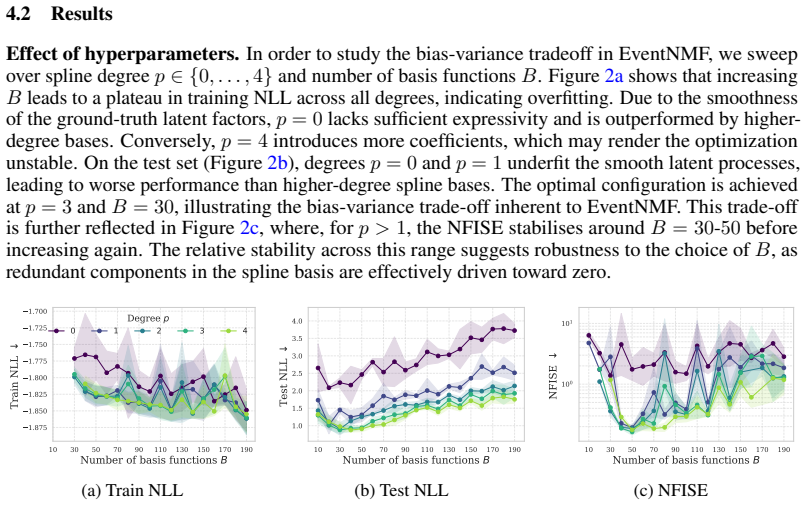
- Bias-variance trade-offs can be explored by varying spline degree and knot placement without changing the overall estimation procedure.
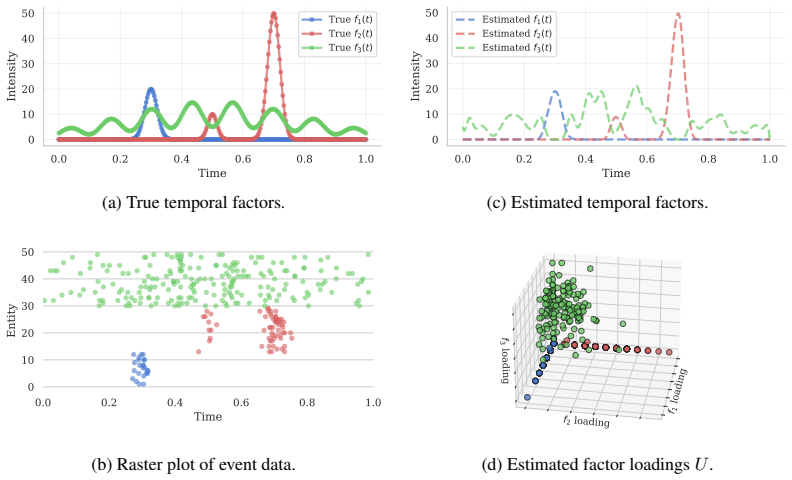
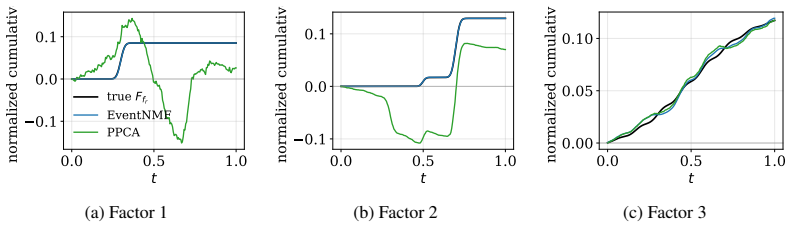
- The method recovers ground-truth factors on synthetic data drawn from a latent-factor Poisson process.
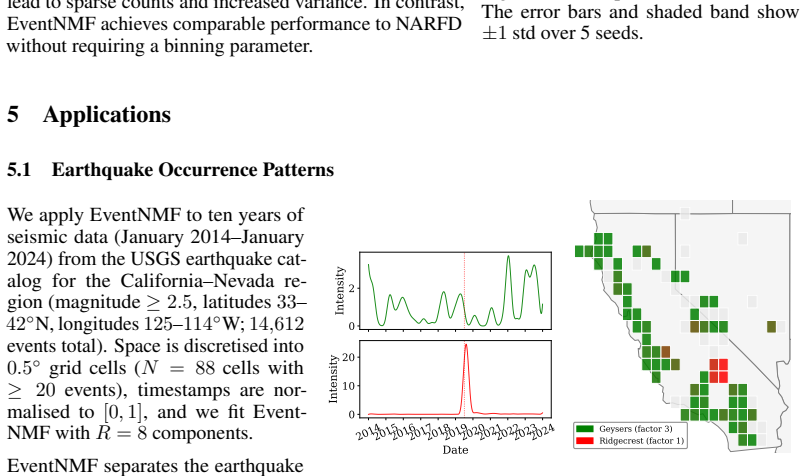
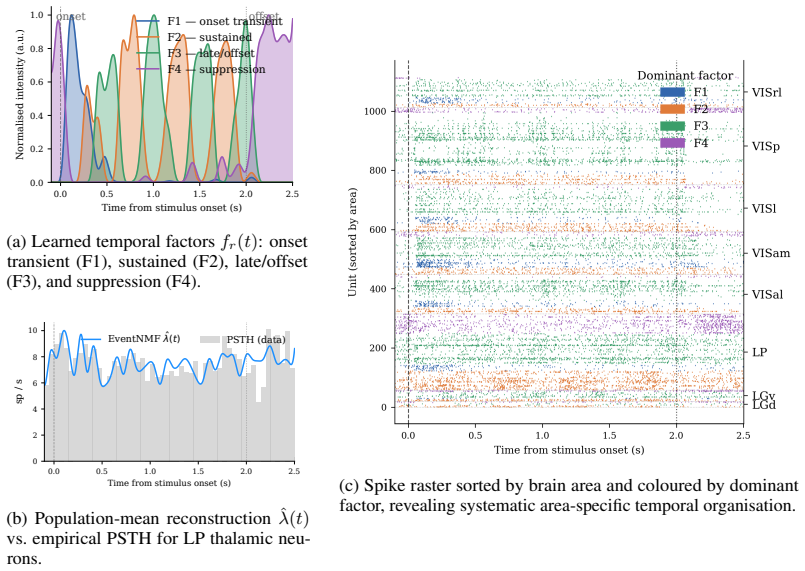
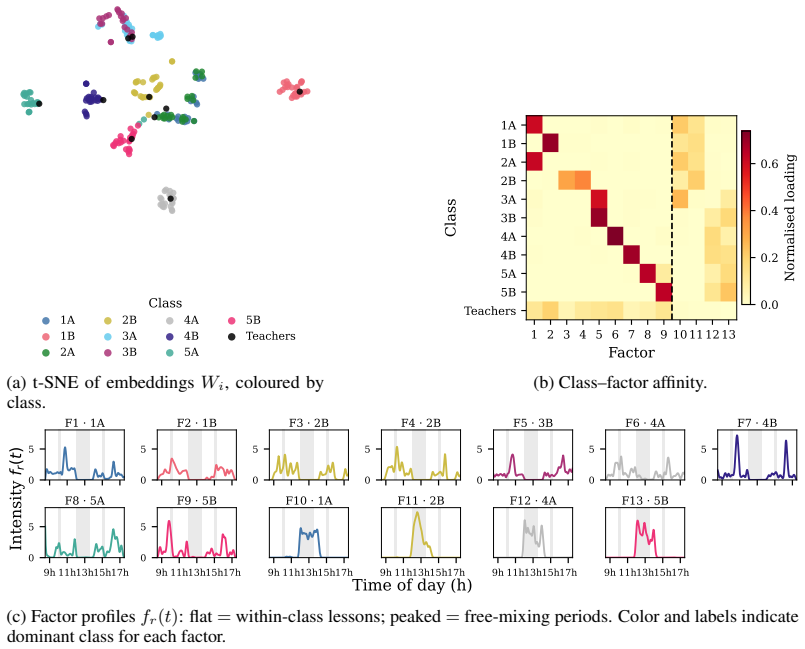
- It produces usable templates on real event streams drawn from neuroscience, seismology, and social-network settings.
Where Pith is reading between the lines
- The same spline-Poisson construction could be paired with other point-process likelihoods such as Hawkes processes.
- Domains that record events at sub-second resolution may see larger gains from avoiding binning than domains with coarser natural timescales.
- One could test whether the recovered templates remain stable when the number of observed entities is reduced while holding the total event count fixed.
Load-bearing premise
The true event intensities admit an accurate low-rank representation as non-negative combinations of B-spline basis functions under the Poisson process model.
What would settle it
Generate synthetic event data from a known low-rank B-spline Poisson model, run EventNMF, and check whether the recovered templates match the generating factors up to permutation and scaling.
Figures
read the original abstract
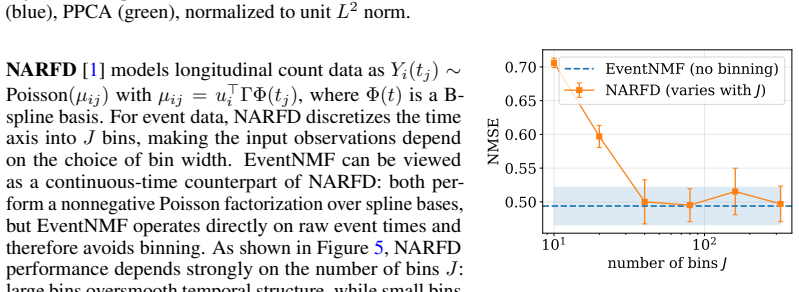
Continuous-time event data, in which entities emit instantaneous events over time, arises naturally across many domains such as neuroscience, seismology, and social networks. Non-negative matrix factorization (NMF) is a natural tool to uncover interpretable structure in such data, but it has so far only been applied after binning or smoothing the entity-level counting measures. This preprocessing step comes with the risk of erasing entity-level heterogeneities and fine-grained temporal features. In this paper, we introduce EventNMF, a continuous-time non-negative factorization model that operates directly on event times: each entity's events are modeled as a Poisson process whose intensity factorizes through a non-negative B-spline basis, and a simple estimation procedure recovers interpretable temporal templates shared across entities. The resulting method is mathematically principled, easy to implement, and computationally efficient. We further show that standard binned-count approaches arise as the special case of degree-zero splines, explore bias-variance tradeoffs and compare against existing methods on a synthetic latent factor model, and demonstrate the effectiveness of EventNMF on several real-world applications.
Editorial analysis
A structured set of objections, weighed in public.
Referee Report
Summary. The paper introduces EventNMF, a continuous-time NMF model for event data in which each entity's events are modeled as an inhomogeneous Poisson process whose intensity is factorized non-negatively over a shared B-spline basis. The method operates directly on event times without binning, recovers interpretable temporal templates, reduces to standard binned NMF when using degree-zero splines, includes bias-variance analysis and synthetic recovery experiments, and is demonstrated on real-world applications in neuroscience, seismology, and social networks.
Significance. If the estimation procedure and recovery guarantees hold, the work supplies a mathematically principled, computationally efficient alternative to binned NMF that preserves fine-grained temporal structure and entity-level heterogeneity. The explicit reduction to the binned case and the provision of bias-variance trade-offs are concrete strengths that could make the approach immediately usable in domains that already rely on NMF for count data.
minor comments (3)
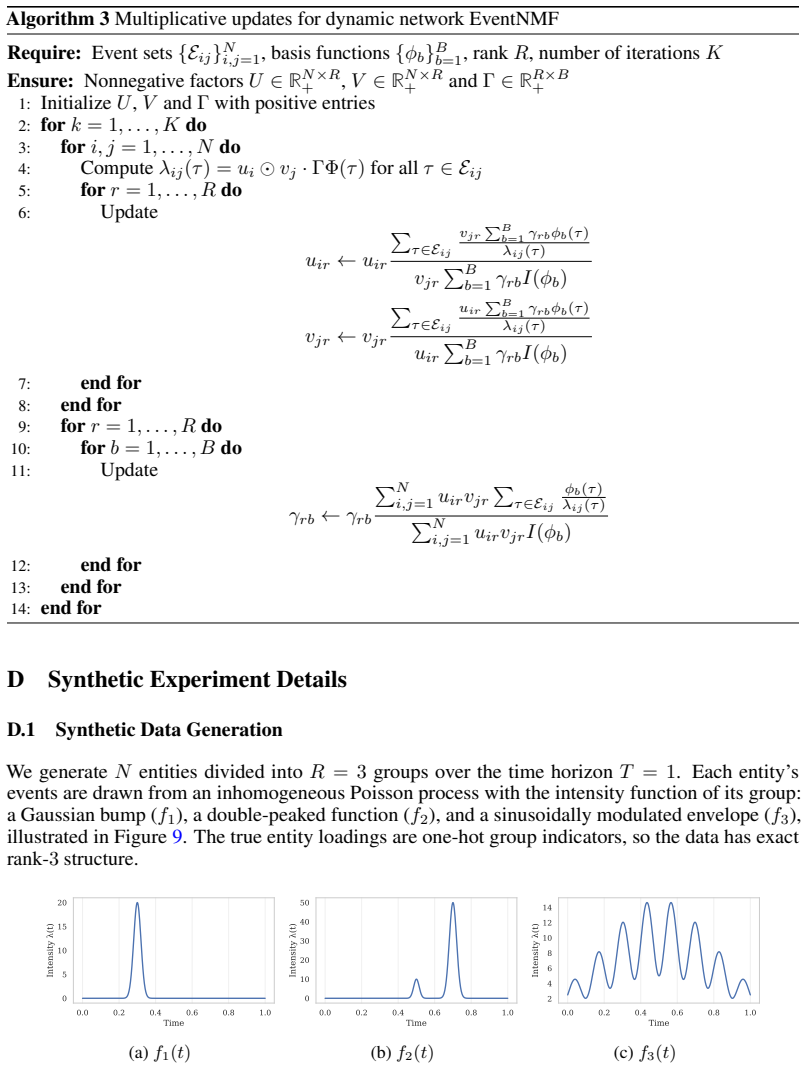
- The abstract and introduction state that the estimation procedure is 'simple' and 'computationally efficient,' but the precise optimization objective, initialization strategy, and convergence criteria should be stated explicitly in §3 or §4 with pseudocode or a short algorithm box.
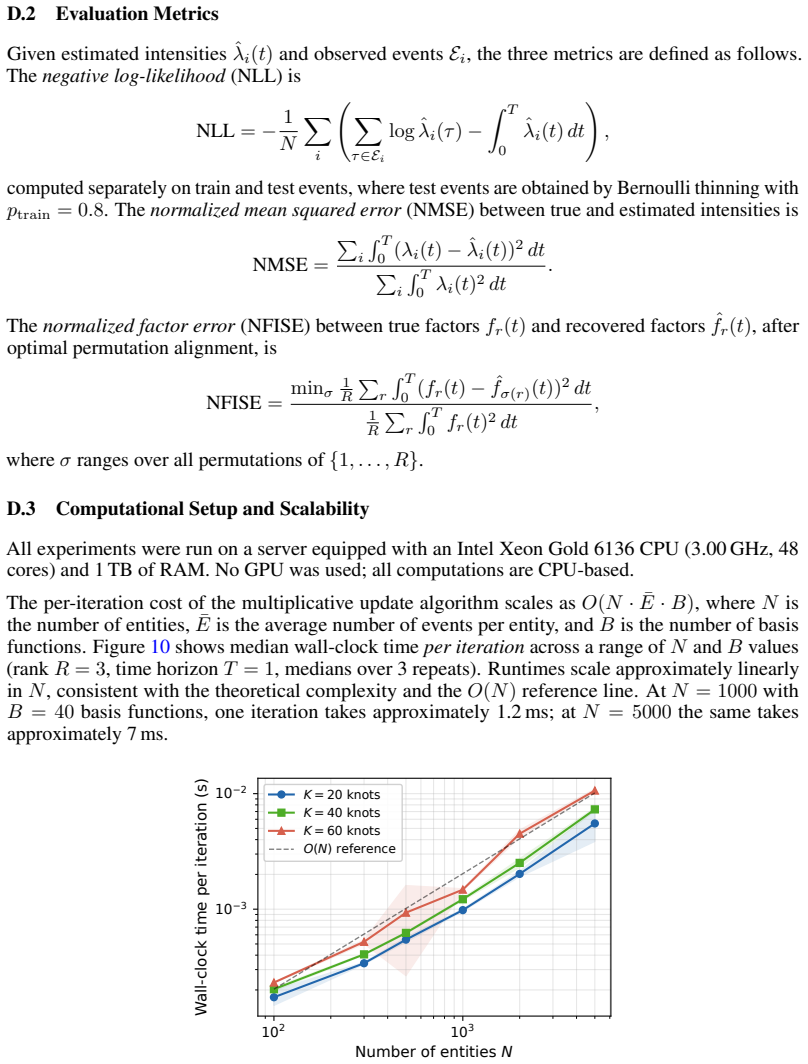
- In the synthetic experiments, the recovery metric (e.g., template correlation or reconstruction error) and the range of spline degrees and knot placements tested should be reported in a table or figure caption so that the bias-variance claims can be directly verified.
- Notation for the B-spline basis functions and the non-negativity constraints on the factor matrices should be introduced once in §2 and used consistently; a small table summarizing symbols would improve readability.
Simulated Author's Rebuttal
We thank the referee for the positive summary of EventNMF and the recommendation of minor revision. The report correctly identifies the core contributions: direct operation on event times via non-negative B-spline factorization of Poisson intensities, the explicit reduction to binned NMF, and the bias-variance analysis. No specific major comments were raised that require point-by-point rebuttal.
Circularity Check
No significant circularity detected
full rationale
The paper defines EventNMF directly via a Poisson process intensity that factorizes over a shared non-negative B-spline basis, then presents an estimation procedure whose output is the recovered templates. The abstract and description show the degree-zero spline case recovering binned NMF as a special case, with bias-variance analysis and synthetic recovery experiments. No quoted step reduces a claimed prediction to a fitted input by construction, no self-citation is load-bearing for the central claim, and no uniqueness theorem or ansatz is smuggled in. The derivation chain is self-contained against external benchmarks.
Axiom & Free-Parameter Ledger
Reference graph
Works this paper leans on
-
[1]
Daniel Backenroth, Russell T. Shinohara, Jennifer A. Schrack, and Jeff Goldsmith. Nonnegative decomposition of functional count data.Biometrics, 76(4):1273–1284, December 2020. ISSN 0006-341X, 1541-0420. doi: 10.1111/biom.13220
-
[2]
Bishop.Pattern Recognition and Machine Learning
Christopher M. Bishop.Pattern Recognition and Machine Learning. Information Science and Statistics. Springer, New York, 2006. ISBN 978-0-387-31073-2
2006
-
[3]
Lisbeth Carstensen, Albin Sandelin, Ole Winther, and Niels R. Hansen. Multivariate Hawkes process models of the occurrence of regulatory elements.BMC bioinformatics, 11:456, Septem- ber 2010. ISSN 1471-2105. doi: 10.1186/1471-2105-11-456
-
[4]
Bruno Cessac, Arnaud Le Ny, and Eva Löcherbach. On the Mathematical Consequences of Binning Spike Trains.Neural Computation, 29(1):146–170, January 2017. ISSN 0899-7667. doi: 10.1162/NECO_a_00898
-
[5]
Novel Multi-layer Non-negative Tensor Factorization with Sparsity Constraints
Andrzej Cichocki, Rafal Zdunek, Seungjin Choi, Robert Plemmons, and Shun-ichi Amari. Novel Multi-layer Non-negative Tensor Factorization with Sparsity Constraints. In Bart- lomiej Beliczynski, Andrzej Dzielinski, Marcin Iwanowski, and Bernardete Ribeiro, editors, Adaptive and Natural Computing Algorithms, volume 4432, pages 271–280. Springer Berlin Heidel...
-
[6]
Cover and Joy A
Thomas M. Cover and Joy A. Thomas.Elements of Information Theory. Wiley-Interscience, Hoboken, NJ, 2001. ISBN 978-0-471-06259-2 978-0-471-20061-1
2001
-
[7]
John P. Cunningham and Byron M. Yu. Dimensionality reduction for large-scale neural recordings.Nature Neuroscience, 17(11):1500–1509, November 2014. ISSN 1546-1726. doi: 10.1038/nn.3776
-
[8]
Cunningham, Vikash Gilja, Stephen I
John P. Cunningham, Vikash Gilja, Stephen I. Ryu, and Krishna V . Shenoy. Methods for Estimating Neural Firing Rates, and Their Application to Brain-Machine Interfaces.Neural networks : the official journal of the International Neural Network Society, 22(9):1235–1246, November 2009. ISSN 0893-6080. doi: 10.1016/j.neunet.2009.02.004
-
[9]
Daley and David Vere-Jones
Daryl J. Daley and David Vere-Jones. An introduction to the theory of point processes. 1: Elementary theory and methods. Springer, New York NY , 2. ed., 2. corr. print edition, 2005. ISBN 978-0-387-95541-4
2005
-
[10]
Poisson intensity estimation with repro- ducing kernels
Seth Flaxman, Yee Whye Teh, and Dino Sejdinovic. Poisson intensity estimation with repro- ducing kernels. InProceedings of the 20th International Conference on Artificial Intelligence and Statistics, pages 270–279. PMLR, April 2017
2017
-
[11]
Detecting the community structure and activity patterns of temporal networks: A non-negative tensor factorization approach.PLoS ONE, 9(1):e86028, January 2014
Laetitia Gauvin, André Panisson, and Ciro Cattuto. Detecting the community structure and activity patterns of temporal networks: A non-negative tensor factorization approach.PLoS ONE, 9(1):e86028, January 2014
2014
-
[12]
Gaelle Gusto and Sophie Schbath. FADO: A statistical method to detect favored or avoided distances between occurrences of motifs using the Hawkes’ model.Statistical Applications in Genetics and Molecular Biology, 4:Article24, 2005. ISSN 1544-6115. doi: 10.2202/1544-6115. 1119. 10
-
[13]
Clara Happ and Sonja Greven. Multivariate Functional Principal Component Analysis for Data Observed on Different (Dimensional) Domains.Journal of the American Statistical Association, 113(522):649–659, April 2018
2018
-
[14]
Cécile Hautecoeur and François Glineur. Nonnegative Matrix Factorization over Continuous Signals using Parametrizable Functions.Neurocomputing, 416:256–265, November 2020. ISSN 09252312. doi: 10.1016/j.neucom.2019.11.109
-
[15]
J. F. C. Kingman.Poisson Processes. Oxford Studies in Probability. Clarendon Press, Oxford University Press, Oxford, UK, 1992. ISBN 9780198536932. URL https://global.oup. com/academic/product/poisson-processes-9780198536932
1992
-
[16]
Kolaczyk
Eric D. Kolaczyk. Wavelet Shrinkage Estimation of Certain Poisson Intensity Signals Using Corrected Thresholds.Statistica Sinica, 9(1):119–135, 1999
1999
-
[17]
Matrix Factorization Techniques for Recommender Systems.Computer, 42(8):30–37, August 2009
Yehuda Koren, Robert Bell, and Chris V olinsky. Matrix Factorization Techniques for Recommender Systems.Computer, 42(8):30–37, August 2009. ISSN 1558-0814. doi: 10.1109/MC.2009.263
-
[18]
Algorithms for Non-negative Matrix Factorization
Daniel D Lee and H Sebastian Seung. Algorithms for Non-negative Matrix Factorization
-
[19]
Daniel D. Lee and H. Sebastian Seung. Learning the parts of objects by non-negative matrix factorization.Nature, 401(6755):788–791, October 1999. ISSN 0028-0836, 1476-4687. doi: 10.1038/44565
-
[20]
Vítor Lopes-dos-Santos, Sidarta Ribeiro, and Adriano B.L. Tort. Detecting cell assemblies in large neuronal populations.Journal of Neuroscience Methods, 220(2):149–166, 2013. ISSN 0165-0270. doi: 10.1016/j.jneumeth.2013.04.010
-
[21]
Emily L Mackevicius, Andrew H Bahle, Alex H Williams, Shijie Gu, Natalia I Denisenko, Mark S Goldman, and Michale S Fee. Unsupervised discovery of temporal sequences in high-dimensional datasets, with applications to neuroscience.eLife, 8:e38471, February 2019. ISSN 2050-084X. doi: 10.7554/eLife.38471
-
[22]
Intensity Profile Projection: A Framework for Continuous-Time Representation Learning for Dynamic Networks.Advances in Neural Information Processing Systems, 36, December 2023
Alexander Modell, Ian Gallagher, Emma Ceccherini, Nick Whiteley, and Patrick Rubin- Delanchy. Intensity Profile Projection: A Framework for Continuous-Time Representation Learning for Dynamic Networks.Advances in Neural Information Processing Systems, 36, December 2023
2023
-
[23]
Functional data analysis for point processes with rare events.Statistica Sinica, 2014
Hans-Georg Mueller, Shuang Wu, and Zhen Zhang. Functional data analysis for point processes with rare events.Statistica Sinica, 2014
2014
-
[24]
Y . Ogata. Statistical model for standard seismicity and detection of anomalies by residual analysis.Tectonophysics, 1989. doi: 10.1016/0040-1951(89)90191-1
-
[25]
Arno Onken, Jian K. Liu, P. P. Chamanthi R. Karunasekara, Ioannis Delis, Tim Gollisch, and Stefano Panzeri. Using Matrix and Tensor Factorizations for the Single-Trial Analysis of Population Spike Trains.PLOS Computational Biology, 12(11):e1005189, November 2016. ISSN 1553-7358. doi: 10.1371/journal.pcbi.1005189
-
[26]
PCA for Point Processes, April 2024
Franck Picard, Vincent Rivoirard, Angelina Roche, and Victor Panaretos. PCA for Point Processes, April 2024
2024
-
[27]
J. O. Ramsay and B. W. Silverman.Functional Data Analysis. Springer Series in Statistics. Springer, New York, 2nd ed edition, 2005
2005
-
[28]
Adaptive estimation of the intensity of inhomogeneous Poisson processes via concentration inequalities.Probability Theory and Related Fields, 126(1):103– 153, May 2003
Patricia Reynaud-Bouret. Adaptive estimation of the intensity of inhomogeneous Poisson processes via concentration inequalities.Probability Theory and Related Fields, 126(1):103– 153, May 2003
2003
-
[29]
Multiresolution Analysis and Statistical Thresholding on Dynamic Networks
Raphael Romero, Tijl De Bie, Nick Heard, and Alexander Modell. Multiresolution Analysis and Statistical Thresholding on Dynamic Networks. InThe Thirty-ninth Annual Conference on Neural Information Processing Systems, October 2025. 11
2025
-
[30]
Community detection and anomaly prediction in dynamic networks.Communications Physics, 7(1):1–10, December 2024
Hadiseh Safdari and Caterina De Bacco. Community detection and anomaly prediction in dynamic networks.Communications Physics, 7(1):1–10, December 2024
2024
-
[31]
Sequeira and J.A
R.E. Sequeira and J.A. Gubner. Blind intensity estimation from shot-noise data.IEEE Transac- tions on Signal Processing, 45(2):421–433, February 1997
1997
-
[32]
A method for selecting the bin size of a time histogram.Neural Computation, 19(6):1503–1527, June 2007
Hideaki Shimazaki and Shigeru Shinomoto. A method for selecting the bin size of a time histogram.Neural Computation, 19(6):1503–1527, June 2007. ISSN 0899-7667. doi: 10.1162/ neco.2007.19.6.1503
2007
-
[33]
Hideaki Shimazaki and Shigeru Shinomoto. Kernel bandwidth optimization in spike rate estimation.Journal of Computational Neuroscience, 29(1):171–182, 2010. ISSN 0929-5313. doi: 10.1007/s10827-009-0180-4
-
[34]
P. Smaragdis and J.C. Brown. Non-negative matrix factorization for polyphonic music tran- scription. In2003 IEEE Workshop on Applications of Signal Processing to Audio and Acoustics, pages 177–180, October 2003. doi: 10.1109/ASPAA.2003.1285860
-
[35]
Latent Functional PARAFAC for modeling multidimensional longitudinal data, October 2024
Lucas Sort, Laurent Le Brusquet, and Arthur Tenenhaus. Latent Functional PARAFAC for modeling multidimensional longitudinal data, October 2024
2024
-
[36]
Juliette Stehlé, Nicolas V oirin, Alain Barrat, Ciro Cattuto, Lorenzo Isella, Jean-François Pinton, Marco Quaggiotto, Wouter Van den Broeck, Corinne Régis, Bruno Lina, and Philippe Vanhems. High-Resolution Measurements of Face-to-Face Contact Patterns in a Primary School.PLOS ONE, 6(8):e23176, August 2011. ISSN 1932-6203. doi: 10.1371/journal.pone.0023176
-
[37]
Youssef Taleb and Edward A. K. Cohen. Multiresolution analysis of point processes and statistical thresholding for Haar wavelet-based intensity estimation.Annals of the Institute of Statistical Mathematics, 73(2):395–423, April 2021
2021
-
[38]
Wiley, 1 edition, January 2014
Xianchuan Yu, Dan Hu, and Jindong Xu.NONNEGATIVE MATRIX FACTORIZATION ALGO- RITHMS AND APPLICATIONS. Wiley, 1 edition, January 2014. ISBN 978-1-118-67984-5 978-1-118-67985-2. doi: 10.1002/9781118679852
-
[39]
B-Spline Smoothing of Feature Vectors in Nonnegative Matrix Factorization
Rafał Zdunek, Andrzej Cichocki, and Tatsuya Yokota. B-Spline Smoothing of Feature Vectors in Nonnegative Matrix Factorization. In David Hutchison, Takeo Kanade, Josef Kittler, Jon M. Kleinberg, Alfred Kobsa, Friedemann Mattern, John C. Mitchell, Moni Naor, Oscar Nierstrasz, C. Pandu Rangan, Bernhard Steffen, Demetri Terzopoulos, Doug Tygar, Gerhard Weikum...
-
[40]
Poisson Intensity Estimation Based on Wavelet Domain Hypothesis Testing
Bo Zhang, Jalal M Fadili, and Jean-Luc Starck. Poisson Intensity Estimation Based on Wavelet Domain Hypothesis Testing. 12 A Full Algorithms A first approach for fitting the EventNMF model is to use multiplicative updates, which are a popular choice for NMF problems due to their simplicity and guaranteed non-negativity. The update rules for U and Γ can be...
discussion (0)
Sign in with ORCID, Apple, or X to comment. Anyone can read and Pith papers without signing in.