Applications of the WW-type approximation to SIDIS
Pith reviewed 2026-05-24 16:07 UTC · model grok-4.3
The pith
WW-type approximation relates TMDs and FFs to simplify SIDIS cross-sections up to 1/Q².
A machine-rendered reading of the paper's core claim, the machinery that carries it, and where it could break.
Core claim
In the Wandzura-Wilczek-type approximation, where bar q g q-correlators are taken to be much smaller than bar q q-correlators, relations among TMD parton distribution functions and fragmentation functions arise. These relations allow the SIDIS cross-section to be expressed in terms of a smaller subset of these functions, valid through order 1/Q².
What carries the argument
The WW-type approximation, which neglects bar q g q-correlators relative to bar q q-correlators, thereby inducing relations between TMDs and FFs.
If this is right
- The SIDIS cross-section depends on fewer independent functions.
- Power-suppressed terms can be included without introducing new unknown correlators.
- Data on unpolarized hadron production can test the approximation's range of validity.
- Azimuthal modulations in the cross-section become linked through the relations.
Where Pith is reading between the lines
- If the approximation holds, global fits of TMDs could use fewer parameters and achieve better constraints from SIDIS data.
- The same logic may apply to other processes like Drell-Yan lepton pair production where similar correlators appear.
- High-precision measurements at future facilities could further validate or refute the size of neglected terms.
Load-bearing premise
Quark-gluon-quark correlators remain much smaller than quark-quark correlators in the relevant kinematic regime of SIDIS.
What would settle it
A clear violation of one of the derived relations between TMDs or FFs in experimental data on unpolarized SIDIS would indicate the approximation does not hold.
Figures


read the original abstract
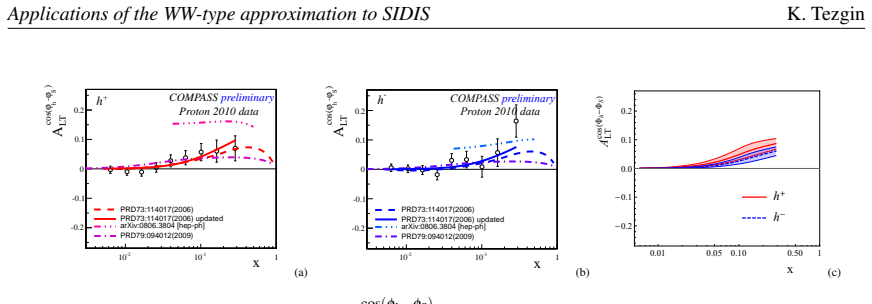
We explore the complete cross-section for the production of unpolarized hadrons in semi-inclusive deep-inelastic scattering up to power-suppressed $\mathcal{O}(1/Q^2)$ terms in the Wandzura-Wilczek-type (WW-type) approximation, which consists in systematically assuming that $\bar{q}gq$-correlators are much smaller than $\bar{q}q$-correlators. Under the applicability of WW-type approximations, certain relations among transverse momentum dependent parton distribution functions (TMDs) and fragmentation functions (FFs) occur which are used to approximate SIDIS cross-section in terms of a smaller subset of TMDs and FFs. We discuss the applicability of the WW-type approximations on the basis of available data.
Editorial analysis
A structured set of objections, weighed in public.
Referee Report
Summary. The manuscript explores the complete cross-section for unpolarized hadron production in semi-inclusive deep-inelastic scattering (SIDIS) up to O(1/Q²) under the Wandzura-Wilczek-type (WW-type) approximation. This approximation is defined by systematically taking bar q g q-correlators to be much smaller than bar q q-correlators. The resulting relations among TMD parton distribution functions and fragmentation functions are used to express the SIDIS cross-section in terms of a reduced subset of these functions. Applicability of the approximation is examined against available experimental data.
Significance. If the WW-type relations hold under the stated assumption, the work supplies a concrete reduction of the independent TMDs and FFs needed for SIDIS phenomenology up to twist-3, which can simplify global fits and data comparisons. The explicit check against data is a positive feature that grounds the approximation in observables rather than leaving it purely formal.
minor comments (3)
- [Abstract] The abstract states that relations 'occur which are used to approximate' the cross-section, but the manuscript should add a short explicit list (perhaps in §2 or §3) of which TMDs/FFs are eliminated by the WW-type assumption and which survive, to make the reduction transparent.
- [Data discussion] In the data-comparison section, the criteria for selecting the datasets used to test applicability should be stated more clearly (kinematic cuts, Q² range, etc.) so that readers can reproduce the assessment.
- [Introduction] Notation for the various correlators and the precise definition of the WW-type suppression (e.g., relative to which scale) should be collected in one place early in the text for easy reference.
Simulated Author's Rebuttal
We thank the referee for the positive evaluation of our manuscript and the recommendation for minor revision. No specific major comments were provided in the report.
Circularity Check
No significant circularity identified
full rationale
The paper explicitly defines the WW-type approximation as the input assumption that bar q g q-correlators are much smaller than bar q q-correlators, then explores the resulting relations among TMDs/FFs and the approximated SIDIS cross section up to O(1/Q^2). This structure is presented as an application of the stated assumption rather than a derivation from first principles or data fits; applicability is checked externally against available data. No load-bearing step reduces a prediction to a fitted parameter by construction, invokes a self-citation chain as the sole justification for a uniqueness claim, or renames an input as an output. The derivation chain remains self-contained under the declared approximation.
Axiom & Free-Parameter Ledger
axioms (1)
- domain assumption bar q g q-correlators are much smaller than bar q q-correlators
Reference graph
Works this paper leans on
-
[1]
New Quark Distributions and Semi-Inclusive Electroproduction on Polarized Nucleons
A. Kotzinian, Nucl. Phys. B 441, 234 (1995) [hep-ph/9412283]
work page internal anchor Pith review Pith/arXiv arXiv 1995
-
[2]
P. J. Mulders and R. D. Tangerman, Nucl. Phys. B 461, 197 (1996) Erratum: [Nucl. Phys. B 484, 538 (1997)] [hep-ph/9510301]
work page internal anchor Pith review Pith/arXiv arXiv 1996
-
[3]
Semi-inclusive deep inelastic scattering at small transverse momentum
A. Bacchetta, M. Diehl, K. Goeke, A. Metz, P. J. Mulders and M. Schlegel, JHEP 0702, 093 (2007) [hep-ph/0611265]. 4 Applications of the WW-type approximation to SIDIS K. Tezgin
work page internal anchor Pith review Pith/arXiv arXiv 2007
- [4]
-
[5]
R. L. Jaffe and X. Ji, Nucl. Phys. B 375, 527 (1992)
work page 1992
-
[6]
Nucleon matrix elements of higher-twist operators from the instanton vacuum
J. Balla, M. V . Polyakov and C. Weiss, Nucl. Phys. B510, 327 (1998) [hep-ph/9707515]
work page internal anchor Pith review Pith/arXiv arXiv 1998
-
[7]
On the twist-3 contribution to h_L in the instanton vacuum
B. Dressler and M. V . Polyakov, Phys. Rev. D61, 097501 (2000) [hep-ph/9912376]
work page internal anchor Pith review Pith/arXiv arXiv 2000
-
[8]
A lattice calculation of the nucleon's spin-dependent structure function g_2 revisited
M. Göckeler, R. Horsley, W. Kurzinger, H. Oelrich, D. Pleiter, P. E. L. Rakow, A. Schäfer and G. Schierholz, Phys. Rev. D 63, 074506 (2001) [hep-lat/0011091]
work page internal anchor Pith review Pith/arXiv arXiv 2001
-
[9]
M. Göckeler, R. Horsley, D. Pleiter, P. E. L. Rakow, A. Schäfer, G. Schierholz, H. Stuben and J. M. Zanotti, Phys. Rev. D 72, 054507 (2005) [hep-lat/0506017]
work page internal anchor Pith review Pith/arXiv arXiv 2005
-
[10]
What can break the Wandzura--Wilczek relation?
A. Accardi, A. Bacchetta, W. Melnitchouk and M. Schlegel, JHEP 0911, 093 (2009) [arXiv:0907.2942 [hep-ph]]
work page internal anchor Pith review Pith/arXiv arXiv 2009
-
[11]
Semi-Inclusive Deep Inelastic Scattering in Wandzura-Wilczek-type approximation
S. Bastami et al., JHEP 1906, 007 (2019) [arXiv:1807.10606 [hep-ph]]
work page internal anchor Pith review Pith/arXiv arXiv 1906
-
[12]
B. U. Musch, P. Hägler, J. W. Negele and A. Schäfer, Phys. Rev. D 83, 094507 (2011) [arXiv:1011.1213 [hep-lat]]
work page internal anchor Pith review Pith/arXiv arXiv 2011
-
[13]
Nucleon Generalized Parton Distributions from Full Lattice QCD
P. Hägler et al. [LHPC Collaboration], Phys. Rev. D 77, 094502 (2008) [arXiv:0705.4295 [hep-lat]]
work page internal anchor Pith review Pith/arXiv arXiv 2008
-
[14]
Quark helicity flip generalized parton distributions from two-flavor lattice QCD
M. Göckeler et al. [QCDSF and UKQCD Collaborations], Phys. Lett. B 627, 113 (2005) [hep-lat/0507001]
work page internal anchor Pith review Pith/arXiv arXiv 2005
-
[15]
A. Metz, P. Schweitzer and T. Teckentrup, Phys. Lett. B 680, 141 (2009)
work page 2009
-
[16]
A. D. Martin, W. J. Stirling, R. S. Thorne and G. Watt, Eur. Phys. J. C 63, 189 (2009) [arXiv:0901.0002 [hep-ph]]
work page internal anchor Pith review Pith/arXiv arXiv 2009
-
[17]
Global analysis of fragmentation functions for pions and kaons and their uncertainties
D. de Florian, R. Sassot and M. Stratmann, Phys. Rev. D 75, 114010 (2007) [hep-ph/0703242 [HEP-PH]]
work page internal anchor Pith review Pith/arXiv arXiv 2007
-
[18]
The role of Cahn and Sivers effects in Deep Inelastic Scattering
M. Anselmino, M. Boglione, U. D’Alesio, A. Kotzinian, F. Murgia and A. Prokudin, Phys. Rev. D 71, 074006 (2005) [hep-ph/0501196]
work page internal anchor Pith review Pith/arXiv arXiv 2005
-
[19]
Dynamical Parton Distributions Revisited
M. Glück, E. Reya and A. V ogt, Eur. Phys. J. C5, 461 (1998) [hep-ph/9806404]
work page internal anchor Pith review Pith/arXiv arXiv 1998
- [20]
-
[21]
Transverse spin asymmetries at COMPASS: beyond Collins and Sivers effects
B. Parsamyan, PoS DIS 2013, 231 (2013) [arXiv:1307.0183 [hep-ex]]
work page internal anchor Pith review Pith/arXiv arXiv 2013
-
[22]
Predictions for double spin asymmetry A_{LT} in Semi Inclusive DIS
A. Kotzinian, B. Parsamyan and A. Prokudin, Phys. Rev. D 73, 114017 (2006) [hep-ph/0603194]
work page internal anchor Pith review Pith/arXiv arXiv 2006
-
[23]
SIDIS Asymmetries in Quark-Diquark Model
A. Kotzinian, arXiv:0806.3804 [hep-ph]
work page internal anchor Pith review Pith/arXiv arXiv
-
[24]
S. Boffi, A. V . Efremov, B. Pasquini and P. Schweitzer, Phys. Rev. D79, 094012 (2009)
work page 2009
-
[25]
Simultaneous extraction of transversity and Collins functions from new SIDIS and e+e- data
M. Anselmino, M. Boglione, U. D’Alesio, S. Melis, F. Murgia and A. Prokudin, Phys. Rev. D 87, 094019 (2013) [arXiv:1303.3822 [hep-ph]]
work page internal anchor Pith review Pith/arXiv arXiv 2013
-
[26]
A. Airapetian et al. [HERMES Collaboration], Phys. Lett. B 622, 14 (2005) [hep-ex/0505042]
work page internal anchor Pith review Pith/arXiv arXiv 2005
-
[27]
A. Airapetian et al. [HERMES Collaboration], Phys. Rev. D 64, 097101 (2001) [hep-ex/0104005]
work page internal anchor Pith review Pith/arXiv arXiv 2001
-
[28]
Semi-Inclusive $\pi_0$ target and beam-target asymmetries from 6 GeV electron scattering with CLAS
S. Jawalkar et al. [CLAS Collaboration], Phys. Lett. B 782, 662 (2018) [arXiv:1709.10054 [nucl-ex]]
work page internal anchor Pith review Pith/arXiv arXiv 2018
-
[29]
B. Parsamyan, PoS DIS 2017, 259 (2018) [arXiv:1801.01488 [hep-ex]]
work page internal anchor Pith review Pith/arXiv arXiv 2017
- [30]
- [31]
discussion (0)
Sign in with ORCID, Apple, or X to comment. Anyone can read and Pith papers without signing in.