REVIEW 4 major objections 5 minor 21 references
Divide, Specialize, and Route: A New Approach to Efficient Ensemble Learning
T0 review · 4 major / 5 minor · reviewed 2026-08-06 · deepseek-v4-flash
Pith's one-line read Hellsemble builds ensembles by partitioning data into difficulty circles and routing each instance to a specialist model.
desk verdict A promising routing-based ensemble idea that is undermined by its own selective evaluation: the reported gains only hold on runs where Hellsemble formed multiple models, and classical ensemble baselines are never tested. read the letter →
The pith
A machine-rendered reading of the paper's core claim, the machinery that carries it, and where it could break.
The reading
What carries the argument
The load-bearing object is the circle of difficulty: the subset of training data handed to each successive base model, defined by the previous model's errors. The circle labels double as training targets for the router, so the same partition that specializes the base models also creates the routing signal. In the greedy variant, the next model is chosen by its validation-score improvement, and training stops when no candidate improves the ensemble, which is what keeps the final system small and cheap.
What would settle it
Shuffle the circle-of-difficulty labels before training the router and rerun the benchmark suite; if test accuracy is unchanged, the router is not using difficulty structure, and the committee alone accounts for any gains.
Extended reading notes
Core claim
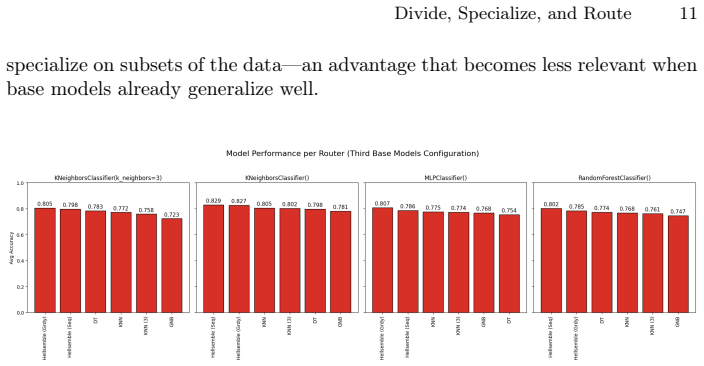
The paper's central discovery is that treating instance-level difficulty as an explicit training signal can replace the usual ensemble aggregation step. Hellsemble starts by training a base model on the full training set, then removes the instances that model got right and trains the next base model on the remaining 'harder' examples. Repeating this yields a chain of models ordered by difficulty, and the iteration index at which an instance is filtered out becomes its circle label. A router trained as a multiclass classifier on those labels predicts, for a new instance, which chain element should answer. On the OpenML-CC18 and Tabzilla benchmarks, the authors report that this arrangement outperforms the individual base models in most tested configurations, with the clearest gains—2 to 3 percentage points—when the base models are simple classifiers.
Load-bearing premise
The router must learn a stable mapping from features to difficulty circles that holds on new data; if test instances fall into different difficulty patterns than the training set, the router sends them to the wrong specialist and the ensemble loses its advantage.
Editorial extensions
If this is right
- With simple base models, Hellsemble reports average accuracy gains of 2–3 percentage points over each individual base model.
- At inference time only the router and one selected base model run, so prediction cost stays near that of a single classifier.
- When no additional model improves validation score, Hellsemble stops and returns a single model, so it does not force ensemble overhead.
- The circle labels give an interpretable segmentation of the data, showing which instances are easy or hard for each learner.
Reading between the lines
- The router's labels come from training-set errors and are noisy; confidence-weighted or iteratively re-labeled circles could improve routing accuracy beyond the paper's reported results.
- The difficulty circles resemble a curriculum, so choosing the order of models by complementary errors rather than validation accuracy alone might create larger gains.
- The reported gains are strongest when the base suite lacks a powerful global model, suggesting the method is a way to upgrade weak learners rather than to beat strong ones.
- The router is itself a classifier, so its capacity may become the bottleneck; using a stronger router than the base models could turn the 2–3 point gains into larger margins.
Editorial analysis
A structured set of objections, weighed in public.
Referee Report
Summary. The paper proposes Hellsemble, an ensemble method for binary classification that builds a committee by iteratively training base models on increasingly difficult subsets of the training data: after each model is added, misclassified instances (plus a fraction α of correctly classified instances) are passed to the next round, and a router classifier is trained on the resulting 'circle of difficulty' labels to choose a single base model at test time. Two training procedures are given (sequential, Algorithm 1, and greedy, Algorithm 2), and experiments are run on OpenML-CC18 and Tabzilla with 16 combinations of base-model suites and router models, comparing against individual base models. The paper claims that Hellsemble often outperforms both its base models and, in the abstract, classical ensemble methods, while being efficient and interpretable.
Significance. If the claims were supported, the Hellsemble idea would be a useful contribution: it provides a simple, interpretable way to specialize simple learners to subregions of the input space and routes at inference through a single model, which could indeed reduce inference cost relative to full ensembles. The framework's core loop in Algorithm 1 is clearly described and easy to implement. However, the empirical evidence in the manuscript does not substantiate the abstract's headline claims: comparisons to classical ensemble methods are absent, and the accuracy analysis is restricted to a selected subset of runs. The paper also ships no code and reports no uncertainty quantification, so the central quantitative claims are not currently verifiable.
major comments (4)
- [Section 5, Figure 2, Algorithm 1] The accuracy analysis restricts attention to 'dataset and experiment pairs where the resulting Hellsemble (either sequential or greedy) included more than one model' (Section 5). Since Figure 2 shows that single-model Hellsembles are the majority in most configurations, this filtering excludes the majority of runs and removes exactly the cases where Hellsemble cannot beat its best base model. Algorithm 1 stops adding models when the validation score does not improve (lines 12–13), so multi-model formation is itself a favorable selection event. The reported 2–3 percentage point improvements therefore apply only to a non-representative subset, and the claim that Hellsemble 'often outperforms' its base models is not supported by the full procedure.
- [Abstract and Section 4] The abstract's claim that Hellsemble 'often outperforms classical ensemble methods' is never tested. The experimental protocol compares Hellsemble only with the individual base models in each suite; there are no bagging, boosting, stacking, or dynamic ensemble selection baselines, nor comparisons to standard ensemble implementations. Consequently, the central comparative claim is unsubstantiated as written.
- [Section 5, Figures 3–6] The accuracy plots report only averages over datasets, without error bars, per-dataset counts, or statistical tests. Given that the number of datasets forming multi-model ensembles varies by configuration, the reader cannot distinguish a consistent improvement from an artifact of averaging over few favorable datasets. The manuscript should report full per-dataset results, win/loss counts, and appropriate significance measures.
- [Section 3, Algorithm 1 (router training, lines 8–10)] The method depends on the router's ability to learn a stable mapping from features to 'circle of difficulty' labels derived from training-set errors, but no analysis of router generalization is provided. The authors should report router accuracy versus an oracle router (which would always pick the model with the best test loss) and versus random routing, and should discuss the failure mode in which misrouting sends an instance to a specialist that is worse than the best base model. A sensitivity analysis for the α parameter and the validation-based stopping threshold would also clarify which components of the algorithm drive performance.
minor comments (5)
- [Figure 1 and Section 5] Figure 1's caption contains a typo ('evalution'), and Section 5 refers to 'configurations 3 and 4' although Table 1 does not number the configurations; please clarify which configurations are meant.
- [References] References [12] and [13] point to the same AutoGluon paper; the duplicate should be removed or replaced with the relevant distinct citation.
- [Acknowledgments and Section 4] The acknowledgments contain a typo ('programme.program'), and the phrase 'a robust suites' should be 'a robust suite'.
- [Section 4] No random seeds, exact dataset versions, or code repository are provided, which makes the experimental results difficult to reproduce.
- [Section 3.1, Algorithm 1] The hyperparameter α (the fraction of correctly classified instances passed forward) and the validation threshold are not specified for the experiments; please report the values used and any sensitivity checks.
Circularity Check
No significant circularity: the method is an empirical procedure evaluated on held-out data, not a derivation that reduces to its own inputs.
full rationale
The paper proposes Hellsemble, an iterative ensemble procedure in which base models are trained on subsets defined by previous models' misclassifications, and a router is trained on instance-level labels derived from the iteration at which each training instance was filtered out. This is a constructive algorithm, not a mathematical derivation: there is no equation in which an output is defined in terms of the claimed result, and no fitted parameter is renamed as a prediction. The router is trained on training-set error labels and evaluated on held-out test data, which is standard practice rather than circular reasoning. The paper does cite prior work, but the cited references are standard benchmarks and related methods, not a self-citation chain that carries the load of the central claim. The main weaknesses are empirical rather than circular: the accuracy analysis in Section 5 is restricted to runs where Hellsemble formed a multi-model ensemble, and the abstract's claim that Hellsemble 'often outperforms classical ensemble methods' is not directly tested against bagging, boosting, or DES in the reported experiments. These are important correctness and reporting concerns, but they do not constitute a reduction of the claimed result to its own inputs. Therefore the circularity score is 0.
Assumptions & free parameters
free parameters (4)
- alpha (fraction of correctly classified instances carried to next iteration) =
Not specified
- Validation-based stopping threshold
- Router model choice and hyperparameters
- Base model suite composition
assumptions (4)
- domain assumption Misclassified instances are intrinsically harder and can be learned by later models
- domain assumption The router can learn a generalizable mapping from features to difficulty circles
- domain assumption Validation accuracy with the current router is a reliable criterion for model selection and stopping
- ad hoc to paper The fraction alpha of correctly classified instances passed forward is sufficient regularization
Cite this review
Pith. "Pith review of Divide, Specialize, and Route: A New Approach to Efficient Ensemble Learning." pith.science (2026). https://pith.science/paper/I6CHOLKD
@misc{pith2026250620814,
  author       = {Pith},
  title        = {Pith review of: Divide, Specialize, and Route: A New Approach to Efficient Ensemble Learning},
  year         = {2026},
  howpublished = {\url{https://pith.science/paper/I6CHOLKD}},
  note         = {Machine review of arXiv:2506.20814}
}
read the original abstract
Ensemble learning has proven effective in boosting predictive performance, but traditional methods such as bagging, boosting, and dynamic ensemble selection (DES) suffer from high computational cost and limited adaptability to heterogeneous data distributions. To address these limitations, we propose Hellsemble, a novel and interpretable ensemble framework for binary classification that leverages dataset complexity during both training and inference. Hellsemble incrementally partitions the dataset into circles of difficulty by iteratively passing misclassified instances from simpler models to subsequent ones, forming a committee of specialised base learners. Each model is trained on increasingly challenging subsets, while a separate router model learns to assign new instances to the most suitable base model based on inferred difficulty. Hellsemble achieves strong classification accuracy while maintaining computational efficiency and interpretability. Experimental results on OpenML-CC18 and Tabzilla benchmarks demonstrate that Hellsemble often outperforms classical ensemble methods. Our findings suggest that embracing instance-level difficulty offers a promising direction for constructing efficient and robust ensemble systems.
Figures


Figures from the paper (3 more)


Reference graph
Works this paper leans on
-
[1]
Pervasive and Mobile Computing 104, 101973 (2024)
Bekku, H., Kume, T., Tsuge, A., Nakazawa, J.: A stable and efficient dynamic ensemble method for pothole detection. Pervasive and Mobile Computing 104, 101973 (2024)
work page 2024
-
[2]
Bischl, B., Casalicchio, G., Feurer, M., Gijsbers, P., Hutter, F., Lang, M., Manto- vani, R.G., van Rijn, J.N., Vanschoren, J.: Openml benchmarking suites (2021), https://arxiv.org/abs/1708.03731
arXiv 2021
-
[3]
Machine learning45, 5–32 (2001)
Breiman, L.: Random forests. Machine learning45, 5–32 (2001)
2001
-
[4]
In: Sixth International Conference on Data Mining (ICDM’06)
Caruana, R., Munson, A., Niculescu-Mizil, A.: Getting the most out of ensemble selection. In: Sixth International Conference on Data Mining (ICDM’06). pp. 828–
-
[5]
In: Proceedings of the twenty-first international conference on Machine learning
Caruana, R., Niculescu-Mizil, A., Crew, G., Ksikes, A.: Ensemble selection from libraries of models. In: Proceedings of the twenty-first international conference on Machine learning. p. 18 (2004)
work page 2004
-
[6]
Neural computing and applications22, 673–688 (2013)
Cavalin, P.R., Sabourin, R., Suen, C.Y.: Dynamic selection approaches for multiple classifier systems. Neural computing and applications22, 673–688 (2013)
work page 2013
-
[7]
Chen, T., Guestrin, C.: Xgboost: A scalable tree boosting sys- tem. In: Proceedings of the 22nd ACM SIGKDD International Con- ference on Knowledge Discovery and Data Mining. p. 785–794. KDD ’16, ACM (Aug 2016). https://doi.org/10.1145/2939672.2939785, http://dx.doi.org/10.1145/2939672.2939785
arXiv 2016
-
[8]
Pattern recognition48(5), 1925–1935 (2015)
Cruz,R.M.,Sabourin,R.,Cavalcanti,G.D.,Ren,T.I.:Meta-des:Adynamicensem- ble selection framework using meta-learning. Pattern recognition48(5), 1925–1935 (2015)
work page 2015
Show all 21 references
-
[9]
Ensemble machine learn- ing: Methods and applications pp
Cutler, A., Cutler, D.R., Stevens, J.R.: Random forests. Ensemble machine learn- ing: Methods and applications pp. 157–175 (2012)
2012
-
[10]
In: International work- shop on multiple classifier systems
Dietterich, T.G.: Ensemble methods in machine learning. In: International work- shop on multiple classifier systems. pp. 1–15. Springer (2000)
2000
-
[11]
arXiv preprint arXiv:2404.14618 (2024)
Ding, D., Mallick, A., Wang, C., Sim, R., Mukherjee, S., Ruhle, V., Lakshmanan, L.V., Awadallah, A.H.: Hybrid llm: Cost-efficient and quality-aware query routing. arXiv preprint arXiv:2404.14618 (2024)
2024 arXiv
-
[13]
Erickson, N., Mueller, J., Shirkov, A., Zhang, H., Larroy, P., Li, M., Smola, A.: Autogluon-tabular: Robust and accurate automl for structured data (2020), https://arxiv.org/abs/2003.06505
2020 arXiv
-
[14]
Journal of Machine Learning Research 23(261), 1–61 (2022)
Feurer, M., Eggensperger, K., Falkner, S., Lindauer, M., Hutter, F.: Auto-sklearn 2.0: Hands-free automl via meta-learning. Journal of Machine Learning Research 23(261), 1–61 (2022)
2022
-
[15]
Journal of computer and system sciences55(1), 119–139 (1997)
Freund, Y., Schapire, R.E.: A decision-theoretic generalization of on-line learning and an application to boosting. Journal of computer and system sciences55(1), 119–139 (1997)
1997
-
[16]
Pattern Recognition34(9), 1879–1881 (2001)
Giacinto, G., Roli, F.: Dynamic classifier selection based on multiple classifier be- haviour. Pattern Recognition34(9), 1879–1881 (2001)
2001
-
[17]
Pattern recognition41(5), 1718–1731 (2008)
Ko, A.H., Sabourin, R., Britto Jr, A.S.: From dynamic classifier selection to dy- namic ensemble selection. Pattern recognition41(5), 1718–1731 (2008)
2008
-
[18]
McElfresh,D.,Khandagale,S.,Valverde,J.,C,V.P.,Feuer,B.,Hegde,C.,Ramakr- ishnan, G., Goldblum, M., White, C.: When do neural nets outperform boosted trees on tabular data? (2024), https://arxiv.org/abs/2305.02997 14 Piwko, Ruciński, Płudowski, Zajko, Żak, Zacharecki
2024 arXiv
-
[19]
In: International Conference on Machine Learning
McGill, M., Perona, P.: Deciding how to decide: Dynamic routing in artificial neu- ral networks. In: International Conference on Machine Learning. pp. 2363–2372. PMLR (2017)
2017
-
[20]
Olson, R.S., Bartley, N., Urbanowicz, R.J., Moore, J.H.: Evaluation of a tree-based pipeline optimization tool for automating data science (2016), https://arxiv.org/abs/1603.06212
2016 arXiv
-
[21]
Wiley interdisciplinary reviews: data min- ing and knowledge discovery5(1), 21–34 (2015)
Sesmero, M.P., Ledezma, A.I., Sanchis, A.: Generating ensembles of heterogeneous classifiers using stacked generalization. Wiley interdisciplinary reviews: data min- ing and knowledge discovery5(1), 21–34 (2015)
2015
-
[22]
IEEE transactions on pattern analysis and machine intelligence 19(4), 405–410 (1997)
Woods, K., Kegelmeyer, W.P., Bowyer, K.: Combination of multiple classifiers using local accuracy estimates. IEEE transactions on pattern analysis and machine intelligence 19(4), 405–410 (1997)
1997
Reviewed August 6, 2026 · model on record in the stance chip above.
Discussion (0). Sign in to comment.