Compact objects in AdS spacetime with exponential, quadratic and power-law bosonic mass profiles
Pith reviewed 2026-05-20 04:40 UTC · model grok-4.3
The pith
Bosonic mass profiles in exponential, quadratic and power-law forms produce stable compact stellar configurations in AdS spacetime.
A machine-rendered reading of the paper's core claim, the machinery that carries it, and where it could break.
Core claim
When the bosonic mass inside an AdS compact object is given an exponential, quadratic, or power-law dependence on radius, the integrated mass increases monotonically with radius, remains within observational compact-star mass limits, and yields a compactness ratio below Buchdahl’s limit; the null and strong energy conditions are satisfied throughout the interior, confirming that the models describe stable compact stellar configurations rather than collapsing ones.
What carries the argument
The bosonic mass expressed as a chosen function of radial coordinate (exponential, quadratic, or power-law) that enters the metric and matter sector of the AdS Einstein equations for the condensate.
If this is right
- All three profiles generate mass-radius curves that lie inside the range of observed compact-star masses.
- Compactness for every profile stays safely below the Buchdahl upper bound.
- Satisfaction of the null and strong energy conditions throughout the interior supports dynamical stability.
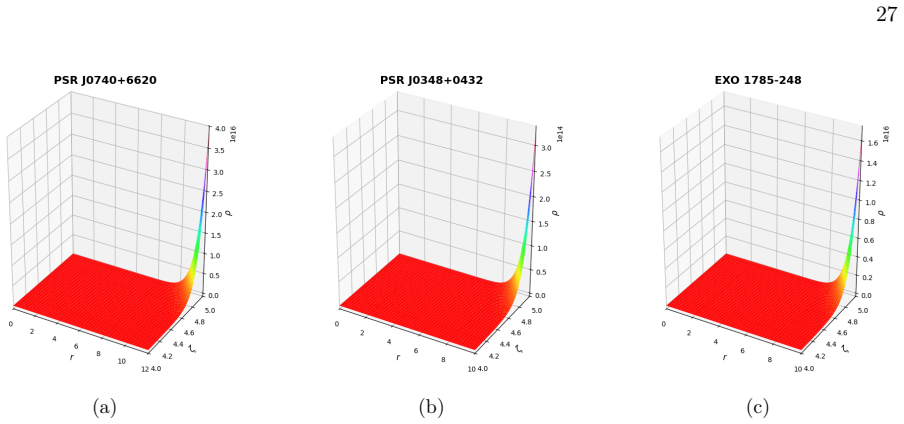
- Mass density is higher near the surface than in the core for the adopted profiles.
Where Pith is reading between the lines
- The same mass-function approach could be applied to other asymptotically AdS geometries to test how the choice of profile affects the approach to a black-hole limit.
- Extending the static models to include slow rotation would allow direct comparison with pulsar timing or gravitational-wave data on compact objects.
- Because the profiles are phenomenological, matching them to a holographic dual description of the condensate could provide a microscopic origin for the radial dependence.
Load-bearing premise
The bosonic mass is taken to follow one of three simple phenomenological functions of radius without a first-principles derivation from a microscopic theory.
What would settle it
A radial integration of the Einstein equations for any of the three mass profiles that produces a compactness exceeding Buchdahl’s limit or a region where the strong energy condition fails would falsify the stability conclusion.
Figures




read the original abstract
This paper reports a study on the formation and physical characteristics of compacts stars in AdS spacetime within the framework of Bose-Einstein Condensate. Considering a Bose-Einstein condensate background at zero temperature this study works on total mass, compactness, surface redshift, density, pressure, adiabatic index and energy conditions. The bosonic mass has been taken as three distinct functions of radial coordinate in exponential form, quadratic form, and power law form. Our results reveal that the mass increases monotonically with radius and remains within observational limit for all the observationally motivated compact-star mass scales considered in this study and the compactness for all the cases is within Buchdahl's limit and hence it was confirmed that the configuration correspondence to compact stellar configuration models rather than forming a collapsing model. Both NEC and SEC are satisfied throughout the stellar interior and hence dynamical stability is ensured. Furthermore, the study also confirms the enhanced mass concentration near the outer region in the stellar models under consideration. Hence present study explores the physical properties and stability of compact bosonic configurations in AdS spacetime within a holographically motivated framework. The present analysis is primarily phenomenological and qualitative in nature. The models considered here are intended to explore possible behaviours of self-gravitating bosonic configurations in AdS geometry and are not proposed as fully realistic neutron-star models.
Editorial analysis
A structured set of objections, weighed in public.
Referee Report
Summary. The paper examines compact stellar configurations in Anti-de Sitter (AdS) spacetime within a zero-temperature Bose-Einstein Condensate (BEC) framework. It adopts three phenomenological bosonic mass profiles m(r)—exponential, quadratic, and power-law—as functions of the radial coordinate, then computes total mass, compactness, surface redshift, density, pressure, adiabatic index, and energy conditions. The central claims are that mass increases monotonically and stays within observational limits, compactness respects Buchdahl's bound (confirming compact-star rather than collapsing models), and both NEC and SEC hold throughout the interior (ensuring dynamical stability), with enhanced mass concentration near the outer regions. The analysis is explicitly described as phenomenological and qualitative, not proposed as realistic neutron-star models.
Significance. If the mass profiles prove consistent with the Einstein equations sourced by a BEC fluid in AdS, the results provide qualitative exploration of possible self-gravitating bosonic configurations in a holographically motivated geometry, including confirmation of stability indicators and outer mass concentration. The work's value is limited by its phenomenological construction, offering illustrative behaviors rather than predictive or first-principles models.
major comments (2)
- [Mass profiles section] § on mass profiles (following abstract description of exponential, quadratic, and power-law forms): the three m(r) profiles are inserted directly as ad-hoc functional forms with free scale and exponent parameters, without derivation from the BEC equation of state (typically p = K ρ² for non-relativistic condensate) or explicit verification that the implied ρ(r), p(r) satisfy the modified TOV equation including the negative cosmological constant. This is load-bearing for the stability and energy-condition claims, as an inconsistent p-ρ relation would mean the configurations are not valid BEC solutions in AdS.
- [Energy conditions and stability results] Results section on energy conditions and stability: while NEC and SEC are stated to be satisfied, the manuscript must demonstrate how these are obtained from the assumed m(r) via the Einstein equations (including AdS term) and confirm that the profiles produce a self-consistent fluid source; without this, the conclusion that 'dynamical stability is ensured' rests on unverified assumptions.
minor comments (3)
- [Abstract] Abstract: 'the configuration correspondence to compact stellar configuration models' contains a grammatical error and should read 'the configurations correspond to compact stellar models'.
- [Parameter choices] Throughout: specify the numerical values or ranges chosen for the free parameters in each mass profile and discuss any sensitivity of the monotonic mass growth or Buchdahl compliance to these choices.
- [Notation] Notation: ensure consistent use of symbols for bosonic mass m(r), energy density, and pressure when transitioning between the three profile cases.
Simulated Author's Rebuttal
We thank the referee for the careful reading of our manuscript and for the constructive comments on the consistency of the phenomenological mass profiles with the Einstein equations. We clarify that the study is explicitly phenomenological and qualitative, as stated in the abstract, and does not claim to derive the profiles from a specific BEC equation of state. We will revise the manuscript to include explicit derivations showing how the energy density and pressure are obtained from the assumed m(r) via the Einstein equations in AdS spacetime, thereby confirming self-consistency of the fluid sources and the validity of the energy-condition and stability results within this framework.
read point-by-point responses
-
Referee: [Mass profiles section] § on mass profiles (following abstract description of exponential, quadratic, and power-law forms): the three m(r) profiles are inserted directly as ad-hoc functional forms with free scale and exponent parameters, without derivation from the BEC equation of state (typically p = K ρ² for non-relativistic condensate) or explicit verification that the implied ρ(r), p(r) satisfy the modified TOV equation including the negative cosmological constant. This is load-bearing for the stability and energy-condition claims, as an inconsistent p-ρ relation would mean the configurations are not valid BEC solutions in AdS.
Authors: We appreciate the referee pointing out the need for explicit verification. Our analysis is phenomenological by design, as noted in the manuscript, and the chosen m(r) forms are intended to illustrate possible behaviors rather than to represent exact solutions derived from the BEC equation of state. In the revised manuscript, we will add a dedicated subsection deriving the energy density ρ(r) directly from the Einstein equations using the mass function m(r) and the AdS cosmological constant term. We will then obtain the pressure p(r) from the modified Tolman-Oppenheimer-Volkoff equation and confirm that the resulting p-ρ relation is consistent for each profile. This will explicitly demonstrate that the assumed forms produce valid fluid sources within the phenomenological setup. revision: yes
-
Referee: [Energy conditions and stability results] Results section on energy conditions and stability: while NEC and SEC are stated to be satisfied, the manuscript must demonstrate how these are obtained from the assumed m(r) via the Einstein equations (including AdS term) and confirm that the profiles produce a self-consistent fluid source; without this, the conclusion that 'dynamical stability is ensured' rests on unverified assumptions.
Authors: We agree that the derivations should be shown explicitly to support the claims. In the revised version, we will present the full expressions for the energy density and isotropic pressure obtained from the Einstein field equations with the negative cosmological constant, using each m(r) profile. We will then compute the null energy condition (ρ + p ≥ 0) and strong energy condition (ρ + 3p ≥ 0 and ρ + p ≥ 0) directly from these quantities and verify that they hold throughout the interior for the chosen parameter ranges. This will confirm that the profiles yield self-consistent sources and that the stability indicators follow from the field equations rather than from unverified assumptions. We will also emphasize that these results are valid within the stated phenomenological context. revision: yes
Circularity Check
No significant circularity; phenomenological inputs are explicit and non-reductive
full rationale
The paper states that the bosonic mass profiles are 'taken as' exponential, quadratic, and power-law functions of radius and frames the entire analysis as 'primarily phenomenological and qualitative in nature' with models 'intended to explore possible behaviours' rather than derived from the BEC equation of state. The reported outcomes (monotonic mass growth, compactness below Buchdahl's limit, satisfaction of NEC/SEC) are direct verifications of quantities obtained by inserting these assumed m(r) forms into the Einstein equations with negative cosmological constant; no step claims a first-principles derivation that reduces to the inputs by construction, no self-citation is load-bearing, and no parameter fit is relabeled as an independent prediction. The derivation chain is therefore self-contained against external benchmarks such as Buchdahl's limit and energy conditions.
Axiom & Free-Parameter Ledger
free parameters (1)
- scale and exponent parameters in the three mass profiles
axioms (2)
- domain assumption Bose-Einstein condensate background at zero temperature
- domain assumption AdS spacetime geometry with holographic motivation
Lean theorems connected to this paper
-
IndisputableMonolith/Cost/FunctionalEquation.leanwashburn_uniqueness_aczel unclear?
unclearRelation between the paper passage and the cited Recognition theorem.
The bosonic mass has been taken as three distinct functions of radial coordinate in exponential form, quadratic form, and power law form.
What do these tags mean?
- matches
- The paper's claim is directly supported by a theorem in the formal canon.
- supports
- The theorem supports part of the paper's argument, but the paper may add assumptions or extra steps.
- extends
- The paper goes beyond the formal theorem; the theorem is a base layer rather than the whole result.
- uses
- The paper appears to rely on the theorem as machinery.
- contradicts
- The paper's claim conflicts with a theorem or certificate in the canon.
- unclear
- Pith found a possible connection, but the passage is too broad, indirect, or ambiguous to say the theorem truly supports the claim.
Reference graph
Works this paper leans on
-
[1]
The adiabatic index is crucial for understanding how changes in density affect the changes in pressure. Higher adiabatic index values show that pressure rises quickly with density, making the star model more resilient to compression and producing a more stable structure. The graph displays a monotonic increase in pattern within the interior of the stars, ...
-
[2]
proposed this limiting value to evaluate the dynamical stability of anisotropic realistic stars with spherical symmetry in the presence of small perturbations in radial adiabatic. Heintzmann and Hillebrandt [45] state that for compact objects with a rising anisotropy factor, the relativistic stability requirement, Γ, should be greater than 4/3. Fig. 4 and...
-
[3]
S. L. Shapiro and S. A. Teukolsky, Black holes, white dwarfs and neutron stars: the physics of compact objects (John Wiley & Sons, 2024)
work page 2024
-
[4]
A. Sedrakian, J. J. Li, and F. Weber, Progress in Particle and Nuclear Physics 131, 104041 (2023). 36
work page 2023
-
[5]
S. L. Shapiro, S. A. Teukolsky, B. Holes, W. Dwarfs, and N. Stars, Wiley, New York 19832, 119 (1983)
work page 1983
-
[6]
Weber, Pulsars as astrophysical laboratories for nuclear and particle physics (Routledge, 2017)
F. Weber, Pulsars as astrophysical laboratories for nuclear and particle physics (Routledge, 2017)
work page 2017
-
[7]
Einstein et al., Annalen Phys 49, 769 (1916)
A. Einstein et al., Annalen Phys 49, 769 (1916)
work page 1916
-
[8]
H. A. Lorentz, A. Einstein, H. Minkowski, H. Weyl, and A. Sommerfeld, The principle of relativity: a collection of original memoirs on the special and general theory of relativity (Courier Corporation, 1952)
work page 1952
-
[9]
P. A. M. Dirac, General theory of relativity , vol. 14 (Princeton University Press, 1996)
work page 1996
-
[10]
Maldacena, International journal of theoretical physics 38, 1113 (1999)
J. Maldacena, International journal of theoretical physics 38, 1113 (1999)
work page 1999
-
[11]
P. Burikham and T. Chullaphan, Journal of High Energy Physics 2014, 1 (2014)
work page 2014
-
[12]
Dimensional Reduction in Quantum Gravity
G. Hooft, arXiv preprint gr-qc/9310026 (1993)
work page internal anchor Pith review Pith/arXiv arXiv 1993
-
[13]
Anti De Sitter Space And Holography
E. Witten, arXiv preprint hep-th/9802150 (1998)
work page internal anchor Pith review Pith/arXiv arXiv 1998
-
[14]
N. Kovensky, A. Poole, and A. Schmitt, Physical Review D 105, 034022 (2022)
work page 2022
-
[15]
N. Kovensky, A. Poole, and A. Schmitt, SciPost Physics Proceedings p. 019 (2022)
work page 2022
-
[16]
J. de Boer, K. Papadodimas, and E. Verlinde, Journal of High Energy Physics 2010, 1 (2010)
work page 2010
-
[17]
X. Arsiwalla, J. de Boer, K. Papadodimas, and E. Verlinde, Journal of High Energy Physics 2011, 1 (2011)
work page 2011
-
[18]
A Gravity Dual of RHIC Collisions
E. Shuryak, S.-J. Sin, and I. Zahed, arXiv preprint hep-th/0511199 (2005)
work page internal anchor Pith review Pith/arXiv arXiv 2005
-
[19]
P. M. Chesler and L. G. Yaffe, arXiv preprint arXiv:0812.2053 (2008)
work page internal anchor Pith review Pith/arXiv arXiv 2053
-
[20]
S. Bhattacharyya and S. Minwalla, Journal of High Energy Physics 2009, 034 (2009)
work page 2009
-
[21]
V. Balasubramanian, A. Bernamonti, J. de Boer, N. Copland, B. Craps, E. Keski-Vakkuri, B. Müller, A. Schäfer, M. Shigemori, and W. Staessens, Physical review letters 106, 191601 (2011)
work page 2011
-
[22]
S. Das, P. Rudra, and S. Chattopadhyay, Nucl. Phys. B 1012, 9 (2025)
work page 2025
- [23]
-
[24]
W. Hu, R. Barkana, and A. Gruzinov, Physical Review Letters 85, 1158 (2000)
work page 2000
-
[25]
Observational constraints on holographic dark energy with varying gravitational constant
Z. Li and C. Bambi, arXiv: 0912.0923 p. 031 (2010)
work page internal anchor Pith review Pith/arXiv arXiv 2010
-
[26]
V. H. Robles and T. Matos, Monthly Notices of the Royal Astronomical Society 422, 282 (2012)
work page 2012
-
[27]
P.-H. Chavanis and L. Delfini, Physical Review D—Particles, Fields, Gravitation, and Cosmology 84, 043532 (2011)
work page 2011
-
[28]
Witten, Communications in mathematical physics 121, 351 (1989)
E. Witten, Communications in mathematical physics 121, 351 (1989)
work page 1989
-
[29]
Feng, arXiv preprint arXiv:2401.01617 (2024)
T. Feng, arXiv preprint arXiv:2401.01617 (2024)
- [30]
-
[31]
B. Hartmann, B. Kleihaus, J. Kunz, and I. Schaffer, Physical Review D—Particles, Fields, Gravitation, and Cosmology 88, 124033 (2013)
work page 2013
-
[32]
Wachter, Relativistic quantum mechanics , vol
A. Wachter, Relativistic quantum mechanics , vol. 422 (Springer, 2011)
work page 2011
-
[33]
Bhuiyan, in Journal of Physics: Conference Series (IOP Publishing, 2021), vol
G. Bhuiyan, in Journal of Physics: Conference Series (IOP Publishing, 2021), vol. 1718, p. 012006
work page 2021
-
[34]
P. Bhar, K. Singh, and N. Pant, Indian Journal of Physics 91, 701 (2017)
work page 2017
- [35]
-
[36]
S. Das, I. Radinschi, and S. Chattopadhyay, Axioms 12, 234 (2023)
work page 2023
-
[37]
S. Das, A. Beesham, and S. Chattopadhyay, Annals of Physics 458, 169460 (2023)
work page 2023
-
[38]
S. Das, S. Chattopadhyay, and E. Güdekli, Nuclear Physics B p. 117072 (2025)
work page 2025
-
[39]
B. V. Ivanov, Physical Review D 65, 104011 (2002)
work page 2002
- [40]
-
[41]
E. Morales and F. Tello-Ortiz, The European Physical Journal C 78, 618 (2018)
work page 2018
-
[42]
S. Das, E. Güdekli, and S. Chattopadhyay, International Journal of Modern Physics A 41, 2650060 (2026)
work page 2026
-
[43]
Hawking, Communications in Mathematical Physics 46, 206 (1976)
S. Hawking, Communications in Mathematical Physics 46, 206 (1976)
work page 1976
- [44]
- [45]
- [46]
-
[47]
H. Heintzmann and W. Hillebrandt, Astronomy and Astrophysics, vol. 38, no. 1, Jan. 1975, p. 51-55. Research supported by the Deutsche Forschungsgemeinschaft. 38, 51 (1975)
work page 1975
-
[48]
Chandrasekhar, Physical Review Letters 12, 114 (1964)
S. Chandrasekhar, Physical Review Letters 12, 114 (1964)
work page 1964
-
[49]
R. S. (London), Proceedings of the Royal Society , vol. 17 (1869)
-
[50]
Nuclear pasta in supernovae and neutron stars
G. Watanabe and T. Maruyama, arXiv preprint arXiv:1109.3511 (2011)
work page internal anchor Pith review Pith/arXiv arXiv 2011
-
[51]
D. Vogt and P. Letelier, Monthly Notices of the Royal Astronomical Society 402, 1313 (2010)
work page 2010
-
[52]
S. S. Gubser, I. R. Klebanov, and A. Peet, Physical Review D 54, 3915 (1996)
work page 1996
-
[53]
I. R. Klebanov, Nuclear Physics B 496, 231 (1997)
work page 1997
-
[54]
S. S. Gubser and I. R. Klebanov, Physics Letters B 413, 41 (1997)
work page 1997
discussion (0)
Sign in with ORCID, Apple, or X to comment. Anyone can read and Pith papers without signing in.