REVIEW 2 major objections 5 minor 68 references
The dynamic critical exponent $z$ of the three-dimensional Ising universality class: Monte Carlo simulations of the improved Blume-Capel model
T0 review · 2 major / 5 minor · reviewed 2026-08-14 · deepseek-v4-flash
Pith's one-line read Precise Monte Carlo measurement puts the 3D Ising dynamic critical exponent at z = 2.0245(15).
desk verdict A careful, high-statistics Monte Carlo determination of z for 3D Ising model A dynamics that gives z = 2.0245(15) and reconciles simulation with field theory; the central value is credible, but the quoted error is an envelope over one-correction fits and may leave a small systematic uncovered. read the letter →
The pith
A machine-rendered reading of the paper's core claim, the machinery that carries it, and where it could break.
The reading
What carries the argument
The carrying mechanism is the improved Blume-Capel model at the parameter $D^* = 0.656(20)$ (simulated at $D = 0.655$), where the amplitude of the leading correction to scaling is suppressed by at least a factor of 30 relative to the spin-$1/2$ Ising model, so the remaining corrections to $\tau \sim L^z$ can be represented by a single effective $L^{-2}$ term. The measured observable is the integrated autocorrelation time of the magnetic susceptibility, evaluated from autocorrelation functions with a self-consistent truncation and single-exponential tail correction, and then fitted with and without the $L^{-2}$ correction over lattice sizes up to $L = 72$. The heat bath and Metropolis algorithms give consistent exponents, and a combined fit yields the central value.
What would settle it
Measure $\tau_{\mathrm{int},\chi}$ on larger lattices, say $L = 96$ and $128$, with errors on $z$ below $5\times10^{-4}$, and refit with the same $L^{-2}$ correction form: if the exponent drifts by more than the quoted $1.5\times10^{-4}$ as $L_{\min}$ increases, the correction ansatz is incomplete. Alternatively, take a second improved coupling inside $D^*=0.656(20)$, such as $D=0.656$; if the two determinations of $z$ disagree beyond error bars, the assumed suppression of leading corrections is wrong.
Extended reading notes
Core claim
The central claim is that, at the improved point $D = 0.655$, the integrated autocorrelation time of the magnetic susceptibility at criticality obeys $\tau_{\mathrm{int},\chi} = a L^z (1 + c L^{-\epsilon})$ with an effective correction exponent $\epsilon = 2$, and fits to this form across lattice sizes $L \ge 14$ give $z = 2.0245(15)$ for the model-A dynamic critical exponent. The same value is obtained from out-of-equilibrium quenches, where the magnetization decays as $m(t) = a (t - t_0)^{-\beta/(\nu z)}$. This estimate is fully consistent with functional renormalization group results and with the four-loop $\epsilon$-expansion analyzed in the paper, and it attributes the earlier spread of Monte Carlo values to unsubtracted leading corrections to scaling.
Load-bearing premise
The load-bearing premise is that at $D = 0.655$ the leading correction to scaling is suppressed by at least a factor of 30, so all remaining corrections to $\tau \sim L^z$ can be absorbed into a single effective $L^{-2}$ term; the improved point itself is taken from the author's earlier work and is not re-derived in this paper.
Editorial extensions
If this is right
- Earlier high Monte Carlo estimates of $z$ for the 3D Ising model, such as $z \approx 2.04$ to $2.08$, can be explained as uncorrected leading corrections to scaling, whose amplitude is particularly large for autocorrelation times.
- The dynamic critical exponent of the 3D Ising universality class for model A dynamics is now consistent across Monte Carlo, functional renormalization group, and resummed four-loop $\epsilon$-expansion results, all near $z = 2.024$.
- The universal ratio of correction amplitudes for the autocorrelation time relative to the Binder cumulant, $a_\tau / a_U = 3.1(6)$, provides a quantitative target for other models in the same universality class.
- Equilibrium and off-equilibrium determinations of $z$ agree, supporting the transferability of the exponent across different dynamical protocols within model A dynamics.
Reading between the lines
- Beyond the paper: the same improved-model strategy could be applied to other dynamics (e.g., conserved order parameter, model B) to test whether a single static universality class fixes the dynamic exponent once corrections are removed, or whether the conservation law changes it as expected.
- Beyond the paper: applying this correction-free analysis to the two-dimensional Ising class might sharpen the accepted value $z = 2.1665(12)$ and test whether the one-term $L^{-2}$ ansatz remains adequate at higher precision.
- Beyond the paper: the reported correction amplitudes predict that re-analyzing published Ising-model autocorrelation data with a leading $L^{-\omega}$ term of amplitude $a_\tau \approx -0.44(3)$ should bring those older estimates down to $z \approx 2.024$; this is directly checkable with existing data.
Signed reviews
Editorial analysis
A structured set of objections, weighed in public.
Referee Report
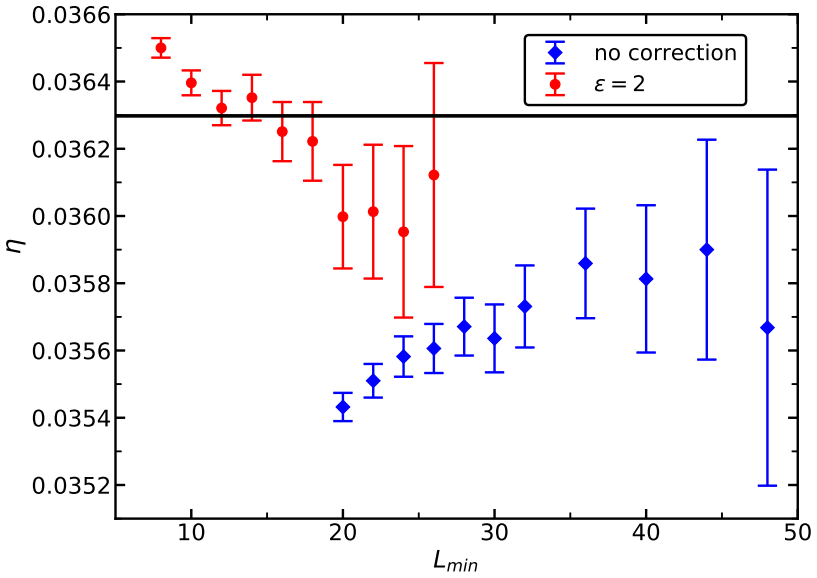
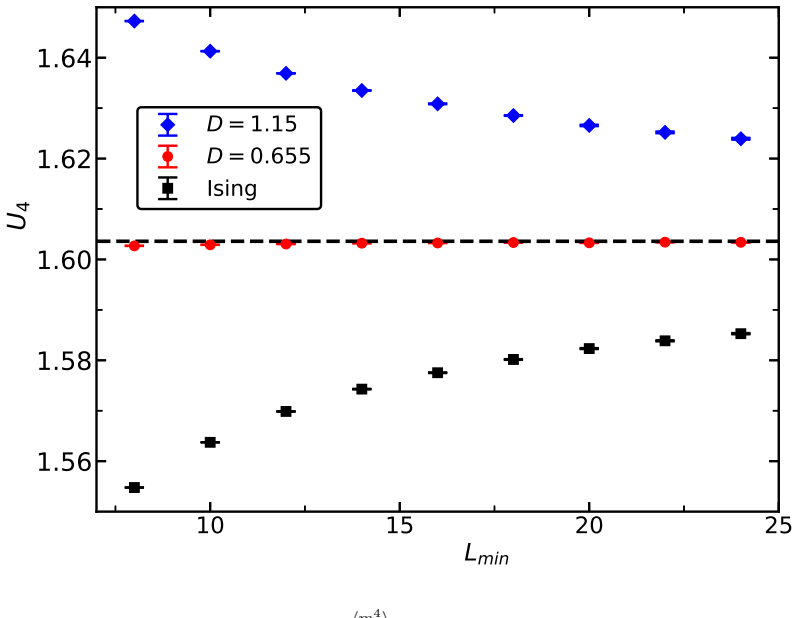
Summary. The paper reports a high-precision Monte Carlo determination of the dynamic critical exponent z of the three-dimensional Ising universality class for purely dissipative relaxational dynamics (model A). The author simulates the improved Blume-Capel model on the simple cubic lattice at D=0.655, β=0.387721735, using local heat-bath and Metropolis algorithms with checkerboard ordering. Equilibrium integrated autocorrelation times of the magnetic susceptibility are computed for lattice sizes up to L=72 and fit with finite-size scaling ansaetze τ=a L^z (1+c L^{-ε}) with ε=2, as well as without correction terms. The quoted final estimate is z=2.0245(15). Supplementary off-equilibrium quenches from a fully magnetized state to criticality give z=2.0245(10) (Metropolis) and z=2.0240(8) (heat bath), consistent with the equilibrium result. The paper also analyzes the four-loop epsilon expansion in Appendix C, obtaining z=2.0243, and includes simulations of the Ising model and of the Blume-Capel model at D=1.15 to quantify leading corrections to scaling. The central claim is that the new value reconciles Monte Carlo results with recent functional RG and field-theoretic estimates.
Significance. If the result holds, this is the most accurate Monte Carlo determination of the dynamic critical exponent of the three-dimensional Ising universality class for model A dynamics, and it resolves a long-standing tension between older lattice simulations (z≈2.03–2.08) and field-theoretic estimates (z≈2.024). The paper's strengths are the use of an improved Hamiltonian to suppress the leading correction to scaling, the cross-check between two independent local algorithms and between two dynamical protocols, the consistency of the extracted static exponent η with the conformal-bootstrap value, and the explicit synthetic-data tests for residual leading corrections. The appendix D analysis of correction amplitudes for χ, U4, and τ is a useful and nontrivial check of universality of amplitude ratios. The final value is also consistent with functional RG and four-loop epsilon-expansion estimates, which lends independent support.
major comments (2)
- [§V.B.2, eqs. (26)–(27)] The final error bar is not robust against the two-correction cancellation that the paper itself flags. In §V.B.1 the author notes for χ that one "can not exclude that these two corrections have amplitudes with opposite sign and cancel to a large extent in the range of lattice sizes considered here"; the two corrections are the analytic background (exponent 2−η) and the lattice rotational-symmetry breaking (exponent ω_NR). The same two corrections enter τ, and the fits of τ with ansatz (27) all replace them by a single L^{-2} term. Since every fit used to set z=2.0245(15) employs this same single-term ansatz, the quoted 0.0015 is an envelope over statistical and Lmin variations only; it does not include the model uncertainty from a possible opposite-sign cancellation. The synthetic-data check for residual leading corrections (multiplying by 1±[0.43/30]L^{-ω}) tests only the leading correction amplitude and cannot detect cancellation between the two subleading terms. I ask for a quantitative bound on this scenario, e.g., fits of τ with the two subleading exponents 2−η and ω_NR included simultaneously with independent amplitudes, or with amplitudes constrained by the corresponding χ and U4 analyses; the systematic error should be inflated by the observed spread.
- [§V.B.2, paragraph containing eq. (28)] The error assignment is not fully documented. The text says the error bar covers fits with ansatz (27) and Lmin=14,16,18 and the Metropolis no-correction fits, but for the heat-bath no-correction fits "at least the central values are covered" for Lmin≥40, and that "completely covering also the error bars of these fits ... seems too pessimistic." This is a subjective exclusion of fits that are not statistically rejected: for the heat-bath algorithm with ansatz (26), χ2/d.o.f. drops below one at Lmin=28. Please state the quantitative criterion by which these fits are excluded, or include a systematic term that captures the difference between the no-correction and correction fits; otherwise the quoted error is smaller than the spread of statistically acceptable analyses.
minor comments (5)
- [Appendix A, eq. (A3)] In the definition of the heat-bath probabilities, p(0) is written twice; the third line should be p(+1)=exp(−D+βSx)/z.
- [§V.B.1] "to a large extend" should read "to a large extent".
- [§VI.A, text near Figure 3] The inequality symbols appear corrupted ("t /greaterorapproxeql840"); they should be rendered as "≳".
- [Appendix C, eqs. (C4) and (C6)] The two-dimensional boundary condition is enforced as z=2.167 exactly, although the quoted literature values are 2.1665(12) and 2.1667(5). The effect of this rounding on the extracted three-dimensional value is not stated; please give the resulting uncertainty.
- [§V.B.2, first paragraph] The sentence "Replacing the 2 by 2−η or ω_NR has only little effect on the results for z" would be more informative if the numerical shifts in z were reported together with the fit ranges for which they were obtained.
Circularity Check
No significant circularity: z is obtained by direct finite-size scaling fits of measured autocorrelation times and independently corroborated by off-equilibrium quenches.
full rationale
The derivation chain for z=2.0245(15) is self-contained. The input data, tau_int,chi(L), are raw Monte Carlo measurements (Section IV, eqs. 13-22), and Section V.B.2 fits them with ansaetze (26) and (27), where z is a free parameter determined by the data; no fitted parameter is renamed as a prediction. The self-cited improved-point inputs D*=0.656(20) and beta_c=0.387721735(25) from ref. [37] only select the simulation point and do not constrain z. The paper independently checks the improvement condition: 'Fitting the data for U4 at D=0.655 confirms that the amplitude of leading corrections vanishes at the level of our numerical precision' (Appendix D), and its synthetic-data rescalings with the residual Ising correction amplitude shift z by at most 0.00049, which is inside the quoted error. The off-equilibrium quench analysis of Section VI uses a different observable and dynamics, giving z=2.0245(10), so the equilibrium result is an independent cross-check rather than a circular restatement. Appendix C's field-theoretic z values are comparisons, not inputs to the fits of Section V.B.2. The paper itself flags the main systematic concern about the single effective L^-2 correction term: 'we can not exclude that these two corrections have amplitudes with opposite sign and cancel to a large extend in the range of lattice sizes considered here.' That is a model-uncertainty caveat about fitting, not an equation that reduces the output to the input. No circular step can therefore be exhibited.
Assumptions & free parameters
free parameters (5)
- z =
2.0245(15)
- a_A =
not tabulated; depends on algorithm
- c_A =
Lmin-dependent; small for Metropolis
- t0 =
Metropolis: -2.1(2); heat bath: 0.0(1)
- effective correction exponent epsilon =
set to 2; checked with 2 - eta and omega_NR
assumptions (4)
- domain assumption At D = 0.655 the leading correction to scaling is suppressed by at least a factor of 30 compared with the Ising model.
- domain assumption The 3D Blume-Capel model at D = 0.655 is in the 3D Ising universality class and has the same dynamic critical exponent z for model A dynamics.
- domain assumption The integrated autocorrelation time of the magnetic susceptibility obeys tau = a L^z (1 + c L^-epsilon) with epsilon = 2 in the analyzed L range.
- domain assumption The conformal bootstrap value Delta_sigma = beta/nu = 0.5181489(10) is accurate enough for converting quench exponents to z.
Cite this review
Pith. "Pith review of The dynamic critical exponent $z$ of the three-dimensional Ising universality class: Monte Carlo simulations of the improved Blume-Capel model." pith.science (2026). https://pith.science/paper/I6KDHOKB
@misc{pith2026190801702,
  author       = {Pith},
  title        = {Pith review of: The dynamic critical exponent $z$ of the three-dimensional Ising universality class: Monte Carlo simulations of the improved Blume-Capel model},
  year         = {2026},
  howpublished = {\url{https://pith.science/paper/I6KDHOKB}},
  note         = {Machine review of arXiv:1908.01702}
}
abstract
We study purely dissipative relaxational dynamics in the three-dimensional Ising universality class. To this end, we simulate the improved Blume-Capel model on the simple cubic lattice by using local algorithms. We perform a finite size scaling analysis of the integrated autocorrelation time of the magnetic susceptibility in equilibrium at the critical point. We obtain $z=2.0245(15)$ for the dynamic critical exponent. As a complement, fully magnetized configurations are suddenly quenched to the critical temperature, giving consistent results for the dynamic critical exponent. Furthermore, our estimate of $z$ is fully consistent with recent field theoretic results.
Figures


Figures from the paper (3 more)


Reference graph
Works this paper leans on
-
[1]
Below we analyze the merged re sults
The magnetic susceptibility First we checked that the results obtained for D = 0.655 by using the Metropolis and the heat bath algorithm are consistent. Below we analyze the merged re sults. Assuming that the amplitude of leading corrections to scaling vanishes, we fitted th e data with the ans¨ atze χ = aL2−η (24) and χ = aL2−η (1 + bL−ǫ) , (25) where we ...
-
[2]
The scaling behavior of the autocorrelation time First we fitted the ratio τM,C /τHB,C using the ansatz (23), where now the exponent ǫ is a free parameter. We get χ2/d.o.f. = 0 .97 taking all lattice sizes into account. We get ǫ = 2.097(23), 2 .167(44), 2 .135(80), and 2 .04(13), for Lmin = 8, 10, 12, and 14, respectively, where all linear lattice sizes L ...
-
[3]
M. E. Fisher, The renormalization group in the theory of critical behavio r, Rev. Mod. Phys. 46, 597 (1974)
work page 1974
-
[4]
M. E. Fisher, Renormalization group theory: Its basis and formulation in statistical physics , Rev. Mod. Phys. 70, 653 (1998)
work page 1998
-
[5]
A. Pelissetto and E. Vicari, Critical Phenomena and Renormalization-Group Theory , [arXiv:cond-mat/0012164], Phys. Rept. 368, 549 (2002)
arXiv 2002
-
[6]
P. C. Hohenberg and B. I. Halperin, Theory of dynamic critical phenomena , Rev. Mod. Phys. 49, 435 (1977)
work page 1977
-
[7]
R. Folk and G. Moser, Critical dynamics: a field-theoretical approach , J. Phys. A: Math. Gen. 39 R208, (2006)
work page 2006
-
[8]
P. Calabrese and A. Gambassi, Ageing properties of critical systems , [arXiv:cond-mat/0410357], J. Phys. A: Math. Gen. 38, R133 (2005)
arXiv 2005
Show all 68 references
-
[9]
2007 fcc, ordered, sudden quench to Tc 2.056(24)
2007
-
[10]
Suzuki, Linear and nonlinear dynamic scaling relations in the renor malization group theory, Phys
M. Suzuki, Linear and nonlinear dynamic scaling relations in the renor malization group theory, Phys. Lett. A 58, 435 (1976)
1976
-
[11]
H. K. Janssen, B. Schaub, and B. Schmittmann, New universal short-time scaling behaviour of critical relaxation processes , Z. Phys. B 73, 539 (1989)
1989
-
[12]
Zheng, Generalized Dynamic Scalingfor Critical Magnetic Systems , [arXiv:cond-mat/9705233], Int
B. Zheng, Generalized Dynamic Scalingfor Critical Magnetic Systems , [arXiv:cond-mat/9705233], Int. J. Mod. Phys. B 12, 1419 (1998). 33
1998 arXiv
-
[13]
Simmons-Duffin, The Lightcone Bootstrap and the Spectrum of the 3d Ising CFT , [arXiv:1612.08471], JHEP 03 (2017) 086
D. Simmons-Duffin, The Lightcone Bootstrap and the Spectrum of the 3d Ising CFT , [arXiv:1612.08471], JHEP 03 (2017) 086
2017 arXiv
-
[14]
K. G. Wilson and J. Kogut, The renormalization group and the ǫ-expansion, Phys. Rep. C 12, 75 (1974)
1974
-
[15]
L. Ts. Adzhemyan, E. V. Ivanova, M. V. Kompaniets, and S. Ye. Vorobyeva, Diagram Reduction in Problem of Critical Dynamics of Ferromagnets: 4-Loop Approximation , [arXiv:1712.05917], J. Phys. A: Math. Theor. 51, 155003 (2018)
2018 arXiv
-
[16]
B. I. Halperin, P. C. Hohenberg and S.-K. Ma, Calculation of Dynamic Critical Properties Using Wilson’s Expansion Methods , Phys. Rev. Lett. 29, 1548 (1972)
1972
-
[17]
N. V. Antonov and A. N. Vasil’ev, Critical dynamics as field theory , Theor. Math. Phys. 60, 671 (1984)
1984
-
[18]
M. P. Nightingale and H. W. J. Bl¨ ote, Dynamic Exponent of the Two-Dimensional Ising Model and Monte Carlo Computation of the Subdominant Eigenvalue o f the Stochastic Matrix , [arXiv:cond-mat/9601059], Phys. Rev. Lett. 76, 4548 (1996)
1996 arXiv
-
[19]
M. P. Nightingale and H. W. J. Bl¨ ote, Monte Carlo computation of correlation times of independent relaxation modes at criticality , [arXiv:cond-mat/0001251], Phys. Rev. B 62, 1089 (2000)
2000 arXiv
-
[20]
Bausch, V
R. Bausch, V. Dohm, H. K. Janssen and R. P. K. Zia, Critical Dynamics of an Interface in 1 + ǫ Dimensions, Phys. Rev. Lett. 47, 1837 (1981)
1981
-
[21]
Henkel and M
M. Henkel and M. Pleimling, Non-equilibrium phase transitions, vol 2: Ageing and dynam ical scaling far from equilibrium , Springer (Heidelberg 2010)
2010
-
[22]
V. V. Prudnikov and A. N. Vakilov, Critical dynamics of dilute magnetic materials , Sov. Phys. JETP 74, 990 (1992)
1992
-
[23]
A. S. Krinitsyn, V. V. Prudnikov, and P. V. Prudnikov, Calculations of the dynamical critical exponent using the asymtotic series summation method , [arXiv:cond-mat/0606530], Theor. Math. Phys. 147, 561 (2006)
2006 arXiv
-
[24]
1987 equilibrium dynamic critical behavior 2.03(4)
1987
-
[25]
1991 equilibrium dynamic critical behavior 2.03(4)
1991
-
[26]
1993 ordered, sudden quench to Tc 2.08(3)
1993
-
[27]
1993 ordered, sudden quench to Tc 2.073(16)
1993
-
[28]
1995 damage spreading 2.032(4)
1995
-
[29]
1999 short time dynamics, various settings 2.042(6)
1999
-
[30]
2000 ordered, sudden quench to Tc 2.055(10)
2000
-
[31]
2007 bcc, ordered, sudden quench to Tc 2.064(24)
2007
-
[32]
In particular all studies that are performed later than 1991 are not compatible within the quoted error bars with eq
2010 improved BC, T = ∞, sudden quench to Tc 2.020(8) ones. In particular all studies that are performed later than 1991 are not compatible within the quoted error bars with eq. (4). None of these simulations shou ld have a principle flaw. Therefore, assuming the correctness of...
2010
-
[33]
Mesterh´ azy, J
D. Mesterh´ azy, J. H. Stockemer, and Y. Tanizaki, From quantum to classical dynamics: The relativistic O(N ) model in the framework ofthe real-time functional renormal ization group , [arXiv:1504.07268], Phys. Rev. D 92, 076001 (2015)
2015 arXiv
-
[34]
Duclut and B
C. Duclut and B. Delamotte, Frequency regulators for the nonperturbative renormaliza tion group: A general study and the model A as a benchmark , [arXiv:1611.07301], Phys. Rev. E 95, 012107 (2017)
2017 arXiv
-
[35]
V. V. Prudnikov, A. V. Ivanov and A. A. Fedorenko, Critical dynamics of spin systems in the four-loop approximation , JEPT Lett. 66, 835 (1997)
1997
-
[36]
Wansleben and D
S. Wansleben and D. P. Landau, Dynamical critical exponent of the 3D Ising model , J. Appl. Phys. 61, 3968 (1987)
1987
-
[37]
Wansleben and D
S. Wansleben and D. P. Landau, Monte Carlo investigation of critical dynamics in the three - 34 dimensional Ising model , Phys. Rev. B 43, 6006 (1991)
1991
-
[38]
M¨ unkel, D
C. M¨ unkel, D. W. Heermann, J. Adler, M. Gofman, and D. St auffer, The dynamical critical exponent of the two-, three- and five-dimensional kinetic Is ing model , Physica A 193, 540 (1993)
1993
-
[39]
Ito, Non-equilibrium critical relaxation of the three-dimensi onal Ising model , Physica A 192, 604 (1993)
N. Ito, Non-equilibrium critical relaxation of the three-dimensi onal Ising model , Physica A 192, 604 (1993)
1993
-
[40]
Grassberger, Damage spreading and critical exponents for model A Ising dy namics, Physica A 214, 547 (1995)
P. Grassberger, Damage spreading and critical exponents for model A Ising dy namics, Physica A 214, 547 (1995)
1995
-
[41]
Jaster, J
A. Jaster, J. Mainville, L. Sch¨ ulke, and B. Zheng, Short-time critical dynamics of the three- dimensional Ising model , [arXiv:cond-mat/9808131], J. Phys. A: Math. Gen. 32, 1395 (1999)
1999 arXiv
-
[42]
N. Ito, K. Hukushima, K. Ogawa, and Y. Ozeki, Nonequilibrium Relaxation of Fluctuations of Physical Quantities , J. Phys. Soc. Jpn. 69, 1931 (2000)
2000
-
[43]
Murase and N
Y. Murase and N. Ito, Dynamic Critical Exponents of Three-Dimensional Ising Mod els and Two-Dimensional Three-States Potts Models , J. Phys. Soc. Jpn. 77, 014002 (2008)
2008
-
[44]
Collura, Off-equilibrium relaxational dynamics with an improved Isin g Hamiltonian , [arXiv:1012.0823], J
M. Collura, Off-equilibrium relaxational dynamics with an improved Isin g Hamiltonian , [arXiv:1012.0823], J. Stat. Mech. (2010) P12036
2010 arXiv
-
[45]
Niermann, C.P
D. Niermann, C.P. Grams, P. Becker, L. Bohat´ y, H. Schen ck, and J. Hemberger, Critical Slowing Down near the Multiferroic Phase Transition in MnWO 4, [arXiv:1408.1557], Phys. Rev. Lett. 114, 037204 (2015)
2015 arXiv
-
[46]
Deserno, Tricriticality and the Blume-Capel model: A Monte Carlo stu dy within the microcanonical ensemble , Phys
M. Deserno, Tricriticality and the Blume-Capel model: A Monte Carlo stu dy within the microcanonical ensemble , Phys. Rev. E 56, 5204 (1997)
1997
-
[47]
J. R. Heringa and H. W. J. Bl¨ ote, Geometric cluster Monte Carlo simulation , Phys. Rev. E 57, 4976 (1998)
1998
-
[48]
Deng and H
Y. Deng and H. W. J. Bl¨ ote, Constraint tricritical Blume-Capel model in three dimensi ons, Phys. Rev. E 70, 046111 (2004)
2004
-
[49]
Hasenbusch, A Finite Size Scaling Study of Lattice Models in the 3D Ising U niversality Class, [arXiv:1004.4486], Phys
M. Hasenbusch, A Finite Size Scaling Study of Lattice Models in the 3D Ising U niversality Class, [arXiv:1004.4486], Phys. Rev. B 82, 174433 (2010)
2010 arXiv
-
[50]
Hasenbusch, The thermodynamic Casimir force: A Monte Carlo study of the c rossover between the ordinary and the normal surface universality cl ass, [arXiv:1012.4986], Phys
M. Hasenbusch, The thermodynamic Casimir force: A Monte Carlo study of the c rossover between the ordinary and the normal surface universality cl ass, [arXiv:1012.4986], Phys. Rev. B 83, 134425 (2011)
2011 arXiv
-
[51]
Hasenbusch, A Monte Carlo study of surface critical phenomena: The speci al point , 35 [arXiv:1108.2425], Phys
M. Hasenbusch, A Monte Carlo study of surface critical phenomena: The speci al point , 35 [arXiv:1108.2425], Phys. Rev. B 84, 134405 (2011)
2011 arXiv
-
[52]
Gliozzi, Truncatable bootstrap equations in algebraic form and crit ical surface exponents , [arXiv:1605.04175], JHEP 10 (2016) 037
F. Gliozzi, Truncatable bootstrap equations in algebraic form and crit ical surface exponents , [arXiv:1605.04175], JHEP 10 (2016) 037
2016 arXiv
-
[53]
K. E. Newman and E. K. Riedel, Critical exponents by the scaling-field method: The isotrop ic N -vector model in three dimensions , Phys. Rev. B 30, 6615 (1984)
1984
-
[54]
D. F. Litim and L. Vergara, Subleading critical exponents from the renormalisation gr oup, [arXiv:hep-th/0310101], Phys. Lett. B 581, 263 (2004)
2004 arXiv
-
[55]
Caselle, M
M. Caselle, M. Hasenbusch, A. Pelissetto, and E. Vicari , Irrelevant operators in the two- dimensional Ising model , [arXiv:cond-mat/0106372], J. Phys. A 35, 4861 (2002)
2002 arXiv
-
[56]
Campostrini, A
M. Campostrini, A. Pelissetto, P. Rossi, and E. Vicari, 25th order high temperature expansion results for three-dimensional Ising like system s on the simple cubic lattice , [arXiv:cond-mat/0201180], Phys. Rev. E 65, 066127 (2002)
2002 arXiv
-
[57]
Wolff, Collective Monte Carlo Updating for Spin Systems , Phys
U. Wolff, Collective Monte Carlo Updating for Spin Systems , Phys. Rev. Lett. 62, 361 (1989)
1989
-
[58]
SIMD-oriented Fast Mersenn e Twister: a 128-bit Pseudorandom Number Generator
M. Saito and M. Matsumoto, “SIMD-oriented Fast Mersenn e Twister: a 128-bit Pseudorandom Number Generator”, in Monte Carlo and Quasi-Monte Carlo Meth- ods 2006 , edited by A. Keller, S. Heinrich, H. Niederreiter, (Spring er, Berlin, Hei- delberg, 2008); M. Saito, Masters thesi...
2006
-
[59]
Panneton, P
F. Panneton, P. L’Ecuyer, and M. Matsumoto, ACM Transac tions on Mathe- matical Software 32, 1 (2006). The source code of the program is provided at http://www.iro.umontreal.ca/~panneton/WELLRNG.html
2006
-
[60]
Madras and A
N. Madras and A. D. Sokal, The pivot algorithm: A highly efficient Monte Carlo method for the self-avoiding walk , J. Stat. Phys. 50, 109 (1988)
1988
-
[61]
A. D. Sokal, Monte Carlo Methods in Statistical Mechanics: Foundations and New Algorithms, In: DeWitt-Morette C., Cartier P., Folacci A. (eds) Functio nal Integration. NATO ASI Series (Series B: Physics), vol 361. Springer, Boston, MA, 1997
1997
-
[62]
Wolff, Monte Carlo errors with less errors , [arXiv:hep-lat/0306017], Comput
U. Wolff, Monte Carlo errors with less errors , [arXiv:hep-lat/0306017], Comput. Phys. Com- mun. 156, 143 (2004)
2004 arXiv
-
[63]
Hasenbusch, F
M. Hasenbusch, F. Parisen Toldin, A. Pelissetto, and E. Vicari, Universality class of 3D site- diluted and bond-diluted Ising systems , [arXiv:cond-mat/0611707], J. Stat. Mech.: Theory 36 Exp. 2007, P02016
2007 arXiv
-
[64]
Grassberger, private e-mail communication (2019)
P. Grassberger, private e-mail communication (2019)
2019
-
[65]
Coniglio, L
A. Coniglio, L. de Arcangelis, H. J. Herrmann and N. Jan, Europhys. Lett. Exact relations between damage spreading and thermodynamical properties , 8, 315 (1989)
1989
-
[66]
D. P. Kroese, T. Taimre, and Z. I. Botev, Handbook of Monte Carlo Methods , Wiley Series in Probability and Statistics, John Wiley & Sons, New York (2 011)
-
[67]
G. A. Baker, Jr., B. G. Nickel, and D. I. Meiron, Critical indices from perturbation analysis of the Callan-Symanzik equation , Phys. Rev. B 17, 1365 (1978)
1978
-
[68]
A. M. Ferrenberg, J. Xu, and D. P. Landau, Pushing the limits of Monte Carlo simulations for the three-dimensional Ising model , Phys. Rev. E 97, 043301 (2018) 37
2018
Reviewed August 14, 2026 · model on record in the stance chip above.
Discussion (0). Continue with ORCID to comment.