Nature Inspired Dimensional Reduction Technique for Fast and Invariant Visual Feature Extraction
Pith reviewed 2026-05-25 11:55 UTC · model grok-4.3
The pith
Error-diffusion color dithering followed by Hessian analysis produces fast invariant visual features.
A machine-rendered reading of the paper's core claim, the machinery that carries it, and where it could break.
Core claim
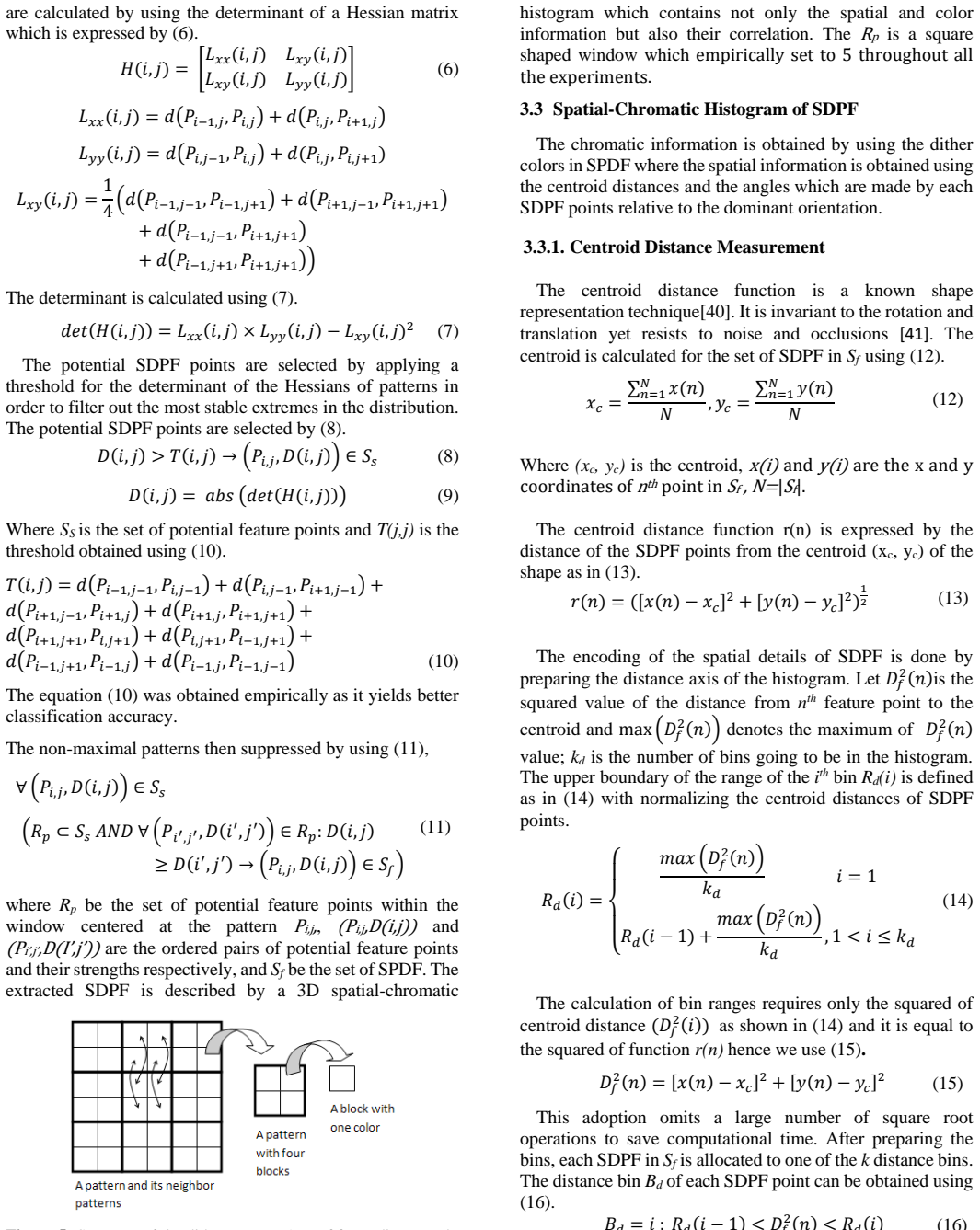
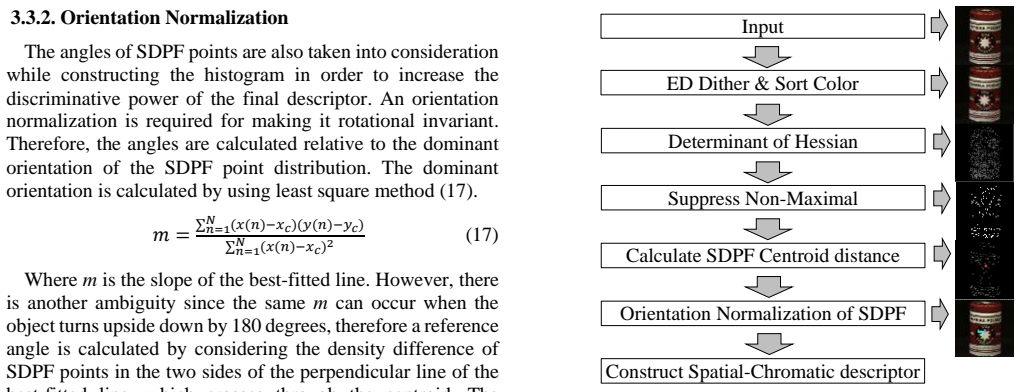
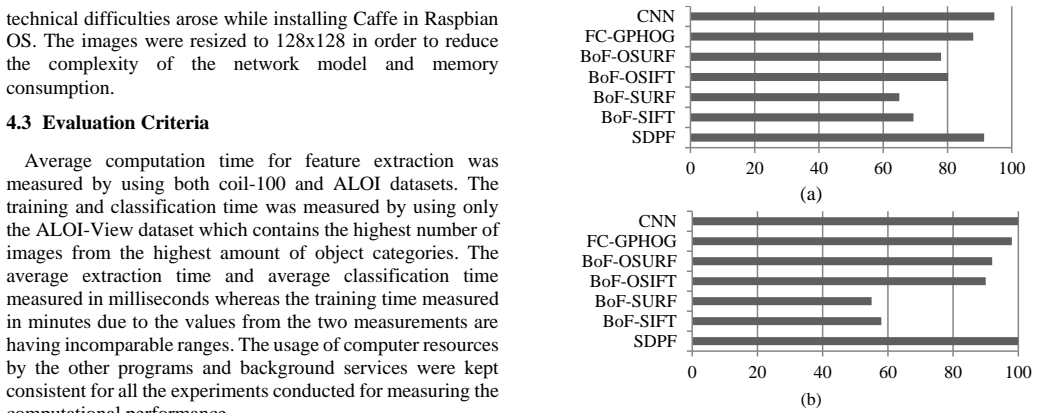
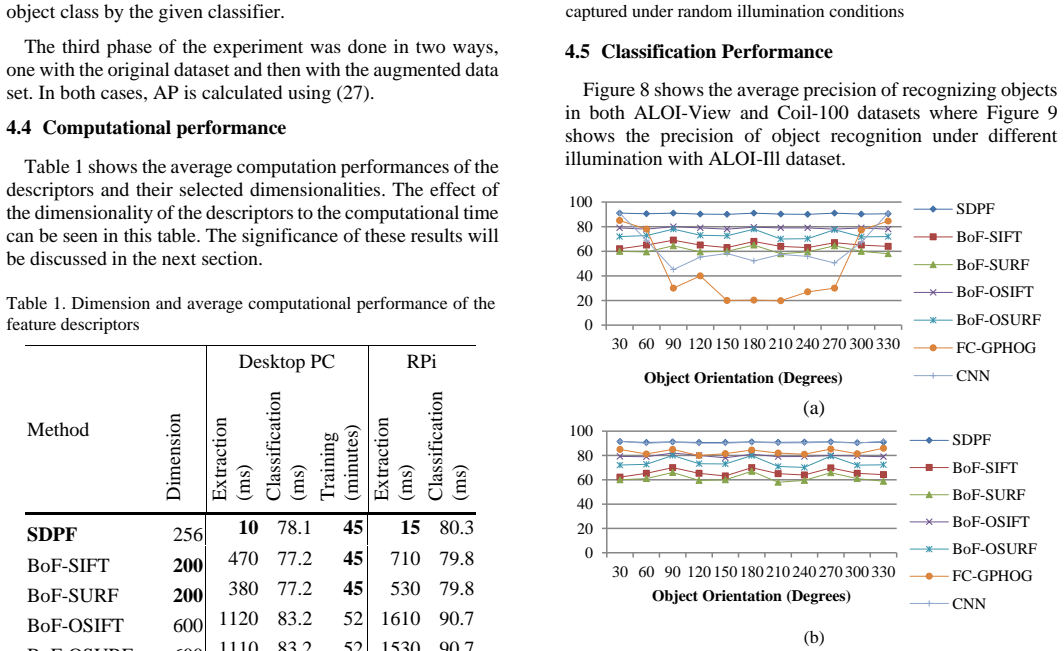
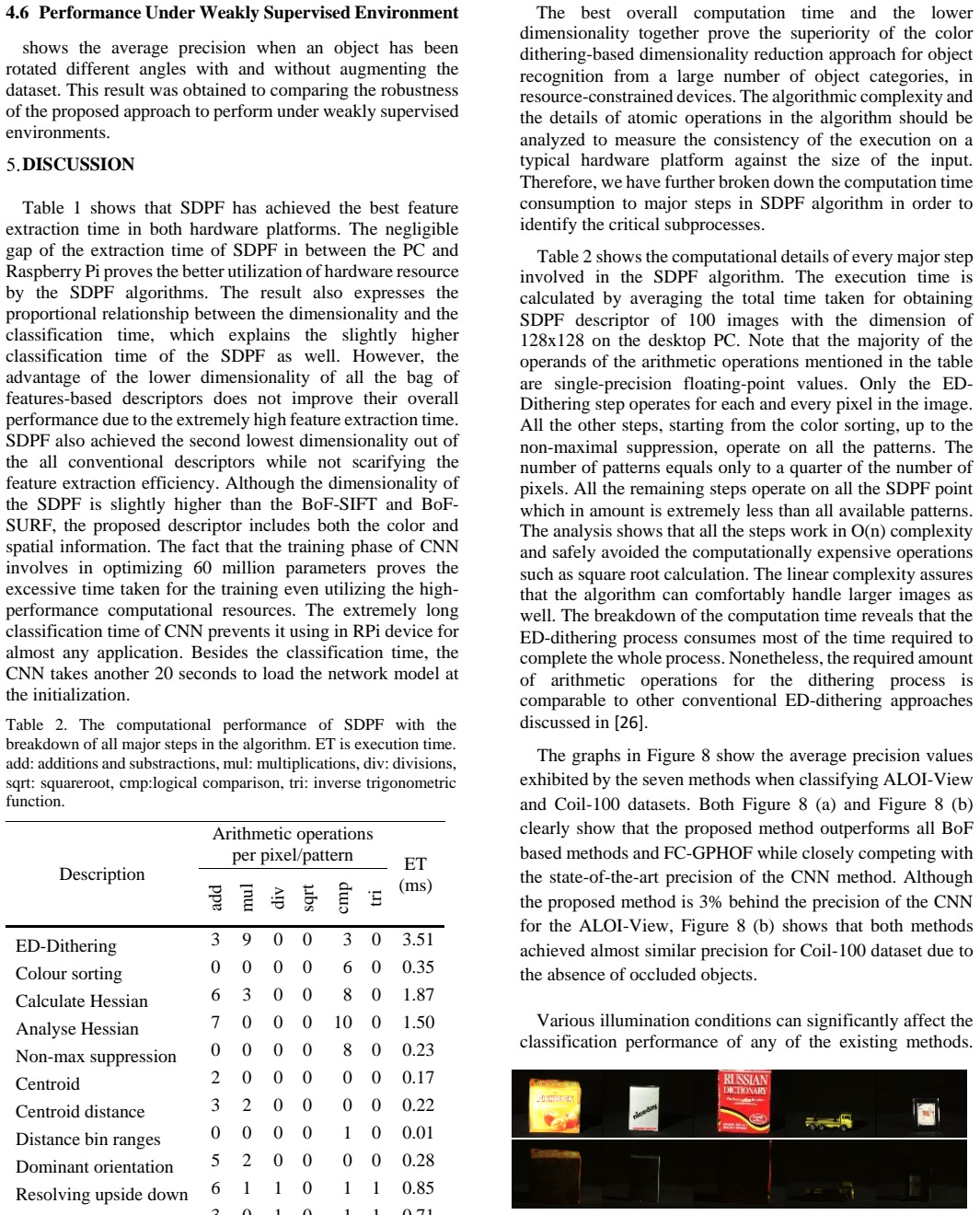
By first applying fast error-diffusion color dithering to lower spectral resolution and then extracting features through novel Hessian matrix analysis expressed as spatial-chromatic histograms, the descriptor achieves lower computation time, high robustness, and classification accuracy comparable to state-of-the-art handcrafted and deep-learned features when objects undergo drastic changes in orientation, viewing angle and illumination on the COIL-100 and ALOI collections.
What carries the argument
Fast error-diffusion color dithering paired with novel Hessian matrix analysis that reduces spectral resolution and isolates salient invariant points for histogram encoding.
If this is right
- The descriptor can operate inside conventional system-on-chip devices using only a small fraction of available hardware resources.
- It supports classification under weakly supervised conditions while remaining robust to the tested appearance changes.
- Computation time stays low on both desktop and embedded platforms, enabling use in time-constrained training and testing phases.
- Performance holds across multiple state-of-the-art baselines without requiring large labeled training sets.
Where Pith is reading between the lines
- The same dithering-plus-Hessian pipeline could be tested on video sequences to check whether temporal coherence further reduces per-frame cost.
- Because the method is handcrafted, it may serve as a lightweight front-end that supplies initial features to a subsequent learned model.
- Accuracy on datasets with greater intra-class variation or clutter would need separate measurement before broader deployment.
Load-bearing premise
The specific pairing of error-diffusion dithering with the chosen Hessian analysis will extract usable invariant features without extra tuning steps that would erase the reported speed and accuracy gains.
What would settle it
On a fresh dataset with comparable orientation, angle and illumination changes, either the measured extraction time exceeds that of the compared methods or the classification accuracy drops materially below the levels reported for COIL-100 and ALOI.
Figures



read the original abstract
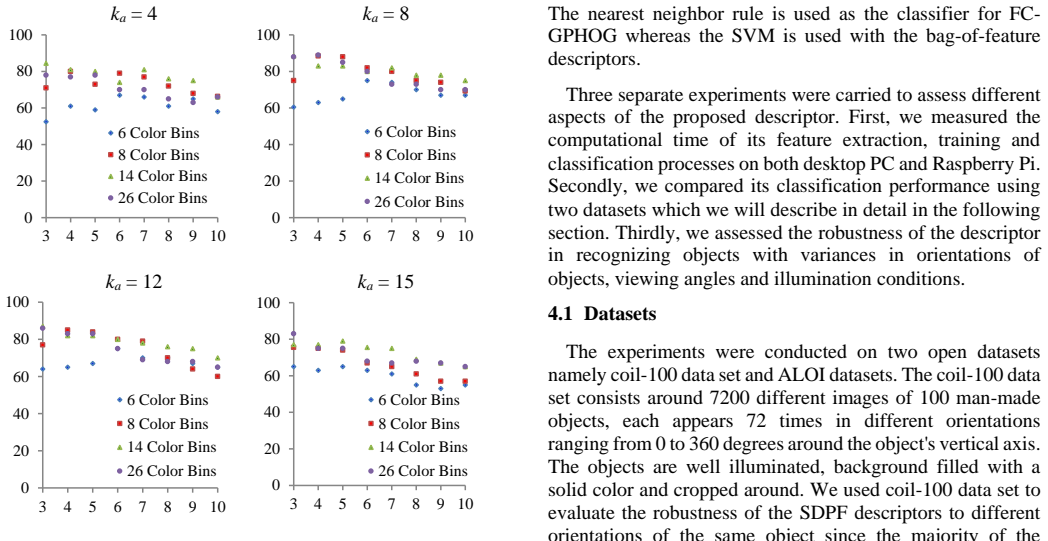
Fast and invariant feature extraction is crucial in certain computer vision applications where the computation time is constrained in both training and testing phases of the classifier. In this paper, we propose a nature-inspired dimensionality reduction technique for fast and invariant visual feature extraction. The human brain can exchange the spatial and spectral resolution to reconstruct missing colors in visual perception. The phenomenon is widely used in the printing industry to reduce the number of colors used to print, through a technique, called color dithering. In this work, we adopt a fast error-diffusion color dithering algorithm to reduce the spectral resolution and extract salient features by employing novel Hessian matrix analysis technique, which is then described by a spatial-chromatic histogram. The computation time, descriptor dimensionality and classification performance of the proposed feature are assessed under drastic variances in orientation, viewing angle and illumination of objects comparing with several different state-of-the-art handcrafted and deep-learned features. Extensive experiments on two publicly available object datasets, coil-100 and ALOI carried on both a desktop PC and a Raspberry Pi device show multiple advantages of using the proposed approach, such as the lower computation time, high robustness, and comparable classification accuracy under weakly supervised environment. Further, it showed the capability of operating solely inside a conventional SoC device utilizing a small fraction of the available hardware resources.
Editorial analysis
A structured set of objections, weighed in public.
Referee Report
Summary. The paper proposes a nature-inspired dimensionality reduction technique for fast and invariant visual feature extraction. It adopts fast error-diffusion color dithering to reduce spectral resolution, followed by a novel Hessian matrix analysis to extract salient features that are then represented via a spatial-chromatic histogram. The approach is evaluated for computation time, descriptor size, and classification accuracy under variations in orientation, viewing angle, and illumination, claiming advantages over handcrafted and deep-learned features on the COIL-100 and ALOI datasets, with additional tests on a Raspberry Pi demonstrating suitability for embedded hardware under weakly supervised conditions.
Significance. If the performance claims are substantiated, the work could offer a practical, low-resource alternative for invariant feature extraction in time-constrained or embedded vision applications. The explicit pipeline combining dithering with Hessian analysis and the dual-platform testing (desktop and Raspberry Pi) provide a concrete engineering contribution, though the lack of any numerical results, tables, or error metrics in the abstract prevents assessment of whether the reported speed and robustness advantages are meaningful or reproducible.
major comments (1)
- [Abstract] Abstract: The central claims of 'lower computation time, high robustness, and comparable classification accuracy' are asserted without any quantitative results, tables, figures, error bars, or exclusion criteria. This prevents verification of the empirical advantages over state-of-the-art methods on COIL-100 and ALOI.
minor comments (2)
- [Abstract] Abstract: Dataset names appear inconsistently as 'coil-100' (lowercase) and 'ALOI'; standard capitalization (COIL-100) should be used throughout for clarity.
- [Abstract] Abstract: The phrase 'novel Hessian matrix analysis technique' is introduced without any indication of how it differs from standard Hessian-based methods or what specific analysis is performed.
Simulated Author's Rebuttal
We thank the referee for their review and the opportunity to clarify the manuscript. We address the single major comment below.
read point-by-point responses
-
Referee: [Abstract] Abstract: The central claims of 'lower computation time, high robustness, and comparable classification accuracy' are asserted without any quantitative results, tables, figures, error bars, or exclusion criteria. This prevents verification of the empirical advantages over state-of-the-art methods on COIL-100 and ALOI.
Authors: We agree that the abstract would be strengthened by including specific quantitative highlights. The full manuscript contains detailed experimental results, including tables reporting computation times (e.g., on desktop and Raspberry Pi), descriptor sizes, and classification accuracies under orientation, viewpoint, and illumination variations on COIL-100 and ALOI, with comparisons to handcrafted and deep features. In revision we will incorporate key numerical values (such as relative speed-ups and accuracy percentages) directly into the abstract while preserving its length constraints. revision: yes
Circularity Check
No significant circularity; algorithmic proposal is self-contained engineering combination
full rationale
The paper presents a direct algorithmic pipeline (fast error-diffusion color dithering followed by Hessian matrix analysis and spatial-chromatic histogram) as a nature-inspired dimensionality reduction technique. No equations, fitted parameters, or derivation chain are described that reduce by construction to prior outputs or self-citations. The method is evaluated empirically on COIL-100 and ALOI datasets against baselines, with claims resting on measured computation time, robustness, and accuracy rather than any self-referential prediction or uniqueness theorem. This is a standard practical proposal without load-bearing self-definition or fitted-input renaming.
Axiom & Free-Parameter Ledger
Reference graph
Works this paper leans on
-
[1]
IEEE Communications Surveys & Tutorials, 2019
Zhang C, Patras P, Haddadi H Deep learning in mobile and wireless networking: A s urvey. IEEE Communications Surveys & Tutorials, 2019
work page 2019
-
[2]
IEEE Robotics and Automation Letters 2:1344–1351, 2017
McCool C, Perez T, Upcroft B Mixtures of lightweight deep convolutional neural networks: applied to agricultural robotics. IEEE Robotics and Automation Letters 2:1344–1351, 2017
work page 2017
-
[3]
In: IEEE 12th International Conference on Industrial and Information Systems (ICIIS’2017)
Bandara R, Kulathilake H, Giragama M Super-Efficient Spatially Adaptive Contrast Enhancement Algorithm for Superficial Vein Imaging . In: IEEE 12th International Conference on Industrial and Information Systems (ICIIS’2017). Peradeniya, Sri Lanka, 2017
work page 2017
-
[4]
Multimedia Tools and Applications 74:6541–6556, 2015
Yin X, Kim D-H, Hong C-P, Kim C-G, Kim KJ, Kim S- D Advanced feature point transformation of corner points for mobile object recognition. Multimedia Tools and Applications 74:6541–6556, 2015
work page 2015
-
[5]
Multimedia Tools and Applications 1 – 18, 2015
Piao J -C, Jung H -S, Hong C -P, Kim S -D Improving performance on object recog nition for real-time on mobile devices. Multimedia Tools and Applications 1 – 18, 2015
work page 2015
-
[6]
Sarala, Tejas Kanikdaley, Sharad Jogi, Rahul K
D. Sarala, Tejas Kanikdaley, Sharad Jogi, Rahul K. Chaurasiya Content-Based Image Retrieval Using Hierarchical Color and Texture Similarity Calculation. IJATCSE 7:11–16, 2018
work page 2018
-
[7]
Ch. Uma, M.Srinivasa C, Sri Ram C P, K.Babulu, D.O Prakash Image Registration of Multi Model Enrollment using Mutual Information Technique. IJATCSE 7:107–110, 2018
work page 2018
-
[8]
Lowe Distinctive Image Features from Scale- Invariant Keypoints
David G. Lowe Distinctive Image Features from Scale- Invariant Keypoints. IJCV, 2004
work page 2004
-
[9]
IEEE transactions on pattern analysis and machine intelligence 40:1224–1244, 2017
Zheng L, Yang Y, Tian Q SIFT meets CNN: A decade survey of instance retrieval. IEEE transactions on pattern analysis and machine intelligence 40:1224–1244, 2017
work page 2017
-
[10]
In: European conference on computer vision
Calonder M, Lepetit V, Strecha C, Fua P Brief: Binary robust independent elementary features. In: European conference on computer vision. Springer, pp 778 –792, 2010
work page 2010
-
[11]
In: 2011 International conference on computer vision
Leutenegger S, Chli M, Siegwart RY BRISK: Binary robust invariant scalable keypoints. In: 2011 International conference on computer vision. IEEE, pp 2548–2555, 2011
work page 2011
-
[12]
Rublee E, Rabaud V, Konolige K, Bradski G (2011) ORB: An efficient alternative to SIFT or SURF. pp 2564–2571
work page 2011
-
[13]
Multimedia Tools and Applications 54:263–289, 2011
Ranathunga L, Zainuddin R, Abdullah NA Performance evaluation of the combination of Compacted Dither Pattern Codes with Bhattacha ryya classifier in video visual concept depiction. Multimedia Tools and Applications 54:263–289, 2011
work page 2011
-
[14]
Machine vision and applications 25:361–375, 2014
Sinha A, Banerji S, Liu C New color GPHOG descriptors for object and scene image classification. Machine vision and applications 25:361–375, 2014
work page 2014
-
[15]
International Journal of Signal Processing, Image Processing and Pattern Reco gnition 3:25–36, 2010
Martin Stommel MS Binarising SIFT -descriptors to reduce the curse of dimensionality in histogram-based object recognition. International Journal of Signal Processing, Image Processing and Pattern Reco gnition 3:25–36, 2010
work page 2010
-
[16]
Luo Juan, Oubong Gwun A Comparison of SIFT, PCA- SIFT and SURF. IJIP 3:143–152, 2009
work page 2009
-
[17]
Neurocomputing 73:245–249, 2009
Xu Y, Feng G, Zhao Y One improvement to two - dimensional locality preserving projection method for use with face recognition. Neurocomputing 73:245–249, 2009
work page 2009
-
[18]
Kapoor R, Gupta R Non-linear dimensionality reduction using fuzzy lattices. Computer Vision, IET 7: . doi: 10.1049/iet-cvi.2012.0097, 2013
-
[19]
In: IEEE 12th International Conference on Industrial and Information Systems (ICIIS’2017)
Bandara R, Giragama MP A Retinal Image Enhancement Technique for Blood Vessel Segmentation Algorithm. In: IEEE 12th International Conference on Industrial and Information Systems (ICIIS’2017). Peradeniya, Sri Lanka, 2017
work page 2017
-
[20]
In: Computer Vision and Pattern Recognition, 2004
Ke Y, Sukthankar R PCA-SIFT: A more distinctive representation for local image descriptors. In: Computer Vision and Pattern Recognition, 2004. CVPR
work page 2004
-
[21]
Proceedings of the 2004 IEEE Computer Society Conference on. IEEE, pp II–506, 2004
work page 2004
-
[22]
Pattern Recognition Letters 31:702–708, 2010
Zhou X, Zhuang X, Tang H, Hasegawa -Johnson M, Huang TS Novel Gaussianized vector representation for improved natural scene categ orization. Pattern Recognition Letters 31:702–708, 2010
work page 2010
-
[23]
Barkans AC, McAllister DL System and method for dithering and quantizing image data to optimize visual quality of a color recovered image, United States patent US 5,649,083. 1999
work page 1999
-
[24]
In: Industrial and Information Systems (ICIIS), 8th IEEE International Conference on
Bandara A , Ranathunga L, Abdullah N Invariant properties of a locally salient dither pattern with a spatial-chromatic histogram. In: Industrial and Information Systems (ICIIS), 8th IEEE International Conference on. IEEE, pp 304–308, 2013
work page 2013
-
[25]
In: Electronics, Communications and Networks IV
Bandara AMRR, Ranathu nga L, Abdullah NA Visual Feature Clustering Using Temporal, Color and Spatial Information. In: Electronics, Communications and Networks IV. CRC Press, Beijing, China, pp 677 – 682, 2014
work page 2014
-
[26]
In: 2015 IEEE 10th International Conference on Industrial and Information Systems (ICIIS)
Bandara AMRR, Ranathunga L, Abdullah NA A feature clustering approach based on Histogram of Oriented Optical Flow and superpixels. In: 2015 IEEE 10th International Conference on Industrial and Information Systems (ICIIS). pp 480–484, 2016
work page 2015
-
[27]
In: Proceedings of the 28th annual conference on Computer graphics and interactive techniques
Ostromoukhov V A simple and efficient error-diffusion algorithm. In: Proceedings of the 28th annual conference on Computer graphics and interactive techniques. ACM, pp 567–572, 2001
work page 2001
-
[28]
Nene SA, Nayar SK, Murase H Columbia Object Image Library (COIL-100), 1996
work page 1996
-
[29]
Int J Comput Vision 61:103–112, 2005
Geusebroek JM, Burghouts GJ, Smeulders AWM T he Amsterdam libra ry of object images. Int J Comput Vision 61:103–112, 2005
work page 2005
-
[30]
H. Bay, A. Ess, T. Tuytelaars, L. V. Gool Speeded-Up Robust Features (SURF). CVIU 110: 2008
work page 2008
-
[31]
Multimedia Tools and Applications 74:2499–2517, 2015
Kim M-U, Yoon K Performance evaluation of large - scale object recognition system using bag -of-visual words model. Multimedia Tools and Applications 74:2499–2517, 2015
work page 2015
-
[32]
Image Processing, IET 6:115–128
Yang F, Lu H, Zhang W, Yang G Visual tracking via bag of features. Image Processing, IET 6:115–128 . doi: 10.1049/iet-ipr.2010.0127, 2012
-
[33]
In: International Conference on Image Processing (ICIP)
Yuan X, Yu J, Qin Z , Wan T A SIFT -LBP image retrieval model based on bag -of features. In: International Conference on Image Processing (ICIP). pp 1061–1064, 2011
work page 2011
-
[34]
In: International Con gress on Computer Applications and Computational Science
Verma A, Banerji S, Liu C A new color SIFT descriptor and methods for image category classification. In: International Con gress on Computer Applications and Computational Science. pp 4–6, 2010
work page 2010
-
[35]
European Journal of Computer Science and Information Technology 1:11–22, 2013
Abdelkhalak Bahri, Hamid zouaki A SURF -Color Moments for Images Retrieval Based on Bag -Of- Features. European Journal of Computer Science and Information Technology 1:11–22, 2013
work page 2013
-
[36]
In: Proceedings of the 6th ACM international conference on Image and video retrieval
Bosch A, Zisserman A, Munoz X Representing shape with a spatial pyramid kernel. In: Proceedings of the 6th ACM international conference on Image and video retrieval. ACM, pp 401–408, 2007
work page 2007
-
[37]
In: Computer Vision and Pattern Recognition, 2005
Dalal N, Triggs B Histograms of oriented gradients for human detection. In: Computer Vision and Pattern Recognition, 2005. CVPR 2005. IEEE Computer Society Conference on. IEEE, pp 886–893, 2005
work page 2005
-
[38]
In: Advances in neural information processing systems
Krizhevsky A, Sutskever I, Hinton GE Imagenet classification with deep convolutional neural networks. In: Advances in neural information processing systems. pp 1097–1105, 2012
work page 2012
-
[39]
Image Processing, IEEE Transactions on 6:950–955, 1997
Akarun L, Yardunci Y, Cetin AE Adaptive methods for dithering color images. Image Processing, IEEE Transactions on 6:950–955, 1997
work page 1997
-
[40]
Malaysian Journal of Computer Science 23:68–84, 2010
Ranathunga L, Zainuddin R, Abdullah NA Compacted Dither Pattern Codes Over Mpeg-7 Dominant Colour Descriptor In Video Visual Depiction. Malaysian Journal of Computer Science 23:68–84, 2010
work page 2010
- [41]
-
[42]
Idiyo, Ronsin Joseph A Survey of Shape Feature Extraction Techniques
Yang Mingqiang, Kpalma K. Idiyo, Ronsin Joseph A Survey of Shape Feature Extraction Techniques. Pattern Recognition 43–90, 2008
work page 2008
-
[43]
http://www.vision.caltech.edu/archive.html
Caltech. http://www.vision.caltech.edu/archive.html
-
[44]
Journal of Machine Learning Research 6:1579–1619, 2005
Bordes A, Ertekin S, Weston J, Bottou L Fast kernel classifiers with online and active learning. Journal of Machine Learning Research 6:1579–1619, 2005
work page 2005
-
[45]
Jurie F, Triggs B Creating efficient codebo oks for visual recognition. In: Computer Vision, 2005. ICCV
work page 2005
- [46]
-
[47]
Hwang S Bag-Of-Visual-Words Approach based on SURF Features to Polyp Detection in Wireless Capsule E ndoscopy Videos. Proceedings of the International Conference on Image Processing, Computer Vision, and Pattern Recognition (IPCV). pp 941 –944, 2011
work page 2011
discussion (0)
Sign in with ORCID, Apple, or X to comment. Anyone can read and Pith papers without signing in.