REVIEW 2 major objections 3 minor 117 references
The Impact of Emerging Phishing Threats: Assessing Quishing and LLM-generated Phishing Emails against Organizations
T0 review · 2 major / 3 minor · reviewed 2026-08-15 · deepseek-v4-flash
Pith's one-line read QR-code phishing emails lure employees to fake login pages just as often as traditional click-through buttons, and LLM-written emails add a cheap, high-impact vector.
desk verdict Useful first multi-org field data on quishing and LLM/OSINT phishing, but the headline RQ1 equivalence claim rides on a company-run, uncontrolled E_Q at the largest site and needs a reanalysis before it can be taken at face value. read the letter →
The pith
A machine-rendered reading of the paper's core claim, the machinery that carries it, and where it could break.
The reading
What carries the argument
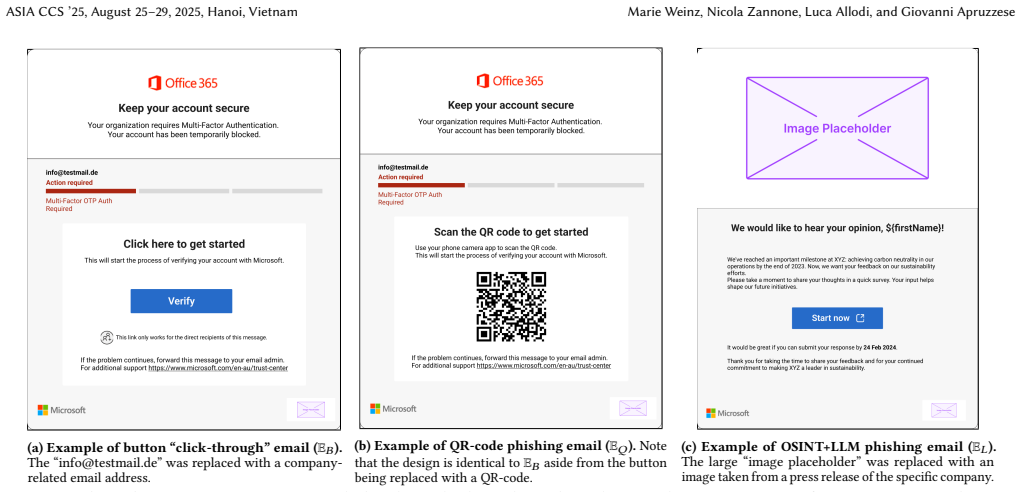
The load-bearing object is a controlled pair of near-identical phishing emails: E_B embeds the URL in a click-through button; E_Q replaces that button with a QR code while keeping the design, pretext, and landing page the same. This isolates the interaction mechanism as the variable of interest. The second mechanism is an OSINT-to-LLM pipeline: data from an employer-rating site, social-network posts, and press releases is summarized by a free LLM through a five-prompt sequence to produce a persuasive company-survey invitation (E_L). The third mechanism is a 40-question survey, rooted in knowledge-attitude-behavior principles, whose aggregated score (PPA) is regressed against the phishing click-through rate (PS) per company.
What would settle it
Run a single-organization randomized controlled trial where E_B and E_Q are sent simultaneously from the same platform to randomly split employees, with identical pretext and landing page; if the QR arm's landing-page visit rate falls outside the ±1% equivalence margin relative to the button arm, the paper's RQ1 claim fails. A cheaper check: re-analyze the multinational data using only the concurrently randomized half of employees who received E_B and the matched E_Q population, and see whether the 8.1% vs 7.9% aggregate result still holds.
Extended reading notes
Core claim
On the paper's own terms, the central discovery is a pair of empirical equivalences and one correlation. RQ1: employees who open a quishing email reach the credential-harvesting webpage about as often as employees who open a traditional button-based email (aggregate 8.0% vs 8.5% of opened emails, p=.276 for the one-tailed difference, with a TOST equivalence within ±1%). RQ2: an email written by a free LLM using OSINT from employer-rating sites, LinkedIn, and press releases outperformed both traditional emails in the small and mid-sized companies (66.6% and 31.5% of opened emails led to the landing page respectively, versus 22.2% and 3.9% for the button email), although it underperformed them at the multinational. RQ3: a linear regression across the three companies found perceived phishing awareness a significant negative predictor of phishing susceptibility (slope -24.2, p<.001).
Load-bearing premise
For RQ1, the paper assumes the button and QR emails differ only in interaction mechanism within each organization, but at the largest company the QR campaign was run earlier by the company itself on all employees, so timing, population, platform, and prior training exposure are not controlled.
Editorial extensions
If this is right
- Security teams cannot treat QR codes as a natural defense: quishing reached the landing page at the same rate as a button, so training and detection must treat QR codes as a first-class phishing vector.
- LLM-generated emails fed with public information are cheap to produce and can outperform carefully crafted traditional phishing emails, particularly in smaller, more homogeneous organizations.
- Perceived phishing awareness, measured by survey, may serve as a rough predictor of organizational phishing susceptibility, allowing pre-emptive training prioritization.
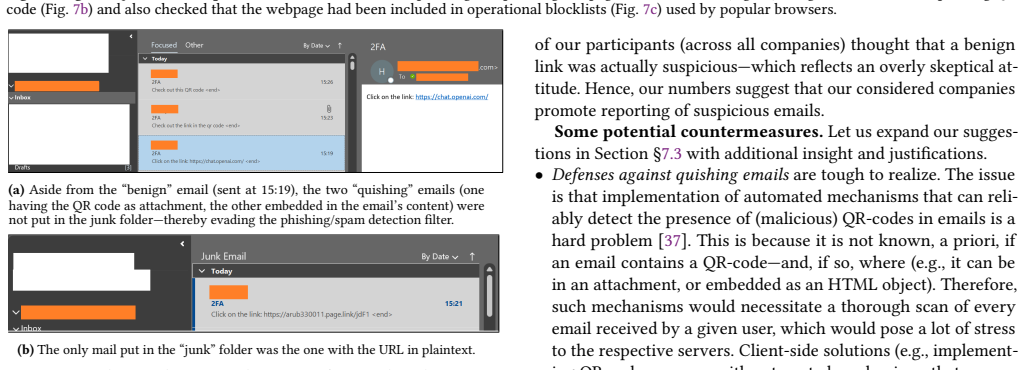
- Because quishing URLs are hard for standard filters to see, client-side QR scanning with URL checks becomes a plausible defense, alongside including quishing in simulated phishing exercises.
- The finding that fewer credentials were submitted after QR scans relative to button clicks suggests the device gap between scanning and typing credentials may be a real mitigation point, though the paper attributes this partly to experimental setup.
Reading between the lines
- The paper's aggregate quishing equivalence is dominated by the multinational's earlier QR campaign, which was not run concurrently or on the same platform as the button email; a fully matched randomized comparison could either confirm or narrow the equivalence.
- If the PPA-PS relationship generalizes beyond three companies, annual survey-based PPA scoring could become a low-cost diagnostic for organizations before investing in phishing training.
- The OSINT+LLM result implies attackers can automate the reconnaissance-to-email pipeline; one testable extension is measuring whether adding urgency or loss cues to E_L pushes its already high click rates higher.
- The lower credential-submission rate after QR scans may be a device artifact (credentials stored in a password manager on a work device); testing with a mobile-friendly password autofill landing page would separate friction from skepticism.
Signed reviews
Editorial analysis
A structured set of objections, weighed in public.
Referee Report
Summary. This paper presents a field study of phishing susceptibility across three organizations (an SME, a mid-size financial company, and a large manufacturer), based on 71,309 sent emails. Three email types are compared: a traditional button-based phishing email (E_B), a nearly identical QR-code phishing email (E_Q), and an OSINT-fed LLM-generated phishing email (E_L). The authors claim that E_B and E_Q have practically the same effectiveness (RQ1), that LLM/OSINT email is cheap and highly effective especially against smaller companies (RQ2), and that a perceived-phishing-awareness score is a statistically significant predictor of phishing susceptibility (RQ3). The paper also reports a survey of 131 employees and an original demonstration that QR-code emails evade a commercial filter.
Significance. The paper contains rare and valuable multi-organization field data, with fine-grained per-company breakdowns, a transparent appendix, and ethical disclosures. The filter-evasion demonstration in Appendix B is a useful original contribution, and the dataset could serve as a benchmark for later work. However, the two central inferential claims need substantial qualification: the RQ1 equivalence conclusion is dominated by an uncontrolled company-run quishing campaign at C_h, and the RQ3 regression is fit to only three company-level points. The descriptive material is significant, but the paper's strong conclusions currently outrun the evidence.
major comments (2)
- [§4.2.2, §5.2, Table 2] The RQ1 equivalence claim is not established because the largest company does not provide a controlled button-vs-QR comparison. For C_h, E_Q was run by the company itself in January 2024 and sent to all employees, while E_B was sent by the authors in April/May 2024 to a random half of employees; the two conditions therefore differ in timing, population, sender infrastructure, and prior exposure to quishing simulations and training. The statement in §4.2.2 that these variations are harmless because E_Q and E_B 'retain consistent properties within each organization' is not justified for C_h, and the claim that E_B was designed to 'match' the company-run E_Q is unverifiable under NDA. Since C_h accounts for 34,031 of 34,610 E_Q emails and 17,751 of 18,339 E_B emails, the aggregate click rates and the TOST equivalence at ±1% are essentially an uncontrolled C_h statement. Recomputing on C_s and C_m alone gives E_B 14/321 (4.4%) versus E_Q 20/330 (6.1%), a difference of about 1.7 percentage points with a confidence interval far wider than ±1%; the equivalence conclusion cannot be reproduced on the controlled subset. The authors should either provide a sensitivity analysis that excludes C_h, or substantially weaken the RQ1 conclusion in §5.2, the abstract, and the contributions.
- [§6.2, Fig. 11] The RQ3 claim that perceived phishing awareness is a 'predictor' of phishing susceptibility is based on a linear regression with only three company-level data points (n=3), which yields R²=1, p<.001, and Spearman's ρ=-1 by construction. Adding the aggregate as a fourth point does not solve the problem because that point is a weighted combination of the same three observations and is not independent. With three points, the model cannot provide meaningful evidence for a predictive relationship; a perfect fit is a mathematical artifact. The paper should reframe RQ3 as an exploratory observation about three companies, and should not present the fitted line, or the derived PPA=1 or PPA=4.7 predictions, as a general predictive model.
minor comments (3)
- [§5.2] The text states that for E_Q '25,172 employees opened it, and 1,970 (8.49%) visited the landing page,' but Table 2 reports 7.8% for this ratio (1,970/25,172 = 7.83%). Please reconcile the rate in the text with the table.
- [§5.2] The company-specific one-tailed chi-square p-values should be verified: for C_m, chi-square=0.514 cannot yield a one-tailed p-value of 1.0 under the stated directional hypothesis. Even if the conclusion is unchanged, the reported p-value appears incorrect and should be recomputed or the test described more precisely.
- [§4.3] The questionnaire was distributed after the phishing simulations, and the paper assumes it is 'reasonable to expect' that respondents had also taken part in the simulation. This should be stated more cautiously as an assumption, since the responses cannot be linked to individual simulation outcomes.
Circularity Check
Empirical field study with no derivation chain; the only mild circular step is the RQ3 regression, whose 'predictions' are read off the same fitted line used to establish the predictor claim.
-
fitted input called prediction
[Section 6.2 (Statistical Assessment of PPA and PS [RQ3])]
"After fitting a linear regression model (shown in Fig. 11 in Appendix E.3), we obtain the following results. First, the coefficient of determination is 1.0... Given that the PPA score ranges between 1–5, we use our linear regression model to estimate the corresponding PS-score."
The regression slope (-24.2), intercept (113.45), and p-value are fit to exactly the three company-level (PPA-score, PS-score) pairs from C_s, C_m, and C_h. The subsequent 'prediction' of PS-score from PPA-score is then evaluated on this same fitted line, and the claim that PPA 'can be a statistically significant predictor' is supported by an in-sample p-value on the fitting data. The predicted values are therefore restatements of the fitted model rather than independent confirmations. This does not affect RQ1 or RQ2, which are based on direct measurements of the simulations.
full rationale
The paper is an empirical field study with no mathematical derivation from first principles, so the derivation-equivalence form of circularity is largely absent. RQ1 compares measured click-through ratios from E_B and E_Q using chi-square and TOST tests; the main weakness there is a confounding of the button-vs-QR variable at C_h (company-run E_Q sent earlier to all employees vs. authors' later E_B to a random half), but that is a validity threat, not a circular reduction. RQ2 is a qualitative analysis of a separate LLM/OSINT-crafted email and does not rename or redefine its inputs. The only step that fits a circularity pattern is RQ3: a linear regression fitted to three company-level points is used to 'predict' PS from PPA, and the same in-sample fit is presented as evidence that PPA is a predictor. This is a mild fitted-input-called-prediction issue, not a load-bearing self-citation or definitional circularity. The paper's self-citations (e.g., Burda et al. for SME behavior, Apruzzese et al. for offensive AI) are contextual and do not carry the central claims. Overall circularity is low.
Assumptions & free parameters
free parameters (2)
- TOST equivalence margin =
±1%
- Linear regression slope and intercept for PPA to PS prediction =
slope -24.2, intercept 113.45
assumptions (4)
- domain assumption An email is counted as 'read' if it was opened
- domain assumption The malicious URL is not listed in any blocklist
- domain assumption E_B and E_Q are identical except for button versus QR code within each organization
- domain assumption Survey respondents are representative of their company's employees
Cite this review
Pith. "Pith review of The Impact of Emerging Phishing Threats: Assessing Quishing and LLM-generated Phishing Emails against Organizations." pith.science (2026). https://pith.science/paper/I6T7VUVW
@misc{pith2026250512104,
  author       = {Pith},
  title        = {Pith review of: The Impact of Emerging Phishing Threats: Assessing Quishing and LLM-generated Phishing Emails against Organizations},
  year         = {2026},
  howpublished = {\url{https://pith.science/paper/I6T7VUVW}},
  note         = {Machine review of arXiv:2505.12104}
}
read the original abstract
Modern organizations are persistently targeted by phishing emails. Despite advances in detection systems and widespread employee training, attackers continue to innovate, posing ongoing threats. Two emerging vectors stand out in the current landscape: QR-code baits and LLM-enabled pretexting. Yet, little is known about the effectiveness of current defenses against these attacks, particularly when it comes to real-world impact on employees. This gap leaves uncertainty around to what extent related countermeasures are justified or needed. Our work addresses this issue. We conduct three phishing simulations across organizations of varying sizes -- from small-medium businesses to a multinational enterprise. In total, we send over 71k emails targeting employees, including: a "traditional" phishing email with a click-through button; a nearly-identical "quishing" email with a QR code instead; and a phishing email written with the assistance of an LLM and open-source intelligence. Our results show that quishing emails have the same effectiveness as traditional phishing emails at luring users to the landing webpage -- which is worrying, given that quishing emails are much harder to identify even by operational detectors. We also find that LLMs can be very good "social engineers": in one company, over 30% of the emails opened led to visiting the landing webpage -- a rate exceeding some prior benchmarks. Finally, we complement our study by conducting a survey across the organizations' employees, measuring their "perceived" phishing awareness. Our findings suggest a correlation between higher self-reported awareness and organizational resilience to phishing attempts.
Figures


Figures from the paper (7 more)




Reference graph
Works this paper leans on
-
[1]
A Comprehensive Guide to SMTP Relay: Definitions, Examples, and Best Practices
2023. A Comprehensive Guide to SMTP Relay: Definitions, Examples, and Best Practices. https://mailtrap.io/blog/smtp-relay/
2023
-
[2]
Anti-phishing protection in Microsoft 365
2024. Anti-phishing protection in Microsoft 365. https://learn.microsoft.com/en- us/defender-office-365/anti-phishing-protection-about
2024
-
[3]
GoPhish – Open Source Phishing Toolkit
2024. GoPhish – Open Source Phishing Toolkit. https://getgophish.com/
2024
-
[4]
Cisco Talos
2024.How are attackers using QR codes in phishing emails and lure documents? Technical Report. Cisco Talos. https://blog.talosintelligence.com/how-are- attackers-using-qr-codes-in-phishing-emails-and-lure-documents/
2024
-
[5]
Cisco Talos
2024.Malicious QR Codes: How big of a problem is it, really?Technical Report. Cisco Talos. https://blog.talosintelligence.com/malicious_qr_codes/
2024
-
[6]
Phishing Attack Simulation Training–Microsoft Security
2024. Phishing Attack Simulation Training–Microsoft Security. https://microsof t.com/en-us/security/business/threat-protection/attack-simulation-training
2024
-
[7]
PhishTank
2024. PhishTank. www.phishtank.org
2024
-
[8]
QR Code Phishing Scams Are on the Rise—Don’t Get Caught - Hoxhunt
2024. QR Code Phishing Scams Are on the Rise—Don’t Get Caught - Hoxhunt. https://www.hoxhunt.com/blog/qr-code-phishing-scams
2024
Show all 117 references
-
[9]
Simulate a phishing attack with Attack simulation training
2024. Simulate a phishing attack with Attack simulation training. https: //learn.microsoft.com/en-us/defender-office-365/attack-simulation-training- simulations
2024
-
[10]
Technical Report
2024.State of the Phish 2024. Technical Report. ProofPoint. https://www.proo fpoint.com/it/resources/threat-reports/state-of-phish
2024
-
[11]
Technical Report
2024.Top Email Threats and Trends. Technical Report. Barracuda. https://assets .barracuda.com/assets/docs/dms/top-email-threats-and-trends-vol1.pdf
2024
-
[12]
Train Your Office 365 Users Against Phishing Attacks using Attack Simulation Training
2024. Train Your Office 365 Users Against Phishing Attacks using Attack Simulation Training. https://web.archive.org/web/20250116155243/https: //o365reports.com/2022/02/16/train-your-office-365-users-against-phishing- attacks-using-attack-simulation-training/
2024
-
[13]
2025. Kununu. https://www.kununu.com/
2025
-
[14]
LinkedIn
2025. LinkedIn. https://www.linkedin.com/
2025
-
[15]
Technical Report
2025.WhatsApp spear phishing campaign uses QR codes to add device. Technical Report. Malwarebytes Labs. https://www.malwarebytes.com/blog/news/2025/ 01/whatsapp-spear-phishing-campaign-uses-qr-codes-to-add-device
2025
-
[16]
W Prah Angela Aba and Otchere Kojo Ennin Opan
Abigail N. W Prah Angela Aba and Otchere Kojo Ennin Opan. 2016. The perceived effectiveness of information security awareness.Information and Knowledge Management(2016)
2016
-
[17]
Dania Aljeaid, Amal Alzhrani, Mona Alrougi, and Oroob Almalki. 2020. As- sessment of end-user susceptibility to cybersecurity threats in Saudi Arabia by simulating phishing attacks.Information(2020)
2020
-
[18]
G Amoah and J Hayfron-Acquah. 2022. QR Code security: mitigating the issue of quishing (QR Code Phishing).Int. J. Comput. Appl975 (2022), 8887
2022
-
[19]
Giovanni Apruzzese, Mauro Conti, and Ying Yuan. 2022. SpacePhish: The Evasion-Space of Adversarial Attacks against Phishing Website Detectors Using Machine Learning. InProc. ACSAC
2022
-
[20]
2024.Phishing Activity Trends Report, Q3
APWG. 2024.Phishing Activity Trends Report, Q3. Technical Report. APWG
2024
-
[21]
Michael Bailey, David Dittrich, Erin Kenneally, and Doug Maughan. 2012. The Menlo report.IEEE Security & Privacy(2012)
2012
-
[22]
Shahryar Baki and Rakesh M Verma. 2023. Sixteen years of phishing user studies: What have we learned?IEEE TDSC(2023)
2023
-
[23]
2014.Handbuch methoden der empirischen sozial- forschung
Nina Baur and Jörg Blasius. 2014.Handbuch methoden der empirischen sozial- forschung. Vol. 13. Springer
2014
-
[24]
Mazal Bethany, Athanasios Galiopoulos, Emet Bethany, Mohammad Bahrami Karkevandi, Nishant Vishwamitra, and Peyman Najafirad. 2024. Large language model lateral spear phishing: A comparative study in large-scale organizational settings.arXiv:2401.09727(2024)
2024 arXiv
-
[25]
Violino Bob. 2023. AI tools such as ChatGPT are generating a mammoth increase in malicious phishing emails.CNBC(2023). https://www.cnbc.com/2023/11/28/ ai-like-chatgpt-is-creating-huge-increase-in-malicious-phishing-email.html
2023
-
[26]
Pavlo Burda, Luca Allodi, and Nicola Zannone. 2020. Don’t forget the human: a crowdsourced approach to automate response and containment against spear phishing attacks. InW ACCO (co-located with IEEE EuroS&P)
2020
-
[27]
Pavlo Burda, Abdul Malek Altawekji, Luca Allodi, and Nicola Zannone. 2023. The Peculiar Case of Tailored Phishing against SMEs: Detection and Collective DefenseMechanisms at a Small IT Company. InW ACCO (IEEE EuroS&PW)
2023
-
[28]
Alexia Cambon, Brent Hecht, Ben Edelman, Donald Ngwe, Sonia Jaffe, et al
-
[29]
2023.AI vs
Stephanie Carruthers. 2023.AI vs. human deceit: Unravelling the new age of phishing tactics. Technical Report. IBM. https://web.archive.org/web/2024 1009154831/https://securityintelligence.com/x-force/ai-vs-human-deceit- unravelling-new-age-phishing-tactics/
2023
-
[30]
Sunil Chaudhary, Vasileios Gkioulos, and Sokratis Katsikas. 2022. Developing metrics to assess the effectiveness of cybersecurity awareness program.Journal of Cybersecurity(2022)
2022
-
[31]
Casey Deccio, Tarun Yadav, Nathaniel Bennett, Alden Hilton, Michael Howe, Tanner Norton, Jacob Rohde, Eunice Tan, and Bradley Taylor. 2021. Measuring email sender validation in the wild. InCoNEXT
2021
-
[32]
Rachna Dhamija and J Doug Tygar. 2005. The battle against phishing: Dynamic security skins. InSOUPS
2005
-
[33]
Matthew Edwards, Robert Larson, Benjamin Green, Awais Rashid, and Alistair Baron. 2017. Panning for gold: Automatically analysing online social engineering attack surfaces.Comp. Secur.(2017)
2017
-
[34]
2024.Email Security Risk Report
Egress. 2024.Email Security Risk Report. Technical Report. Egress
2024
-
[35]
Robert Wall Emerson. 2015. Convenience sampling, random sampling, and snowball sampling: How does sampling affect the validity of research?Journal of Visual Impairment & Blindness(2015)
2015
-
[36]
Chiarello Filippo, Giordano Vito, Spada Irene, Barandoni Simone, and Fantoni Gualtiero. 2024. Future applications of generative large language models: A data-driven case study on ChatGPT.Technovation(2024)
2024
-
[37]
Jason Ford and Hala Strohmier Berry. 2024. Feasibility of Machine Learning- Enhanced Detection for QR Code Images in Email-based Threats. InIEEE Cyber A wareness and Research Symposium
2024
-
[38]
Joel Frank, Franziska Herbert, Jonas Ricker, Lea Schönherr, Thorsten Eisenhofer, Asja Fischer, Markus Dürmuth, and Thorsten Holz. 2024. A representative study on human detection of artificially generated media across countries. InS&P
2024
-
[39]
Thomas D Gauthier. 2001. Detecting trends using Spearman’s rank correlation coefficient.Environmental forensics(2001)
2001
-
[40]
William J Gordon, Adam Wright, Ranjit Aiyagari, Leslie Corbo, Robert J Glynn, et al. 2019. Assessment of employee susceptibility to phishing attacks at US health care institutions.JAMA network open(2019)
2019
-
[41]
Kristen K Greene, Michelle Steves, Mary Theofanos, Jennifer Kostick, et al. 2018. User context: an explanatory variable in phishing susceptibility. InUSEC
2018
-
[42]
Abhimanyu Hans, Avi Schwarzschild, Valeriia Cherepanova, Hamid Kazemi, Aniruddha Saha, Micah Goldblum, Jonas Geiping, and Tom Goldstein. 2024. Spotting LLMs With Binoculars: Zero-Shot Detection of Machine-Generated Text. InForty-first International Conference on Machine Learni...
2024
-
[44]
Julian Hazell. 2023. Spear phishing with large language models.arXiv preprint arXiv:2305.06972(2023)
2023 arXiv
-
[45]
Fred Heiding, Simon Lermen, Andrew Kao, Bruce Schneier, and Arun Vish- wanath. 2024. Evaluating Large Language Models’ Capability to Launch Fully Automated Spear Phishing Campaigns: Validated on Human Subjects. arXiv:2412.00586(2024)
2024 arXiv
-
[46]
Fredrik Heiding, Bruce Schneier, Arun Vishwanath, Jeremy Bernstein, and Peter S Park. 2024. Devising and detecting phishing emails using large language models.IEEE Access(2024)
2024
-
[47]
Doron Hillman, Yaniv Harel, and Eran Toch. 2023. Evaluating organizational phishing awareness training on an enterprise scale.Comp. Secur.(2023)
2023
-
[48]
Grant Ho, Ariana Mirian, Elisa Luo, Khang Tong, Euyhyun Lee, et al . 2025. Understanding the Efficacy of Phishing Training in Practice. InIEEE S&P
2025
-
[49]
Markus Jakobsson. 2018. Two-factor inauthentication–the rise in SMS phishing attacks.Computer Fraud & Security(2018)
2018
-
[50]
Francisco Jáñez-Martino, Rocío Alaiz-Rodríguez, Víctor González-Castro, Ed- uardo Fidalgo, and Enrique Alegre. 2023. A review of spam email detection: analysis of spammer strategies and the dataset shift problem.Artificial Intelli- gence Review(2023)
2023
-
[51]
Matthew L Jensen, Michael Dinger, Ryan T Wright, and Jason Bennett Thatcher
-
[52]
Prasanna Kansakar, Arslan Munir, and Neda Shabani. 2019. Technology in the hospitality industry: Prospects and challenges.IEEE Consumer Electronics Magazine(2019)
2019
-
[53]
Rabimba Karanjai. 2022. Targeted phishing campaigns using large scale language models.arXiv:2301.00665(2022)
2022 arXiv
-
[54]
Doowon Kim, Haehyun Cho, Yonghwi Kwon, Adam Doupé, Sooel Son, Gail-Joon Ahn, and Tudor Dumitras. 2021. Security analysis on practices of certificate authorities in the HTTPS phishing ecosystem. InACM AsiaCCS
2021
-
[55]
Michael Koddebusch. 2022. Exposing the phish: the effect of persuasion tech- niques in phishing e-mails. InAnnual International Conference on Digital Gov- ernment Research
2022
-
[56]
Tadayoshi Kohno, Yasemin Acar, and Wulf Loh. 2023. Ethical frameworks and computer security trolley problems: Foundations for conversations. InUSENIX Sec. 13 ASIA CCS ’25, August 25–29, 2025, Hanoi, Vietnam Marie Weinz, Nicola Zannone, Luca Allodi, and Giovanni Apruzzese
2023
-
[57]
Takashi Koide, Naoki Fukushi, Hiroki Nakano, and Daiki Chiba. 2023. PhishRepli- cant: A Language Model-based Approach to Detect Generated Squatting Domain Names. InACSAC
2023
-
[58]
Katharina Krombholz, Peter Frühwirt, Peter Kieseberg, Ioannis Kapsalis, Markus Huber, and Edgar Weippl. 2014. QR code security: A survey of attacks and challenges for usable security. InHAS (part of HCI International). Springer
2014
-
[59]
Daniele Lain, Tarek Jost, Sinisa Matetic, Kari Kostiainen, and Srdjan Capkun
-
[60]
Daniele Lain, Kari Kostiainen, and Srdjan Čapkun. 2022. Phishing in organiza- tions: Findings from a large-scale and long-term study. InS&P
2022
-
[61]
Tyson Langford and Bryson Payne. 2023. Phishing faster: Implementing chatgpt into phishing campaigns. InFuture Technologies Conference
2023
-
[62]
Jehyun Lee, Farren Tang, Pingxiao Ye, Fahim Abbasi, Phil Hay, and Dinil Mon Divakaran. 2021. D-fence: A flexible, efficient, and comprehensive phishing email detection system. InIEEE EuroS&P
2021
-
[63]
Tian Lin, Daniel E Capecci, Donovan M Ellis, Harold A Rocha, Sandeep Dom- maraju, Daniela S Oliveira, and Natalie C Ebner. 2019. Susceptibility to spear- phishing emails: Effects of internet user demographics and email content.ACM Transactions on Computer-Human Interaction (TO...
2019
-
[64]
M Lokesh, A Keerthi Devi, U Dinesh Chowdary, PVNS Divya Lakshmi, and G Rama Koteswara Rao. 2023. Data Redundancy, Data Phishing, and Data Cloud Backup. InIEEE ICECCT
2023
-
[65]
Charalampos Manifavas, Konstantinos Fysarakis, Konstantinos Rantos, and George Hatzivasilis. 2014. DSAPE–dynamic security awareness program evalu- ation. InHAS (part of HCI International). Springer
2014
-
[66]
2021.Intro- duction to linear regression analysis
Douglas C Montgomery, Elizabeth A Peck, and G Geoffrey Vining. 2021.Intro- duction to linear regression analysis. John Wiley & Sons
2021
-
[67]
Santana N Morris. 2023. Cultural diversity in workplace and the role of man- agement.American Journal of Industrial and Business Management(2023)
2023
-
[68]
Aleksandr Nahapetyan, Sathvik Prasad, Kevin Childs, Adam Oest, Yeganeh Ladwig, Alexandros Kapravelos, and Bradley Reaves. 2024. On sms phishing tactics and infrastructure. InIEEE Symposium on Security and Privacy
2024
-
[69]
Geoff Norman. 2010. Likert scales, levels of measurement and the “laws” of statistics.Advances in health sciences education(2010)
2010
-
[70]
Adam Oest, Yeganeh Safaei, Penghui Zhang, Brad Wardman, Kevin Tyers, Yan Shoshitaishvili, and Adam Doupé. 2020. PhishTime : Continuous longitudinal measurement of the effectiveness of anti-phishing blacklists. InUSENIX Security
2020
-
[71]
Justin Petelka, Yixin Zou, and Florian Schaub. 2019. Put your warning where your link is: Improving and evaluating email phishing warnings. InACM CHI
2019
-
[72]
Iasonas Polakis, Georgios Kontaxis, Spiros Antonatos, Eleni Gessiou, Thanasis Petsas, and Evangelos P Markatos. 2010. Using social networks to harvest email addresses. InACM WPES
2010
-
[73]
Rana Pourmohamad, Steven Wirsz, Adam Oest, Tiffany Bao, Yan Shoshitaishvili, et al. 2024. Deep Dive into Client-Side Anti-Phishing: A Longitudinal Study Bridging Academia and Industry. InAsiaCCS
2024
-
[74]
Ward Priestman, Tony Anstis, Isabel G Sebire, Shankar Sridharan, and Neil J Sebire. 2019. Phishing in healthcare organisations: Threats, mitigation and approaches.BMJ Health & Care Informatics(2019)
2019
-
[75]
Ahmad Sahban Rafsanjani, Norshaliza Binti Kamaruddin, Hazlifah Mohd Rusli, and Mohammad Dabbagh. 2023. Qsecr: Secure qr code scanner according to a novel malicious url detection framework.IEEE Access(2023)
2023
-
[76]
Rakesh Rana and Richa Singhal. 2015. Chi-square test and its application in hypothesis testing.Journal of Primary Care Specialties(2015)
2015
-
[77]
Konstantinos Rantos, Konstantinos Fysarakis, and Charalampos Manifavas. 2012. How effective is your security awareness program? An evaluation methodology. Information Security Journal: A Global Perspective(2012)
2012
-
[78]
Benjamin Reinheimer, Lukas Aldag, Peter Mayer, Mattia Mossano, Reyhan Duezguen, Bettina Lofthouse, Tatiana Von Landesberger, and Melanie Volkamer
-
[79]
Sayak Saha Roy, Poojitha Thota, Krishna Vamsi Naragam, and Shirin Nilizadeh
-
[80]
Said Salloum, Tarek Gaber, Sunil Vadera, and Khaled Shaalan. 2021. Phish- ing email detection using natural language processing techniques: a literature survey.Procedia Computer Science189 (2021)
2021
-
[81]
Francesco Salvi, Manoel Horta Ribeiro, Riccardo Gallotti, and Robert West. 2024. On the conversational persuasiveness of large language models: A randomized controlled trial.Nature Human Behaviour(2024)
2024
-
[82]
Orvila Sarker, Asangi Jayatilaka, Sherif Haggag, Chelsea Liu, and M Ali Babar
-
[83]
Dawn M Sarno and Mark B Neider. 2022. So many phish, so little time: Exploring email task factors and phishing susceptibility.Human Factors(2022)
2022
-
[84]
InIEEE S&P
From Chatbots to Phishbots?: Phishing Scam Generation in Commercial Large Language Models. InIEEE S&P
-
[85]
Philipp Schoenegger, Indre Tuminauskaite, Peter S Park, Rafael Valdece Sousa Bastos, and Philip E Tetlock. 2024. Wisdom of the silicon crowd: LLM ensemble prediction capabilities rival human crowd accuracy.Science Advances(2024)
2024
-
[86]
Paul G Schrader and Kimberly A Lawless. 2004. The knowledge, attitudes, & behaviors approach how to evaluate performance and learning in complex environments.Performance Improvement(2004)
2004
-
[87]
Anderson, et al
Saskia Laura Schröer, Giovanni Apruzzese, Human Soheil, Pavel Laskov, Hyrum S. Anderson, et al . 2025. SoK: On the Offensive Potential of AI. In IEEE SaTML
2025
-
[88]
Systems and Software(2024)
A Multi-vocal Literature Review on challenges and critical success factors of phishing education, training and awareness.J. Systems and Software(2024)
2024
-
[89]
Filipo Sharevski, Amy Devine, Emma Pieroni, and Peter Jachim. 2022. Phishing with malicious QR codes. InEuroUSEC
2022
-
[90]
It’s like when a child reaches onto the hot hob
Katharina Schiller, Florian Adamsky, Christian Eichenmüller, Matthias Reimert, and Zinaida Benenson. 2024. Employees’ Attitudes towards Phishing Simula- tions:“It’s like when a child reaches onto the hot hob”. InACM CCS
2024
-
[91]
Hossein Siadati, Sean Palka, Avi Siegel, and Damon McCoy. 2017. Measuring the effectiveness of embedded phishing exercises. InUSENIX CSET 17
2017
-
[92]
2023.The State of Phishing
Slashnext. 2023.The State of Phishing. Technical Report. Slashnext. https: //slashnext.com/wp-content/uploads/2023/10/SlashNext-The-State-of - Phishing-Report-2023.pdf
2023
-
[93]
Stephanie Stacey. 2025. AI-generated phishing scams target corporate executives. Financial Times(2025). https://www.ft.com/content/d60fb4fb-cb85-4df7-b246- ec3d08260e6f
2025
-
[94]
Donald J Schuirmann. 1987. A comparison of the two one-sided tests procedure and the power approach for assessing the equivalence of average bioavailability. Journal of pharmacokinetics and biopharmaceutics(1987)
1987
-
[95]
Karthika Subramani, William Melicher, Oleksii Starov, Phani Vadrevu, and Roberto Perdisci. 2022. PhishInPatterns: measuring elicited user interactions at scale on phishing websites. InACM Internet Measurement Conference
2022
-
[96]
Filipo Sharevski, Mattia Mossano, Maxime Fabian Veit, Gunther Schiefer, and Melanie Volkamer. 2024. Exploring Phishing Threats through QR Codes in Naturalistic Settings. InUSEC
2024
-
[97]
Saranya Vaithilingam and Santhosh Aradhya Mohan Shankar. 2024. Enhancing Security in QR Code Technology Using AI: Exploration and Mitigation Strategies. International Journal of Intelligence Science(2024)
2024
-
[98]
Rohit Valecha, Pranali Mandaokar, and H Raghav Rao. 2021. Phishing email detection using persuasion cues.IEEE TDSC(2021)
2021
-
[99]
Suresh Veluru, Yogachandran Rahulamathavan, P Viswanath, Paul Longley, and Muttukrishnan Rajarajan. 2013. E-mail Address Categorization based on Semantics of Surnames. InIEEE CIDM
2013
-
[100]
Michelle Steves, Kristen Greene, and Mary Theofanos. 2020. Categorizing human phishing difficulty: a Phish Scale.Journal of Cybersecurity(2020)
2020
-
[101]
Emma J Williams, Joanne Hinds, and Adam N Joinson. 2018. Exploring suscep- tibility to phishing in the workplace.Int. J. Human-Computer Studies(2018)
2018
-
[102]
Zhibo Sun, Faris Bugra Kokulu, Penghui Zhang, Adam Oest, Gianluca Stringhini, et al. 2024. From Victims to Defenders: An Exploration of the Phishing Attack Reporting Ecosystem. InRAID
2024
-
[103]
Rundong Yang, Kangfeng Zheng, Bin Wu, Di Li, Zhe Wang, and Xiujuan Wang
-
[104]
Ezer Osei Yeboah-Boateng and Priscilla Mateko Amanor. 2014. Phishing, SMiSh- ing & Vishing: an assessment of threats against mobile devices.Journal of Emerging Trends in Computing and Information Sciences(2014)
2014
-
[105]
William Yeoh, He Huang, Wang-Sheng Lee, Fadi Al Jafari, and Rachel Mansson
-
[106]
Thomas Weber, Maximilian Brandmaier, Albrecht Schmidt, and Sven Mayer
-
[107]
Significant Productivity Gains through Programming with Large Language Models.Proceedings of the ACM on Human-Computer Interaction(2024)
2024
-
[108]
Microsoft login
Tianyi Zhang, Faisal Ladhak, Esin Durmus, Percy Liang, Kathleen McKeown, and Tatsunori B Hashimoto. 2024. Benchmarking large language models for news summarization.T. of the Association for Computational Linguistics(2024). Appendix A Technical details (and challenges) We expan...
2024
-
[109]
Emma J Williams and Danielle Polage. 2019. How persuasive is phishing email? The role of authentic design, influence and current events in email judgements. Behaviour & Information Technology(2019)
2019
-
[114]
Simulated phishing attack and embedded training campaign.Journal of Computer Information Systems(2022)
2022
-
[115]
Kelvin SC Yong, Kang Leng Chiew, and Choon Lin Tan. 2019. A survey of the QR code phishing: the current attacks and countermeasures. InIEEE ICSCC
2019
-
[116]
Ying Yuan, Qingying Hao, Giovanni Apruzzese, Mauro Conti, and Gang Wang
-
[117]
Are Adversarial Phishing Webpages a Threat in Reality?
"Are Adversarial Phishing Webpages a Threat in Reality?" Understanding the Users’ Perception of Adversarial Webpages. InTheWebConf
-
[2017]
Journal of Management Information Systems(2017)
Training to mitigate phishing attacks using mindfulness techniques. Journal of Management Information Systems(2017)
2017
-
[2020]
An investigation of phishing awareness and education over time: When and how to best remind users. InSOUPS
-
[2022]
Predicting User Susceptibility to Phishing Based on Multidimensional Features.Computational Intelligence and Neuroscience(2022)
2022
-
[2023]
Early LLM-based Tools for Enterprise Information Workers Likely Provide Meaningful Boosts to Productivity.Microsoft Research(2023)
2023
-
[2024]
InACM CCS
Content, Nudges and Incentives: A Study on the Effectiveness and Per- ception of Embedded Phishing Training. InACM CCS
Reviewed August 15, 2026 · model on record in the stance chip above.
Discussion (0). Continue with ORCID to comment.