REVIEW 2 major objections 2 minor 36 references
Rainbow RABBITT as a Probe of Coherent Rabi Dynamics
T0 review · 2 major / 2 minor · reviewed 2026-06-27 · grok-4.3
Pith's one-line read Rainbow RABBITT reveals that intra-sideband phase dispersion tracks the dynamical phase accumulated by a Rabi-dressed atomic wave packet rather than instantaneous state populations.
desk verdict Intra-sideband phase dispersion in RABBITT tracks dynamical phase of Rabi-dressed states rather than populations. read the letter →
The pith
A machine-rendered reading of the paper's core claim, the machinery that carries it, and where it could break.
The reading
What carries the argument
Intra-sideband phase dispersion extracted from rainbow RABBITT spectra, which maps the dynamical phase of the Rabi-dressed wave packet.
What would settle it
A measured photoelectron spectrum near the 2s-2p resonance in lithium that either shows the intra-sideband phase dispersion flattening exactly at resonance or fails to do so.
Extended reading notes
Core claim
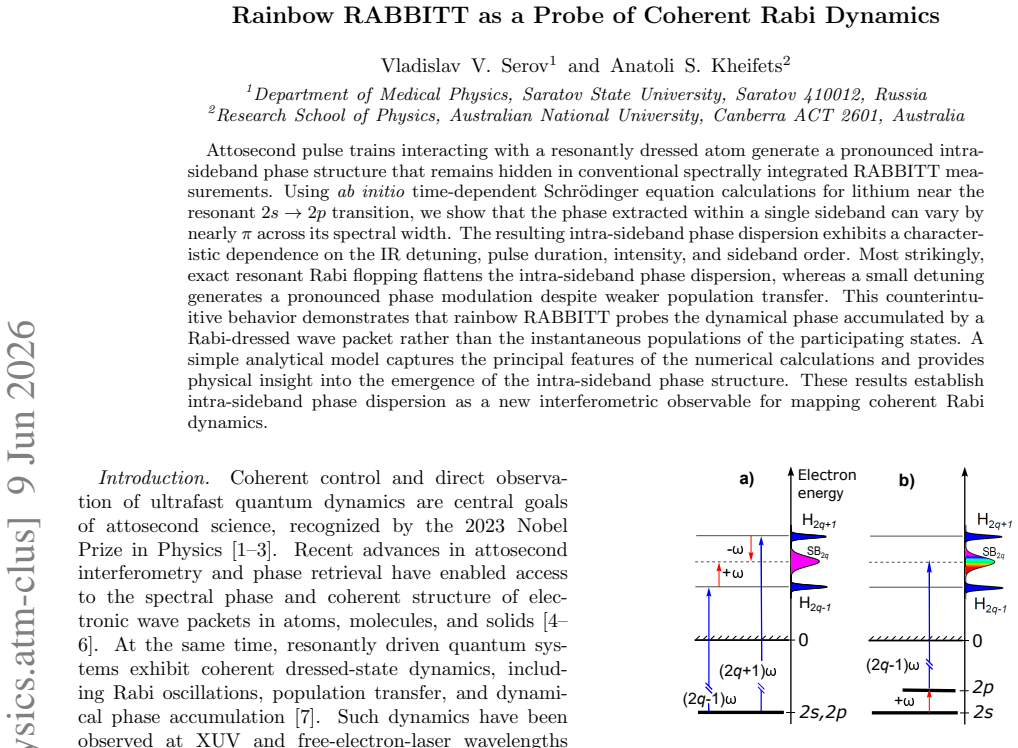
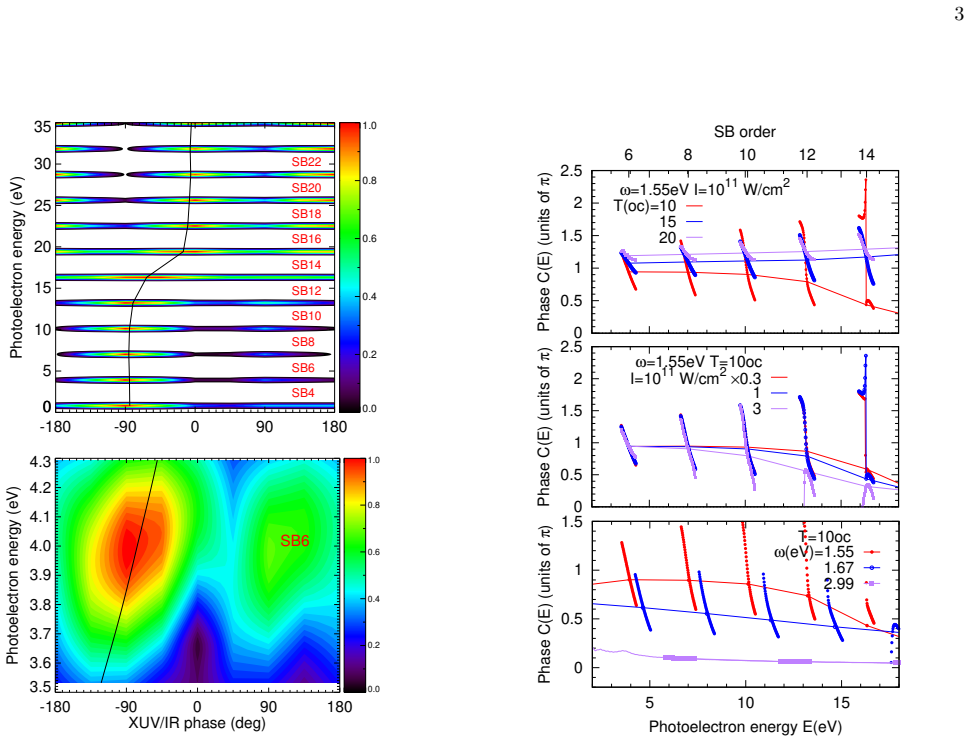
Attosecond pulse trains interacting with a resonantly dressed atom generate a pronounced intra-sideband phase structure that remains hidden in conventional spectrally integrated RABBITT measurements. Using ab initio time-dependent Schrödinger equation calculations for lithium near the resonant 2s to 2p transition, the phase extracted within a single sideband can vary by nearly π across its spectral width. The resulting intra-sideband phase dispersion exhibits a characteristic dependence on the IR detuning, pulse duration, intensity, and sideband order. Exact resonant Rabi flopping flattens the intra-sideband phase dispersion, whereas a small detuning generates a pronounced phase modulation d
Load-bearing premise
The ab initio time-dependent Schrödinger equation calculations for lithium accurately capture the phase extraction within a single sideband without numerical artifacts that would change the reported structure.
Editorial extensions
If this is right
- The intra-sideband phase dispersion depends on IR detuning, pulse duration, intensity, and sideband order.
- Exact resonant Rabi flopping flattens the intra-sideband phase dispersion.
- A small detuning produces pronounced phase modulation despite weaker population transfer.
- A simple analytical model reproduces the main features of the full numerical results.
- Intra-sideband phase dispersion serves as a new interferometric observable for mapping coherent Rabi dynamics.
Reading between the lines
- The same phase-dispersion signature could appear in other atoms or molecules once a suitable resonance is dressed.
- Controlled detuning might be used experimentally to amplify the phase signal for easier detection.
- Matching measured dispersion curves to the analytical model could yield values for the Rabi frequency or dressing strength.
Editorial analysis
A structured set of objections, weighed in public.
Referee Report
Summary. The manuscript introduces 'rainbow RABBITT' as an extension of RABBITT spectroscopy that resolves intra-sideband phase dispersion in attosecond pulse trains interacting with a resonantly dressed atom. Using ab initio TDSE calculations for lithium near the 2s–2p transition, the authors report that the extracted phase within a single sideband can vary by nearly π across its spectral width, with this dispersion depending on IR detuning, pulse duration, intensity, and sideband order. Exact resonance flattens the dispersion while small detuning produces pronounced modulation despite weaker population transfer; an analytical model is shown to capture the main features. The central claim is that rainbow RABBITT probes the dynamical phase of the Rabi-dressed wave packet rather than instantaneous state populations.
Significance. If the TDSE results and model are robust, the work supplies a new interferometric observable for coherent Rabi dynamics that is inaccessible to conventional, spectrally integrated RABBITT. The counterintuitive flattening on resonance versus modulation off resonance, together with the analytical model, offers physical insight into dressed-state phase accumulation and could be extended to other resonant systems.
major comments (2)
- [Numerical Methods / TDSE results section] The central claim rests on the fidelity of intra-sideband phase extraction from the TDSE wave packet for lithium. The stress-test concern is load-bearing: without explicit documentation of convergence with respect to spatial grid, time step, absorbing-boundary parameters, and Rabi-period sampling, it remains possible that the reported near-π variation and its flattening on resonance contain numerical artifacts rather than purely physical dressed-state phase.
- [Analytical model section] The analytical model is stated to capture the principal features, yet the manuscript must show whether its derivation of the intra-sideband phase is independent of the TDSE data or contains adjustable parameters that are tuned to reproduce the numerical dispersion curves. If the model reduces to a post-hoc fit, its role in demonstrating that the observable maps dynamical phase (rather than populations) is weakened.
minor comments (2)
- Ensure that all laser parameters (peak intensity, pulse duration, exact detuning values, and sideband orders) are tabulated or clearly stated so that the reported dependencies can be reproduced.
- Figure captions should explicitly label which curves correspond to exact resonance versus finite detuning so that the flattening effect is immediately visible without cross-referencing the text.
Simulated Author's Rebuttal
We thank the referee for the detailed and constructive report. The two major comments raise important points about numerical robustness and the independence of the analytical model. We address each below and will incorporate clarifications and additional documentation in a revised manuscript.
read point-by-point responses
-
Referee: [Numerical Methods / TDSE results section] The central claim rests on the fidelity of intra-sideband phase extraction from the TDSE wave packet for lithium. The stress-test concern is load-bearing: without explicit documentation of convergence with respect to spatial grid, time step, absorbing-boundary parameters, and Rabi-period sampling, it remains possible that the reported near-π variation and its flattening on resonance contain numerical artifacts rather than purely physical dressed-state phase.
Authors: We have conducted systematic convergence tests on the spatial grid spacing (down to 0.05 a.u.), time step (down to 0.01 a.u.), absorbing-boundary strength and position, and sampling density over multiple Rabi periods. These tests show that the intra-sideband phase dispersion remains stable to within 0.05 rad across the reported parameter range, with the near-π variation and its detuning dependence preserved. In the revised manuscript we will add an appendix or subsection that tabulates the convergence metrics and demonstrates that the reported features are not numerical artifacts. revision: yes
-
Referee: [Analytical model section] The analytical model is stated to capture the principal features, yet the manuscript must show whether its derivation of the intra-sideband phase is independent of the TDSE data or contains adjustable parameters that are tuned to reproduce the numerical dispersion curves. If the model reduces to a post-hoc fit, its role in demonstrating that the observable maps dynamical phase (rather than populations) is weakened.
Authors: The analytical model is derived from first-order time-dependent perturbation theory applied to the Rabi-dressed two-level system, using only the known atomic dipole moment, the IR detuning, the pulse envelope, and the sideband order. No parameters are adjusted to match the TDSE curves; the model is evaluated once and then compared to the numerical results. We will revise the manuscript to present the full derivation explicitly, state the absence of fitting parameters, and emphasize that the model serves as an independent interpretive tool rather than a post-hoc fit. revision: yes
Circularity Check
No significant circularity in derivation chain
full rationale
The paper's central results on intra-sideband phase dispersion are obtained from ab initio TDSE simulations for lithium near the 2s-2p resonance, with a simple analytical model introduced to capture the principal features. No load-bearing steps reduce the reported phase structure or its dependence on detuning/intensity to a fitted parameter, self-definition, or self-citation chain; the numerical solutions and model are independent of the target observable by construction.
Assumptions & free parameters
assumptions (1)
- domain assumption TDSE accurately describes the lithium atom under resonant IR dressing and attosecond pulse interaction
Cite this review
Pith. "Pith review of Rainbow RABBITT as a Probe of Coherent Rabi Dynamics." pith.science (2026). https://pith.science/paper/I7BUZJQU
@misc{pith2026260610272,
  author       = {Pith},
  title        = {Pith review of: Rainbow RABBITT as a Probe of Coherent Rabi Dynamics},
  year         = {2026},
  howpublished = {\url{https://pith.science/paper/I7BUZJQU}},
  note         = {Machine review of arXiv:2606.10272}
}
abstract
Attosecond pulse trains interacting with a resonantly dressed atom generate a pronounced intra-sideband phase structure that remains hidden in conventional spectrally integrated RABBITT measurements. Using \textit{ab initio} time-dependent Schr\"odinger equation calculations for lithium near the resonant $2s\to2p$ transition, we show that the phase extracted within a single sideband can vary by nearly $\pi$ across its spectral width. The resulting intra-sideband phase dispersion exhibits a characteristic dependence on the IR detuning, pulse duration, intensity, and sideband order. Most strikingly, exact resonant Rabi flopping flattens the intra-sideband phase dispersion, whereas a small detuning generates a pronounced phase modulation despite weaker population transfer. This counterintuitive behavior demonstrates that rainbow RABBITT probes the dynamical phase accumulated by a Rabi-dressed wave packet rather than the instantaneous populations of the participating states. A simple analytical model captures the principal features of the numerical calculations and provides physical insight into the emergence of the intra-sideband phase structure. These results establish intra-sideband phase dispersion as a new interferometric observable for mapping coherent Rabi dynamics.
Figures
Reference graph
Works this paper leans on
-
[1]
L’Huillier,Nobel lecture: Genesis and applications of attosecond pulse trains, Rev
A. L’Huillier,Nobel lecture: Genesis and applications of attosecond pulse trains, Rev. Mod. Phys.96, 030501 (2024)
2024
-
[2]
Agostini,Nobel lecture: Measuring the fastest pro- cesses in atoms and molecules, Rev
P. Agostini,Nobel lecture: Measuring the fastest pro- cesses in atoms and molecules, Rev. Mod. Phys.96, 030502 (2024)
2024
-
[3]
Krausz,Nobel lecture: Sub-cycle control of strong- field physics and attosecond science, Rev
F. Krausz,Nobel lecture: Sub-cycle control of strong- field physics and attosecond science, Rev. Mod. Phys.96, 030503 (2024)
2024
-
[4]
Pedrelli, P
L. Pedrelli, P. D. Keathley, L. Cattaneo, F. X. K¨ artner, and U. Keller,Complete phase retrieval of photoelectron wavepackets, New J. Physics22(5), 053028 (2020)
2020
-
[5]
Berkane, R
M. Berkane, R. Ta¨ ıeb, G. Granveau, P. Sali` eres, C. Bourassin-Bouchet, C. L´ evˆ eque, and J. Caillat,Com- plete retrieval of attosecond photoelectron dynamics from partially coherent states in entangled photoemission, Phys. Rev. A111, L041101 (2025)
2025
-
[6]
Fuchs, N
J. Fuchs, N. Douguet, S. Donsa, F. Mart´ ın, J. Burgd¨ orfer, L. Argenti, L. Cattaneo, and U. Keller,Towards the com- plete phase profiling of attosecond wave packets, Phys. Rev. Res.3, 013195 (2021)
2021
-
[7]
Allen and J
L. Allen and J. H. Eberly,Optical Resonance and Two- Level Atoms(Dover Publications, New York, 1975)
1975
-
[8]
Nandi et al.,Observation of rabi dynamics with a short-wavelength free-electron laser, Nature608, 488 (2022)
S. Nandi et al.,Observation of rabi dynamics with a short-wavelength free-electron laser, Nature608, 488 (2022)
2022
Show all 36 references
-
[9]
Nandi, A
S. Nandi, A. Stenquist, A. Papoulia, et al.,Generation of entanglement using a short-wavelength seeded free- electron laser, Sci. Adv.10, eado0668 (2024)
2024
-
[10]
Y. Liao, Y. Zhou, L.-W. Pi, J. Liang, Q. Ke, Y. Zhao, M. Li, and P. Lu,Reconstruction of attosecond beating by interference of two-photon transitions on the lithium atom with Rabi oscillations, Phys. Rev. A105, 063110 (2022)
2022
-
[11]
J. D. Gaynor, A. P. Fidler, Y. Kobayashi, Y.-C. Lin, C. L. Keenan, D. M. Neumark, and S. R. Leone,Non- resonant coherent amplitude transfer in attosecond four- wave-mixing spectroscopy, Phys. Rev. A107, 023526 (2023)
2023
-
[12]
Jakob, C
J. Jakob, C. Bauer, M.-J. Ilhan, D. Bharti, C. Ott, T. Pfeifer, K. Bartschat, and A. Harth,Extracting rabbitt-like phase information from time-dependent tran- sient absorption spectra, Phys. Rev. Res.7, 023244 (2025)
2025
-
[13]
L. Rico, M. Berkane, J. Dubois, J. Caillat, R. Ta¨ ıeb, and C. L´ evˆ eque,Time-domain interferences as the source of electron-ion entanglement in Rabi-dressed photoemission, arXiv2507.05850(2025), preprint
2025
-
[14]
Muller,Reconstruction of attosecond harmonic beat- ing by interference of two-photon transitions, Applied Physics B74(1), s17 (2002)
H. Muller,Reconstruction of attosecond harmonic beat- ing by interference of two-photon transitions, Applied Physics B74(1), s17 (2002)
2002
-
[15]
E. S. Toma and H. G. Muller,Calculation of matrix ele- ments for mixed extreme-ultraviolet–infrared two-photon above-threshold ionization of argon, J. Phys. B35(16), 3435 (2002)
2002
-
[16]
Pazourek, S
R. Pazourek, S. Nagele, and J. Burgd¨ orfer,Attosecond chronoscopy of photoemission, Rev. Mod. Phys.87, 765 (2015)
2015
-
[17]
Dahlstr¨ om, D
J. Dahlstr¨ om, D. Gu´ enot, K. Kl¨ under, M. Gisselbrecht, J. Mauritsson, A. L. Huillier, A. Maquet, and R. Ta¨ ıeb, Theory of attosecond delays in laser-assisted photoioniza- tion, Chem. Phys.414, 53 (2012)
2012
-
[18]
A. S. Kheifets and A. W. Bray,RABBITT phase transi- tion across the ionization threshold, Phys. Rev. A103, L011101 (2021)
2021
-
[19]
A. S. Kheifets,Strongly resonant RABBITT on lithium, Phys. Rev. A104, L021103 (2021)
2021
-
[20]
Mao, Z.-H
Y.-J. Mao, Z.-H. Zhang, H.-B. Yao, M. He, Y. Li, and F. He,Unveiling Rabi dynamics through angle-resolved photoelectron momentum distributions using anω-2ω pulse pair, Phys. Rev. A108, 053117 (2023)
2023
-
[21]
Y. Liao, E. Olofsson, J. M. Dahlstr¨ om, L.-W. Pi, Y. Zhou, and P. Lu,Circularly polarized RABBITT ap- plied to a Rabi-cycling atom, Phys. Rev. A109, 043104 (2024)
2024
-
[22]
Kotur, D
M. Kotur, D. Gu´ enot, Jim´ enez-Gal´ an, D. Kroon, E. W. Larsen, M. Louisy, S. Bengtsson, M. Miranda, J. Mau- ritsson, C. L. Arnold, et al.,Spectral phase measurement of a Fano resonance using tunable attosecond pulses, Na- ture Communications7, 10566 (2016)
2016
-
[23]
Gruson, L
V. Gruson, L. Barreau, ´A. Jim´ enez-Galan, F. Risoud, J. Caillat, A. Maquet, B. Carr´ e, F. Lepetit, J.-F. Her- gott, T. Ruchon, et al.,Attosecond dynamics through a Fano resonance: Monitoring the birth of a photoelectron, Science354(6313), 734 (2016)
2016
-
[24]
Busto, L
D. Busto, L. Barreau, M. Isinger, M. Turconi, C. Alexan- dridi, A. Harth, S. Zhong, R. J. Squibb, D. Kroon, S. Plogmaker, et al.,Time-frequency representation of autoionization dynamics in helium, J. Phys. B51(4), 044002 (2018)
2018
-
[25]
Isinger, D
M. Isinger, D. Busto, S. Mikaelsson, S. Zhong, C. Guo, P. Sali` eres, C. L. Arnold, A. L’Huillier, and M. Gissel- brecht,Accuracy and precision of the RABBIT technique, Phil. Trans. Royal Soc. A377(2145), 20170475 (2019)
2019
-
[26]
Turconi, L
M. Turconi, L. Barreau, D. Busto, M. Isinger, C. Alexan- dridi, A. Harth, R. J. Squibb, D. Kroon, C. L. Arnold, R. Feifel, et al.,Spin–orbit-resolved spectral phase mea- surements around a Fano resonance, J. Phys. B53(18), 184003 (2020)
2020
-
[27]
Neorici´ c, D
L. Neorici´ c, D. Busto, H. Laurell, R. Weissenbilder, M. Ammitzb¨ oll, S. Luo, J. Peschel, H. Wikmark, J. Lahl, S. Maclot, et al.,Resonant two-photon ionization of he- lium atoms studied by attosecond interferometry, Fron- tiers in Physics10(2022)
2022
-
[28]
Roantree, J
L. Roantree, J. Wragg, H. van der Hart, and A. Brown, Energy- and angle-resolved spectral phases via semirela- tivistic ab initio RABBITT simulations, Phys. Rev. A 108, 023112 (2023)
2023
-
[29]
A. H. N. C. D. Silva, D. Atri-Schuller, S. Dubey, B. P. Acharya, K. L. Romans, K. Foster, O. Russ, K. Compton, C. Rischbieter, N. Douguet, et al.,Using circular dichro- ism to control energy transfer in multi-photon ionization, Phys. Rev. A102, 013111 (2020)
2020
-
[30]
A. H. N. C. D. Silva, T. Moon, K. L. Romans, B. P. Acharya, S. Dubey, K. Foster, O. Russ, C. Rischbieter, N. Douguet, K. Bartschat, et al.,Circular dichroism in atomic resonance-enhanced few-photon ionization, Phys. Rev. A103, 053101 (2021)
2021
-
[31]
Fischer (2025), private communication
D. Fischer (2025), private communication
2025
-
[32]
Sarsa, F
A. Sarsa, F. J. G´ alvez, and E. Buendia,Parameterized optimized effective potential for the ground state of the atoms He through Xe, Atomic Data and Nuclear Data Tables88(1), 163 (2004)
2004
-
[33]
Kramida, Yu
A. Kramida, Yu. Ralchenko, J. Reader, and and NIST 8 ASD Team, NIST Atomic Spectra Database (ver. 5.2), [Online]. Available:http://physics.nist.gov/asd [2015, June 30]. National Institute of Standards and Technology, Gaithersburg, MD. (2014)
2015
-
[34]
V. V. Serov,Calculation of intermediate-energy electron- impact ionization of molecular hydrogen and nitrogen us- ing the paraxial approximation, Phys. Rev. A84, 062701 (2011)
2011
-
[35]
V. V. Serov, J.-B. Ji, M. Han, K. Ueda, H. J. W¨ orner, and A. S. Kheifets,Circular RABBITT goes under thresh- old: A sensitive probe of discrete excitations in noble gas atoms, Phys. Rev. Lett.136, 083202 (2026)
2026
-
[36]
V. V. Serov and A. S. Kheifets,Continuous rainbow RABBITT investigation of resonant states in He and H 2, J. Phys. B59(10), 105601 (2026)
2026
Reviewed June 27, 2026 · model on record in the stance chip above.
Discussion (0). Continue with ORCID to comment.