REVIEW 3 major objections 4 minor 51 references
Constraining Lorentz invariance violation from the depth of air-shower maximum
T0 review · 3 major / 4 minor · reviewed 2026-08-06 · deepseek-v4-flash
Pith's one-line read The paper claims that comparing simulated, Lorentz-violating air-shower profiles with published Pierre Auger $X_{\max,\mathrm{reco}}$ distributions constrains subluminal photon-sector Lorentz invariance violation to…
desk verdict A careful, honest toy analysis that finds a strikingly strong LIV bound, but the headline number rests on an unvalidated extrapolation three orders of magnitude above the simulated grid, so the result should be read as a proof-of-principle rather than a constraint. read the letter →
The pith
A machine-rendered reading of the paper's core claim, the machinery that carries it, and where it could break.
The reading
What carries the argument
The engine of the argument is the modified photon dispersion relation $E_\gamma^2=k_\gamma^2-k_\gamma^4/M_{\mathrm{LIV}}^2$ and the resulting suppression of Bethe-Heitler pair production, whose LIV-to-LI cross-section ratio behaves as $\sigma_{\mathrm{BH,LIV}}/\sigma_{\mathrm{BH,LI}}\simeq (12m_e^2M_{\mathrm{LIV}}^2/7E_\gamma^4)\ln(E_\gamma^4/2m_e^2M_{\mathrm{LIV}}^2)$. The simulations implement this by modifying the EGS4 electromagnetic interaction rates inside CONEX, and the predicted observables are organized by the quasi-universal variable $\xi=A^{-1}(m_eM_{\mathrm{LIV}})^{-1/2}E$. A generalized Gumbel distribution for $X_{\max}$ and an analytic reconstructed-energy bias are fitted to the simulations, then forward folded with Auger acceptance and resolution kernels before a mock-calibrated likelihood-ratio test compares the predicted $X_{\max,\mathrm{reco}}$ counts with the measured binned distributions.
What would settle it
A concrete calculation that would settle the claim is to include soft vacuum Cherenkov emission in the EGS4 rates used by CONEX and rerun the same forward-folding likelihood on the Auger distributions; if the calibrated $p$-value curve no longer crosses $0.05$ above $M_{\mathrm{LIV}}\sim2\times10^{16}$ GeV, the quoted bound is not a pure photon-sector limit, whereas if the crossing remains near $10^{21}$ GeV, the photon-only treatment is the decisive ingredient.
Extended reading notes
Core claim
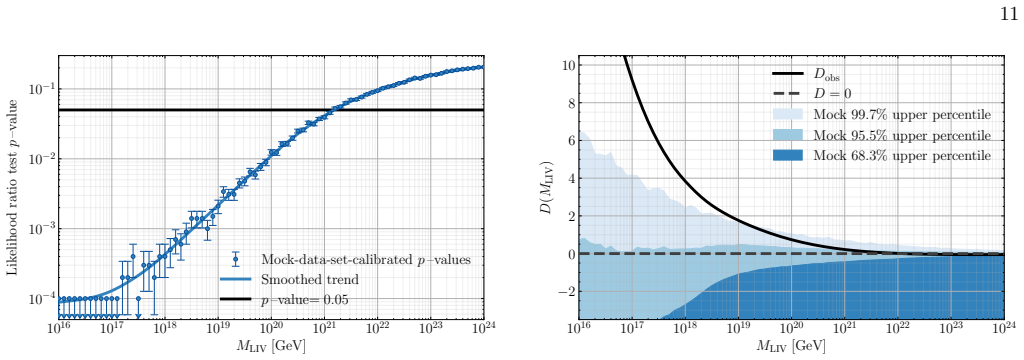
The central claim is that subluminal photon-sector LIV, described by the dispersion relation $E_\gamma^2=k_\gamma^2-k_\gamma^4/M_{\mathrm{LIV}}^2$, suppresses Bethe-Heitler pair production and thereby shifts the depth-of-shower-maximum distribution and biases reconstructed energies in ordinary nucleus-induced showers. After forward folding the simulated distributions through Auger acceptance and resolution parametrizations and allowing free composition fractions in each reconstructed-energy bin, a likelihood-ratio test calibrated on $10^4$ mock data sets excludes $M_{\mathrm{LIV}}<1.5\times10^{21}$ GeV at 95% confidence. The paper is explicit that this should not be interpreted as a detector-level experimental limit because the treatment uses simplified detector response and reconstruction and remains composition dependent.
Load-bearing premise
The whole bound rests on assuming that Lorentz invariance breaks only in the photon sector, so the only new shower physics is the delayed conversion of high-energy photons to electron-positron pairs; if electrons also have comparable LIV or vacuum Cherenkov drains energy, the predicted $X_{\max}$ shift and energy bias change and the quoted scale is not a pure photon-sector bound.
Editorial extensions
If this is right
- If the analysis is right, subluminal photon-sector LIV is excluded up to scales around $1.5\times10^{21}$ GeV, about five orders of magnitude above the previous bound from shower muon content.
- The result implies that the full shape of the $X_{\max}$ distribution in ordinary hadronic showers carries competitive LIV information, not only ultra-high-energy photon-induced showers.
- A dedicated detector-level analysis with full simulation and event reconstruction could turn this toy estimate into a genuine experimental limit.
- The reconstructed-energy bias contributes to the sensitivity alongside the $X_{\max}$ shift, so energy calibration must be treated carefully in any future LIV search based on fluorescence profiles.
Reading between the lines
- If this sensitivity survives full detector simulation, the same forward-folding method could be applied to other fluorescence and Cherenkov observables, including lower-energy extensions such as Telescope Array, to test the bound independently.
- Because the quoted limit lies far above the existing electron-sector LIV bound, a two-sector treatment that also includes soft vacuum Cherenkov energy loss could plausibly shift or weaken the constraint; checking this is a direct next step.
- A testable extension is to repeat the composition fit with smoothness constraints across reconstructed-energy bins; if the exclusion remains under a richer composition model, the bound is less dependent on the flexible four-species mixture used here.
Editorial analysis
A structured set of objections, weighed in public.
Referee Report
Summary. The paper develops a simulation-based toy analysis to constrain subluminal photon-sector Lorentz invariance violation (LIV) using the Pierre Auger fluorescence-detector distributions of the reconstructed depth of shower maximum (Xmax,reco). LIV is implemented in CONEX through a modified Bethe–Heitler cross section, and the simulated longitudinal profiles are reconstructed to obtain Xmax and calorimetric energy. The authors build analytical parametrizations for the reconstructed-energy bias and the Xmax distribution, forward-fold them with Auger acceptance and resolution, fit composition fractions per energy bin, and compare predictions with data using a likelihood-ratio test calibrated with mock data sets. The central result is the approximate 95% CL lower limit M_LIV > 1.5×10^21 GeV, accompanied by explicit caveats that this is not a detector-level limit and that the result remains composition dependent.
Significance. If the central claim survives scrutiny, the result would show that the depth of shower maximum of ordinary hadronic air showers is a far more sensitive probe of subluminal photon-sector LIV than existing constraints, which are at the level M_LIV ≳ 10^12–10^14 GeV, and would approach the sensitivity of prospective photon-induced-shower searches. The paper's strengths are its transparent statistical procedure: simulation-calibrated analytical parametrizations, forward folding with public Auger response parametrizations, a likelihood-ratio test without Wilks assumptions, and a mock-data-set p-value calibration. The authors also make the processed inputs and numerical scan values publicly available and state the limitations of the toy treatment unusually explicitly. However, the numerical central claim rests on an extrapolation of the analytical model over roughly three orders of magnitude in M_LIV beyond the largest simulated finite LIV scale, and this extrapolation is not yet validated by simulations.
major comments (3)
- [§VIII A, §V C, Eq. (24), §IV A] The quoted limit M_LIV > 1.5×10^21 GeV is obtained by extrapolating the LIV-shift parametrization (Eq. (24)) and the reconstructed-energy-bias parametrization (Eq. (19)) about three orders of magnitude beyond the largest simulated finite LIV scale, M_LIV = 10^18 GeV. In the extrapolated region the predicted Xmax shift is at the level of 1 g cm^-2 or less for the relevant mass groups and energies, and the reconstructed-energy bias is below about 0.015 in log10 E; these values are comparable to the 14% Auger energy resolution, the 9% simulation-level energy scatter, and the systematic simplifications already admitted in the detector-response treatment. No CONEX shower in the published grid samples this region; the only anchor is the explicitly simulated LI limit M_LIV = +∞. Eq. (24) contains a positive term proportional to exp(-η/η_μ) and a negative term proportional to -(ζ - ζ_μ,c) that can nearly cancel in part of this interval, so modest errors in the fitted amplitudes could change the sign or magnitude of the predicted Xmax shift and move the 95% crossing by orders of magnitude. I ask the authors to validate the extrapolation with additional simulations at intermediate scales such as 10^19, 10^20, and 10^21 GeV, or, at minimum, to provide a robustness test with alternative functional forms for δμ_LIV(ζ, η) and propagate the resulting uncertainty into the p(η) curve before quoting Eq. (38).
- [§III A, §VIII B, Eq. (10)] The result is presented as a constraint on the photon-sector LIV scale, but the analysis assumes that the electron-sector LIV scale is sufficiently larger than the photon-sector one. The existing 95% CL bound quoted in Eq. (10) is M_LIV,e > 2×10^16 GeV, which is five orders of magnitude below the photon-sector limit claimed here. If electron-sector LIV were present at a comparable or only moderately larger scale, both the Bethe–Heitler modification and the soft vacuum Cherenkov energy-loss channel (acknowledged in §VIII B as neglected) would change the electromagnetic cascade and the reconstructed-energy bias, and the numerical value in Eq. (38) would not be interpretable as a pure photon-sector bound. This is an internal assumption of the toy model rather than an inconsistency with existing data, but it is load-bearing for the interpretation of the central claim. The authors should either quantify the effect of a combined photon-plus-electron LIV scenario on the limit or state categorically that Eq. (38) is conditional on the electron sector being LIV-free by many orders of magnitude.
- [§IV A, §VIII B] The analysis uses a single high-energy hadronic interaction model, EPOS LHC–R, and the paper explicitly notes that hadronic-model dependence is not investigated. This is a load-bearing limitation because the LIV-induced Xmax shift in the extrapolated exclusion region is of order 1 g cm^-2, while differences in Xmax predictions among contemporary hadronic interaction models are typically tens of g cm^-2. The free per-bin composition fractions can partially absorb such differences, but it is not demonstrated that they do so while preserving the LIV sensitivity. I ask the authors to include a robustness check with at least one alternative hadronic model, or to show analytically and with mock studies that the fitted composition fully compensates hadronic-model differences in the relevant energy range.
minor comments (4)
- [§VIII A, Fig. 3] The lower limit is read from a smoothing spline that is described as 'used only to guide the eye.' Since the crossing defines the central numerical result, the interpolation procedure should be specified precisely, or the p-values should be computed on a denser η grid without visual smoothing.
- [§VII B, Fig. 3] The p-value saturation at approximately 10^-4 is mentioned in the main text and figure caption, but the number of mock data sets, N_mock = 10^4, appears only in Appendix D. The figure caption or the main text should state N_mock explicitly, since it determines the resolution of the calibrated p-values.
- [§V C, Eq. (24)] The function expit is defined after its first use in Eq. (24); moving the definition before the equation would improve readability.
- [Abstract, §VIII A] The abstract states that the comparison gives 'a sensitivity to LIV compatible with that expected from ultra-high-energy photon-induced showers.' This compatibility is not quantified; the sentence should be rephrased to state the actual numerical comparison or the relevant reference.
Circularity Check
No significant circularity: the LIV limit is obtained by forward-folding simulation-based predictions and comparing with independent Auger Xmax distributions.
full rationale
The central claim, M_LIV > 1.5e21 GeV at 95% CL, is derived by simulating LIV-modified hadronic air showers and comparing their forward-folded Xmax,reco distributions with published Auger fluorescence-detector data. The LIV cross-section input (Eq. 5) is an EFT result from prior work, and the simulation implementation is cited to the authors' earlier Ref. [29]; both are external, independently published results with stated assumptions, so citing them is not a circular reduction. The analytical model parameters in Eqs. (19) and (24) are fitted to CONEX simulations, not to the Auger data, and the LIV scale itself is scanned rather than fitted. Composition fractions are free nuisance parameters per reconstructed-energy bin, not the LIV scale, so the data comparison is not self-definitional. The mock-data-set calibration in Sec. VII B is a standard frequentist procedure and does not build the bound into the input. The paper's explicit caveats—that the detector response and reconstruction are simplified, that the result is composition dependent, and that soft vacuum Cherenkov emission and electron-sector LIV are neglected—are honesty and systematic-risk statements, not admissions of circularity. The extrapolation of Eqs. (19) and (24) beyond the largest simulated finite M_LIV is a model-validity concern, but the model is anchored to the simulated LI endpoint and the reported crossing is a statistical comparison with external data; no equation in the paper reduces by construction to the Auger input. Therefore no specific circular step can be exhibited. The finding is no significant circularity.
Assumptions & free parameters
free parameters (5)
- Composition fractions f_b,y =
60 independent values (20 reconstructed-energy bins x 4 mass groups, normalized per bin)
- Reconstructed-energy offset and calibration slope =
epsilon_offset = 3.95e-2, kappa_cal = 9.79e-1
- Reconstructed-energy bias parameters =
Delta_epsilon = 2.46e-2, zeta_epsilon,c = 1.42, zeta_epsilon,s = 2.16e-1
- LIV-induced Gumbel location-shift parameters =
Delta+_mu = 9.57e-2, Delta-_mu = 6.03, eta_mu = 1.07, zeta_mu,c = 2.39, zeta_mu,s = 7.75e-1
- LI Gumbel coefficient matrices W_lambda, W_mu, W_sigma =
26 total parameters, including the five LIV shift parameters
assumptions (7)
- standard math The dimension-six EFT LIV Lagrangian with the modified photon dispersion relation in Eq. (4) is the correct framework.
- domain assumption Suppressed Bethe-Heitler pair production is the only significant LIV process in the electromagnetic cascade for the parameter range considered.
- domain assumption The electron-sector LIV scale is much larger than the photon-sector LIV scale.
- domain assumption Vertical EASs simulated with CONEX and a single high-energy hadronic model, EPOS LHC-R, adequately describe the longitudinal development.
- domain assumption The published Auger acceptance and resolution parametrizations, calibrated for Lorentz-invariant showers, apply unchanged to LIV-modified longitudinal profiles.
- ad hoc to paper The generalized-Gumbel shape and width parameters are unchanged under LIV; only the location parameter shifts.
- domain assumption Four representative mass groups with unconstrained per-energy-bin fractions can represent the physical cosmic-ray composition under the LIV hypothesis.
Cite this review
Pith. "Pith review of Constraining Lorentz invariance violation from the depth of air-shower maximum." pith.science (2026). https://pith.science/paper/I7TGHJXK
@misc{pith2026260805106,
  author       = {Pith},
  title        = {Pith review of: Constraining Lorentz invariance violation from the depth of air-shower maximum},
  year         = {2026},
  howpublished = {\url{https://pith.science/paper/I7TGHJXK}},
  note         = {Machine review of arXiv:2608.05106}
}
abstract
Hypothetical Lorentz invariance violation (LIV) remains strongly constrained but has not been excluded as a possible manifestation of new high-energy physics. In subluminal photon-sector LIV, suppressed Bethe$\unicode{x2013}$Heitler pair production modifies the electromagnetic component of extensive air showers. We present a simulation-based toy analysis of this effect using published Pierre Auger fluorescence-detector distributions of the reconstructed depth of air-shower maximum. The modified distributions of the depth of the shower maximum are folded with the Auger detector-response parametrizations and compared with the data using free composition fractions in each reconstructed-energy bin. Within this approach, the comparison gives a sensitivity to LIV compatible with that expected from ultra-high-energy photon-induced showers. We obtain $M_{\rm LIV}>1.5\times 10^{21}\,\text{GeV}$ ($95\%$ confidence level). This result should not be interpreted as a detector-level experimental limit because the detector response and reconstruction are simplified, and the result remains composition dependent. However, the approach presented here opens the way for constraining LIV in hadronic air showers with more detailed analyses.
Figures


Figures from the paper (1 more)

Reference graph
Works this paper leans on
-
[1]
A. Addaziet al., Prog. Part. Nucl. Phys.125, 103948 (2022), arXiv:2111.05659 [hep-ph]
arXiv 2022
-
[2]
D. Colladay and V. A. Kostelecky, Phys. Rev. D58, 116002 (1998), arXiv:hep-ph/9809521
arXiv 1998
-
[3]
V. A. Kostelecky and N. Russell, Rev. Mod. Phys.83, 11 (2011), arXiv:0801.0287 [hep-ph]
arXiv 2011
-
[4]
T. Jacobson, S. Liberati, and D. Mattingly, Annals Phys. 321, 150 (2006), arXiv:astro-ph/0505267
arXiv 2006
-
[5]
H. Mart ´ ınez-Huerta, R. G. Lang, and V. de Souza, Sym- metry12, 1232 (2020)
work page 2020
-
[6]
Abreuet al.(Pierre Auger Collaboration), JCAP2022 (01), 023, arXiv:2112.06773 [astro-ph.HE]
P. Abreuet al.(Pierre Auger Collaboration), JCAP2022 (01), 023, arXiv:2112.06773 [astro-ph.HE]
-
[7]
A. Abdul Halimet al.(Pierre Auger Collabora- tion), Bounds on Lorentz Invariance Violation from Muon Fluctuations at the Pierre Auger Observatory (2026), accepted for publication in Phys. Rev. Lett., arXiv:2602.14720 [astro-ph.HE]
arXiv 2026
- [8]
Show all 51 references
-
[9]
Vankov and T
H. Vankov and T. Stanev, Phys. Lett. B538, 251 (2002), arXiv:astro-ph/0202388
2002 arXiv
-
[10]
Rubtsov, P
G. Rubtsov, P. Satunin, and S. Sibiryakov, Phys. Rev. D 86, 085012 (2012), arXiv:1204.5782 [hep-ph]
2012 arXiv
-
[11]
Galaverni and G
M. Galaverni and G. Sigl, Phys. Rev. D78, 063003 (2008), arXiv:0807.1210 [astro-ph]
2008 arXiv
-
[12]
R. G. Lang, H. Mart ´ ınez-Huerta, and V. de Souza, Astro- phys. J.853, 23 (2018), arXiv:1701.04865 [astro-ph.HE]
2018 arXiv
-
[13]
R. G. Lang, H. Mart ´ ınez-Huerta, and V. de Souza, Phys. Rev. D99, 043015 (2019), arXiv:1810.13215 [astro- ph.HE]
2019 arXiv
-
[14]
Rubtsov, P
G. Rubtsov, P. Satunin, and S. Sibiryakov, JCAP2017 (05), 049, arXiv:1611.10125 [astro-ph.HE]
- [15]
- [16]
-
[17]
E. E. Antonovet al., JETP Lett.73, 446 (2001)
2001
-
[18]
J. S. Diaz, F. R. Klinkhamer, and M. Risse, Phys. Rev. D94, 085025 (2016), arXiv:1607.02099 [hep-ph]
2016 arXiv
-
[19]
F. R. Klinkhamer, M. Niechciol, and M. Risse, Phys. Rev. 16 D96, 116011 (2017), arXiv:1710.02507 [hep-ph]
2017 arXiv
-
[20]
Duenkel, M
F. Duenkel, M. Niechciol, and M. Risse, Phys. Rev. D 104, 015010 (2021), arXiv:2106.01012 [hep-ph]
2021 arXiv
-
[21]
Duenkel, M
F. Duenkel, M. Niechciol, and M. Risse, Phys. Rev. D 107, 083004 (2023), arXiv:2303.05849 [hep-ph]
2023 arXiv
-
[22]
Satunin and A
P. Satunin and A. Sharofeev, Eur. Phys. J. C84, 793 (2024), arXiv:2312.06307 [hep-ph]
2024 arXiv
-
[23]
A. Abdul Halimet al.(Pierre Auger Collabora- tion), Depth of Maximum of Air-Shower Profiles above 1017.7 eV Measured with the Fluorescence Detector of the Pierre Auger Observatory (2026), arXiv:2605.12598 [astro-ph.HE]
2026 arXiv
-
[24]
Depth of Maximum of Air-Shower Profiles above 1017.7 eV Measured with the Fluorescence Detector of the Pierre Auger Observatory
Pierre Auger Collaboration, Data and analysis products for “Depth of Maximum of Air-Shower Profiles above 1017.7 eV Measured with the Fluorescence Detector of the Pierre Auger Observatory”, Zenodo (2026)
2026
-
[25]
Mattingly, inProc
D. Mattingly, inProc. Quantum to Emergent Gravity: Theory and Phenomenology, Vol. 043 (SISSA, 2008) p. 026
2008
- [26]
-
[27]
Jacobson, S
T. Jacobson, S. Liberati, and D. Mattingly, Phys. Rev. D67, 124011 (2003), arXiv:hep-ph/0209264
2003 arXiv
-
[28]
T. J. Konopka and S. A. Major, New J. Phys.4, 57 (2002), arXiv:hep-ph/0201184
2002 arXiv
-
[29]
N. S. Martynenko, G. I. Rubtsov, P. S. Satunin, A. K. Sharofeev, and S. V. Troitsky, Phys. Rev. D111, 063010 (2025), arXiv:2412.08349 [astro-ph.HE]
2025
-
[30]
Liberati, L
S. Liberati, L. Maccione, and T. P. Sotiriou, Phys. Rev. Lett.109, 151602 (2012), arXiv:1207.0670 [gr-qc]
2012 arXiv
-
[31]
F. R. Klinkhamer, Mod. Phys. Lett. A33, 1850104 (2018), arXiv:1610.03315 [hep-ph]
2018 arXiv
-
[32]
G., and Zatsepin, G
Gorjunov, N., Dedenko, L. G., and Zatsepin, G. T., in Proc. Int. Conf. on Cosmic Rays and the Earth Storm, Kyoto, 4-15 September, 1961(Physical Society of Japan,
1961
-
[33]
Pieroget al., Nucl
T. Pieroget al., Nucl. Phys. B Proc. Suppl.151, 159 (2006), arXiv:astro-ph/0411260
2006 arXiv
-
[34]
Bergmannet al., Astropart
T. Bergmannet al., Astropart. Phys.26, 420 (2007), astro-ph/0606564
2007 arXiv
-
[35]
Pierog and K
T. Pierog and K. Werner, inProc. 39th Int. Cosmic Ray Conf., Vol. 501 (SISSA, 2025) p. 358
2025
-
[36]
Basset al., Prog
S. Basset al., Prog. Part. Nucl. Phys.41, 255 (1998)
1998
-
[37]
Bleicheret al., J
M. Bleicheret al., J. Phys. G: Nucl. Part. Phys.25, 1859 (1999)
1999
-
[38]
D. Heck, J. Knapp, J. N. Capdevielle, G. Schatz, and T. Thouw,CORSIKA: a Monte Carlo code to simulate extensive air showers.(Forschungszentrum Karlsruhe Re- port FZKA 6019, 1998)
1998
-
[39]
D. Heck, T. Huege, and T. Pierog,Extensive Air Shower Simulation with CORSIKA: A User’s Guide(2024), available at:https://www.iap.kit.edu/ corsika/downloads/CORSIKA_GUIDE7.7550.pdf
2024
-
[40]
W. R. Nelson and D. W. O. Rogers, Structure and Opera- tion of the EGS4 Code System, inMonte Carlo Transport of Electrons and Photons, edited by T. M. Jenkins, W. R. Nelson, and A. Rindi (Springer US, Boston, MA, 1988) pp. 287–305
1988
-
[41]
T. K. Gaisser and A. M. Hillas, inProc. 15th Int. Cosmic Ray Conf., Vol. 8 (Bulgarian Academy of Sciences, 1977) p. 353
1977
-
[42]
Andringa, R
S. Andringa, R. Concei¸ c˜ ao, and M. Pimenta, Astropart. Phys.34, 360 (2011)
2011
-
[43]
Bellidoet al., inProc
J. Bellidoet al., inProc. 38th Int. Cosmic Ray Conf., Vol. 444 (SISSA, 2023) p. 211
2023
-
[44]
Matthews, Astropart
J. Matthews, Astropart. Phys.22, 387 (2005)
2005
-
[45]
M. D. Domenico, M. Settimo, S. Riggi, and E. Bertin, JCAP2013(07), 050
-
[46]
Evoli, I
C. Evoli, I. Vaiman, S. Petrera, and F. Salamida, Up- dated Air-ShowerX max Moment Parametrizations for UHECR Composition with Latest Hadronic Interaction Models (2026), arXiv:2602.18118 [astro-ph.HE]
2026
-
[47]
Aabet al.(Pierre Auger Collaboration), Phys
A. Aabet al.(Pierre Auger Collaboration), Phys. Rev. D90, 122006 (2014)
2014
-
[48]
Rubtsov, P
G. Rubtsov, P. Satunin, and S. Sibiryakov, Phys. Rev. D 89, 123011 (2014), arXiv:1312.4368 [astro-ph.HE]
2014 arXiv
-
[49]
R. U. Abbasiet al.(Telescope Array), Phys. Rev. D113, 062003 (2026), arXiv:2603.14804 [astro-ph.HE]
2026
-
[50]
and Rubtsov, Grigory I
Martynenko, Nickolay S. and Rubtsov, Grigory I. and Satunin, Petr S. and Sharofeev, Andrey K. and Troitsky, Sergey V., Testing LIV with Auger FD Data, GitHub repository (2026)
2026
-
[51]
Unger, B
M. Unger, B. Dawson, R. Engel, F. Sch¨ ussler, and R. Ul- rich, Nucl. Instrum. Methods Phys. Res., Sect. A588, 433 (2008)
2008
Reviewed August 6, 2026 · model on record in the stance chip above.
Discussion (0). Sign in to comment.