REVIEW 4 major objections 4 minor 48 references
Dual Attention MobDenseNet(DAMDNet) for Robust 3D Face Alignment
T0 review · 4 major / 4 minor · reviewed 2026-08-14 · deepseek-v4-flash
Pith's one-line read DAMDNet significantly improves 3D face alignment accuracy on AFLW and AFLW2000-3D while reducing model parameters and complexity.
desk verdict An honest, reproducible architecture paper whose internal ablation is solid, but whose headline SOTA claim is inflated by mismatched NME normalization and training data. read the letter →
The pith
A machine-rendered reading of the paper's core claim, the machinery that carries it, and where it could break.
The reading
What carries the argument
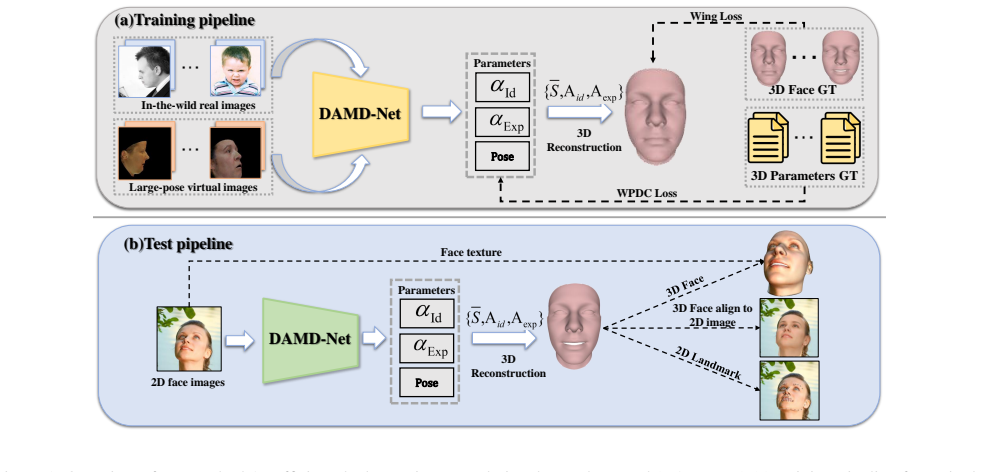
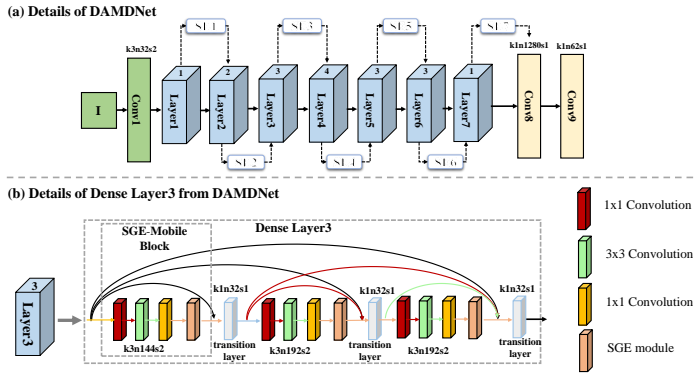
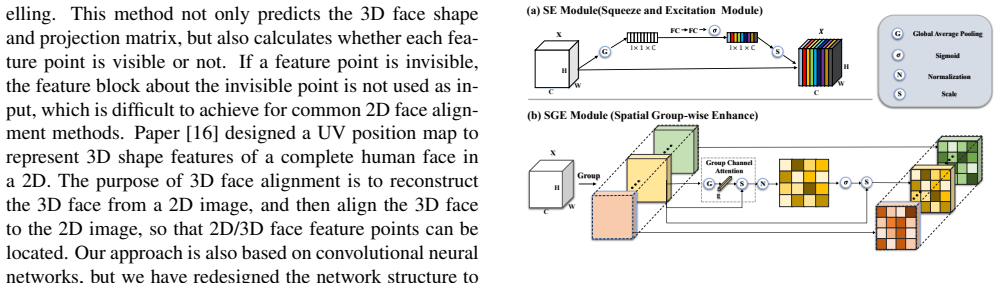
The central object is DAMDNet, a densely connected convolutional network whose basic building block, the SGE-MobileBlock, applies 1x1, 3x3, 1x1 depthwise separable convolutions followed by a Spatial Group-wise Enhancement module, with Squeeze-and-Excitation channel attention placed between dense blocks. The dual attention mechanism is what carries the argument: channel attention re-weights feature maps globally, while SGE computes, within each feature group, a spatial attention mask from the similarity between local features and the group's global pooled feature, suppressing noise and emphasizing face-relevant locations. The loss pair is the other load-bearing mechanism: the weighted parameter distance cost constrains the 3DMM parameters using per-parameter inverse-standard-deviation weights, and the Wing loss constrains the reconstructed 3D vertices, jointly keeping both the model coefficients and the final landmark geometry close to ground truth.
What would settle it
Re-run the compared baselines under DAMDNet's exact test protocol, including square-root-of-bounding-box NME, 120 by 120 cropped inputs, the same yaw subsets, and the same training data excluding the 250,000 synthetic images; if the mean NME gaps shrink to near zero, the architectural advantage is not the source of the reported improvement.
Extended reading notes
Core claim
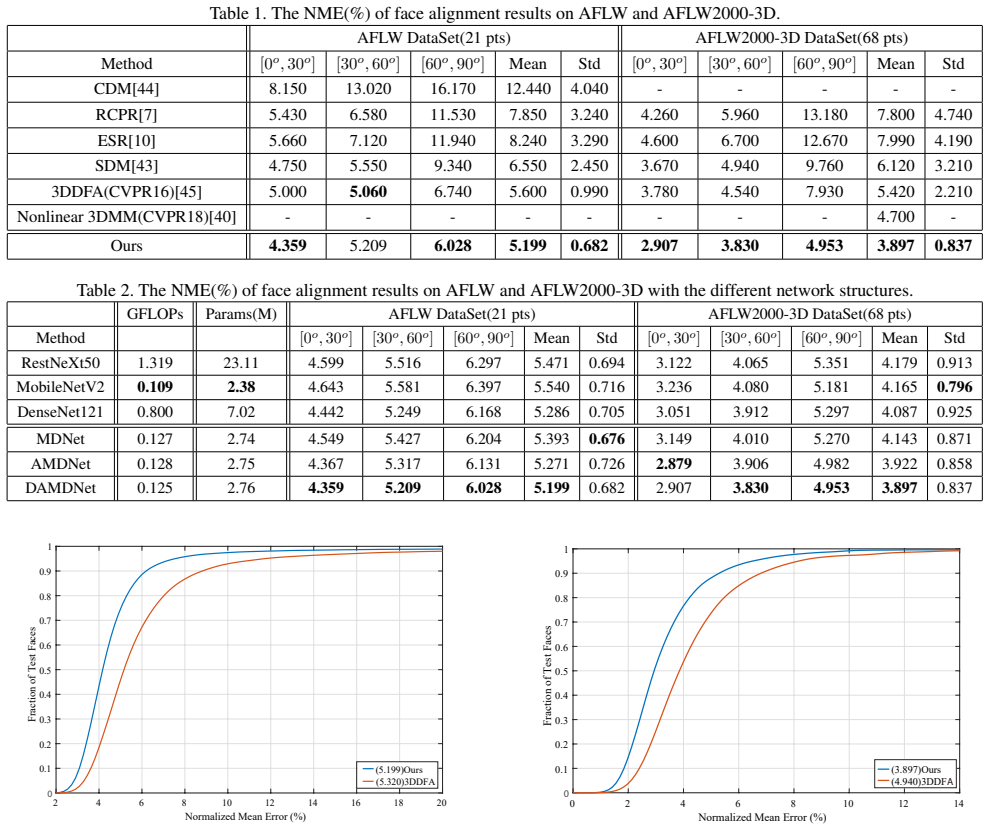
On its own terms, the paper claims that DAMDNet significantly improves 3D face alignment accuracy on AFLW and AFLW2000-3D relative to existing methods such as 3DDFA, while also reducing parameters and computational cost. The discovery is an architecture-level combination: a densely connected network built from depthwise-separable-convolution blocks, with Squeeze-and-Excitation channel attention inserted between dense blocks and Spatial Group-wise Enhancement applied inside blocks to recalibrate spatial features group-by-group. The network outputs a 62-dimensional 3DMM parameter vector (40 identity, 10 expression, 12 pose), and the reconstructed 3D vertices are supervised with a Wing loss while the parameters are supervised with the weighted parameter distance cost. The paper also claims that training with augmented real images plus 250,000 synthetic large-pose faces solves the pose imbalance problem. The result is the lowest reported mean NME among the compared methods on both benchmarks, strongest in the 60 to 90 degree yaw range, and a claimed efficiency advantage: 0.125 GFLOPs and 2.76 million parameters, about 10.5 times fewer GFLOPs and 8.37 times fewer parameters than ResNeXt50.
Load-bearing premise
The accuracy comparison presumes that the published baseline results are directly comparable even though DAMDNet is evaluated with a different normalization (square root of the face bounding box size instead of inter-ocular distance) and is trained on 250,000 synthetic images the baselines did not use.
Editorial extensions
If this is right
- If the reported numbers are correct, DAMDNet gives the best full-pose 3D alignment accuracy among the compared methods, with mean NME of 5.199% on AFLW and 3.897% on AFLW2000-3D, including the hardest 60 to 90 degree yaw subsets.
- The claimed efficiency makes the approach deployable where ResNeXt-based or DenseNet-based aligners are too heavy: 0.125 GFLOPs and 2.76 million parameters versus 1.319 GFLOPs and 23.11 million for ResNeXt50.
- The joint WPDC-and-Wing training should make invisible landmark prediction more reliable in extreme poses, because the vertex-level Wing loss directly supervises the reconstructed 3D geometry rather than only the parameter vector.
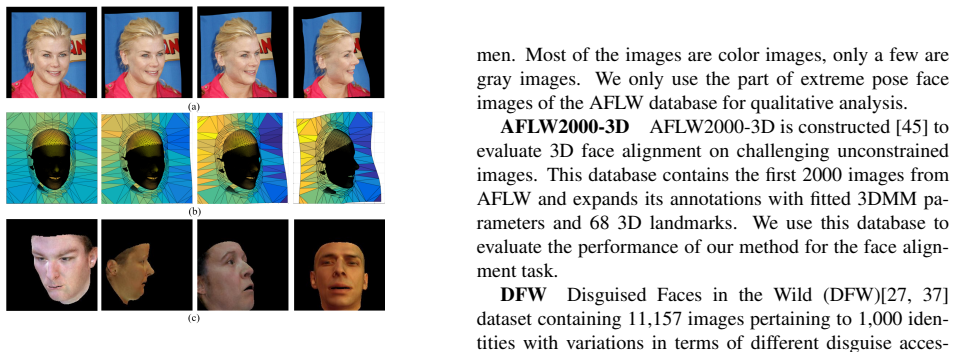
- The large-pose augmentation recipe, including synthetic virtual faces and profile rotation from 10 to 90 degrees, is claimed to reduce the pose imbalance that typically hurts near-frontal face aligners.
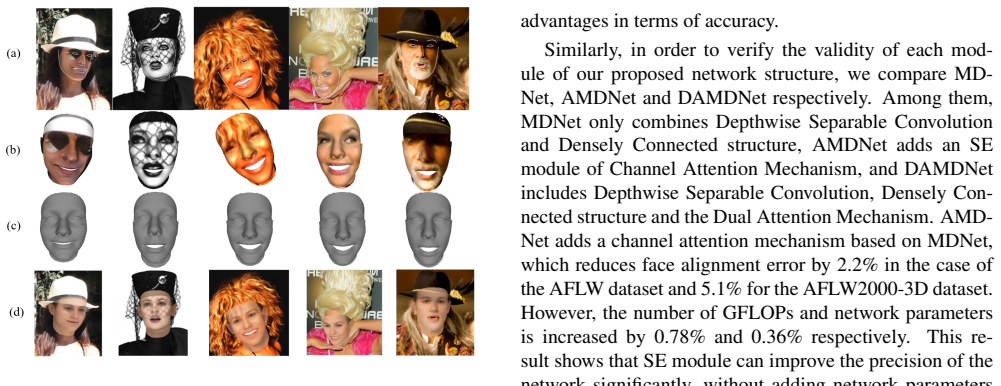
- Qualitative results on the DFW disguised-face dataset indicate the same network can align and reconstruct faces under disguise, which is the preprocessing step the authors target for disguise detection.
Reading between the lines
- The paper's headline comparison may not be apples-to-apples: it uses square-root-of-bounding-box normalization while most prior baselines report inter-ocular-distance NME, and it trains on 250,000 synthetic images those baselines did not use; re-evaluating baselines under the identical protocol would be needed to isolate the architecture's contribution.
- A quantitative disguise-recognition experiment on DFW, rather than only qualitative alignment visualizations, would test whether the improved 3D alignment actually translates into higher disguised-face verification accuracy.
- The same dual-attention building block, channel Squeeze-and-Excitation plus spatial group-wise enhancement inside depthwise-separable dense blocks, is a generic recipe that could transfer to other dense prediction tasks such as facial landmark detection under occlusion or face parsing, and to pose-imbalanced 3D reconstruction beyond faces.
- Because the paper reports only aggregate NME by yaw band and does not break down errors by individual landmarks or occlusion, a finer error analysis might reveal whether the gain comes from spatial attention on the face contour or simply from the extra synthetic profile data.
Signed reviews
Editorial analysis
A structured set of objections, weighed in public.
Referee Report
Summary. The paper proposes DAMDNet, a lightweight convolutional architecture for monocular 3D face alignment. The network combines depthwise separable convolutions, densely connected blocks, a squeeze-and-excitation channel attention module, and a spatial group-wise enhancement module. The model is trained with a weighted sum of the WPDC loss on 3DMM parameters and the Wing loss on reconstructed 3D vertices, using a training set of 680k images that includes 250k synthetic large-pose faces plus pose augmentation. Experiments are reported on AFLW and AFLW2000-3D, with NME as the metric, and qualitative results are shown on the DFW disguised-face dataset. The paper claims that DAMDNet significantly improves 3D face alignment accuracy over state-of-the-art methods while reducing model parameters and computational complexity.
Significance. If the reported results hold under a protocol-matched comparison, the paper would make a useful empirical contribution: it demonstrates that a carefully designed mobile-style dense network with dual attention can reach competitive 3D face alignment accuracy at 0.125 GFLOPs and 2.76M parameters. The internal ablation in Table 2, where all backbones are trained under the same pipeline, is a genuine strength and provides some evidence that the proposed modules help within the authors' own framework. The public code link is also a positive feature. However, the headline claim of state-of-the-art accuracy is currently not established because the external comparison in Table 1 uses a different NME normalization and a substantially enlarged synthetic training set, as the paper itself acknowledges in Section 4.3. The controlled ablation supports an architecture-level claim, but not the cross-method superiority claim as stated.
major comments (4)
- [Section 4.3 (Eq. 6) and Table 1] The headline comparison in Table 1 is not protocol-matched. The NME in Eq. (6) uses d_i equal to the square root of the face bounding box size, and Section 4.3 itself notes that most prior face alignment work uses the inter-ocular distance instead. The baseline rows in Table 1 are taken from prior publications rather than recomputed with Eq. (6). The reported margins (e.g., 5.600 to 5.199 on AFLW and 5.420 to 3.897 on AFLW2000-3D) may therefore be partly an artifact of the normalization rather than of the method. Please recompute all baseline methods under the same normalization, or report both normalizations and restrict the state-of-the-art claim to the protocol-matched comparison.
- [Section 4.1 and Table 1] The external comparison is also unbalanced in training data. DAMDNet is trained on 680,000 images, including 250,000 synthetic large-pose images and additional pose augmentation with rotations by 10 to 90 degrees around the z-axis, whereas the baseline results in Table 1 were produced by the original authors without this synthetic data. Consequently, the accuracy gain could be due to the enlarged training set rather than to the proposed architecture. The internal ablation in Table 2 controls for training data among the authors' own backbones and is a valid way to isolate the architecture contribution, but it does not validate the state-of-the-art comparison in Table 1. Please retrain baseline networks under the same data protocol, or clearly frame Table 1 as an indicative rather than a controlled comparison.
- [Section 4.4.3 and Abstract] The claim that DAMDNet 'exhibits excellent performance' and is 'robust to disguise' on the DFW dataset is not supported by quantitative evaluation. The only evidence is a small set of qualitative visualizations in Figure 7; no landmark error, reconstruction error, or other quantitative metric is reported on DFW. Please add a quantitative evaluation on DFW or weaken the claim to a qualitative demonstration.
- [Section 4.4.4 and Table 2] The marginal contribution of the SGE module is not convincingly established. DAMDNet improves over AMDNet by only 0.64% relative error on AFLW2000-3D (3.922 vs 3.897) and by 1.37% relative error on AFLW (5.271 vs 5.199), and no repeated runs or significance tests are reported. Since the paper's architecture claim rests partly on this final module, please report variance across runs or a statistical significance test, or temper the conclusion accordingly.
minor comments (4)
- [Section 5 and Section 3.4] The conclusion states that the paper proposes 'two novel loss functions', but the WPDC loss is from Zhu et al. [45] and the Wing loss is from Feng et al. [17]. Please revise the wording to say that existing losses are combined, not newly proposed.
- [Section 4.2] The text says that the AFLW face database consists of approximately '250 million hand-labeled face images', which appears to be a typo; the published AFLW dataset contains tens of thousands of images. Please correct the stated number.
- [Figures 5 and 6] The CED curves compare only with 3DDFA, although Table 1 lists several other baselines. Please clarify why the remaining baselines are omitted, or include them for completeness.
- [Throughout] The manuscript contains numerous grammatical errors and typos (e.g., 'detcting', 'prepose', 'Surry' for Surrey, 'strengthen the the spatial'). A thorough language edit is needed before publication.
Circularity Check
No significant circularity: DAMDNet is an empirical architecture paper whose test metrics are neither fitted inputs nor derived from self-citation.
full rationale
The paper's central claim is that DAMDNet improves 3D face alignment accuracy on AFLW and AFLW2000-3D. The network is trained end-to-end with a weighted sum of WPDC loss and Wing loss, and the reported NME values are measured on held-out test sets. No parameter is fitted to the test metrics, and no predicted quantity is defined in terms of the outcome it claims to predict. The WPDC loss is taken from Zhu et al. and the Wing loss from Feng et al., but both loss formulas are stated explicitly in the paper (Eqs. 3 and 4), so their use does not reduce the experimental result to an unverified self-citation. The only author-overlapping citation is the Wing loss paper, whose co-authors include Kittler and Wu; however, the loss function is externally published, reproducible from the quoted formula, and is one component of a jointly trained objective rather than the source of the benchmark numbers. Section 4.4.4 provides a same-protocol ablation across backbones, which supports the architectural contribution independently of the Table 1 baselines. The possible mismatch in NME normalization (Section 4.3, di as square root of bounding box size versus inter-ocular distance in prior work) and the use of 250,000 synthetic training images are threats to the fairness of the state-of-the-art comparison, but they are not circularity: the paper does not define its architecture, loss, or evaluation in terms of the baseline results it seeks to beat. No self-definitional step, fitted-input-as-prediction, or author-imported uniqueness argument appears in the manuscript.
Assumptions & free parameters
free parameters (4)
- lambda_1 =
0.5
- lambda_2 =
1
- Wing loss omega =
10
- Wing loss epsilon =
2
assumptions (4)
- domain assumption The 3D Morphable Model with BFM shape basis and FaceWarehouse expression basis faithfully represents the face shape space (Eq. 1).
- domain assumption AFLW2000-3D annotations, obtained from 3DDFA fitting, are treated as ground truth for training and evaluation.
- domain assumption Weak perspective projection adequately models the image formation process for faces (Eq. 2).
- domain assumption The generated virtual pose face samples and depth-based profile rotation improve large-pose generalization.
Cite this review
Pith. "Pith review of Dual Attention MobDenseNet(DAMDNet) for Robust 3D Face Alignment." pith.science (2026). https://pith.science/paper/IAKQ5YVV
@misc{pith2026190811821,
  author       = {Pith},
  title        = {Pith review of: Dual Attention MobDenseNet(DAMDNet) for Robust 3D Face Alignment},
  year         = {2026},
  howpublished = {\url{https://pith.science/paper/IAKQ5YVV}},
  note         = {Machine review of arXiv:1908.11821}
}
read the original abstract
3D face alignment of monocular images is a crucial process in the recognition of faces with disguise.3D face reconstruction facilitated by alignment can restore the face structure which is helpful in detcting disguise interference.This paper proposes a dual attention mechanism and an efficient end-to-end 3D face alignment framework.We build a stable network model through Depthwise Separable Convolution, Densely Connected Convolutional and Lightweight Channel Attention Mechanism. In order to enhance the ability of the network model to extract the spatial features of the face region, we adopt Spatial Group-wise Feature enhancement module to improve the representation ability of the network. Different loss functions are applied jointly to constrain the 3D parameters of a 3D Morphable Model (3DMM) and its 3D vertices. We use a variety of data enhancement methods and generate large virtual pose face data sets to solve the data imbalance problem. The experiments on the challenging AFLW,AFLW2000-3D datasets show that our algorithm significantly improves the accuracy of 3D face alignment. Our experiments using the field DFW dataset show that DAMDNet exhibits excellent performance in the 3D alignment and reconstruction of challenging disguised faces.The model parameters and the complexity of the proposed method are also reduced significantly.The code is publicly available at https:// github.com/LeiJiangJNU/DAMDNet
Figures
Figures from the paper (3 more)
Reference graph
Works this paper leans on
-
[1]
A. Asthana, S. Zafeiriou, S. Cheng, and M. Pantic. Robust discriminative response map fitting with constrained local models. In Proceedings of the IEEE conference on computer vision and pattern recognition, pages 3444–3451, 2013
work page 2013
-
[2]
P. N. Belhumeur, D. W. Jacobs, D. J. Kriegman, and N. Ku- mar. Localizing parts of faces using a consensus of exem- plars. IEEE transactions on pattern analysis and machine intelligence, 35(12):2930–2940, 2013
work page 2013
-
[3]
V . Bettadapura. Face expression recognition and analysis: the state of the art. arXiv preprint arXiv:1203.6722, 2012
arXiv 2012
- [4]
-
[5]
V . Blanz and T. Vetter. A morphable model for the synthesis of 3d faces. In Proceedings of the 26th annual conference on Computer graphics and interactive techniques , pages 187–
-
[6]
V . Blanz and T. Vetter. Face recognition based on fitting a 3d morphable model. IEEE Transactions on pattern analysis and machine intelligence, 25(9):1063–1074, 2003
work page 2003
-
[7]
X. P. Burgos-Artizzu, P. Perona, and P. Doll ´ar. Robust face landmark estimation under occlusion. In Proceedings of the IEEE International Conference on Computer Vision , pages 1513–1520, 2013
work page 2013
-
[8]
C. Cao, Y . Weng, S. Zhou, Y . Tong, and K. Zhou. Faceware- house: A 3d facial expression database for visual computing. IEEE Transactions on Visualization and Computer Graphics, 20(3):413–425, 2014
work page 2014
Show all 48 references
-
[9]
C. Cao, H. Wu, Y . Weng, T. Shao, and K. Zhou. Real-time facial animation with image-based dynamic avatars. ACM Transactions on Graphics, 35(4), 2016
2016
-
[10]
X. Cao, Y . Wei, F. Wen, and J. Sun. Face alignment by ex- plicit shape regression. International Journal of Computer Vision, 107(2):177–190, 2014
2014
-
[11]
Cootes, E
T. Cootes, E. Baldock, and J. Graham. An introduction to active shape models. Image processing and analysis, pages 223–248, 2000
2000
-
[12]
T. F. Cootes, G. J. Edwards, and C. J. Taylor. Active appear- ance models. IEEE Transactions on Pattern Analysis & Machine Intelligence, (6):681–685, 2001
2001
-
[13]
T. F. Cootes, C. J. Taylor, and A. Lanitis. Active shape mod- els: Evaluation of a multi-resolution method for improving image search. In BMVC, volume 1, pages 327–336. Citeseer, 1994
1994
-
[14]
Cristinacce and T
D. Cristinacce and T. F. Cootes. Feature detection and track- ing with constrained local models. In Bmvc, volume 1, page 3. Citeseer, 2006
2006
-
[15]
Doll ´ar, P
P. Doll ´ar, P. Welinder, and P. Perona. Cascaded pose regres- sion. In Computer Vision and Pattern Recognition (CVPR), 2010 IEEE Conference on, pages 1078–1085. IEEE, 2010
2010
-
[16]
Y . Feng, F. Wu, X. Shao, Y . Wang, and X. Zhou. Joint 3d face reconstruction and dense alignment with position map regression network. arXiv preprint arXiv:1803.07835, 2018
2018 arXiv
-
[17]
Z.-H. Feng, J. Kittler, M. Awais, P. Huber, and X.-J. Wu. Wing loss for robust facial landmark localisation with con- volutional neural networks. In 2018 IEEE/CVF Conference on Computer Vision and Pattern Recognition , pages 2235–
2018
-
[18]
D. Forsyth. Object detection with discriminatively trained part-based models. Computer, (2):6–7, 2014
2014
-
[19]
Gu and T
L. Gu and T. Kanade. 3d alignment of face in a single image. In null, pages 1305–1312. IEEE, 2006
2006
-
[20]
A. G. Howard, M. Zhu, B. Chen, D. Kalenichenko, W. Wang, T. Weyand, M. Andreetto, and H. Adam. Mobilenets: Effi- cient convolutional neural networks for mobile vision appli- cations. arXiv preprint arXiv:1704.04861, 2017
2017 arXiv
-
[21]
J. Hu, L. Shen, and G. Sun. Squeeze-and-excitation net- works. In Proceedings of the IEEE conference on computer vision and pattern recognition, pages 7132–7141, 2018
2018
-
[22]
Huang, Z
G. Huang, Z. Liu, L. Van Der Maaten, and K. Q. Weinberger. Densely connected convolutional networks. In CVPR, vol- ume 1, page 3, 2017
2017
-
[23]
Jourabloo and X
A. Jourabloo and X. Liu. Pose-invariant 3d face alignment. In Proceedings of the IEEE International Conference on Computer Vision, pages 3694–3702, 2015
2015
-
[24]
Jourabloo and X
A. Jourabloo and X. Liu. Large-pose face alignment via cnn-based dense 3d model fitting. In Proceedings of the IEEE conference on computer vision and pattern recogni- tion, pages 4188–4196, 2016
2016
-
[25]
D. P. Kingma and J. Ba. Adam: A method for stochastic optimization. arXiv preprint arXiv:1412.6980, 2014
2014 arXiv
-
[26]
Koestinger, P
M. Koestinger, P. Wohlhart, P. M. Roth, and H. Bischof. Annotated facial landmarks in the wild: A large-scale, real- world database for facial landmark localization. InComputer Vision Workshops (ICCV Workshops), 2011 IEEE Interna- tional Conference on, pages 2144–2151. IEEE, 2011
2011
-
[27]
Kushwaha, M
V . Kushwaha, M. Singh, R. Singh, M. Vatsa, N. Ratha, and R. Chellappa. Disguised faces in the wild. In Proceed- ings of the IEEE Conference on Computer Vision and Pattern Recognition Workshops, pages 1–9, 2018
2018
-
[28]
X. Li, X. Hu, and J. Yang. Spatial group-wise enhance: En- hancing semantic feature learning in convolutional networks. 2019
2019
-
[29]
X. Liu. Discriminative face alignment. IEEE Transactions on Pattern Analysis and Machine Intelligence, 31(11):1941, 2009
1941
-
[30]
Matthews and S
I. Matthews and S. Baker. Active appearance models revis- ited. International journal of computer vision , 60(2):135– 164, 2004
2004
-
[31]
Paysan, R
P. Paysan, R. Knothe, B. Amberg, S. Romdhani, and T. Vet- ter. A 3d face model for pose and illumination invariant face recognition. In Advanced video and signal based surveil- lance, 2009. AVSS’09. Sixth IEEE International Conference on, pages 296–301. Ieee, 2009
2009
-
[32]
Richardson, M
E. Richardson, M. Sela, and R. Kimmel. 3d face reconstruc- tion by learning from synthetic data. In 3D Vision (3DV), 2016 Fourth International Conference on , pages 460–469. IEEE, 2016
2016
-
[33]
Sandler, A
M. Sandler, A. Howard, M. Zhu, A. Zhmoginov, and L.-C. Chen. Inverted residuals and linear bottlenecks: Mobile net- works for classification, detection and segmentation. arXiv preprint arXiv:1801.04381, 2018
2018 arXiv
-
[34]
Saragih and R
J. Saragih and R. Goecke. A nonlinear discriminative ap- proach to aam fitting. In Computer Vision, 2007. ICCV 2007. IEEE 11th International Conference on , pages 1–8. IEEE, 2007
2007
-
[35]
J. M. Saragih, S. Lucey, and J. F. Cohn. Face alignment through subspace constrained mean-shifts. In Computer Vi- sion, 2009 IEEE 12th International Conference on , pages 1034–1041. Ieee, 2009
2009
-
[36]
J. M. Saragih, S. Lucey, and J. F. Cohn. Deformable model fitting by regularized landmark mean-shift. International Journal of Computer Vision, 91(2):200–215, 2011
2011
-
[37]
Singh, M
R. Singh, M. Vatsa, and A. Noore. Recognizing face images with disguise variations. In Recent Advances in Face Recog- nition. IntechOpen, 2008
2008
-
[38]
Y . Sun, X. Wang, and X. Tang. Deep convolutional net- work cascade for facial point detection. In Proceedings of the IEEE conference on computer vision and pattern recog- nition, pages 3476–3483, 2013
2013
-
[39]
A. T. Tran, T. Hassner, I. Masi, and G. Medioni. Regressing robust and discriminative 3d morphable models with a very deep neural network. InComputer Vision and Pattern Recog- nition (CVPR), 2017 IEEE Conference on, pages 1493–1502. IEEE, 2017
2017
-
[40]
Tran and X
L. Tran and X. Liu. Nonlinear 3d face morphable model. arXiv preprint arXiv:1804.03786, 2018
2018 arXiv
-
[41]
Valstar, B
M. Valstar, B. Martinez, X. Binefa, and M. Pantic. Facial point detection using boosted regression and graph models. In Computer Vision and Pattern Recognition (CVPR), 2010 IEEE Conference on, pages 2729–2736. IEEE, 2010
2010
-
[42]
S. Xie, R. Girshick, P. Doll ´ar, Z. Tu, and K. He. Aggregated residual transformations for deep neural networks. In Com- puter Vision and Pattern Recognition (CVPR), 2017 IEEE Conference on, pages 5987–5995. IEEE, 2017
2017
-
[43]
J. Yan, Z. Lei, D. Yi, and S. Li. Learn to combine multi- ple hypotheses for accurate face alignment. In Proceedings of the IEEE International Conference on Computer Vision Workshops, pages 392–396, 2013
2013
-
[44]
X. Yu, J. Huang, S. Zhang, and D. N. Metaxas. Face land- mark fitting via optimized part mixtures and cascaded de- formable model. IEEE Transactions on Pattern Analysis & Machine Intelligence, (11):2212–2226, 2016
2016
-
[45]
X. Zhu, Z. Lei, X. Liu, H. Shi, and S. Z. Li. Face align- ment across large poses: A 3d solution. In Proceedings of the IEEE conference on computer vision and pattern recog- nition, pages 146–155, 2016
2016
-
[46]
X. Zhu, Z. Lei, J. Yan, D. Yi, and S. Z. Li. High-fidelity pose and expression normalization for face recognition in the wild. In Proceedings of the IEEE Conference on Computer Vision and Pattern Recognition, pages 787–796, 2015
2015
-
[47]
Zhu and D
X. Zhu and D. Ramanan. Face detection, pose estimation, and landmark localization in the wild. In Computer Vision and Pattern Recognition (CVPR), 2012 IEEE Conference on, pages 2879–2886. IEEE, 2012
2012
-
[194]
ACM Press/Addison-Wesley Publishing Co., 1999
1999
Reviewed August 14, 2026 · model on record in the stance chip above.
Discussion (0). Continue with ORCID to comment.