Microscopic derivation of the microstretch theory for carbon nanotubes
Pith reviewed 2026-06-28 09:22 UTC · model grok-4.3
The pith
Linearizing nonlinear elasticity around a uniformly twisted nanotube equilibrium produces a microstretch theory whose constants depend on Lamé parameters, radius, and twist rate.
A machine-rendered reading of the paper's core claim, the machinery that carries it, and where it could break.
Core claim
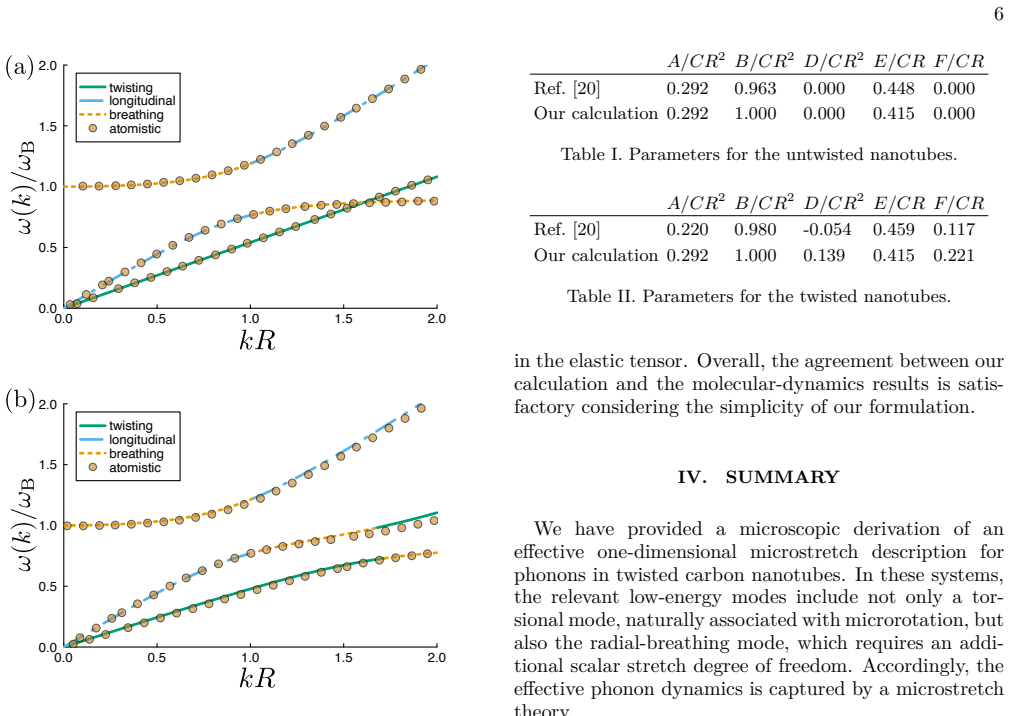
Starting from nonlinear elasticity on a cylindrical surface, linearization around a uniformly twisted equilibrium configuration produces a dynamical matrix that coincides with that of a one-dimensional microstretch theory. The elastic constants in this theory are expressed in terms of the Lamé constants, the nanotube radius, and the twist rate. The twist generates chiral couplings which hybridize the twisting, longitudinal, and radial-breathing modes and open an anticrossing in the phonon dispersion.
What carries the argument
Linearization of the nonlinear elasticity equations on the cylindrical surface around the uniformly twisted equilibrium, which yields a dynamical matrix identical to the microstretch form.
If this is right
- Elastic constants of the effective theory are fixed by the Lamé constants, nanotube radius, and twist rate.
- Twist produces chiral couplings between the three phonon branches.
- The couplings hybridize torsion, longitudinal, and radial-breathing modes.
- An anticrossing gap opens in the dispersion relation.
Where Pith is reading between the lines
- The same linearization procedure could be applied to other cylindrical or helical nanostructures to derive analogous effective theories.
- The twist-rate dependence of the couplings suggests that phonon spectra could be tuned by controlled twisting.
- If the anticrossing is observed, it would provide a direct experimental signature of the chiral terms derived from the continuum model.
Load-bearing premise
Linearizing the nonlinear elasticity equations around the uniformly twisted state is enough to capture the phonon modes without discrete atomic lattice effects or higher-order geometric nonlinearities.
What would settle it
Measurement of the phonon dispersion in twisted carbon nanotubes that either exhibits or fails to exhibit the predicted mode hybridization and anticrossing gap whose size scales with the twist rate.
Figures
read the original abstract
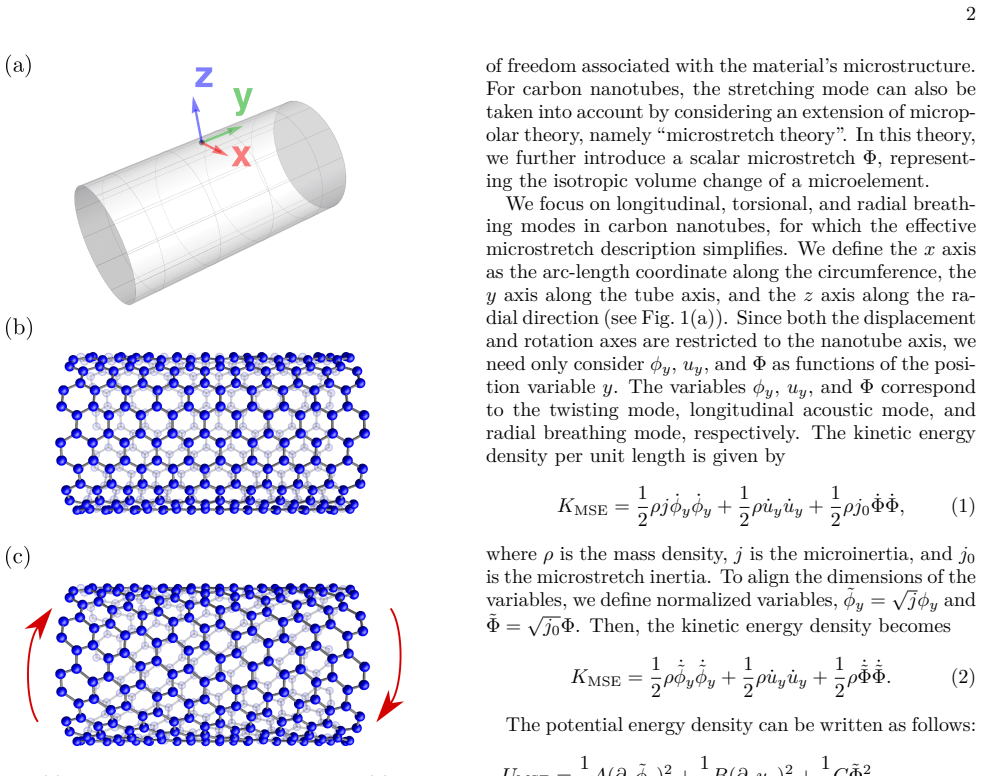
Twisted carbon nanotubes support phonons involving not only torsion, naturally associated with microrotation, but also radial breathing, which requires a scalar stretch degree of freedom. We derive an effective microstretch theory for these modes starting from nonlinear elasticity on a cylindrical surface. By linearizing the equation of motion around a uniformly twisted equilibrium configuration, we obtain the dynamical matrix for the twisting, longitudinal, and radial-breathing modes. This matrix coincides with that of a one-dimensional microstretch theory, and the corresponding elastic constants are expressed in terms of the Lam\'e constants, the nanotube radius, and the twist rate. The twist generates chiral couplings in the effective theory, which hybridize the three modes and open an anticrossing in the phonon dispersion. These results provide a microscopic basis for the microstretch description of phonons in twisted carbon nanotubes and clarify how structural chirality enters the effective couplings.
Editorial analysis
A structured set of objections, weighed in public.
Referee Report
Summary. The manuscript claims to derive an effective one-dimensional microstretch theory for phonons (torsion, longitudinal, and radial-breathing modes) in twisted carbon nanotubes from nonlinear elasticity on a cylindrical surface. Linearizing the equations of motion around a uniformly twisted equilibrium yields a dynamical matrix that coincides with the microstretch form; the effective elastic constants are expressed directly in terms of the Lamé parameters, nanotube radius, and twist rate. Twist induces chiral couplings that hybridize the modes and produce an anticrossing in the dispersion relation.
Significance. If correct, the work supplies a continuum-based microscopic foundation for microstretch models of twisted-CNT phonons and shows explicitly how the twist rate enters the effective couplings. The parameter-free character of the constants (expressed solely in terms of standard Lamé parameters, radius, and twist rate) is a clear strength. The result is internally consistent within the stated 2D continuum model but its applicability to real carbon nanotubes remains to be assessed.
major comments (2)
- [Derivation / linearization section (equations following the equilibrium twist configuration)] The central claim is that the linearized dynamical matrix exactly coincides with the 1D microstretch matrix. The manuscript must therefore display the explicit matrix elements obtained from the continuum linearization (presumably in the derivation section following the statement of the nonlinear equations) and place them side-by-side with the standard microstretch dynamical matrix so that the matching of every entry, including the twist-induced off-diagonal chiral terms, can be verified directly.
- [Discussion or conclusions (applicability paragraph)] The radial-breathing mode in small-radius CNTs is known to be sensitive to atomic discreteness and curvature corrections that are absent from the starting 2D continuum elasticity equations on the cylinder. Because the anticrossing and the hybridization rest on the coupling of this mode to the torsional and longitudinal modes, the manuscript must supply either an a-priori estimate of the radius range where the continuum approximation remains quantitatively reliable or a brief discussion of why discrete-lattice effects do not alter the form of the effective couplings.
minor comments (2)
- [Abstract] The abstract states the main results but contains no key equations or the explicit dependence of the effective constants on Lamé parameters and twist rate; adding one or two representative expressions would improve immediate readability.
- [Notation / introduction] Notation for the twist rate (often denoted au or hetȧ) and for the Lamé constants should be introduced once and used uniformly; any redefinition between sections should be flagged.
Simulated Author's Rebuttal
We thank the referee for the careful reading and constructive comments. We address each major comment below.
read point-by-point responses
-
Referee: [Derivation / linearization section (equations following the equilibrium twist configuration)] The central claim is that the linearized dynamical matrix exactly coincides with the 1D microstretch matrix. The manuscript must therefore display the explicit matrix elements obtained from the continuum linearization (presumably in the derivation section following the statement of the nonlinear equations) and place them side-by-side with the standard microstretch dynamical matrix so that the matching of every entry, including the twist-induced off-diagonal chiral terms, can be verified directly.
Authors: We agree that an explicit side-by-side comparison will strengthen the presentation. Although the manuscript derives the dynamical matrix via linearization of the nonlinear equations around the twisted equilibrium, the individual elements are not displayed in tabulated form for direct verification. In the revised manuscript we will insert a new table (or expanded paragraph) in the linearization section that lists every entry of the continuum-derived dynamical matrix next to the corresponding entry of the standard one-dimensional microstretch matrix, explicitly confirming agreement on all diagonal terms and on the twist-induced off-diagonal chiral couplings. revision: yes
-
Referee: [Discussion or conclusions (applicability paragraph)] The radial-breathing mode in small-radius CNTs is known to be sensitive to atomic discreteness and curvature corrections that are absent from the starting 2D continuum elasticity equations on the cylinder. Because the anticrossing and the hybridization rest on the coupling of this mode to the torsional and longitudinal modes, the manuscript must supply either an a-priori estimate of the radius range where the continuum approximation remains quantitatively reliable or a brief discussion of why discrete-lattice effects do not alter the form of the effective couplings.
Authors: This observation is correct within the stated model. The derivation is performed entirely inside two-dimensional continuum elasticity on the cylinder; the chiral couplings and resulting anticrossing arise from the broken mirror symmetry of the uniformly twisted configuration. Discrete-lattice and curvature corrections can shift the radial-breathing frequency and therefore move the location of the anticrossing, but they do not change the symmetry-allowed structure of the effective dynamical matrix. We will add a concise paragraph to the discussion section explaining that the form of the couplings is protected by the continuum symmetries of the twisted cylinder and is therefore expected to survive in an effective description even when atomic discreteness is present. Because a quantitative radius estimate would require atomistic calculations outside the scope of this continuum study, we supply the symmetry-based discussion instead. revision: yes
Circularity Check
Derivation from nonlinear elasticity is self-contained with no circular steps
full rationale
The paper derives the effective dynamical matrix by starting from nonlinear elasticity on a cylindrical surface, linearizing around the uniformly twisted equilibrium, and obtaining elastic constants expressed directly in terms of the input Lamé constants, radius, and twist rate. This constitutes a standard continuum reduction of degrees of freedom rather than any self-definition, fitted-input prediction, or self-citation chain. No load-bearing step reduces to its own outputs by construction, and the abstract provides no evidence of the enumerated circularity patterns.
Axiom & Free-Parameter Ledger
axioms (1)
- domain assumption Nonlinear elasticity theory applies to a continuous cylindrical surface without discrete atomic corrections.
Reference graph
Works this paper leans on
-
[1]
Zhang and Q
L. Zhang and Q. Niu, Angular Momentum of Phonons and the Einstein-de Haas Effect, Phys. Rev. Lett. 112, 085503 (2014)
2014
-
[2]
J. J. Nakane and H. Kohno, Angular momentum of phonons and its application to single-spin relaxation, Phys. Rev. B 97, 174403 (2018)
2018
-
[3]
Hamada, E
M. Hamada, E. Minamitani, M. Hirayama, and S. Mu- rakami, Phonon Angular Momentum Induced by the Temperature Gradient, Phys. Rev. Lett. 121, 175301 (2018)
2018
-
[4]
Park and B.-J
S. Park and B.-J. Yang, Phonon Angular Momentum Hall Effect, Nano Letters 20, 7694 (2020)
2020
-
[5]
Hamada and S
M. Hamada and S. Murakami, Phonon rotoelectric effect, Phys. Rev. B 101, 144306 (2020)
2020
-
[6]
Streib, Difference between angular momentum and pseudoangular momentum, Phys
S. Streib, Difference between angular momentum and pseudoangular momentum, Phys. Rev. B 103, L100409 (2021)
2021
-
[7]
Zhang and Q
L. Zhang and Q. Niu, Chiral Phonons at High-Symmetry Points in Monolayer Hexagonal Lattices, Phys. Rev. Lett. 115, 115502 (2015)
2015
-
[8]
H. Zhu, J. Yi, M.-Y. Li, J. Xiao, L. Zhang, C.-W. Yang, R. A. Kaindl, L.-J. Li, Y. Wang, and X. Zhang, Obser- vation of chiral phonons, Science 359, 579 (2018)
2018
-
[9]
Ishito, H
K. Ishito, H. Mao, Y. Kousaka, Y. Togawa, S. Iwasaki, T. Zhang, S. Murakami, J.-i. Kishine, and T. Satoh, Truly chiral phonons in α-HgS, Nat. Phys. 19, 35 (2023)
2023
-
[10]
H. Chen, W. Wu, J. Zhu, S. A. Yang, and L. Zhang, Prop- agating Chiral Phonons in Three-Dimensional Materials, Nano Lett. 21, 3060 (2021)
2021
-
[11]
Tsunetsugu and H
H. Tsunetsugu and H. Kusunose, Theory of Energy Dis- persion of Chiral Phonons, J. Phys. Soc. Jpn. 92, 023601 (2023)
2023
-
[12]
K. Ohe, H. Shishido, M. Kato, S. Utsumi, H. Matsuura, and Y. Togawa, Chirality-Induced Selectivity of Phonon Angular Momenta in Chiral Quartz Crystals, Phys. Rev. Lett. 132, 056302 (2024)
2024
-
[13]
Funato, M
T. Funato, M. Matsuo, and T. Kato, Chirality-Induced Phonon-Spin Conversion at an Interface, Phys. Rev. Lett. 132, 236201 (2024)
2024
-
[14]
Yang and J
C. Yang and J. Ren, Chirality-induced phonon spin selec- tivity by elastic spin-orbit interaction, Proc. Natl. Acad. Sci. U.S.A. 121, e2411427121 (2024)
2024
-
[15]
Nishimura, T
N. Nishimura, T. Funato, M. Matsuo, and T. Kato, The- ory of spin Seebeck effect activated by acoustic chiral phonons, J. Magn. Magn. Mater. 630, 173386 (2025)
2025
-
[16]
D. M. Juraschek, R. M. Geilhufe, H. Zhu, M. Basini, P. Baum, A. Baydin, S. Chaudhary, M. Fechner, B. Fle- bus, G. Grissonnanche, A. I. Kirilyuk, M. Lemeshko, S. F. Maehrlein, M. Mignolet, S. Murakami, Q. Niu, U. Nowak, C. P. Romao, H. Rostami, T. Satoh, N. A. Spaldin, H. Ueda, and L. Zhang, Chiral phonons, Nat. Phys. 21, 1532 (2025)
2025
-
[17]
Saito, G
R. Saito, G. Dresselhaus, and M. S. Dresselhaus, Physical Properties of Carbon Nanotubes (Imperial College Press, London, 1998)
1998
-
[18]
Suzuura and T
H. Suzuura and T. Ando, Phonons and electron-phonon scattering in carbon nanotubes, Phys. Rev. B 65, 235412 (2002)
2002
-
[19]
Jorio, M
A. Jorio, M. S. Dresselhaus, R. Saito, and G. Dressel- haus, Raman spectroscopy of carbon nanotubes, Phy. Rep. 409, 47 (2005)
2005
-
[20]
Gupta and A
P. Gupta and A. Kumar, Phonons in chiral nanorods and nanotubes: A Cosserat-rod-based continuum approach, Math. Mech. Solids 24, 3897 (2019)
2019
-
[21]
R. Akimoto, H. Matsuura, and T. Yamamoto, Thermal Einstein-de Haas Effect Induced by Chiral Phonons in Carbon Nanotubes , arXiv:2602.06392
-
[22]
Nowacki, Theory of Asymmetric Elasticity (Perga- mon Press, 1985)
W. Nowacki, Theory of Asymmetric Elasticity (Perga- mon Press, 1985)
1985
-
[23]
A. C. Eringen, Microcontinuum Field Theories: I. Foun- dations and Solids (Springer Science & Business Media, 2012)
2012
-
[24]
Kishine, A
J. Kishine, A. S. Ovchinnikov, and A. A. Tereshchenko, Chirality-Induced Phonon Dispersion in a Noncen- trosymmetric Micropolar Crystal, Phys. Rev. Lett. 125, 245302 (2020)
2020
-
[25]
M. Matsuo, N. Nishimura, A. Yamakage, and T. Kato, Generalized continuum theory of phonon angular mo- mentum in crystals , arXiv:2605.01678
-
[26]
Pao and U
Y.-H. Pao and U. Gamer, Acoustoelastic waves in or- thotropic media, J. Acoust. Soc. Am. 77, 806 (1985)
1985
discussion (0)
Sign in with ORCID, Apple, or X to comment. Anyone can read and Pith papers without signing in.