Power Lindley distribution and software metrics
Pith reviewed 2026-05-25 11:39 UTC · model grok-4.3
The pith
The power Lindley distribution is moment-indeterminate for certain parameter values and determinate for others.
A machine-rendered reading of the paper's core claim, the machinery that carries it, and where it could break.
Core claim
The power Lindley distribution is moment-indeterminate when the power parameter lies in specific intervals, shown by constructing distinct distributions that share the same moments, and moment-determinate outside those intervals; the distribution is then applied to model software metrics data.
What carries the argument
The power Lindley distribution, formed by a power transformation of the Lindley distribution, whose moment sequence is analyzed for uniqueness depending on the parameters.
If this is right
- When the distribution is indeterminate, its moments alone cannot identify it uniquely among all possible distributions.
- The distribution can still be used to fit positive-valued data such as software metrics.
- Parameter selection can ensure moment determinacy if uniqueness from moments is needed for inference.
Where Pith is reading between the lines
- The same parameter-based criteria for (in)determinacy might extend to other members of the Lindley family.
- In applications where moments are matched to data, indeterminacy would require extra conditions such as support restrictions to restore uniqueness.
Load-bearing premise
The power Lindley distribution is assumed to provide a useful description of software metrics data that justifies moving from the moment analysis to the fitting examples.
What would settle it
An explicit demonstration that two different distributions with the claimed identical moments do not exist for the parameter values asserted to be indeterminate would falsify the indeterminacy results.
Figures
read the original abstract
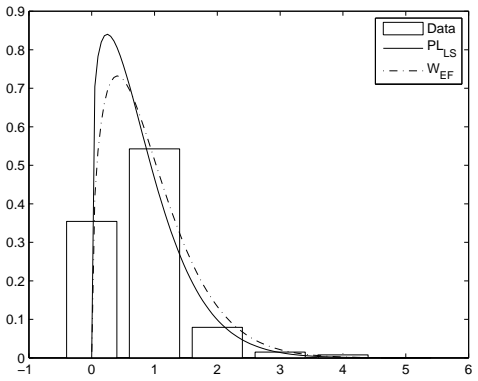
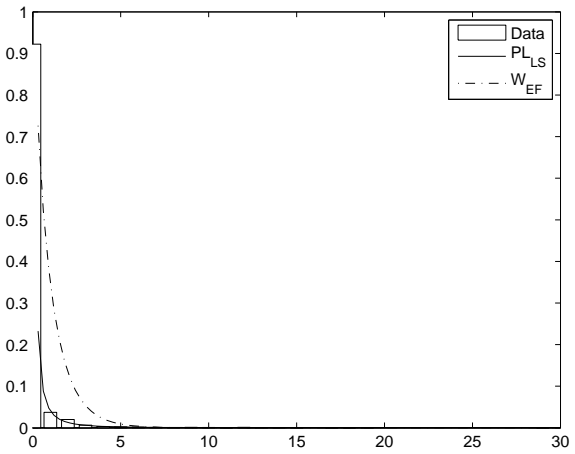
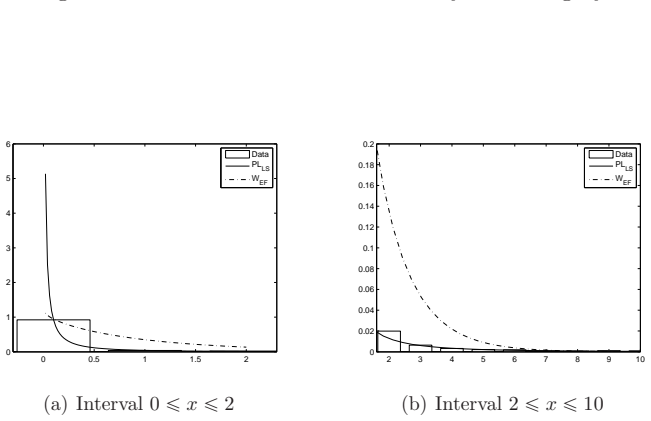
The Lindley distribution and its numerous generalizations are widely used in statistical and engineering practice. Recently, a power transformation of Lindley distribution, called the power Lindley distribution, has been introduced by M. E. Ghitany et al., who initiated the investigation of its properties and possible applications. In this article, new results on the power Lindley distribution are presented. The focus of this work is on the moment-(in)determinacy of the distribution for various values of the parameters. Afterwards, certain applications are provided to describe data sets of software metrics.
Editorial analysis
A structured set of objections, weighed in public.
Referee Report
Summary. The manuscript derives new results on the moment-(in)determinacy of the power Lindley distribution across parameter values and applies the distribution to model several software metrics data sets.
Significance. If the moment-indeterminacy results are fully derived with explicit parameter ranges and the data applications include comparative goodness-of-fit statistics, the work would strengthen the literature on generalized Lindley families and their use for positive skewed data in reliability and software engineering.
major comments (2)
- [Application section] Application section: the text proceeds directly to fitting examples without reporting comparative goodness-of-fit statistics (AIC, BIC, KS statistic, or likelihood-ratio tests) against the ordinary Lindley, Weibull, gamma, or lognormal distributions on the same data sets; this leaves the claim that the power Lindley yields a meaningfully better or novel description resting on an untested assumption.
- [Moment-indeterminacy analysis] Moment-indeterminacy section: the abstract states that new results on moment-(in)determinacy are derived, yet the manuscript does not supply the full derivations or explicit statements of the parameter ranges for which indeterminacy holds, preventing verification of the central analytic claims.
minor comments (1)
- Add error bars or standard errors to any fitted parameter estimates and goodness-of-fit values reported in the data examples.
Simulated Author's Rebuttal
We thank the referee for the constructive comments. We address each major point below and will revise the manuscript to incorporate the suggested improvements.
read point-by-point responses
-
Referee: [Application section] Application section: the text proceeds directly to fitting examples without reporting comparative goodness-of-fit statistics (AIC, BIC, KS statistic, or likelihood-ratio tests) against the ordinary Lindley, Weibull, gamma, or lognormal distributions on the same data sets; this leaves the claim that the power Lindley yields a meaningfully better or novel description resting on an untested assumption.
Authors: We agree that direct comparison via standard goodness-of-fit criteria is necessary to substantiate the practical advantage of the power Lindley distribution. In the revised manuscript we will add tables reporting AIC, BIC, Kolmogorov-Smirnov statistics and likelihood-ratio tests for the power Lindley versus the ordinary Lindley, Weibull, gamma and lognormal distributions on each software-metrics data set. revision: yes
-
Referee: [Moment-indeterminacy analysis] Moment-indeterminacy section: the abstract states that new results on moment-(in)determinacy are derived, yet the manuscript does not supply the full derivations or explicit statements of the parameter ranges for which indeterminacy holds, preventing verification of the central analytic claims.
Authors: The moment-indeterminacy results form the theoretical core of the paper. We will expand the relevant section (and add an appendix if needed) to present the complete derivations together with explicit statements of the parameter regions (in terms of the two shape parameters) for which the distribution is moment-indeterminate or determinate. revision: yes
Circularity Check
No significant circularity; moment results use standard techniques independent of data fits
full rationale
The paper's primary chain derives moment-(in)determinacy results for the power Lindley distribution via analytic methods on the Stieltjes moment problem, citing the distribution's prior introduction by Ghitany et al. (distinct authors) only for background. No equations reduce a claimed prediction to a fitted parameter from the software metrics data, nor do self-citations bear the load of uniqueness or ansatzes. The applications section simply fits the distribution to data sets as descriptive examples, without presenting fitted values as independent predictions. This is self-contained against external benchmarks and receives the default non-circularity finding.
Axiom & Free-Parameter Ledger
axioms (1)
- standard math The classical moment problem on the positive reals determines uniqueness or non-uniqueness of a distribution from its moment sequence.
Reference graph
Works this paper leans on
-
[1]
M. Abramowitz and I. A. Stegun, Handbook of mathematical functions with formulas, graphs, and mathematical tables , Dover Publications, New York, 1972
work page 1972
-
[2]
A. Al-Babtain, A. A. Fattah, A-H. N. Ahmed and F. Merovci, The Kumaraswamy-transmuted exponentiated modified Weibull distribu tion, Com- munications in Statistics - Simulation and Computation 46(5) (2017), 3812– 3832. 12
work page 2017
-
[3]
C. Armero and M. J. Bayarri, A Bayesian analysis of a queueing sys tem with unlimited service, Technical Report # 93-50 (1993), Department of Statistics, Purdue University
work page 1993
-
[4]
C. Armero and M. J. Bayarri, A Bayesian analysis of a queueing sys tem with unlimited service, J. Stat. Plan. Inf. 58 (1997), 241–261
work page 1997
- [5]
-
[6]
H. S. Bakouch, B. M. Al-Zahrani, A. A. Al-Shomrani, V. A. A. Marc hi, F. Louzada, An extended Lindley distribution, J. Korean Stat. Soc 41 (2012) 75– 85
work page 2012
-
[7]
S. R. Chidamber, and C. F. Kemerer, A metrics suite for object o riented design, IEEE Trans. Software Eng. 20(6) (1994) 476-493
work page 1994
-
[8]
K. A. M. Ferreira, M. A. S. Bigonha, R. S. Bigonha, L. F. O. Mende s, H. C. Almeida. Identifying thresholds for object-oriented software me trics, J. Systems and Software 85 (2012), 244–257
work page 2012
-
[9]
M.E. Ghitany, B. Atieh, S. Nadarajah, Lindley distribution and its a pplication, Math. Comput. Simulat. 78 (2008) 493–506
work page 2008
-
[10]
M. E. Ghitany, D. K. Al-Mutairi, S. Nadarajah, Zero-truncate d Poisson-Lindley distribution and its application, Math. Comput. Simulat. 79 (2008) 279–287
work page 2008
-
[11]
M. E. Ghitany, F. Alqallaf, D. K. Al-Mutairi, H. A. Husain, A two-pa rameter weighted Lindley distribution and its applications to survival data, Math. Com- put. Simulat. 81 (2011) 1190–1201
work page 2011
-
[12]
M. E. Ghitany, D. K. Al-Mutairi, N. Balakrishnan, L. J. Al-Enezi, P ower Lind- ley distribution and associated inference, Comput. Stat. Data Anal. , 64 (2013) 20–33
work page 2013
-
[13]
I. S. Gradshteyn and I. M. Ryzhik, Table of Integrals, Series, and Products , 8-th Edition, Elsevier/Academic Press, Amsterdam, 2015
work page 2015
-
[14]
V. M. Koutras, K. Drakos, and M. V. Koutras, A polynomial logis tic distribu- tion and its application in finance. Communications in Statistics: Theory and Methods, 43 (10–12) (2014) 2045–2065. Special Issue: Advances in Probabilit y and Statistics. 13
work page 2014
-
[15]
Kitchenham, Whats up with software metrics? a preliminary ma pping study J
B. Kitchenham, Whats up with software metrics? a preliminary ma pping study J. Systems and Software 83 (1) (2010) 37–51
work page 2010
-
[16]
G. D. Lin, Recent developments on the moment problem, J. Stat. Distributions Appl (2017) 4:5, DOI: 10.1186/s40488-017-0059-2
-
[17]
D. V. Lindley, Fiducial distributions and Bayes’ theorem, J. Royal Stat. Soc. Series B 20 (1958) 102–107
work page 1958
-
[18]
Yu. V. Linnik, I. V. Ostrovskii, Decomposition of random variables and vectors , Translations of Mathematical Monographs, Vol. 48. American Math ematical Society, Providence, R. I., 1977
work page 1977
- [19]
- [20]
-
[21]
K. W. Ng, S. Kotz, Kummer-Gamma and Kummer-Beta univariate and bivari- ate distributions, Research report Serial No. 84, May 1995 . The University of Hong Kong, Department of Statistics, 1995
work page 1995
-
[22]
S. Ostrovska, Constructing Stieltjes classes for M-indeterm inate absolutely con- tinuous probability distributions, ALEA, Lat. Am. J. Probab. Math. Stat. 11 (1) (2014) 253–258
work page 2014
-
[23]
S. Ostrovska, M. Turan, On the powers of the Kummer distribu tion, Kuwait J. Sci. 44 (2017) 1–8
work page 2017
-
[24]
A. G. Pakes, Structure of Stieltjes classes of moment-equiva lent probability laws, J. Math. Anal. Appl. 326 (2) (2007) 1268–1290
work page 2007
-
[25]
K. A. Penson, P. Blasiak, G. H. E. Duchamp, A. Horzela, and A. I . Solomon, On certain non-unique solutions of the Stieltjes moment problem, Disc. Math. Theor. Comp. Sci. 12 (2), (2010) 295–306
work page 2010
-
[26]
T. J. Stieltjes, Recherches sur les fractions continues. Annales de la Facult´ e des Sciences de Toulouse 8 (1894) J76-J122
-
[27]
Stojkovski, Thresholds for Software Quality Metrics in Open Source Android Projects
M. Stojkovski, Thresholds for Software Quality Metrics in Open Source Android Projects. Master thesis (2017), NTNU. URL: https://brage.bibsys.no/xmlui/bitstream/handle/11250/24 79193 /18263 FULLTEXT.pdf?sequence=1&isAllowed=y 14
work page 2017
-
[28]
Stoyanov, Stieltjes classes for moment-indeterminate pro bability distribu- tions, J
J. Stoyanov, Stieltjes classes for moment-indeterminate pro bability distribu- tions, J. Appl. Probab. 41A (2004) 281–294
work page 2004
-
[29]
J. Stoyanov, Moment Properties of Probability Distributions Us ed in Stochastic Financial Models, In Recent Advances in Financial Engineering (2014). 15
work page 2014
discussion (0)
Sign in with ORCID, Apple, or X to comment. Anyone can read and Pith papers without signing in.