A dressed polarizability framework for interface-coupled meta-atoms and large-scale metasurfaces
Pith reviewed 2026-06-26 13:42 UTC · model grok-4.3
The pith
The dressed Global Polarizability Matrix represents meta-atoms near interfaces as compact scattering operators for accurate modeling of large metasurfaces.
A machine-rendered reading of the paper's core claim, the machinery that carries it, and where it could break.
Core claim
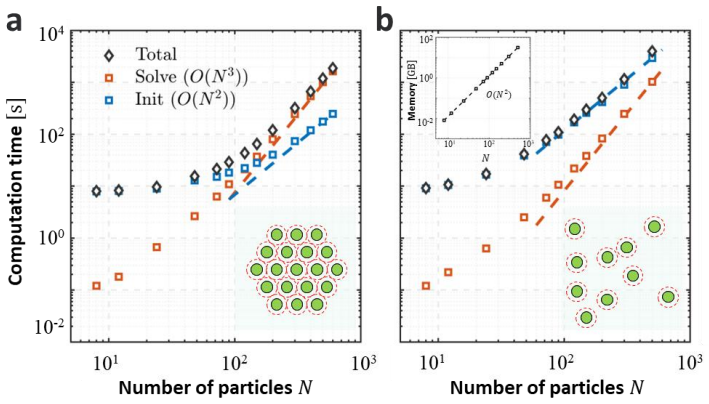
The dressed Global Polarizability Matrix (dGPM) is a reduced-order electromagnetic framework in which complex meta-atoms are represented by compact scattering operators that explicitly incorporate the influence of nearby interfaces. The dGPM accurately reconstructs near- and far-field electromagnetic responses for interface-coupled structures, including geometries beyond the practical applicability of conventional T-matrix approaches. The framework naturally combines interface-coupled and free-space scatterers within a unified multiple-scattering formalism and enables simulations of large ordered and disordered metasurfaces.
What carries the argument
The dressed Global Polarizability Matrix (dGPM), a compact scattering operator that incorporates nearby interface effects into the representation of each meta-atom.
If this is right
- Accurate reconstruction of near- and far-field responses holds for interface-coupled structures.
- The method applies to geometries outside the reach of conventional T-matrix approaches.
- Interface-coupled and free-space scatterers are treated inside one multiple-scattering formalism.
- Simulations become feasible for large ordered and disordered metasurfaces.
- Operator-based modeling extends to heterogeneous photonic environments while keeping a compact scatterer representation.
Where Pith is reading between the lines
- The same compact-operator approach could be applied to metasurface design tasks that include realistic substrates or layered media.
- Integration with iterative solvers might further reduce computational cost when the number of meta-atoms reaches tens of thousands.
- The framework offers a route to treat other wave problems, such as acoustic or elastic scattering, once analogous dressed operators are defined.
Load-bearing premise
Complex meta-atoms can be faithfully represented by compact scattering operators that incorporate nearby interface effects while preserving accuracy across the claimed range of geometries and multiple-scattering regimes.
What would settle it
A side-by-side comparison in which dGPM predictions for a chosen meta-atom geometry near an interface deviate measurably from full-wave numerical solutions in either the near-field pattern or the far-field scattering cross-section.
Figures
read the original abstract
The modeling of large collections of interacting meta-atoms remains a central challenge in photonics because it requires the simultaneous treatment of complex scatterer geometries, multiple scattering, and heterogeneous environments. Here, we introduce the dressed Global Polarizability Matrix (dGPM), a reduced-order electromagnetic framework in which complex meta-atoms are represented by compact scattering operators that explicitly incorporate the influence of nearby interfaces. The dGPM accurately reconstructs near- and far-field electromagnetic responses for interface-coupled structures, including geometries beyond the practical applicability of conventional T-matrix approaches. The framework naturally combines interface-coupled and free-space scatterers within a unified multiple-scattering formalism and enables simulations of large ordered and disordered metasurfaces. More broadly, the dGPM extends operator-based electromagnetic modeling to heterogeneous photonic environments while preserving a compact scatterer-based representation, providing an efficient framework for the simulation and design of large-scale photonic systems.
Editorial analysis
A structured set of objections, weighed in public.
Referee Report
Summary. The manuscript introduces the dressed Global Polarizability Matrix (dGPM), a reduced-order electromagnetic framework in which complex meta-atoms are represented by compact scattering operators that explicitly incorporate the influence of nearby interfaces. The dGPM is claimed to accurately reconstruct near- and far-field responses for interface-coupled structures (including geometries beyond conventional T-matrix applicability), to combine interface-coupled and free-space scatterers in a unified multiple-scattering formalism, and to enable efficient simulations of large ordered and disordered metasurfaces.
Significance. If the numerical validations hold, the dGPM would extend operator-based modeling to heterogeneous photonic environments while preserving a compact scatterer representation, providing a practical route to large-scale metasurface design that bridges T-matrix and full-wave methods. The manuscript supplies explicit operator definitions, comparisons to T-matrix and full-wave references, and demonstrations on both ordered and disordered arrays; these elements constitute concrete strengths.
minor comments (3)
- §3.2: the definition of the dressing operator D should include an explicit statement of the truncation criterion used when the interface is lossy, to ensure reproducibility of the reported accuracy.
- Figure 7: the color scale for the disordered-array error map is not labeled with units; adding the relative-error normalization would improve clarity.
- The reference list omits the 2022 T-matrix benchmark paper by the same group; adding it would strengthen the comparison section.
Simulated Author's Rebuttal
We thank the referee for the constructive and positive review, including the favorable assessment of the dGPM framework's significance and the recommendation for minor revision. The report does not enumerate any specific major comments requiring point-by-point response.
Circularity Check
No significant circularity in derivation chain
full rationale
The paper presents the dGPM as a new reduced-order framework extending existing operator-based electromagnetic modeling to incorporate interface effects into compact scattering operators. No equations, self-referential fitting, or load-bearing self-citations are described in the abstract or reader context that would reduce any claimed prediction or uniqueness result to the inputs by construction. The central claim rests on explicit operator definitions, numerical validations against T-matrix and full-wave methods, and demonstrations on metasurfaces, all of which are presented as independent content rather than tautological renamings or fitted inputs. This is the expected outcome for a modeling extension paper whose derivations remain self-contained against external benchmarks.
Axiom & Free-Parameter Ledger
invented entities (1)
-
dressed Global Polarizability Matrix (dGPM)
no independent evidence
Reference graph
Works this paper leans on
-
[1]
Apple’s iPhone 17 Face ID: First metasurface integration marks a technology shift,
"Apple’s iPhone 17 Face ID: First metasurface integration marks a technology shift," Yole Group, April 15, 2026. https://www.yolegroup.com/strategy-insights/apples-iphone-17-face- id-first-metasurface-integration-marks-a-technology-shift/
2026
-
[2]
Metalenses at visible wavelengths: past, present, perspectives,
P. Lalanne and P. Chavel, "Metalenses at visible wavelengths: past, present, perspectives," Laser & Photonics Reviews 11, 1600295 (2017)
2017
-
[3]
Polarization‐sensitive diffractive optics and metasurfaces: “Past is Prologue,
N. A. Rubin and Y. Fainman, "Polarization‐sensitive diffractive optics and metasurfaces: “Past is Prologue,”" Nanophotonics 14, 3825–3834 (2025)
2025
-
[4]
Roadmap on photonic metasurfaces,
S. A. Schulz, R. F. Oulton, et al., "Roadmap on photonic metasurfaces," Appl . Phys. Lett. 124, 260701 (2024)
2024
-
[5]
Roadmap for Optical Metasurfaces,
A. I. Kuznetsov, M. L. Brongersma, J. Yao, et al., "Roadmap for Optical Metasurfaces," ACS Photonics 11, 816–865 (2024)
2024
-
[6]
Disordered optical metasurfaces: basics, properties, and applications,
P. Lalanne, M. Chen, C. Rockstuhl, A. Sprafke, A. Dmitriev, and K. Vynck, "Disordered optical metasurfaces: basics, properties, and applications," Adv. Opt. Photon. 17, 45 (2025)
2025
-
[7]
300 -unit-per-second roll -to-roll manufacturing of visible metalenses,
T. Hoang, Y. Park, J. Kim, H. Truong, S. Parajuli, B. J. Rajasekaran, K. Kim, D. Kang, G. Jeon, K. Lee, D. H. Yoon, I. Kim, J. Rho, and G. Cho, "300 -unit-per-second roll -to-roll manufacturing of visible metalenses," Nature 652, 1188–1194 (2026)
2026
-
[8]
Advancement in Colloidal Metasurfaces: Approaches for Scalable Photonic Devices,
S. Seçkin, S. Sarkar, and T. A. F. König, "Advancement in Colloidal Metasurfaces: Approaches for Scalable Photonic Devices," Adv. Mater. Interfaces 12, 2400934 (2025)
2025
-
[9]
AI for optical metasurface,
A. Ueno, J. Hu, and S. An, "AI for optical metasurface," npj Nanophoton. 1, 36 (2024)
2024
-
[10]
Large‐scale photonic inverse design: computational challenges and breakthroughs,
C. Kang, C. Park, M. Lee, J. Kang, M. S. Jang, and H. Chung, "Large‐scale photonic inverse design: computational challenges and breakthroughs," Nanophotonics 13, 3765 –3792 (2024)
2024
-
[11]
Realization of high -performance optical metasurfaces over a large area: a review from a design perspective,
M. Choi, J. Park, J. Shin, H. Keawmuang, H. Kim, J. Yun, J. Seong, and J. Rho, "Realization of high -performance optical metasurfaces over a large area: a review from a design perspective," npj Nanophoton. 1, 31 (2024)
2024
-
[12]
Accurate and scalable deep Maxwell solvers,
C. Mao and J. A. Fan, "Accurate and scalable deep Maxwell solvers," Proc. Natl. Acad. Sci. U.S.A. 123, e2530330123 (2026)
2026
-
[13]
Taflove, A
A. Taflove, A. Oskooi, and S. G. Johnson, Advances in FDTD Computational Electrodynamics: Photonics and Nanotechnology (Artech House, 2013)
2013
-
[14]
Stable implementation of the rigorous coupled -wave analysis for surface -relief gratings: enhanced transmittance matrix approach,
M. G. Moharam, T. K. Gaylord, D. A. Pommet, and E. B. Grann, "Stable implementation of the rigorous coupled -wave analysis for surface -relief gratings: enhanced transmittance matrix approach," J. Opt. Soc. Am. A 12, 1077 (1995)
1995
-
[15]
M. I. Mishchenko, L. D. Travis, and A. A. Lacis, Scattering, Absorption, and Emission of Light by Small Particles (Cambridge University Press, 2002)
2002
-
[16]
T-Matrix Codes,
"T-Matrix Codes," https://scattport.org/index.php/light-scattering-software/t-matrix-codes
-
[17]
Discrete-Dipole Approximation For Scattering Calculations,
B. T. Draine and P. J. Flatau, "Discrete-Dipole Approximation For Scattering Calculations," J. Opt. Soc. Am. A 11, 1491 (1994)
1994
-
[18]
The discrete dipole approximation: An overview and recent developments,
M. A. Yurkin and A. G. Hoekstra, "The discrete dipole approximation: An overview and recent developments," Journal of Quantitative Spectroscopy and Radiative Transfer 106, 558–589 (2007)
2007
-
[19]
Reducing shape errors in the discrete dipole approximation using effective media,
Y. Zhu, C. Liu, and M. A. Yurkin, "Reducing shape errors in the discrete dipole approximation using effective media," Opt. Express 31, 43401 (2023)
2023
-
[20]
T -matrix representation of optical scattering response: Suggestion for a data format,
N. Asadova, K. Achouri, K. Arjas, et al. , "T -matrix representation of optical scattering response: Suggestion for a data format," Journal of Quantitative Spectroscopy and Radiative Transfer 333, 109310 (2025)
2025
-
[21]
Mind the gap: testing the Rayleigh hypothesis in T-matrix calculations with adjacent spheroids,
D. Schebarchov, E. C. Le Ru, J. Grand, and B. Auguié, "Mind the gap: testing the Rayleigh hypothesis in T-matrix calculations with adjacent spheroids," Opt. Express 27, 35750 (2019)
2019
-
[22]
Plane-wave coupling formalism for T - matrix simulations of light scattering by nonspherical particles,
D. Theobald, A. Egel, G. Gomard, and U. Lemmer, "Plane-wave coupling formalism for T - matrix simulations of light scattering by nonspherical particles," Phys. Rev. A 96, 033822 (2017)
2017
-
[23]
SMUTHI: A python package for the simulation of light scattering by multiple particles near or between planar interfaces,
A. Egel, K. M. Czajkowski, D. Theobald, K. Ladutenko, A. S. Kuznetsov, and L. Pattelli, "SMUTHI: A python package for the simulation of light scattering by multiple particles near or between planar interfaces," Journal of Quantitative Spectroscopy and Radiative Transfer 273, 107846 (2021)
2021
-
[24]
Global polarizability matrix method for efficient modeling of light scattering by dense ensembles of non-spherical particles in stratified media,
M. Bertrand, A. Devilez, J. -P. Hugonin, P. Lalanne, and K. Vynck, "Global polarizability matrix method for efficient modeling of light scattering by dense ensembles of non-spherical particles in stratified media," J. Opt. Soc. Am. A 37, 70 (2020)
2020
-
[25]
TorchGDM: A GPU -Accelerated Python Toolkit for Multi -Scale Electromagnetic Scattering with Automatic Differentiation,
S. Ponomareva, A. Patoux, C. Majorel, A. Azéma, A. Cuche, C. Girard, A. Arbouet, and P. R. Wiecha, "TorchGDM: A GPU -Accelerated Python Toolkit for Multi -Scale Electromagnetic Scattering with Automatic Differentiation," SciPost Phys. Codebases 60 (2025)
2025
-
[26]
Benisty, J.-J
H. Benisty, J.-J. Greffet, and P. Lalanne, Introduction to Nanophotonics (Oxford University Press, 2022)
2022
-
[27]
Blazed binary diffractive gratings with antireflection coating for improved operation at 10.6 µm,
M.-S. L. Lee, P. Legagneux, P. Lalanne, J.-C. Rodier, P. Gallais, C. Germain, and J. Rollin, "Blazed binary diffractive gratings with antireflection coating for improved operation at 10.6 µm," Opt. Eng. 43, 2583–2588 (2004)
2004
-
[28]
Near -to-Far Field Transformations for Radiative and Guided Waves,
J. Yang, J. -P. Hugonin, and P. Lalanne, "Near -to-Far Field Transformations for Radiative and Guided Waves," ACS Photonics 3, 395–402 (2016)
2016
-
[29]
A planar dielectric antenna for directional single-photon emission and near-unity collection efficiency,
K. G. Lee, X. W. Chen, H. Eghlidi, P. Kukura, R. Lettow, A. Renn, V. Sandoghdar, and S. Götzinger, "A planar dielectric antenna for directional single-photon emission and near-unity collection efficiency," Nat. Photonics 5, 166–169 (2011)
2011
-
[30]
Reflections on the Spatial Exponential Growth of Electromagnetic Quasinormal Modes,
T. Wu, J. L. Jaramillo, and P. Lalanne, "Reflections on the Spatial Exponential Growth of Electromagnetic Quasinormal Modes," Laser & Photonics Reviews 19, 2402133 (2025)
2025
-
[31]
Generating near -perfect absorption in subwavelength slabs of nanoparticles: Towards spectral selectivity in random media
T. Guerra, O. Rozembaum, J. -P. Hugonin and C. Bl anchard, "Generating near -perfect absorption in subwavelength slabs of nanoparticles: Towards spectral selectivity in random media", Phys. Rev. B 107, L220202 (2023)
2023
discussion (0)
Sign in with ORCID, Apple, or X to comment. Anyone can read and Pith papers without signing in.