Mirror Symmetry and Double Signature Change
Pith reviewed 2026-06-26 13:16 UTC · model grok-4.3
The pith
The black mirror spacetime contains no surface layer at the horizon.
A machine-rendered reading of the paper's core claim, the machinery that carries it, and where it could break.
Core claim
Using techniques adapted from previous work on signature change, the black mirror spacetime is reexamined as a model of double signature change. The investigation confirms that there is no surface layer at the horizon, that is, no distributional curvature singularity corresponding to an impulsive gravitational wave. The result is compared with previous claims that the curvature components are analytic. The global structure connects the two exterior regions directly, and worldlines and curves can pass through the junction.
What carries the argument
Black mirror spacetime modeled as double signature change, analyzed with adapted signature change techniques to detect any distributional curvature effects at the horizon.
If this is right
- No impulsive gravitational wave is generated at the horizon.
- Worldlines and curves traverse the junction without encountering a curvature singularity.
- The two exterior regions connect directly with no intervening interior region.
- Curvature components remain consistent with analytic behavior through the horizon.
Where Pith is reading between the lines
- The same adapted methods could be applied to other signature-changing constructions to check for overlooked distributional layers.
- Mirror-symmetric junctions of this type may preserve regularity more generally than expected in signature change models.
Load-bearing premise
Techniques from prior signature change studies apply directly to the black mirror spacetime without introducing or missing extra distributional effects at the horizon.
What would settle it
Detection of a nonzero jump or delta-function term in the curvature tensor or its derivatives across the horizon would show a surface layer is present.
Figures


read the original abstract
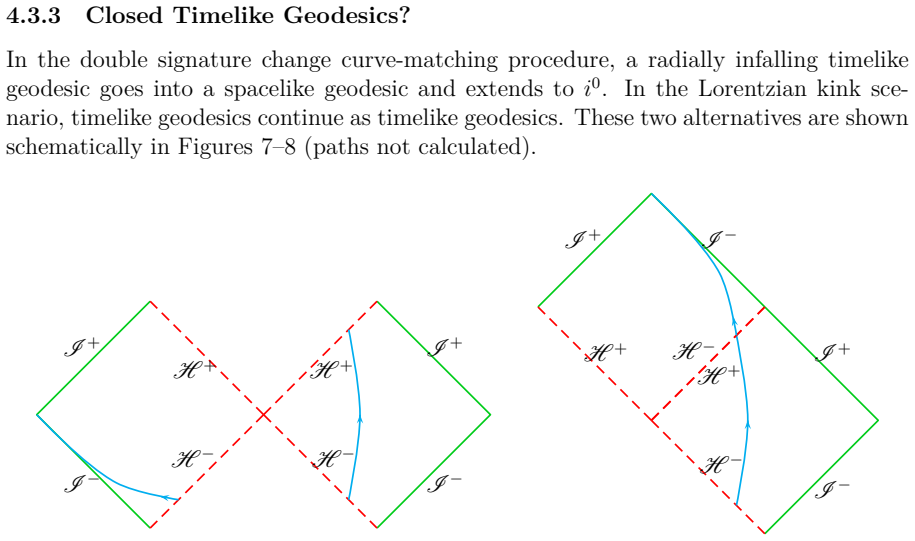
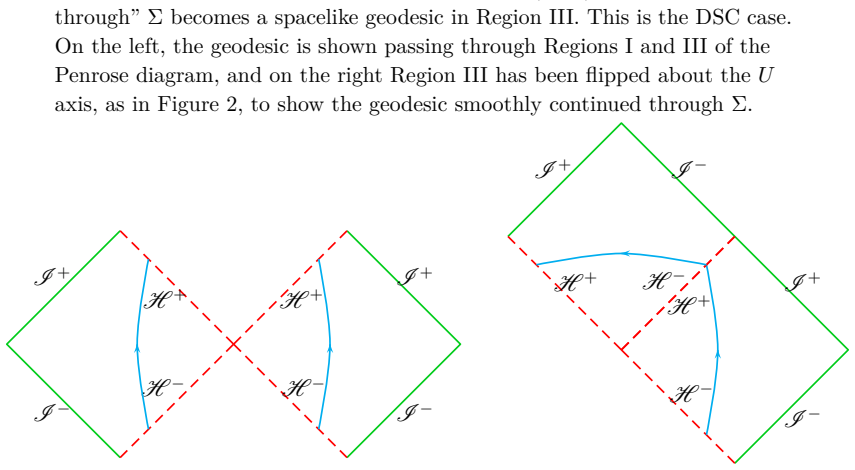
The black mirror spacetime proposed by Tzanavaris, Boyle, and Turok [1] connects the two exterior regions of the extended Schwarzschild black hole directly to each other, with no intervening interior region. Using techniques adapted from previous work on signature change, we reexamine the black mirror spacetime as a model of double signature change, and investigate whether there is a surface layer at the horizon, that is, a distributional curvature singularity corresponding to an impulsive gravitational wave. We confirm that the black mirror spacetime does not contain any such singularity, and compare our result with previous claims that the curvature components are analytic. We also discuss the global structure of the black mirror spacetime, and examine what happens to worldlines and curves passing through.
Editorial analysis
A structured set of objections, weighed in public.
Referee Report
Summary. The manuscript adapts techniques from prior signature-change literature to the black mirror spacetime of Tzanavaris, Boyle, and Turok, which directly joins two exterior Schwarzschild regions. It claims to confirm the absence of any surface layer (distributional curvature singularity corresponding to an impulsive gravitational wave) at the horizon, compares the result to prior claims of analytic curvature components, and examines the global structure together with the behavior of worldlines and curves crossing the horizon.
Significance. If the central claim holds, the work strengthens the case that the black mirror construction is free of distributional singularities at the horizon and supplies a consistent double-signature-change model. The explicit comparison with analytic-curvature results and the discussion of global causal structure provide concrete additions to the literature on horizon matching in Schwarzschild extensions.
major comments (1)
- [Curvature calculation / junction analysis (near the horizon)] The central claim that no distributional curvature singularity exists at the horizon rests on the adapted signature-change techniques correctly capturing all possible delta-function contributions. Because the black mirror glues two exterior regions directly (without an interior) and employs a double signature flip, the paper must demonstrate explicitly that the junction conditions or curvature calculations account for any additional terms that may arise from this geometry and are absent in standard signature-change examples.
minor comments (1)
- [Abstract / Introduction] The abstract and introduction should state more precisely which prior signature-change results are being adapted and which coordinate identifications are used for the black-mirror gluing.
Simulated Author's Rebuttal
We thank the referee for their careful reading of the manuscript and for highlighting the need for explicit verification of the junction conditions in this geometry. We address the major comment below and have revised the manuscript accordingly.
read point-by-point responses
-
Referee: [Curvature calculation / junction analysis (near the horizon)] The central claim that no distributional curvature singularity exists at the horizon rests on the adapted signature-change techniques correctly capturing all possible delta-function contributions. Because the black mirror glues two exterior regions directly (without an interior) and employs a double signature flip, the paper must demonstrate explicitly that the junction conditions or curvature calculations account for any additional terms that may arise from this geometry and are absent in standard signature-change examples.
Authors: We agree that the double signature flip and direct gluing of two exterior regions require explicit confirmation that no additional distributional terms arise. The adapted signature-change formalism used in the manuscript is coordinate-independent and applies directly to this case, as the metric is C^0 but not C^1 across the horizon with the signature change implemented symmetrically. In the revised manuscript we have added an explicit calculation (new subsection in Section 3) of the distributional curvature, confirming that the only possible delta-function contributions are those already ruled out by the standard junction conditions; the double flip introduces no extra terms because the normal vectors and extrinsic curvatures match symmetrically on both sides. This is now shown by direct computation of the jump in the second fundamental form, which vanishes. revision: yes
Circularity Check
No significant circularity; derivation relies on adapted external techniques
full rationale
The paper adapts techniques from prior signature-change literature to check for distributional curvature at the horizon in the black mirror construction. The central claim (absence of surface layer) is presented as a confirmation via direct curvature computation rather than a redefinition or fit to the input data. No equations reduce the result to a self-citation chain or to a parameter fitted from the target quantity itself. The work compares against independent prior claims about analytic curvature components, keeping the argument self-contained against external benchmarks.
Axiom & Free-Parameter Ledger
Reference graph
Works this paper leans on
- [1]
-
[2]
Karl Schwarzschild, Über das Gravitationsfeld eines Massenpunktes nach der Ein- steinschen Theorie, Sitzungsberichte der Königlich Preussischen Akademie der Wis- senschaften 7, 189–196 (1916)
1916
-
[3]
Jørg Tofte Jebsen, Über die allgemeinen kugelsymmetrischen Lösungen der Ein- steinschen Gravitationsgleichungen im Vakuum , Arkiv för Matematik, Astronomi och Fysik 15, 1–9 (1921). 24
1921
-
[4]
George David Birkhoff, Relativity and Modern Physics , Harvard University Press, Cambridge, MA, 1923
1923
-
[5]
Johannes Droste, The field of a single centre in Einstein ’s theory of gravitation and the motion of a particle in that field , Koninklijke Nederlandsche Akademie van Wetenschappen Proceedings 19, 197–215 (1917)
1917
-
[6]
Arthur Eddington, The Mathematical Theory of Relativity , 2nd ed., Cam- bridge University Press, 1924, p. 93
1924
-
[7]
George Szekeres, On the singularities of a Riemannian manifold , Publicationes Math- ematicae Debrecen 7, 285 (1960)
1960
-
[8]
Martin Kruskal, Maximal extension of Schwarzschild metric , Physical Review 119, 1743–1745 (1960)
1960
-
[9]
Penrose Conformal Treatment of Infinity , in Relativity, Groups and Topol- ogy, Ed
R. Penrose Conformal Treatment of Infinity , in Relativity, Groups and Topol- ogy, Ed. C.M. de Witt and B. de Witt, Les Houches Summer School (1963)
1963
-
[10]
Hawking and G.F.R
S. Hawking and G.F.R. Ellis, The Large Scale Structure of Space-Time , Cam- bridge University Press, Cambridge (1973), p 155
1973
-
[11]
Wald, General Relativity , University of Chicago Press (1984), p 153
R.M. Wald, General Relativity , University of Chicago Press (1984), p 153
1984
-
[12]
P. C. Aichelburg and R. U. Sexl, On the gravitational field of a massless particle , Gen. Rel. Grav. 2, 303–312 (1971)
1971
-
[13]
Tevian Dray and Gerard ’t Hooft, Shock Wave of a Massless Particle , Nucl. Phys. B253, 173–188 (1985)
1985
-
[14]
Tevian Dray and Gerard ’t Hooft, The Effect of Spherical Shells of Matter on the Schwarzschild Black Hole , Commun. Math. Phys. 99, 613–625 (1985)
1985
-
[15]
Quantum Grav
Tevian Dray and Gerard ’t Hooft, The Gravitational Effect of Colliding Planar Shells of Matter , Class. Quantum Grav. 3, 825–840 (1986)
1986
-
[16]
Georges Darmois, Les équations de la gravitation einsteinienne , Mémorial des sciences mathématiques, fascicule 25, Gauthier-Villars et Cie, Paris (1927), Chapitre V
1927
-
[17]
Israel, Singular Hypersurfaces and Thin Shells in General Relativity , Il Nuov
W. Israel, Singular Hypersurfaces and Thin Shells in General Relativity , Il Nuov. Cim. 44B, 1, 1–14 (1966); corrections in Il Nuov. Cim. 48B, 463 (1966)
1966
-
[18]
Lichnerowicz, Théories Relativistes de la Gravitation et de l’Élec- tromagnétisme, Masson, Paris (1955), Chap III
A. Lichnerowicz, Théories Relativistes de la Gravitation et de l’Élec- tromagnétisme, Masson, Paris (1955), Chap III
1955
-
[19]
Georg Dautcourt, Über Flächenbelegungen in der allgemeinen Relativitätstheorie , Math. Nachr. 27, 277–288 (1964)
1964
-
[20]
Penrose, The geometry of impulsive gravitational waves , in: General Relativity: Papers in Honour of J L Synge , ed
R. Penrose, The geometry of impulsive gravitational waves , in: General Relativity: Papers in Honour of J L Synge , ed. L O’Raifeartaigh, Clarendon, Oxford (1972), p. 101. 25
1972
-
[21]
A. H. Taub, General Relativistic Shock Waves in Fluids for which Pressure Equals Energy Density, Commun. Math. Phys. 29, 79–88 (1973)
1973
-
[22]
Quantum Grav
C J S Clarke and Tevian Dray, Junction conditions for null hypersurfaces , Class. Quantum Grav. 4, 265–275 (1987)
1987
-
[23]
Manogue, and Robin W
Tevian Dray, Corinne A. Manogue, and Robin W. Tucker, Particle Production from Signature Change, Gen. Rel. Grav. 23, 967–971 (1991)
1991
-
[24]
Manogue, and Robin W
Tevian Dray, Corinne A. Manogue, and Robin W. Tucker, The Scalar Field Equation in the Presence of Signature Change , Phys. Rev. D48, 2587–2590 (1993)
1993
-
[25]
Ellis, A
G.F.R. Ellis, A. Sumeruk, D. Coule and C. Hellaby, Change of Signature in Classical Relativity, Class. Quantum Grav. 9, 1535–1554 (1992)
1992
-
[26]
Ellis, Covariant Change of Signature in Classical Relativity , Gen
G.F.R. Ellis, Covariant Change of Signature in Classical Relativity , Gen. Rel. Grav. 24, 10, 1047–1068 (1992)
1992
-
[27]
Hellaby and T
C. Hellaby and T. Dray, Failure of Standard Conservation Laws at a Classical Change of Signature , Phys. Rev. D 49, 5096–5104 (1994)
1994
-
[28]
Dray and C
T. Dray and C. Hellaby, Reply Comment: Comparison of Approaches to Classical Signature Change Phys. Rev. D 52, 7333–7339 (1995)
1995
-
[29]
Dray and C
T. Dray and C. Hellaby Comment on ‘Smooth and Discontinuous Signature Type Change in General Relativity’ , Gen. Rel. Grav. 28, 1401–1408 (1996)
1996
-
[30]
Dray and C
T. Dray and C. Hellaby, The Patchwork Divergence Theorem , J. Math. Phys. 35, 5922–5929 (1994)
1994
-
[31]
Dray, G.F.R
T. Dray, G.F.R. Ellis, C. Hellaby and C.A. Manogue, Gravity and Signature Change , Gen. Rel. Grav. 29, 591–597 (1997)
1997
-
[32]
Tevian Dray, Einstein ’s equations in the presence of signature change, J. Math. Phys. 37, 5627–5636 (1996)
1996
-
[33]
Hellaby, A
C. Hellaby, A. Sumeruk and G.F.R. Ellis, Classical Signature Change in the Black Hole Topology, Internat. J. Mod. Phys. D 6, 211–238 (1997). 26
1997
discussion (0)
Sign in with ORCID, Apple, or X to comment. Anyone can read and Pith papers without signing in.