REVIEW 3 major objections 2 minor 20 references
Towards Pedagogically Aligned LLM Tutors for Math Mistake Remediation
T0 review · 3 major / 2 minor · reviewed 2026-06-26 · grok-4.3
Pith's one-line read A two-stage alignment pipeline produces open LLM tutors that match proprietary systems on math mistake remediation.
desk verdict The paper applies SFT then DPO to synthetic pedagogical data for open LLMs in math mistake remediation and reports gains over baselines plus competitiveness with a proprietary model, but the evaluation details are thin. read the letter →
The pith
A machine-rendered reading of the paper's core claim, the machinery that carries it, and where it could break.
The reading
What carries the argument
Two-stage alignment pipeline: supervised fine-tuning on tutoring dialogs followed by Direct Preference Optimization on synthetic preference pairs constructed along dimensions of scaffolding and factuality.
What would settle it
A randomized study that measures actual student learning gains on new math problems when tutored by the aligned open model versus a base model or the proprietary baseline.
Extended reading notes
Core claim
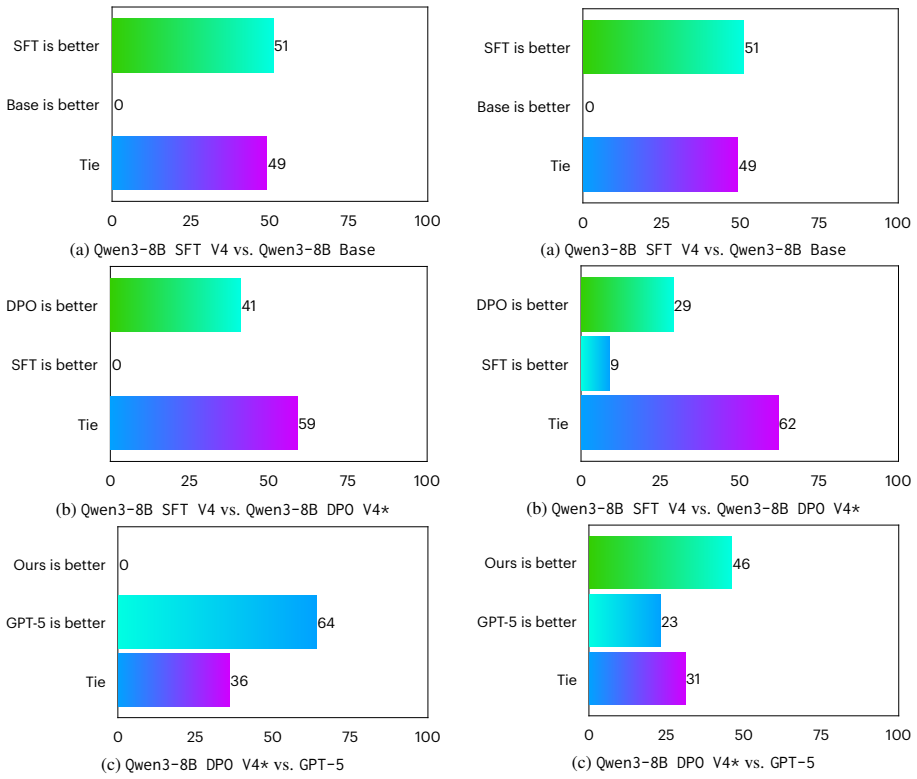
Combining supervised fine-tuning on tutoring dialogs with Direct Preference Optimization on synthetic preference pairs generated along pedagogical dimensions such as scaffolding and factuality produces models that improve factual accuracy and pedagogical quality over base models and existing tutoring systems, reaching human-evaluated parity with a strong proprietary baseline while providing openness, transparency, and reproducibility.
Load-bearing premise
Synthetic preference pairs generated along scaffolding and factuality, together with the human judgments used to validate them, accurately capture tutoring behaviors that generalize to real students.
Editorial extensions
If this is right
- Open models can serve as drop-in replacements for closed tutoring systems in intelligent tutoring applications.
- Input configurations that include solution correctness and gold answers further boost the quality of generated guidance.
- Preference optimization along explicit pedagogical axes reliably improves both factuality and scaffolding behavior.
- Human evaluation remains necessary because automatic metrics alone do not fully capture tutoring effectiveness.
- The resulting models offer additional benefits of openness and reproducibility for educational deployment.
Reading between the lines
- The same pipeline could be applied to tutoring domains outside mathematics by generating analogous synthetic pairs.
- Long-term classroom trials would be needed to confirm whether the measured quality gains translate into measurable student progress over weeks.
- Because the models are open, external researchers can audit them for unintended biases in the scaffolding style they adopt.
- Combining the aligned tutor with live student interaction logs could create a feedback loop that further refines the preference data.
Signed reviews
Editorial analysis
A structured set of objections, weighed in public.
Referee Report
Summary. The manuscript proposes a two-stage alignment pipeline (SFT on tutoring dialogs followed by DPO on synthetic preference pairs) for math mistake remediation in LLMs. Synthetic pairs are generated along pedagogical axes such as scaffolding and factuality, integrated with existing corpora, and tested under varying input configurations that include solution correctness and gold answers. The central claim is that this yields improvements in factual accuracy and pedagogical quality over base models and prior tutoring systems, with the best open model competitive to a strong proprietary baseline in human evaluation while offering transparency benefits.
Significance. If the results are robust, the work would meaningfully advance open, pedagogically aligned tutoring systems by showing that preference optimization can target specific teaching strategies. It supplies a reproducible alternative to closed models and surfaces evaluation challenges in tutoring quality. Credit is due for the explicit study of input configurations and the integration of real and synthetic data.
major comments (3)
- [§4] §4 (Experiments and Input Configurations): The inclusion of gold-answer leakage in some training configurations is load-bearing for the factuality claims; without a dedicated zero-knowledge ablation (where the model has no access to correct solutions during training or inference), reported gains in factual accuracy may not generalize to realistic remediation settings where the tutor must discover errors without oracle information.
- [§3.2] §3.2 (Synthetic Preference Pair Construction): The preference data generation along scaffolding/factuality axes lacks reported controls for distribution shift between synthetic mistakes and real student errors; this directly undermines the generalization claim that human judgments on the test set reflect effective tutoring behavior beyond the synthetic distribution.
- [Human Evaluation] Human Evaluation subsection: The competitiveness result with the proprietary baseline rests on human judgments, yet no details are supplied on test-set size, inter-annotator agreement, statistical significance, or whether evaluators were blinded to model identity; these omissions make the headline comparison difficult to interpret.
minor comments (2)
- [Abstract] The abstract reports only directional improvements without any quantitative metrics, baseline names, or sample sizes; adding these would strengthen the summary for readers.
- [§3] Notation for the pedagogical dimensions (scaffolding, factuality) is introduced without a formal definition or example preference pair; a table of sample pairs would improve clarity.
Simulated Author's Rebuttal
We thank the referee for the constructive feedback. We address each major comment below, proposing revisions to strengthen the manuscript where the points identify gaps in reporting or analysis.
read point-by-point responses
-
Referee: [§4] §4 (Experiments and Input Configurations): The inclusion of gold-answer leakage in some training configurations is load-bearing for the factuality claims; without a dedicated zero-knowledge ablation (where the model has no access to correct solutions during training or inference), reported gains in factual accuracy may not generalize to realistic remediation settings where the tutor must discover errors without oracle information.
Authors: Our experiments explicitly compare multiple input configurations, including those that withhold gold answers and solution correctness. Improvements in factual accuracy are observed even in the no-gold configurations. To make this explicit and address the concern about generalization, we will add a dedicated zero-knowledge ablation subsection with corresponding results in the revised version. revision: yes
-
Referee: [§3.2] §3.2 (Synthetic Preference Pair Construction): The preference data generation along scaffolding/factuality axes lacks reported controls for distribution shift between synthetic mistakes and real student errors; this directly undermines the generalization claim that human judgments on the test set reflect effective tutoring behavior beyond the synthetic distribution.
Authors: Synthetic mistakes were constructed to align with error patterns from the real tutoring corpora we integrate. We agree that explicit controls would better support generalization claims. We will add an analysis quantifying overlap in error types and distributions between synthetic and real data in the revised manuscript. revision: yes
-
Referee: [Human Evaluation] Human Evaluation subsection: The competitiveness result with the proprietary baseline rests on human judgments, yet no details are supplied on test-set size, inter-annotator agreement, statistical significance, or whether evaluators were blinded to model identity; these omissions make the headline comparison difficult to interpret.
Authors: We acknowledge these reporting omissions. The human evaluation used a test set of 150 examples, with inter-annotator agreement of 0.68 (Cohen's kappa), statistical significance via paired t-tests, and blinded evaluators. We will include these details, along with the evaluation protocol, in the revised manuscript. revision: yes
Circularity Check
Empirical alignment study with no derivation chain or self-referential inputs
full rationale
The paper presents an empirical pipeline: dataset construction from existing corpora plus synthetic pairs along scaffolding/factuality axes, followed by SFT then DPO, with evaluation against base models, prior tutoring systems, and a proprietary baseline. No equations, mathematical derivations, fitted parameters renamed as predictions, or uniqueness theorems appear. Claims rest on external comparisons and human judgments rather than any internal reduction to the paper's own inputs or self-citations. This matches the default case of a non-circular empirical ML paper.
Assumptions & free parameters
Cite this review
Pith. "Pith review of Towards Pedagogically Aligned LLM Tutors for Math Mistake Remediation." pith.science (2026). https://pith.science/paper/IBOLQAH5
@misc{pith2026260621502,
  author       = {Pith},
  title        = {Pith review of: Towards Pedagogically Aligned LLM Tutors for Math Mistake Remediation},
  year         = {2026},
  howpublished = {\url{https://pith.science/paper/IBOLQAH5}},
  note         = {Machine review of arXiv:2606.21502}
}
read the original abstract
Large language models have strong potential for use in intelligent tutoring systems, but they often fail to follow effective pedagogical strategies, such as guiding students without revealing final answers. We study the application of a two-stage alignment pipeline for math mistake remediation, combining supervised fine-tuning on tutoring dialogs with Direct Preference Optimization on synthetic preference pairs. We construct a dataset that integrates existing tutoring corpora with synthetic data generated along pedagogical dimensions, such as scaffolding and factuality, and study different input configurations that incorporate solution correctness and gold answers. Experiments show that this approach improves both factual accuracy and pedagogical quality over base models and existing tutoring models. Human evaluation further indicates that our best model is competitive with a strong proprietary baseline, while providing additional benefits in terms of openness, transparency, and reproducibility. Our results highlight the effectiveness of preference-based pedagogical alignment, while also revealing challenges in reliably evaluating tutoring quality.
Figures


Figures from the paper (5 more)


Reference graph
Works this paper leans on
-
[1]
Kawin Ethayarajh, Winnie Xu, Niklas Muennighoff, Dan Jurafsky, and Douwe Kiela
From Problem-Solving to Teaching Problem- Solving: Aligning LLMs with Pedagogy using Rein- forcement Learning.Preprint, arXiv:2505.15607. Kawin Ethayarajh, Winnie Xu, Niklas Muennighoff, Dan Jurafsky, and Douwe Kiela. 2024. KTO: Model Alignment as Prospect Theoretic Optimiza- tion.Preprint, arXiv:2402.01306. Scott Freeman, Sarah L Eddy, Miles McDonough, M...
-
[2]
InThe Twelfth Inter- national Conference on Learning Representations
Let’s verify step by step. InThe Twelfth Inter- national Conference on Learning Representations. Jiayu Liu, Zhenya Huang, Tong Xiao, Jing Sha, Jinze Wu, Qi Liu, Shijin Wang, and Enhong Chen. 2024a. SocraticLM: Exploring socratic personalized teach- ing with large language models.Advances in Neural Information Processing Systems, 37:85693–85721. Rongxin Li...
-
[3]
Sankalan Pal Chowdhury, Vilém Zouhar, and Mrinmaya Sachan
AutoTutor and family: A review of 17 years of natural language tutoring.International Journal of Artificial Intelligence in Education, 24:427–469. Sankalan Pal Chowdhury, Vilém Zouhar, and Mrinmaya Sachan. 2024. AutoTutor meets large language mod- els: A language model tutor with rich pedagogy and guardrails. InProceedings of the Eleventh ACM Con- ference...
2024
-
[4]
Direct preference optimization: Your language model is secretly a reward model.Advances in neural information processing systems, 36:53728–53741. Jiaming Shen, Ran Xu, Yennie Jun, Zhen Qin, Tianqi Liu, Carl Yang, Yi Liang, Simon Baumgartner, and Michael Bendersky. 2024. Boosting reward model with preference-conditional multi-aspect synthetic data generati...
-
[5]
Qwen3 technical report.arXiv preprint arXiv:2505.09388. Jingfeng Yang, Hongye Jin, Ruixiang Tang, Xiao- tian Han, Qizhang Feng, Haoming Jiang, Shaochen Zhong, Bing Yin, and Xia Hu. 2024. Harnessing the power of llms in practice: A survey on chatgpt and beyond.ACM Transactions on Knowledge Discovery from Data, 18(6):1–32. Zhongshen Zeng, Pengguang Chen, Sh...
work page Pith review arXiv 2024
-
[6]
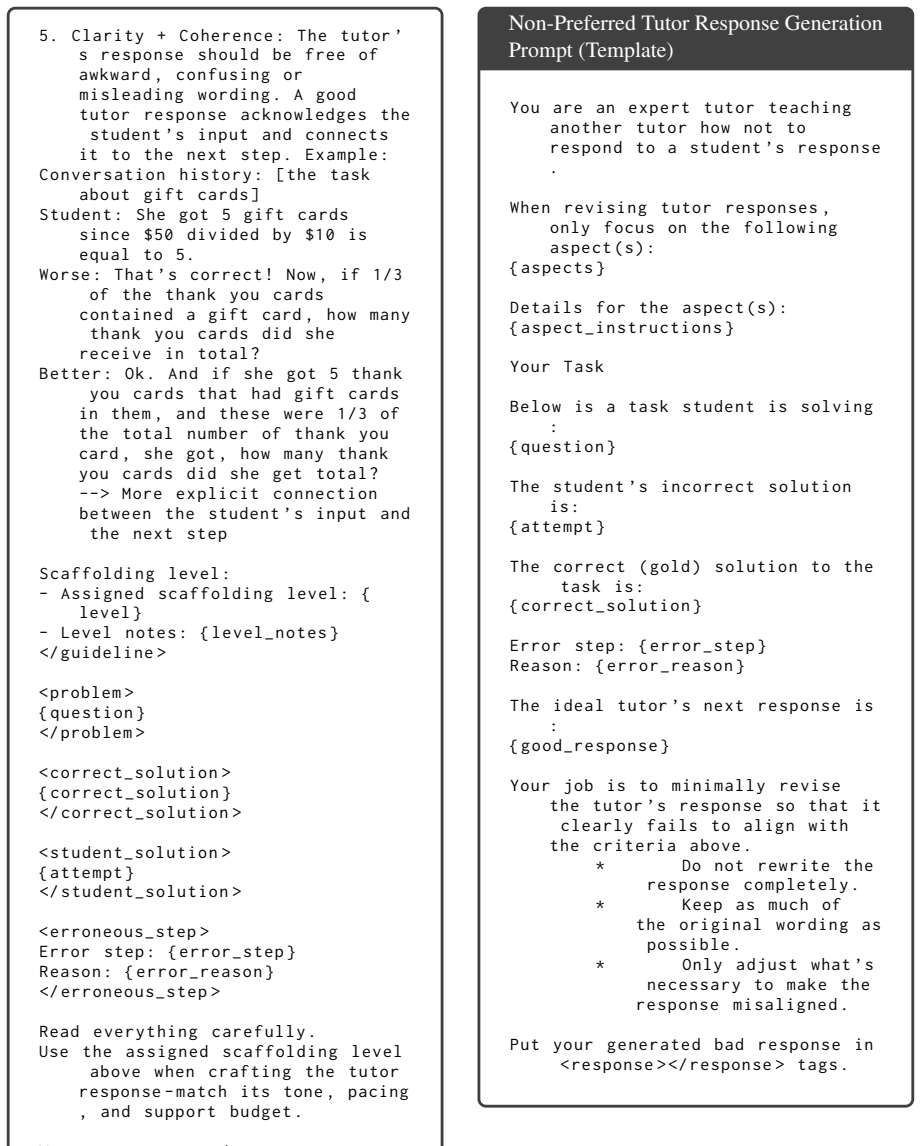
A detailed guideline describing evaluation aspects of a good tutor response
-
[7]
A math problem , the correct ( gold ) solution , the student ’ s solution , and the specific step where the mistake occurs
-
[8]
Your task is to produce a high - quality tutor response that helps the student progress meaningfully while adhering to the guideline AND the assigned level
A scaffolding level that has been selected for you . Your task is to produce a high - quality tutor response that helps the student progress meaningfully while adhering to the guideline AND the assigned level . </ task_description > < guideline > A good tutor response is evaluated along the following aspects :
Show all 20 references
-
[9]
Example : Conversation history : [ the task about gift cards ] Bad : If Ms
Factuality + Non - contradiction + No Nonsense : The response should be factually correct , should not contradict what the student has said , and should not contain irrelevant information . Example : Conversation history : [ the task about gift cards ] Bad : If Ms . Jones rece...
-
[10]
Nice try
Mistake Identification + Location : The response should identify , either explicitly or implicitly , that there is a mistake in the student ’ s solution . For example , saying " Nice try " would miss this aspect . Example : Conversation history : Student : yay Tutor : Next , w...
-
[11]
Targetedness : The response should address the core misconception / m isunderst anding of a student . Example : Conversation history : [ the task about eggs ] Worse : Ok , remember there are only 12 eggs to begin with --> doesn ’ t point to any misconception Better : It looks ...
-
[12]
Not revealing the final answer : While it is sometimes necessary and acceptable to share the answer to a substep , the tutor should avoid giving away the final answer . Example : Conversation history : [ the task about average speed ] Worse : You ’ re close , but let ’ s re - ...
-
[13]
A good tutor response acknowledges the student ’ s input and connects it to the next step
Clarity + Coherence : The tutor ’ s response should be free of awkward , confusing or misleading wording . A good tutor response acknowledges the student ’ s input and connects it to the next step . Example : Conversation history : [ the task about gift cards ] Student : She g...
-
[14]
# V1 - V4
The dialog history between the student and the tutor . # V1 - V4
-
[15]
# V2 , V4
A boolean flag indicating whether the student ’ s solution is mathematically correct . # V2 , V4
-
[16]
# V3 , V4 Guidelines for your response : - If the student ’ s solution is incorrect , guide the student toward the correct reasoning
A gold solution to the task . # V3 , V4 Guidelines for your response : - If the student ’ s solution is incorrect , guide the student toward the correct reasoning . - If the student ’ s solution is correct , clearly acknowledge correctness and optionally provide brief reinforc...
-
[17]
half as many [carrot sticks] + 2
Matt wants 5 cookies in [garbled text: 89] [garbled text: teacher] Let’s start over with the problem. We know Matt can have cookies based on the number [garbled text] (carrot sticks) he eats. Can you write an equation that represents this relationship? The rule is: the number ...
-
[18]
Max has 6children with 8children each
-
[19]
You correctly calculated that each of these 8-child families contributes6×7grandchildren
-
[20]
I subtracted one from that [number]
The other 2children each have 3children (since they don’t have 7 like the others). Now, let’s see if we can simplify or double-check any part of your calculation. Can you calculate the number [garbled text] grandchildren from the 6.children first without adding the 2.children ...
Reviewed June 26, 2026 · model on record in the stance chip above.
Discussion (0). Continue with ORCID to comment.