REVIEW 3 major objections 4 minor 74 references
Probing Light Particles With Optically Trapped Sensors Through Nucleon Scattering
T0 review · 3 major / 4 minor · reviewed 2026-08-09 · deepseek-v4-flash
Pith's one-line read This paper proposes that optically levitated SiO2 nanospheres, read out near the standard quantum limit, can act as low-threshold nuclear-recoil detectors, claiming a single 15-nanometer sphere could probe pseudoscalar and vector dark…
desk verdict The ALP and pseudoscalar-DM projections rest on an invalid spin-independent structure factor; the vector and Earth-bound channels may still be sound. read the letter →
The pith
A machine-rendered reading of the paper's core claim, the machinery that carries it, and where it could break.
The reading
What carries the argument
The load-bearing object is the structure factor $S(q)=\sum_i N_i Z_i^2 F_H^2(q r_{Ai}) + N_p^2 F_c^2(q)$, with $F_c(q)=3 j_1(r_{\rm sp}q)/(r_{\rm sp}q)$. It describes how the nanosphere responds to a momentum transfer $q$: at large $q$, individual nuclei scatter coherently and the Helm form factor $F_H$ suppresses high-$q$ response; at small $q$, the whole sphere is the scattering object and the second term gives an $N_p^2$ coherence enhancement. The other mechanism is the SQL momentum uncertainty $\sigma_{\rm SQL}=\sqrt{m_{\rm sp}\omega}$, which sets the slowest detectable recoil and therefore the low-mass cutoff for each sphere size.
What would settle it
Run a single 15 nm sphere with threshold $q_{\rm th}=1\sigma_{\rm SQL}$ for one year in a low-background environment; if the resulting null limit on pseudoscalar dark matter does not reach $g_{p\chi_s}=10^{-6}$ at $m_{\chi_s}=85$ eV, the central sensitivity claim would be ruled out. Equivalently, compute the full spin-dependent nuclear matrix element for the SiO2 isotopes, such as 29Si, and check whether the rate retains the $N_p^2$ scaling used in the paper.
Extended reading notes
Core claim
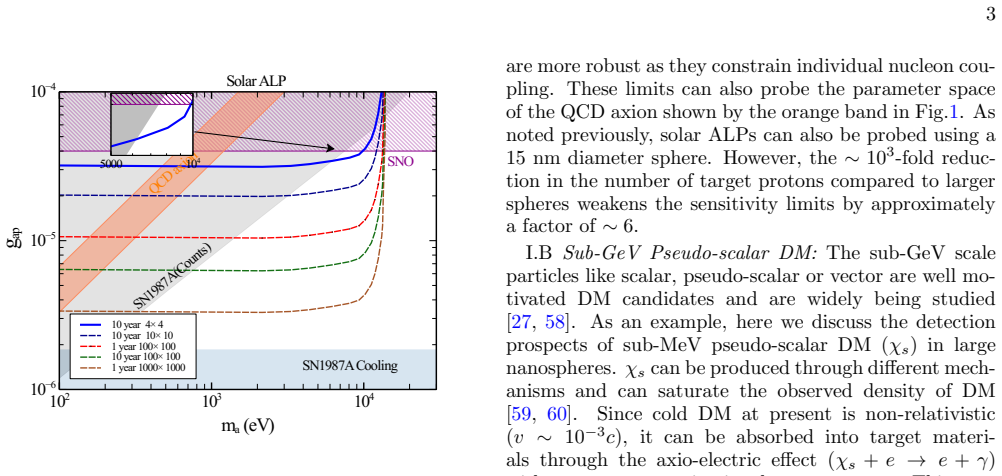
The central claim is that the momentum threshold of an optically trapped nanosphere, set by the standard quantum limit $\sigma_{\rm SQL}=\sqrt{m_{\rm sp}\omega}$, together with the target's structure factor $S(q)$, determines which dark-matter or ALP parameter space the detector can reach. For a 200 nm sphere the threshold is about 18 keV, so nuclear scattering with individual nuclei is sensitive to masses around 10 keV; a 4x4 array can already exceed the SNO and SN1987A-count bounds and probe $g_{ap}\sim 3\times10^{-5}$. For a 15 nm sphere the threshold is about 85 eV, and when the transferred momentum is below $2\pi/r_{\rm sp}$ the entire sphere recoils coherently, so the event rate scales as the square of the number of nucleons; a single such sphere can then reach pseudoscalar dark matter with $m\sim 85$ eV and $g_{p\chi_s}\sim 10^{-6}$ and vector dark matter with $g_{p\chi_V}\sim 10^{-10}$, and the same coherence gives sensitivity to Earth-bound dark matter with fractional abundance $10^{-10}$ and cross-sections near $10^{-23}\,\mathrm{cm}^2$.
Load-bearing premise
The entire rate calculation for pseudoscalar ALPs and pseudoscalar dark matter assumes that the nuclear response is a coherent sum over protons squared, $Z^2$ or $N_p^2$, when in reality the axial coupling is spin-dependent and may not receive this coherent enhancement.
Editorial extensions
If this is right
- A 4x4 array of 200 nm spheres, a configuration already demonstrated, would start excluding solar-ALP nucleon couplings near $3\times10^{-5}$ for masses below about 10 keV, an unconstrained region.
- A single 15 nm sphere could probe pseudoscalar dark matter at masses down to ~85 eV and couplings down to ~$10^{-6}$; a 10x10 array of such spheres would go beyond SNO and SN1987A-count exclusion.
- Sub-keV vector dark matter with nucleon coupling $g_{p\chi_V}\sim 10^{-10}$ at masses near 85 eV could be reached, providing a direct nuclear-scattering constraint where only loop-induced electron-recoil and astrophysical bounds exist.
- Earth-bound strongly interacting dark matter with $f_\chi=10^{-10}$ and $\sigma_{\chi n}\sim 10^{-23}\,\mathrm{cm}^2$ would become detectable in a 15 nm sphere within a year, stronger than Lyman-alpha and Dewar-heating limits.
- Scaling to 100x100 or 1000x1000 arrays would push couplings toward $10^{-6}$ (pseudoscalar) and $10^{-10}$ (vector) even at sub-keV masses.
Reading between the lines
- The same small-sphere coherence argument could be applied to other monoenergetic solar nuclear lines, such as the 478 keV line from lithium-7, extending the mass reach beyond 85 eV at the cost of a higher effective threshold.
- If sub-SQL momentum readouts become available, the 15 nm sphere's threshold would drop below 85 eV, pushing the pseudoscalar and vector dark matter reach below 50 eV and possibly probing the QCD-axion band at low mass.
- An intermediate sphere, roughly 100 nm in diameter, would naturally fill the $q\sim 1$ keV gap between the large- and small-sphere regimes, as the paper itself notes; a graded array could map the recoil spectrum continuously from 0.1 to 100 keV.
- For Earth-bound dark matter, the density profile peaks toward Earth's core, so a levitated sensor placed far from the surface would sample a different column density and could distinguish the capture model used here from the surface benchmark.
Editorial analysis
A structured set of objections, weighed in public.
Referee Report
Summary. The manuscript proposes using optically levitated SiO2 nanospheres as nuclear-recoil detectors for light exotic particles: solar ALPs via the 14.4 keV 57Fe line, sub-GeV pseudoscalar and vector dark matter, and Earth-bound strongly interacting dark matter. It presents projected 90% C.L. sensitivities for arrays of 200 nm and 15 nm spheres under SQL-level momentum thresholds, claiming access to previously unconstrained parameter space. The analysis uses a structure factor S(q) with spin-independent coherence terms and computes rates for each scenario, with a dedicated appendix for the ALP-nucleon scattering amplitude and an Earth-bound DM density profile.
Significance. If the projections were correct, this would be a valuable proposal: optically levitated nanospheres with SQL-limited momentum thresholds could probe nucleon couplings in mass ranges inaccessible to conventional direct detection, and the Earth-bound DM analysis adds a novel detection channel. The paper includes concrete experimental parameters, array configurations, and a detailed appendix with the differential cross section, and it makes quantitative predictions that are falsifiable by future tabletop experiments. However, the central claims for ALP and pseudoscalar DM rest on a structure factor that is inappropriate for the assumed axial-vector interactions, which undermines the headline sensitivities.
major comments (3)
- [Scattering rate; Sections I.B and II.A] The structure factor S(q) = sum_i N_i Z_i^2 F_H^2(q r_Ai) + N_p^2 F_c^2(q), defined in the 'Scattering rate' section and used in Eq. (1) and in the rate formulas for pseudoscalar DM in Sections I.B and II.A, is a spin-independent, coherent response. For the ALP and pseudoscalar-DM Lagrangians considered, which contain gamma5 (axial-vector) couplings, the nonrelativistic nuclear matrix element is spin-dependent. The dominant isotopes in SiO2, 28Si and 16O, are spin-0, so the elastic axial-vector matrix element vanishes, and low-lying inelastic channels are kinematically closed for the keV-scale recoils considered. Consequently, the projected limits in Figs. 1-3, including the stated single-sphere sensitivity to g_p_chi_s ~ 1e-6 at m ~ 85 eV, are built on rates overestimated by orders of magnitude. The analysis must be redone with a proper spin-dependent structure factor, which will not scale as Z^2 or N_p^2 and will not receive the N_p^2 whole-sphere coherence enhancement.
- [Section I.A] The 14.4 keV solar ALP flux from 57Fe de-excitation is itself proportional to the same nucleon coupling (e.g., g_ap^2) that the scattering rate is designed to probe. The projected limit in Fig. 1 therefore depends on both the production and detection vertices, scaling as g^4, and the claim of constraining 'individual nucleon coupling' should be qualified. The analysis should state explicitly that the flux is computed at a reference coupling or as a function of the coupling, and that the limit is on the product of production and detection matrix elements; otherwise the 'model-independent' framing in the text is misleading.
- [Section II.C and Appendix B] The Earth-bound DM rate calculation appears to use the same coherent structure factor for fermionic DM scattering. If the interaction is assumed to be spin-independent, the use of S(q) is reasonable, but this should be stated explicitly. The paper defines the effective Lagrangian for pseudoscalar and vector DM but does not give the corresponding Lagrangian for the fermionic DM-nucleon interaction, so the spin structure of that channel is unspecified. Please clarify whether the fermionic DM coupling is assumed to be scalar/vector, and if so, confirm that the coherent structure factor applies to that case.
minor comments (4)
- [Throughout] The notation for couplings is inconsistent: the text uses g_ap, gap, g_p_chi_s, and gp_chi_s interchangeably. Rename all couplings with a uniform subscript convention for clarity.
- [Section I.A] The sentence 'One such process that causes nuclear recoil is a(k1) + N (k2) -> gamma(k3) + N (k4)' is incomplete: it should specify the target nucleon and the final state photon, and the amplitude derivation in Appendix A should be checked for sign errors in the M_2^2 and M_3^2 terms.
- [Figure captions] The captions of Figs. 2-5 do not state the integration time for the 4x4 and 10x10 arrays in Fig. 2 (the text says 10 years, but the caption lists only threshold), nor do they list the q_th values for all lines. Add these details to the captions for reproducibility.
- [Section II.C] The choice f_chi = 1e-10 is stated as a benchmark, but no motivation or sensitivity to varying f_chi is provided. At least a brief comment on how the limits scale with f_chi would help the reader assess the robustness.
Circularity Check
No significant circularity: the sensitivity projections are computed directly from externally cited fluxes, cross sections, and structure factors, with no fitted parameter renamed as a prediction.
full rationale
The paper's derivation chain is input-driven rather than self-referential. Equation (1) builds the solar-ALP recoil rate from the 14.4 keV 57Fe flux taken from refs. [36,47], a photoproduction-like ALP-nucleon cross section from refs. [48-50], and the levitated-sphere structure factor S(q) from ref. [24] (Afek, Carney, Moore), none of which are authored by the present authors. The sub-MeV pseudoscalar and vector DM rates use the halo density rho_DM = 0.3 GeV/cm^3 and absorption cross sections from refs. [63,64] (pseudo-scalar) and standard vector-DM scattering, with quoted thresholds q_th = sigma_SQL or 0.5 sigma_SQL set as experimental benchmarks, not fit to data. The Earth-bound DM rate is built from a gravitational-capture model (Appendix B) with externally specified f_chi = 1e-10 and f_c = 0.1, again benchmark assumptions. No equation in the paper defines the predicted coupling limits in terms of themselves, and no fitted parameter is later relabeled as a sensitivity. The few self-citations (refs. [19,42] include coauthor Dutta) appear in the literature survey and astrophysical-constraint context only; they are not load-bearing for the projected exclusions. The spin-independent vs. spin-dependent structure-factor concern for pseudoscalar interactions is a physics-validity criticism of an adopted external formula, not a circularity: the limits would follow from the paper's stated (possibly incorrect) assumptions, rather than reducing to those assumptions by construction. The paper is therefore self-contained against external benchmarks and receives a circularity score of 0.
Assumptions & free parameters
free parameters (4)
- q_th (momentum detection threshold) =
0.5 sigma_SQL or 1 sigma_SQL depending on projection; e.g., 9 keV for the 200 nm sphere and 43 eV for the 15 nm sphere
- f_c (capture fraction for Earth-bound DM) =
0.1
- f_chi (fractional abundance of strongly interacting DM) =
1e-10 (benchmark)
- array size and integration time =
single sphere to 1000 x 1000 (1 to 1e6 spheres); 1 to 10 years
assumptions (4)
- domain assumption Structure factor S(q) with Helm form factor and sphere-coherent form factor from ref [24] applies to all considered couplings
- domain assumption Solar ALP flux from 57Fe de-excitation is taken from refs [36,47] with standard normalization
- domain assumption Earth-bound DM capture, thermalization, and density profile follow refs [8,9] with f_c = 0.1 and a thermal equilibrium approximation
- domain assumption Background rate is negligible (< 1 event) at the chosen thresholds
Cite this review
Pith. "Pith review of Probing Light Particles With Optically Trapped Sensors Through Nucleon Scattering." pith.science (2026). https://pith.science/paper/IBVAB5DV
@misc{pith2026250200093,
  author       = {Pith},
  title        = {Pith review of: Probing Light Particles With Optically Trapped Sensors Through Nucleon Scattering},
  year         = {2026},
  howpublished = {\url{https://pith.science/paper/IBVAB5DV}},
  note         = {Machine review of arXiv:2502.00093}
}
abstract
Optically levitated nanospheres are highly sensitive to the motion of their center of mass even under small momentum transfer. We propose detecting exotic particles via nucleon scattering in such spheres in the context of an ongoing experiment. The 200 nm-diameter spheres within the present experimental realization, featuring a configuration of the array $4\times 4$ and its upgrade, can achieve sensitivity to nuclear couplings of ALPs exclusively and pseudoscalar dark matter in the $\sim 10$ keV mass range, targeting previously unconstrained regions of parameter space. In contrast, a smaller sphere with a diameter of 15 nm benefits from overall coherence enhancement, enabling the detection of pseudoscalar and vector dark matter down to $\mathcal{O}(100)$ eV even with a single sphere. This smaller setup also offers the potential for the direct detection of Earth-bound dark matter strongly coupled with visible matter, even with its minimal velocity and tiny fractional abundance.
Figures


Figures from the paper (3 more)


Reference graph
Works this paper leans on
- [1]
-
[2]
R. D. Peccei and H. R. Quinn, Phys. Rev. Lett. 38, 1440 (1977)
1977
-
[3]
Weinberg, Phys
S. Weinberg, Phys. Rev. Lett. 40, 223 (1978)
1978
-
[4]
Wilczek, Phys
F. Wilczek, Phys. Rev. Lett. 40, 279 (1978)
1978
-
[5]
J. E. Kim and G. Carosi, Rev. Mod. Phys. 82, 557 (2010), [Erratum: Rev.Mod.Phys. 91, 049902 (2019)], arXiv:0807.3125 [hep-ph]
arXiv 2010
-
[6]
A. Caputo and G. Raffelt, in 1st Training School of the COST Action COSMIC WISPers (CA21106)(2024) arXiv:2401.13728 [hep-ph]
arXiv 2024
-
[7]
G. Zaharijas and G. R. Farrar, Phys. Rev. D 72, 083502 (2005), arXiv:astro-ph/0406531
arXiv 2005
-
[8]
D. A. Neufeld, G. R. Farrar, and C. F. McKee, As- trophys. J. 866, 111 (2018), arXiv:1805.08794 [astro- ph.CO]
arXiv 2018
Show all 74 references
-
[9]
Bramante, J
J. Bramante, J. Kumar, G. Mohlabeng, N. Raj, and N. Song, Phys. Rev. D 108, 063022 (2023), arXiv:2210.01812 [hep-ph]
2023 arXiv
-
[10]
McKeen, D
D. McKeen, D. E. Morrissey, M. Pospelov, H. Ra- mani, and A. Ray, Phys. Rev. Lett. 131, 011005 (2023), arXiv:2303.03416 [hep-ph]
2023 arXiv
-
[11]
Essig, M
R. Essig, M. Fernandez-Serra, J. Mardon, A. Soto, T. Volansky, and T.-T. Yu, JHEP 05, 046 (2016), arXiv:1509.01598 [hep-ph]
2016 arXiv
-
[12]
Hochberg, Y
Y. Hochberg, Y. Kahn, M. Lisanti, K. M. Zurek, A. G. Grushin, R. Ilan, S. M. Griffin, Z.-F. Liu, S. F. We- ber, and J. B. Neaton, Phys. Rev. D 97, 015004 (2018), arXiv:1708.08929 [hep-ph]
2018 arXiv
- [13]
-
[14]
Arnquist et al
I. Arnquist et al. (DAMIC-M), Phys. Rev. Lett. 130, 171003 (2023), arXiv:2302.02372 [hep-ex]
2023 arXiv
-
[15]
I. M. Bloch et al. (SENSEI), (2024), arXiv:2410.18716 [astro-ph.CO]
2024
-
[16]
Aprile et al
E. Aprile et al. (XENON), Phys. Rev. Lett. 131, 041003 (2023), arXiv:2303.14729 [hep-ex]
2023 arXiv
-
[17]
Aalbers et al
J. Aalbers et al. (LZ), Phys. Rev. Lett. 131, 041002 (2023), arXiv:2207.03764 [hep-ex]
2023 arXiv
-
[18]
Huang et al.(PandaX), Phys
D. Huang et al.(PandaX), Phys. Rev. Lett. 131, 191002 (2023), arXiv:2308.01540 [hep-ex]
2023 arXiv
-
[19]
Dutta, W.-C
B. Dutta, W.-C. Huang, D. Kim, J. L. Newstead, J.-C. Park, and I. S. Ali, Phys. Rev. Lett. 133, 161801 (2024), arXiv:2402.04184 [hep-ph]
2024 arXiv
-
[20]
C. J. Riedel, Phys. Rev. D 88, 116005 (2013), arXiv:1212.3061 [quant-ph]
2013 arXiv
-
[21]
Monteiro, G
F. Monteiro, G. Afek, D. Carney, G. Krnjaic, J. Wang, and D. C. Moore, Phys. Rev. Lett. 125, 181102 (2020), arXiv:2007.12067 [hep-ex]
2020 arXiv
-
[22]
D. C. Moore and A. A. Geraci, Quantum Sci. Technol. 6, 014008 (2021), arXiv:2008.13197 [quant-ph]
2021 arXiv
-
[23]
Carney, K
D. Carney, K. G. Leach, and D. C. Moore, PRX Quan- tum 4, 010315 (2023), arXiv:2207.05883 [hep-ex]
2023 arXiv
-
[24]
G. Afek, D. Carney, and D. C. Moore, Phys. Rev. Lett. 128, 101301 (2022), arXiv:2111.03597 [physics.ins-det]
2022 arXiv
-
[25]
J. Yan, X. Yu, Z. V. Han, T. Li, and J. Zhang, Photon. Res. 11, 600 (2023)
2023
-
[26]
C. M. Caves, Phys. Rev. D 23, 1693 (1981)
1981
-
[27]
Aprile et al
E. Aprile et al. (XENON), Phys. Rev. D 102, 072004 (2020), arXiv:2006.09721 [hep-ex]
2020 arXiv
-
[28]
Gross, T
C. Gross, T. Zibold, E. Nicklas, J. Est` eve, and M. K. Oberthaler, Nature 464, 1165 (2010)
2010
-
[29]
Hosten, N
O. Hosten, N. J. Engelsen, R. Krishnakumar, and M. A. Kasevich, Nature 529, 505 (2016)
2016
-
[30]
Rossi, D
M. Rossi, D. Mason, J. Chen, Y. Tsaturyan, and A. Schliesser, Nature 563, 53 (2018)
2018
-
[31]
McCuller et al., Phys
L. McCuller et al., Phys. Rev. Lett. 124, 171102 (2020), arXiv:2003.13443 [astro-ph.IM]
2020 arXiv
-
[32]
Kilian et al., A VS Quantum Sci
E. Kilian et al., A VS Quantum Sci. 6, 030503 (2024), arXiv:2401.17990 [quant-ph]
2024 arXiv
-
[33]
Zhang, G
J. Zhang, G. Pagano, P. W. Hess, A. Kyprianidis, P. Becker, H. Kaplan, A. V. Gorshkov, Z. X. Gong, and C. Monroe, Nature 551, 601 (2017), arXiv:1708.01044 [quant-ph]
2017 arXiv
-
[34]
K. A. Gilmore, M. Affolter, R. J. Lewis-Swan, D. Barber- ena, E. Jordan, A. M. Rey, and J. J. Bollinger, Science 373, 673 (2021), arXiv:2103.08690 [quant-ph]. 7
2021 arXiv
-
[35]
H. J. Manetsch, G. Nomura, E. Bataille, K. H. Leung, X. Lv, and M. Endres (2024) arXiv:2403.12021 [quant- ph]
2024 arXiv
-
[36]
We will demonstrate that the levi- tated nanosphere setup offers a powerful tool to explore 1 Private communication with David Moore
and pseudo-scalar and vector DM utilizing galac- tic halo DM flux. We will demonstrate that the levi- tated nanosphere setup offers a powerful tool to explore 1 Private communication with David Moore. arXiv:2502.00093v1 [hep-ph] 31 Jan 2025 2 a substantial portion of previousl...
2025 arXiv
-
[37]
Alessandria et al
F. Alessandria et al. (CUORE), JCAP 05, 007 (2013), arXiv:1209.2800 [hep-ex]
2013 arXiv
-
[38]
Y. Ema, M. Pospelov, and A. Ray, JHEP 07, 094 (2024), arXiv:2402.03431 [hep-ph]
2024 arXiv
-
[39]
Pospelov, S
M. Pospelov, S. Rajendran, and H. Ramani, Phys. Rev. D 101, 055001 (2020), arXiv:1907.00011 [hep-ph]
2020 arXiv
-
[40]
J. D. Lewin and P. F. Smith, Astropart. Phys. 6, 87 (1996)
1996
-
[41]
Anastassopoulos et al.(CAST), Nature Phys
V. Anastassopoulos et al.(CAST), Nature Phys. 13, 584 (2017), arXiv:1705.02290 [hep-ex]
2017 arXiv
-
[42]
Lucente, N
G. Lucente, N. Nath, F. Capozzi, M. Giannotti, and A. Mirizzi, Phys. Rev. D 106, 123007 (2022), arXiv:2209.11780 [hep-ph]
2022 arXiv
-
[43]
Capozzi, B
F. Capozzi, B. Dutta, G. Gurung, W. Jang, I. M. Shoe- maker, A. Thompson, and J. Yu, Phys. Rev. D 108, 075019 (2023), arXiv:2307.03878 [hep-ph]
2023 arXiv
-
[44]
Bhusal, N
A. Bhusal, N. Houston, and T. Li, Phys. Rev. Lett. 126, 091601 (2021), arXiv:2004.02733 [hep-ph]
2021 arXiv
-
[45]
A. V. Derbin, A. S. Kayunov, V. N. Muratova, D. A. Semenov, and E. V. Unzhakov, Phys. Rev. D 83, 023505 (2011), arXiv:1101.2290 [hep-ex]
2011 arXiv
-
[46]
van Bibber, P
K. van Bibber, P. M. McIntyre, D. E. Morris, and G. G. Raffelt, Phys. Rev. D 39, 2089 (1989)
1989
-
[47]
Fu et al
C. Fu et al. (PandaX), Phys. Rev. Lett. 119, 181806 (2017), arXiv:1707.07921 [hep-ex]
2017 arXiv
-
[48]
Andriamonje et al
S. Andriamonje et al. (CAST), JCAP 12, 002 (2009), arXiv:0906.4488 [hep-ex]
2009 arXiv
-
[49]
Guo and Z.-W
D. Guo and Z.-W. Liu, Phys. Rev. D 105, 114039 (2022), arXiv:2201.11555 [hep-ph]
2022 arXiv
-
[50]
F. T. Avignone, C. Baktash, W. C. Barker, F. P. Calaprice, R. W. Dunford, W. C. Haxton, D. Kahana, R. T. Kouzes, H. S. Miley, and D. M. Moltz, Phys. Rev. D 37, 618 (1988)
1988
-
[51]
J. D. Vergados, P. C. Divari, and H. Ejiri, Adv. High Energy Phys. 2022, 7373365 (2022), arXiv:2104.12213 [hep-ph]
2022 arXiv
-
[52]
Lella, P
A. Lella, P. Carenza, G. Co’, G. Lucente, M. Giannotti, A. Mirizzi, and T. Rauscher, Phys. Rev. D 109, 023001 (2024), arXiv:2306.01048 [hep-ph]
2024 arXiv
-
[53]
Carenza, T
P. Carenza, T. Fischer, M. Giannotti, G. Guo, G. Mart ´ ınez-Pinedo, and A. Mirizzi, JCAP 10, 016 (2019), [Erratum: JCAP 05, E01 (2020)], arXiv:1906.11844 [hep-ph]
2019 arXiv
-
[54]
N. Bar, K. Blum, and G. D’Amico, Phys. Rev. D 101, 123025 (2020), arXiv:1907.05020 [hep-ph]
2020 arXiv
-
[55]
Wu et al., Phys
T. Wu et al., Phys. Rev. Lett. 122, 191302 (2019), arXiv:1901.10843 [hep-ex]
2019 arXiv
-
[56]
I. M. Bloch, R. Shaham, Y. Hochberg, E. Kuflik, T. Volansky, and O. Katz (NASDUCK), Nature Com- mun. 14, 5784 (2023), arXiv:2209.13588 [hep-ph]
2023
-
[57]
Bellini et al
G. Bellini et al. (Borexino), Phys. Rev. D 85, 092003 (2012), arXiv:1203.6258 [hep-ex]
2012 arXiv
- [58]
-
[59]
Angloher et al
G. Angloher et al. (CRESST), Eur. Phys. J. C 77, 637 (2017), arXiv:1707.06749 [astro-ph.CO]
2017 arXiv
-
[60]
L. F. Abbott and P. Sikivie, Phys. Lett. B 120, 133 (1983)
1983
-
[61]
Dine and W
M. Dine and W. Fischler, Phys. Lett. B 120, 137 (1983)
1983
-
[62]
Aralis et al.(SuperCDMS), Phys
T. Aralis et al.(SuperCDMS), Phys. Rev. D 101, 052008 (2020), [Erratum: Phys.Rev.D 103, 039901 (2021)], arXiv:1911.11905 [hep-ex]
2020 arXiv
-
[63]
Armengaud et al
E. Armengaud et al. (EDEL WEISS), Phys. Rev. D 98, 082004 (2018), arXiv:1808.02340 [hep-ex]
2018 arXiv
-
[64]
J. A. Dror, G. Elor, and R. Mcgehee, Phys. Rev. Lett. 124, 18 (2020), arXiv:1905.12635 [hep-ph]
2020 arXiv
-
[65]
J. A. Dror, G. Elor, and R. Mcgehee, JHEP 02, 134 (2020), arXiv:1908.10861 [hep-ph]
2020 arXiv
-
[66]
H. An, M. Pospelov, J. Pradler, and A. Ritz, Phys. Lett. B 747, 331 (2015), arXiv:1412.8378 [hep-ph]
2015 arXiv
-
[67]
Hambye, JHEP 01, 028 (2009), arXiv:0811.0172 [hep- ph]
T. Hambye, JHEP 01, 028 (2009), arXiv:0811.0172 [hep- ph]
2009 arXiv
- [68]
-
[69]
J. H. Chang, R. Essig, and S. D. McDermott, JHEP 01, 107 (2017), arXiv:1611.03864 [hep-ph]
2017 arXiv
-
[70]
R. K. Leane and J. Smirnov, JCAP 10, 057 (2023), arXiv:2209.09834 [hep-ph]
2023 arXiv
-
[71]
M. A. Buen-Abad, R. Essig, D. McKeen, and Y.- M. Zhong, Phys. Rept. 961, 1 (2022), arXiv:2107.12377 [astro-ph.CO]
2022 arXiv
-
[72]
D. A. Neufeld and D. J. Brach-Neufeld, Astrophys. J. 877, 8 (2019), arXiv:1904.01590 [astro-ph.CO]
2019 arXiv
-
[73]
McKeen, M
D. McKeen, M. Moore, D. E. Morrissey, M. Pospelov, and H. Ramani, Phys. Rev. D 106, 035011 (2022), arXiv:2202.08840 [hep-ph]
2022 arXiv
-
[74]
A. M. Dziewonski and D. L. Anderson, Phys. Earth Planet. Interiors 25, 297 (1981). 8 A. ALP nucleon scattering a p p γ a p p γ FIG. 6. Feyman diagram of ALP proton scattering ALP can interact with protons (neutrons) by the pro- cess as described in Fig.6 and the amplitude of t...
1981
Reviewed August 9, 2026 · model on record in the stance chip above.
Discussion (0). Continue with ORCID to comment.