REVIEW 3 major objections 4 minor 46 references
Steady state and mixing of two run-and-tumble particles interacting through jamming and attractive forces
T0 review · 3 major / 4 minor · reviewed 2026-08-10 · deepseek-v4-flash
Pith's one-line read This paper derives explicit invariant measures and exponential mixing rates for three one-dimensional models of two run-and-tumble particles whose attraction and jamming produce clustered, non-Boltzmann steady states, with sharp parameter…
desk verdict Solid extension of the jamming-RTP program with explicit invariant measures and sharp mixing bounds; the main fix needed is stating v > c in the linear-process theorems. read the letter →
The pith
A machine-rendered reading of the paper's core claim, the machinery that carries it, and where it could break.
The reading
What carries the argument
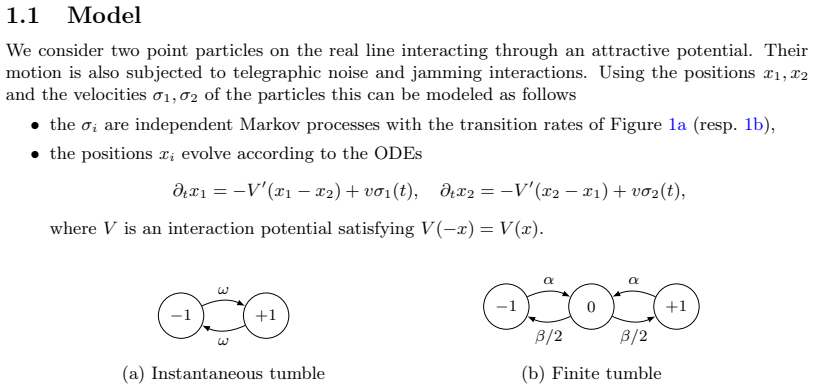
The load-bearing object is the extended generator of the processes viewed as piecewise-deterministic Markov processes — flows that evolve deterministically between random tumbling kicks. Stationarity is expressed through ∫Lf dπ=0, which encodes the jamming boundary in the domain of the generator rather than in a separate boundary condition. In the bulk x>0 the stationarity equations reduce to a linear ODE system Π′=AΠ, so the invariant density is a matrix exponential; the exponents are explicit roots of characteristic polynomials, and the Dirac weights are fixed by the invariant distribution of the velocity chain. For mixing, a synchronous coupling makes the velocities of two copies equal after a random time and then preserves their spatial order, so convergence to the steady state is controlled by the hitting time of the boundary; non-asymptotic large-deviation bounds for additive functionals of the velocity process bound the Laplace transform of that hitting time, and a separate large-separation argument gives matching upper bounds on the decay rate. The harmonic case instead exploits the deterministic flow's exponential contraction and uses a Wasserstein-type mixed distance.
What would settle it
Run a long simulation of the instantaneous linear process with v<c, say c=1, v=0.5, ω=1, and measure whether the occupation measure over x≥0 converges to any finite limit; the paper's formula is not normalizable in that regime, so a finite steady state there would disprove the claimed parameter dependence, while escape of x to large values would confirm the necessity of v>c.
Extended reading notes
Core claim
The central discovery is that adding jamming to two attracting run-and-tumble particles produces invariant measures with a singular boundary part: in the linear cases π = Σσ (dσ δ0 + aσ $e^{{ζx}}$ dx) ⊗ δσ, with positive Dirac weights at jammed relative-velocity states and an exponential bulk density whose exponent is ζ = −2cω/(v²−c²). The finite-tumble linear model changes character at v=2c: for c<v≤2c the bulk is a product measure and the jammed state (0,1) carries Dirac mass, while for v>2c an additional exponential term appears, the product form is lost, and that Dirac mass vanishes. The harmonic model has a compactly supported steady state on [0,v/µ]×Σ whose density can diverge or vanish at the boundary according to whether µ is larger or smaller than ω. The paper also establishes unique invariant probabilities and proves that convergence to them is exponential: the total-variation rate for the instantaneous linear process is between ωc²/(2v²) and 4ωc²/v², with analogous constant-factor bounds in the finite linear case, and the harmonic process converges in a Wasserstein-type distance at rate at least min(µ, ω/p).
Load-bearing premise
The linear-process results rest on the premise that the run speed v exceeds the attraction strength c, since the exponent ζ = −2cω/(v²−c²) is negative only then and otherwise the advertised exponential densities are not integrable, yet this condition appears only in a lemma, not in the main theorem statements.
Editorial extensions
If this is right
- For the instantaneous linear process, the total-variation relaxation rate is sandwiched between ωc²/(2v²) and 4ωc²/v², so the dependence of the mixing time on all model parameters is known up to a constant factor.
- For the finite linear process, the steady state undergoes a qualitative transition at v=2c: below it the bulk is a product measure and the jammed state (0,1) has positive probability, while above it an extra exponential term appears and that Dirac mass disappears.
- For the instantaneous harmonic process, the invariant measure has compact support [0,v/µ], boundary Dirac masses at 0, and a density that either diverges or vanishes at the two boundaries depending on whether µ is larger or smaller than ω.
- In all three processes the jammed boundary carries Dirac masses, so exactly clustered configurations are typical in steady state — a purely out-of-equilibrium phenomenon that cannot occur for a Boltzmann measure.
- The non-asymptotic convergence bounds have prefactors growing exponentially in the initial separation, so widely separated particles take a time that grows like their separation before the steady-state description becomes accurate.
Reading between the lines
- One step beyond the paper would be to use the same generator-plus-matrix-exponential route for other solvable tumbling mechanisms and power-law potentials; the paper notes that the finite-tumble harmonic potential already seems intractable this way, so the exact boundary weights might be special to linear and harmonic potentials.
- The gap between the finite-linear upper and lower rates when α/β is large leaves which bound is sharp unresolved; a natural conjecture is that the true rate in the tumbling-dominated regime is controlled by rare long-running stretches rather than by the large-deviation rate used in the lower bound.
- Because the two-particle setup reduces to a single relative-coordinate process, these exact Dirac-mass steady states are the cleanest available microscopic signature of motility-induced clustering; extending them to three or more jammed particles is open, and these formulas are the natural baseline for testing whether boundary masses persist.
Editorial analysis
A structured set of objections, weighed in public.
Referee Report
Summary. The paper studies the long-time behavior of two one-dimensional run-and-tumble particles interacting through an attractive potential and jamming, for three models: the instantaneous linear process (V(x)=c|x|, instantaneous tumbling), the finite linear process (V(x)=c|x|, finite tumble duration), and the instantaneous harmonic process (V(x)=\mu x^2/2). For each model the author derives an explicit invariant measure, typically a mixture of a bulk absolutely continuous part and Dirac masses on the jamming boundary x=0, and proves quantitative exponential convergence: total-variation bounds for the two linear processes and Wasserstein-type bounds for the harmonic process. The linear-process convergence rates are shown to be sharp up to constant factors. The methods are the extended generator of piecewise-deterministic Markov processes, reduction of the stationary Fokker-Planck equation to linear ODE systems, synchronous couplings, and non-asymptotic large-deviation estimates for additive functionals of Markov chains.
Significance. If the results are correct, they provide exact steady-state statistics and relaxation times for two interacting, jammed, attracting run-and-tumble particles in one dimension. The explicit invariant measures display boundary Dirac masses and parameter-dependent qualitative changes, which are relevant for the active-matter literature on clustering and on close-to-equilibrium versus strongly out-of-equilibrium universality classes. The paper's methods are a genuine strength: the invariant measures are derived from the generator equation by solving linear ODE systems without fitted parameters, the convergence bounds are non-asymptotic and explicit, and the sharpness analysis identifies concrete obstacles to mixing. The harmonic-process formulas import the bulk density from BMR+20 but remain self-contained enough to be checked. The central limitation is a missing parameter condition in several theorem statements, which is local and fixable.
major comments (3)
- [Section 1.2, Theorem 4(i); Section 2.1, Proposition 6] Theorem 4(i) and Proposition 6 state the invariant measure of the instantaneous linear process without any restriction on v and c, but the proof uses the normalization 1/4 = a\int_0^\infty e^{\zeta x}dx = a/(-\zeta), which is valid only when \zeta<0, i.e. v>c. For v<c one has \zeta>0 and the displayed exponential density is not integrable; for v=c the quantity \zeta is undefined. In the regime v\le c the bulk drift v\sigma-2c is non-positive for every \sigma, so the relative position is driven to 0 and remains jammed, and the unique invariant probability is \delta_0\otimes\pi_Q rather than the mixture asserted in Theorem 4(i). The same missing hypothesis affects Theorem 5(i), where the rate I(c/v) is undefined for c/v>1, and the statements in Section 3.1 that use I(c/v). The theorems should be restricted to v>c and the v\le c case should be described separately; this is a local but load-bearing correction.
- [Section 2.3, Proposition 12 and Theorem 4(iii)] The boundary normalization for the instantaneous harmonic process is only sketched. After importing the bulk density from [BMR+20], the text states that the three equations in (4) determine C1, C2, C3, but the algebra is not shown, and the final statement gives explicit formulas only for d0 and C, not for C3=\pi(\{(0,-2)\}) even though Theorem 4(iii) asserts d_{-2}>0. Please provide the explicit values of C1, C2, C3, or a verification that the displayed d0 and C satisfy (4), and give a separate argument for the asserted positivity of d_{-2}. This is needed because the boundary Dirac masses are one of the paper's central claims.
- [Section 4.2, Lemma 37(iii)] The upper bound limsup - (1/t) log ||\delta_{(x,\sigma)}P_t - \pi||_{TV} \le 4\alpha(1+\alpha/\beta)c^2/v^2 is obtained by optimizing an explicit rational expression over r>0 and 0<R<1 'with the help of a computer algebra system', but no certificate, code, or derivative calculation is provided. Since this optimization is the only step producing the constant 4 in the finite-linear sharpness bound, please include a rigorous proof of the sup equals 4, or provide a verifiable computer-assisted proof in a supplementary file.
minor comments (4)
- [Lemma 34, proof] In Case 1 and Case 2 the factors v are missing from the drift terms: the text reads '\partial_t x = -2c + \sigma_2(t_k) - \sigma_1(t_k)' and '\partial_t x > -2c + \sigma_2 - \sigma_1' instead of the v-scaled terms used in Definition 33.
- [Theorem 25(ii)] The bound W_p(\eta P_t, \pi) \le (1+2^{1/s})^{1/p}(F_q(\eta)+v/\mu)\exp(...) uses F_q(\eta); the statement should explicitly assume that \eta has finite q-th moment for all q>p used in the bound, or define the right-hand side as +\infty otherwise.
- [Lemma 15 vs. Lemma 30] The function \Lambda defined in Lemma 15 (the log-moment generating function used in the large-deviation bound) and the function \Lambda defined in Lemma 30 (the hitting-time exponent) are unrelated; please relabel one of them to avoid confusion.
- [Proposition 10 and Notation] In the finite linear case the coefficient c_2 of the exponential term and the model parameter c (the attractive force strength) have very similar names; this is a readability issue, not a mathematical one, but it may confuse readers comparing the formula with the parameter c.
Circularity Check
No significant circularity: invariant measures are solved from the generator equation and fixed by independent marginal normalizations; mixing rates follow from large-deviation and tail estimates, with no fitted input renamed as prediction.
full rationale
The paper's central derivations are self-contained and do not reduce to their own inputs. The invariant measures are obtained by writing the generator characterization ∫Lf dπ = 0, solving the induced linear ODE system in the bulk, and fixing the remaining constants by three independent ingredients: integrability (which discards positive eigenvalues), the invariant measure πQ of the one-dimensional velocity Markov chain (an elementary, independently solvable object), and an ergodicity argument showing the boundary Dirac mass at (0,2) is zero. For the instantaneous linear process, the normalization condition π([0,∞)×{2}) = 1/4 fixes the bulk coefficient a via the identity 1/4 = a∫_0^∞ e^{ζx}dx; this is a check against the velocity-marginal invariant measure, not a restatement of the target measure. The finite linear process uses the same scheme with the spectral decomposition of A = V^{-1}Q^t, with Lemmas 7 and 9 proved internally, and the constants c2, c3 fixed by the two or four marginal equations π(R_+×{σ}) = πQ({σ}). The harmonic process imports the bulk density P,Q,R from the external reference BMR+20 and then determines the boundary Dirac masses by the marginal system (4); this imports an external result as a tool, not the paper's own conclusion, and the boundary contribution is new content. The mixing-rate lower bounds are proved by an explicit synchronous coupling (Lemma 22) together with non-asymptotic large-deviation estimates quoted from Wu00, with the rate function I computed explicitly in Proposition 19; the upper bounds use a Laplace-transform computation for the hitting time of large x and the tail decay λπ of the already-computed invariant measure. None of these steps fits a fitted parameter renamed as a prediction. The paper does cite the author's prior work HGM23 and GHM24, but those citations supply the PDMP/jamming formalism and the synchronous-coupling idea; they are not the source of the exponential-rate estimates, which are derived here with the external results [Wu00], [MT93], and [Lez01]. The omission of the v>c hypothesis from the statements of Theorems 4(i) and 5(i), while mathematically important and noted in the paper's own proof (ζ = -2cω/(v²-c²) requires v>c for integrability), is a parameter-range oversight rather than circular reasoning. Therefore the appropriate finding is no significant circularity.
Assumptions & free parameters
assumptions (6)
- standard math The interacting run-and-tumble process is a Feller PDMP with extended generator L; stationary measures are exactly those with integral Lf d pi = 0 for all domain functions.
- standard math Foster-Lyapunov criteria imply existence, uniqueness, and exponential ergodicity for the linear processes.
- standard math Non-asymptotic large-deviation bounds of Wu 2000 and Lezaud 2001 control additive functionals of the velocity process.
- domain assumption The exact stationary bulk density of a three-state run-and-tumble particle in a harmonic trap, from BMR+20, is valid and is used to build the harmonic invariant measure.
- domain assumption For the linear processes, the run speed exceeds the attractive force, v>c, so the exponential densities are integrable and the boundary escape rules are as stated.
- domain assumption The jamming rule x(t)=max(0, phi^sigma_{t-T_n}(x(T_n))) correctly models collisions, with particles gluing at x=0 when their relative drift is non-positive.
Cite this review
Pith. "Pith review of Steady state and mixing of two run-and-tumble particles interacting through jamming and attractive forces." pith.science (2026). https://pith.science/paper/IBY7VJYD
@misc{pith2026250111379,
  author       = {Pith},
  title        = {Pith review of: Steady state and mixing of two run-and-tumble particles interacting through jamming and attractive forces},
  year         = {2026},
  howpublished = {\url{https://pith.science/paper/IBY7VJYD}},
  note         = {Machine review of arXiv:2501.11379}
}
read the original abstract
We study the long-time behavior of two run-and-tumble particles on the real line subjected to an attractive interaction potential and jamming interactions, which prevent the particles from crossing. We provide the explicit invariant measure, a useful tool for studying clustering phenomena in out-ofequilibrium statistical mechanics, for different tumbling mechanisms and potentials. An important difference with invariant measures of equilibrium systems are Dirac masses on the boundary of the state space, due to the jamming interactions. Qualitative changes in the invariant measure depending on model parameters are also observed, suggesting, like a growing body of evidence, that run-andtumble particle systems can be classified into close-to-equilibrium and strongly out-of-equilibrium models. We also study the relaxation properties of the system, which are linked to the timescale at which clustering emerges from an arbitrary initial configuration. When the interaction potential is linear, we show that the total variation distance to the invariant measure decays exponentially and provide sharp bounds on the decay rate. When the interaction potential is harmonic, we give quantitative exponential bounds in a Wasserstein-type distance.
Figures


Figures from the paper (1 more)

Reference graph
Works this paper leans on
-
[1]
Active hard spheres in infinitely many dimensions
Thibaut Arnoulx de Pirey, Gustavo Lozano, and Fr \'e d \'e ric Van Wijland. Active hard spheres in infinitely many dimensions. Physical review letters , 123(26):260602, 2019
work page 2019
-
[2]
Thibaut Arnoulx de Pirey and Fr \'e d \'e ric van Wijland. A run-and-tumble particle around a spherical obstacle: the steady-state distribution far-from-equilibrium. Journal of Statistical Mechanics: Theory and Experiment , 2023(9):093202, 2023
work page 2023
-
[3]
Confined run-and-tumble swimmers in one dimension
Luca Angelani. Confined run-and-tumble swimmers in one dimension. Journal of Physics A: Mathematical and Theoretical , 50(32):325601, 2017
work page 2017
-
[4]
Chemotaxis in escherichia coli analysed by three-dimensional tracking
Howard C Berg and Douglas A Brown. Chemotaxis in escherichia coli analysed by three-dimensional tracking. nature , 239(5374):500--504, 1972
work page 1972
-
[5]
Howard C Berg. E. Coli in Motion . Springer, 2004
work page 2004
-
[6]
Sticky PDMP samplers for sparse and local inference problems
Joris Bierkens, Sebastiano Grazzi, Frank van der Meulen, and Moritz Schauer. Sticky PDMP samplers for sparse and local inference problems. Statistics and Computing , 33(1):8, 2023
work page 2023
-
[7]
Quantitative ergodicity for some switched dynamical systems
Michel Benaïm, St \'e phane Le Borgne, Florent Malrieu, and Pierre-Andr \'e Zitt. Quantitative ergodicity for some switched dynamical systems. Electronic Communications in Probability , 2012
work page 2012
-
[8]
Exact stationary state of a run-and-tumble particle with three internal states in a harmonic trap
Urna Basu, Satya N Majumdar, Alberto Rosso, Sanjib Sabhapandit, and Gr \'e gory Schehr. Exact stationary state of a run-and-tumble particle with three internal states in a harmonic trap. Journal of Physics A: Mathematical and Theoretical , 53(9):09LT01, 2020
work page 2020
Show all 46 references
-
[9]
Lumpability and marginalisability for continuous-time Markov chains
Frank Ball and Geoffrey F Yeo. Lumpability and marginalisability for continuous-time Markov chains. Journal of Applied Probability , 30(3):518--528, 1993
1993
-
[10]
Deviation bounds for additive functionals of markov processes
Patrick Cattiaux and Arnaud Guillin. Deviation bounds for additive functionals of markov processes. ESAIM: Probability and Statistics , 12:12--29, 2008
2008
-
[11]
Exponential ergodicity for Markov processes with random switching
Bertrand Cloez and Martin Hairer. Exponential ergodicity for Markov processes with random switching. Bernoulli , 21(1), 2015
2015
-
[12]
Confinement by biased velocity jumps: aggregation of Escherichia Coli
Vincent Calvez, Ga \"e l Raoul, and Christian Schmeiser. Confinement by biased velocity jumps: aggregation of Escherichia Coli . arXiv preprint arXiv:1404.0643 , 2014
2014 arXiv
-
[13]
Motility-induced phase separation
Michael E Cates and Julien Tailleur. Motility-induced phase separation. Annual Review of Condensed Matter Physics , 6(1):219--244, 2015
2015
-
[14]
Piecewise-deterministic markov processes: A general class of non-diffusion stochastic models
Mark HA Davis. Piecewise-deterministic markov processes: A general class of non-diffusion stochastic models. Journal of the Royal Statistical Society: Series B (Methodological) , 46(3):353--376, 1984
1984
-
[15]
Markov models & optimization , volume 49
Mark HA Davis. Markov models & optimization , volume 49. CRC Press, 1993
1993
-
[16]
Boundaries control collective dynamics of inertial self-propelled robots
Antoine Deblais, Thomas Barois, T Guerin, Pierre-Henri Delville, R \'e mi Vaudaine, Juho S Lintuvuori, Jean-Fran c ois Boudet, Jean-Christophe Baret, and H Kellay. Boundaries control collective dynamics of inertial self-propelled robots. Physical review letters , 120(18):188002, 2018
2018
-
[17]
Gap statistics of two interacting run and tumble particles in one dimension
Arghya Das, Abhishek Dhar, and Anupam Kundu. Gap statistics of two interacting run and tumble particles in one dimension. Journal of Physics A: Mathematical and Theoretical , 53(34):345003, 2020
2020
-
[18]
Universal scaling in active single-file dynamics
Pritha Dolai, Arghya Das, Anupam Kundu, Chandan Dasgupta, Abhishek Dhar, and K Vijay Kumar. Universal scaling in active single-file dynamics. Soft Matter , 16(30):7077--7087, 2020
2020
-
[19]
Run-and-tumble particle in one-dimensional confining potentials: Steady-state, relaxation, and first-passage properties
Abhishek Dhar, Anupam Kundu, Satya N Majumdar, Sanjib Sabhapandit, and Gr \'e gory Schehr. Run-and-tumble particle in one-dimensional confining potentials: Steady-state, relaxation, and first-passage properties. Physical Review E , 99(3):032132, 2019
2019
-
[20]
Physics of microswimmers—single particle motion and collective behavior: a review
Jens Elgeti, Roland G Winkler, and Gerhard Gompper. Physics of microswimmers—single particle motion and collective behavior: a review. Reports on progress in physics , 78(5):056601, 2015
2015
-
[21]
Quantitative estimates for the long-time behavior of an ergodic variant of the telegraph process
Joaquin Fontbona, H \'e l \`e ne Gu \'e rin, and Florent Malrieu. Quantitative estimates for the long-time behavior of an ergodic variant of the telegraph process. Advances in Applied Probability , 44(4):977--994, 2012
2012
-
[22]
Long time behavior of telegraph processes under convex potentials
Joaquin Fontbona, H \'e l \`e ne Gu \'e rin, and Florent Malrieu. Long time behavior of telegraph processes under convex potentials. Stochastic Processes and their Applications , 126(10):3077--3101, 2016
2016
-
[23]
Generalized run-and-tumble model in 1d geometry for an arbitrary distribution of drift velocities
Derek Frydel. Generalized run-and-tumble model in 1d geometry for an arbitrary distribution of drift velocities. Journal of Statistical Mechanics: Theory and Experiment , 2021(8):083220, 2021
2021
-
[24]
Long-time analysis of a pair of on-lattice and continuous run-and-tumble particles with jamming interactions
Arnaud Guillin, Leo Hahn, and Manon Michel. Long-time analysis of a pair of on-lattice and continuous run-and-tumble particles with jamming interactions. arXiv preprint arXiv:2411.13964 , 2024
2024 arXiv
-
[25]
Active particle in a harmonic trap driven by a resetting noise: an approach via kesten variables
Mathis Gu \'e neau, Satya N Majumdar, and Gr \'e gory Schehr. Active particle in a harmonic trap driven by a resetting noise: an approach via kesten variables. Journal of Physics A: Mathematical and Theoretical , 56(47):475002, 2023
2023
-
[26]
Jamming pair of general run-and-tumble particles: Exact results and universality classes
Leo Hahn, Arnaud Guillin, and Manon Michel. Jamming pair of general run-and-tumble particles: Exact results and universality classes. arXiv preprint arXiv:2306.00831 , 2023
2023 arXiv
-
[27]
Yet another look at Harris’ ergodic theorem for Markov chains
Martin Hairer and Jonathan C Mattingly. Yet another look at Harris’ ergodic theorem for Markov chains. In Seminar on Stochastic Analysis, Random Fields and Applications VI: Centro Stefano Franscini, Ascona, May 2008 , pages 109--117. Springer, 2011
2008
-
[28]
Ergodic properties of recurrent diffusion processes and stabilization of the solution to the cauchy problem for parabolic equations
Rafail Z Khas'minskii. Ergodic properties of recurrent diffusion processes and stabilization of the solution to the cauchy problem for parabolic equations. Theory of Probability & Its Applications , 5(2):179--196, 1960
1960
-
[29]
Stationary nonequilibrium bound state of a pair of run and tumble particles
Pierre Le Doussal, Satya N Majumdar, and Gr \'e gory Schehr. Stationary nonequilibrium bound state of a pair of run and tumble particles. Physical Review E , 104(4):044103, 2021
2021
-
[30]
Chernoff and Berry--Ess \'e en inequalities for Markov processes
Pascal Lezaud. Chernoff and Berry--Ess \'e en inequalities for Markov processes. ESAIM: Probability and Statistics , 5:183--201, 2001
2001
-
[31]
Continuous time Markov processes: an introduction , volume 113
Thomas Milton Liggett. Continuous time Markov processes: an introduction , volume 113. American Mathematical Soc., 2010
2010
-
[32]
Computable exponential convergence rates for stochastically ordered Markov processes
Robert B Lund, Sean P Meyn, and Richard L Tweedie. Computable exponential convergence rates for stochastically ordered Markov processes. The Annals of Applied Probability , 6(1):218--237, 1996
1996
-
[33]
Some simple but challenging Markov processes
Florent Malrieu. Some simple but challenging Markov processes. Annales de la Faculté des sciences de Toulouse : Mathématiques , 24(4):857--883, January 2016
2016
-
[34]
Exact spectral solution of two interacting run-and-tumble particles on a ring lattice
Emil Mallmin, Richard A Blythe, and Martin R Evans. Exact spectral solution of two interacting run-and-tumble particles on a ring lattice. Journal of Statistical Mechanics: Theory and Experiment , 2019(1):013204, 2019
2019
-
[35]
From a microscopic solution to a continuum description of interacting active particles
Matthew J Metson, Martin R Evans, and Richard A Blythe. From a microscopic solution to a continuum description of interacting active particles. Physical Review E , 2022
2022
-
[36]
Tuning attraction and repulsion between active particles through persistence
Matthew J Metson, Martin R Evans, and Richard A Blythe. Tuning attraction and repulsion between active particles through persistence. Europhysics Letters , 141(4):41001, 2023
2023
-
[37]
Steady state, relaxation and first-passage properties of a run-and-tumble particle in one-dimension
Kanaya Malakar, V Jemseena, Anupam Kundu, K Vijay Kumar, Sanjib Sabhapandit, Satya N Majumdar, S Redner, and Abhishek Dhar. Steady state, relaxation and first-passage properties of a run-and-tumble particle in one-dimension. Journal of Statistical Mechanics: Theory and Experim...
2018
-
[38]
Stability of Markovian processes III : Foster--Lyapunov criteria for continuous-time processes
Sean P Meyn and Richard L Tweedie. Stability of Markovian processes III : Foster--Lyapunov criteria for continuous-time processes. Advances in Applied Probability , 25(3):518--548, 1993
1993
-
[39]
NIST handbook of mathematical functions hardback and CD-ROM
Frank WJ Olver. NIST handbook of mathematical functions hardback and CD-ROM . Cambridge university press, 2010
2010
-
[40]
Theory of continuum random walks and application to chemotaxis
Mark J Schnitzer. Theory of continuum random walks and application to chemotaxis. Physical Review E , 48(4):2553, 1993
1993
-
[41]
Jamming and attraction of interacting run-and-tumble random walkers
AB Slowman, MR Evans, and RA Blythe. Jamming and attraction of interacting run-and-tumble random walkers. Physical review letters , 116(21):218101, 2016
2016
-
[42]
Exact solution of two interacting run-and-tumble random walkers with finite tumble duration
AB Slowman, MR Evans, and RA Blythe. Exact solution of two interacting run-and-tumble random walkers with finite tumble duration. Journal of Physics A: Mathematical and Theoretical , 50(37):375601, 2017
2017
-
[43]
Exact position distribution of a harmonically confined run-and-tumble particle in two dimensions
Naftali R Smith, Pierre Le Doussal, Satya N Majumdar, and Gr \'e gory Schehr. Exact position distribution of a harmonically confined run-and-tumble particle in two dimensions. Physical Review E , 106(5):054133, 2022
2022
-
[44]
Modeling E
Jonathan Saragosti, Pascal Silberzan, and Axel Buguin. Modeling E. coli tumbles by rotational diffusion. implications for chemotaxis. PloS one , 7(4):e35412, 2012
2012
-
[45]
Phase separation and multibody effects in three-dimensional active brownian particles
Francesco Turci and Nigel B Wilding. Phase separation and multibody effects in three-dimensional active brownian particles. Physical Review Letters , 126(3):038002, 2021
2021
-
[46]
A deviation inequality for non-reversible markov processes
Liming Wu. A deviation inequality for non-reversible markov processes. In Annales de l'Institut Henri Poincare (B) Probability and Statistics , volume 36, pages 435--445. Elsevier, 2000
2000
Reviewed August 10, 2026 · model on record in the stance chip above.
Discussion (0). Continue with ORCID to comment.